REVIEW 3 major objections 6 minor 2 cited by
DanceTogether! Identity-Preserving Multi-Person Interactive Video Generation
T0 review · 3 major / 6 minor · reviewed 2026-08-07 · deepseek-v4-flash
Pith's one-line read DanceTogether claims to be the first end-to-end diffusion framework that turns a single reference image plus per-person pose and mask streams into long, photorealistic two-person videos while strictly preserving every identity, by binding…
desk verdict A plausible multi-person animation method with a real new mechanism and, if released, useful datasets, but the evaluation does not actually test the paper's headline claim of strict identity preservation. read the letter →
The pith
A machine-rendered reading of the paper's core claim, the machinery that carries it, and where it could break.
The reading
What carries the argument
The MaskPoseAdapter is the load-bearing module: it encodes each person's RGB pose map with a shared PoseNet, runs binary tracking masks through a light 3-channel processor, gates both streams per-pixel with a learnable weight (λ≈0.8 favoring pose), enhances and LayerNorms the fused features, then applies temperature-scaled soft attention across the person dimension so each subject's identity and motion are bound in a single latent at every denoising step. It works alongside the MultiFace Encoder, which turns an ArcFace vector into K=4 Perceiver-refined identity tokens appended to the UNet's cross-attention keys/values, and a masked reconstruction loss that weights body regions 1× and face regions 2×. The paper's ablation shows that removing the adapter collapses HOTA from 83.94 to 48.95, which is the concrete evidence that the fusion — not just the extra data — carries the result.
What would settle it
Take the DanceTogEval-100 outputs and have human raters, or an independent detector suite never used in training, judge identity switches and pose faithfulness; if human-visible identity drift or detector-free judgment diverges from the HOTA/IDF1/MPJPE2D numbers, the benchmark's margin is partly an artifact of the model learning to be legible to SAMURAI-DWPose-OSNet rather than a true gain in identity preservation.
Extended reading notes
Core claim
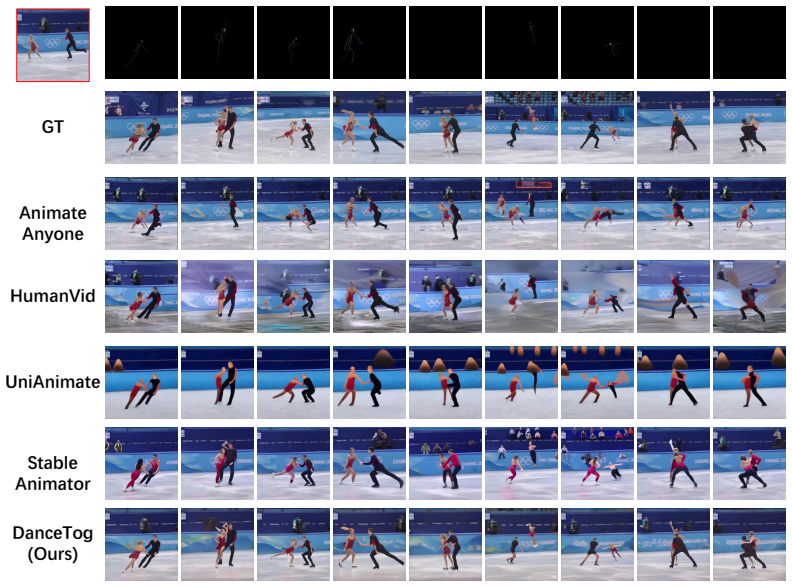
The central claim is that an explicit, persistent binding between identity and action is what lets a diffusion model generate long, photorealistic multi-actor videos from a single reference image. DanceTogether implements this with three coupled modules: a MultiFace Encoder that compresses an ArcFace identity embedding into four refined tokens injected into every cross-attention layer; a MaskPoseAdapter that fuses per-person tracking masks with semantically rich but noisy pose heat-maps through gated, attention-reordered integration, producing a single pose-mask latent; and a StableAnimator-style video diffusion backbone with a human-tracking masked reconstruction loss that upweights face and body regions. Trained on the paper's curated multi-person data, the pipeline lifts HOTA from 71.35 to 83.94, cuts MPJPE2D from 1555 px to 492 px, and improves masked-region FVD from 29.0 to 17.1 relative to the strongest baseline on the new TogetherVideoBench.
Load-bearing premise
The reported identity and motion scores assume that the automated detectors used to measure them are neutral, accurate instruments, even though the same mask tracker, pose estimator, and ReID model also produced the training annotations those scores reward.
Editorial extensions
If this is right
- Identity drift and appearance bleeding in two-person generation become tractable: the same single-reference-image interface used for single-person animation now works for pairs, including position exchanges and occlusion-heavy interactions.
- Because the conditioning is per-person, a user can choreograph two actors independently and the model composes them into one coherent video, realizing what the paper calls compositionally controllable multi-actor interaction.
- A one-hour fine-tune on the HumanRob-300 robot set yields human-robot interaction videos that retain each agent's identity, pointing to cheap cross-domain transfer for embodied-AI and human-robot interaction work.
- TogetherVideoBench gives the field three standard tracks (identity consistency, interaction coherence, video quality), and the reported margins set the bar that future multi-person controllable video generation systems must beat.
Reading between the lines
- The benchmark's detectors (SAMURAI masks, DWPose keypoints, OSNet ReID) also produced the training annotations, so the reported HOTA/IDF1 gains may partly measure how legible the generated video is to those specific models rather than to human viewers; a human-rating study or a held-out detector suite would separate the two effects.
- The gated-fusion recipe is portable: any control task pairing a semantically rich but noisy signal with a sparse but reliable one (depth plus keypoint tracks, text prompts plus object masks, robot joints plus silhouettes) could reuse the same MaskPoseAdapter-style design.
- If identity-action binding is the true cause of the gains, the framework should transfer to non-human multi-instance generation (multiple objects, multiple camera viewpoints of a scene) without architectural rethinking — a directly testable prediction of the paper's framing.
- The ablation ordering (framework +8.91 HOTA on swing data versus PairFS-4K adding only +2.15 HOTA on top of full data) suggests that once interaction types are represented, the fusion machinery rather than raw data volume is the binding constraint.
Editorial analysis
A structured set of objections, weighed in public.
Referee Report
Summary. The paper proposes DanceTogether, an end-to-end diffusion framework for generating two-person interaction videos from a single reference image plus per-person pose and mask sequences. The method introduces a MaskPoseAdapter that fuses tracking masks with pose heatmaps to bind identity to action, and a MultiFace Encoder that injects identity tokens into cross-attention. The authors also contribute PairFS-4K and HumanRob-300 datasets, and a three-track benchmark (TogetherVideoBench) with 100 curated test clips. They report large improvements over prior baselines on identity-consistency (HOTA 83.94 vs. 71.35), interaction-coherence (MPJPE2D 492 vs. 1555 px), and video quality (masked FVD 17.1 vs. 29.0).
Significance. If the reported gains reflect genuine identity preservation, the work is a useful step toward controllable multi-person video generation: the MaskPoseAdapter design and the ablations isolating the mask input are informative, and the datasets/benchmark are a potential community resource. The paper also includes a same-data comparison (DanceTog w. Dataswing vs. StableAnimator w. Dataswing) that partially controls for training data, and the module ablation in Table 6 clearly shows the mask input is critical. However, the central claim of 'strictly preserving every identity' is not substantiated by the chosen metrics, and the evaluation pipeline's reliance on the same detectors used to create training annotations is a serious correctness risk.
major comments (3)
- [Sec. F.1, Eq. (21), Eq. (23)] The Identity-Consistency track does not measure identity preservation relative to the reference image. HOTA (Eq. 23) is sqrt(DetA * AssA) and IDF1 (Eq. 21) is a harmonic mean of ID precision/recall; both are computed from per-frame detections, ReID associations, and ground-truth trajectory labels. They measure whether the automated pipeline yields temporally stable, separable tracks, not whether each actor's appearance matches the reference identity. A generated video with the two identities swapped, or with both faces blended into an average appearance, can still produce stable separate tracks and hence high HOTA/IDF1. Consequently, Table 2 and the Abstract's 'strictly preserving every identity' and Sec. 3.3's 'eliminating appearance bleeding' are not supported by the reported evidence. Please add a reference-to-generated appearance metric (e.g., ArcFace cosine similarity between the reference face crop and each generated per-person face crop averaged over frames) and ideally a human perception study.
- [Sec. D.3, Sec. F.1, Eq. (25)] All three tracks rely on the same automated pipeline (DWPose, SAMURAI, OSNet) used to produce training annotations, which creates a circularity risk. MPJPE2D (Eq. 25) is computed from DWPose keypoints on generated frames; the model is trained to satisfy DWPose-derived pose conditions, so it may be optimized to be legible to DWPose rather than to produce accurate human pose. Similarly, Track-3 masked FVD/FID use SAMURAI masks on the generated video, and Track-1 uses OSNet ReID embeddings; all are the same detectors/embeddings used in Sec. D.3 to annotate training data. A model that learns to produce videos 'legible' to these exact detectors can score high even if human-visible identity and pose fidelity are worse. Please evaluate at least one independent detector/tracker (e.g., a different pose estimator and a different segmentation or ReID model) on a subset, or validate the automated scores against human ratings on a subset, and report the agreement.
- [Sec. 4.2, Tables 2–5] The headline comparisons are asymmetric. In Sec. 4.2 only StableAnimator is fine-tuned, on the swing-dance subset for 40 epochs; all other baselines are used with released weights, while DanceTogether is trained on the full multi-person dataset (Tab. 1) including the new PairFS-4K. The only controlled comparison that isolates method from data is 'DanceTog w. Dataswing' versus 'StableAnimator w. Dataswing' in Tables 2–5, which still shows substantial gains. But the prose and Abstract quote the fully trained model's numbers. Please either fine-tune all baselines on the same training data, or restrict the 'SOTA' claims to the same-data row, and discuss the contribution of additional training data explicitly.
minor comments (6)
- [Sec. 4.1] 'Pre-trained weights from StableAnimator [5]' cites reference [5] (Stable Video Diffusion); the StableAnimator reference is [79]. This citation error should be corrected.
- [Sec. 2.2] The sentence 'Tevet et al. [77] generate high-quality action sequences but lack robust identity modeling' describes a human motion diffusion model, not a video generation method; please rephrase to avoid confusion.
- [Tables 2–5] The tables report no confidence intervals or significance tests over generation seeds; given the stochastic nature of diffusion sampling and only 100 test clips, please report at least three seeds with error bars, or per-clip bootstrap intervals, for the main comparisons.
- [Sec. 3.3, Eqs. (7) and (10)] The text calls lambda a learnable weight and reports lambda approx 0.8, while s_p is set to 1.5 and alpha_res to 0.5. Please clarify which quantities are learned and which are fixed, and report the final learned values.
- [Secs. 3.5, D.2, E] The detection model is referred to as YOLOv8x in Sec. 3.5 and D.2 but as YOLOX in Sec. E; please make the detector name consistent.
- [Tables 2–5] Some table entries have formatting artifacts (e.g., 'DanceTog w.Data f ull+DataP airF S'); please clean the row labels for readability.
Circularity Check
Identity-consistency scores are measured with the same detector/tracker pipeline that generated the training conditions; the headline identity claim is not independently tested.
-
fitted input called prediction
[Sec. F.1 (TogetherVideoBench overview) and Sec. F.3 Track 1, Eqs. (21)-(24); training annotation in Sec. D.3]
"All tracks share a unified Data Curation Pipeline that automatically extracts per-person pose, mask, face-crop, and bounding box for both ground truth and generated videos, ensuring reproducibility and fair comparison. ... We extract pose information of 133 keypoints using DW-Pose [107] and assign each pose to independent subject IDs via an IOU matching approach utilizing the masks generated by SAMURAI."
The headline 'strictly preserving every identity' is scored with HOTA/IDF1 computed by running the same DWPose/SAMURAI/ReID pipeline on generated videos that was used to create the training masks, poses, and IDs. Eq. (23) defines HOTA as sqrt(DetA*AssA) over pipeline-extracted boxes/tracks, and Eq. (21) defines IDF1 over Hungarian-ID matches; neither references the reference image or the two ArcFace identities. A model optimized to be legible to these detectors (the same instruments that generated its targets) can inflate the scores through stable separable tracks even if identities are swapped or blended. The reported identity 'prediction' is therefore partially forced by the training/evaluation instrumentation rather than an independent test of reference-to-video identity preservation.
full rationale
There is no equation-level circularity in the diffusion architecture: MaskPoseAdapter fusion, MultiFace Encoder tokens, and the reconstruction loss are all stated with their own equations and are not derived from the benchmark numbers. The main circularity is confined to the evaluation of the central claim. Track 1's HOTA/IDF1 are computed from the unified Data Curation Pipeline that also generated DWPose/SAMURAI training annotations, and the metrics do not use the reference image, so the identity-consistency score partly measures detector legibility rather than identity preservation. Masked FVD/FID and qualitative stills provide some independent visual support, which keeps the paper from being wholly circular, but the paper does not report a reference-to-generated face similarity or human study, so the strongest claim rests on an instrument shared with the training targets. Accordingly the score is a moderate 4, not higher.
Assumptions & free parameters
free parameters (8)
- gate fusion weight lambda =
learned, reported ~0.8
- residual fusion alpha_res =
0.5
- pose feature scale s_p =
1.5
- final fusion weights =
0.95 and 0.05
- loss weights for body and face masks =
1 and 2
- softmax temperature tau =
learned
- mask processor output channels =
3
- identity tokens K =
4
assumptions (5)
- standard math Diffusion model training, cross-attention, and Perceiver building blocks as established in Stable Video Diffusion and StableAnimator.
- domain assumption Per-person masks, 133-point poses, and ReID tracks can be reliably extracted from monocular RGB video via SAMURAI, DWPose, and OSNet.
- domain assumption ArcFace plus CLIP embeddings of a single reference image provide sufficient identity information for multiple individuals.
- domain assumption Automated metrics computed from DWPose/SAMURAI outputs on generated videos faithfully measure identity preservation and interaction coherence.
- domain assumption Evaluation domain assumes mostly static cameras and simple backgrounds.
Cite this review
Pith. "Pith review of DanceTogether! Identity-Preserving Multi-Person Interactive Video Generation." pith.science (2026). https://pith.science/paper/ULJ2WH2N
@misc{pith2026250518078,
  author       = {Pith},
  title        = {Pith review of: DanceTogether! Identity-Preserving Multi-Person Interactive Video Generation},
  year         = {2026},
  howpublished = {\url{https://pith.science/paper/ULJ2WH2N}},
  note         = {Machine review of arXiv:2505.18078}
}
read the original abstract
Controllable video generation (CVG) has advanced rapidly, yet current systems falter when more than one actor must move, interact, and exchange positions under noisy control signals. We address this gap with DanceTogether, the first end-to-end diffusion framework that turns a single reference image plus independent pose-mask streams into long, photorealistic videos while strictly preserving every identity. A novel MaskPoseAdapter binds "who" and "how" at every denoising step by fusing robust tracking masks with semantically rich-but noisy-pose heat-maps, eliminating the identity drift and appearance bleeding that plague frame-wise pipelines. To train and evaluate at scale, we introduce (i) PairFS-4K, 26 hours of dual-skater footage with 7,000+ distinct IDs, (ii) HumanRob-300, a one-hour humanoid-robot interaction set for rapid cross-domain transfer, and (iii) TogetherVideoBench, a three-track benchmark centered on the DanceTogEval-100 test suite covering dance, boxing, wrestling, yoga, and figure skating. On TogetherVideoBench, DanceTogether outperforms the prior arts by a significant margin. Moreover, we show that a one-hour fine-tune yields convincing human-robot videos, underscoring broad generalization to embodied-AI and HRI tasks. Extensive ablations confirm that persistent identity-action binding is critical to these gains. Together, our model, datasets, and benchmark lift CVG from single-subject choreography to compositionally controllable, multi-actor interaction, opening new avenues for digital production, simulation, and embodied intelligence. Our video demos and code are available at https://DanceTog.github.io/.
Figures


Figures from the paper (18 more)




Forward citations
Cited by 2 Pith papers
-
Go to Zero: Towards Zero-shot Motion Generation with Million-scale Data
A 7B text-to-motion model trained on the new 2M-clip MotionMillion dataset is reported to generalize zero-shot to complex, out-of-domain prompts.
-
Animate-X++: Universal Character Image Animation with Dynamic Backgrounds
Animate-X++ turns cartoon images into pose-driven animations with text-controlled moving backgrounds, claiming state-of-the-art results on a new synthetic anthropomorphic benchmark.
Reference graph
Works this paper leans on
-
[1]
Kling ai: Next-generation ai creative studio
Kling AI. Kling ai: Next-generation ai creative studio. 10
-
[2]
Mert Albaba, Chenhao Li, Markos Diomataris, Omid Taheri, Andreas Krause, and Michael Black. Nil: No- data imitation learning by leveraging pre-trained video diffusion models.arXiv preprint arXiv:2503.10626, 2025
arXiv 2025
-
[3]
Evaluating multiple object tracking performance: the clear mot metrics.EURASIP Journal on Image and Video Processing, 2008:1–10, 2008
Keni Bernardin and Rainer Stiefelhagen. Evaluating multiple object tracking performance: the clear mot metrics.EURASIP Journal on Image and Video Processing, 2008:1–10, 2008
2008
-
[4]
Homanga Bharadhwaj, Debidatta Dwibedi, Abhinav Gupta, Shubham Tulsiani, Carl Doersch, Ted Xiao, Dhruv Shah, Fei Xia, Dorsa Sadigh, and Sean Kirmani. Gen2act: Human video generation in novel scenarios enables generalizable robot manipulation.arXiv preprint arXiv:2409.16283, 2024
arXiv 2024
-
[5]
Andreas Blattmann, Tim Dockhorn, Sumith Kulal, Daniel Mendelevitch, Maciej Kilian, Dominik Lorenz, Yam Levi, Zion English, Vikram V oleti, Adam Letts, et al. Stable video diffusion: Scaling latent video diffusion models to large datasets.arXiv preprint arXiv:2311.15127, 2023
arXiv 2023
-
[6]
Align your latents: High-resolution video synthesis with latent diffusion models
Andreas Blattmann, Robin Rombach, Huan Ling, Tim Dockhorn, Seung Wook Kim, Sanja Fidler, and Karsten Kreis. Align your latents: High-resolution video synthesis with latent diffusion models. In Proceedings of the IEEE/CVF Conference on Computer Vision and Pattern Recognition, pages 22563– 22575, 2023
2023
-
[7]
Emanuele Bugliarello, Anurag Arnab, Roni Paiss, Pieter-Jan Kindermans, and Cordelia Schmid. What are you doing? a closer look at controllable human video generation.arXiv preprint arXiv:2503.04666, 2025
arXiv 2025
-
[8]
Deep video generation, prediction and completion of human action sequences
Haoye Cai, Chunyan Bai, Yu-Wing Tai, and Chi-Keung Tang. Deep video generation, prediction and completion of human action sequences. InProceedings of the European conference on computer vision (ECCV), pages 366–382, 2018
2018
Show all 122 references
-
[9]
Realtime multi-person 2d pose estimation using part affinity fields
Zhe Cao, Tomas Simon, Shih-En Wei, and Yaser Sheikh. Realtime multi-person 2d pose estimation using part affinity fields. InCVPR, 2017
2017
-
[10]
Everybody dance now
Caroline Chan, Shiry Ginosar, Tinghui Zhou, and Alexei A Efros. Everybody dance now. InProceedings of the IEEE/CVF international conference on computer vision, pages 5933–5942, 2019
2019
-
[11]
A survey on evaluation of large language models.ACM transactions on intelligent systems and technology, 15(3):1–45, 2024
Yupeng Chang, Xu Wang, Jindong Wang, Yuan Wu, Linyi Yang, Kaijie Zhu, Hao Chen, Xiaoyuan Yi, Cunxiang Wang, Yidong Wang, et al. A survey on evaluation of large language models.ACM transactions on intelligent systems and technology, 15(3):1–45, 2024
2024
-
[12]
Idea23d: Collaborative lmm agents enable 3d model generation from interleaved multimodal inputs
Junhao Chen, Xiang Li, Xiaojun Ye, Chao Li, Zhaoxin Fan, and Hao Zhao. Idea23d: Collaborative lmm agents enable 3d model generation from interleaved multimodal inputs. InProceedings of the 31st International Conference on Computational Linguistics, pages 4149–4166, 2025
2025
-
[13]
Ultraman: Ultra-fast and high-resolution texture generation for 3d human reconstruction from a single image
Mingjin Chen, Junhao Chen, Huan-ang Gao, Xiaoxue Chen, Zhaoxin Fan, and Hao Zhao. Ultraman: Ultra-fast and high-resolution texture generation for 3d human reconstruction from a single image. 2025
2025
-
[14]
Follow-your-canvas: Higher-resolution video outpainting with extensive content generation.arXiv preprint arXiv:2409.01055, 2024
Qihua Chen, Yue Ma, Hongfa Wang, Junkun Yuan, Wenzhe Zhao, Qi Tian, Hongmei Wang, Shaobo Min, Qifeng Chen, and Wei Liu. Follow-your-canvas: Higher-resolution video outpainting with extensive content generation.arXiv preprint arXiv:2409.01055, 2024
2024 arXiv
-
[15]
Control3d: Towards controllable text-to-3d generation
Yang Chen, Yingwei Pan, Yehao Li, Ting Yao, and Tao Mei. Control3d: Towards controllable text-to-3d generation. InProceedings of the 31st ACM International Conference on Multimedia, pages 1148–1156, 2023
2023
-
[16]
Abo: Dataset and benchmarks for real-world 3d object understanding
Jasmine Collins, Shubham Goel, Kenan Deng, Achleshwar Luthra, Leon Xu, Erhan Gundogdu, Xi Zhang, Tomas F Yago Vicente, Thomas Dideriksen, Himanshu Arora, et al. Abo: Dataset and benchmarks for real-world 3d object understanding. InProceedings of the IEEE/CVF conference on comp...
2022
-
[17]
Arcface: Additive angular margin loss for deep face recognition
Jiankang Deng, Jia Guo, Niannan Xue, and Stefanos Zafeiriou. Arcface: Additive angular margin loss for deep face recognition. InProceedings of the IEEE/CVF conference on computer vision and pattern recognition, pages 4690–4699, 2019
2019
-
[18]
Magicdance: Realistic human dance video generation with motions & facial expressions transfer.arXiv preprint arXiv:2311.12052, 2(3):4, 2023
Yichun Shi Di Chang, Quankai Gao, Jessica Fu, Hongyi Xu, Guoxian Song, Qing Yan, Xiao Yang, and Mohammad Soleymani. Magicdance: Realistic human dance video generation with motions & facial expressions transfer.arXiv preprint arXiv:2311.12052, 2(3):4, 2023
2023 arXiv
-
[19]
Image quality assessment: Unifying structure and texture similarity.IEEE transactions on pattern analysis and machine intelligence, 44(5):2567–2581, 2020
Keyan Ding, Kede Ma, Shiqi Wang, and Eero P Simoncelli. Image quality assessment: Unifying structure and texture similarity.IEEE transactions on pattern analysis and machine intelligence, 44(5):2567–2581, 2020
2020
-
[20]
A survey of embodied ai: From simulators to research tasks.IEEE Transactions on Emerging Topics in Computational Intelligence, 6(2):230–244, 2022
Jiafei Duan, Samson Yu, Hui Li Tan, Hongyuan Zhu, and Cheston Tan. A survey of embodied ai: From simulators to research tasks.IEEE Transactions on Emerging Topics in Computational Intelligence, 6(2):230–244, 2022
2022
-
[21]
Dreamoving: A human video generation framework based on diffusion models
Mengyang Feng, Jinlin Liu, Kai Yu, Yuan Yao, Zheng Hui, Xiefan Guo, Xianhui Lin, Haolan Xue, Chen Shi, Xiaowen Li, et al. Dreamoving: A human video generation framework based on diffusion models. arXiv preprint arXiv:2312.05107, 2023
2023 arXiv
-
[22]
Reconstructing three-dimensional models of interacting humans.arXiv preprint arXiv:2308.01854, 2023
Mihai Fieraru, Mihai Zanfir, Elisabeta Oneata, Alin-Ionut Popa, Vlad Olaru, and Cristian Sminchisescu. Reconstructing three-dimensional models of interacting humans.arXiv preprint arXiv:2308.01854, 2023
2023 arXiv
-
[23]
Iw-bench: Evaluating large multimodal models for converting image-to-web
Hongcheng Guo, Wei Zhang, Junhao Chen, Yaonan Gu, Jian Yang, Junjia Du, Binyuan Hui, Tianyu Liu, Jianxin Ma, Chang Zhou, and Zhoujun Li. Iw-bench: Evaluating large multimodal models for converting image-to-web. 2024
2024
-
[24]
Reparo: Compositional 3d assets generation with differentiable 3d layout alignment.arXiv preprint arXiv:2405.18525, 2024
Haonan Han, Rui Yang, Huan Liao, Jiankai Xing, Zunnan Xu, Xiaoming Yu, Junwei Zha, Xiu Li, and Wanhua Li. Reparo: Compositional 3d assets generation with differentiable 3d layout alignment.arXiv preprint arXiv:2405.18525, 2024. 11
2024 arXiv
-
[25]
Controllable video generation with sparse trajectories
Zekun Hao, Xun Huang, and Serge Belongie. Controllable video generation with sparse trajectories. In Proceedings of the IEEE Conference on Computer Vision and Pattern Recognition, pages 7854–7863, 2018
2018
-
[26]
Clipscore: A reference-free evaluation metric for image captioning
Jack Hessel, Ari Holtzman, Maxwell Forbes, Ronan Le Bras, and Yejin Choi. Clipscore: A reference-free evaluation metric for image captioning. InProceedings of the 2021 Conference on Empirical Methods in Natural Language Processing (EMNLP), pages 7514–7528, 2021
2021
-
[27]
Gans trained by a two time-scale update rule converge to a local nash equilibrium
Martin Heusel, Hubert Ramsauer, Thomas Unterthiner, Bernhard Nessler, and Sepp Hochreiter. Gans trained by a two time-scale update rule converge to a local nash equilibrium. In I. Guyon, U. V on Luxburg, S. Bengio, H. Wallach, R. Fergus, S. Vishwanathan, and R. Garnett, editor...
2017
-
[28]
Video diffusion models.Advances in Neural Information Processing Systems, 35:8633–8646, 2022
Jonathan Ho, Tim Salimans, Alexey Gritsenko, William Chan, Mohammad Norouzi, and David J Fleet. Video diffusion models.Advances in Neural Information Processing Systems, 35:8633–8646, 2022
2022
-
[29]
Animate anyone: Consistent and controllable image-to-video synthesis for character animation
Li Hu. Animate anyone: Consistent and controllable image-to-video synthesis for character animation. In Proceedings of the IEEE/CVF Conference on Computer Vision and Pattern Recognition, pages 8153–8163, 2024
2024
-
[30]
Make it move: controllable image-to-video generation with text descriptions
Yaosi Hu, Chong Luo, and Zhenzhong Chen. Make it move: controllable image-to-video generation with text descriptions. InProceedings of the IEEE/CVF Conference on Computer Vision and Pattern Recognition, pages 18219–18228, 2022
2022
-
[31]
T2i-compbench: A comprehensive benchmark for open-world compositional text-to-image generation.Advances in Neural Information Processing Systems, 36:78723–78747, 2023
Kaiyi Huang, Kaiyue Sun, Enze Xie, Zhenguo Li, and Xihui Liu. T2i-compbench: A comprehensive benchmark for open-world compositional text-to-image generation.Advances in Neural Information Processing Systems, 36:78723–78747, 2023
2023
-
[32]
Learning high fidelity depths of dressed humans by watching social media dance videos
Yasamin Jafarian and Hyun Soo Park. Learning high fidelity depths of dressed humans by watching social media dance videos. InProceedings of the IEEE/CVF Conference on Computer Vision and Pattern Recognition, pages 12753–12762, 2021
2021
-
[33]
Yolo by ultralytics
Glenn Jocher, Ayush Chaurasia, and Jing Qiu. Yolo by ultralytics. https://github.com/ ultralytics/ultralytics, 2023
2023
-
[34]
Dreampose: Fashion image-to-video synthesis via stable diffusion
Johanna Karras, Aleksander Holynski, Ting-Chun Wang, and Ira Kemelmacher-Shlizerman. Dreampose: Fashion image-to-video synthesis via stable diffusion. In2023 IEEE/CVF International Conference on Computer Vision (ICCV), pages 22623–22633. IEEE, 2023
2023
-
[35]
Text2video-zero: Text-to-image diffusion models are zero-shot video generators
Levon Khachatryan, Andranik Movsisyan, Vahram Tadevosyan, Roberto Henschel, Zhangyang Wang, Shant Navasardyan, and Humphrey Shi. Text2video-zero: Text-to-image diffusion models are zero-shot video generators. InProceedings of the IEEE/CVF International Conference on Computer V...
2023
-
[36]
Harmony4d: A video dataset for in-the-wild close human interactions.Advances in Neural Information Processing Systems, 37:107270–107285, 2024
Rawal Khirodkar, Jyun-Ting Song, Jinkun Cao, Zhengyi Luo, and Kris Kitani. Harmony4d: A video dataset for in-the-wild close human interactions.Advances in Neural Information Processing Systems, 37:107270–107285, 2024
2024
-
[37]
Hunyuanvideo: A systematic framework for large video generative models.arXiv preprint arXiv:2412.03603, 2024
Weijie Kong, Qi Tian, Zijian Zhang, Rox Min, Zuozhuo Dai, Jin Zhou, Jiangfeng Xiong, Xin Li, Bo Wu, Jianwei Zhang, et al. Hunyuanvideo: A systematic framework for large video generative models.arXiv preprint arXiv:2412.03603, 2024
2024 arXiv
-
[38]
World knowledge from ai image generation for robot control
Jonas Krumme and Christoph Zetzsche. World knowledge from ai image generation for robot control. arXiv preprint arXiv:2503.16579, 2025
2025 arXiv
-
[39]
Collaborative video diffusion: Consistent multi-video generation with camera control.Advances in Neural Information Processing Systems, 37:16240–16271, 2024
Zhengfei Kuang, Shengqu Cai, Hao He, Yinghao Xu, Hongsheng Li, Leonidas J Guibas, and Gordon Wet- zstein. Collaborative video diffusion: Consistent multi-video generation with camera control.Advances in Neural Information Processing Systems, 37:16240–16271, 2024
2024
-
[40]
Interactive control of avatars animated with human motion data
Jehee Lee, Jinxiang Chai, Paul SA Reitsma, Jessica K Hodgins, and Nancy S Pollard. Interactive control of avatars animated with human motion data. InProceedings of the 29th annual conference on Computer graphics and interactive techniques, pages 491–500, 2002
2002
-
[41]
Dispose: Disentangling pose guidance for controllable human image animation
Hongxiang Li, Yaowei Li, Yuhang Yang, Junjie Cao, Zhihong Zhu, Xuxin Cheng, and Long Chen. Dispose: Disentangling pose guidance for controllable human image animation. InThe Thirteenth International Conference on Learning Representations, 2025
2025
-
[42]
Magicmotion: Controllable video generation with dense-to-sparse trajectory guidance.arXiv preprint arXiv:2503.16421, 2025
Quanhao Li, Zhen Xing, Rui Wang, Hui Zhang, Qi Dai, and Zuxuan Wu. Magicmotion: Controllable video generation with dense-to-sparse trajectory guidance.arXiv preprint arXiv:2503.16421, 2025
2025
-
[43]
Ai choreographer: Music conditioned 3d dance generation with aist++
Ruilong Li, Shan Yang, David A Ross, and Angjoo Kanazawa. Ai choreographer: Music conditioned 3d dance generation with aist++. InProceedings of the IEEE/CVF international conference on computer vision, pages 13401–13412, 2021
2021
-
[44]
Lodge: A coarse to fine diffusion network for long dance generation guided by the characteristic dance primitives
Ronghui Li, YuXiang Zhang, Yachao Zhang, Hongwen Zhang, Jie Guo, Yan Zhang, Yebin Liu, and Xiu Li. Lodge: A coarse to fine diffusion network for long dance generation guided by the characteristic dance primitives. InProceedings of the IEEE/CVF Conference on Computer Vision and...
2024
-
[45]
Finedance: A fine-grained choreography dataset for 3d full body dance generation
Ronghui Li, Junfan Zhao, Yachao Zhang, Mingyang Su, Zeping Ren, Han Zhang, Yansong Tang, and Xiu Li. Finedance: A fine-grained choreography dataset for 3d full body dance generation. InProceedings of the IEEE/CVF International Conference on Computer Vision, pages 10234–10243, 2023
2023
-
[46]
Evaluation of text-to-video generation models: A dynamics perspective.Advances in Neural Information Processing Systems, 37:109790–109816, 2024
Mingxiang Liao, Qixiang Ye, Wangmeng Zuo, Fang Wan, Tianyu Wang, Yuzhong Zhao, Jingdong Wang, Xinyu Zhang, et al. Evaluation of text-to-video generation models: A dynamics perspective.Advances in Neural Information Processing Systems, 37:109790–109816, 2024
2024
-
[47]
Open-sora plan: Open-source large video generation model.arXiv 12 preprint arXiv:2412.00131, 2024
Bin Lin, Yunyang Ge, Xinhua Cheng, Zongjian Li, Bin Zhu, Shaodong Wang, Xianyi He, Yang Ye, Shenghai Yuan, Liuhan Chen, et al. Open-sora plan: Open-source large video generation model.arXiv 12 preprint arXiv:2412.00131, 2024
2024 arXiv
-
[48]
Microsoft coco: Common objects in context
Tsung-Yi Lin, Michael Maire, Serge Belongie, James Hays, Pietro Perona, Deva Ramanan, Piotr Dollár, and C Lawrence Zitnick. Microsoft coco: Common objects in context. InEuropean Conference on Computer Vision (ECCV), pages 740–755, 2014
2014
-
[49]
Rich: Robust implicit clothed humans reconstruction from multi-scale spatial cues
Yukang Lin, Ronghui Li, Kedi Lyu, Yachao Zhang, and Xiu Li. Rich: Robust implicit clothed humans reconstruction from multi-scale spatial cues. InChinese Conference on Pattern Recognition and Computer Vision (PRCV), pages 193–206. Springer, 2023
2023
-
[50]
Fr \’echet video motion distance: A metric for evaluating motion consistency in videos.arXiv preprint arXiv:2407.16124, 2024
Jiahe Liu, Youran Qu, Qi Yan, Xiaohui Zeng, Lele Wang, and Renjie Liao. Fr \’echet video motion distance: A metric for evaluating motion consistency in videos.arXiv preprint arXiv:2407.16124, 2024
2024 arXiv
-
[51]
Evalcrafter: Benchmarking and evaluating large video generation models
Yaofang Liu, Xiaodong Cun, Xuebo Liu, Xintao Wang, Yong Zhang, Haoxin Chen, Yang Liu, Tieyong Zeng, Raymond Chan, and Ying Shan. Evalcrafter: Benchmarking and evaluating large video generation models. InProceedings of the IEEE/CVF Conference on Computer Vision and Pattern Reco...
2024
-
[52]
Fetv: A benchmark for fine-grained evaluation of open-domain text-to-video generation.Advances in Neural Information Processing Systems, 36:62352–62387, 2023
Yuanxin Liu, Lei Li, Shuhuai Ren, Rundong Gao, Shicheng Li, Sishuo Chen, Xu Sun, and Lu Hou. Fetv: A benchmark for fine-grained evaluation of open-domain text-to-video generation.Advances in Neural Information Processing Systems, 36:62352–62387, 2023
2023
-
[53]
Hota: A higher order metric for evaluating multi-object tracking.International Journal of Computer Vision, 129(2):548–578, 2021
Jonathon Luiten, Aljosa Osep, Patrick Dendorfer, Laura Leal-Taixé, Daniel Cremers, Ian Reid, Stefan Roth, Simone Milani, Alexander Kirillov, and Paul V oigtlaender. Hota: A higher order metric for evaluating multi-object tracking.International Journal of Computer Vision, 129(2...
2021
-
[54]
Dreamactor-m1: Holistic, expressive and robust human image animation with hybrid guidance.arXiv preprint arXiv:2504.01724, 2025
Yuxuan Luo, Zhengkun Rong, Lizhen Wang, Longhao Zhang, Tianshu Hu, and Yongming Zhu. Dreamactor-m1: Holistic, expressive and robust human image animation with hybrid guidance.arXiv preprint arXiv:2504.01724, 2025
2025 arXiv
-
[55]
Notice of removal: Videofusion: Decomposed diffusion models for high-quality video generation
Zhengxiong Luo, Dayou Chen, Yingya Zhang, Yan Huang, Liang Wang, Yujun Shen, Deli Zhao, Jingren Zhou, and Tieniu Tan. Notice of removal: Videofusion: Decomposed diffusion models for high-quality video generation. In2023 IEEE/CVF Conference on Computer Vision and Pattern Recogn...
2023
-
[56]
Follow your pose: Pose-guided text-to-video generation using pose-free videos
Yue Ma, Yingqing He, Xiaodong Cun, Xintao Wang, Siran Chen, Xiu Li, and Qifeng Chen. Follow your pose: Pose-guided text-to-video generation using pose-free videos. InProceedings of the AAAI Conference on Artificial Intelligence, volume 38, pages 4117–4125, 2024
2024
-
[57]
Foundation models for video understanding: A survey.Authorea Preprints, 2024
Neelu Madan, Andreas Møgelmose, Rajat Modi, Yogesh S Rawat, and Thomas B Moeslund. Foundation models for video understanding: A survey.Authorea Preprints, 2024
2024
-
[58]
Synergy and synchrony in couple dances.arXiv preprint arXiv:2409.04440, 2024
V ongani Maluleke, Lea Müller, Jathushan Rajasegaran, Georgios Pavlakos, Shiry Ginosar, Angjoo Kanazawa, and Jitendra Malik. Synergy and synchrony in couple dances.arXiv preprint arXiv:2409.04440, 2024
2024 arXiv
-
[59]
Benchmarking counterfactual image generation.Advances in Neural Information Processing Systems, 37:133207–133230, 2024
Thomas Melistas, Nikos Spyrou, Nefeli Gkouti, Pedro Sanchez, Athanasios Vlontzos, Yannis Panagakis, Giorgos Papanastasiou, and Sotirios Tsaftaris. Benchmarking counterfactual image generation.Advances in Neural Information Processing Systems, 37:133207–133230, 2024
2024
-
[60]
Efficient motion weighted spatio-temporal video ssim index
Anush K Moorthy and Alan C Bovik. Efficient motion weighted spatio-temporal video ssim index. In Human Vision and Electronic Imaging XV, volume 7527, pages 440–448. SPIE, 2010
2010
-
[61]
Sora: Creating video from text.https://openai.com/sora, 2024
OpenAI. Sora: Creating video from text.https://openai.com/sora, 2024. Accessed: 2024-06-01
2024
-
[62]
Controlnext: Powerful and efficient control for image and video generation.arXiv preprint arXiv:2408.06070, 2024
Bohao Peng, Jian Wang, Yuechen Zhang, Wenbo Li, Ming-Chang Yang, and Jiaya Jia. Controlnext: Powerful and efficient control for image and video generation.arXiv preprint arXiv:2408.06070, 2024
2024 arXiv
-
[63]
Sdxl: Improving latent diffusion models for high-resolution image synthesis
Dustin Podell, Zion English, Kyle Lacey, Andreas Blattmann, Tim Dockhorn, Jonas Müller, Joe Penna, and Robin Rombach. Sdxl: Improving latent diffusion models for high-resolution image synthesis. In The Twelfth International Conference on Learning Representations, 2024
2024
-
[64]
Dreamfusion: Text-to-3d using 2d diffusion.arXiv preprint arXiv:2209.14988, 2022
Ben Poole, Ajay Jain, Jonathan T Barron, and Ben Mildenhall. Dreamfusion: Text-to-3d using 2d diffusion.arXiv preprint arXiv:2209.14988, 2022
2022 arXiv
-
[65]
Worldsimbench: Towards video generation models as world simulators.arXiv preprint arXiv:2410.18072, 2024
Yiran Qin, Zhelun Shi, Jiwen Yu, Xijun Wang, Enshen Zhou, Lijun Li, Zhenfei Yin, Xihui Liu, Lu Sheng, Jing Shao, et al. Worldsimbench: Towards video generation models as world simulators.arXiv preprint arXiv:2410.18072, 2024
2024 arXiv
-
[66]
Performance measures and a data set for multi-target, multi-camera tracking
Ergys Ristani, Francesco Solera, Roger Zou, Rita Cucchiara, and Carlo Tomasi. Performance measures and a data set for multi-target, multi-camera tracking. InEuropean Conference on Computer Vision (ECCV), pages 17–35, 2016
2016
-
[67]
High-resolution image synthesis with latent diffusion models
Robin Rombach, Andreas Blattmann, Dominik Lorenz, Patrick Esser, and Björn Ommer. High-resolution image synthesis with latent diffusion models. InCVPR, 2022
2022
-
[68]
Motion-i2v: Consistent and controllable image-to- video generation with explicit motion modeling
Xiaoyu Shi, Zhaoyang Huang, Fu-Yun Wang, Weikang Bian, Dasong Li, Yi Zhang, Manyuan Zhang, Ka Chun Cheung, Simon See, Hongwei Qin, et al. Motion-i2v: Consistent and controllable image-to- video generation with explicit motion modeling. InACM SIGGRAPH 2024 Conference Papers, pa...
2024
-
[69]
Make-a-video: Text-to-video generation without text-video data.arXiv preprint arXiv:2209.14792, 2022
Uriel Singer, Adam Polyak, Thomas Hayes, Xi Yin, Jie An, Songyang Zhang, Qiyuan Hu, Harry Yang, Oron Ashual, Oran Gafni, et al. Make-a-video: Text-to-video generation without text-video data.arXiv preprint arXiv:2209.14792, 2022
2022 arXiv
-
[70]
Directorllm for human-centric video generation.arXiv preprint arXiv:2412.14484, 2024
Kunpeng Song, Tingbo Hou, Zecheng He, Haoyu Ma, Jialiang Wang, Animesh Sinha, Sam Tsai, Yaqiao Luo, Xiaoliang Dai, Li Chen, et al. Directorllm for human-centric video generation.arXiv preprint arXiv:2412.14484, 2024
2024 arXiv
-
[71]
Transnet v2: An effective deep network architecture for fast shot transition detection
Tomás Soucek and Jakub Lokoc. Transnet v2: An effective deep network architecture for fast shot transition detection. InProceedings of the 32nd ACM International Conference on Multimedia, pages 13 11218–11221, 2024
2024
-
[72]
T2v-compbench: A comprehensive benchmark for compositional text-to-video generation.arXiv preprint arXiv:2407.14505, 2024
Kaiyue Sun, Kaiyi Huang, Xian Liu, Yue Wu, Zihan Xu, Zhenguo Li, and Xihui Liu. T2v-compbench: A comprehensive benchmark for compositional text-to-video generation.arXiv preprint arXiv:2407.14505, 2024
2024 arXiv
-
[73]
Journeydb: A benchmark for generative image understanding.Advances in neural information processing systems, 36:49659–49678, 2023
Keqiang Sun, Junting Pan, Yuying Ge, Hao Li, Haodong Duan, Xiaoshi Wu, Renrui Zhang, Aojun Zhou, Zipeng Qin, Yi Wang, et al. Journeydb: A benchmark for generative image understanding.Advances in neural information processing systems, 36:49659–49678, 2023
2023
-
[74]
Drive: Diffusion-based rigging empowers generation of versatile and expressive characters.arXiv preprint arXiv:2411.17423, 2024
Mingze Sun, Junhao Chen, Junting Dong, Yurun Chen, Xinyu Jiang, Shiwei Mao, Puhua Jiang, Jingbo Wang, Bo Dai, and Ruqi Huang. Drive: Diffusion-based rigging empowers generation of versatile and expressive characters.arXiv preprint arXiv:2411.17423, 2024
2024 arXiv
-
[75]
Beyond talking–generating holistic 3d human dyadic motion for communication.International Journal of Computer Vision, 133(5):2910–2926, 2025
Mingze Sun, Chao Xu, Xinyu Jiang, Yang Liu, Baigui Sun, and Ruqi Huang. Beyond talking–generating holistic 3d human dyadic motion for communication.International Journal of Computer Vision, 133(5):2910–2926, 2025
2025
-
[76]
Video understanding with large language models: A survey.IEEE Transactions on Circuits and Systems for Video Technology, 2025
Yunlong Tang, Jing Bi, Siting Xu, Luchuan Song, Susan Liang, Teng Wang, Daoan Zhang, Jie An, Jingyang Lin, Rongyi Zhu, et al. Video understanding with large language models: A survey.IEEE Transactions on Circuits and Systems for Video Technology, 2025
2025
-
[77]
Human motion diffusion model.arXiv preprint arXiv:2209.14916, 2022
Guy Tevet, Sigal Raab, Brian Gordon, Yonatan Shafir, Daniel Cohen-Or, and Amit H Bermano. Human motion diffusion model.arXiv preprint arXiv:2209.14916, 2022
2022 arXiv
-
[78]
Emo2: End-effector guided audio-driven avatar video generation.arXiv preprint arXiv:2501.10687, 2025
Linrui Tian, Siqi Hu, Qi Wang, Bang Zhang, and Liefeng Bo. Emo2: End-effector guided audio-driven avatar video generation.arXiv preprint arXiv:2501.10687, 2025
2025 arXiv
-
[79]
Stablean- imator: High-quality identity-preserving human image animation.arXiv preprint arXiv:2411.17697, 2024
Shuyuan Tu, Zhen Xing, Xintong Han, Zhi-Qi Cheng, Qi Dai, Chong Luo, and Zuxuan Wu. Stablean- imator: High-quality identity-preserving human image animation.arXiv preprint arXiv:2411.17697, 2024
2024 arXiv
-
[80]
Fvd: A new metric for video generation
Thomas Unterthiner, Sjoerd Van Steenkiste, Karol Kurach, Raphaël Marinier, Marcin Michalski, and Sylvain Gelly. Fvd: A new metric for video generation. 2019
2019
-
[81]
Articulated mesh animation from multi-view silhouettes
Daniel Vlasic, Ilya Baran, Wojciech Matusik, and Jovan Popovi ´c. Articulated mesh animation from multi-view silhouettes. InAcm Siggraph 2008 papers, pages 1–9. 2008
2008
-
[82]
This&that: Language-gesture controlled video generation for robot planning.arXiv preprint arXiv:2407.05530, 2024
Boyang Wang, Nikhil Sridhar, Chao Feng, Mark Van der Merwe, Adam Fishman, Nima Fazeli, and Jeong Joon Park. This&that: Language-gesture controlled video generation for robot planning.arXiv preprint arXiv:2407.05530, 2024
2024 arXiv
-
[83]
Cove: Unleashing the diffusion feature correspondence for consistent video editing.arXiv preprint arXiv:2406.08850, 2024
Jiangshan Wang, Yue Ma, Jiayi Guo, Yicheng Xiao, Gao Huang, and Xiu Li. Cove: Unleashing the diffusion feature correspondence for consistent video editing.arXiv preprint arXiv:2406.08850, 2024
2024 arXiv
-
[84]
Taming rectified flow for inversion and editing.arXiv preprint arXiv:2411.04746, 2024
Jiangshan Wang, Junfu Pu, Zhongang Qi, Jiayi Guo, Yue Ma, Nisha Huang, Yuxin Chen, Xiu Li, and Ying Shan. Taming rectified flow for inversion and editing.arXiv preprint arXiv:2411.04746, 2024
2024 arXiv
-
[85]
Vividpose: Advancing stable video diffusion for realistic human image animation.arXiv preprint arXiv:2405.18156, 2024
Qilin Wang, Zhengkai Jiang, Chengming Xu, Jiangning Zhang, Yabiao Wang, Xinyi Zhang, Yun Cao, Weijian Cao, Chengjie Wang, and Yanwei Fu. Vividpose: Advancing stable video diffusion for realistic human image animation.arXiv preprint arXiv:2405.18156, 2024
2024 arXiv
-
[86]
Disco: Disentangled control for realistic human dance generation
Tan Wang, Linjie Li, Kevin Lin, Yuanhao Zhai, Chung-Ching Lin, Zhengyuan Yang, Hanwang Zhang, Zicheng Liu, and Lijuan Wang. Disco: Disentangled control for realistic human dance generation. In Proceedings of the IEEE/CVF Conference on Computer Vision and Pattern Recognition (C...
2024
-
[87]
Unianimate: Taming unified video diffusion models for consistent human image animation
Xiang Wang, Shiwei Zhang, Changxin Gao, Jiayu Wang, Xiaoqiang Zhou, Yingya Zhang, Luxin Yan, and Nong Sang. Unianimate: Taming unified video diffusion models for consistent human image animation. Science China Information Sciences, 2025
2025
-
[88]
Unianimate-dit: Human image animation with large-scale video diffusion transformer.arXiv preprint arXiv:2504.11289, 2025
Xiang Wang, Shiwei Zhang, Longxiang Tang, Yingya Zhang, Changxin Gao, Yuehuan Wang, and Nong Sang. Unianimate-dit: Human image animation with large-scale video diffusion transformer.arXiv preprint arXiv:2504.11289, 2025
2025
-
[89]
Instructavatar: Text-guided emotion and motion control for avatar generation
Yuchi Wang, Junliang Guo, Jianhong Bai, Runyi Yu, Tianyu He, Xu Tan, Xu Sun, and Jiang Bian. Instructavatar: Text-guided emotion and motion control for avatar generation. InProceedings of the AAAI Conference on Artificial Intelligence, volume 39, pages 8132–8140, 2025
2025
-
[90]
Bovik, H.R
Zhou Wang, A.C. Bovik, H.R. Sheikh, and E.P. Simoncelli. Image quality assessment: from error visibility to structural similarity.IEEE Transactions on Image Processing, 13(4):600–612, 2004
2004
-
[91]
Humanvid: Demystifying training data for camera-controllable human image animation
Zhenzhi Wang, Yixuan Li, Yanhong Zeng, Youqing Fang, Yuwei Guo, Wenran Liu, Jing Tan, Kai Chen, Tianfan Xue, Bo Dai, et al. Humanvid: Demystifying training data for camera-controllable human image animation. InThe Thirty-eight Conference on Neural Information Processing System...
2024
-
[92]
Multi- identity human image animation with structural video diffusion.arXiv preprint arXiv:2504.04126, 2025
Zhenzhi Wang, Yixuan Li, Yanhong Zeng, Yuwei Guo, Dahua Lin, Tianfan Xue, and Bo Dai. Multi- identity human image animation with structural video diffusion.arXiv preprint arXiv:2504.04126, 2025
2025
-
[93]
Mo- tionctrl: A unified and flexible motion controller for video generation.arXiv preprint arXiv:2312.03641, 2023
Zhouxia Wang, Ziyang Yuan, Xintao Wang, Tianshui Chen, Menghan Xia, Ping Luo, and Ying Shan. Mo- tionctrl: A unified and flexible motion controller for video generation.arXiv preprint arXiv:2312.03641, 2023
2023 arXiv
-
[94]
Easyanimate: A high-performance long video generation method based on transformer architecture.arXiv preprint arXiv:2405.18991, 2024
Jiaqi Xu, Xinyi Zou, Kunzhe Huang, Yunkuo Chen, Bo Liu, MengLi Cheng, Xing Shi, and Jun Huang. Easyanimate: A high-performance long video generation method based on transformer architecture.arXiv preprint arXiv:2405.18991, 2024
2024
-
[95]
Xagen: 3d expressive human avatars generation.Advances in Neural Information Processing Systems, 36, 2024
Zhongcong Xu, Jianfeng Zhang, Jun Hao Liew, Jiashi Feng, and Mike Zheng Shou. Xagen: 3d expressive human avatars generation.Advances in Neural Information Processing Systems, 36, 2024. 14
2024
-
[96]
Magicanimate: Temporally consistent human image animation using diffusion model
Zhongcong Xu, Jianfeng Zhang, Jun Hao Liew, Hanshu Yan, Jia-Wei Liu, Chenxu Zhang, Jiashi Feng, and Mike Zheng Shou. Magicanimate: Temporally consistent human image animation using diffusion model. InProceedings of the IEEE Conference on Computer Vision and Pattern Recognition...
2024
-
[97]
Magicanimate: Temporally consistent human image animation using diffusion model
Zhongcong Xu, Jianfeng Zhang, Jun Hao Liew, Hanshu Yan, Jia-Wei Liu, Chenxu Zhang, Jiashi Feng, and Mike Zheng Shou. Magicanimate: Temporally consistent human image animation using diffusion model. InProceedings of the IEEE/CVF Conference on Computer Vision and Pattern Recogni...
2024
-
[98]
Human motion video generation: A survey.Authorea Preprints, 2024
Haiwei Xue, Xiangyang Luo, Zhanghao Hu, Xin Zhang, Xunzhi Xiang, Yuqin Dai, Jianzhuang Liu, Zhensong Zhang, Minglei Li, Jian Yang, et al. Human motion video generation: A survey.Authorea Preprints, 2024
2024
-
[99]
Follow-your-pose v2: Multiple-condition guided character image animation for stable pose control.arXiv preprint arXiv:2406.03035, 2024
Jingyun Xue, Hongfa Wang, Qi Tian, Yue Ma, Andong Wang, Zhiyuan Zhao, Shaobo Min, Wenzhe Zhao, Kaihao Zhang, Heung-Yeung Shum, et al. Follow-your-pose v2: Multiple-condition guided character image animation for stable pose control.arXiv preprint arXiv:2406.03035, 2024
2024 arXiv
-
[100]
Video quality assessment via gradient magnitude similarity deviation of spatial and spatiotemporal slices
Peng Yan, Xuanqin Mou, and Wufeng Xue. Video quality assessment via gradient magnitude similarity deviation of spatial and spatiotemporal slices. InMobile Devices and Multimedia: Enabling Technologies, Algorithms, and Applications 2015, volume 9411, pages 182–191. SPIE, 2015
2015
-
[101]
Dialoguenerf: Towards realistic avatar face-to-face conversation video generation.Visual Intelligence, 2(1):24, 2024
Yichao Yan, Zanwei Zhou, Zi Wang, Jingnan Gao, and Xiaokang Yang. Dialoguenerf: Towards realistic avatar face-to-face conversation video generation.Visual Intelligence, 2(1):24, 2024
2024
-
[102]
Pose guided human video generation
Ceyuan Yang, Zhe Wang, Xinge Zhu, Chen Huang, Jianping Shi, and Dahua Lin. Pose guided human video generation. InProceedings of the European conference on computer vision (ECCV), pages 201–216, 2018
2018
-
[103]
Samurai: Adapting segment anything model for zero-shot visual tracking with motion-aware memory.arXiv preprint arXiv:2411.11922, 2024
Cheng-Yen Yang, Hsiang-Wei Huang, Wenhao Chai, Zhongyu Jiang, and Jenq-Neng Hwang. Samurai: Adapting segment anything model for zero-shot visual tracking with motion-aware memory.arXiv preprint arXiv:2411.11922, 2024
2024 arXiv
-
[104]
MatAnyone: Stable video matting with consistent memory propagation
Peiqing Yang, Shangchen Zhou, Jixin Zhao, Qingyi Tao, and Chen Change Loy. MatAnyone: Stable video matting with consistent memory propagation. InCVPR, 2025
2025
-
[105]
Holodeck: Language guided generation of 3d embodied ai environments
Yue Yang, Fan-Yun Sun, Luca Weihs, Eli VanderBilt, Alvaro Herrasti, Winson Han, Jiajun Wu, Nick Haber, Ranjay Krishna, Lingjie Liu, et al. Holodeck: Language guided generation of 3d embodied ai environments. InProceedings of the IEEE/CVF Conference on Computer Vision and Patte...
2024
-
[106]
Idea2img: Iterative self-refinement with gpt-4v for automatic image design and generation
Zhengyuan Yang, Jianfeng Wang, Linjie Li, Kevin Lin, Chung-Ching Lin, Zicheng Liu, and Lijuan Wang. Idea2img: Iterative self-refinement with gpt-4v for automatic image design and generation. InEuropean Conference on Computer Vision, pages 167–184. Springer, 2024
2024
-
[107]
Effective whole-body pose estimation with two- stages distillation
Zhendong Yang, Ailing Zeng, Chun Yuan, and Yu Li. Effective whole-body pose estimation with two- stages distillation. InProceedings of the IEEE/CVF International Conference on Computer Vision, pages 4210–4220, 2023
2023
-
[108]
Mmad: Multi-modal movie audio description
Xiaojun Ye, Junhao Chen, Xiang Li, Haidong Xin, Chao Li, Sheng Zhou, and Jiajun Bu. Mmad: Multi-modal movie audio description. InProceedings of the 2024 Joint International Conference on Computational Linguistics, Language Resources and Evaluation (LREC-COLING 2024), pages 114...
2024
-
[109]
Whac: World-grounded humans and cameras
Wanqi Yin, Zhongang Cai, Ruisi Wang, Fanzhou Wang, Chen Wei, Haiyi Mei, Weiye Xiao, Zhitao Yang, Qingping Sun, Atsushi Yamashita, Lei Yang, and Ziwei Liu. Whac: World-grounded humans and cameras. InEuropean Conference on Computer Vision, pages 20–37. Springer, 2024
2024
-
[110]
Hi4d: 4d instance segmentation of close human interaction
Yifei Yin, Chen Guo, Manuel Kaufmann, Juan Jose Zarate, Jie Song, and Otmar Hilliges. Hi4d: 4d instance segmentation of close human interaction. InProceedings of the IEEE/CVF Conference on Computer Vision and Pattern Recognition, pages 17016–17027, 2023
2023
-
[111]
Pose-guided human animation from a single image in the wild
Jae Shin Yoon, Lingjie Liu, Vladislav Golyanik, Kripasindhu Sarkar, Hyun Soo Park, and Christian Theobalt. Pose-guided human animation from a single image in the wild. InProceedings of the IEEE/CVF Conference on Computer Vision and Pattern Recognition, pages 15039–15048, 2021
2021
-
[112]
Follow-your-multipose: Tuning-free multi-character text-to-video generation via pose guidance.arXiv preprint arXiv:2412.16495, 2024
Beiyuan Zhang, Yue Ma, Chunlei Fu, Xinyang Song, Zhenan Sun, and Ziqiang Li. Follow-your-multipose: Tuning-free multi-character text-to-video generation via pose guidance.arXiv preprint arXiv:2412.16495, 2024
2024 arXiv
-
[113]
Zhujiu: A multi-dimensional, multi-faceted chinese benchmark for large language models
Baoli Zhang, Haining Xie, Pengfan Du, Junhao Chen, Pengfei Cao, Yubo Chen, Shengping Liu, Kang Liu, and Jun Zhao. Zhujiu: A multi-dimensional, multi-faceted chinese benchmark for large language models. InProceedings of the 2023 Conference on Empirical Methods in Natural Langua...
2023
-
[114]
Adding conditional control to text-to-image diffusion models
Lvmin Zhang, Anyi Rao, and Maneesh Agrawala. Adding conditional control to text-to-image diffusion models. InProceedings of the IEEE/CVF International Conference on Computer Vision, pages 3836–3847, 2023
2023
-
[115]
Mimicmotion: High-quality human motion video generation with confidence-aware pose guidance.arXiv preprint arXiv:2406.19680, 2024
Yuang Zhang, Jiaxi Gu, Li-Wen Wang, Han Wang, Junqi Cheng, Yuefeng Zhu, and Fangyuan Zou. Mimicmotion: High-quality human motion video generation with confidence-aware pose guidance.arXiv preprint arXiv:2406.19680, 2024
2024 arXiv
-
[116]
Taste- rob: Advancing video generation of task-oriented hand-object interaction for generalizable robotic manipulation.arXiv preprint arXiv:2503.11423, 2025
Hongxiang Zhao, Xingchen Liu, Mutian Xu, Yiming Hao, Weikai Chen, and Xiaoguang Han. Taste- rob: Advancing video generation of task-oriented hand-object interaction for generalizable robotic manipulation.arXiv preprint arXiv:2503.11423, 2025. 15
2025 arXiv
-
[117]
Torchreid: A library for deep learning person re-identification in pytorch
Kaiyang Zhou and Tao Xiang. Torchreid: A library for deep learning person re-identification in pytorch. arXiv preprint arXiv:1910.10093, 2019
1910 arXiv
-
[118]
Omni-scale feature learning for person re-identification
Kaiyang Zhou, Yongxin Yang, Andrea Cavallaro, and Tao Xiang. Omni-scale feature learning for person re-identification. InICCV, 2019
2019
-
[119]
Learning generalisable omni-scale representations for person re-identification.TPAMI, 2021
Kaiyang Zhou, Yongxin Yang, Andrea Cavallaro, and Tao Xiang. Learning generalisable omni-scale representations for person re-identification.TPAMI, 2021
2021
-
[120]
Genimage: A million-scale benchmark for detecting ai-generated image
Mingjian Zhu, Hanting Chen, Qiangyu Yan, Xudong Huang, Guanyu Lin, Wei Li, Zhijun Tu, Hailin Hu, Jie Hu, and Yunhe Wang. Genimage: A million-scale benchmark for detecting ai-generated image. Advances in Neural Information Processing Systems, 36:77771–77782, 2023
2023
-
[121]
Champ: Controllable and consistent human image animation with 3d parametric guidance
Shenhao Zhu, Junming Leo Chen, Zuozhuo Dai, Zilong Dong, Yinghui Xu, Xun Cao, Yao Yao, Hao Zhu, and Siyu Zhu. Champ: Controllable and consistent human image animation with 3d parametric guidance. InEuropean Conference on Computer Vision, pages 145–162. Springer, 2024
2024
-
[122]
Inference with HJB-based Face Optimization
Tianyi Zhu, Dongwei Ren, Qilong Wang, Xiaohe Wu, and Wangmeng Zuo. Generative inbetweening through frame-wise conditions-driven video generation.arXiv preprint arXiv:2412.11755, 2024. A Limitations While DanceTogether achieves state-of-the-art performance on two-person interac...
2024 arXiv
Reviewed August 7, 2026 · model on record in the stance chip above.
Discussion (0). Sign in to comment.