REVIEW 4 major objections 6 minor 3 cited by
Animate-X++ claims to be the first universal character image animation framework that can animate generic cartoon and anthropomorphic images without strict pose alignment, while also generating text-driven dynamic backgrounds.
Reviewed by Pith at T0; open to challenge. T0 means a machine referee read the full paper against a public rubric. the ladder, T0–T4 →
Animate-X++ turns cartoon images into pose-driven animations with text-controlled moving backgrounds, claiming state-of-the-art results on a new synthetic anthropomorphic benchmark.
T0 review reviewed 2026-08-05 challenge →
load-bearing objection A plausible extension of Animate-X with thorough ablations, but the headline SOTA claim on A2Bench is confounded by the rescaled-pose protocol. the 4 major comments →
Animate-X++: Universal Character Image Animation with Dynamic Backgrounds
The pith
A machine-rendered reading of the paper's core claim, the machinery that carries it, and where it could break.
The reading
Core claim
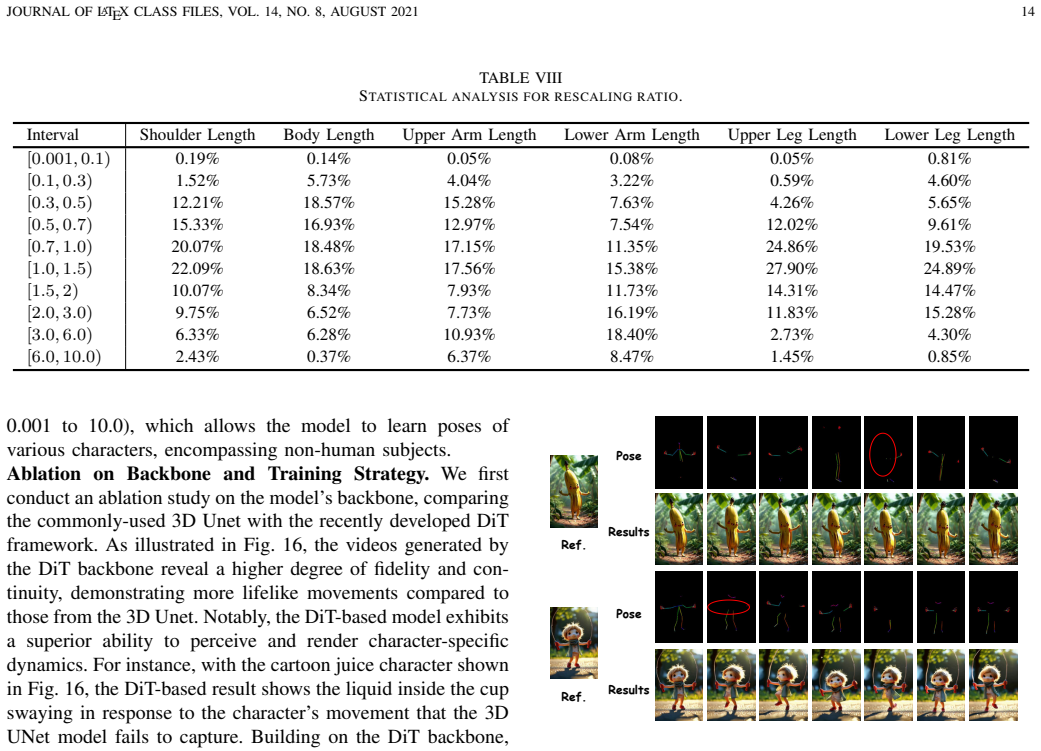
Animate-X++ is built on a Diffusion Transformer (DiT) denoising network initialized from a large video generation model. Given a reference image and a driving video, it extracts an explicit pose sequence with DWPose and an implicit motion descriptor with a CLIP image encoder. The Implicit Pose Indicator (IPI) uses a learnable query plus pose keypoint embeddings to attend over CLIP features, capturing motion patterns and temporal relations that skeletons miss. The Explicit Pose Indicator (EPI) simulates misalignments during training by realigning the driving pose to an anchor pose from a pool and rescaling body-part lengths, so the model learns to follow approximate motion rather than exact j
What carries the argument
The Pose Indicator, consisting of the Implicit Pose Indicator (IPI) and the Explicit Pose Indicator (EPI), is the central mechanism. IPI fuses DWPose keypoint queries with a learnable query and attends over CLIP visual features of the driving video, capturing the gist of motion beyond skeleton positions. EPI perturbs the pose during training by realigning it to an anchor pose and rescaling body parts, teaching the model to be robust to shape mismatches between the reference image and the driving pose. A secondary mechanism is the multi-task, partial-parameter training strategy: on the text-image-to-video task the pose modules are frozen and only LoRA parameters are updated, allowing text-dri
Load-bearing premise
The quantitative evidence stands on A2Bench, a benchmark whose reference dance videos are themselves generated by a commercial AI pipeline and screened by hand for pose accuracy, so the measured superiority is only as strong as that synthetic ground truth is valid.
What would settle it
Run the model on the roughly 400 image-video pairs from A2Bench that were excluded because DWPose could not extract accurate poses, while giving it a human dance video as the motion source; if human raters find that identity is not preserved or motion is not followed on a substantial share of these hardest cases, the claim that strict pose alignment is unnecessary would be directly contradicted.
If this is right
- A single trained model can animate anthropomorphic characters from games, films, and posters without per-character retraining or pose-aligned reference images.
- The same model can generate text-driven background dynamics, such as light changes, glowing auras, or ocean motion, concurrently with character animation.
- Because the model is trained only on human dance videos and generic text-video pairs, it demonstrates that motion understanding from human data can transfer to non-human body plans when the motion representation is made flexible.
- On human benchmarks such as TikTok and Fashion, the method matches or exceeds previous state-of-the-art, so the changes do not sacrifice human animation quality.
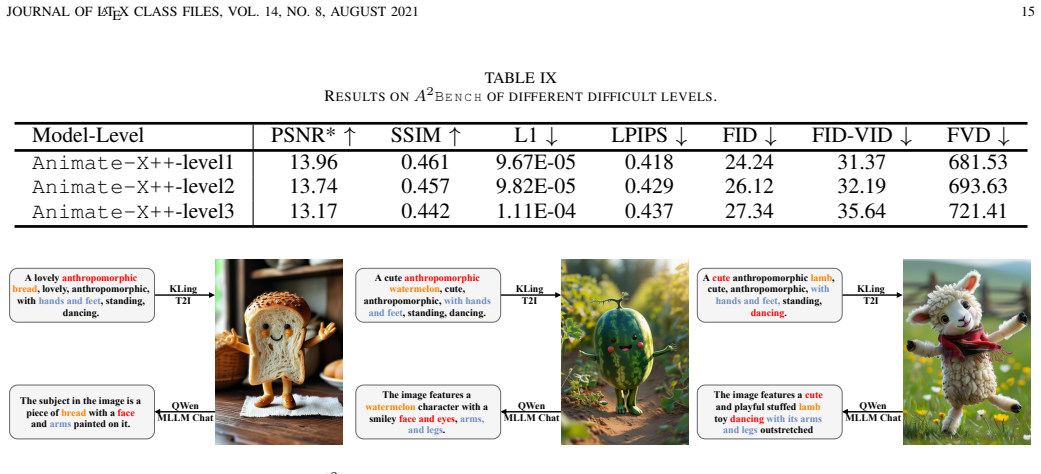
- The new A2Bench benchmark, organized into three difficulty levels, provides a common testbed for comparing future anthropomorphic animation methods.
Where Pith is reading between the lines
- If the central claim holds, character animation pipelines in games and short-video production could be shortened to a single reference image and any dance clip, removing the need for rigging or pose retargeting for each character.
- The IPI's use of CLIP video features suggests that motion descriptors could be learned from other cross-modal sources, such as audio or text descriptions of motion, and then combined with pose skeletons for even less human-centric control.
- A natural stress test is to evaluate on the roughly 400 A2Bench image-video pairs that were excluded because DWPose could not produce accurate poses; success there would directly confirm that strict pose alignment is unnecessary.
- The A2Bench ground truth is itself generated by a commercial AI pipeline, so an independent benchmark with real recorded or hand-animated anthropomorphic characters would make the quantitative superiority claim more robust.
Editorial analysis
A structured set of objections, weighed in public.
Referee Report
Summary. The paper proposes Animate-X++, a diffusion-transformer (DiT) model for character image animation that targets anthropomorphic characters and adds text-driven background dynamics. The method combines an Implicit Pose Indicator (IPI), which extracts motion-related information from CLIP features of the driving video, with an Explicit Pose Indicator (EPI), which trains the pose encoder on realigned and rescaled poses to tolerate body-shape mismatch. A multi-task training strategy with partial parameter updates (LoRA) is used to add a Text-Image-to-Video (TI2V) objective. The authors introduce A2Bench, a synthetic benchmark of 500 anthropomorphic character images and dance videos generated by GPT-4o and Kling AI, and report quantitative comparisons on A2Bench and on the TikTok/Fashion human benchmarks, along with ablations. The central claim is that Animate-X++ generalizes pose-driven animation to arbitrary cartoon/anthropomorphic images without strict pose alignment.
Significance. If fully supported, the contribution would be practically valuable: EPI's pose-rescaling augmentation is a sensible way to mitigate human/non-human pose mismatch, IPI's CLIP-based implicit motion summary complements DWPose skeletons, and LoRA-based multi-task training is a clean approach to adding background dynamics without degrading animation. The authors also make an effort to hold A2Bench out from training and to disclose its construction pipeline. However, the main quantitative evidence for the headline capability currently rests on a benchmark protocol that is not a valid fidelity test, and the gains on the human benchmarks are small and reported without uncertainty estimates. The dynamic-background contribution is supported only qualitatively. With the measurement issues addressed, the work has clear potential, but the evaluation needs to be repaired before the claims can be accepted.
major comments (4)
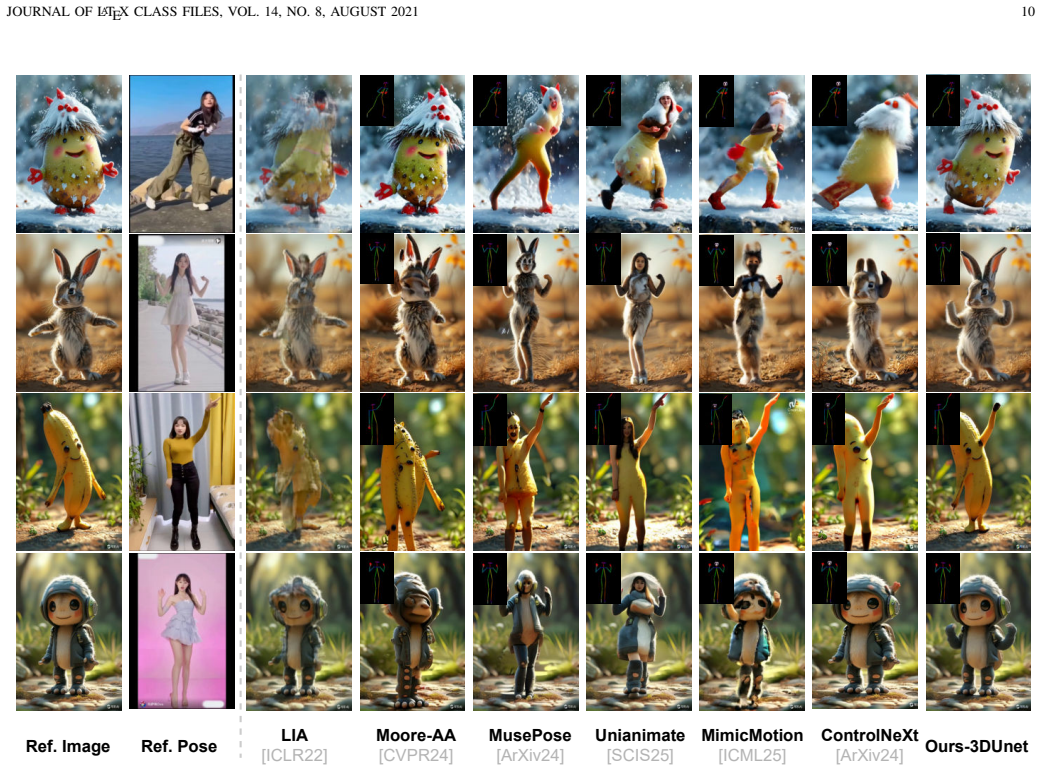
- [Section IV-B, Table I] The 'rescaled pose setting' is not a valid reconstruction test. Each method receives a pose p_a^b that has been realigned to a randomly chosen human body shape, while the ground-truth video is the original Kling-generated anthropomorphic character with its own non-human proportions. A model that faithfully follows p_a^b cannot simultaneously match the ground-truth frames, so PSNR/SSIM/LPIPS/FVD no longer measure fidelity to the reference video; they reward methods that ignore part of the input. Because EPI is trained on exactly such realigned/rescaled poses, this protocol aligns with the proposed method's inductive bias rather than with a neutral measure of universal capability. The claim in §IV-B that Animate-X++ 'markedly surpasses all comparative methods' is therefore unsupported by Table I. The evaluation should be redone with the original anthropomorphic pose sequence (or with a gro
- [Section III-E and Section IV-B, Tables II and X] A2Bench's reference videos are generated by Kling AI, and only 100 of the 500 videos are manually screened for accurate DWPose poses. The screening criteria and inter-annotator reliability are not reported, so it is unclear whether the 100-video test set is representative or whether it preferentially selects human-like characters that favor methods trained on human dance data. Additionally, the metric PSNR* is introduced in Table I with the note 'using the modified metric [84] to avoid numerical overflow,' but the modification is never defined. This makes the central numbers unreproducible. Please define PSNR*, report the full screening protocol, and validate A2Bench with human evaluation or an independently collected anthropomorphic benchmark.
- [Tables III and VI] On the standard human benchmarks, the reported advantage over Unianimate-DiT is small (e.g., Table VI: PSNR 31.05 vs 30.95, SSIM 0.817 vs 0.815, FVD 135.20 vs 136.10). No error bars, confidence intervals, or significance tests are provided for any metric in any table. Given the small margins and the 100-video test sets, the claim that Animate-X++ 'exceeds' state-of-the-art methods on human datasets is not statistically established. Please report per-metric uncertainty and, if possible, multiple seeds or bootstrapped intervals.
- [Section III-D, Fig. 16, Table IV] The text-driven background dynamics contribution is demonstrated only qualitatively. No quantitative metric is reported for prompt adherence, background motion, or the effect of the TI2V task on the generated background. The user study (Table IV) asks about identity preservation, temporal consistency, and visual quality, but not about background dynamics or text alignment. Since the title and abstract foreground dynamic backgrounds as a core contribution, please add a quantitative evaluation on held-out TI2V pairs (e.g., prompt-video alignment scores and background motion metrics) or explicitly scope this as a qualitative capability.
minor comments (6)
- [Tables I, II, VII] The L1 metric is defined as mean absolute difference, so lower is better, but the table headers show an upward arrow. The arrow direction should be reversed.
- [Tables III and VI] The row labeled 'Unianimate-DiT' is cited as [66], which is StableAnimator; the correct reference is [80]. This also affects the reference numbering in the captions.
- [Section V, Limitation and Future Work] The limitation section says, 'even though we replace the transformer with a more efficient Mamba model for temporal modeling,' but the method described in Section III-C and Fig. 2 uses DiT blocks with self-attention, not Mamba. This sentence appears to be inconsistent with the rest of the manuscript.
- [Fig. 8] The notation p_a^b is used in the comparison-setting figure but is not formally defined in the text. Please define the realignment/rescaling mapping and how the random human pose P_b is selected.
- [References] There are duplicate references: [3] and [83] are the same work, [50] and [91] are the same, and [62] and [84] are the same. Please consolidate them.
- [Table V] The rows in Table V are misaligned; for example, the '90%' row entries do not line up with the columns. Please reformat.
Circularity Check
The headline A2Bench SOTA is partially circular: its 'rescaled pose' test inputs are generated by the same realign-and-rescale procedure used to train the EPI module, and the key EPI hyperparameter λ is tuned on A2Bench itself.
specific steps
-
other
[Section III-B (Explicit Pose Indicator) and Section IV-B (Quantitative Results, rescaled pose setting)]
"The transformed pose I p n retains the same motion as the sampled pose I p but has a body shape similar to the anchor pose I p anchor. This simulates scenarios during inference where there are body shape differences between the reference image and the driving pose, enabling the model to generalize to such cases. ... For each case in A 2Bench (i.e., a reference image I a and a pose P a), we randomly select one human’s pose image P b and align the anthropomorphic character’s pose P a to it, such that the aligned pose p a b retains the movements of P a but has the same body shape (fat/thin, tall/"
The A2Bench evaluation inputs are generated by the exact operation EPI uses during training: realign the driving pose to a random anchor human pose, then rescale body parts. Animate-X++ is trained under this transformation with probability λ>98%, so Table I measures the model's ability to invert its own training augmentation rather than an independent external benchmark. Competing methods are not trained on this synthetic distribution, so they are systematically disadvantaged. Moreover, the ground-truth video retains the anthropomorphic body shape while the input pose is human-aligned, so no model can simultaneously match the pose and the reference; PSNR/SSIM/LPIPS/FVD then partly measure the induced pose mismatch rather than animation quality.
-
fitted input called prediction
[Section IV-C, Ablation on Explicit Pose Indicator, Table V]
"The results presented in Tab. V suggest that a high λ performs better on A 2Bench, i.e., it performs better when the reference image and pose image are not aligned, but harms performance on the TikTok dataset, i.e., when the reference image and pose image are strictly aligned."
The key hyperparameter λ of the EPI module is selected by monitoring A2Bench metrics in Table V, and the final model then uses a high λ (over 98%) because it maximizes A2Bench performance. Reporting the same A2Bench numbers as evidence of state-of-the-art results is therefore test-set configuration: the model has been fitted to the benchmark, so the quantitative superiority on A2Bench is not an independent prediction but a consequence of tuning on that benchmark.
full rationale
The paper's central technical derivation — Pose Indicator (IPI + EPI), DiT backbone, multi-task partial-parameter training — is not circular in the sense of assuming what it proves: IPI is a learned CLIP-conditioned query extraction, EPI is a data-augmentation scheme, and the multi-task loss is a standard combination of animation and TI2V objectives. However, the headline quantitative claim on A2Bench is partially circular. The A2Bench 'rescaled pose setting' constructs test inputs by realigning an anthropomorphic pose onto a random human body shape, which is precisely the EPI training augmentation (pose realignment + pose rescale). Thus the benchmark is aligned with the method's inductive bias, and the reported 'markedly surpasses' margins in Table I are partly by construction. Additionally, the EPI probability λ is ablated directly on A2Bench and then the same A2Bench numbers are presented as the final result, which is test-set hyperparameter selection. These issues affect the strength of the quantitative evidence, but not all evidence: the self-driven A2Bench (Table II), human TikTok/Fashion benchmarks, and qualitative demonstrations provide some independent support for the method's capability. The paper's own stated limitations (hands/faces and non-real-time speed) do not affect circularity. Overall, the central claim retains independent content, but the A2Bench-based SOTA claim is partially reduced by construction, giving a score of 6.
Axiom & Free-Parameter Ledger
free parameters (3)
- lambda (pose transformation probability) =
0.98
- alpha (IPI residual weight) =
1.0
- p_ti2v (TI2V task sampling probability) =
not specified
axioms (4)
- domain assumption CLIP visual features encode a transferable 'gist of motion' from the driving video.
- domain assumption DWPose keypoint rescaling and realignment on human videos spans the body-shape space of anthropomorphic characters.
- domain assumption A2Bench videos generated by Kling AI are valid references for quantitative animation metrics.
- domain assumption A model trained only on human dance videos transfers to anthropomorphic characters.
invented entities (1)
-
A2Bench benchmark dataset
no independent evidence
Cite this review
Pith. "Pith review of Animate-X++: Universal Character Image Animation with Dynamic Backgrounds." pith.science (2026). https://pith.science/paper/XTUWLJ32
@misc{pith2026250809454,
  author       = {Pith},
  title        = {Pith review of: Animate-X++: Universal Character Image Animation with Dynamic Backgrounds},
  year         = {2026},
  howpublished = {\url{https://pith.science/paper/XTUWLJ32}},
  note         = {Machine review of arXiv:2508.09454}
}
read the original abstract
Character image animation, which generates high-quality videos from a reference image and target pose sequence, has seen significant progress in recent years. However, most existing methods only apply to human figures, which usually do not generalize well on anthropomorphic characters commonly used in industries like gaming and entertainment. Furthermore, previous methods could only generate videos with static backgrounds, which limits the realism of the videos. For the first challenge, our in-depth analysis suggests to attribute this limitation to their insufficient modeling of motion, which is unable to comprehend the movement pattern of the driving video, thus imposing a pose sequence rigidly onto the target character. To this end, this paper proposes Animate-X++, a universal animation framework based on DiT for various character types, including anthropomorphic characters. To enhance motion representation, we introduce the Pose Indicator, which captures comprehensive motion pattern from the driving video through both implicit and explicit manner. The former leverages CLIP visual features of a driving video to extract its gist of motion, like the overall movement pattern and temporal relations among motions, while the latter strengthens the generalization of DiT by simulating possible inputs in advance that may arise during inference. For the second challenge, we introduce a multi-task training strategy that jointly trains the animation and TI2V tasks. Combined with the proposed partial parameter training, this approach achieves not only character animation but also text-driven background dynamics, making the videos more realistic. Moreover, we introduce a new Animated Anthropomorphic Benchmark (A2Bench) to evaluate the performance of Animate-X++ on universal and widely applicable animation images. Extensive experiments demonstrate the superiority and effectiveness of Animate-X++.
Figures





Forward citations
Cited by 3 Pith papers
-
CoMoVi: Co-Generation of 3D Human Motions and Realistic Videos
CoMoVi co-generates 3D human motions and 2D videos synchronously in a single diffusion denoising loop using 3D-to-2D projection and dual-branch diffusion with 3D-2D cross attentions.
-
Towards 3D-Aware Video Diffusion Models: Render-Free Human Motion Control with Mesh Tokenization
Introduces mesh tokenization to condition DiT-based video diffusion models directly on 3D human meshes for motion control without 2D rendering.
-
EDTalk++: Full Disentanglement for Controllable Talking Head Synthesis
EDTalk++ disentangles talking-head video into four orthogonal motion banks (mouth, pose, eyes, expression) and drives them from either video or audio inputs.
Reference graph
Works this paper leans on
-
[1]
Animate-x: Universal character image anima- tion with enhanced motion representation,
S. Tan, B. Gong, X. Wang, S. Zhang, D. Zheng, R. Zheng, K. Zheng, J. Chen, and M. Yang, “Animate-x: Universal character image anima- tion with enhanced motion representation,” inICLR, 2025
2025
-
[2]
Pose guided human video generation,
C. Yang, Z. Wang, X. Zhu, C. Huang, J. Shi, and D. Lin, “Pose guided human video generation,” inECCV, 2018
2018
-
[4]
Animate any- one: Consistent and controllable image-to-video synthesis for character animation,
L. Hu, X. Gao, P. Zhang, K. Sun, B. Zhang, and L. Bo, “Animate any- one: Consistent and controllable image-to-video synthesis for character animation,”arXiv:2311.17117, 2023
Pith/arXiv arXiv 2023
-
[5]
Magicanimate: Temporally consistent human image animation using diffusion model,
Z. Xu, J. Zhang, J. H. Liew, H. Yan, J.-W. Liu, C. Zhang, J. Feng, and M. Z. Shou, “Magicanimate: Temporally consistent human image animation using diffusion model,”arXiv:2311.16498, 2023
Pith/arXiv arXiv 2023
-
[6]
Magicdance: Realistic human dance video generation with motions & facial expressions transfer,
D. Chang, Y . Shi, Q. Gao, J. Fu, H. Xu, G. Song, Q. Yan, X. Yang, and M. Soleymani, “Magicdance: Realistic human dance video generation with motions & facial expressions transfer,”arXiv:2311.12052, 2023
Pith/arXiv arXiv 2023
-
[7]
Text2human: Text-driven controllable human image generation,
Y . Jiang, S. Yang, H. Qiu, W. Wu, C. C. Loy, and Z. Liu, “Text2human: Text-driven controllable human image generation,”ACM Transactions on Graphics, 2022
2022
-
[8]
Generative adversarial nets,
I. Goodfellow, J. Pouget-Abadie, M. Mirza, B. Xu, D. Warde-Farley, S. Ozair, A. Courville, and Y . Bengio, “Generative adversarial nets,” NeurIPS, 2014
2014
-
[9]
Bidirectionally deformable motion modulation for video-based human pose transfer,
W.-Y . Yu, L.-M. Po, R. C. Cheung, Y . Zhao, Y . Xue, and K. Li, “Bidirectionally deformable motion modulation for video-based human pose transfer,” inICCV, 2023
2023
-
[11]
Imagen video: High definition video generation with diffusion models,
J. Ho, W. Chan, C. Saharia, J. Whang, R. Gao, A. Gritsenko, D. P. Kingma, B. Poole, M. Norouzi, D. J. Fleetet al., “Imagen video: High definition video generation with diffusion models,”arXiv:2210.02303, 2022
Pith/arXiv arXiv 2022
-
[12]
Denoising diffusion probabilistic models,
J. Ho, A. Jain, and P. Abbeel, “Denoising diffusion probabilistic models,”NeurIPS, vol. 33, 2020
2020
-
[13]
An- imatediff: Animate your personalized text-to-image diffusion models without specific tuning,
Y . Guo, C. Yang, A. Rao, Y . Wang, Y . Qiao, D. Lin, and B. Dai, “An- imatediff: Animate your personalized text-to-image diffusion models without specific tuning,”arXiv:2307.04725, 2023
Pith/arXiv arXiv 2023
-
[14]
High- resolution image synthesis with latent diffusion models,
R. Rombach, A. Blattmann, D. Lorenz, P. Esser, and B. Ommer, “High- resolution image synthesis with latent diffusion models,” inCVPR, 2022
2022
-
[15]
Wan: Open and advanced large-scale video generative mod- els,
T. Wan, “Wan: Open and advanced large-scale video generative mod- els,”arXiv:2503.20314, 2025
Pith/arXiv arXiv 2025
-
[16]
Scalable diffusion models with transformers,
W. Peebles and S. Xie, “Scalable diffusion models with transformers,” inICCV, 2023
2023
-
[17]
Denoising diffusion implicit mod- els,
J. Song, C. Meng, and S. Ermon, “Denoising diffusion implicit mod- els,” inICLR, 2021
2021
-
[18]
Glide: Towards photorealistic image generation and editing with text-guided diffusion models,
A. Q. Nichol, P. Dhariwal, A. Ramesh, P. Shyam, P. Mishkin, B. Mc- grew, I. Sutskever, and M. Chen, “Glide: Towards photorealistic image generation and editing with text-guided diffusion models,” inICML, 2022
2022
-
[19]
Hierarchical text-conditional image generation with clip latents,
A. Ramesh, P. Dhariwal, A. Nichol, C. Chu, and M. Chen, “Hierarchical text-conditional image generation with clip latents,” arXiv:2204.06125, 2022
Pith/arXiv arXiv 2022
-
[20]
C. Mou, X. Wang, L. Xie, J. Zhang, Z. Qi, Y . Shan, and X. Qie, “T2i-adapter: Learning adapters to dig out more controllable ability for text-to-image diffusion models,”arXiv:2302.08453, 2023
Pith/arXiv arXiv 2023
-
[21]
Composer: Creative and controllable image synthesis with composable conditions,
L. Huang, D. Chen, Y . Liu, Y . Shen, D. Zhao, and J. Zhou, “Composer: Creative and controllable image synthesis with composable conditions,” ICML, 2023
2023
-
[22]
Adding conditional control to text-to-image diffusion models,
L. Zhang, A. Rao, and M. Agrawala, “Adding conditional control to text-to-image diffusion models,” inICCV, 2023
2023
-
[23]
Survey on leveraging pre-trained generative adversarial networks for image editing and restoration,
M. Liu, Y . Wei, X. Wu, W. Zuo, and L. Zhang, “Survey on leveraging pre-trained generative adversarial networks for image editing and restoration,”Science China Information Sciences, 2023
2023
-
[24]
Photorealistic text-to-image diffusion models with deep language understanding,
C. Saharia, W. Chan, S. Saxena, L. Li, J. Whang, E. L. Denton, K. Ghasemipour, R. Gontijo Lopes, B. Karagol Ayan, T. Salimanset al., “Photorealistic text-to-image diffusion models with deep language understanding,”NeurIPS, 2022
2022
-
[25]
Make-a-video: Text-to-video generation without text-video data,
U. Singer, A. Polyak, T. Hayes, X. Yin, J. An, S. Zhang, Q. Hu, H. Yang, O. Ashual, O. Gafniet al., “Make-a-video: Text-to-video generation without text-video data,”ICLR, 2023
2023
-
[26]
Modelscope text-to-video technical report,
J. Wang, H. Yuan, D. Chen, Y . Zhang, X. Wang, and S. Zhang, “Modelscope text-to-video technical report,”arXiv:2308.06571, 2023
Pith/arXiv arXiv 2023
-
[27]
A recipe for scaling up text-to-video generation with text-free videos,
X. Wang, S. Zhang, H. Yuan, Z. Qing, B. Gong, Y . Zhang, Y . Shen, C. Gao, and N. Sang, “A recipe for scaling up text-to-video generation with text-free videos,” inCVPR, 2024
2024
-
[28]
Tune-a-video: One-shot tuning of image diffusion models for text-to-video generation,
J. Z. Wu, Y . Ge, X. Wang, S. W. Lei, Y . Gu, Y . Shi, W. Hsu, Y . Shan, X. Qie, and M. Z. Shou, “Tune-a-video: One-shot tuning of image diffusion models for text-to-video generation,” inICCV, 2023
2023
-
[29]
Stablevideo: Text-driven consistency-aware diffusion video editing,
W. Chai, X. Guo, G. Wang, and Y . Lu, “Stablevideo: Text-driven consistency-aware diffusion video editing,” inICCV, 2023
2023
-
[30]
Pix2video: Video editing using image diffusion,
D. Ceylan, C.-H. P. Huang, and N. J. Mitra, “Pix2video: Video editing using image diffusion,” inICCV, 2023
2023
-
[31]
Mag- icvideo: Efficient video generation with latent diffusion models,
D. Zhou, W. Wang, H. Yan, W. Lv, Y . Zhu, and J. Feng, “Mag- icvideo: Efficient video generation with latent diffusion models,” arXiv:2211.11018, 2022
Pith/arXiv arXiv 2022
-
[32]
Latent-shift: Latent diffusion with temporal shift for efficient text-to- video generation,
J. An, S. Zhang, H. Yang, S. Gupta, J.-B. Huang, J. Luo, and X. Yin, “Latent-shift: Latent diffusion with temporal shift for efficient text-to- video generation,”arXiv:2304.08477, 2023
Pith/arXiv arXiv 2023
-
[33]
Simda: Simple diffusion adapter for efficient video generation,
Z. Xing, Q. Dai, H. Hu, Z. Wu, and Y .-G. Jiang, “Simda: Simple diffusion adapter for efficient video generation,”arXiv:2308.09710, 2023. JOURNAL OF LATEX CLASS FILES, VOL. 14, NO. 8, AUGUST 2021 17
Pith/arXiv arXiv 2023
-
[34]
Hierarchical spatio-temporal decoupling for text-to-video generation,
Z. Qing, S. Zhang, J. Wang, X. Wang, Y . Wei, Y . Zhang, C. Gao, and N. Sang, “Hierarchical spatio-temporal decoupling for text-to-video generation,”arXiv:2312.04483, 2023
Pith/arXiv arXiv 2023
-
[35]
Instructvideo: Instructing video diffusion models with human feedback,
H. Yuan, S. Zhang, X. Wang, Y . Wei, T. Feng, Y . Pan, Y . Zhang, Z. Liu, S. Albanie, and D. Ni, “Instructvideo: Instructing video diffusion models with human feedback,”arXiv:2312.12490, 2023
Pith/arXiv arXiv 2023
-
[36]
Style2talker: High-resolution talking head generation with emotion style and art style,
S. Tan, B. Ji, and Y . Pan, “Style2talker: High-resolution talking head generation with emotion style and art style,” inAAAI, 2024
2024
-
[37]
Check locate rectify: A training-free layout calibration system for text-to- image generation,
B. Gong, S. Huang, Y . Feng, S. Zhang, Y . Li, and Y . Liu, “Check locate rectify: A training-free layout calibration system for text-to- image generation,” inCVPR, 2024
2024
-
[38]
Dreamvideo: Composing your dream videos with customized subject and motion,
Y . Wei, S. Zhang, Z. Qing, H. Yuan, Z. Liu, Y . Liu, Y . Zhang, J. Zhou, and H. Shan, “Dreamvideo: Composing your dream videos with customized subject and motion,” inCVPR, 2024
2024
-
[39]
Dreamvideo-2: Zero-shot subject-driven video customization with precise motion control,
Y . Wei, S. Zhang, H. Yuan, X. Wang, H. Qiu, R. Zhao, Y . Feng, F. Liu, Z. Huang, J. Yeet al., “Dreamvideo-2: Zero-shot subject-driven video customization with precise motion control,”arXiv:2410.13830, 2024
Pith/arXiv arXiv 2024
-
[40]
Mimir: Improving video diffusion models for precise text understanding,
S. Tan, B. Gong, Y . Feng, K. Zheng, D. Zheng, S. Shi, Y . Shen, J. Chen, and M. Yang, “Mimir: Improving video diffusion models for precise text understanding,”arXiv:2412.03085, 2024
Pith/arXiv arXiv 2024
-
[41]
S. Shi, B. Gong, X. Chen, D. Zheng, S. Tan, Z. Yang, Y . Li, J. He, K. Zheng, J. Chenet al., “Motionstone: Decoupled motion intensity modulation with diffusion transformer for image-to-video generation,” arXiv:2412.05848, 2024
work page internal anchor Pith review Pith/arXiv arXiv 2024
-
[42]
Synmotion: Semantic-visual adaptation for motion customized video generation,
S. Tan, B. Gong, Y . Wei, S. Zhang, Z. Liu, D. Zheng, J. Chen, Y . Wang, H. Ouyang, K. Zheng, and Y . Shen, “Synmotion: Semantic-visual adaptation for motion customized video generation,”arXiv preprint arXiv:2506.23690, 2025
Pith/arXiv arXiv 2025
-
[43]
Mimicmotion: High-quality human motion video generation with confidence-aware pose guidance,
Y . Zhang, J. Gu, L.-W. Wang, H. Wang, J. Cheng, Y . Zhu, and F. Zou, “Mimicmotion: High-quality human motion video generation with confidence-aware pose guidance,”arXiv:2406.19680, 2024
Pith/arXiv arXiv 2024
-
[44]
Magicpose: Realistic human poses and facial expressions retargeting with identity-aware diffusion,
D. Chang, Y . Shi, Q. Gao, H. Xu, J. Fu, G. Song, Q. Yan, Y . Zhu, X. Yang, and M. Soleymani, “Magicpose: Realistic human poses and facial expressions retargeting with identity-aware diffusion,” inICML, 2023
work page 2023
-
[45]
Dancetogether! identity-preserving multi- person interactive video generation,
J. Chen, M. Chen, J. Xu, X. Li, J. Dong, M. Sun, P. Jiang, H. Li, Y . Yang, H. Zhaoet al., “Dancetogether! identity-preserving multi- person interactive video generation,”arXiv:2505.18078, 2025
Pith/arXiv arXiv 2025
-
[46]
Flexiact: Towards flexible action control in heterogeneous scenarios,
S. Zhang, J. Zhuang, Z. Zhang, Y . Shan, and Y . Tang, “Flexiact: Towards flexible action control in heterogeneous scenarios,” inPro- ceedings of the Special Interest Group on Computer Graphics and Interactive Techniques Conference Conference Papers, 2025
work page 2025
-
[47]
Stableanimator++: Overcoming pose misalignment and face distortion for human image animation,
S. Tu, Z. Xing, X. Han, Z.-Q. Cheng, Q. Dai, C. Luo, Z. Wu, and Y .-G. Jiang, “Stableanimator++: Overcoming pose misalignment and face distortion for human image animation,”arXiv:2507.15064, 2025
Pith/arXiv arXiv 2025
-
[48]
EvAnimate: Event-conditioned Image-to-Video Generation for Human Animation
Q. Qu, M. Li, X. Chen, and T. Liu, “Evanimate: Event-conditioned image-to-video generation for human animation,”arXiv:2503.18552, 2025
work page internal anchor Pith review Pith/arXiv arXiv 2025
-
[49]
Dense intrinsic appearance flow for human pose transfer,
Y . Li, C. Huang, and C. C. Loy, “Dense intrinsic appearance flow for human pose transfer,” inCVPR, 2019
work page 2019
-
[53]
Edtalk: Efficient disentanglement for emotional talking head synthesis,
S. Tan, B. Ji, M. Bi, and Y . Pan, “Edtalk: Efficient disentanglement for emotional talking head synthesis,” inECCV. Springer, 2024
work page 2024
-
[54]
Latent image animator: Learning to animate images via latent space navigation,
Y . Wang, D. Yang, F. Bremond, and A. Dantcheva, “Latent image animator: Learning to animate images via latent space navigation,” arXiv:2203.09043, 2022
Pith/arXiv arXiv 2022
-
[55]
S. Tan, B. Ji, and Y . Pan, “Flowvqtalker: High-quality emotional talking face generation through normalizing flow and quantization,” inCVPR, 2024
work page 2024
-
[56]
S. Tan, B. Ji, Y . Ding, and Y . Pan, “Say anything with any style,” in AAAI, 2024
work page 2024
-
[57]
Emmn: Emotional motion memory network for audio-driven emotional talking face generation,
S. Tan, B. Ji, and Y . Pan, “Emmn: Emotional motion memory network for audio-driven emotional talking face generation,” inICCV, 2023
work page 2023
-
[58]
Y . Pan, S. Tan, S. Cheng, Q. Lin, Z. Zeng, and K. Mitchell, “Expressive talking avatars,”IEEE Transactions on Visualization and Computer Graphics, 2024
work page 2024
-
[59]
Fixtalk: Taming identity leakage for high-quality talking head generation in extreme cases,
S. Tan, B. Gong, B. Ji, and Y . Pan, “Fixtalk: Taming identity leakage for high-quality talking head generation in extreme cases,” inICCV, 2025
work page 2025
-
[60]
Advancing pose-guided image synthesis with progressive conditional diffusion models,
F. Shen, H. Ye, J. Zhang, C. Wang, X. Han, and Y . Wei, “Advancing pose-guided image synthesis with progressive conditional diffusion models,” inICLR, 2024. [Online]. Available: https: //openreview.net/forum?id=rHzapPnCgT
work page 2024
-
[61]
Champ: Controllable and consistent human image animation with 3d parametric guidance,
S. Zhu, J. L. Chen, Z. Dai, Y . Xu, X. Cao, Y . Yao, H. Zhu, and S. Zhu, “Champ: Controllable and consistent human image animation with 3d parametric guidance,” inECCV, 2024
work page 2024
-
[62]
Disco: Disentangled control for referring human dance generation in real world,
T. Wang, L. Li, K. Lin, C.-C. Lin, Z. Yang, H. Zhang, Z. Liu, and L. Wang, “Disco: Disentangled control for referring human dance generation in real world,”arXiv e-prints, 2023
work page 2023
-
[63]
Adding conditional control to text-to-image diffusion models,
L. Zhang, A. Rao, and M. Agrawala, “Adding conditional control to text-to-image diffusion models,” 2023
2023
-
[64]
Magicanimate: Temporally consistent human image animation using diffusion model,
Z. Xu, J. Zhang, J. H. Liew, H. Yan, J.-W. Liu, C. Zhang, J. Feng, and M. Z. Shou, “Magicanimate: Temporally consistent human image animation using diffusion model,” inarXiv, 2023
work page 2023
-
[65]
Attention is all you need,
A. Vaswani, “Attention is all you need,”NeurIPS, 2017
2017
-
[66]
Stableanimator: High-quality identity-preserving human image anima- tion,
S. Tu, Z. Xing, X. Han, Z.-Q. Cheng, Q. Dai, C. Luo, and Z. Wu, “Stableanimator: High-quality identity-preserving human image anima- tion,” inProceedings of the Computer Vision and Pattern Recognition Conference, 2025
work page 2025
-
[67]
Vision mamba: Efficient visual representation learning with bidirectional state space model,
L. Zhu, B. Liao, Q. Zhang, X. Wang, W. Liu, and X. Wang, “Vision mamba: Efficient visual representation learning with bidirectional state space model,”arXiv:2401.09417, 2024
Pith/arXiv arXiv 2024
-
[68]
Plainmamba: Improving non-hierarchical mamba in visual recognition,
C. Yang, Z. Chen, M. Espinosa, L. Ericsson, Z. Wang, J. Liu, and E. J. Crowley, “Plainmamba: Improving non-hierarchical mamba in visual recognition,”arXiv:2403.17695, 2024
Pith/arXiv arXiv 2024
-
[69]
Vmamba: Visual state space model,
Y . Liu, Y . Tian, Y . Zhao, H. Yu, L. Xie, Y . Wang, Q. Ye, and Y . Liu, “Vmamba: Visual state space model,”arXiv:2401.10166, 2024
Pith/arXiv arXiv 2024
-
[70]
Video mamba suite: State space model as a versatile alternative for video understanding,
G. Chen, Y . Huang, J. Xu, B. Pei, Z. Chen, Z. Li, J. Wang, K. Li, T. Lu, and L. Wang, “Video mamba suite: State space model as a versatile alternative for video understanding,”arXiv:2403.09626, 2024
Pith/arXiv arXiv 2024
-
[71]
Videomamba: State space model for efficient video understanding,
K. Li, X. Li, Y . Wang, Y . He, Y . Wang, L. Wang, and Y . Qiao, “Videomamba: State space model for efficient video understanding,” arXiv:2403.06977, 2024
Pith/arXiv arXiv 2024
-
[72]
Mamba: Linear-time sequence modeling with selective state spaces,
A. Gu and T. Dao, “Mamba: Linear-time sequence modeling with selective state spaces,”arXiv:2312.00752, 2023
Pith/arXiv arXiv 2023
-
[73]
Efficiently modeling long sequences with structured state spaces,
A. Gu, K. Goel, and C. R ´e, “Efficiently modeling long sequences with structured state spaces,”arXiv:2111.00396, 2021
Pith/arXiv arXiv 2021
-
[74]
Unianimate: Taming unified video diffusion models for consistent human image animation,
X. Wang, S. Zhang, C. Gao, J. Wang, X. Zhou, Y . Zhang, L. Yan, and N. Sang, “Unianimate: Taming unified video diffusion models for consistent human image animation,”arXiv:2406.01188, 2024
Pith/arXiv arXiv 2024
-
[75]
Hypermotion: Dit-based pose-guided human image animation of complex motions,
S. Xu, S. Zheng, Z. Wang, H. Yu, J. Chen, H. Zhang, B. Li, and P.-T. Jiang, “Hypermotion: Dit-based pose-guided human image animation of complex motions,”arXiv:2505.22977, 2025
arXiv 2025
-
[76]
Auto-encoding variational bayes,
D. P. Kingma, “Auto-encoding variational bayes,”arXiv:1312.6114, 2013
Pith/arXiv arXiv 2013
-
[77]
Effective whole-body pose estimation with two-stages distillation,
Z. Yang, A. Zeng, C. Yuan, and Y . Li, “Effective whole-body pose estimation with two-stages distillation,” inICCV, 2023
work page 2023
-
[78]
Openflamingo: An open-source framework for training large autoregressive vision- language models,
A. Awadalla, I. Gao, J. Gardner, J. Hessel, Y . Hanafy, W. Zhu, K. Marathe, Y . Bitton, S. Gadre, S. Sagawaet al., “Openflamingo: An open-source framework for training large autoregressive vision- language models,”arXiv:2308.01390, 2023
Pith/arXiv arXiv 2023
-
[79]
Perceiver: General perception with iterative attention,
A. Jaegle, F. Gimeno, A. Brock, O. Vinyals, A. Zisserman, and J. Carreira, “Perceiver: General perception with iterative attention,” in ICML. PMLR, 2021
work page 2021
-
[80]
Unianimate-dit: Human image animation with large-scale video diffusion transformer,
X. Wang, S. Zhang, L. Tang, Y . Zhang, C. Gao, Y . Wang, and N. Sang, “Unianimate-dit: Human image animation with large-scale video diffusion transformer,”arXiv:2504.11289, 2025
arXiv 2025
-
[81]
Roformer: En- hanced transformer with rotary position embedding,
J. Su, M. Ahmed, Y . Lu, S. Pan, W. Bo, and Y . Liu, “Roformer: En- hanced transformer with rotary position embedding,”Neurocomputing, 2024
work page 2024
-
[82]
Learning high fidelity depths of dressed humans by watching social media dance videos,
Y . Jafarian and H. S. Park, “Learning high fidelity depths of dressed humans by watching social media dance videos,” inCVPR, 2021
work page 2021
-
[83]
Dwnet: Dense warp-based network for pose-guided human video generation,
P. Zablotskaia, A. Siarohin, B. Zhao, and L. Sigal, “Dwnet: Dense warp-based network for pose-guided human video generation,” arXiv:1910.09139, 2019
Pith/arXiv arXiv 1910
-
[84]
Disco: Disentangled control for referring human dance generation in real world,
T. Wang, L. Li, K. Lin, C.-C. Lin, Z. Yang, H. Zhang, Z. Liu, and L. Wang, “Disco: Disentangled control for referring human dance generation in real world,” inICLR, 2024
work page 2024
-
[85]
M. T. Corporation, “Moore-AnimateAnyone,” 2024. [Online]. Available: https://github.com/MooreThreads/Moore-AnimateAnyone
work page 2024
This paper was first reviewed by deepseek-v4-flash on August 5, 2026.
discussion (0)
Sign in with ORCID, Apple, or X to comment. Anyone can read and Pith papers without signing in.