Tuning Thermal Conductivity and Electron-Phonon Interactions in Carbon and Boron Nitride Moir\'e Diamanes via Twist Angle Manipulation
Pith reviewed 2026-05-19 13:04 UTC · model grok-4.3
The pith
Increasing the twist angle in carbon and boron nitride moiré diamanes reduces their in-plane lattice thermal conductivity by 4.5 to 9 times due to increased structural disorder.
A machine-rendered reading of the paper's core claim, the machinery that carries it, and where it could break.
Core claim
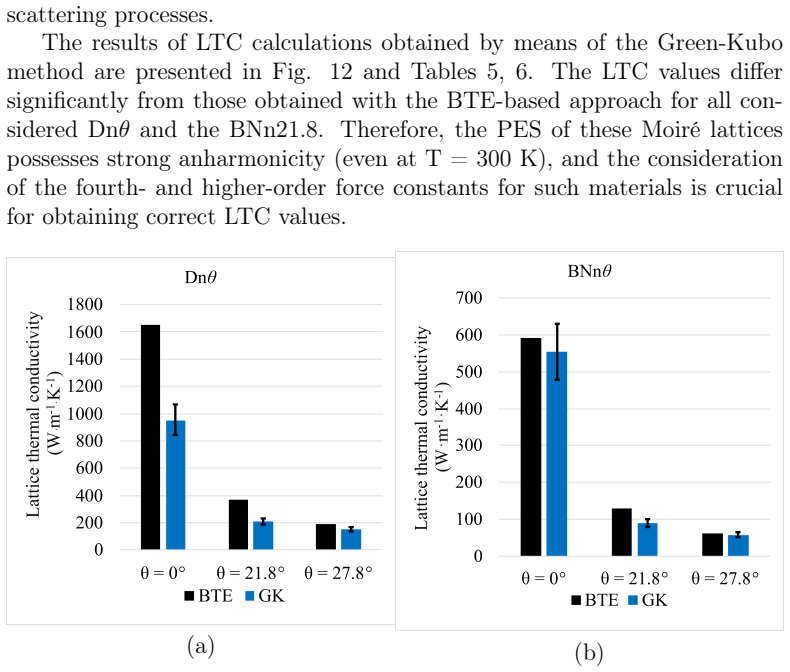
We have shown that increasing the twist angle in moiré diamanes of carbon and boron nitride leads to a reduction in in-plane lattice thermal conductivity by a factor of 4.5 to 9, driven by the growth of structural disorder. This disorder also enhances band gap renormalization induced by classical nuclei motion, while high phonon frequencies from surface hydrogen bonds cause notable renormalization when quantum nuclear effects are considered. The calculations reveal 20-40% differences between Green-Kubo and Boltzmann transport equation methods, highlighting the role of high-order anharmonic contributions.
What carries the argument
Twist angle manipulation that induces structural disorder in moiré diamanes, thereby scattering phonons and modifying electron-phonon interactions.
Load-bearing premise
The moment tensor potentials accurately reproduce the interatomic forces and anharmonic interactions for the range of twist angles and disorder levels in the moiré diamanes.
What would settle it
Measuring the in-plane thermal conductivity of moiré diamane samples prepared with increasing twist angles from 0 to 30 degrees using techniques like time-domain thermoreflectance would test if the conductivity drops by the predicted factors of 4.5 to 9.
Figures




read the original abstract
We have investigated the effect of interlayer twist angle on lattice thermal conductivity (LTC) and band gap renormalization in boron nitride and carbon Moir\'e diamanes. Moment tensor potentials were used for calculating energies and forces of interatomic interactions. The methods based on the solution of Boltzmann transport equation (BTE) for phonons and the GreenKubo (GK) formula were utilized to calculate LTC. The 20-40 % difference in LTC values obtained with GK and BTE-based methods showed the importance of high-order anharmonic contributions to LTC. Significant reduction (by 4.5 - 9 times) of the in-plane LTC with the twist angle increase caused by the growth of structural disorder was observed in the Moir\'e diamanes. This growth of disorder also leads to higher band gap renormalization (induced by classical nuclei motion) in the structures with higher twist angles. Significant band gap renormalization values obtained considering the quantum nuclear effects are caused by the high phonon frequencies related to the bonds with hydrogen atoms on the Moir\'e diamanes surfaces. Understanding of the twist angle effect on LTC and electron-phonon coupling in the Moir\'e diamanes provides a fundamental basis for manipulating their thermal and electronic properties, making these materials promising for thermoelectrics, microelectronics and optoelectronics.
Editorial analysis
A structured set of objections, weighed in public.
Referee Report
Summary. The manuscript investigates the effect of interlayer twist angle on lattice thermal conductivity (LTC) and band gap renormalization in boron nitride and carbon Moiré diamanes. Moment tensor potentials (MTPs) are employed to compute interatomic energies and forces, with LTC evaluated via both the Boltzmann transport equation (BTE) for phonons and the Green-Kubo (GK) formula. The authors report a 20-40% discrepancy between BTE and GK results, indicating significant high-order anharmonic contributions, and a 4.5-9 times reduction in in-plane LTC with increasing twist angle, attributed to growing structural disorder. Higher twist angles are also linked to increased band gap renormalization, with notable values arising from quantum nuclear effects due to high-frequency phonons associated with surface hydrogen bonds.
Significance. If the central numerical results hold after validation, the work would offer useful quantitative guidance on twist-angle engineering of thermal transport and electron-phonon coupling in these layered materials, with potential relevance to thermoelectrics and nanoelectronics. The dual use of BTE and GK methods, together with explicit consideration of quantum nuclear effects on the band gap, represents a methodological strength. The reported LTC reduction factors and anharmonicity discrepancies are concrete and falsifiable, which strengthens the paper's contribution if the underlying potentials are shown to be reliable across the explored configurations.
major comments (1)
- [Methods] Methods section (description of MTP training and usage): No quantitative benchmarks are provided for the accuracy of the moment tensor potentials in reproducing anharmonic forces or energies for the full range of twist angles and associated structural disorder. Force-error statistics, phonon-dispersion comparisons to DFT reference calculations, or transferability tests at the largest twist angles are absent. Because the headline claim of a 4.5–9× LTC drop is attributed to disorder-induced scattering and rests entirely on MTP-derived forces fed into both BTE and GK calculations, the lack of such validation is load-bearing for the central attribution.
minor comments (2)
- [Abstract] The abstract states a '20-40 % difference' between GK and BTE LTC values but does not specify which method yields the higher values or provide error bars; adding this information would improve clarity.
- [Figures and Results] Figure captions and text should explicitly define the in-plane versus out-of-plane LTC components and the precise definition of 'structural disorder' (e.g., atomic displacement variance or bond-length distribution) used to correlate with the LTC reduction.
Simulated Author's Rebuttal
We thank the referee for their thorough review and insightful comments on our manuscript. We address the major comment point by point below and outline the revisions we plan to make.
read point-by-point responses
-
Referee: [Methods] Methods section (description of MTP training and usage): No quantitative benchmarks are provided for the accuracy of the moment tensor potentials in reproducing anharmonic forces or energies for the full range of twist angles and associated structural disorder. Force-error statistics, phonon-dispersion comparisons to DFT reference calculations, or transferability tests at the largest twist angles are absent. Because the headline claim of a 4.5–9× LTC drop is attributed to disorder-induced scattering and rests entirely on MTP-derived forces fed into both BTE and GK calculations, the lack of such validation is load-bearing for the central attribution.
Authors: We agree with the referee that quantitative validation of the MTPs is crucial for supporting the central claims regarding the LTC reduction. Although the MTPs were trained on DFT data for a range of configurations including twisted structures, explicit benchmarks were not reported in the original submission. In the revised manuscript, we will add detailed information on the MTP training, including root-mean-square errors for forces and energies on validation sets that cover the full range of twist angles. Additionally, we will include comparisons of phonon dispersions calculated with MTPs versus DFT for representative low-twist and high-twist configurations to demonstrate accuracy and transferability. These additions will directly address the concerns about the reliability of the potentials for disordered systems. revision: yes
Circularity Check
No significant circularity; results from direct simulation
full rationale
The paper computes LTC via MTP-derived forces and energies fed into standard BTE and Green-Kubo solvers applied to explicitly constructed moiré structures at varying twist angles. These numerical outputs (including the reported 4.5–9× reduction) are not defined in terms of the target LTC values, nor obtained by fitting parameters to subsets of the same LTC data. No self-citation chains, uniqueness theorems, or ansatzes are invoked to justify the core computational pipeline. The derivation remains independent of its own results and is therefore self-contained.
Axiom & Free-Parameter Ledger
axioms (2)
- domain assumption Moment tensor potentials trained on reference configurations accurately capture forces and anharmonic interactions in twisted diamane structures
- domain assumption The Boltzmann transport equation and Green-Kubo formula remain applicable despite increasing structural disorder from twist
Lean theorems connected to this paper
-
IndisputableMonolith/Cost/FunctionalEquation.leanwashburn_uniqueness_aczel unclear?
unclearRelation between the paper passage and the cited Recognition theorem.
Significant reduction (by 4.5 - 9 times) of the in-plane LTC with the twist angle increase caused by the growth of structural disorder was observed in the Moiré diamanes.
-
IndisputableMonolith/Foundation/AlphaCoordinateFixation.leanJ_uniquely_calibrated_via_higher_derivative unclear?
unclearRelation between the paper passage and the cited Recognition theorem.
The 20-40 % difference in LTC values obtained with GK and BTE-based methods showed the importance of high-order anharmonic contributions to LTC.
What do these tags mean?
- matches
- The paper's claim is directly supported by a theorem in the formal canon.
- supports
- The theorem supports part of the paper's argument, but the paper may add assumptions or extra steps.
- extends
- The paper goes beyond the formal theorem; the theorem is a base layer rather than the whole result.
- uses
- The paper appears to rely on the theorem as machinery.
- contradicts
- The paper's claim conflicts with a theorem or certificate in the canon.
- unclear
- Pith found a possible connection, but the passage is too broad, indirect, or ambiguous to say the theorem truly supports the claim.
Reference graph
Works this paper leans on
-
[1]
S. Carr, D. Massatt, S. Fang, P. Cazeaux, M. Luskin, E. Kaxiras, Twistronics: Manipulating the electronic properties of two-dimensional layered structures through their twist angle, Physical Review B 95 (7) (2017) 075420
work page 2017
-
[2]
Y. Cao, V. Fatemi, S. Fang, K. Watanabe, T. Taniguchi, E. Kaxi- ras, P. Jarillo-Herrero, Unconventional superconductivity in magic-angle graphene superlattices, Nature 556 (7699) (2018) 43–50
work page 2018
-
[3]
R. Bistritzer, A. H. MacDonald, Moiré bands in twisted double-layer graphene, Proceedings of the National Academy of Sciences 108 (30) (2011) 12233—12237
work page 2011
-
[4]
D. Wu, Y. Pan, T. Min, Twistronics in graphene, from transfer assembly to epitaxy, Applied Sciences 10 (14) (2020) 4690
work page 2020
-
[5]
Y. Hou, J. Zhou, M. Xue, M. Yu, Y. Han, Z. Zhang, Y. Lu, Strain engineering of twisted bilayer graphene: The rise of strain-twistronics, Small (2024) 2311185
work page 2024
-
[6]
A. I. Cocemasov, D. L. Nika, A. A. Balandin, Phonons in twisted bilayer graphene, Physical Review B 88 (3) (2013) 035428
work page 2013
-
[7]
S. Chowdhury, V. A. Demin, L. A. Chernozatonskii, A. G. Kvashnin, Ultra-low thermal conductivity of Moiré diamanes, Membranes 12 (10) (2022) 925
work page 2022
-
[8]
F. Eriksson, E. Fransson, C. Linderalv, Z. Fan, P. Erhart, Tuning the through-plane lattice thermal conductivity in van der Waals structures throughrotational(dis)ordering, ACSnano17(24)(2023)25565–25574. 26
work page 2023
-
[9]
L. Manunza, R. Dettori, A. Cappai, C. Melis, Thermal conductivity of graphene Moiré superlattices at small twist angles: An approach-to- equilibrium molecular dynamics and Boltzmann transport study, C 11 (3) (2025) 46
work page 2025
-
[10]
K. S. Novoselov, A. Mishchenko, A. Carvalho, A. Castro Neto, 2D ma- terials and van der Waals heterostructures, Science 353 (6298) (2016) aac9439
work page 2016
-
[11]
M. Zacharias, M. Scheffler, C. Carbogno, Fully anharmonic nonpertur- bative theory of vibronically renormalized electronic band structures, Phys. Rev. B 102 (2020) 045126
work page 2020
- [12]
- [13]
- [14]
-
[15]
X. Yuan, Y. Zhao, Y. Sun, J. Ni, Z. Dai, Influence of quartic anhar- monicity on lattice dynamics and thermal transport properties of 16 antifluorite structures, Phys. Rev. B 110 (2024) 014304
work page 2024
-
[16]
L. A. Chernozatonskii, A. I. Kochaev, K. P. Katin, M. M. Maslov, Moiré M-nitridanes (M= Al, B, Ga) analogues of carbon diamanes:ab initio investigation of atomic structures, electronic, and mechanical properties, ACS Applied Electronic Materials 5 (10) (2023) 5677–5686
work page 2023
-
[17]
L. A. Chernozatonskii, V. A. Demin, D. G. Kvashnin, Fully hydro- genated and fluorinated bigraphenes–diamanes: Theoretical and exper- imental studies, C 7 (1) (2021) 17
work page 2021
-
[18]
B. Mortazavi, X. Zhuang, T. Rabczuk, A. V. Shapeev, Atomistic model- ingofthemechanicalproperties: theriseofmachinelearninginteratomic potentials, Materials Horizons 10 (6) (2023) 1956–1968. 27
work page 2023
-
[19]
V. Ladygin, P. Y. Korotaev, A. Yanilkin, A. Shapeev, Lattice dynam- ics simulation using machine learning interatomic potentials, Computa- tional Materials Science 172 (2020) 109333
work page 2020
- [20]
-
[21]
V. L. Deringer, G. Csányi, Machine learning based interatomic potential for amorphous carbon, Physical Review B 95 (9) (2017) 094203
work page 2017
-
[22]
Y. Zuo, C. Chen, X. Li, Z. Deng, Y. Chen, J. Behler, G. Csányi, A. V. Shapeev, A. P. Thompson, M. A. Wood, et al., Performance and cost assessment of machine learning interatomic potentials, The Journal of Physical Chemistry A 124 (4) (2020) 731–745
work page 2020
-
[23]
I. S. Novikov, K. Gubaev, E. V. Podryabinkin, A. V. Shapeev, The MLIP package: moment tensor potentials with MPI and active learning, Machine Learning: Science and Technology 2 (2) (2020) 025002
work page 2020
-
[24]
B. Mortazavi, I. S. Novikov, E. V. Podryabinkin, S. Roche, T. Rabczuk, A. V. Shapeev, X. Zhuang, Exploring phononic properties of two- dimensional materials using machine learning interatomic potentials, Applied Materials Today 20 (2020) 100685
work page 2020
-
[25]
E. V. Podryabinkin, E. V. Tikhonov, A. V. Shapeev, A. R. Oganov, Ac- celerating crystal structure prediction by machine-learning interatomic potentials with active learning, Physical Review B 99 (6) (2019) 064114
work page 2019
-
[26]
P. Korotaev, I. Novoselov, A. Yanilkin, A. Shapeev, Accessing thermal conductivity of complex compounds by machine learning interatomic potentials, Physical Review B 100 (14) (2019) 144308
work page 2019
- [27]
-
[28]
B. Mortazavi, Ultrahigh thermal conductivity and strength in direct- gap semiconducting graphene-like BC6N: A first-principles and classical investigation, Carbon 182 (2021) 373–383. 28
work page 2021
- [29]
-
[30]
P. E. Bl¨ochl, Projector augmented-wave method, Physical Review B 50 (24) (1994) 17953–17979
work page 1994
-
[31]
J. P. Perdew, K. Burke, M. Ernzerhof, Generalized gradient approxima- tion made simple, Physical Review Letters 77 (18) (1996) 3865–3868
work page 1996
-
[32]
S.Grimme, J.Antony, S.Ehrlich, H.Krieg, Aconsistentandaccurateab initio parametrization of density functional dispersion correction (DFT- D) for the 94 elements H-Pu, Journal of Chemical Physics 132 (15) (2010)
work page 2010
-
[33]
L. A. Chernozatonskii, K. P. Katin, A. I. Kochaev, M. M. Maslov, Moiré and non-twisted sp3-hybridized structures based on hexagonal boron nitride bilayers:Ab initioinsight into infrared and Raman spectra, bands structures and mechanical properties, Applied Surface Science 606 (2022) 154909
work page 2022
-
[34]
J. Campanera, G. Savini, I. Suarez-Martinez, M. Heggie, Density func- tionalcalculationsontheintricaciesofMoirépatternsongraphite, Phys- ical Review B 75 (2007) 235449
work page 2007
-
[35]
S. A. Goreinov, I. V. Oseledets, D. V. Savostyanov, E. E. Tyrtyshnikov, N. L. Zamarashkin, How to find a good submatrix, in Matrix Methods: Theory, Algorithms And Applications: Dedicated to the Memory of Gene Golub, World Scientific, 2010, pp. 247–256
work page 2010
-
[36]
S.Nosé, Aunifiedformulationoftheconstanttemperaturemoleculardy- namics methods, The Journal of chemical physics 81 (1) (1984) 511–519
work page 1984
-
[37]
A. P. Thompson, H. M. Aktulga, R. Berger, D. S. Bolintineanu, W. M. Brown, P. S. Crozier, P. J. In’t Veld, A. Kohlmeyer, S. G. Moore, T. D. Nguyen, et al., LAMMPS - a flexible simulation tool for particle- based materials modeling at the atomic, meso, and continuum scales, Computer Physics Communications 271 (2022) 108171. 29
work page 2022
-
[38]
A. Togo, L. Chaput, T. Tadano, I. Tanaka, Implementation strategies in phonopy and phono3py, Journal of Physics: Condensed Matter 35 (35) (2023) 353001
work page 2023
-
[39]
A. Togo, L. Chaput, I. Tanaka, Distributions of phonon lifetimes in brillouin zones, Phys. Rev. B 91 (2015) 094306
work page 2015
-
[40]
K. Mizokami, A. Togo, I. Tanaka, Lattice thermal conductivities of two SiO2 polymorphs by first-principles calculations and the phonon Boltz- mann transport equation, Phys. Rev. B 97 (2018) 224306
work page 2018
-
[41]
K. Parlinski, Z. Q. Li, Y. Kawazoe, First-principles determination of the soft mode in cubic ZrO2, Physical Review Letters 78 (1997) 4063–4066
work page 1997
-
[42]
A. Togo, I. Tanaka, First principles phonon calculations in materials science, Scripta Materialia 108 (2015) 1–5
work page 2015
-
[43]
B. Mortazavi, Electronic, thermal and mechanical properties of carbon and boron nitride holey graphyne monolayers, Materials 16 (20) (2023) 6642
work page 2023
-
[44]
Y. Li, X. Li, B. Wei, J. Liu, F. Pan, H. Wang, P. Cheng, H. Zhang, D. Xu, W. Bao, et al., Phonon coherence in bismuth-halide perovskite Cs3Bi2Br9 withultralowthermalconductivity, AdvancedFunctionalMa- terials (2024) 2411152
work page 2024
- [45]
-
[46]
A. Fiorentino, S. Baroni, From Green-Kubo to the full Boltzmann ki- netic approach to heat transport in crystals and glasses, Phys. Rev. B 107 (2023) 054311
work page 2023
-
[47]
C. Carbogno, R. Ramprasad, M. Scheffler,Ab InitioGreen-Kubo Ap- proach for the Thermal Conductivity of Solids, Phys. Rev. Lett. 118 (2017) 175901
work page 2017
- [48]
-
[49]
A. Castellano, J.P.A. Batista, O. Hellman, M.J. Verstraete, Mode- coupling formulation of heat transport in anharmonic materials, Phys. Rev. B 111 (2025) 094306
work page 2025
- [50]
-
[51]
S. T. Tai, C. Wang, R. Cheng, Y. Chen, Revisiting many-body interac- tion heat current and thermal conductivity calculations using the mo- ment tensor potential/LAMMPS interface, Journal of Chemical Theory and Computation 21 (7) (2025) 3649-3657
work page 2025
- [52]
-
[53]
F. Saiz, C. Da Silva, C.H. Amon, Prediction of Thermal Conductivity of Two-Dimensional Superlattices of Graphene and Boron Nitride by Equi- librium Molecular Dynamics, Heat Transfer and Thermal Engineering, American Society of Mechanical Engineers 8B (2015) V08BT10A026
work page 2015
-
[54]
L.F.C. Pereira, D. Donadio, Divergence of the thermal conductivity in uniaxially strained graphene, Phys. Rev. B 87 (2013) 125424
work page 2013
-
[55]
F. Eriksson, E. Fransson, P. Erhart, The hiphive package for the ex- traction of high-order force constants by machine learning, Advanced Theory and Simulations 2 (5) (2019) 1800184
work page 2019
-
[56]
V. Blum, R. Gehrke, F. Hanke, P. Havu, V. Havu, X. Ren, K. Reuter, M. Scheffler,Ab initiomolecular simulations with numeric atom-centered orbitals, Computer Physics Communications 180 (11) (2009) 2175–2196
work page 2009
- [57]
-
[58]
L. Lindsay, Isotope scattering and phonon thermal conductivity in light atom compounds: LiH and LiF, Physical Review B 94 (17) (2016) 174304. 31
work page 2016
-
[59]
Y. P. Varshni, Temperature dependence of the energy gap in semicon- ductors, Physica 34 (1) (1967) 149–154. 32
work page 1967
discussion (0)
Sign in with ORCID, Apple, or X to comment. Anyone can read and Pith papers without signing in.