REVIEW 3 major objections 4 minor 65 references
Dynamical Evolutions in Globular Clusters and Dwarf Galaxies: Conduction Fluid Simulations
T0 review · 3 major / 4 minor · reviewed 2026-08-07 · deepseek-v4-flash
Pith's one-line read The paper claims that in stellar-dark-matter systems both gravothermal core collapse and mass segregation are clocked by the heavier component's fiducial relaxation timescale, and that observed globular clusters mostly sit near that clock…
desk verdict Solid two-fluid conduction method with a real stability proof; the observational comparison, however, misplaces the collapse threshold by a factor of 3-10 relative to the paper's own Table IV. read the letter →
The pith
A machine-rendered reading of the paper's core claim, the machinery that carries it, and where it could break.
The reading
What carries the argument
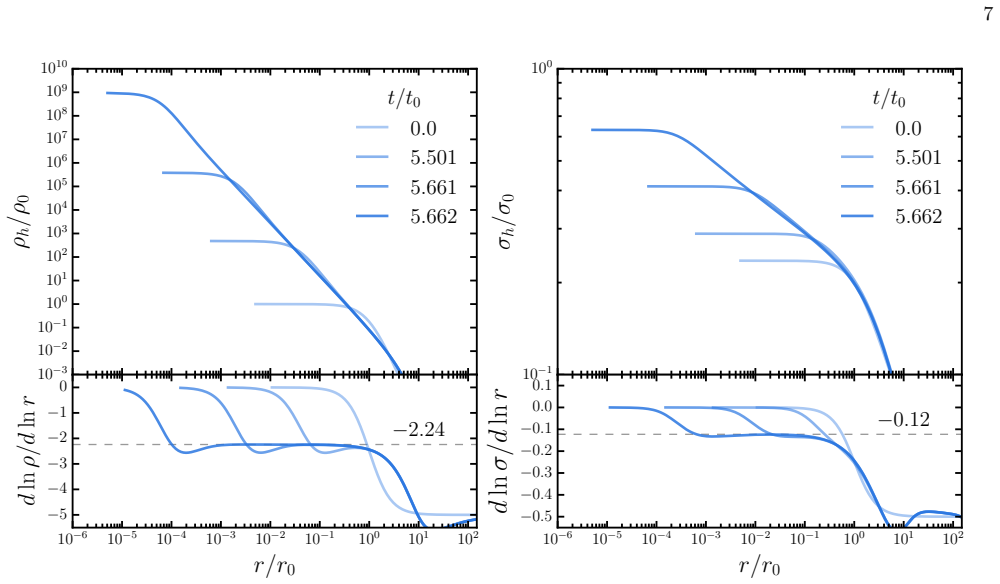
The central object is the two-fluid conduction-fluid model of a spherical self-gravitating cluster. Each component (heavier and lighter) is a monatomic fluid with its own set of finely spaced Lagrangian mass zones, and relaxation enters through two collision terms: a conduction luminosity proportional to $G\rho_i m_i \ln\Lambda_i/\sigma_i$ within each fluid, and a dynamical heating/cooling rate between fluids proportional to $G^2\rho_h\rho_l\ln\Lambda_{hl}$. The clock of the whole evolution is the fiducial time $t_0^h$ built from the heavier fluid's initial scale density, scale radius, particle mass, and Coulomb logarithm. The numerical engine is a conduction/interaction--relaxation--realignment cycle solved with a semi-implicit update whose linearized stability analysis shows it is unconditionally stable (satisfies the Courant-Friedrichs-Lewy condition) whenever the lighter mass is much smaller than the heavier mass.
What would settle it
A decisive check would be a high-resolution two-component N-body or Fokker-Planck evolution of the same cored initial density profiles used here, run far enough into the collapse to measure when the heavier fluid's central density exceeds its initial value by a fixed factor, say $10^4$; if the measured collapse time divided by $t_0^h$ differs from the fluid prediction by more than a factor of about two for identical initial conditions, the $\beta=1$, $\gamma=0.11$ coefficients are falsified for two-fluid use.
Extended reading notes
Core claim
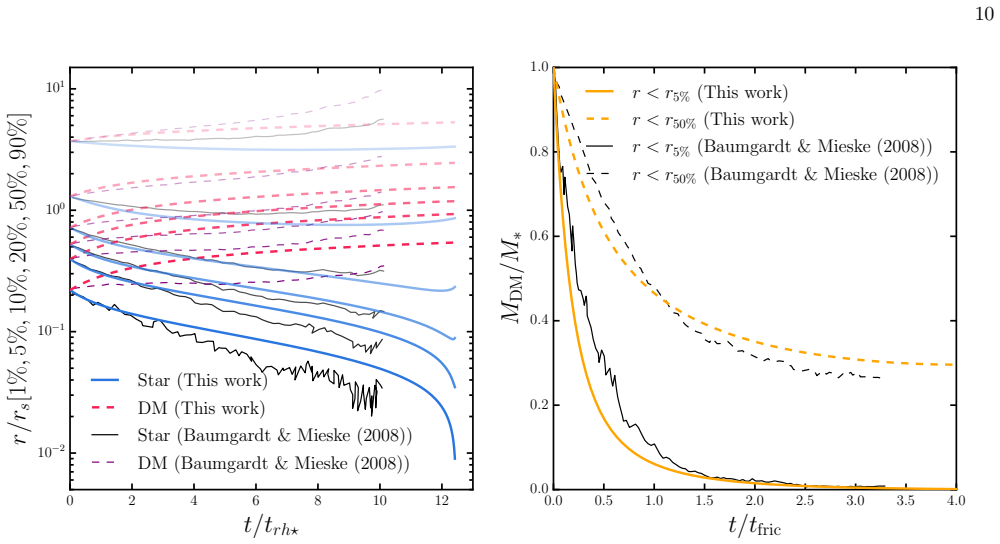
The central discovery is that in a two-component, self-gravitating system the times to gravothermal core collapse ($t_c$) and to significant mass segregation ($t_s$) are both controlled by the fiducial timescale of the heavier component, $t_0^h$, which is close to the heavier component's half-mass relaxation time. Across the explored parameter space (scale-density ratio $\xi=0.1$--$10$ and scale-radius ratio $\zeta=0.5$--$2$, in the limit $m_l \ll m_h$), the heavier component always collapses into a dense cuspy core whose inner density log-slope approaches $-2.2$, while the lighter component expands; significant segregation occurs at $t_s \sim 0.1\,t_c$ or $t_s \sim t_0^h$. Comparing $t_0^h$ with the observed properties of 62 globular clusters and 87 dwarf galaxies in the Local Volume, the authors find that most globular clusters fall in the band $t_0^h \sim 10$--$13$ Gyr, including all clusters observed to be core-collapsed, whereas almost all dwarf galaxies have $t_0^h$ much larger than the system age. In a two-dark-species scenario in which a heavier $20\,M_\odot$ component dominates dwarf halos, collapse times scale almost linearly with dynamical mass, so only the smallest, most compact dwarfs should form ultradense dark cores.
Load-bearing premise
The load-bearing premise is that the two-fluid conduction coefficients are the same as the one-fluid values ($\beta_l=\beta_h=1$ with Coulomb-logarithm constant $\gamma=0.11$) even though they were never recalibrated for two-component heat exchange; collapse and segregation times scale with these coefficients, so an order-one error would change which observed systems are classified as dynamically evolved.
Editorial extensions
If this is right
- Most observed globular clusters should currently be in or near the gravothermal-collapse phase; the observed core-collapsed clusters should appear in the region where $t_0^h$ matches the 10--13 Gyr age band.
- Typical dwarf galaxies should show little mass segregation or core collapse, so dense stellar cores should be rare and confined to the lowest-mass, most compact dwarfs.
- Dynamical heating can lower a globular cluster's central dark-matter density by orders of magnitude but cannot remove dark matter at large radii, so a present-day lack of central dark matter does not by itself prove the cluster formed without it.
- If a dwarf's dark matter is dominated by particles heavier than stars (for example a $20\,M_\odot$ population), collapse should produce an ultradense, cuspy dark core that could be detectable through strong lensing.
- The same two-fluid framework extends to multi-species systems, self-interacting dark matter, stellar binaries, central black holes, and tidal fields, so the method can test how each ingredient shifts the collapse/expansion balance.
Reading between the lines
- One implication the authors leave implicit is that the observational comparison treats the observed half-mass radius as a proxy for the initial radius; if typical clusters expanded between formation and observation, their inferred position on the $t_0^h$ clock would shift, and a sample of young massive clusters with known initial radii could test this.
- Because $\beta_l=\beta_h=1$ is adopted without a dedicated two-component calibration, the absolute values of $t_c$ and $t_s$ could change by an order-one factor; calibrating these coefficients against particle-based simulations on identical initial conditions would sharpen the boundary between evolved and unevolved observed systems.
- A testable extension is to search ultra-faint dwarf galaxies for dense central cores: cores made of stars would support a stellar-heavy hierarchy, while massive dark cores would support a heavy-dark-matter hierarchy such as $\sim20\,M_\odot$ primordial black holes.
- Treating the stellar population as a single fluid with an average stellar mass likely smooths the onset of mass segregation; a multi-mass stellar fluid could alter $t_s$ by tens of percent and is a natural next step for the method.
Editorial analysis
A structured set of objections, weighed in public.
Referee Report
Summary. Zhong and Shapiro present a two-fluid conduction scheme for the secular gravothermal evolution of spherically symmetric, two-component self-gravitating systems such as stars and collisionless dark matter. The paper derives the coupled fluid equations (mass conservation, hydrostatic balance, energy/heat conduction, and dynamical heating/cooling), describes a semi-implicit Lagrangian algorithm with a new realignment step, validates it in the one-fluid limit and through an artificial one-fluid-splitting-in-two test, and benchmarks against N-body and Fokker-Planck simulations. It then evaluates the fiducial timescale t0 of the heavier component for 62 globular clusters and 87 dwarf galaxies and concludes that most GCs have undergone significant dynamical evolution (core collapse or mass segregation) while most dwarfs have not, unless they are low-mass and compact. The central quantitative claim is that the core-collapse time tc and mass-segregation time ts are largely determined by t0.
Significance. If the method and the timescale ordering are correct, this provides a computationally inexpensive tool for following stellar-dark-matter systems on gravothermal timescales, complementing N-body and Fokker-Planck methods. The paper's strengths are explicit: it passes a one-fluid limit test and a splitting-in-two self-consistency test, reproduces the broad behavior of independent N-body and Fokker-Planck simulations, and contains an analytic stability argument for the semi-implicit conduction step in the m_h >> m_l limit. The final astrophysical predictions are not obtained by fitting the model to the observed GC or dwarf data. However, two load-bearing issues currently weaken the observational conclusion: the comparison in Section V is not quantitatively consistent with the paper's own dimensionless collapse and segregation times, and the two-fluid conduction coefficients are inherited from one-fluid calibrations without recalibration.
major comments (3)
- [Section V; Fig. 7; Table IV] Section V states that t0^h can be adopted as 'an approximate indicator of both the mass-segregation and core-collapse times', and Fig. 7 draws the age band at t0 = 10-13 Gyr, with the text saying that most GCs are 'around the collapsed phase t_h0 ~ t_age'. This is not consistent with Table IV, which reports tc/t0 = 2.56-10.4 and ts/t0 = 1.27-2.59 for the benchmarks used to justify that statement. If t0 is comparable to the age, those numbers imply tc ~ 26-104 Gyr and ts ~ 13-26 Gyr for a 10 Gyr-old system, i.e., no collapsed or strongly segregated system. The comparison should instead test t0 against age/(tc/t0) for collapse and age/(ts/t0) for segregation. This misplacement changes which GCs are classified as evolved and directly affects the central observational claim; it should be corrected, and the figure and text updated accordingly.
- [Section II.C, Eqs. (3) and (21); Appendix C] The two-fluid conduction coefficients are set to beta_l = beta_h = 1, and the Coulomb-logarithm constant gamma = 0.11 is taken from one-fluid calibrations without a two-fluid recalibration. The paper explicitly leaves this calibration for future work at Eq. (21), and Appendix C attributes the discrepancy with the Fokker-Planck results at t = 12 Gyr to 'uncertainties in the conduction coefficients'. Because tc/t0 and ts/t0 depend on the conductivity, an order-unity error in beta changes the physical collapse and segregation times and shifts the threshold used in Fig. 7 by the same order-unity factor. This is load-bearing for the main conclusion, since the statement about which observed systems have evolved depends on comparing tc and ts with the age. A calibration against two-component N-body or Fokker-Planck tests, or an explicit range of thresholds for plausible beta values, is needed.
- [Section V, Eq. (56)] The observational timescale is evaluated with an assumed stellar mass m_star = 1 M_sun for all GCs and dwarfs, whereas the N-body comparisons in Section IV.A use a mean stellar mass of 0.335 M_sun, and realistic GC mass functions have mean stellar masses of order 0.3-0.5 M_sun. Since t0 in Eq. (56) is inversely proportional to m_star, this choice shifts the computed t0 values by a factor of 2-3. The qualitative conclusion that 'most GCs' have evolved may survive if a smaller m_star is adopted, but the quantitative support and the location of the age band in Fig. 7 depend on this assumption; the robustness of the classification should be demonstrated over a plausible range of mean stellar masses.
minor comments (4)
- [Appendix A] The stability proof is announced for the limit 'ml ≫ mh' in the first paragraph, but the subsequent derivation and the abstract/main text require ml ≪ mh; this appears to be a typographical reversal of the inequality.
- [Fig. 3 left panel] The legend lists '1%, 5%, 10%, 20%, 50%, 90%' while the caption and text describe only 1%, 5%, 20%, 50%, and 90% mass radii; the 10% entry should be either defined or removed.
- [Table IV and Section IV.B] The dash entries for ts/t0 are defined in the caption, but the text in Section IV.B says 'ts ≈ O(10%)tc or ts ≈ t0' without quoting Table IV; a cross-reference would help readers connect the qualitative statement to the tabulated values.
- [Section V, Fig. 7 right panel] The right panel introduces a two-DM scenario with m_psi = 20 M_sun and the concentration-mass relation, but the text does not explicitly state that the GC classification in the right panel is unchanged from the left panel; a sentence clarifying that only dwarfs are re-evaluated in the right panel would be helpful.
Circularity Check
No significant circularity: the two-fluid conduction results are validated against independent N-body and Fokker-Planck simulations, and the observational comparison uses t0 as a relaxation-time proxy rather than fitting the model to the target data.
full rationale
The paper's central claim that gravothermal collapse and mass-segregation timescales are governed by the fiducial relaxation timescale t0^h is a simulation result, not an identity. The dimensionless ratios tc/t0 and ts/t0 are computed from the two-fluid equations (Table IV) and vary by factors of roughly 2-4 and 2 across the (xi,zeta) grid, so tc ~ O(1) t0 is a nontrivial outcome of the integration rather than a definitional restatement. The conduction coefficients beta_l = beta_h = 1 are openly adopted as an uncalibrated choice (Eq. 21), and gamma = 0.11 is taken from a prior one-fluid N-body calibration; these are stated caveats that affect absolute timescales, but they are not fitted to the GC/dwarf data used in the final comparison. The method is checked against external N-body simulations (Baumgardt & Mieske 2008) and Fokker-Planck integrations (Zhu et al. 2018), with the only noted discrepancy attributed to conduction-coefficient uncertainty (Appendix C). The observational step evaluates t0 from catalog data using Eq. (57) and compares it to system ages; it does not optimize any parameter against the observed core-collapse status. The self-citations (Shapiro 2018 for the one-fluid limit, Essig et al. 2019 for the operator-splitting strategy) serve as methodological points of comparison and are not load-bearing for the main conclusion. A possible quantitative concern is that the text's 't0 ~ t_age' collapse criterion does not explicitly incorporate tc/t0 = 2.56-10.4 and ts/t0 = 1.27-2.59 from Table IV, but that is an internal-consistency or correctness issue, not circularity: the conclusion is not obtained by construction from the input data.
Assumptions & free parameters
free parameters (3)
- beta_l = beta_h =
1
- gamma in Coulomb logarithms =
0.11
- m_star =
1 solar mass
assumptions (8)
- domain assumption Conduction-fluid approximation is valid for weakly collisional self-gravitating systems once they are in dynamical equilibrium
- domain assumption Both fluids are locally Maxwellian, monatomic gases with adiabatic index Gamma = 5/3
- domain assumption Systems are spherical, nonrotating, isolated, and in hydrostatic equilibrium between steps
- domain assumption Mass hierarchy m_h much greater than m_l holds, so the lighter fluid has negligible conductivity and only receives dynamical heating
- domain assumption Initial density profiles are Plummer profiles for both components
- domain assumption Coulomb logarithms use b_max = r50, virial-averaged velocity dispersions, and fixed gamma = 0.11
- ad hoc to paper Operator splitting: densities are fixed during conduction/interaction and updated during relaxation; realignment interpolates using regularity conditions
- domain assumption The observed present-day stellar half-mass radius equals the initial half-mass radius when estimating t0^h
Cite this review
Pith. "Pith review of Dynamical Evolutions in Globular Clusters and Dwarf Galaxies: Conduction Fluid Simulations." pith.science (2026). https://pith.science/paper/EFYURLCC
@misc{pith2026250518251,
  author       = {Pith},
  title        = {Pith review of: Dynamical Evolutions in Globular Clusters and Dwarf Galaxies: Conduction Fluid Simulations},
  year         = {2026},
  howpublished = {\url{https://pith.science/paper/EFYURLCC}},
  note         = {Machine review of arXiv:2505.18251}
}
read the original abstract
We present a new two-fluid conduction scheme to simulate the evolution of an isolated, self-gravitating, equilibrium cluster of stars and collisionless dark matter on secular (gravothermal) timescales. We integrate the equations in Lagrangian coordinates via a second-order, semi-implicit algorithm, which is unconditionally stable when the mass of the lighter species is much less than that of the heavier species. The method can be straightforwardly generalized to handle a multi-species system with a population of stars or components beyond collisionless dark matter and stars. We apply the method to simulate the dynamical evolution of stellar-dark matter systems, exploring the consequences of mass segregation and gravothermal core collapse, and assessing those effects for observed globular clusters and dwarf galaxies in the Local Volume.
Figures

Figures from the paper (5 more)


Reference graph
Works this paper leans on
-
[1]
Mass Conservation: ∂Mh ∂r = 4πr2ρh, (13) ∂Ml ∂r = 4πr2ρl; (14)
-
[2]
Pressure Balance: ∂ ∂r ρhσ2 h = − G(Ml + Mh)ρh r2 , (15) ∂ ∂r ρlσ2 l = − G(Ml + Mh)ρl r2 ; (16)
-
[3]
Note that the first and second terms on the right- hand sides of Eqs
Energy Conservation: For the heavier compo- nent, ρhσ2 h D Dt ln σ3 h ρh = − 1 4πr2 ∂Lh ∂r − R (17) For the lighter component, ρlσ2 l D Dt ln σ3 l ρl = − 1 4πr2 ∂Ll ∂r + R (18) where D/Dt is the Lagrangian time derivative [14]. Note that the first and second terms on the right- hand sides of Eqs. (17) and (18) are the gravother- mal conduction and dynamic...
-
[4]
Conduction Equations: Lh 4πr2 = − βh αbGρhmh ln Λh√ 3σh ∂σ 2 h ∂r , (19) Ll 4πr2 = − βl αbGρlml ln Λl√ 3σl ∂σ 2 l ∂r , (20) We leave a detailed calibration for future work and set βl = βh = 1 (21) hereafter. As we will see in Section IV A, such a param- eter choice already yields reasonable agreement for the evolved properties of the system between N-body...
work page 2008
- [5]
-
[6]
I. Misgeld and M. Hilker, Monthly Notices of the Royal Astronomical Society 414, 3699 (2011)
work page 2011
-
[7]
A. B. Pace, (2024), 2411.07424
arXiv 2024
-
[8]
D. A. Forbes et al., Proceedings of the Royal Society of London Series A 474, 20170616 (2018), 1801.05818
work page Pith review arXiv 2018
Show all 65 references
-
[9]
Bekki, W
K. Bekki, W. J. Couch, M. J. Drinkwater, and Y. Shioya, 17 IAU Symp. 217, 77 (2004), astro-ph/0310350
2004 arXiv
-
[10]
Pfeffer and H
J. Pfeffer and H. Baumgardt, Mon. Not. Roy. Astron. Soc. 433, 1997 (2013), 1305.3656
2013 arXiv
- [11]
- [12]
- [13]
-
[14]
van Donkelaar et al., MNRAS 522, 1726 (2023), 2210.04915
F. van Donkelaar et al., MNRAS 522, 1726 (2023), 2210.04915
2023 arXiv
-
[15]
van Donkelaar et al., MNRAS 529, 4104 (2024), 2303.12828
F. van Donkelaar et al., MNRAS 529, 4104 (2024), 2303.12828
2024 arXiv
-
[16]
Baumgardt and S
H. Baumgardt and S. Mieske, Monthly No- tices of the Royal Astronomical Society 391, 942 (2008), https://academic.oup.com/mnras/article- pdf/391/2/942/5777487/mnras0391-0942.pdf
2008
-
[17]
Ardi and H
E. Ardi and H. Baumgardt, J. Phys. Conf. Ser. 1503, 012023 (2020)
2020
-
[18]
D. C. Heggie and S. J. Aarseth, MNRAS 257, 513 (1992)
1992
-
[19]
Giersz and D
M. Giersz and D. C. Heggie, Mon. Not. Roy. Astron. Soc. 270, 298 (1994), astro-ph/9403024
1994 arXiv
-
[20]
Baumgardt and J
H. Baumgardt and J. Makino, Mon. Not. Roy. Astron. Soc. 340, 227 (2003), astro-ph/0211471
2003 arXiv
-
[21]
Heggie and P
D. Heggie and P. Hut, The Gravitational Million–Body Problem: A Multidisciplinary Approach to Star Cluster Dynamics (Cambridge University Press, 2003)
2003
-
[22]
P. G. Breen and D. C. Heggie, Mon. Not. Roy. Astron. Soc. 420, 309 (2012), 1110.5198
2012 arXiv
- [23]
-
[24]
Baumgardt, J
H. Baumgardt, J. Faller, N. Meinhold, C. McGovern- Greco, and M. Hilker, MNRAS 510, 3531 (2022), 2112.04689
2022 arXiv
-
[25]
A. P. Lightman and S. L. Shapiro, Rev. Mod. Phys. 50, 437 (1978)
1978
-
[26]
Spitzer, Dynamical evolution of globular clusters (Princeton University Press, 1987)
L. Spitzer, Dynamical evolution of globular clusters (Princeton University Press, 1987)
1987
-
[27]
Lynden-Bell and P
D. Lynden-Bell and P. Eggleton, Monthly Notices of the Royal Astronomical Society 191, 483 (1980)
1980
-
[28]
Spurzem and K
R. Spurzem and K. Takahashi, MNRAS 272, 772 (1995)
1995
-
[29]
Balberg, S
S. Balberg, S. L. Shapiro, and S. Inagaki, Astrophys. J. 568, 475 (2002), astro-ph/0110561
2002 arXiv
-
[30]
S. L. Shapiro, Phys. Rev. D 98, 023021 (2018), 1809.02618
2018 arXiv
-
[31]
P. W. Graham and H. Ramani, (2023), 2311.07654
2023 arXiv
-
[32]
P. W. Graham and H. Ramani, (2024), 2404.01378
2024 arXiv
-
[33]
Balberg and S
S. Balberg and S. L. Shapiro, Phys. Rev. Lett. 88, 101301 (2002), astro-ph/0111176
2002 arXiv
- [34]
-
[35]
D. E. Kaplan, G. Z. Krnjaic, K. R. Rehermann, and C. M. Wells, JCAP 05, 021 (2010), 0909.0753
2010 arXiv
-
[36]
D. E. Kaplan, G. Z. Krnjaic, K. R. Rehermann, and C. M. Wells, JCAP 10, 011 (2011), 1105.2073
2011 arXiv
-
[37]
J. M. Cline, SciPost Phys. Lect. Notes 52, 1 (2022), 2108.10314
2022 arXiv
-
[38]
K. K. Boddy, M. Kaplinghat, A. Kwa, and A. H. G. Peter, Phys. Rev. D 94, 123017 (2016), 1609.03592
2016 arXiv
-
[39]
Essig, S
R. Essig, S. D. Mcdermott, H.-B. Yu, and Y.-M. Zhong, Phys. Rev. Lett. 123, 121102 (2019), 1809.01144
2019 arXiv
- [40]
- [41]
-
[42]
W. E. Harris, AJ 112, 1487 (1996)
1996
-
[43]
W. E. Harris, (2010), 1012.3224
2010 arXiv
-
[44]
Giersz and D
M. Giersz and D. C. Heggie, Monthly Notices of the Royal Astronomical Society 268, 257 (1994)
1994
-
[45]
Spurzem, Fluid techniques and evolution of anisotropy, in Symposium-International Astronomical Union Vol
R. Spurzem, Fluid techniques and evolution of anisotropy, in Symposium-International Astronomical Union Vol. 174, pp. 111–120, Cambridge University Press, 1996
1996
-
[46]
Koda and P
J. Koda and P. R. Shapiro, Mon. Not. Roy. Astron. Soc. 415, 1125 (2011), 1101.3097
2011 arXiv
-
[47]
Dvorkin, K
C. Dvorkin, K. Blum, and M. Kamionkowski, Phys. Rev. D 89, 023519 (2014), 1311.2937
2014 arXiv
-
[48]
H. C. Plummer, Mon. Not. Roy. Astron. Soc. 71, 460 (1911)
1911
-
[49]
Giersz and D
M. Giersz and D. C. Heggie, Mon. Not. Roy. Astron. Soc. 279, 1037 (1996), astro-ph/9506143
1996 arXiv
-
[50]
Freitag, F
M. Freitag, F. A. Rasio, and H. Baumgardt, Mon. Not. Roy. Astron. Soc. 368, 121 (2006), astro-ph/0503129
2006 arXiv
-
[51]
Pollack, D
J. Pollack, D. N. Spergel, and P. J. Steinhardt, Astro- phys. J. 804, 131 (2015), 1501.00017
2015 arXiv
-
[52]
Cohn and P
H. Cohn and P. Hut, ApJ 277, L45 (1984)
1984
-
[53]
D. C. Heggie, Dynamical evolution of globular clusters after core collapse., in Dynamics of Star Clusters, edited by J. Goodman and P. Hut Vol. 113, pp. 139–157, 1985
1985
-
[54]
S. L. Shapiro, ApJ 217, 281 (1977)
1977
- [55]
- [56]
-
[57]
A. D. Ludlow et al., Mon. Not. Roy. Astron. Soc. 460, 1214 (2016), 1601.02624
2016 arXiv
-
[58]
D. E. McLaughlin and R. P. van der Marel, ApJS 161, 304 (2005), astro-ph/0605132
2005 arXiv
-
[59]
Y.-F. Cai, X. Tong, D.-G. Wang, and S.-F. Yan, Phys. Rev. Lett. 121, 081306 (2018), 1805.03639
2018 arXiv
- [60]
-
[61]
Planck, P. A. R. Ade et al., Astron. Astrophys. 594, A13 (2016), 1502.01589
2016 arXiv
-
[62]
Q. Zhu, E. Vasiliev, Y. Li, and Y. Jing, Mon. Not. Roy. Astron. Soc. 476, 2 (2018), 1710.05032
2018 arXiv
-
[63]
Dehnen, Mon
W. Dehnen, Mon. Not. Roy. Astron. Soc. 265, 250 (1993). Appendix A: Algorithm for the conduction/interaction step Our conduction fluid simulation involves solving par- tial differential equations, such as the equation of conduc- tion/interaction, which includes a first-order d...
1993
-
[64]
Substituting Eq
A semi-implicit algorithm to solve the conduction/interaction equation Let us first focus on the conduction/interaction of the heavier fluid. Substituting Eq. (43) into Eq. (42) yields Dˆuh Dˆt = c′ 2 ˆρhˆr2 ∂ ∂ ˆr ˆρhˆr2 ∂√ˆuh ∂ ˆr − c1 ˆρl ˆuh − ml mh ˆul (ˆuh + ˆul)3/2 = c′...
-
[65]
(A7), which involves spa- tial derivative requires checking the CFL condition
Checking the CFL condition In the limit ml ≪ mh, only the heavier fluid contains the conductivity term, see Eq. (A7), which involves spa- tial derivative requires checking the CFL condition. We start by imposing the standard modal ansatz ˆun h,j = (ξh)neikj∆ ln ˆr, (A9) and su...
2017
Reviewed August 7, 2026 · model on record in the stance chip above.
Discussion (0). Sign in to comment.