REVIEW 2 major objections 4 minor 59 references
High-precision Penning trap mass measurements of neutron-rich chlorine isotopes at the N=28 shell closure
T0 review · 2 major / 4 minor · reviewed 2026-08-07 · deepseek-v4-flash
Pith's one-line read New Penning trap masses for $^{43-45}$Cl cut uncertainties by up to a factor of 40 and show the $N=28$ neutron shell gap in chlorine is only about 60 percent of its value in potassium.
desk verdict Solid Penning trap masses for 43-45Cl with big uncertainty gains, but the unflagged isomer question needs a direct answer before the numbers are final. read the letter →
The pith
A machine-rendered reading of the paper's core claim, the machinery that carries it, and where it could break.
The reading
What carries the argument
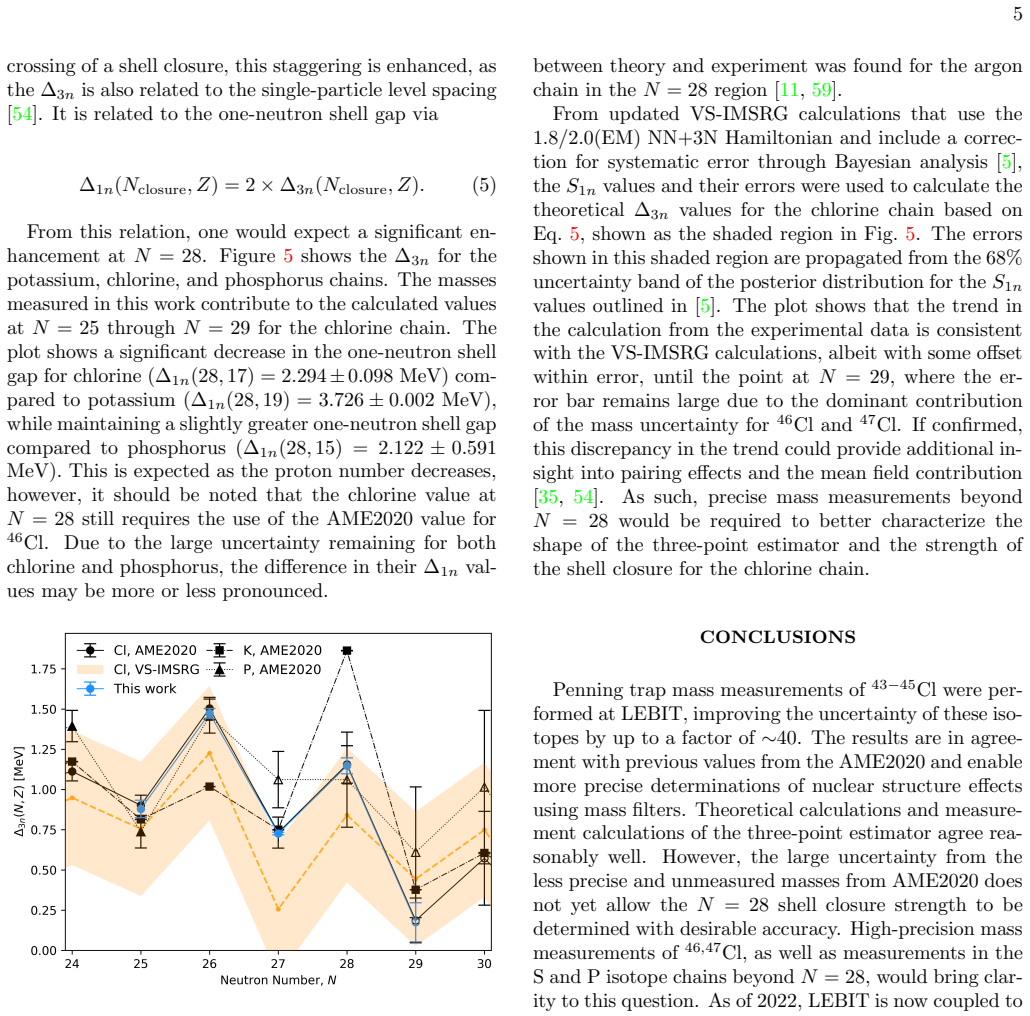
The measurements use time-of-flight ion cyclotron resonance (TOF-ICR) in a 9.4 T Penning trap: ions excited by a quadrupolar radio-frequency pulse reach the detector with minimal time-of-flight when the applied frequency equals the true cyclotron frequency, $\nu_c = qB/(2\pi m)$. Masses are obtained from cyclotron-frequency ratios to well-known reference ions, giving atomic masses relative to the references. The shell-closure strength is then extracted from the three-point pairing-gap estimator $\Delta_{3n}(N,Z) = \frac{(-1)^N}{2}[\mathrm{ME}(N+1,Z) - 2\mathrm{ME}(N,Z) + \mathrm{ME}(N-1,Z)]$, which is related to the one-neutron shell gap by $\Delta_{1n} = 2\Delta_{3n}$ at the closure; the sharp drop of $\Delta_{1n}$ in chlorine relative to potassium is the structural signal.
What would settle it
A measurement of the mass of $^{44}$Cl with resolving power high enough to separate a possible long-lived isomeric state from the ground state, or an independent mass measurement by a different technique (for example, storage-ring or multi-reflection time-of-flight) that reproduces the reported value, would settle the ground-state assignment; observing a second resolved resonance component would falsify it.
Extended reading notes
Core claim
The central claim is that precise masses of the neutron-rich chlorine isotopes pin down the weakening of the $N=28$ shell closure below calcium. Specifically, the mass excesses are ME($^{43}$Cl) = $-24114.4(1.7)$ keV, ME($^{44}$Cl) = $-20450.8(10.6)$ keV, and ME($^{45}$Cl) = $-18240.1(3.7)$ keV, with uncertainties 8 to 37 times smaller than the 2020 Atomic Mass Evaluation. From these, the paper derives a one-neutron shell gap for chlorine of $\Delta_{1n}(28,17) = 2.294 \pm 0.098$ MeV, compared with $3.726$ MeV in potassium and $2.122$ MeV in phosphorus, quantifying the erosion trend with proton number. The new values agree with previous measurements within uncertainties but are precise enough to make the shell-gap reduction statistically clear.
Load-bearing premise
The extracted masses are assumed to come from the ground states of $^{43-45}$Cl; if any long-lived nuclear isomer survived to the trap, the measured cyclotron frequency would shift and the reported mass excesses would not be ground-state values.
Editorial extensions
If this is right
- The chlorine chain now joins argon and sulfur as isotopic chains with high-precision masses across $N=28$, enabling a systematic comparison of shell-gap strength as a function of proton number.
- The reduced chlorine shell gap strengthens the evidence that $N=28$ erosion is not confined to silicon and sulfur but is already visible at $Z=17$.
- The agreement between the measured mass trend and VS-IMSRG calculations supports the use of modern ab initio methods for binding energies near the closure.
- The precise masses tighten the three-point estimator at $N=25$ through $N=29$, providing a sharper test of pairing and mean-field contributions to odd-even mass staggering.
Reading between the lines
- If the reported masses hold, the closeness of the chlorine and phosphorus shell gaps (2.294 vs 2.122 MeV) suggests the erosion of $N=28$ is already nearly fully developed at $Z=17$, which would make measurements of $^{46,47}$Cl and of sulfur beyond $N=28$ a direct test of how the gap evolves between $Z=17$ and $Z=14$.
- The paper's shell-gap value still leans on the AME2020 mass of $^{46}$Cl, a large extrapolation; a future measurement of $^{46}$Cl could either sharpen or revise the reported 2.294 MeV gap.
- The absence of any discussion of isomeric contamination leaves open the possibility that a long-lived isomer in $^{44}$Cl could bias its mass; a dedicated search for such an isomer would clarify whether the average reported here is truly the ground-state value.
Signed reviews
Editorial analysis
A structured set of objections, weighed in public.
Referee Report
Summary. This manuscript reports high-precision Penning trap mass measurements of the neutron-rich chlorine isotopes 43Cl, 44Cl, and 45Cl, performed with the TOF-ICR technique at the LEBIT facility coupled to the NSCL. The measured mass excesses are ME(43Cl) = -24114.4(1.7) keV, ME(44Cl) = -20450.8(10.6) keV, and ME(45Cl) = -18240.1(3.7) keV, which improve on AME2020 uncertainties by factors of about 34, 8, and 37, respectively. Using these masses together with the AME2020 value for 46Cl, the authors construct the three-point mass filter and infer a one-neutron shell gap at N=28 for chlorine of 2.294(98) MeV, strongly reduced compared with potassium (3.726 MeV) and slightly larger than phosphorus (2.122 MeV). The results are compared with VS-IMSRG calculations, showing reasonable agreement up to and at N=28.
Significance. If the reported masses are correct, they provide a substantial improvement in the mass surface for the neutron-rich chlorine chain near the eroding N=28 shell closure, with uncertainty reductions of one to almost two orders of magnitude. The derived shell-gap estimator is a direct, parameter-free mass filter and thereby offers a sharp constraint on the evolution of the N=28 gap between Z=18 and Z=16, complementing the existing high-precision argon and sulfur data. The experimental techniques are mature, the reference-ion procedure is standard, and the authors are transparent that the chlorine value at N=28 still relies on the AME2020 mass of 46Cl, which limits the precision of the shell-gap extraction. The comparison to VS-IMSRG is made without any tuning of parameters, which is a strength. The central physics claim is plausible and the data are potentially valuable for nuclear structure and ab initio theory benchmarks.
major comments (2)
- [Experiment/Results, Table I] The manuscript never addresses the possibility of long-lived nuclear isomers in the 43-45Cl beams. The A/Q selection by the dipole magnet (resolving power ~1500) and the dipolar RF cleaning described in the Results section reject isobaric contamination with different A/Q, but they cannot separate an excited state of the same A and Z if that state survives the gas-cell extraction and transport times. For the odd-odd nucleus 44Cl (half-life 562 ms), the presence of a low-lying isomeric state is a realistic concern, and an unresolved isomeric admixture would shift the fitted cyclotron frequency, thus biasing the reported mass excess and the derived shell gap in Eqs. (4)-(5). The agreement between the two reference-ion measurements for 44Cl does not exclude this possibility, because both samples would contain the same mixture if an isomer were present. I request that the authors either demonstrate that the TOF-ICR spectra are single-component (e.g., via a two-component fit or an explicit lineshape check) or otherwise justify the ground-state purity assumption for these isotopes.
- [Results, Table I caption] The caption of Table I states that the listed uncertainties are statistical, yet the preceding paragraph in the Results section says that 'several sources of systematic effects contribute to the uncertainty δR in ¯R.' This is an inconsistency in the uncertainty budget. If the quoted uncertainties already include the systematic contributions (which appear to be small), the caption should be corrected to say so; if they do not, the reported mass-excess uncertainties are incomplete and the precision claim is overstated. The total uncertainty should be defined clearly and used consistently in the abstract, Table I, and Figure 4.
minor comments (4)
- [Introduction, first paragraph] There is a typo 'appearing at at 2, 8, 20...' where 'at' is repeated; the sentence should read 'appearing at 2, 8, 20, 28...'.
- [Results, Table I] The molecular reference formula for A=44 is written as '[12C14N1H16 2O]+' in Table I but as '[12C14N1H216O]+' in the text; the notation should be made consistent (and the correct formula, presumably C H2 NO+, should be verified).
- [Discussion, Figure 5] The caption of Figure 5 says that potassium and phosphorus values are represented by squares and triangles, respectively, but the text and figure do not identify which symbol corresponds to which element in a way that is easy to parse in a black-and-white print; please use clear markers or add a legend.
- [Results, systematic effects paragraph] The description of systematic effects would benefit from stating explicitly how the mass-dependent shift estimate of δR ≈ 2 × 10⁻¹⁰/u was included in the final uncertainty, if it was included. The current text mentions the effect and then gives the table caption as 'statistical,' which is the source of the inconsistency raised in the major comments.
Circularity Check
No significant circularity: the mass excesses are measured against known reference ions and the shell-gap estimator is a standard mass difference, not a fit to theory.
full rationale
The central results—ME(43Cl), ME(44Cl), ME(45Cl)—are obtained from measured cyclotron frequency ratios relative to 39K+, [12C14N1H16 2 O]+, and [28Si16O1H]+ reference ions using the standard TOF-ICR relations R = νc/νc,ref and M = ([M_ref − m_e]/Rbar) + m_e. The reference masses are independent, well-known inputs; the paper does not tune any parameter to force agreement with AME2020 or VS-IMSRG. The derived N=28 one-neutron shell gap uses the standard three-point mass filter Δ3n(N,Z) and the textbook relation Δ1n = 2×Δ3n (Eqs. 4–5); this is a direct mass difference (for chlorine, ME(46Cl) − 2ME(45Cl) + ME(44Cl)), not a fit, and the paper explicitly notes that 46Cl is taken from AME2020 and that this limits the accuracy. The comparison to VS-IMSRG uses external calculations by Stroberg et al. with the 1.8/2.0(EM) NN+3N Hamiltonian; it is an independent benchmark, not a fitted input. The limitations the paper itself states—"the chlorine value at N = 28 still requires the use of the AME2020 value for 46Cl" and "the large uncertainty ... does not yet allow the N = 28 shell closure strength to be determined with desirable accuracy"—weaken the conclusion but are not circular reasoning. The possible isomeric contamination of odd-odd 44Cl is a systematics/correctness concern, not a demonstration that any prediction reduces to its input by construction. No load-bearing self-citation chain is present; the cited prior LEBIT work provides standard systematic-effect corrections rather than defining the measured masses. The derivation is therefore self-contained and scores 0.
Assumptions & free parameters
assumptions (5)
- domain assumption Cyclotron frequency relation nu_c = qB/(2*pi*m) in an ideal Penning trap.
- domain assumption The analytical TOF-ICR line shape from Koenig et al. [39] gives an unbiased estimate of nu_c.
- domain assumption Reference ion masses for 39K, 12C14N1H2 16O, and 28Si16O1H are known well enough to ignore their uncertainty.
- domain assumption The AME2020 mass excess for 46Cl is accurate enough to compute the N=28 three-point mass filter.
- domain assumption The relation Delta_1n(N,Z) = 2*Delta_3n(N,Z) in Eq. (5) correctly represents the one-neutron shell gap.
Cite this review
Pith. "Pith review of High-precision Penning trap mass measurements of neutron-rich chlorine isotopes at the N=28 shell closure." pith.science (2026). https://pith.science/paper/ZYGDZN75
@misc{pith2026250518354,
  author       = {Pith},
  title        = {Pith review of: High-precision Penning trap mass measurements of neutron-rich chlorine isotopes at the N=28 shell closure},
  year         = {2026},
  howpublished = {\url{https://pith.science/paper/ZYGDZN75}},
  note         = {Machine review of arXiv:2505.18354}
}
abstract
Although it is known that the $N=28$ spherical shell closure erodes, the strength of the closure with decreasing proton number $Z<20$ is an open question in nuclear structure. In this region of interest, direct high-precision mass measurements of neutron-rich $^{43-45}$Cl isotopes were performed at the Low Energy Beam and Ion Trap (LEBIT) when coupled to the National Superconducting Cyclotron Lab. The resulting mass excesses (MEs) are ME($^{43}$Cl) = -24114.4(1.7) keV, ME($^{44}$Cl) = -20450.8(10.6) keV, and ME($^{45}$Cl) = -18240.1(3.7) keV, and improve the uncertainty of these masses by up to a factor of ~40 compared to the previous values reported in the 2020 Atomic Mass Evaluation. Comparison to $\textit{ab initio}$ calculations using the Valence-Space In-Medium Similarity Renormalization Group (VS-IMSRG) shows good agreement up to and including the closure.
Figures


Figures from the paper (2 more)

Reference graph
Works this paper leans on
-
[1]
M. G. Mayer, On Closed Shells in Nuclei. II, Phys. Rev. 75, 1969 (1949)
1949
- [2]
-
[3]
O. Sorlin and M.-G. Porquet, Nuclear magic numbers: New features far from stability, Progress in Particle and Nuclear Physics 61, 602 (2008)
work page 2008
-
[4]
N. Smirnova, B. Bally, K. Heyde, F. Nowacki, and K. Sieja, Shell evolution and nuclear forces, Physics Let- ters B 686, 109 (2010)
work page 2010
-
[5]
S. R. Stroberg, J. D. Holt, A. Schwenk, and J. Simonis, Ab Initio Limits of Atomic Nuclei, Phys. Rev. Lett. 126, 022501 (2021)
work page 2021
-
[6]
H. Scheit, T. Glasmacher, B. A. Brown, J. A. Brown, P. D. Cottle, P. G. Hansen, R. Harkewicz, M. Hellstr¨ om, R. W. Ibbotson, J. K. Jewell, K. W. Kemper, D. J. Mor- rissey, M. Steiner, P. Thirolf, and M. Thoennessen, New Region of Deformation: The Neutron-Rich Sulfur Iso- topes, Phys. Rev. Lett. 77, 3967 (1996)
work page 1996
-
[7]
S. Calinescu, L. C´ aceres, S. Gr´ evy, O. Sorlin, Z. Dombr´ adi, M. Stanoiu, R. Astabatyan, C. Borcea, R. Borcea, M. Bowry, W. Catford, E. Cl´ ement, S. Fran- choo, R. Garcia, R. Gillibert, I. H. Guerin, I. Kuti, S. Lukyanov, A. Lepailleur, V. Maslov, P. Mor- fouace, J. Mrazek, F. Negoita, M. Niikura, L. Perrot, Z. Podoly´ ak, C. Petrone, Y. Penionzhkevi...
work page 2016
-
[8]
R. Winkler, A. Gade, T. Baugher, D. Bazin, B. A. Brown, T. Glasmacher, G. F. Grinyer, R. Meharc- hand, S. McDaniel, A. Ratkiewicz, and D. Weisshaar, Quadrupole Collectivity beyond N = 28: Intermediate- Energy Coulomb Excitation of 47,48Ar, Phys. Rev. Lett. 108, 182501 (2012)
work page 2012
Show all 59 references
-
[9]
R. W. Ibbotson, T. Glasmacher, P. F. Mantica, and H. Scheit, Coulomb excitation of odd-A neutron-rich π(s − d) and ν(f − p) shell nuclei, Phys. Rev. C 59, 642 (1999)
1999
-
[10]
Longfellow, D
B. Longfellow, D. Weisshaar, A. Gade, B. A. Brown, D. Bazin, K. W. Brown, B. Elman, J. Pereira, D. Rhodes, and M. Spieker, Shape Changes in the N = 28 Island of Inversion: Collective Structures Built on Configuration- Coexisting States in 43S, Phys. Rev. Lett. 125, 232501 (2020)
2020
-
[11]
Mougeot, D
M. Mougeot, D. Atanasov, C. Barbieri, K. Blaum, M. Breitenfeld, A. de Roubin, T. Duguet, S. George, F. Herfurth, A. Herlert, J. D. Holt, J. Karthein, D. Lun- ney, V. Manea, P. Navr´ atil, D. Neidherr, M. Rosen- busch, L. Schweikhard, A. Schwenk, V. Som` a, A. Welker, F. Wienho...
2020
-
[12]
L. A. Riley, I. Conroy, A. M. Himmelreich, M. Heinze, J. Kosa, B. McNulty, P. D. Cottle, M. Spieker, A. Volya, A. L. Conley, D. Houlihan, B. Kelly, K. W. Kemper, S. M. Ali, T. Beck, S. A. Gillespie, M. Hausmann, S. Noji, J. Pereira, D. Weisshaar, J. Chung-Jung, P. Far- ris, A....
2025
-
[13]
Bastin, S
B. Bastin, S. Gr´ evy, D. Sohler, O. Sorlin, Z. Dombr´ adi, N. L. Achouri, J. C. Ang´ elique, F. Azaiez, D. Bai- borodin, R. Borcea, C. Bourgeois, A. Buta, A. B¨ urger, R. Chapman, J. C. Dalouzy, Z. Dlouhy, A. Drouard, Z. Elekes, S. Franchoo, S. Iacob, B. Laurent, M. Lazar, X....
2007
-
[14]
Takeuchi, M
S. Takeuchi, M. Matsushita, N. Aoi, P. Doornenbal, K. Li, T. Motobayashi, H. Scheit, D. Steppenbeck, H. Wang, H. Baba, D. Bazin, L. C` aceres, H. Crawford, P. Fallon, R. Gernh¨ auser, J. Gibelin, S. Go, S. Gr´ evy, C. Hinke, C. R. Hoffman, R. Hughes, E. Ideguchi, D. Jenkins, N...
2012
-
[15]
S. R. Stroberg, A. Gade, J. A. Tostevin, V. M. Bader, T. Baugher, D. Bazin, J. S. Berryman, B. A. Brown, C. M. Campbell, K. W. Kemper, C. Langer, E. Lunder- berg, A. Lemasson, S. Noji, F. Recchia, C. Walz, D. Weis- shaar, and S. J. Williams, Single-particle structure of sil- i...
2014
-
[16]
A. Gade, B. A. Brown, J. A. Tostevin, D. Bazin, P. C. Bender, C. M. Campbell, H. L. Crawford, B. El- man, K. W. Kemper, B. Longfellow, E. Lunderberg, D. Rhodes, and D. Weisshaar, Is the Structure of 42Si Understood?, Phys. Rev. Lett. 122, 222501 (2019)
2019
-
[17]
Glasmacher, B
T. Glasmacher, B. Brown, M. Chromik, P. Cottle, M. Fauerbach, R. Ibbotson, K. Kemper, D. Morrissey, H. Scheit, D. Sklenicka, and M. Steiner, Collectivity in 44S, Physics Letters B 395, 163 (1997)
1997
-
[18]
A. Gade, P. Adrich, D. Bazin, B. A. Brown, J. M. Cook, C. A. Diget, T. Glasmacher, S. McDaniel, A. Ratkiewicz, K. Siwek, and D. Weisshaar, In-Beam γ-Ray Spec- troscopy of Very Neutron-Rich Nuclei: Excited States in 46S and 48Ar, Phys. Rev. Lett. 102, 182502 (2009)
2009
-
[19]
Gaudefroy, J
L. Gaudefroy, J. M. Daugas, M. Hass, S. Gr´ evy, C. Stodel, J. C. Thomas, L. Perrot, M. Girod, B. Ross´ e, 7 J. C. Ang´ elique, D. L. Balabanski, E. Fiori, C. Force, G. Georgiev, D. Kameda, V. Kumar, R. L. Lozeva, I. Matea, V. M´ eot, P. Morel, B. S. N. Singh, F. Nowacki, and ...
2009
-
[20]
Force, S
C. Force, S. Gr´ evy, L. Gaudefroy, O. Sorlin, L. C´ aceres, F. Rotaru, J. Mrazek, N. L. Achouri, J. C. Ang´ elique, F. Azaiez, B. Bastin, R. Borcea, A. Buta, J. M. Dau- gas, Z. Dlouhy, Z. Dombr´ adi, F. De Oliveira, F. Negoita, Y. Penionzhkevich, M. G. Saint-Laurent, D. Sohle...
2010
-
[21]
Santiago-Gonzalez, I
D. Santiago-Gonzalez, I. Wiedenh¨ over, V. Abramkina, M. L. Avila, T. Baugher, D. Bazin, B. A. Brown, P. D. Cottle, A. Gade, T. Glasmacher, K. W. Kemper, S. Mc- Daniel, A. Rojas, A. Ratkiewicz, R. Meharchand, E. C. Simpson, J. A. Tostevin, A. Volya, and D. Weisshaar, Triple co...
2011
-
[22]
Longfellow, D
B. Longfellow, D. Weisshaar, A. Gade, B. A. Brown, D. Bazin, K. W. Brown, B. Elman, J. Pereira, D. Rhodes, and M. Spieker, Quadrupole collectivity in the neutron- rich sulfur isotopes 38,40,42,44S, Phys. Rev. C 103, 054309 (2021)
2021
-
[23]
J. J. Parker, I. Wiedenh¨ over, P. D. Cottle, J. Baker, D. McPherson, M. A. Riley, D. Santiago-Gonzalez, A. Volya, V. M. Bader, T. Baugher, D. Bazin, A. Gade, T. Ginter, H. Iwasaki, C. Loelius, C. Morse, F. Recchia, D. Smalley, S. R. Stroberg, K. Whitmore, D. Weisshaar, A. Lem...
2017
-
[24]
Nowacki, A
F. Nowacki, A. Poves, E. Caurier, and B. Bounthong, Shape Coexistence in 78Ni as the Portal to the Fifth Is- land of Inversion, Phys. Rev. Lett. 117, 272501 (2016)
2016
-
[25]
A. Gade, B. A. Brown, D. Bazin, C. M. Campbell, J. A. Church, D. C. Dinca, J. Enders, T. Glasmacher, M. Horoi, Z. Hu, K. W. Kemper, W. F. Mueller, T. Ot- suka, L. A. Riley, B. T. Roeder, T. Suzuki, J. R. Terry, K. L. Yurkewicz, and H. Zwahlen, Evolution of the E(1/2+ 1 ) − E(3...
2006
-
[26]
L. A. Riley, D. Bazin, J. Belarge, P. C. Bender, B. A. Brown, P. D. Cottle, B. Elman, A. Gade, S. D. Gregory, E. B. Haldeman, K. W. Kemper, B. R. Klybor, M. A. Liggett, S. Lipschutz, B. Longfellow, E. Lunderberg, T. Mijatovic, J. Pereira, L. M. Skiles, R. Titus, A. Volya, D. W...
2019
-
[27]
Tripathi, B
V. Tripathi, B. Longfellow, A. Volya, E. Rubino, C. Benetti, J. F. Perello, S. L. Tabor, S. N. Liddick, P. C. Bender, M. P. Carpenter, J. J. Carroll, A. Chester, C. J. Chiara, K. Childers, B. R. Clark, B. P. Crider, J. T. Harke, R. Jain, S. Luitel, M. J. Mogannam, T. H. Ogunbe...
2025 arXiv
-
[28]
Ringle, C
R. Ringle, C. Bachelet, M. Block, G. Bollen, M. Facina, C. M. Folden, C. Gu´ enaut, A. A. Kwiatkowski, D. J. Mor- rissey, G. K. Pang, A. M. Prinke, J. Savory, P. Schury, S. Schwarz, and C. S. Sumithrarachchi, High-precision Penning trap mass measurements of neutron-rich sulfur...
2009
-
[29]
Ringle, S
R. Ringle, S. Schwarz, and G. Bollen, Penning trap mass spectrometry of rare isotopes produced via projectile fragmentation at the LEBIT facility, International Jour- nal of Mass Spectrometry 349-350, 87 (2013), 100 years of Mass Spectrometry
2013
-
[30]
Mukherjee, D
M. Mukherjee, D. Beck, K. Blaum, G. Bollen, J. Dilling, S. George, F. Herfurth, A. Herlert, A. Kellerbauer, H.- J. Kluge, S. Schwarz, L. Schweikhard, and C. Yazidjian, ISOLTRAP: An on-line Penning trap for mass spectrom- etry on short-lived nuclides, The European Physical Jour...
2008
-
[31]
R. Wolf, F. Wienholtz, D. Atanasov, D. Beck, K. Blaum, C. Borgmann, F. Herfurth, M. Kowalska, S. Kreim, Y. A. Litvinov, D. Lunney, V. Manea, D. Neidherr, M. Rosenbusch, L. Schweikhard, J. Stanja, and K. Zuber, ISOLTRAP’s multi-reflection time-of-flight mass separa- tor/spectro...
2013
-
[32]
Bhattacharyya, M
S. Bhattacharyya, M. Rejmund, A. Navin, E. Cau- rier, F. Nowacki, A. Poves, R. Chapman, D. O’Donnell, M. Gelin, A. Hodsdon, X. Liang, W. Mittig, G. Mukher- jee, F. Rejmund, M. Rousseau, P. Roussel-Chomaz, K.- M. Spohr, and C. Theisen, Structure of Neutron-Rich Ar Isotopes Beyo...
2008
-
[33]
A. Gade, D. Bazin, C. A. Bertulani, B. A. Brown, C. M. Campbell, J. A. Church, D. C. Dinca, J. Enders, T. Glas- macher, P. G. Hansen, Z. Hu, K. W. Kemper, W. F. Mueller, H. Olliver, B. C. Perry, L. A. Riley, B. T. Roeder, B. M. Sherrill, J. R. Terry, J. A. Tostevin, and K. L. ...
2005
-
[34]
Sarazin, H
F. Sarazin, H. Savajols, W. Mittig, F. Nowacki, N. A. Orr, Z. Ren, P. Roussel-Chomaz, G. Auger, D. Bai- borodin, A. V. Belozyorov, C. Borcea, E. Caurier, Z. Dlouh´ y, A. Gillibert, A. S. Lalleman, M. Lewitowicz, S. M. Lukyanov, F. de Oliveira, Y. E. Penionzhkevich, D. Ridikas,...
2000
-
[35]
Jurado, H
B. Jurado, H. Savajols, W. Mittig, N. Orr, P. Roussel- Chomaz, D. Baiborodin, W. Catford, M. Chartier, C. De- monchy, Z. Dlouh´ y, A. Gillibert, L. Giot, A. Khouaja, A. L´ epine-Szily, S. Lukyanov, J. Mrazek, Y. Penionzhke- vich, S. Pita, M. Rousseau, and A. Villari, Mass mea-...
2007
-
[36]
Meisel, S
Z. Meisel, S. George, S. Ahn, J. Browne, D. Bazin, B. A. Brown, J. F. Carpino, H. Chung, R. H. Cyburt, A. Estrad´ e, M. Famiano, A. Gade, C. Langer, M. Matoˇ s, W. Mittig, F. Montes, D. J. Morrissey, J. Pereira, H. Schatz, J. Schatz, M. Scott, D. Shapira, K. Smith, J. Stevens,...
2015
-
[37]
Bollen, R
G. Bollen, R. B. Moore, G. Savard, and H. Stolzen- berg, The accuracy of heavy-ion mass measurements using time of flight-ion cyclotron resonance in a Pen- ning trap, Journal of Applied Physics 68, 4355 (1990), https://doi.org/10.1063/1.346185
1990 doi
-
[38]
Becker, G
S. Becker, G. Bollen, F. Kern, H.-J. Kluge, R. Moore, G. Savard, L. Schweikhard, and H. Stolzenberg, Mass measurements of very high accuracy by time-of-flight ion cyclotron resonance of ions injected into a Penning trap, International Journal of Mass Spectrometry and Ion Pro- ...
1990
-
[39]
K¨ onig, G
M. K¨ onig, G. Bollen, H.-J. Kluge, T. Otto, and J. Sz- erypo, Quadrupole excitation of stored ion motion at the true cyclotron frequency, International Journal of Mass Spectrometry and Ion Processes 142, 95 (1995)
1995
-
[40]
Morrissey, B
D. Morrissey, B. Sherrill, M. Steiner, A. Stolz, and I. Wiedenhoever, Commissioning the A1900 projectile fragment separator, Nuclear Instruments and Methods in Physics Research Section B: Beam Interactions with Materials and Atoms 204, 90 (2003), 14th International Conference ...
2003
-
[41]
Sumithrarachchi, D
C. Sumithrarachchi, D. Morrissey, S. Schwarz, K. Lund, G. Bollen, R. Ringle, G. Savard, and A. Villari, Beam thermalization in a large gas catcher, Nuclear Instru- ments and Methods in Physics Research Section B: Beam Interactions with Materials and Atoms 463, 305 (2020)
2020
-
[42]
K. Lund, G. Bollen, D. Lawton, D. Morrissey, J. Ottar- son, R. Ringle, S. Schwarz, C. Sumithrarachchi, A. Vil- lari, and J. Yurkon, Online tests of the Advanced Cryo- genic Gas Stopper at NSCL, Nuclear Instruments and Methods in Physics Research Section B: Beam Interac- tions ...
2020
-
[43]
Ion surfing
G. Bollen, “Ion surfing” with radiofrequency carpets, International Journal of Mass Spectrometry 299, 131 (2011)
2011
-
[44]
Schwarz, G
S. Schwarz, G. Bollen, R. Ringle, J. Savory, and P. Schury, The LEBIT ion cooler and buncher, Nuclear Instruments and Methods in Physics Research Section A: Accelerators, Spectrometers, Detectors and Associated Equipment 816, 131 (2016)
2016
-
[45]
Ringle, G
R. Ringle, G. Bollen, A. Prinke, J. Savory, P. Schury, S. Schwarz, and T. Sun, The LEBIT 9.4T Penning trap mass spectrometer, Nuclear Instruments and Methods in Physics Research Section A: Accelerators, Spectrometers, Detectors and Associated Equipment 604, 536 (2009)
2009
-
[46]
Gabrielse, Why Is Sideband Mass Spectrometry Pos- sible with Ions in a Penning Trap?, Phys
G. Gabrielse, Why Is Sideband Mass Spectrometry Pos- sible with Ions in a Penning Trap?, Phys. Rev. Lett.102, 172501 (2009)
2009
-
[47]
Ringle, G
R. Ringle, G. Bollen, A. Prinke, J. Savory, P. Schury, S. Schwarz, and T. Sun, A “Lorentz” steerer for ion in- jection into a Penning trap, International Journal of Mass Spectrometry 263, 38 (2007)
2007
-
[48]
Kretzschmar, The Ramsey method in high-precision mass spectrometry with Penning traps: Theoretical foun- dations, International Journal of Mass Spectrometry 264, 122 (2007)
M. Kretzschmar, The Ramsey method in high-precision mass spectrometry with Penning traps: Theoretical foun- dations, International Journal of Mass Spectrometry 264, 122 (2007)
2007
-
[49]
M. Wang, W. Huang, F. Kondev, G. Audi, and S. Naimi, The AME 2020 atomic mass evaluation (II). Tables, graphs and references*, Chinese Physics C 45, 030003 (2021)
2021
-
[50]
F. G. Kondev, M. Wang, W. J. Huang, S. Naimi, and G. Audi, The NUBASE2020 evaluation of nuclear physics properties*, Chin. Phys. C 45, 030001 (2021)
2021
-
[51]
Gulyuz, J
K. Gulyuz, J. Ariche, G. Bollen, S. Bustabad, M. Eibach, C. Izzo, S. J. Novario, M. Redshaw, R. Ringle, R. San- dler, S. Schwarz, and A. A. Valverde, Determination of the direct double- β-decay Q value of 96Zr and atomic masses of 90−92,94,96Zr and 92,94−98,100Mo, Phys. Rev. C...
2015
-
[52]
Ringle, T
R. Ringle, T. Sun, G. Bollen, D. Davies, M. Facina, J. Huikari, E. Kwan, D. J. Morrissey, A. Prinke, J. Savory, P. Schury, S. Schwarz, and C. S. Sum- ithrarachchi, High-precision Penning trap mass measure- ments of 37,38Ca and their contributions to conserved vec- tor current ...
2007
-
[53]
Blaum, D
K. Blaum, D. Beck, G. Bollen, P. Delahaye, C. Gu´ enaut, F. Herfurth, A. Kellerbauer, H.-J. Kluge, D. Lunney, S. Schwarz, L. Schweikhard, and C. Yazidjian, Popula- tion inversion of nuclear states by a Penning trap mass spectrometer, Europhysics Letters 67, 586 (2004)
2004
-
[54]
Satu la, J
W. Satu la, J. Dobaczewski, and W. Nazarewicz, Odd- Even Staggering of Nuclear Masses: Pairing or Shape Effect?, Phys. Rev. Lett. 81, 3599 (1998)
1998
-
[55]
Hergert, A Guided Tour of ab initio Nu- clear Many-Body Theory, Frontiers in Physics 8, 10.3389/fphy.2020.00379 (2020)
H. Hergert, A Guided Tour of ab initio Nu- clear Many-Body Theory, Frontiers in Physics 8, 10.3389/fphy.2020.00379 (2020)
2020
-
[56]
S. R. Stroberg, H. Hergert, J. D. Holt, S. K. Bogner, and A. Schwenk, Ground and excited states of doubly open- shell nuclei from ab initio valence-space Hamiltonians, Phys. Rev. C 93, 051301 (2016)
2016
-
[57]
S. R. Stroberg, A. Calci, H. Hergert, J. D. Holt, S. K. Bogner, R. Roth, and A. Schwenk, Nucleus-Dependent Valence-Space Approach to Nuclear Structure, Phys. Rev. Lett. 118, 032502 (2017)
2017
-
[58]
S. R. Stroberg, H. Hergert, S. K. Bogner, and J. D. Holt, Nonempirical Interactions for the Nuclear Shell Model: An Update, Annual Review of Nuclear and Particle Sci- ence 69, 307–362 (2019)
2019
-
[59]
Hergert, S
H. Hergert, S. Bogner, T. Morris, A. Schwenk, and K. Tsukiyama, The In-Medium Similarity Renormaliza- tion Group: A novel ab initio method for nuclei, Physics Reports 621, 165 (2016), memorial Volume in Honor of Gerald E. Brown
2016
Reviewed August 7, 2026 · model on record in the stance chip above.
Discussion (0). Continue with ORCID to comment.