REVIEW 3 major objections 5 minor 1 cited by
ImLPR: Image-based LiDAR Place Recognition using Vision Foundation Models
T0 review · 3 major / 5 minor · reviewed 2026-08-07 · deepseek-v4-flash
Pith's one-line read The paper claims that a mostly frozen vision foundation model, fed a three-channel range image, outperforms task-specific LiDAR place recognition networks.
desk verdict ImLPR is a solid, honest empirical LPR paper whose central claim likely holds, but the cross-sensor generalization evidence is weaker than it appears because the NCLT and HeLiPR-V results use accumulated submaps rather than single scans. read the letter →
The pith
A machine-rendered reading of the paper's core claim, the machinery that carries it, and where it could break.
The reading
What carries the argument
The load-bearing object is the Range Image View (RIV): each LiDAR scan is projected onto a cylinder and written as a three-channel image whose channels are reflectivity, range, and a normal-ratio scalar computed as the log ratio of the largest to smallest singular value of the covariance of the $k$ nearest neighbours. This image is fed to DINOv2 ViT-S/14, a self-supervised vision transformer pre-trained on 140 million natural images; ImLPR keeps most of its weights frozen, fine-tunes only the last two transformer blocks, and inserts MultiConv adapters every three blocks to shift the features toward LiDAR structure. Patch-level supervision comes from the Patch-InfoNCE loss, which mines geometrically verified positive and negative patch pairs from pairs of range images. The adapter-refined patch features are then aggregated into a global descriptor by SALAD-style optimal-transport pooling over learned cluster centres. Together these pieces let a largely 2D pre-trained model produce discriminative, yaw-robust LiDAR descriptors.
What would settle it
Run the released model on single scans without five-second accumulation over the NCLT and HeLiPR-V sequences, using the same 10 m match threshold and the same compared baselines; if ImLPR's margin over the best BEV-based baseline shrinks or reverses, the cross-sensor generalization claim rests on scan accumulation rather than on descriptor quality.
Extended reading notes
Core claim
The central claim is that a pre-trained vision foundation model, kept mostly intact, can serve as the backbone of a state-of-the-art LiDAR place recognition system if the point cloud is first rendered as a three-channel range image. ImLPR projects each scan into reflectivity, range, and normal-ratio channels, adapts DINOv2 with lightweight MultiConv adapters and fine-tuning of the last two transformer blocks, and adds a Patch-InfoNCE loss that aligns corresponding patches between scans. The paper reports that this pipeline achieves the highest Recall@1 and F1 score among compared methods in intra-session and inter-session evaluations on HeLiPR Ouster sequences, and that it generalizes without retraining to MulRan, NCLT, and HeLiPR Velodyne data, with each added channel, the adapter, and the patch-level loss contributing measurable gains in ablations. The authors also state that the method is the first LPR pipeline to exploit a vision foundation model while retaining the majority of its pre-trained knowledge, and they delimit it to homogeneous LPR: query and database scans must come from the same type of LiDAR sensor.
Load-bearing premise
The cross-sensor results for low-resolution sensors assume that evaluating on five-second accumulated submaps is a fair stand-in for single-scan place recognition, and that this protocol does not favour the vision-foundation-model descriptors more than it favours the baselines.
Editorial extensions
If this is right
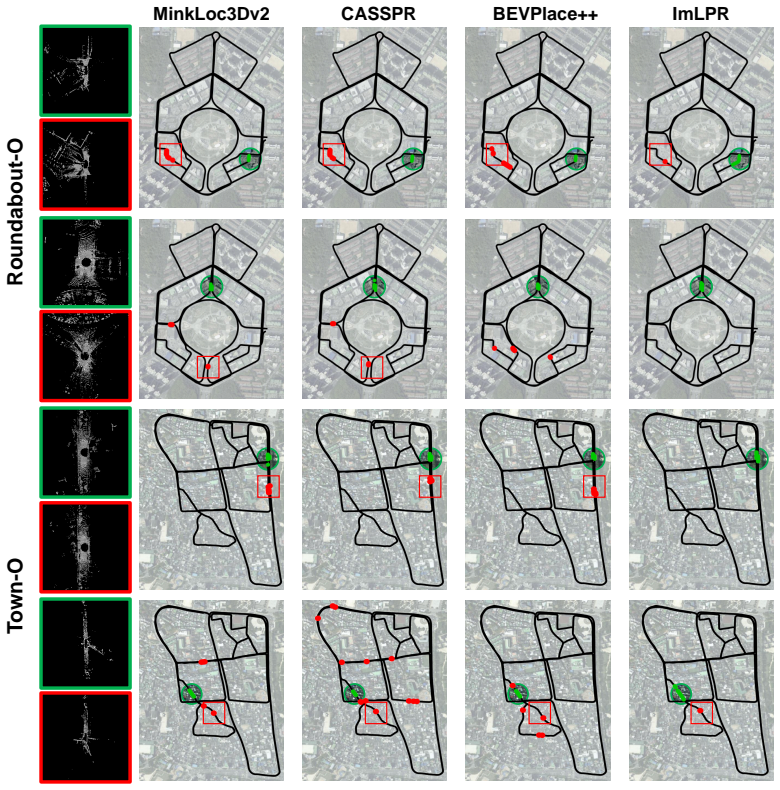
- On the HeLiPR Ouster sequences, ImLPR reports an average Recall@1 of 0.976 for intra-session matching and roughly 0.989-0.990 across inter-session pairs, ahead of every compared method.
- Without retraining, the model reports AR@1 of 0.865 on MulRan DCC, AF1 of 0.927 on NCLT, and AR@1 of 0.712 on HeLiPR Velodyne, the highest among the compared methods in each set.
- Ablations show each of the three RIV channels improves performance: reflectivity alone is weaker than reflectivity plus range, and adding the normal-ratio channel improves results further.
- Removing the MultiConv adapters while fine-tuning two blocks drops average AR@1 from 0.952 to 0.795, and using neither adapters nor fine-tuning gives 0.331, indicating the adapter is what unlocks the pre-trained features.
- Descriptor extraction with the ViT-S/14 backbone takes 18.1 ms per scan, faster than the attention-based baselines and comparable to the 3D sparse-convolution methods, suggesting the approach is practical for real-time use.
Reading between the lines
- Because a horizontal shift of a range image is exactly a yaw rotation, and both the convolutional adapters and the optimal-transport aggregation are shift-equivariant or shift-invariant, yaw robustness may be a structural side-effect of this design rather than something learned; an ablation isolating the yaw-augmentation contribution could confirm how much is architectural.
- If these results reproduce, image-domain transfer could become the default recipe for LiDAR place recognition: future improvements to generic vision foundation models would flow directly into LPR by re-rendering scans as range images, instead of waiting for comparable 3D foundation models.
- The same frozen-backbone-plus-RIV recipe is a natural candidate for adjacent problems such as loop-closure detection in LiDAR SLAM, global re-ranking of candidate places, or appearance-based localization across seasons; each would be a testable extension outside the paper's scope.
- The paper's stated limitation to homogeneous LPR suggests the sharpest stress test is heterogeneous matching, where query and database come from different LiDAR sensors and geometry, intensity scale, and field of view all change; the authors leave this as future work.
Editorial analysis
A structured set of objections, weighed in public.
Referee Report
Summary. This paper presents ImLPR, a LiDAR place recognition pipeline that projects raw point clouds into a three-channel range-image view (reflectivity, range, and normal ratio), processes the resulting image with a mostly frozen DINOv2 ViT-S/14 backbone, inserts lightweight MultiConv adapters, and aggregates patch features with a SALAD-style optimal transport layer. Training combines a global TSAP loss with a proposed Patch-InfoNCE loss over geometrically validated patch pairs. The authors evaluate intra-session and inter-session recognition on HeLiPR, MulRan, and NCLT, report improvements over LoGG3D-Net, MinkLoc3Dv2, CASSPR, and BEVPlace++, and provide extensive ablations on channels, input representation, adapters, number of trained blocks, augmentation, backbone size, and comparisons with VPR and 3D foundation models. They also give a proof of horizontal shift invariance for the OT aggregation and state that the code is released open source.
Significance. If the benchmark results hold, the paper makes a useful empirical contribution: it demonstrates that a largely frozen image foundation model can outperform task-specific LiDAR networks on public benchmarks when fed a well-designed three-channel range-image view, and that the proposed adapters and patch-level contrastive loss have measurable value. The strengths include the breadth of the ablation study, the explicit attempt to control for spatial overlap in the MulRan generalization test (Appendix E.1, Table 7), the comparison against both VPR models and a 3D foundation model, the machine-checkable shift-invariance argument in Section G.2, and the promise of open-source release. The main gap is that the strongest cross-sensor evidence, on NCLT (HDL-32E) and HeLiPR-V (VLP-16C), is obtained with five-second accumulated submaps for both query and database, so the paper's sensor-generalization component is not yet supported at the single-scan level that real deployment requires.
major comments (3)
- [Tables 4 and 8; Appendix D.1, E.2, E.3; Section 6] The cross-sensor generalization claims rest on experiments in which both query and database are five-second accumulated submaps for NCLT and HeLiPR-V, while the mulberry MulRan experiments use single scans but a sensor (OS1-64) that is closer to the training distribution. The paper contains no single-scan cross-sensor experiment with genuinely different LiDARs, and Section 6 concedes that scan accumulation only partially mitigates sensor-geometry discrepancies. Because the RIV representation and DINOv2 features are tuned for dense image-like inputs, accumulation may interact unevenly with the method compared with sparse-convolution baselines capped at 8192 points. The central claim of generalization across unseen sensors is therefore under-supported; the authors should add a single-scan cross-sensor evaluation or explicitly scope the claim to accumulated-submap place recognition.
- [Tables 1-8] All reported Recall@1 and F1 values are single-run point estimates, with no variance, number of seeds, or statistical test reported. In Table 8, for example, ImLPR's NCLT average AR@1 is 0.834 versus BEVPlace++'s 0.850, so the apparent ranking could plausibly change under training noise. The authors should report mean and standard deviation over at least three training runs, or otherwise justify that the differences are not within run-to-run variability.
- [Section 1, Section 2.2, Appendix H.1] The novelty claim that ImLPR is 'the first LPR pipeline using a VFM while retaining the majority of pre-trained knowledge' is not established by the related-work discussion. SelaVPR++ is cited for VPR and LIP-Loc is cited for full fine-tuning, but the paper does not discuss whether any prior LPR method combined a frozen DINOv2 backbone with adapters; this positioning claim should either be supported by a targeted search or softened to a statement about the specific design being new in this combination.
minor comments (5)
- [Section G.2] The proof contains a wording error: after flattening, the shift in the score matrix is described as a row shift, but a later sentence says 'A column shift in S results in a row shift in M'; this should be corrected to 'row shift in S' for consistency with the surrounding derivation.
- [Tables 13 and 15] The reported ImLPR runtime differs between the two tables (18.1 ms in Table 13 and 12.9 ms in Table 15), and the GPU model also differs (RTX 3090 vs RTX 4090); please state the exact hardware for each table and explain the discrepancy.
- [Appendix D.1] The description of accumulated scans says stationary scans are excluded to avoid redundant accumulation, but it does not specify how stationary periods are detected; please provide the criterion (e.g., translational speed threshold) so the protocol is reproducible.
- [Section D.2] The naming is potentially confusing because HeLiPR contains DCC04-06 as training sequences and MulRan contains DCC01-03 as test sequences; please clarify the dataset origin of each DCC sequence at first mention to avoid ambiguous references in Tables 5, 6, 11, and 12.
- [Appendix H.3.2] The claim that BEVPlace++ requires 27.5 ms due to 'multiple ResNet instances for yaw invariance' should state whether this is the total descriptor extraction time including the rotation-equivariant module; the comparison basis for runtime should be identical across methods.
Circularity Check
No significant circularity: empirical benchmark claims with controlled ablations and an explicit, assumption-bound OT proof.
full rationale
ImLPR is an empirical systems paper; its central claims are benchmark outcomes rather than quantities derived from fitted inputs. I find no step where a prediction reduces to a training target or where a load-bearing premise is justified only by a self-citation. The DINOv2 backbone and SALAD aggregator are external, published components, while HeLiPR, MulRan, and NCLT are public datasets used for training and evaluation rather than as evidence for the method's correctness. The MultiConv adapter design is validated by controlled ablations (Tables 6 and 11) instead of being asserted through citation. The horizontal-shift invariance proof in Section G.2 is a genuine mathematical argument with stated assumptions, namely translation-equivariant score and feature maps and uniform Sinkhorn log-weights; it does not assume the conclusion, and the paper itself acknowledges the residual positional-encoding caveat in Section G.1. The generalization experiments in Tables 4 and 8 use accumulated submaps for NCLT and HeLiPR-V, as stated in Appendices D.1 and E, and Section 6 explicitly concedes that accumulation only partially mitigates sensor-geometry discrepancies and that heterogeneous LPR is not solved. That is an evaluation limitation rather than a circularity: all methods are compared under the same protocol, and no fitted parameter is relabeled as a prediction. Therefore, no circular step meeting the quoted-evidence standard is present.
Assumptions & free parameters
free parameters (6)
- Normal ratio neighborhood size k =
8 (HeLiPR-O), 25 (MulRan, NCLT, HeLiPR-V)
- Positive patch overlap threshold rho_valid =
0.5
- Negative patch distance thresholds =
v_dist=3, h_dist=20
- Patch-InfoNCE temperature tau_l =
0.2
- Combined loss weight lambda =
2.0
- Descriptor dimensions (m, l, e) =
(128, 64, 256)
assumptions (4)
- domain assumption DINOv2's RGB-pretrained features transfer to three-channel LiDAR range images after light adapter-based adaptation.
- domain assumption Ground-truth poses refined by ICP give correct patch correspondences for training the Patch-InfoNCE loss.
- standard math Standard SVD, Sinkhorn optimal transport, and InfoNCE are used as background results.
- domain assumption The horizontal-shift invariance proof assumes translation-equivariant convolutional layers in the score and value heads.
Cite this review
Pith. "Pith review of ImLPR: Image-based LiDAR Place Recognition using Vision Foundation Models." pith.science (2026). https://pith.science/paper/LGVEOF3N
@misc{pith2026250518364,
  author       = {Pith},
  title        = {Pith review of: ImLPR: Image-based LiDAR Place Recognition using Vision Foundation Models},
  year         = {2026},
  howpublished = {\url{https://pith.science/paper/LGVEOF3N}},
  note         = {Machine review of arXiv:2505.18364}
}
read the original abstract
LiDAR Place Recognition (LPR) is a key component in robotic localization, enabling robots to align current scans with prior maps of their environment. While Visual Place Recognition (VPR) has embraced Vision Foundation Models (VFMs) to enhance descriptor robustness, LPR has relied on task-specific models with limited use of pre-trained foundation-level knowledge. This is due to the lack of 3D foundation models and the challenges of using VFM with LiDAR point clouds. To tackle this, we introduce ImLPR, a novel pipeline that employs a pre-trained DINOv2 VFM to generate rich descriptors for LPR. To the best of our knowledge, ImLPR is the first method to utilize a VFM for LPR while retaining the majority of pre-trained knowledge. ImLPR converts raw point clouds into novel three-channel Range Image Views (RIV) to leverage VFM in the LiDAR domain. It employs MultiConv adapters and Patch-InfoNCE loss for effective feature learning. We validate ImLPR on public datasets and outperform state-of-the-art (SOTA) methods across multiple evaluation metrics in both intra- and inter-session LPR. Comprehensive ablations on key design choices such as channel composition, RIV, adapters, and the patch-level loss quantify each component's impact. We release ImLPR as open source for the robotics community: https://github.com/minwoo0611/ImLPR.
Figures


Figures from the paper (11 more)


Forward citations
Cited by 1 Pith paper
-
TreeLoc++: Robust 6-DoF LiDAR Localization in Forests with a Compact Digital Forest Inventory
TreeLoc++ localizes a forest robot with 6-DoF centimeter accuracy using only compact tree inventories — positions and diameters — beating point-cloud-backed methods on 27 sequences in four countries.
Reference graph
Works this paper leans on
-
[1]
R. Arandjelovic, P. Gronat, A. Torii, T. Pajdla, and J. Sivic. Netvlad: Cnn architecture for weakly supervised place recognition. InProceedings of the IEEE conference on computer vision and pattern recognition, pages 5297–5307, 2016
work page 2016
-
[2]
S. Hausler, S. Garg, M. Xu, M. Milford, and T. Fischer. Patch-netvlad: Multi-scale fusion of locally-global descriptors for place recognition. InProceedings of the IEEE/CVF conference on computer vision and pattern recognition, pages 14141–14152, 2021
work page 2021
-
[3]
K. Vidanapathirana, M. Ramezani, P. Moghadam, S. Sridharan, and C. Fookes. Logg3d-net: Locally guided global descriptor learning for 3d place recognition. In2022 International Conference on Robotics and Automation (ICRA), pages 2215–2221. IEEE, 2022
work page 2022
-
[4]
J. Komorowski. Improving point cloud based place recognition with ranking-based loss and large batch training. In2022 26th international conference on pattern recognition (ICPR), pages 3699–3705. IEEE, 2022
work page 2022
-
[5]
Y . Xia, M. Gladkova, R. Wang, Q. Li, U. Stilla, J. F. Henriques, and D. Cremers. Casspr: Cross attention single scan place recognition. InProceedings of the IEEE/CVF international conference on computer vision, pages 8461–8472, 2023
work page 2023
-
[6]
BEVPlace++: Fast, Robust, and Lightweight LiDAR Global Localization for Unmanned Ground Vehicles
L. Luo, S.-Y . Cao, X. Li, J. Xu, R. Ai, Z. Yu, and X. Chen. Bevplace++: Fast, ro- bust, and lightweight lidar global localization for unmanned ground vehicles.arXiv preprint arXiv:2408.01841, 2024
work page Pith review arXiv 2024
-
[7]
K. Garg, S. S. Puligilla, S. Kolathaya, M. Krishna, and S. Garg. Revisit anything: Visual place recognition via image segment retrieval. InEuropean Conference on Computer Vision, pages 326–343. Springer, 2024
work page 2024
-
[8]
S. Izquierdo and J. Civera. Optimal transport aggregation for visual place recognition. InPro- ceedings of the ieee/cvf conference on computer vision and pattern recognition, pages 17658– 17668, 2024. ix
work page 2024
Show all 38 references
-
[9]
Keetha, A
N. Keetha, A. Mishra, J. Karhade, K. M. Jatavallabhula, S. Scherer, M. Krishna, and S. Garg. Anyloc: Towards universal visual place recognition.IEEE Robotics and Automation Letters, 9 (2):1286–1293, 2023
2023
-
[10]
J. Nie, D. Xue, F. Pan, S. Cheng, W. Liu, J. Hu, and Z. Ning. Mixvpr++: Enhanced visual place recognition with hierarchical-region feature-mixer and adaptive gabor texture fuser.IEEE Robotics and Automation Letters, 2024
2024
-
[11]
Kirillov, E
A. Kirillov, E. Mintun, N. Ravi, H. Mao, C. Rolland, L. Gustafson, T. Xiao, S. Whitehead, A. C. Berg, W.-Y . Lo, et al. Segment anything. InProceedings of the IEEE/CVF international conference on computer vision, pages 4015–4026, 2023
2023
-
[12]
Oquab, T
M. Oquab, T. Darcet, T. Moutakanni, H. V o, M. Szafraniec, V . Khalidov, P. Fernandez, D. Haz- iza, F. Massa, A. El-Nouby, et al. Dinov2: Learning robust visual features without supervision. arXiv preprint arXiv:2304.07193, 2023
2023 arXiv
-
[13]
Radford, J
A. Radford, J. W. Kim, C. Hallacy, A. Ramesh, G. Goh, S. Agarwal, G. Sastry, A. Askell, P. Mishkin, J. Clark, et al. Learning transferable visual models from natural language supervi- sion. InInternational conference on machine learning, pages 8748–8763. PmLR, 2021
2021
-
[14]
X. Wu, L. Jiang, P.-S. Wang, Z. Liu, X. Liu, Y . Qiao, W. Ouyang, T. He, and H. Zhao. Point transformer v3: Simpler faster stronger. InProceedings of the IEEE/CVF Conference on Com- puter Vision and Pattern Recognition, pages 4840–4851, 2024
2024
-
[15]
X. Wu, D. DeTone, D. Frost, T. Shen, C. Xie, N. Yang, J. Engel, R. Newcombe, H. Zhao, and J. Straub. Sonata: Self-supervised learning of reliable point representations.arXiv preprint arXiv:2503.16429, 2025
2025 arXiv
-
[16]
X. Chen, T. L ¨abe, A. Milioto, T. R¨ohling, O. Vysotska, A. Haag, J. Behley, and C. Stachniss. OverlapNet: Loop Closing for LiDAR-based SLAM. InProceedings of Robotics: Science and Systems (RSS), 2020
2020
-
[17]
M. A. Uy and G. H. Lee. Pointnetvlad: Deep point cloud based retrieval for large-scale place recognition. pages 4470–4479, 2018
2018
-
[18]
Z. Liu, S. Zhou, C. Suo, P. Yin, W. Chen, H. Wang, H. Li, and Y .-H. Liu. Lpd-net: 3d point cloud learning for large-scale place recognition and environment analysis. pages 2831–2840, 2019
2019
-
[19]
J. Guo, P. V . Borges, C. Park, and A. Gawel. Local descriptor for robust place recognition using lidar intensity. 4(2):1470–1477, 2019
2019
-
[20]
J. Ma, J. Zhang, J. Xu, R. Ai, W. Gu, and X. Chen. Overlaptransformer: An efficient and yaw-angle-invariant transformer network for lidar-based place recognition.IEEE Robotics and Automation Letters, 7(3):6958–6965, 2022
2022
-
[21]
J. Ma, G. Xiong, J. Xu, and X. Chen. Cvtnet: A cross-view transformer network for lidar- based place recognition in autonomous driving environments.IEEE Transactions on Industrial Informatics, 20(3):4039–4048, 2023
2023
-
[22]
L. Luo, S. Zheng, Y . Li, Y . Fan, B. Yu, S.-Y . Cao, J. Li, and H.-L. Shen. Bevplace: Learning lidar-based place recognition using bird’s eye view images. InProceedings of the IEEE/CVF International Conference on Computer Vision, pages 8700–8709, 2023
2023
-
[23]
C. E. Lin, J. Song, R. Zhang, M. Zhu, and M. Ghaffari. Se (3)-equivariant point cloud-based place recognition. InConference on Robot Learning, pages 1520–1530. PMLR, 2023
2023
-
[24]
S. Garg, M. Vankadari, and M. Milford. Seqmatchnet: Contrastive learning with sequence matching for place recognition & relocalization. InConference on Robot Learning, pages 429–443. PMLR, 2022. x
2022
-
[25]
G. Puy, S. Gidaris, A. Boulch, O. Sim ´eoni, C. Sautier, P. P ´erez, A. Bursuc, and R. Mar- let. Three pillars improving vision foundation model distillation for lidar. InProceedings of the IEEE/CVF Conference on Computer Vision and Pattern Recognition, pages 21519–21529, 2024
2024
-
[26]
V ¨odisch, G
N. V ¨odisch, G. Cioffi, M. Cannici, W. Burgard, and D. Scaramuzza. Lidar registration with visual foundation models.arXiv preprint arXiv:2502.19374, 2025
2025 arXiv
-
[27]
K. He, X. Zhang, S. Ren, and J. Sun. Deep residual learning for image recognition. InPro- ceedings of the IEEE conference on computer vision and pattern recognition, pages 770–778, 2016
2016
-
[28]
Shubodh, M
S. Shubodh, M. Omama, H. Zaidi, U. S. Parihar, and M. Krishna. Lip-loc: Lidar image pretraining for cross-modal localization. InProceedings of the IEEE/CVF Winter Conference on Applications of Computer Vision (WACV) Workshops, pages 948–957, January 2024
2024
-
[29]
F. Lu, T. Jin, X. Lan, L. Zhang, Y . Liu, Y . Wang, and C. Yuan. Selavpr++: Towards seamless adaptation of foundation models for efficient place recognition.arXiv preprint arXiv:2502.16601, 2025
2025
-
[30]
M. Cuturi. Sinkhorn distances: Lightspeed computation of optimal transport. volume 26. Curran Associates, Inc., 2013
2013
-
[31]
M. Jung, W. Yang, D. Lee, H. Gil, G. Kim, and A. Kim. Helipr: Heterogeneous lidar dataset for inter-lidar place recognition under spatiotemporal variations.The International Journal of Robotics Research, 43(12):1867–1883, 2024
2024
-
[32]
G. Kim, Y . S. Park, Y . Cho, J. Jeong, and A. Kim. Mulran: Multimodal range dataset for urban place recognition. In2020 IEEE international conference on robotics and automation (ICRA), pages 6246–6253. IEEE, 2020
2020
-
[33]
Carlevaris-Bianco, A
N. Carlevaris-Bianco, A. K. Ushani, and R. M. Eustice. University of michigan north campus long-term vision and lidar dataset.The International Journal of Robotics Research, 35(9): 1023–1035, 2016
2016
-
[34]
M. Jung, S. Jung, H. Gil, and A. Kim. Helios: Heterogeneous lidar place recognition via overlap-based learning and local spherical transformer. InProceedings of the IEEE Interna- tional Conference on Robotics and Automation (ICRA), Atlanta, May. 2025
2025
-
[35]
Revaud, J
J. Revaud, J. Almaz ´an, R. S. Rezende, and C. R. d. Souza. Learning with average precision: Training image retrieval with a listwise loss. InProceedings of the IEEE/CVF International Conference on Computer Vision, pages 5107–5116, 2019
2019
-
[36]
Ali-Bey, B
A. Ali-Bey, B. Chaib-draa, and P. Giguere. Boq: A place is worth a bag of learnable queries. In Proceedings of the IEEE/CVF Conference on Computer Vision and Pattern Recognition, pages 17794–17803, 2024
2024
-
[37]
F. Lu, L. Zhang, X. Lan, S. Dong, Y . Wang, and C. Yuan. Towards seamless adaptation of pre-trained models for visual place recognition.arXiv preprint arXiv:2402.14505, 2024. xi Appendices A Experimental Setup Implementation Details:ImLPR is trained by fine-tuning the final tw...
2024 arXiv
-
[38]
The Patch-InfoNCE loss is computed using only 1/8 of the positive image pairs within the batch to optimize computational efficiency. To establish correspondence between two LiDAR scans represented as RIV images, the RIV images are first converted into 3D point clouds and voxel...
Reviewed August 7, 2026 · model on record in the stance chip above.
Discussion (0). Sign in to comment.