REVIEW 5 major objections 6 minor 53 references
SP2RINT: Spatially-Decoupled Physics-Inspired Progressive Inverse Optimization for Scalable, PDE-Constrained Meta-Optical Neural Network Training
T0 review · 5 major / 6 minor · reviewed 2026-08-07 · deepseek-v4-flash
Pith's one-line read SP2RINT makes physically realizable optical neural networks trainable by replacing per-iteration full-wave simulation with patched transfer-matrix probing, claiming a 1825x speedup over simulation-in-the-loop training.
desk verdict The progressive projection method is a genuine contribution and the appendix field checks are real evidence, but the headline speedup and 'digital-comparable' accuracy outrun what is actually validated. read the letter →
The pith
A machine-rendered reading of the paper's core claim, the machinery that carries it, and where it could break.
The reading
What carries the argument
The load-bearing object is the banded transfer matrix: because scattered near-field light from one meta-atom is negligible beyond a patch of P atoms, the full transfer matrix of a metasurface can be approximated by overlapping P-atom patch simulations stitched together, which is what reduces simulation complexity from cubic to near-linear. Training alternates between relaxed updates on these matrices and a progressive soft-to-hard binarization projection via adjoint inverse design, with an optional system-level fine-tuning step that matches the total cascaded transfer matrix rather than each layer separately.
What would settle it
Measure the actual optical response of a fabricated 32-meta-atom metasurface trained by SP2RINT and compare it with the banded transfer matrix produced by patch probing; if the field error exceeds the few-percent level claimed, or if a full-wave simulation of the complete two-layer stack diverges from the cascaded patch model, the central assumption fails.
Extended reading notes
Core claim
The central claim is that DONN training can be reformulated as a PDE-constrained learning problem and solved by alternating between unconstrained training on freely trainable banded transfer matrices and adjoint-based projection onto the subspace of physically realizable metasurface responses. The projection is made tractable by exploiting the locality of near-field interactions: each meta-atom's response is simulated in an overlapping patch of P atoms, turning O($n^{3}$) full-wave simulation into O(n) patch simulations, and the binarization constraint is introduced progressively so the optimizer explores before being locked to a discrete design. The paper reports that on Fashion-MNIST, SVHN, and Darcy Flow benchmarks, SP2RINT outperforms heuristic LPA-based methods by an average of 63.88% test accuracy while being 1825x faster than the simulation-in-the-loop baseline.
Load-bearing premise
The whole scheme assumes that each meta-atom only interacts with its neighbors within a patch of about 17 atoms and that the metasurface layers are independent, so that probing patches and stitching them together captures the true physics; if long-range coupling or inter-layer multiple scattering is significant, the trained designs will not behave as simulated.
Editorial extensions
If this is right
- If SP2RINT works as described, designing a physically realizable DONN no longer requires embedding full-wave simulations in every training iteration; the same framework can train machines with more metasurface layers and larger systems.
- The patch-based transfer matrix probing makes simulation cost scale near-linearly with metasurface size, so training should remain feasible as systems grow from 32 to 160 meta-atoms and beyond.
- Because the final design is guaranteed to satisfy the Maxwell constraint up to the patch approximation, the trained models can be sent directly to fabrication without a separate phase-mask-to-layout conversion step.
- The progressive projection schedule provides a way to balance exploration and physical feasibility for other PDE-constrained learning problems, not only optics.
Reading between the lines
- Beyond the paper's own claims, the 1825x speedup is computed against an estimated 178-hour-per-epoch runtime for the simulation-in-the-loop baseline, which was never run to completion; a head-to-head wall-clock comparison on identical hardware would test whether the speedup holds in practice.
- The locality assumption implies a testable prediction: with a fixed patch size, the approximation error of the probed transfer matrix should stay roughly constant as the metasurface grows, and should jump when the interaction range exceeds P atoms; measuring this error across device sizes would validate the scaling claim.
- The same decoupling idea could extend to two-dimensional metasurface arrays and to other wave-based platforms such as acoustic or microwave networks, where fields also have finite interaction ranges; the main open question is whether patch size remains small enough to preserve linear scaling.
Editorial analysis
A structured set of objections, weighed in public.
Referee Report
Summary. The paper proposes SP2RINT, a training framework for metasurface-based diffractive optical neural networks (DONNs). It formulates DONN training as a PDE-constrained learning problem, relaxes the metasurface transfer matrix into a banded trainable matrix, and alternates between relaxed network training and adjoint-based inverse design on spatially local patches to enforce physical realizability. The method is evaluated on Fashion-MNIST, SVHN, and Darcy Flow, with claims of up to 63.88% higher accuracy than heuristic baselines and a 1825x speedup over simulation-in-the-loop training, and the code is released publicly.
Significance. The core idea of decoupling training from full-wave simulation via patched transfer-matrix probing and progressive projection is a valuable contribution that could make physically constrained DONN training scalable to larger devices. The appendix's comparison of predicted intermediate fields against FDFD ground truth for cascaded random systems is genuine evidence that the probing approximation captures substantial physics, and the public code availability supports reproducibility. However, the central quantitative claims of speedup, physical realizability, and digital-comparable accuracy are not yet fully established, because the speedup is computed against an estimated baseline, the test-time model is the same patched approximation used in training, and no digital classifier baseline is reported.
major comments (5)
- [Section IV D, Table II] The 1825x speedup is derived from an estimated simulation-in-the-loop cost of about 178 hours per epoch, but this baseline was never run to completion and is listed as 'Time out' in all benchmarks. Please report measured wall-clock times for at least one full training epoch of the simulation-in-the-loop baseline, or provide a clearly justified upper bound based on an actual partial run, and report variability across multiple random seeds for the accuracy numbers.
- [Section IV D, final paragraph] The test accuracies in Table II are evaluated with 'real simulated responses of implemented metasurfaces,' but these responses are generated with the same patched transfer-matrix probing model used during training, not with an end-to-end full-wave simulation of the trained devices. The Appendix VIII B field comparisons against FDFD are performed on random cascaded systems, not on the specifically trained classifiers. Please add a full-wave FDFD evaluation of the final trained designs (or explicitly state that the physical-realizability claim has not yet been validated end-to-end).
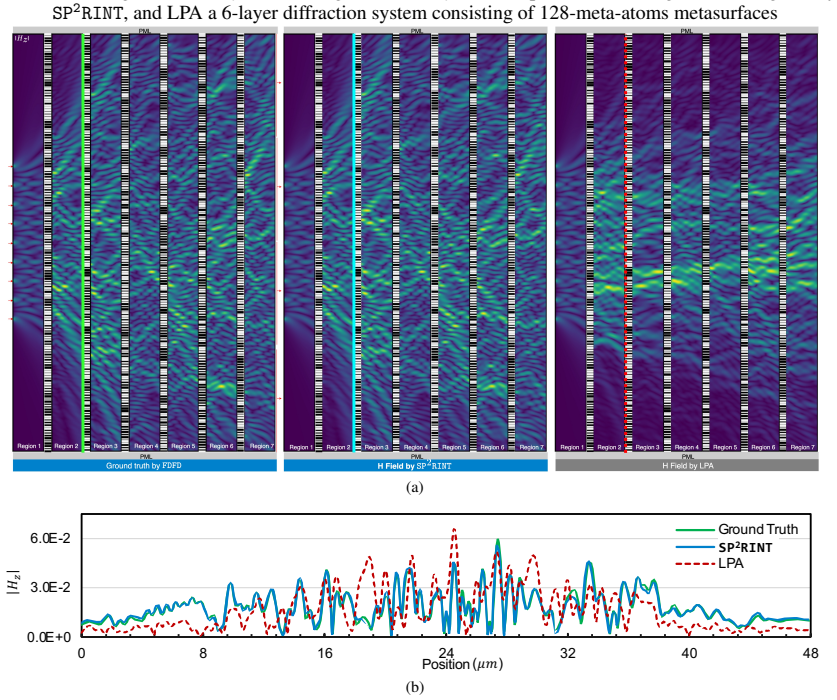
- [Eq. (5) and Section III D] The factorization of the system into independent layer-wise transfer matrices and the banded-locality assumption are load-bearing for the method's scalability and physical fidelity. The paper's own calibration in Appendix VIII B uses a patch size of 53 for a 64-meta-atom system (covering 83% of the array) and a patch size of 27 for a 32-meta-atom system (which contradicts Section IV C's stated default of 17), so the 'small patch' approximation is not as localized as implied. With 4-um inter-layer spacing at 850 nm (approximately 4.7 wavelengths), inter-layer multiple scattering may not be negligible. Please provide a patch-size convergence study and an end-to-end full-wave comparison on the trained designs to quantify these approximation errors.
- [Abstract and Section V] The claim of 'digital-comparable accuracy' is not substantiated because no purely digital classifier baseline is presented. Table II compares only with heuristic methods and a simulation-in-the-loop baseline that timed out. Please define the digital comparison (for example, a same-capacity CNN using the same input features) and report its accuracy so that the claim is falsifiable.
- [Sections IV C and Appendix VIII A] Several hyperparameters, including patch size, convolution kernel size, output channel number, input port spacing and width, near-field downsampling rate, and the projection sharpness schedule, are selected based on their effect on test accuracy. This practice risks inflating the reported test results and makes the generalization claims fragile. Please select hyperparameters on a validation split and report the sensitivity of the main results to these choices.
minor comments (6)
- [Figure 1] The label 'SP2INT' in the figure legend is a typo and should be 'SP2RINT'.
- [Title] The title contains an unintended space in 'S patially-Decoupled'; it should be 'Spatially-Decoupled'.
- [Appendix VIII B] The stated patch size for 32-meta-atom systems is 27, which conflicts with the default of 17 described in Section IV C; please reconcile this inconsistency.
- [Eq. (7)] The notation uses 'bT' for both the trainable target matrix and the physical transfer matrix in different places; please disambiguate these quantities to avoid confusion.
- [Figure 5] The error metric 'Err' used in the patch-size sweep is not defined in the caption; please state how the probing error is normalized and computed.
- [Table II] For the Darcy Flow benchmark, the column header 'Test Acc' is misleading because the reported metric is a normalized L2 norm, not an accuracy; please use a generic 'Test metric' header or a separate column.
Circularity Check
No derivation in SP2RINT reduces to its inputs; the central method is independently supported by FDFD field comparisons, though the end-to-end full-wave accuracy validation is missing and some hyperparameters are selected on test-set performance.
full rationale
SP2RINT's derivation chain is not circular. The framework defines the physical response T via the Maxwell operator (Eq. 6) and then alternately trains relaxed matrices bT (Eq. 8) and projects them onto the implementable subspace by inverse design (Eq. 9), with an optional system-level matching objective (Eq. 10). Accuracy is reported on test data and is not defined as the projection residual, so the central claim does not reduce to its own optimization objective. The patched probing model is independently checked: Appendix VIII B and Fig. 6 compare intermediate fields against FDFD ground truth for cascaded systems. The main weaknesses are not circularity: (i) the 1825x speedup is computed from an estimated ~178 h/epoch for the simulation-in-the-loop baseline that was never run (Sec. IV D); (ii) the test accuracies in Table II are evaluated under the same patched, factorized probe model used in training ('real simulated responses of implemented metasurfaces'), so no end-to-end full-wave accuracy validation of the final binarized designs is reported; (iii) several hyperparameters (patch size, downsample rate, projection frequency, sharpness schedule) are chosen using test-set accuracy (Sec. IV C, Appendix VIII A), which can inflate reported gains. These are evidence gaps and model-selection bias, not cases where a prediction is equivalent to its input by construction. The only self-citation by the authors, ref. [29] for hybrid DONNs, is not load-bearing for the method's claims.
Assumptions & free parameters
free parameters (5)
- Patch size P =
17 for 32-atom systems; 53 for 64/128/160-atom systems
- Near-field downsampling rate S =
3
- Projection frequency and iterations =
10 projections per epoch, 2 adjoint updates per projection
- Binarization sharpness schedule (s0, sT) =
Not numerically specified
- Architecture hyperparameters =
Kernel size 3, output channels 4, port spacing 0.4 um, port width 0.2 um
assumptions (5)
- domain assumption The global system response factorizes as a product of independent metasurface transfer matrices and free-space diffraction operators (Eq. 5).
- domain assumption Each metasurface transfer matrix is band-local: scattering from one meta-atom is negligible beyond a patch of P atoms.
- domain assumption The optical field is approximately constant within one meta-atom region, allowing one pulse source per meta-atom and downsampling of the response.
- domain assumption FDFD simulation of the designed permittivity distribution is the ground truth for the physical metasurface response.
- domain assumption A linear scalar PDE model with TM polarization and a single magnetic field component captures the relevant physics.
Cite this review
Pith. "Pith review of SP2RINT: Spatially-Decoupled Physics-Inspired Progressive Inverse Optimization for Scalable, PDE-Constrained Meta-Optical Neural Network Training." pith.science (2026). https://pith.science/paper/BUEGL6QB
@misc{pith2026250518377,
  author       = {Pith},
  title        = {Pith review of: SP2RINT: Spatially-Decoupled Physics-Inspired Progressive Inverse Optimization for Scalable, PDE-Constrained Meta-Optical Neural Network Training},
  year         = {2026},
  howpublished = {\url{https://pith.science/paper/BUEGL6QB}},
  note         = {Machine review of arXiv:2505.18377}
}
read the original abstract
DONNs leverage light propagation for efficient analog AI and signal processing. Advances in nanophotonic fabrication and metasurface-based wavefront engineering have opened new pathways to realize high-capacity DONNs across various spectral regimes. Training such DONN systems to determine the metasurface structures remains challenging. Heuristic methods are fast but oversimplify metasurfaces modulation, often resulting in physically unrealizable designs and significant performance degradation. Simulation-in-the-loop optimizes implementable metasurfaces via adjoint methods, but is computationally prohibitive and unscalable. To address these limitations, we propose SP2RINT, a spatially decoupled, progressive training framework that formulates DONN training as a PDE-constrained learning problem. Metasurface responses are first relaxed into freely trainable transfer matrices with a banded structure. We then progressively enforce physical constraints by alternating between transfer matrix training and adjoint-based inverse design, avoiding per-iteration PDE solves while ensuring final physical realizability. To further reduce runtime, we introduce a physics-inspired, spatially decoupled inverse design strategy based on the natural locality of field interactions. This approach partitions the metasurface into independently solvable patches, enabling scalable and parallel inverse design with system-level calibration. Evaluated across diverse DONN training tasks, SP2RINT achieves digital-comparable accuracy while being 1825 times faster than simulation-in-the-loop approaches. By bridging the gap between abstract DONN models and implementable photonic hardware, SP2RINT enables scalable, high-performance training of physically realizable meta-optical neural systems. Our code is available at https://github.com/ScopeX-ASU/SP2RINT
Figures


Figures from the paper (11 more)


Reference graph
Works this paper leans on
-
[1]
merlin.mbs aapmrev4-1.bst 2010-07-25 4.21a (PWD, AO, DPC) hacked
FUNCTION id.bst "merlin.mbs aapmrev4-1.bst 2010-07-25 4.21a (PWD, AO, DPC) hacked" ENTRY address archive archivePrefix author bookaddress booktitle chapter collaboration doi edition editor eid eprint howpublished institution isbn issn journal key language month note number organization pages primaryClass publisher school SLACcitation series title translat...
2010
-
[2]
merlin.mbs aipauth4-1.bst 2010-07-25 4.21a (PWD, AO, DPC) hacked
FUNCTION id.bst "merlin.mbs aipauth4-1.bst 2010-07-25 4.21a (PWD, AO, DPC) hacked" ENTRY address archive archivePrefix author bookaddress booktitle chapter collaboration doi edition editor eid eprint howpublished institution isbn issn journal key language month note number organization pages primaryClass publisher school SLACcitation series title translat...
2010
-
[3]
merlin.mbs aipnum4-1.bst 2010-07-25 4.21a (PWD, AO, DPC) hacked
FUNCTION id.bst "merlin.mbs aipnum4-1.bst 2010-07-25 4.21a (PWD, AO, DPC) hacked" ENTRY address archive archivePrefix author bookaddress booktitle chapter collaboration doi edition editor eid eprint howpublished institution isbn issn journal key language month note number organization pages primaryClass publisher school SLACcitation series title translati...
2010
-
[4]
merlin.mbs apsrev4-1.bst 2010-07-25 4.21a (PWD, AO, DPC) hacked
FUNCTION id.bst "merlin.mbs apsrev4-1.bst 2010-07-25 4.21a (PWD, AO, DPC) hacked" ENTRY address archive archivePrefix author bookaddress booktitle chapter collaboration doi edition editor eid eprint howpublished institution isbn issn journal key language month note number organization pages primaryClass publisher school SLACcitation series title translati...
2010
-
[5]
merlin.mbs apsrmp4-1.bst 2010-07-25 4.21a (PWD, AO, DPC) hacked
FUNCTION id.bst "merlin.mbs apsrmp4-1.bst 2010-07-25 4.21a (PWD, AO, DPC) hacked" ENTRY address archive archivePrefix author bookaddress booktitle chapter collaboration doi edition editor eid eprint howpublished institution isbn issn journal key language month note number organization pages primaryClass publisher school SLACcitation series title translati...
2010
-
[6]
author author X. Lin , author Y. Rivenson , author N. T. \ Yardimci , author M. Veli , author Y. Luo , author M. Jarrahi , \ and\ author A. Ozcan ,\ title title All-optical machine learning using diffractive deep neural networks , \ @noop journal journal Science \ volume 361 ,\ pages 1004--1008 ( year 2018 ) NoStop
work page 2018
-
[7]
author author Y. Luo , author Y. Zhao , author J. Li , author E. C etinta s , author Y. Rivenson , author M. Jarrahi , \ and\ author A. Ozcan ,\ title title Computational imaging without a computer: seeing through random diffusers at the speed of light , \ @noop journal journal eLight \ volume 2 ,\ pages 4 ( year 2022 a ) NoStop
work page 2022
-
[8]
author author D. Mengu , author M. Veli , author Y. Rivenson , \ and\ author A. Ozcan ,\ title title Classification and reconstruction of spatially overlapping phase images using diffractive optical networks , \ @noop journal journal Scientific Reports \ volume 12 ,\ pages 8446 ( year 2022 ) NoStop
work page 2022
Show all 53 references
-
[9]
Mengu \ and\ author A
author author D. Mengu \ and\ author A. Ozcan ,\ title title All-optical phase recovery: diffractive computing for quantitative phase imaging , \ @noop journal journal Advanced Optical Materials \ volume 10 ,\ pages 2200281 ( year 2022 ) NoStop
2022
-
[10]
Li , author Y.-C
author author J. Li , author Y.-C. \ Hung , author O. Kulce , author D. Mengu , \ and\ author A. Ozcan ,\ title title Polarization multiplexed diffractive computing: all-optical implementation of a group of linear transformations through a polarization-encoded diffractive netw...
2022
-
[11]
Li , author Y
author author Y. Li , author Y. Luo , author B. Bai , \ and\ author A. Ozcan ,\ title title Analysis of diffractive neural networks for seeing through random diffusers , \ 10.1109/JSTQE.2022.3194574 journal journal IEEE Journal of Selected Topics in Quantum Electronics \ volum...
2022
-
[12]
Bai , author X
author author B. Bai , author X. Yang , author T. Gan , author J. Li , author D. Mengu , author M. Jarrahi , \ and\ author A. Ozcan ,\ title title Pyramid diffractive optical networks for unidirectional image magnification and demagnification , \ @noop journal journal Light: S...
2024
-
[13]
Mengu , author A
author author D. Mengu , author A. Tabassum , author M. Jarrahi , \ and\ author A. Ozcan ,\ title title Snapshot multispectral imaging using a diffractive optical network , \ @noop journal journal Light: Science & Applications \ volume 12 ,\ pages 86 ( year 2023 ) NoStop
2023
-
[14]
Li , author R
author author Y. Li , author R. Chen , author M. Lou , author B. Sensale-Rodriguez , author W. Gao , \ and\ author C. Yu ,\ title title Lightridge: An end-to-end agile design framework for diffractive optical neural networks , \ in\ 10.1145/3623278.3624757 booktitle Proceeding...
-
[15]
Wu , author M
author author Z. Wu , author M. Zhou , author E. Khoram , author B. Liu , \ and\ author Z. Yu ,\ title title Neuromorphic metasurface , \ @noop journal journal Photonics Research \ volume 8 ,\ pages 46--50 ( year 2019 ) NoStop
2019
-
[16]
Zhou , author Y
author author S. Zhou , author Y. Li , author M. Lou , author W. Gao , author Z. Shi , author C. Yu , \ and\ author C. Ding ,\ title title Physics-aware roughness optimization for diffractive optical neural networks , \ in\ @noop booktitle 2023 60th ACM/IEEE Design Automation ...
2023
-
[17]
Li , author W
author author Y. Li , author W. Gao , \ and\ author C. Yu ,\ title title Rubik's optical neural networks: multi-task learning with physics-aware rotation architecture , \ in\ 10.24963/ijcai.2023/847 booktitle Proceedings of the Thirty-Second International Joint Conference on A...
2023 doi
-
[18]
Chen , author Y
author author R. Chen , author Y. Li , author M. Lou , author J. Fan , author Y. Tang , author B. Sensale-Rodriguez , author C. Yu , \ and\ author W. Gao ,\ title title Physics-aware machine learning and adversarial attack in complex-valued reconfigurable diffractive all-optic...
2022
-
[19]
Li , author R
author author Y. Li , author R. Chen , author W. Gao , \ and\ author C. Yu ,\ title title Physics-aware differentiable discrete codesign for diffractive optical neural networks , \ in\ @noop booktitle Proceedings of the 41st IEEE/ACM International Conference on Computer-Aided ...
2022
-
[20]
Chen , author Y
author author R. Chen , author Y. Li , author M. Lou , author C. Yu , \ and\ author W. Gao ,\ title title Complex-valued reconfigurable diffractive optical neural networks using cost-effective spatial light modulators , \ in\ @noop booktitle CLEO: Applications and Technology \...
2022
-
[21]
Xiang , author S
author author J. Xiang , author S. Colburn , author A. Majumdar , \ and\ author E. Shlizerman ,\ title title Knowledge distillation circumvents nonlinearity for optical convolutional neural networks , \ @noop journal journal Applied Optics \ volume 61 ,\ pages 2173--2183 ( yea...
2022
-
[22]
Tseng , author S
author author E. Tseng , author S. Colburn , author J. Whitehead , author L. Huang , author S.-H. \ Baek , author A. Majumdar , \ and\ author F. Heide ,\ title title Neural nano-optics for high-quality thin lens imaging , \ @noop journal journal Nature communications \ volume ...
2021
-
[23]
Colburn , author Y
author author S. Colburn , author Y. Chu , author E. Shilzerman , \ and\ author A. Majumdar ,\ title title Optical frontend for a convolutional neural network , \ @noop journal journal Applied optics \ volume 58 ,\ pages 3179--3186 ( year 2019 ) NoStop
2019
-
[24]
Qian , author X
author author C. Qian , author X. Lin , author X. Lin , author J. Xu , author Y. Sun , author E. Li , author B. Zhang , \ and\ author H. Chen ,\ title title Performing optical logic operations by a diffractive neural network , \ @noop journal journal Light: Science & Applicati...
2020
-
[25]
Luo , author D
author author Y. Luo , author D. Mengu , author N. T. \ Yardimci , author Y. Rivenson , author M. Veli , author M. Jarrahi , \ and\ author A. Ozcan ,\ title title Design of task-specific optical systems using broadband diffractive neural networks , \ @noop journal journal Ligh...
2019
-
[26]
Chen , author J
author author H. Chen , author J. Feng , author M. Jiang , author Y. Wang , author J. Lin , author J. Tan , \ and\ author P. Jin ,\ title title Diffractive deep neural networks at visible wavelengths , \ @noop journal journal Engineering \ volume 7 ,\ pages 1483--1491 ( year 2...
2021
-
[27]
Luo , author Y
author author X. Luo , author Y. Hu , author X. Ou , author X. Li , author J. Lai , author N. Liu , author X. Cheng , author A. Pan , \ and\ author H. Duan ,\ title title Metasurface-enabled on-chip multiplexed diffractive neural networks in the visible , \ @noop journal journ...
2022
-
[28]
Gu , author Q
author author Z. Gu , author Q. Ma , author X. Gao , author J. W. \ You , \ and\ author T. J. \ Cui ,\ title title Direct electromagnetic information processing with planar diffractive neural network , \ @noop journal journal Science Advances \ volume 10 ,\ pages eado3937 ( ye...
2024
-
[29]
Yu , author Z
author author H. Yu , author Z. Huang , author S. Lamon , author B. Wang , author H. Ding , author J. Lin , author Q. Wang , author H. Luan , author M. Gu , \ and\ author Q. Zhang ,\ title title All-optical image transportation through a multimode fibre using a miniaturized di...
2025
-
[30]
Tang , author R
author author Y. Tang , author R. Chen , author M. Lou , author J. Fan , author C. Yu , author A. Nonaka , author Z. Yao , \ and\ author W. Gao ,\ title title Optical neural engine for solving scientific partial differential equations , \ @noop journal journal arXiv preprint a...
2024 arXiv
-
[31]
Hu , author D
author author J. Hu , author D. Mengu , author D. C. \ Tzarouchis , author B. Edwards , author N. Engheta , \ and\ author A. Ozcan ,\ title title Diffractive optical computing in free space , \ 10.1038/s41467-024-45083-5 journal journal Nature Communications \ volume 15 ,\ pag...
-
[32]
Ji , author J
author author W. Ji , author J. Chang , author H.-X. \ Xu , author J. R. \ Gao , author S. Gröblacher , author H. P. \ Urbach , \ and\ author A. J. L. \ Adam ,\ title title Recent advances in metasurface design and quantum optics applications with machine learning, physics-inf...
-
[33]
Khoram , author A
author author E. Khoram , author A. Chen , author D. Liu , author L. Ying , author Q. Wang , author M. Yuan , \ and\ author Z. Yu ,\ title title Nanophotonic media for artificial neural inference , \ @noop journal journal Photonics Research \ volume 7 ,\ pages 823--827 ( year ...
2019
-
[34]
Yin , author Y
author author Z. Yin , author Y. Yao , author J. Zhang , \ and\ author J. Gu ,\ https://arxiv.org/abs/2411.05748 title Multi-dimensional reconfigurable, physically composable hybrid diffractive optical neural network , \ ( year 2024 ),\ http://arxiv.org/abs/2411.05748 arXiv:24...
2024 arXiv
-
[35]
Wei , author X
author author K. Wei , author X. Li , author J. Froech , author P. Chakravarthula , author J. Whitehead , author E. Tseng , author A. Majumdar , \ and\ author F. Heide ,\ title title Spatially varying nanophotonic neural networks , \ @noop journal journal Science Advances \ vo...
2024
-
[36]
Liu , author Y
author author W. Liu , author Y. Huang , author R. Sun , author T. Fu , author S. Yang , \ and\ author H. Chen ,\ title title Ultra-compact multi-task processor based on in-memory optical computing , \ @noop journal journal Light: Science & Applications \ volume 14 ,\ pages 13...
2025
-
[37]
Sun , author T
author author R. Sun , author T. Fu , author Y. Huang , author W. Liu , author Z. Du , \ and\ author H. Chen ,\ title title Multimode diffractive optical neural network , \ @noop journal journal Advanced Photonics Nexus \ volume 3 ,\ pages 026007--026007 ( year 2024 ) NoStop
2024
-
[38]
Cheng , author C
author author J. Cheng , author C. Huang , author J. Zhang , author B. Wu , author W. Zhang , author X. Liu , author J. Zhang , author Y. Tang , author H. Zhou , author Q. Zhang , et al. ,\ title title Multimodal deep learning using on-chip diffractive optics with in situ trai...
2024
-
[39]
Zhou , author L
author author T. Zhou , author L. Fang , author T. Yan , author J. Wu , author Y. Li , author J. Fan , author H. Wu , author X. Lin , \ and\ author Q. Dai ,\ title title In situ optical backpropagation training of diffractive optical neural networks , \ @noop journal journal P...
2020
-
[40]
Xue , author T
author author Z. Xue , author T. Zhou , author Z. Xu , author S. Yu , author Q. Dai , \ and\ author L. Fang ,\ title title Fully forward mode training for optical neural networks , \ @noop journal journal Nature \ volume 632 ,\ pages 280--286 ( year 2024 ) NoStop
2024
-
[41]
Pai , author Z
author author S. Pai , author Z. Sun , author T. W. \ Hughes , et al. ,\ title title Experimentally realized in situ backpropagation for deep learning in photonic neural networks , \ @noop journal journal Science \ volume 380 ,\ pages 398--404 ( year 2023 ) NoStop
2023
-
[42]
Aieta , author M
author author F. Aieta , author M. A. \ Kats , author P. Genevet , \ and\ author F. Capasso ,\ title title Multiwavelength achromatic metasurfaces by dispersive phase compensation , \ @noop journal journal Science \ volume 347 ,\ pages 1342--1345 ( year 2015 ) NoStop
2015
-
[43]
author author W. T. \ Chen , author A. Y. \ Zhu , author V. Sanjeev , author M. Khorasaninejad , author Z. Shi , author E. Lee , \ and\ author F. Capasso ,\ title title A broadband achromatic metalens for focusing and imaging in the visible , \ @noop journal journal Nature nan...
2018
-
[44]
Chen , author F
author author J. Chen , author F. Yu , author X. Liu , author Y. Bao , author R. Chen , author Z. Zhao , author J. Wang , author X. Wang , author W. Liu , author Y. Shi , et al. ,\ title title Polychromatic full-polarization control in mid-infrared light , \ @noop journal jour...
2023
-
[45]
Fan , author Y
author author Y. Fan , author Y. Xu , author M. Qiu , author W. Jin , author L. Zhang , author E. Y. \ Lam , author D. P. \ Tsai , \ and\ author D. Lei ,\ title title Phase-controlled metasurface design via optimized genetic algorithm , \ @noop journal journal Nanophotonics \ ...
2020
-
[46]
Jafar-Zanjani , author S
author author S. Jafar-Zanjani , author S. Inampudi , \ and\ author H. Mosallaei ,\ title title Adaptive genetic algorithm for optical metasurfaces design , \ @noop journal journal Scientific Reports \ volume 8 ,\ pages 11040 ( year 2018 ) NoStop
2018
-
[47]
Mansouree , author A
author author M. Mansouree , author A. McClung , author S. Samudrala , \ and\ author A. Arbabi ,\ title title Large-scale parametrized metasurface design using adjoint optimization , \ @noop journal journal Acs Photonics \ volume 8 ,\ pages 455--463 ( year 2021 ) NoStop
2021
-
[48]
Zhang , author Z
author author D. Zhang , author Z. Liu , author X. Yang , \ and\ author J. J. \ Xiao ,\ title title Inverse design of multifunctional metasurface based on multipole decomposition and the adjoint method , \ @noop journal journal ACS Photonics \ volume 9 ,\ pages 3899--3905 ( ye...
2022
-
[49]
Oh , author K
author author J. Oh , author K. Li , author J. Yang , author W. T. \ Chen , author M.-J. \ Li , author P. Dainese , \ and\ author F. Capasso ,\ title title Adjoint-optimized metasurfaces for compact mode-division multiplexing , \ @noop journal journal ACS Photonics \ volume 9 ...
2022
-
[50]
Phan , author D
author author T. Phan , author D. Sell , author E. W. \ Wang , author S. Doshay , author K. Edee , author J. Yang , \ and\ author J. A. \ Fan ,\ title title High-efficiency, large-area, topology-optimized metasurfaces , \ @noop journal journal Light: Science & Applications \ v...
2019
-
[51]
Xiao , author K
author author H. Xiao , author K. Rasul , \ and\ author R. Vollgraf ,\ title title Fashion-MNIST: a Novel Image Dataset for Benchmarking Machine Learning Algorithms , \ @noop journal journal Arxiv \ ( year 2017 ) NoStop
2017
-
[52]
Netzer , author T
author author Y. Netzer , author T. Wang , author A. Coates , author A. Bissacco , et al. ,\ title title Reading Digits in Natural Images with Unsupervised Feature Learning , \ in\ @noop booktitle Proc. NIPS \ ( year 2011 ) NoStop
2011
-
[53]
Li , author N
author author Z. Li , author N. Kovachki , author K. Azizzadenesheli , author B. Liu , author K. Bhattacharya , author A. Stuart , \ and\ author A. Anandkumar ,\ @noop title Fourier neural operator for parametric partial differential equations , \ ( year 2021 ),\ http://arxiv....
2021 arXiv
Reviewed August 7, 2026 · model on record in the stance chip above.
Discussion (0). Continue with ORCID to comment.