REVIEW 5 major objections 5 minor 50 references
How Particle System Theory Enhances Hypergraph Message Passing
T0 review · 5 major / 5 minor · reviewed 2026-08-07 · deepseek-v4-flash
Pith's one-line read This paper proves that adding repulsion and Allen-Cahn damping to hypergraph message passing keeps the Dirichlet energy positive, so deep networks do not over-smooth.
desk verdict The paper's advertised anti-over-smoothing guarantee is not proven: the central lower-bound claim on Dirichlet energy does not follow from the ratio estimates they prove, though the particle-system framing and the empirical results are worth a look. read the letter →
The pith
A machine-rendered reading of the paper's core claim, the machinery that carries it, and where it could break.
The reading
What carries the argument
The central object is the hypergraph Dirichlet energy $\mathcal{E}(x)=\operatorname{tr}(x^\top Lx)=\sum_{i,j}\sum_{e\in E}H_{i,e}H_{j,e}\|x_i-x_j\|^2$, where $L$ is the hypergraph Laplacian; over-smoothing is defined as exponential decay of this energy with depth. The mechanism carrying the argument is the composite field $F_i=\sum_{e:i\in e}F_i^e+F^d$, whose gradient yields the first-order dynamics $\dot x_i=\sum_{e:i\in e}\sum_{j\in e}f_\beta(x_i,x_j,e)(x_j-x_i)+f_d(x_i)$, with sign-changing $f_\beta$ controlling attraction versus repulsion and $f_d$ the Allen-Cahn force $\delta(1-x_i^2)x_i$ acting as damping. The proof couples a lower bound on the growth of the inter-group center distance $\|\bar x^{(1)}-\bar x^{(2)}\|$ with an upper bound on the within-group second moment, so their ratio obeys a Lyapunov-type separation inequality; because a connected hypergraph has at least one cross-group edge, this separation forces the Dirichlet energy to stay above a positive floor.
What would settle it
Measure the layer-wise hypergraph Dirichlet energy of a trained HAMP-I on a connected, two-class hypergraph whose interaction coefficients satisfy the paper's sign assumptions: if the energy decays to zero across integration steps while classification accuracy stays above chance, the claimed positive lower bound is false. On a multi-class benchmark such as Cora or Walmart, the same measurement tests whether the assumed two-group structure is ever realized in practice.
Extended reading notes
Core claim
The paper's central claim is that adding repulsion and Allen-Cahn forcing to hypergraph message passing turns a purely diffusive propagation—which is known to drive the Dirichlet energy to zero exponentially—into a dynamics whose Dirichlet energy stays bounded below by a positive constant. In HAMP, each hyperedge acts as a field that superposes interaction forces on its nodes, with pair coefficients $f_\beta$ that are positive inside a group (attraction) and negative between groups (repulsion). Under a two-group sign assumption on these coefficients, the paper proves an $L^2$ separation bound for the first-order system and invokes a bi-flocking result for the second-order Cucker–Smale-type system, yielding Proposition 5.4: for a connected hypergraph, the Dirichlet energy has a strictly positive lower bound during propagation. The two instantiations, HAMP-I and HAMP-II, then achieve competitive node-classification accuracy on nine benchmarks, with the clearest gains on heterophilic datasets and with HAMP-II remaining stable as depth increases.
Load-bearing premise
The load-bearing premise is that interactions split cleanly into two groups with positive intra-group and non-positive inter-group coefficients, and that a fixed constant bounds the repulsion-induced separation of the two group centers from below; if real data violates that split, or if the discretized MLP dynamics leave the regime of the analyzed ODEs, the claimed lower bound on the Dirichlet energy does not follow.
Editorial extensions
If this is right
- Deep HAMP networks can keep discriminative node representations: the Dirichlet energy stays above a positive floor, so accuracy does not degrade sharply as layers are added.
- The second-order variant HAMP-II supports deeper message passing than first-order and diffusion-based baselines, as shown by depth-accuracy experiments on Cora, Citeseer, and Congress.
- The framework extends to heterophilic hypergraphs, where repulsion keeps different classes from merging; HAMP reports 1–3% accuracy gains over prior baselines on Congress, Senate, Walmart, and House.
- Adding Brownian noise to the deterministic dynamics improves both accuracy and stability, indicating that stochastic message passing can model interaction uncertainty rather than hurting learning.
- The particle interpretation provides a physically interpretable account of hypergraph neural networks, connecting node classification to equilibria of attractive-repulsive systems and suggesting a principled way to design new propagation rules.
Reading between the lines
- The paper leaves implicit that the same two-group separation argument should extend to slowly evolving temporal hypergraphs; testing HAMP on dynamic incidence structures would show whether the Dirichlet-energy floor survives topology drift.
- The theory is proved for the continuous ODE limit, while the implemented networks use MLPs, activations, and noise; measuring layer-wise Dirichlet energy in the discrete model and comparing it with the predicted positive floor would close that gap.
- Because the Allen-Cahn force comes from a double-well potential, HAMP can be read as a soft clustering regularizer; one could test whether the learned equilibria align with class proportions even when labels are scarce.
- The two-group sign pattern assumed in the proof is strong for datasets with more than two classes; an adaptive or learned sign pattern might be needed in general, and the energy lower bound would have to be re-proved for that setting.
Editorial analysis
A structured set of objections, weighed in public.
Referee Report
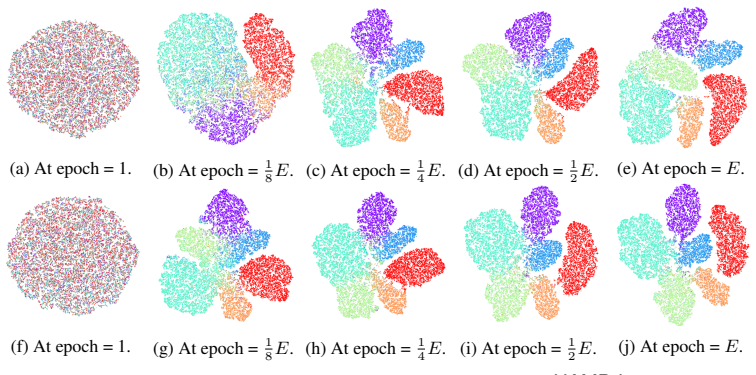
Summary. The manuscript proposes HAMP, a hypergraph message-passing framework inspired by interacting particle systems, with first-order (HAMP-I) and second-order (HAMP-II) variants and a stochastic extension. Hyperedges are treated as fields that exert attraction, repulsion, and Allen-Cahn forces on node features. The central theoretical claim is that these dynamics maintain a strictly positive lower bound on the hypergraph Dirichlet energy, thereby preventing over-smoothing (Prop. 5.4). The paper also reports node-classification experiments on nine real-world hypergraph benchmarks, ablations, depth-accuracy experiments, and t-SNE visualizations.
Significance. If the anti-over-smoothing theorem were established, the paper would provide a useful bridge between collective-dynamics theory and hypergraph neural networks, and the empirical results on heterophilic benchmarks are competitive. The particle-system analogy is clearly explained, and the ablation studies (Tables 2, 5, 6) usefully isolate the contributions of repulsion, Allen-Cahn, and noise terms. However, the theoretical guarantee is the main advertised contribution, and it is not supported by the supplied proofs. The empirical results alone, while solid, do not compensate for the unsupported central claim.
major comments (5)
- [Section 5, Prop. 5.4 / Appendix B, proof of Prop. B.7] The claimed positive lower bound on the Dirichlet energy does not follow from Prop. 5.2/B.5. Inequality (9) is an upper bound on the ratio λ(t) = cM2(t)/‖x̄(1)-x̄(2)‖²; it does not lower-bound either factor. Both cM2(t) and the squared center distance may decay at the same rate, keeping λ(t) bounded while E(x) = Σ_{i,j} Σ_e H_{i,e}H_{j,e}‖x_i-x_j‖² tends to zero, which is exactly the over-smoothing regime of Def. 5.1. The proof of Prop. B.7 asserts 'there is a positive bound between different clusters' without deriving any quantitative lower bound on the center distance or on E(x). This is a load-bearing gap in the main advertised guarantee.
- [Appendix B, Eq. (46) and Lemma B.3] The key lower-bound inequality (34) relies on the unquantified assumption (46), which postulates a constant c_m such that P_e^s(mean vectors) ≥ c_m (x̄(1)-x̄(2)). No construction or verification of such c_m is given for the interaction coefficients f_β used in the models or for general connected hypergraphs. This assumption already presumes the two-group separability that the theorem is supposed to establish, so the hypotheses of Prop. 5.2 are not checkable or guaranteed by the model design.
- [Section 5, Props. 5.3-5.4 and Appendix B, Remarks B.8-B.9] The second-order separation result is quoted from [19], and its extension to the Dirichlet-energy lower bound is deferred with 'can be proved in a similar way' (Remark B.8). The stochastic version is asserted in Remark B.9 without proof. Consequently, the paper supplies no independent proof for HAMP-II or for the SDE formulation, even though both are part of the advertised framework.
- [Appendix A, Algorithms 1-2 vs. Section 5] The implemented algorithms use a nonlinearity σ, an MLP classifier, explicit noise ϵB(t), and a residual connection βX(0), whereas Propositions 5.2-5.4 are stated for the deterministic ODEs (4)-(5) with no activation, no noise, and no such residual term. No argument is provided that the discrete stochastic updates inherit the ODE separation properties, so the theoretical anti-over-smoothing guarantee does not directly cover the evaluated models.
- [Appendix B, proof of Prop. B.5] The proof of the L2 separation invokes 'Lemma 4.1 in [27]' without stating the lemma or verifying its hypotheses. Since [27] is a prior work by the same group and the conditions needed here (including the existence of c_m in Eq. (46)) are not established, the proof is incomplete as written.
minor comments (5)
- [Section 1, Contributions] In the bullet list, 'we should that HAMP achieves competitive results' should read 'we show that HAMP achieves competitive results'.
- [Section 5 and Appendix B] The notation cM2 is used inconsistently: Eq. (16) defines it via centered moments, while Prop. 5.2 defines cM2(t) := M2(x^(1)) + M2(x^(2)). Please reconcile the definitions.
- [Section 5, Prop. 5.4] Prop. 5.4 refers to 'the conditions of Theorem 5.2' and 'Theorem 5.1 in [19]', but the manuscript's own results are numbered as Propositions; the cross-reference should be aligned with the actual numbering.
- [Appendix B, Remark B.9] Remark B.9 states that the separability of the stochastic system 'also holds' without proof; this should at minimum be labeled as a conjecture or supported by a proof.
- [Section 6.3, Fig. 3] The noise ablation is shown only on the Senate dataset in the main text; since the full ablation tables appear in Appendix C.2, a brief statement in the main text directing readers to those tables would improve clarity.
Circularity Check
Prop. 5.4's proof of a positive Dirichlet-energy lower bound assumes the very bound it claims to derive; the ratio bound in Prop. 5.2 cannot supply the missing lower bound.
-
self definitional
[Section 5, Prop. 5.4; Appendix B, Proof of Proposition 5.4]
"Proof of Proposition 5.4.The relative size between ∥¯x(1) −¯x(2)∥2 and cM2 is an indicator of group separation in the sense of L2: if ∥¯x(1) −¯x(2)∥2 is much larger than cM2, then the two groups are well-separated in average sense. Since the hypergraph is connected, there is a positive bound between different clusters, hence the Dirichlet energy does not decay to zero."
Proposition 5.4 is the paper's central theoretical claim: 'there exists a positive lower bound of the Dirichlet energy.' The proof's only substantive premise is 'there is a positive bound between different clusters,' i.e. the same separation guarantee being proved, rephrased; connectedness alone implies no quantitative lower bound (a connected hypergraph can converge to consensus). Prop. 5.2/Eq. (9) only upper-bounds the ratio λ(t)=cM2(t)/||bar x^(1)(t)-bar x^(2)(t)||^2; an upper bound on a ratio does not prevent both numerator and denominator from decaying to zero, so it supplies no floor for E(x)=Σ H_{i,e}H_{j,e}||x_i-x_j||^2. The anti-over-smoothing conclusion therefore reduces to assuming the conclusion.
full rationale
The paper's empirical evaluation is self-contained against standard external benchmarks (ED-HNN, HDSode, etc.), and the ODE derivations in Lemmas B.1-B.4 are genuine computations. The circularity is confined to the advertised theory. Proposition 5.3 is quoted from the prior published theorem [19] (coauthor Shi Jin) and is legitimate external support for a bi-flocking statement, but the paper's Proposition 5.4 extends it to a hypergraph Dirichlet-energy lower bound without proof (Remark B.8 only says it 'can be proved in a similar way'), which is a gap rather than a circular step. Similarly, Lemma B.3's unquantified assumption (46) — existence of c_m with P_e^s ≥ c_m(bar x^(1)-bar x^(2)) — is never derived from the stated f_beta sign conditions, and it already encodes the separation mechanism; this is flagged as missing support. Because the central anti-over-smoothing theorem's proof asserts its own conclusion, the derivation is partially circular: score 6.
Assumptions & free parameters
free parameters (6)
- δ (Allen-Cahn force strength) =
Grid-searched over {0,...,15}, per dataset
- γ (repulsive force coefficient) =
Grid-searched over {0.01,...,0.15}, per dataset
- ε (noise amplitude) =
Grid-searched over {0, 0.1, 0.3}
- time step τ =
Grid-searched over {0.09,...,0.25}
- ω (interaction force weight) =
Not reported, used in Algorithm 1 and 2
- Neural network weights (Φ1, Φ2, Ψ, MLP) =
Learned
assumptions (6)
- domain assumption Interaction coefficients can be partitioned into sign-definite groups: f_β(h) ≥ 0 within groups and ≤ 0 between groups, with symmetry f_β(h_{i,j}^e) = f_β(h_{j,i}^e).
- ad hoc to paper There exist constants c_m, c_v such that P_e^s(mean vectors) ≥ c_m (mean difference) (Eq. 46).
- domain assumption Initial data satisfies λ(0) ≤ λ+ and N1, N2 are sufficiently large.
- domain assumption The hypergraph is connected (for the Dirichlet energy lower bound).
- standard math Known results from [19], [27], [43] are correct and apply to the ODEs considered (e.g., Lemma 4.1 in [27], Theorem 5.1 in [19]).
- ad hoc to paper The stochastic system Eq. 6 inherits the separation properties of the deterministic systems.
Cite this review
Pith. "Pith review of How Particle System Theory Enhances Hypergraph Message Passing." pith.science (2026). https://pith.science/paper/IR5IDEQY
@misc{pith2026250518505,
  author       = {Pith},
  title        = {Pith review of: How Particle System Theory Enhances Hypergraph Message Passing},
  year         = {2026},
  howpublished = {\url{https://pith.science/paper/IR5IDEQY}},
  note         = {Machine review of arXiv:2505.18505}
}
read the original abstract
Hypergraphs effectively model higher-order relationships in natural phenomena, capturing complex interactions beyond pairwise connections. We introduce a novel hypergraph message passing framework inspired by interacting particle systems, where hyperedges act as fields inducing shared node dynamics. By incorporating attraction, repulsion, and Allen-Cahn forcing terms, particles of varying classes and features achieve class-dependent equilibrium, enabling separability through the particle-driven message passing. We investigate both first-order and second-order particle system equations for modeling these dynamics, which mitigate over-smoothing and heterophily thus can capture complete interactions. The more stable second-order system permits deeper message passing. Furthermore, we enhance deterministic message passing with stochastic element to account for interaction uncertainties. We prove theoretically that our approach mitigates over-smoothing by maintaining a positive lower bound on the hypergraph Dirichlet energy during propagation and thus to enable hypergraph message passing to go deep. Empirically, our models demonstrate competitive performance on diverse real-world hypergraph node classification tasks, excelling on both homophilic and heterophilic datasets.
Figures


Figures from the paper (2 more)

Reference graph
Works this paper leans on
-
[27]
Shi Jin and Ruiwen Shu. Collective dynamics of opposing groups with stochastic communica- tion.Vietnam Journal of Mathematics, 49:619–636, 2021
work page 2021
-
[19]
Di Fang, Seung-Yeal Ha, and Shi Jin. Emergent behaviors of the Cucker-Smale ensemble under attractive-repulsive couplings and rayleigh frictions.Mathematical Models and Methods in Applied Sciences, 29(07):1349–1385, 2019
work page 2019
-
[1]
Samuel M Allen and John W Cahn. A microscopic theory for antiphase boundary motion and its application to antiphase domain coarsening.Acta metallurgica, 27(6):1085–1095, 1979
work page 1979
-
[2]
Hypergraph convolution and hypergraph attention
Song Bai, Feihu Zhang, and Philip HS Torr. Hypergraph convolution and hypergraph attention. Pattern Recognition, 110:107637, 2021
2021
-
[3]
Peter W. Battaglia, Jessica B. Hamrick, Victor Bapst, Alvaro Sanchez-Gonzalez, Vinícius Flo- res Zambaldi, Mateusz Malinowski, Andrea Tacchetti, David Raposo, Adam Santoro, Ryan Faulkner, Çaglar Gülçehre, H. Francis Song, Andrew J. Ballard, Justin Gilmer, George E. Dahl, Ashish Vaswani, Kelsey R. Allen, Charles Nash, Victoria Langston, Chris Dyer, Nicolas...
arXiv 2018
-
[4]
Federico Battiston, Enrico Amico, Alain Barrat, Ginestra Bianconi, Guilherme Ferraz de Arruda, Benedetta Franceschiello, Iacopo Iacopini, Sonia Kéfi, Vito Latora, Yamir Moreno, Micah M. Murray, Tiago P. Peixoto, Francesco Vaccarino, and Giovanni Petri. The physics of higher-order interactions in complex systems.Nature Physics, 17(10):1093–1098, October 20...
work page 2021
-
[5]
Adrián Bazaga, Pietro Lio, and Gos Micklem. HyperBERT: Mixing hypergraph-aware layers with language models for node classification on text-attributed hypergraphs. InFindings of the Association for Computational Linguistics: EMNLP 2024, Miami, Florida, USA, November
work page 2024
-
[6]
José A Carrillo and Ruiwen Shu. From radial symmetry to fractal behavior of aggregation equilibria for repulsive–attractive potentials.Calculus of Variations and Partial Differential Equations, 62(1):28, 2023
work page 2023
Show all 50 references
-
[7]
Particle, kinetic, and hydrodynamic models of swarming.Mathematical modeling of collective behavior in socio-economic and life sciences, pages 297–336, 2010
José A Carrillo, Massimo Fornasier, Giuseppe Toscani, and Francesco Vecil. Particle, kinetic, and hydrodynamic models of swarming.Mathematical modeling of collective behavior in socio-economic and life sciences, pages 297–336, 2010
2010
-
[8]
Self-propelled interacting particle systems with roosting force.Mathematical Models and Methods in Applied Sciences, 20(supp01):1533–1552, 2010
José A Carrillo, Axel Klar, Stephan Martin, and Sudarshan Tiwari. Self-propelled interacting particle systems with roosting force.Mathematical Models and Methods in Applied Sciences, 20(supp01):1533–1552, 2010
2010
-
[9]
Gorinova, Stefan D Webb, Emanuele Rossi, and Michael M
Benjamin Paul Chamberlain, James Rowbottom, Maria I. Gorinova, Stefan D Webb, Emanuele Rossi, and Michael M. Bronstein. GRAND: Graph neural diffusion. InICML, 2021
2021
-
[10]
Neural ordinary differential equations.NeurIPS, 31, 2018
Ricky TQ Chen, Yulia Rubanova, Jesse Bettencourt, and David K Duvenaud. Neural ordinary differential equations.NeurIPS, 31, 2018
2018
-
[11]
You are allset: A multiset function framework for hypergraph neural networks
Eli Chien, Chao Pan, Jianhao Peng, and Olgica Milenkovic. You are allset: A multiset function framework for hypergraph neural networks. InICLR, 2022
2022
-
[12]
Classification of edge-dependent labels of nodes in hypergraphs
Minyoung Choe, Sunwoo Kim, Jaemin Yoo, and Kijung Shin. Classification of edge-dependent labels of nodes in hypergraphs. InKDD, page 298–309, New York, NY , USA, 2023. Association for Computing Machinery
2023
-
[13]
Emergent behavior in flocks.IEEE Transactions on Automatic Control, 52(5):852–862, 2007
Felipe Cucker and Steve Smale. Emergent behavior in flocks.IEEE Transactions on Automatic Control, 52(5):852–862, 2007
2007
-
[14]
Hnhn: Hypergraph networks with hyperedge neurons
Yihe Dong, Will Sawin, and Yoshua Bengio. Hnhn: Hypergraph networks with hyperedge neurons. InICML, 2020
2020
-
[15]
The stochastic delayed cucker-smale system in a harmonic potential field.Kinetic and Related Models, 16(1):54–68, 2023
Linglong Du and Xinyun Zhou. The stochastic delayed cucker-smale system in a harmonic potential field.Kinetic and Related Models, 16(1):54–68, 2023. ISSN 1937-5093. doi: 10.3934/krm.2022022
2023 doi
-
[16]
Sheaf hypergraph networks
Iulia Duta, Giulia Cassarà, Fabrizio Silvestri, and Pietro Lió. Sheaf hypergraph networks. In NeurIPS, volume 36, pages 12087–12099. Curran Associates, Inc., 2023. 10
2023
-
[17]
Self-propelled particles with soft-core interactions: patterns, stability, and collapse.Physical review letters, 96 (10):104302, 2006
Maria R D’Orsogna, Yao-Li Chuang, Andrea L Bertozzi, and Lincoln S Chayes. Self-propelled particles with soft-core interactions: patterns, stability, and collapse.Physical review letters, 96 (10):104302, 2006
2006
-
[18]
A proposal on machine learning via dynamical systems.Communications in Mathematics and Statistics, 1(5):1–11, 2017
Weinan E. A proposal on machine learning via dynamical systems.Communications in Mathematics and Statistics, 1(5):1–11, 2017
2017
-
[20]
Hypergraph neural networks
Yifan Feng, Haoxuan You, Zizhao Zhang, Rongrong Ji, and Yue Gao. Hypergraph neural networks. InAAAI, volume 33, pages 3558–3565, 2019
2019
-
[21]
Hypergraph Learning: Methods and Practices.TPAMI, 44(5), May 2022
Yue Gao, Zizhao Zhang, Haojie Lin, Xibin Zhao, Shaoyi Du, and Changqing Zou. Hypergraph Learning: Methods and Practices.TPAMI, 44(5), May 2022. ISSN 1939-3539
2022
-
[22]
Hgnn+: General hypergraph neural networks
Yue Gao, Yifan Feng, Shuyi Ji, and Rongrong Ji. Hgnn+: General hypergraph neural networks. TPAMI, 45(3):3181–3199, 2023. doi: 10.1109/TPAMI.2022.3182052
2023
-
[23]
Neural message passing for quantum chemistry
Justin Gilmer, Samuel S Schoenholz, Patrick F Riley, Oriol Vinyals, and George E Dahl. Neural message passing for quantum chemistry. InICML, 2017
2017
-
[24]
Emergence of time-asymptotic flocking in a stochastic cucker-smale system.Communications in Mathematical Sciences, 7(2), 2009
Seung-Yeal Ha, Kiseop Lee, and Doron Levy. Emergence of time-asymptotic flocking in a stochastic cucker-smale system.Communications in Mathematical Sciences, 7(2), 2009
2009
-
[25]
Formation of clumps and patches in self-aggregation of finite-size particles.Physica D: Nonlinear Phenomena, 220(2):183–196, 2006
Darryl D Holm and Vakhtang Putkaradze. Formation of clumps and patches in self-aggregation of finite-size particles.Physica D: Nonlinear Phenomena, 220(2):183–196, 2006
2006
-
[26]
Unignn: a unified framework for graph and hypergraph neural networks
Jing Huang and Jie Yang. Unignn: a unified framework for graph and hypergraph neural networks. InIJCAI, 2021
2021
-
[28]
A survey on hypergraph neural networks: An in-depth and step-by-step guide
Sunwoo Kim, Soo Yong Lee, Yue Gao, Alessia Antelmi, Mirko Polato, and Kijung Shin. A survey on hypergraph neural networks: An in-depth and step-by-step guide. InKDD, page 6534–6544, New York, NY , USA, 2024. Association for Computing Machinery
2024
-
[29]
Semi-supervised classification with graph convolutional networks
Thomas N Kipf and Max Welling. Semi-supervised classification with graph convolutional networks. InICLR, 2017
2017
-
[30]
Stability of ring patterns arising from two-dimensional particle interactions.Physical Review E, 84(1):015203, 2011
Theodore Kolokolnikov, Hui Sun, David Uminsky, and Andrea L Bertozzi. Stability of ring patterns arising from two-dimensional particle interactions.Physical Review E, 84(1):015203, 2011
2011
-
[31]
Emergent behaviour in multi-particle systems with non-local interactions, 2013
Theodore Kolokolnikov, José A Carrillo, Andrea Bertozzi, Razvan Fetecau, and Mark Lewis. Emergent behaviour in multi-particle systems with non-local interactions, 2013
2013
-
[32]
When hypergraph meets heterophily: New benchmark datasets and baseline
Ming Li, Yongchun Gu, Yi Wang, Yujie Fang, Lu Bai, Xiaosheng Zhuang, and Pietro Lio. When hypergraph meets heterophily: New benchmark datasets and baseline. InAAAI, pages 18377–18384, 2025
2025
-
[33]
Heterophilious dynamics enhances consensus.SIAM Review, 56(4):577–621, 2014
Sebastien Motsch and Eitan Tadmor. Heterophilious dynamics enhances consensus.SIAM Review, 56(4):577–621, 2014
2014
-
[34]
Revisiting graph neural networks: All we have is low-pass filters.arXiv preprint arXiv:1905.09550, 2019
Hoang Nt and Takanori Maehara. Revisiting graph neural networks: All we have is low-pass filters.arXiv preprint arXiv:1905.09550, 2019
1905 arXiv
-
[35]
Graph neural networks exponentially lose expressive power for node classification
Kenta Oono and Taiji Suzuki. Graph neural networks exponentially lose expressive power for node classification. InICLR, 2019
2019
-
[36]
Nonlinear feature diffusion on hypergraphs
Konstantin Prokopchik, Austin R Benson, and Francesco Tudisco. Nonlinear feature diffusion on hypergraphs. InICML, pages 17945–17958. PMLR, 2022. 11
2022
-
[37]
Loan Rayleigh.JWS, The Theory of Sound, vol. 1. Macmillan, London (reprinted Dover, New York, 1945), 1894
1945
-
[38]
Visualizing data using t-sne.Journal of Machine Learning Research, 9(86):2579–2605, 2008
Laurens van der Maaten and Geoffrey Hinton. Visualizing data using t-sne.Journal of Machine Learning Research, 9(86):2579–2605, 2008
2008
-
[39]
Gomez, Łukasz Kaiser, and Illia Polosukhin
Ashish Vaswani, Noam Shazeer, Niki Parmar, Jakob Uszkoreit, Llion Jones, Aidan N. Gomez, Łukasz Kaiser, and Illia Polosukhin. Attention is all you need. InNeurIPS, pages 6000–6010, 2017
2017
-
[40]
Hypergraph factorization for multi-tissue gene expression imputation
Ramon Viñas, Chaitanya K Joshi, Dobrik Georgiev, Phillip Lin, Bianca Dumitrascu, Eric R Gamazon, and Pietro Liò. Hypergraph factorization for multi-tissue gene expression imputation. Nature Machine Intelligence, pages 1–15, 2023
2023
-
[41]
Fangxin Wang, Yuqing Liu, Kay Liu, Yibo Wang, Sourav Medya, and Philip S. Yu. Uncertainty in graph neural networks: A survey.Transactions on Machine Learning Research, 2024
2024
-
[42]
Equivariant hyper- graph diffusion neural operators
Peihao Wang, Shenghao Yang, Yunyu Liu, Zhangyang Wang, and Pan Li. Equivariant hyper- graph diffusion neural operators. InICLR, 2023
2023
-
[43]
ACMP: Allen-cahn message passing with attractive and repulsive forces for graph neural networks
Yuelin Wang, Kai Yi, Xinliang Liu, Yu Guang Wang, and Shi Jin. ACMP: Allen-cahn message passing with attractive and repulsive forces for graph neural networks. InICLR, 2023
2023
-
[44]
Collective dynamics of ‘small-world’networks.Nature, 393(6684):440–442, 1998
Duncan J Watts and Steven H Strogatz. Collective dynamics of ‘small-world’networks.Nature, 393(6684):440–442, 1998
1998
-
[45]
Se3set: Harnessing equivariant hypergraph neural networks for molecular representation learning.Transactions on Machine Learning Research, 2025
Hongfei Wu, Lijun Wu, Guoqing Liu, Zhirong Liu, Bin Shao, and Zun Wang. Se3set: Harnessing equivariant hypergraph neural networks for molecular representation learning.Transactions on Machine Learning Research, 2025
2025
-
[46]
Hypergcn: A new method for training graph convolutional networks on hypergraphs
Naganand Yadati, Madhav Nimishakavi, Prateek Yadav, Vikram Nitin, Anand Louis, and Partha Talukdar. Hypergcn: A new method for training graph convolutional networks on hypergraphs. InNeurIPS, 2019
2019
-
[47]
Hypergraph dynamic system
Jielong Yan, Yifan Feng, Shihui Ying, and Yue Gao. Hypergraph dynamic system. InICLR, 2024
2024
-
[48]
Co-representation neural hypergraph diffusion for edge- dependent node classification.arXiv preprint arXiv:2405.14286, 2024
Yijia Zheng and Marcel Worring. Co-representation neural hypergraph diffusion for edge- dependent node classification.arXiv preprint arXiv:2405.14286, 2024
2024
-
[49]
1 N1 + 1 N2 X e∈E X i∈e ψe,− i # ¯x(1) (42) 17 − 1 N1 + 1 N2 X e∈E X j∈e ψe,− j ˆx(2) j +
Dengyong Zhou, Jiayuan Huang, and Bernhard Schölkopf. Learning with hypergraphs: Cluster- ing, classification, and embedding. InNeurIPS, volume 19, 2006. 12 A Algorithms Complexity Analysis.Here, we analyze the computational complexity of one layer inHAMP-I andHAMP-II. Analyti...
2006
-
[2024]
Association for Computational Linguistics
Reviewed August 7, 2026 · model on record in the stance chip above.
Discussion (0). Continue with ORCID to comment.