REVIEW 4 major objections 5 minor 24 references
MAVL: A Multilingual Audio-Video Lyrics Dataset for Animated Song Translation
T0 review · 4 major / 5 minor · reviewed 2026-08-07 · deepseek-v4-flash
Pith's one-line read The paper claims that hearing the audio and seeing the video, on top of an explicit syllable target, makes machine translation of animated-song lyrics more singable and contextually accurate, and introduces the five-language benchmark…
desk verdict The MAVL dataset is a genuine resource for lyrics translation, but the paper's central claim that audio-video cues drive the gains is contradicted by its own ablation tables. read the letter →
The pith
A machine-rendered reading of the paper's core claim, the machinery that carries it, and where it could break.
The reading
What carries the argument
The load-bearing mechanism is SylAVL-CoT, a three-step inference-time pipeline wrapping a closed multimodal large language model rather than a trained translation model. Step one uses the audio to locate the lyric line and segment it into a syllable list, fixing a rhythmic template; step two uses the video to generate a target-language syllable list that preserves the count and reflects on-screen imagery and mood; step three rephrases iteratively until the syllable count and naturalness converge. The benchmark's evaluation machinery scores outputs with a weighted Syllable Error ($\beta=2$ for over-long lines), Syllable Count Distance, error rate, MPNet embedding cosine similarity for sense, and IPA Levenshtein distance for naturalness, computed against both the original English and the official dubbed lyrics.
What would settle it
Take a set of lyric translations with identical syllable counts but different melodic fit, and have trained singers rate how easily each line sings over the original melody; if the ratings do not track the syllable-error metric, the paper's quantitative 'singability' advantage is an artifact of the proxy rather than a property of the audio-video method.
Extended reading notes
Core claim
The paper's central claim is that singable lyric translation is a multimodal constraint-satisfaction problem, not a text-to-text one. MAVL is presented as the first multilingual parallel benchmark for this task that includes audio and video alongside verified dubbed lyrics; SylAVL-CoT is its proposed solution, using a chain-of-thought prompt on Gemini 2.0 Flash to segment the source line by syllables, draft a target-language syllable list with video context, and iterate until the output matches the original syllable count. On the benchmark, SylAVL-CoT reports lower Syllable Error and IPA phonetic distance than text-only translators with or without syllable prompting, and its translations score closer to human expert dubs on both original and dubbed references. The paper takes this as evidence that the audio provides the rhythmic template and the video provides the expressive context that syllable count alone cannot supply.
Load-bearing premise
The headline results hinge on the assumption that matching the syllable count of a reference and being phonetically close to it capture what makes lyrics singable and natural; if those proxies diverge from what listeners experience when a lyric is sung, the reported advantage of the multimodal method would not reflect a real improvement.
Editorial extensions
If this is right
- Text-only translation, even when told the syllable count, leaves a measurable singability gap that audio and video context close.
- Syllable constraints can be enforced at inference time through prompting alone, so the method improves automatically when the underlying LLM improves; the paper demonstrates this by swapping Gemini 2.0 Flash for 2.5 Flash.
- The dual-reference evaluation, scoring against both original English lyrics and official dubs, offers a reusable template for judging whether a translation is both faithful and dubbing-like.
- The timestamped, verified MAVL data supports future work on constrained generation, audio-video alignment, and multilingual translation evaluation.
Reading between the lines
- Extension: the paper's singability and naturalness claims depend on syllable-count and IPA-distance proxies; a blind singing study that varies syllable fit while holding meaning constant would show whether the measured advantage corresponds to what a listener hears.
- Extension: because SylAVL-CoT is a prompting pipeline rather than a trained model, the same three-step recipe could transfer to live-action dubbing or cover songs, where official dubbed references may not exist and the source audio is the only rhythm anchor.
- Extension: the dual-reference structure could be used to semi-automatically curate training data for under-resourced languages, filtering fan translations by syllable-count agreement with the audio before adding them to a benchmark.
Editorial analysis
A structured set of objections, weighed in public.
Referee Report
Summary. The paper introduces MAVL, a multilingual audio-video lyrics benchmark for animated song translation, comprising 228 English songs with aligned text, audio, and video and official dubbed lyrics in Spanish, French, Japanese, and Korean. It also proposes SylAVL-CoT, a chain-of-thought prompting strategy built on Gemini 2.0 Flash that incorporates audio and video context and enforces syllable-count constraints. The authors define syllable-error, semantic-similarity, and IPA-Levenshtein metrics, report comparisons against several text-only baselines with and without syllable constraints, run modality ablations, and present a small user study. The headline claim is that SylAVL-CoT significantly outperforms text-based models in both singability and contextual accuracy.
Significance. The dataset is a potentially valuable community resource: it is the first five-language, multimodal parallel lyrics benchmark with audio, video, and human-verified official dubs, and the collection pipeline (vocal separation, Whisper-based ensemble alignment, and human cross-checking) is a practical contribution. The proposed prompting method, SylAVL-CoT, is simple, reproducible, and addresses a real constraint—syllable matching—in a creative translation task. The paper provides code and dataset links and includes a detailed prompt appendix, which supports reproducibility. However, the experimental support for the central claim is incomplete: the modality ablation omits the very metrics used to define singability, and the notion of 'contextual accuracy' is asserted rather than directly measured. If the dataset and method are released as described, the work is a solid benchmark contribution, but the claimed multimodal advantage over text-only systems needs substantially stronger evidence.
major comments (4)
- [Section 3.3, Table 6, Table 8] The paper's central claim that audio and video context improves singability is not established. The modality ablation in Table 6 reports only MPNet semantic similarity and omits the syllable-error metrics (SE, SCD, error rate) that the paper itself defines as the singability measure in Section 3.3. Table 8 shows that the text-only CoT version of Gemini (the same prompting scheme without audio or video) achieves a lower syllable error than SylAVL-CoT on French (0.848 vs. 0.902) and Japanese (2.026 vs. 2.572), and no significance testing is reported for the languages where SylAVL-CoT is numerically better. Because the method differs from the text-only baselines in multiple respects—CoT prompting, syllable-list generation, iterative refinement, and multimodal inputs—the reported gains cannot be attributed to audio-video context without a full factorial ablation that reports syllable and phonetic metrics for T, T+A, T+V, and T+A+V.
- [Abstract, Section 4.2, Table 4, Table 9] The claim of improved 'contextual accuracy' is not supported by the evidence presented. In Table 4, against dubbed lyrics, SylAVL-CoT's MPNet scores are not consistently above text-only baselines (e.g., ES: 0.656 vs. Qwen2.5-72B w/o SC at 0.677; FR: 0.640 vs. Qwen at 0.655), and against English lyrics SylAVL-CoT is substantially below all text-only models. The paper reinterprets this gap as desirable creative paraphrasing, but this interpretation is not independently validated. The user study in Table 9 has only ten participants per language, reports no significance tests or inter-annotator agreement, and does not isolate whether improvements in perceived quality stem from syllable adherence, semantic fidelity, or audio-video context. The authors should either propose a metric that directly scores alignment with visual and auditory content or explicitly narrow the claim to singability rather than contextual accuracy.
- [Section 3.3, Eq. (1), Section 6 (Evaluation Metrics)] The syllable-error metric in Eq. (1) is presented as a measure of 'singability,' but the paper provides no evidence that matching the original syllable count, or the dubbed count, corresponds to perceived singing fit. The only perceptual validation is the user study, which is too small to establish this correspondence. The paper's own Limitations section acknowledges that automated metrics cannot fully capture musicality or artistic style. Additionally, because the model is given the original syllable count in the prompt and then evaluated on how closely it matches that same count, SE partly measures instruction-following ability rather than musical fit. This limitation should be stated prominently in the metric discussion, and the headline claim 'significantly outperforms in singability' should be softened to 'syllable-count agreement' unless a controlled perceptual study supports it.
- [Section 4.3, Table 6] The ablation study in Table 6 does not isolate the contribution of audio or video. The rows labeled T+A and T+A+V compare text-plus-audio and text-plus-audio-plus-video, but there is no audio-only or video-only condition, and the text says 'using only the audio modality yields the highest scores,' which is inaccurate given the table. The conclusion that 'leveraging all modalities produces the most dubbing-like translations' is based only on small MPNet differences with no significance testing. This table needs a complete modality matrix with syllable-error results to support the claim that multimodal cues are necessary.
minor comments (5)
- [Table 1] The column header 'Singablilty' is misspelled; it should be 'Singability.'
- [Section 4.3] The sentence 'using only the audio modality yields the highest scores' contradicts Table 6, where T+A (text plus audio) is the best row, not an audio-only condition; please rephrase to 'adding audio to text.'
- [Section 3.1, Table 2] The paper states '228 songs across five languages,' but Table 2 shows 228 English songs and fewer non-English songs; please clarify that 228 is the number of English source songs, and that the non-English subsets are smaller.
- [Appendix I] The reported API cost of 'about $400K total' for approximately 20,000 calls appears implausibly high; if this is a real expenditure, it should be explained, and if it is a typo it should be corrected, as it has implications for the reproducibility of the method.
- [Section 4.5] The user study report does not state whether the ten participants per language were balanced for age, gender, or familiarity with dubbed musicals, nor does it provide inter-annotator agreement statistics; adding these details would strengthen the study's credibility.
Circularity Check
No significant circularity: the benchmark and prompting method are empirical, and the syllable-count constraint is disclosed and applied equally to baselines.
full rationale
MAVL is an empirical benchmark paper, not a derivation chain, so the circularity burden is low. The load-bearing claims—dataset construction, SylAVL-CoT's prompting pipeline, and metric-based comparisons—do not reduce to their inputs by construction. The strongest candidate for circularity is that SylAVL-CoT is prompted with the exact source syllable count (Table 15: 'Real Syllable Count: {syllable_count}') and then scored by Syllable Error (Eq. 1) against that same count. This makes SE partly an instruction-following measure, but the paper is transparent about this design, and the headline singability comparison in Table 3 is against text-only LLMs that also receive the same syllable-constraint prompt ('w/ SC' rows). The modality ablation in Table 6 and the CoT ablation in Table 8 provide independent, if incomplete, decompositions. Metrics are adapted from cited external work (Ye et al. 2024; Kim et al. 2024) rather than invented to match the method. No self-citation chain carries a load-bearing premise; the 'first multilingual benchmark' claim is a dataset scope claim, not a derived theorem. The skeptical concerns about whether the modality effect is isolated and whether syllable error captures melodic fit are validity and correctness issues, not circularity.
Assumptions & free parameters
free parameters (1)
- SE penalty factor beta =
2.0
assumptions (6)
- domain assumption Whisper/stable-ts timestamps accurately align lyric lines with audio and video.
- domain assumption lyricstranslate candidates, after human cross-checking against official dub audio and video, are official singable dubbed lyrics.
- domain assumption Syllable-count match is a valid, sufficiently complete proxy for singability.
- domain assumption MPNet cosine similarity between the model output and reference lyrics measures semantic fidelity.
- domain assumption Levenshtein distance between IPA transcriptions measures phonetic naturalness.
- domain assumption Per-language syllable and IPA libraries, such as Epitran and the listed syllabifiers, give correct counts for all five languages.
Cite this review
Pith. "Pith review of MAVL: A Multilingual Audio-Video Lyrics Dataset for Animated Song Translation." pith.science (2026). https://pith.science/paper/GNCVLJE6
@misc{pith2026250518614,
  author       = {Pith},
  title        = {Pith review of: MAVL: A Multilingual Audio-Video Lyrics Dataset for Animated Song Translation},
  year         = {2026},
  howpublished = {\url{https://pith.science/paper/GNCVLJE6}},
  note         = {Machine review of arXiv:2505.18614}
}
read the original abstract
Lyrics translation requires both accurate semantic transfer and preservation of musical rhythm, syllabic structure, and poetic style. In animated musicals, the challenge intensifies due to alignment with visual and auditory cues. We introduce Multilingual Audio-Video Lyrics Benchmark for Animated Song Translation (MAVL), the first multilingual, multimodal benchmark for singable lyrics translation. By integrating text, audio, and video, MAVL enables richer and more expressive translations than text-only approaches. Building on this, we propose Syllable-Constrained Audio-Video LLM with Chain-of-Thought SylAVL-CoT, which leverages audio-video cues and enforces syllabic constraints to produce natural-sounding lyrics. Experimental results demonstrate that SylAVL-CoT significantly outperforms text-based models in singability and contextual accuracy, emphasizing the value of multimodal, multilingual approaches for lyrics translation.
Figures


Figures from the paper (6 more)



Reference graph
Works this paper leans on
-
[1]
It quantifies the phonetic deviation from ref- erence lyrics, which are assumed to be inher- ently natural and pronounceable in their re- spective languages. A lower distance suggests that the translation inherits this natural pho- netic structure, making it more likely to sound fluent
-
[2]
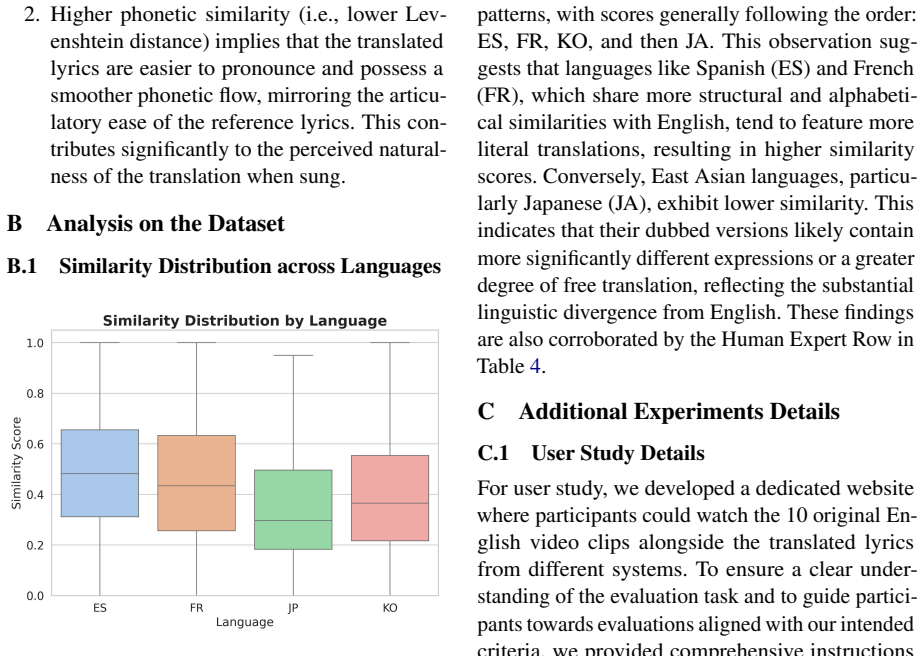
Higher phonetic similarity (i.e., lower Lev- enshtein distance) implies that the translated lyrics are easier to pronounce and possess a smoother phonetic flow, mirroring the articu- latory ease of the reference lyrics. This con- tributes significantly to the perceived natural- ness of the translation when sung. B Analysis on the Dataset B.1 Similarity Di...
-
[3]
Iterate and Refine the Translation - After generating the initial translation, check for syllable count, natural flow, rhythm, rhyme, and meaning in context with the video and audio. - If the lyric was originally a single sentence, confirm that your translation remains one smooth, complete sentence in {target_lang}. - If maintaining the syllable count as ...
-
[4]
Generate the Final Translation - After ensuring the translation feels natural and maintains the desired structure (single sentence if the original lyric was one, etc.), use the final syllable list to form the completed translation. - The final translation should include natural spacing as is customary in the target language. For languages that do not typi...
-
[5]
Three months of winter coolness and awesome holidays
Identify the Core Lyric and Perform Syllable Segmentation - You are given both an audio clip (which may include additional lyrics before or after) and the corresponding lyric text for a specific scene. - Use the provided lyric text to determine the exact lyric line you need to process, and disregard any extraneous audio content that is not part of the giv...
-
[6]
Generate the Target Language Translation Syllable List Utilizing the Video Information - Translate the meaning of the lyric naturally and idiomatically into the target language ({target_lang}). - Review the provided video context and generate the description of the video to understand the intended mood, imagery, and cultural nuances of the original lyric....
-
[9]
Three months of winter coolness and awesome holidays
Identify the Core Lyric and Perform Syllable Segmentation - Read carefully to the provided lyrics to capture the natural rhythm, pronunciation, and any important phonetic, musical, or syllabic characteristics of the identified lyric line. - You will be also given the real syllable count of the original lyric. - Important: You must create a syllable list t...
-
[10]
Generate the Target Language Translation Syllable List - Translate the meaning of the lyric naturally and idiomatically into the target language ({target_lang}). - If specific cultural elements appear, choose the most context-appropriate term in target_lang to convey the intended meaning. - Strive to maintain or approximate any rhymes present in the origi...
Show all 24 references
-
[11]
- If the lyric was originally a single sentence, confirm that your translation remains one smooth, complete sentence in {target_lang}
Iterate and Refine the Translation - After generating the initial translation, check for syllable count, natural flow, rhythm, rhyme, and meaning in context. - If the lyric was originally a single sentence, confirm that your translation remains one smooth, complete sentence in...
-
[12]
‘json "translation
Generate the Final Translation - After ensuring the translation feels natural and maintains the desired structure (single sentence if the original lyric was one, etc.), use the final syllable list to form the completed translation. - The final translation should include natura...
-
[13]
And there’s a butterfly
Identify the Core Lyric and Perform Syllable Segmentation - The core lyric is: "And there’s a butterfly". - Audio analysis indicates a natural flow with emphasis on "butterfly". - The original syllable count is 6. - Syllable segmentation: ‘["And", "there’s", "a", "but", "ter", "fly"]‘
-
[14]
ᄂ ᅡᄇ ᅵ" (nabi). - Initial translation:
Generate the Target Language Translation Syllable List Utilizing the Video Information - Video context: The scene shows a colorful, cheerful environment with a pink Troll, running happily. A butterfly flits around. The mood is light and joyful. - Translation considerations: We...
-
[15]
ᄂ ᅡᄇ ᅵᄀ ᅡ있ᄋ ᅥᄋ ᅭ
Iterate and Refine the Translation - The initial translation "ᄂ ᅡᄇ ᅵᄀ ᅡ있ᄋ ᅥᄋ ᅭ" is grammatically correct and fits the context. The syllable count is also correct at 6. - We can consider other options to see if we can get a more singable result, but this is already quite good...
-
[16]
ᄂ ᅡᄇ ᅵ ᄀ ᅡᄂ ᅡ ᆯᄋ ᅡ 와
Generate the Final Translation - I think "ᄂ ᅡᄇ ᅵ ᄀ ᅡᄂ ᅡ ᆯᄋ ᅡ 와" is slightly better because it has a sense of movement. - Final Syllable List: ‘["ᄂ ᅡ", "ᄇ ᅵ", "ᄀ ᅡ", "ᄂ ᅡ ᆯ", "ᄋ ᅡ", "와"]‘ - Final Translation:ᄂ ᅡᄇ ᅵᄀ ᅡᄂ ᅡ ᆯᄋ ᅡ와 “‘json {"translation": "ᄂ ᅡᄇ ᅵᄀ ᅡᄂ ᅡ ᆯᄋ ᅡ와"} “‘...
-
[17]
Remember me, don’t let it make you cry
Identify the Core Lyric and Perform Syllable Segmentation I begin with the original lyric “Remember me, don’t let it make you cry” and note the natural break after “me.” I segment the lyric into its constituent syllables as follows: ‘["Re", "mem", "ber", "me,", "don’t", "let",...
-
[18]
ᄂ ᅡ ᆯ",
Generate the Target Language Translation Syllable List The video shows a young boy singing to his elderly grandmother, who looks sad. Given the context, the translation should be comforting and gentle. I will aim for a translation that conveys the same emotion and fits the rhy...
-
[19]
ᄂ ᅡ ᆯ",
Iterate and Refine the Translation Upon reviewing the segmentation ["ᄂ ᅡ ᆯ", "ᄀ ᅵ", "ᄋ ᅥ ᆨ", "ᄒ ᅢ", "ᄌ ᅯ", "울", "ᄌ ᅵ", "는", "ᄆ ᅡ"], several issues become apparent: Upon reviewing the initial segmentation ["ᄂ ᅡ ᆯ", "ᄀ ᅵ", "ᄋ ᅥ ᆨ", "ᄒ ᅢ", "ᄌ ᅯ", "울", "ᄌ ᅵ", "는", "ᄆ ᅡ"], ...
-
[20]
ᄂ ᅡ ᆯ",
Generate the Final Translation The final syllable list is: ‘["ᄂ ᅡ ᆯ", "이 ᆽ", "ᄌ ᅵ", "ᄆ ᅡ", "ᄉ ᅳ ᆯ", "ᄑ ᅥ", "ᄒ ᅡ", "ᄌ ᅵ", "는", "ᄆ ᅡ"]‘ “‘json {"translation": "ᄂ ᅡ ᆯ이 ᆽᄌ ᅵ ᄆ ᅡᄉ ᅳ ᆯᄑ ᅥᄒ ᅡᄌ ᅵ는ᄆ ᅡ"} “‘ Table 19:Sample Reasoning Process for Chain-of-Thought Lyrics Translation
-
[21]
ᄀ ᅵᄋ ᅥ ᆨᄒ ᅢᄌ ᅯᄌ ᅵ그 ᆷᄄ ᅥᄂ ᅡᄀ ᅡᄌ ᅵ만
Identify the Core Lyric and Perform Syllable Segmentation The original lyric is “ᄀ ᅵᄋ ᅥ ᆨᄒ ᅢᄌ ᅯᄌ ᅵ그 ᆷᄄ ᅥᄂ ᅡᄀ ᅡᄌ ᅵ만”. I segment the lyric into its constituent syllables as follows: ‘["ᄀ ᅵ", "ᄋ ᅥ ᆨ", "ᄒ ᅢ", "ᄌ ᅯ", "ᄌ ᅵ", "그 ᆷ", "ᄄ ᅥ", "ᄂ ᅡ", "ᄀ ᅡ", "ᄌ ᅵ", "만"]‘ This gives ...
-
[22]
Re", "mem
Generate the Target Language Translation Syllable List The video shows a young boy singing to an elderly woman in a wheelchair. The boy is trying to cheer her up with the song. Given the context, I need to translate the line to convey a sense of longing and remembrance as the ...
-
[23]
remember me
Iterate and Refine the Translation The initial translation has 11 syllables, which matches the original. The phrase "remember me" captures the essence of the original lyric "ᄀ ᅵᄋ ᅥ ᆨᄒ ᅢᄌ ᅯ". The phrase "though I have to leave you now" translates "ᄌ ᅵ그 ᆷᄄ ᅥᄂ ᅡᄀ ᅡᄌ ᅵ만" effect...
-
[24]
Remember me though I have to leave you now
Generate the Final Translation The translation meets all the required conditions: natural flow, correct syllable count, and cultural appropriateness. The final English translation is: "Remember me though I have to leave you now" “‘json { "translation": "Remember me though I ha...
-
[2023]
Singability
Songs across borders: Singable and controllable neural lyric translation.Preprint, arXiv:2305.16816. Kishore Papineni, Salim Roukos, Todd Ward, and Wei- Jing Zhu. 2002. Bleu: a method for automatic evalu- ation of machine translation. InProceedings of the 40th annual meeting o...
2002 arXiv
-
[2024]
do you want to build a snowman?
Multi-modal latent space learning for chain-of- thought reasoning in language models. InProceed- ings of the AAAI Conference on Artificial Intelligence, volume 38, pages 18180–18187. Ke Hu, Zhehuai Chen, Chao-Han Huck Yang, Piotr ˙Ze- lasko, Oleksii Hrinchuk, Vitaly Lavrukhin,...
Reviewed August 7, 2026 · model on record in the stance chip above.
Discussion (0). Continue with ORCID to comment.