Coupling an elastic string to an active bath: the emergence of inverse damping
Pith reviewed 2026-05-19 13:07 UTC · model grok-4.3
The pith
An active bath of run-and-tumble particles can induce negative friction on an elastic string, producing wave instability via a sign-changing frenetic term.
A machine-rendered reading of the paper's core claim, the machinery that carries it, and where it could break.
Core claim
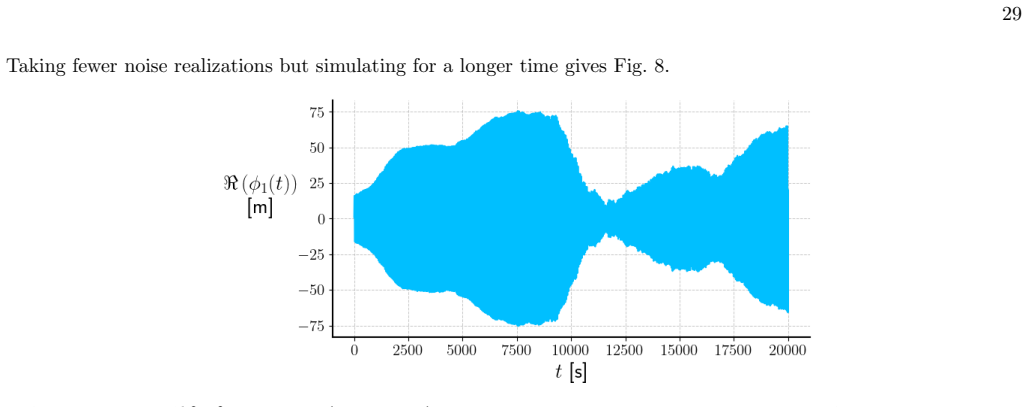
The induced friction coefficient is the sum of an entropic term, proportional to the noise variance, and a frenetic term that can be positive or negative. For sufficiently persistent run-and-tumble baths the frenetic term wins, the total friction becomes negative, and the string develops a wave instability akin to inverse Landau damping. The acceleration fades and eventually disappears at much higher propulsion speeds. Direct simulations confirm the initial growth driven by this anti-damping.
What carries the argument
The frenetic contribution to the friction coefficient, obtained exactly within the weak-coupling expansion of the induced Langevin-Klein-Gordon equation.
If this is right
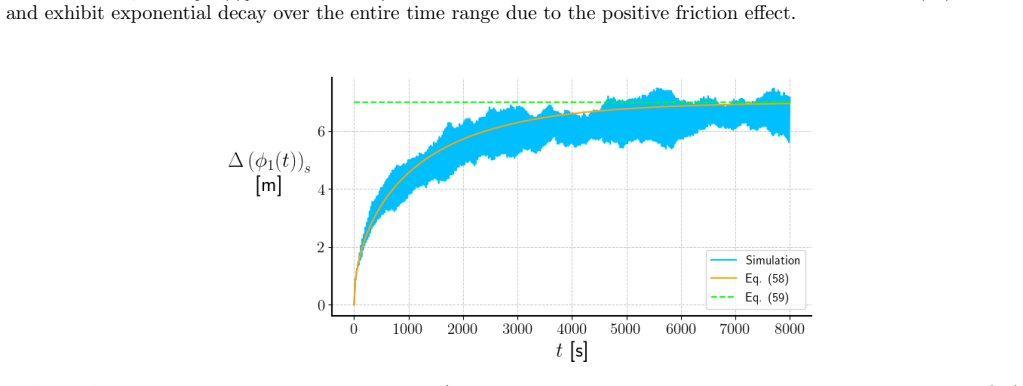
- Wave amplitudes on the string grow exponentially at early times because of the anti-damping.
- The instability is absent both at low persistence and at extremely high propulsion speeds.
- The effective equation supplies closed-form expressions for the streaming term, friction, and noise variance.
- The same sign change in friction can appear in any system where persistent active particles couple to a deformable passive object.
Where Pith is reading between the lines
- The mechanism may operate in other active-matter settings where persistence competes with coupling strength, such as membranes or filaments in bacterial baths.
- It supplies a route to spontaneous pattern formation or self-amplification without external energy input beyond the bath activity.
- Testing the same coupling in two or three dimensions would show whether the instability produces extended structures or localized modes.
Load-bearing premise
The weak-coupling expansion remains valid and the run-and-tumble particles keep their persistence statistics while interacting with the string.
What would settle it
Observation of negative total friction or exponential growth of string displacement modes at intermediate persistence values, together with suppression of that growth at very high propulsion speeds, would confirm the result; failure to see either the growth or its suppression would falsify it.
Figures



read the original abstract
We consider a slow elastic string with Klein-Gordon dynamics coupled to a bath of run-and-tumble particles. We derive and solve the induced Langevin-Klein-Gordon string dynamics with explicit expressions for the streaming term, friction coefficient, and noise variance. These parameters are computed exactly in a weak coupling expansion. The induced friction is a sum of two terms: one entropic, proportional to the noise variance as in the Einstein relation for a thermal equilibrium bath, and a frenetic contribution that can take both signs. The frenetic part wins for higher bath persistence, making the total friction negative, and hence creating a wave instability akin to inverse Landau damping. However, this acceleration decreases and eventually disappears when the propulsion speed of the active particles becomes much higher. Detailed simulations confirm the initial growth driven by this anti-damping.
Editorial analysis
A structured set of objections, weighed in public.
Referee Report
Summary. The manuscript considers a slow elastic string with Klein-Gordon dynamics coupled to a bath of run-and-tumble particles. It derives the induced effective Langevin-Klein-Gordon dynamics for the string via a weak-coupling expansion, providing explicit expressions for the streaming term, the friction coefficient (split into entropic and frenetic contributions), and the noise variance. The central result is that the frenetic term can dominate and render the total friction negative at higher bath persistence, producing a linear wave instability analogous to inverse Landau damping; the effect weakens at very high propulsion speeds. Detailed simulations are reported to confirm the initial growth phase driven by this anti-damping.
Significance. If the result holds, the work identifies a concrete mechanism by which frenetic contributions from an active bath can induce negative damping and instabilities in a passive elastic medium, extending inverse-damping concepts to active-matter settings. Potential relevance includes biological filaments or soft active materials. Explicit parameter-free expressions obtained from the bath properties in weak coupling and the simulation confirmation of initial growth constitute clear strengths.
major comments (1)
- [Derivation of the induced Langevin-Klein-Gordon dynamics (weak-coupling expansion)] The weak-coupling expansion used to obtain the friction coefficient (entropic plus frenetic) assumes small string displacements so that the run-and-tumble persistence statistics of the bath particles remain unperturbed. Once the total friction is negative, however, the linear modes grow exponentially; the resulting large excursions necessarily increase the effective coupling strength, taking the system outside the regime in which the sign change was computed. No self-consistency estimate or time-scale analysis is provided to show that the instability remains inside the perturbative window.
minor comments (2)
- [Effective dynamics and friction decomposition] The distinction between the entropic and frenetic contributions to friction would benefit from an explicit side-by-side comparison (e.g., a dedicated equation or short subsection) that isolates their microscopic origins.
- [Numerical simulations] In the simulation section, quantitative details on how the initial growth rate is extracted (fitting window, number of realizations, system size) would improve reproducibility and allow direct comparison with the analytic prediction.
Simulated Author's Rebuttal
We thank the referee for the positive overall assessment and for highlighting an important point regarding the regime of validity of our weak-coupling analysis. We address the major comment below.
read point-by-point responses
-
Referee: The weak-coupling expansion used to obtain the friction coefficient (entropic plus frenetic) assumes small string displacements so that the run-and-tumble persistence statistics of the bath particles remain unperturbed. Once the total friction is negative, however, the linear modes grow exponentially; the resulting large excursions necessarily increase the effective coupling strength, taking the system outside the regime in which the sign change was computed. No self-consistency estimate or time-scale analysis is provided to show that the instability remains inside the perturbative window.
Authors: We agree that the derivation of the effective Langevin-Klein-Gordon dynamics, including the sign change in the total friction, is performed under the assumption of small displacements that leave the bath persistence statistics unperturbed. The negative friction coefficient signals a linear instability whose initial exponential growth occurs while amplitudes remain small. Our simulations are designed to capture precisely this initial growth phase before nonlinear saturation sets in. To address the referee's concern, we will add a dedicated paragraph in the revised manuscript that provides a time-scale estimate: the growth rate is fixed by the magnitude of the negative friction, and the duration of the linear regime scales as (1/|γ|) log(1/ε) where ε is the initial fluctuation amplitude set by the noise strength. For sufficiently weak coupling this window remains inside the perturbative regime, furnishing the requested self-consistency check. We will also note that the instability is reported only as the onset of wave growth, not as a description of the fully developed nonlinear state. revision: yes
Circularity Check
Derivation is self-contained via weak-coupling expansion
full rationale
The paper derives the effective Langevin-Klein-Gordon dynamics and explicit expressions for streaming term, friction coefficient, and noise variance exactly in a weak-coupling expansion from the run-and-tumble bath properties. The entropic and frenetic friction contributions are outputs of that expansion rather than inputs or fits to the instability. Negative total friction for higher persistence is a computed result, not a definitional or fitted premise. No self-citation chains, ansatz smuggling, or reductions by construction are present; simulations provide separate confirmation. The derivation does not reduce to its own inputs.
Axiom & Free-Parameter Ledger
axioms (1)
- domain assumption Weak coupling expansion is valid for the string-bath interaction.
Reference graph
Works this paper leans on
-
[1]
Decomposing the friction From the SM [81], we learn the stationary distribution ρϕ in the weak coupling limit to linear order in ζϕ. That yields the friction coefficient (13), which can be decom- posed as ν = (βeffB + γ) Y + O(ζ3 ϕ) (16) γ(r, u,[ϕ]) = −k2 µ v0 NX i,j Z ∞ 0 dτ · (17) G(r − zi(t + τ)) ; sj ∂zj G(u − zj(t)) BO ϕ with βeff = 2αµ/v2
-
[2]
The friction in (16) can thus be de- composed as a term proportional to the noise covariance νeq = βeffBY – representing the standard fluctuation- dissipation relation of the second kind (FDRII) at ef- fective temperature βeff – and an additional active con- tribution νactive = γY that vanishes in the passive limit, v0 → ∞, v 2 0/α → 2µkBT , when we effec...
-
[3]
Working per mode The time-dependent transition probabilities can be com- puted perturbatively; see SM [81], yielding the friction ν, (16), the noise coefficient B, (14), and γ from (17), all to order ζ2 ϕ. They can be represented with a Fourier co- sine series, e.g. ν(r, u) = ν0 +2P∞ n=1 νn cos 2πn L (r − u) with coefficients, for n ̸= 0, γn = − k2 N µ|Gn...
- [4]
- [5]
-
[6]
M. te Vrugt and R. Wittkowski. Metareview: a survey of active matter reviews. Eur. Phys. J. E , 48(2):12, 2025
work page 2025
-
[7]
G. Gompper, R. G. Winkler, T. Speck, A. Solon, C. Nar- dini, F. Peruani, H. L¨ owen, R. Golestanian, U. B. Kaupp, and L. Alvarez. The 2020 motile active mat- ter roadmap. J. Condens. Matter Phys. , 32(19):193001,
work page 2020
-
[8]
Topical Review, Open Access
-
[9]
´E. Fodor and M. C. Marchetti. The statistical physics of active matter: From self-catalytic colloids to living cells. Phys. A: Stat. Mech. Appl. , 504:106–120, 2018. Lecture Notes of the 14th International Summer School on Fundamental Problems in Statistical Physics
work page 2018
-
[10]
C. Bechinger, R. Di Leonardo, H. L¨ owen, C. Reichhardt, G. Volpe, and G. Volpe. Active particles in complex and crowded environments.Rev. Mod. Phys., 88:045006, 2016
work page 2016
- [11]
-
[12]
A. Dhar, A. Kundu, S. N. Majumdar, S. Sabhapan- dit, and G. Schehr. Run-and-tumble particle in one- dimensional confining potentials: Steady-state, relax- ation, and first-passage properties. Phys. Rev. E , 99:032132, 2019
work page 2019
-
[13]
R. Brown. XXVII. A brief account of microscopical ob- servations made in the months of June, July and August 1827, on the particles contained in the pollen of plants; and on the general existence of active molecules in or- ganic and inorganic bodies. Phil. Mag., 4(21):161–173, 1828
- [14]
-
[15]
J. Prost and R. Bruinsma. Shape fluctuations of active membranes. Europhys. Lett., 33(4):321–326, 1996
work page 1996
-
[16]
J.-B. Manneville, P. Bassereau, S. Ramaswamy, and J. Prost. Active membrane fluctuations studied by micropipet aspiration. Phys. Rev. Lett. , 64(2):021908, 2001
work page 2001
-
[17]
S. Ramaswamy, J. Toner, and J. Prost. Nonequilibrium fluctuations, traveling waves, and instabilities in active membranes. Phys. Rev. Lett., 84(16):3494, 2000
work page 2000
-
[18]
L.-C. Lin, N. Gov, and F. L. H. Brown. Nonequilib- rium membrane fluctuations driven by active proteins. J. Chem. Phys. , 124(7):074903, 2006
work page 2006
- [19]
-
[20]
D. Lacoste and P. Bassereau. An update on active mem- branes. In P. Lesieur, C. Dufourc, and D. L. Mayer, ed- itors, Liposomes, Lipid Bilayers and Model Membranes: From Basic Research to Application , pages 271–287. CRC Press/Taylor & Francis Group, Boca Raton, 2014
work page 2014
-
[21]
H. Turlier and T. Betz. Unveiling the active nature of living-membrane fluctuations and mechanics. Annu. Rev. of Condens. Matter Phys. , 10(1):213–232, 2019
work page 2019
- [22]
-
[23]
S. A. Mallory, C. Valeriani, and A. Cacciuto. Anoma- lous dynamics of an elastic membrane in an active fluid. Phys. Rev. E , 92(1), July 2015
work page 2015
- [24]
-
[25]
A. Kaiser and H. L¨ owen. Unusual swelling of a polymer in a bacterial bath. J. Chem. Phys. , 141(4):044903, 07 2014
work page 2014
- [26]
- [27]
-
[28]
H. Vandebroek and C. Vanderzande. Dynamics of a polymer in an active and viscoelastic bath. Phys. Rev. E, 92(6), December 2015
work page 2015
-
[29]
J. Shin, A. G. Cherstvy, W. K. Kim, and R. Metzler. Facilitation of polymer looping and giant polymer dif- fusivity in crowded solutions of active particles. New J. Phys., 17(11):113008, October 2015
work page 2015
- [30]
-
[31]
N. Kikuchi, A. Ehrlicher, D. Koch, J. A. K¨ as, S. Ra- maswamy, and M. Rao. Buckling, stiffening, and neg- ative dissipation in the dynamics of a biopolymer in an active medium. Proc. Natl. Acad. Sci. U.S.A. , 106(47):19776–19779, 2009. Epub 2009 Nov 9
work page 2009
-
[32]
S. F. Edwards and D. R. Wilkinson. The surface statis- tics of a granular aggregate. Proc. R. Soc. Lond. , 381(1780):17–31, 1982
work page 1982
-
[33]
A. P. Misra and G. Brodin. Wave-particle interactions in quantum plasmas. Rev. Mod. Plasma Phys. , 6(1), 2022
work page 2022
-
[34]
R. Kulsrud and W. P. Pearce. The Effect of Wave- Particle Interactions on the Propagation of Cosmic Rays. Astrophys. J., 156:445, 1969
work page 1969
-
[35]
B. T. Tsurutani and G. S. Lakhina. Some basic con- cepts of wave-particle interactions in collisionless plas- mas. Rev. Geophys., 35(4):491–501, 1997
work page 1997
-
[36]
L. I. Rudakov and V. N. Tsytovich. The theory of plasma turbulence for strong wave-particle interaction. Plasma Phys., 13(3):213, 1971
work page 1971
-
[37]
S. Proti` ere, A. Boudaoud, and Y. Couder. Parti- cle–wave association on a fluid interface.J. Fluid Mech., 554:85–108, 2006
work page 2006
-
[38]
S. Løland Bore, M. Schindler, K.-D. Nguyen Thu Lam, E. Bertin, and O. Dauchot. Coupling spin to velocity: collective motion of Hamiltonian polar particles.J. Stat. Mech. Theory Exp., 2016(3):033305, mar 2016
work page 2016
-
[39]
M. Casiulis, M. Tarzia, L. F. Cugliandolo, and O. Dau- chot. Velocity and Speed Correlations in Hamiltonian Flocks. Phys. Rev. Lett., 124:198001, May 2020
work page 2020
-
[40]
M. Casiulis, E. Arbel, C. van Waes, Y. Lahini, S. Mar- tiniani, N. Oppenheimer, and M. Y. B. Zion. A geomet- ric condition for robot-swarm cohesion and cluster-flock transition, 2025. arXiv:2409.04618 [cond-mat.soft]
- [41]
-
[42]
G. Wang, T. V. Phan, S. Li, M. Wombacher, J. Qu, Y. Peng, G. Chen, D. I. Goldman, S. A. Levin, R. H. Austin, and L. Liu. Emergent Field-Driven Robot Swarm States. Phys. Rev. Lett., 126:108002, Mar 2021
work page 2021
-
[43]
T. V. Phan, G. Wang, L. Liu, and R. H. Austin. Boot- strapped Motion of an Agent on an Adaptive Resource Landscape. Symmetry, 13(2), 2021
work page 2021
-
[44]
C. Maes. Response Theory: A Trajectory-Based Ap- proach. Front. Phys., 8, 2020
work page 2020
- [45]
- [46]
-
[47]
M. Baiesi and C. Maes. An update on the nonequilib- rium linear response. New J. Phys., 15(1):013004, 2013
work page 2013
- [48]
-
[49]
C. Maes. Fluctuating Motion in an Active Environment. Phys. Rev. Lett., 125:208001, 2020
work page 2020
- [50]
-
[51]
M. Itami and S.-i. Sasa. Universal Form of Stochastic Evolution for Slow Variables in Equilibrium Systems. J. Stat. Phys., 167(1):46–63, 2017
work page 2017
-
[52]
T. Harada and S.-i. Sasa. Energy dissipation and vi- olation of the fluctuation-response relation in nonequi- librium Langevin systems. Phys. Rev. E , 73(2):026131, 2006
work page 2006
-
[53]
C. Maes. On the Second Fluctuation–Dissipation Theorem for Nonequilibrium Baths. J. Stat. Phys. , 154(3):705–722, 2014
work page 2014
-
[54]
C. Maes and S. Steffenoni. Friction and Noise for a Probe in a Nonequilibrium Fluid. Phys. Rev. E , 91(2):022128, 2015
work page 2015
-
[55]
C. Maes and S. R. Thomas. From Langevin to general- ized Langevin equations for the nonequilibrium Rouse model. Phys. Rev. E , 87(2):022145, 2013
work page 2013
- [56]
- [57]
- [59]
-
[60]
R. Zwanzig. Ensemble Method in the Theory of Irre- versibility. J. Chem. Phys. , 33(5):1338–1341, 1960
work page 1960
-
[61]
R. Zwanzig. Nonequilibrium Statistical Mechanics. Ox- ford University Press, 2001
work page 2001
-
[62]
Mori-Zwanzig Equations With Time-Dependent Liouvillian
L.-S. Bouchard. Mori-Zwanzig Equations With Time-Dependent Liouvillian, 2007. arXiv:0709.1358 [physics.chem-ph]
work page internal anchor Pith review Pith/arXiv arXiv 2007
-
[63]
G. A. van Lear and G. E. Uhlenbeck. The Brownian Mo- tion of Strings and Elastic Rods. Phys. Rev., 38:1583– 1598, 1931
work page 1931
- [64]
-
[65]
M. E. Cates. Active Field Theories. In Active Mat- ter and Nonequilibrium Statistical Physics: Lecture Notes of the Les Houches Summer School: Volume 112, September 2018. Oxford University Press, 2022
work page 2018
-
[66]
T. Markovich, ´E. Fodor, E. Tjhung, and M. E. Cates. Thermodynamics of Active Field Theories: En- ergetic Cost of Coupling to Reservoirs. Phys. Rev. X , 11:021057, 2021
work page 2021
-
[67]
M. te Vrugt, J. Bickmann, and R. Wittkowski. How to derive a predictive active field theory: a step-by-step tutorial, 2022. arXiv:2212.00078 [cond-mat.soft]
-
[68]
A. Kamenev. Field Theory of Non-Equilibrium Systems. Cambridge University Press, 2011
work page 2011
-
[69]
J. Zinn-Justin. Quantum Field Theory and Critical Phe- nomena. International series of monographs on physics. Oxford University Press, 2021
work page 2021
-
[70]
L. D. Landau. On the vibrations of the electronic plasma. J. Phys. (USSR) , 10:25–34, 1946
work page 1946
-
[71]
F.F. Chen. Introduction to Plasma Physics and Con- trolled Fusion, Volume 1: Plasma Physics . Introduction to Plasma Physics and Controlled Fusion. Springer, 2nd edition, 1984
work page 1984
-
[72]
L. Tonks and I. Langmuir. Oscillations in Ionized Gases. Phys. Rev., 33:195–210, 1929
work page 1929
-
[73]
E. Bormashenko and I.Legchenkova. Negative Effec- tive Mass in Plasmonic Systems. Materials, 13(8):1890, 2020
work page 2020
-
[74]
E. Bormashenko, I. Legchenkova, and M. Frenkel. Nega- tive Effective Mass in Plasmonic Systems II: Elucidating the Optical and Acoustical Branches of Vibrations and the Possibility of Anti-Resonance Propagation. Materi- als, 13(16):3512, 2020
work page 2020
-
[75]
T. Gilet. Quantum-like statistics of deterministic wave- particle interactions in a circular cavity. Phys. Rev. E , 93:042202, 2016
work page 2016
-
[76]
T. Gilet. Dynamics and statistics of wave-particle inter- actions in a confined geometry.Phys. Rev. E, 90:052917, 2014
work page 2014
-
[77]
J. D. Jackson. Classical electrodynamics. Wiley, New York, NY, 3rd edition, 1999
work page 1999
- [78]
- [79]
-
[80]
L.D. Landau, E.M. Lifshits, A.M. Kosevich, and L.P. Pitaevskii. Theory of Elasticity: Volume 7 . Course of theoretical physics. Butterworth-Heinemann, 1986
work page 1986
-
[81]
P. Gravel and C. Gauthier. Classical applications of the Klein-Gordon equation. Am. J. Phys. , 79:447–453, 2011
work page 2011
discussion (0)
Sign in with ORCID, Apple, or X to comment. Anyone can read and Pith papers without signing in.