REVIEW 3 major objections 5 minor 27 references
Is Architectural Complexity Overrated? Competitive and Interpretable Knowledge Graph Completion with RelatE
T0 review · 3 major / 5 minor · reviewed 2026-08-07 · deepseek-v4-flash
Pith's one-line read The paper argues that a simple, fully real-valued embedding model, RelatE, can match or beat complex-valued and deep models for knowledge graph completion, with competitive accuracy, lower cost, and a formal expressiveness proof.
desk verdict Plausible model, unproven theory: RelatE's YAGO3-10 result is worth a look, but the full-expressiveness proof does not survive contact with the scoring function, and the abstract oversells the benchmark results. read the letter →
The pith
A machine-rendered reading of the paper's core claim, the machinery that carries it, and where it could break.
The reading
What carries the argument
The load-bearing mechanism is the phase-modulus decomposition: every entity and relation has a real-valued phase vector (for direction, cyclical structure, and angular alignment) and a real-valued modulus vector (for magnitude, hierarchy, and type-like scaling), plus a learned relation bias. The phase score is the L1 norm of the sine of half the phase difference $\sin((h^{(p)}+r^{(p)}-t^{(p)})/2)$, which makes symmetric relations correspond to zero phase shift, inverse relations to negated relation phases, and composition to additive phase combination. The modulus score is a slope-weighted L1 distance between the transformed head and tail magnitudes, which absorbs structural noise and supports hierarchical scaling. The final score subtracts relation-weighted phase and modulus penalties from a margin, and training couples this with self-adversarial negative sampling and a learnable type-bias regularizer.
What would settle it
Take a small graph with entities $A,B,C$ and one relation $r$, with true triples $(A,r,B)$ and $(B,r,C)$ and a false triple $(A,r,C)$. Follow the proof's recipe: perturb only $C$'s phase or modulus to push $(A,r,C)$ below margin while keeping both true triples above it. If any adjustment that accomplishes this also changes the score of $(B,r,C)$, or if no adjustment can separate the triples within $d=|E||R|$ dimensions, the independence premise of the proof fails.
Extended reading notes
Core claim
On its own terms, the paper establishes that a fully real-valued, interpretable embedding model can rival recent complex-valued and neural architectures for knowledge graph completion. RelatE represents each entity and relation by separate phase and modulus components, scores candidate triples by $f(h,r,t)=\gamma-(\lambda_r^{(m)}\cdot\text{ModulusScore}+\lambda_r^{(p)}\cdot\text{PhaseScore})$, and reports state-of-the-art filtered ranking results on YAGO3-10 (MRR 0.521, Hit@10 0.680) while remaining competitive on FB15k-237 and WN18RR. The same architecture is claimed to reduce training time by 24%, inference latency by 31%, and peak GPU memory by 22% relative to RotatE, to lose less accuracy than TransE and RotatE under edge removals, relation swaps, and counterfactual injections, and, in the formal part, to be fully expressive at embedding dimension $d=|E||R|$ and to realize the standard first-order inference patterns through phase alignment and modulus scaling.
Load-bearing premise
The full-expressiveness proof assumes that changing one entity's embedding can change the score of exactly one chosen false triple while leaving every other triple's score unchanged; because an entity appears in many triples, that isolation is not assured, and the proof's dimension bound depends on it.
Editorial extensions
If this is right
- If the reported YAGO3-10 numbers hold, simple real-valued models can serve as drop-in replacements for heavier baselines in large-scale link prediction without sacrificing accuracy.
- If the full-expressiveness theorem holds at $d=|E||R|$, then RelatE has no representational gap relative to complex-valued models, so any observed benchmark gaps would be optimization effects rather than capacity limits.
- If the perturbation results hold, separating directional phase information from scalar magnitude information is a practical way to make embeddings more stable under noisy or adversarially edited graphs.
- The capacity to encode symmetry, inversion, and composition with real-valued sinusoidal alignment means those reasoning patterns can be inspected directly in the learned phase vectors, supporting interpretability claims.
Reading between the lines
- The strongest implied extension is that the phase-modulus split could transfer to any task needing disentangled representations, not just knowledge graphs; that is a conjecture beyond the paper's experiments.
- If the independence assumption behind Theorem 1 fails, the dimension bound $d=|E||R|$ may need to be replaced by a bound depending on the number of triples an entity participates in; the empirical results would not necessarily change, but the theoretical guarantee would be weaker.
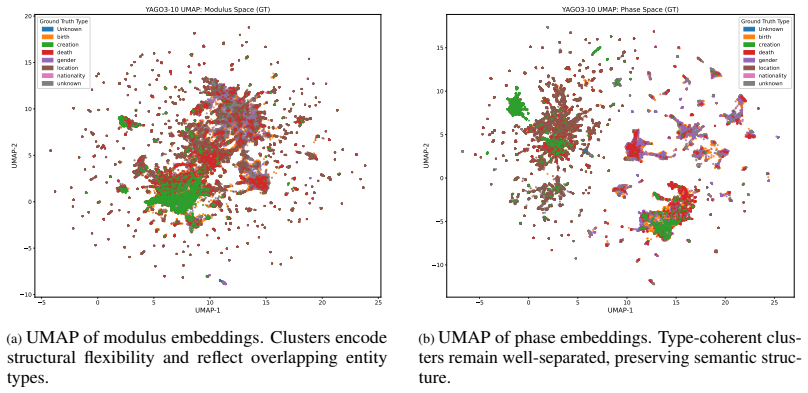
- The robustness claims suggest a testable prediction: phase embeddings should remain type-coherent under perturbations, so a quantitative cluster-purity measurement on phase vectors should reproduce the qualitative UMAP story; the paper only shows visual evidence.
- Because the paper excludes neural baselines by design, the title's 'architectural complexity is overrated' should be read as about geometric and complex-valued complexity; whether deep encoders would lose to RelatE under matched training budgets remains untested.
Editorial analysis
A structured set of objections, weighed in public.
Referee Report
Summary. The paper introduces RelatE, a fully real-valued knowledge graph embedding model that decomposes entity and relation representations into phase and modulus components, uses a sinusoidal phase scoring term and a slope-weighted modulus term, and is trained with self-adversarial negative sampling and a learnable type bias. The authors claim that RelatE is competitive or superior to complex-valued and neural baselines on FB15k-237, WN18RR, and YAGO3-10; that it is more efficient than RotatE in training time, inference latency, and memory; that perturbation studies show improved robustness; and that formal analysis establishes full expressiveness with dimension d=|E||R| as well as provable encoding of symmetry, inversion, hierarchy, composition, and disjointness. The reported experiments include filtered link-prediction metrics, efficiency benchmarks, UMAP visualizations, and robustness comparisons against TransE and RotatE.
Significance. If the theoretical and empirical claims were correct, RelatE would be a notable result: a simple real-valued model that matches or beats complex-valued models on several benchmarks while also being fully expressive and interpretable. The perturbation study and the efficiency measurements are genuinely useful parts of the paper, and the YAGO3-10 result is a concrete empirical contribution. However, the central theoretical claim of full expressiveness rests on a flawed independence argument, the pattern-analysis results in Appendix C are largely restatements of parameter choices rather than derived consequences, and the WN18RR result in Table 1 directly contradicts the abstract's broad claim of competitive or superior performance. These issues are load-bearing because the paper's main selling points are the formal expressivity and the general competitive claim.
major comments (3)
- [Section 4.1, Theorem 1, and Appendix B] The independence assumption in Lemmas 1 and 2 is not justified by the scoring function in Equations (1)-(3). Changing the phase of a tail entity t' changes the score of every triple in which t' appears, not only the targeted false triple, and the same holds for a modulus perturbation of a head entity h'. The Appendix B proof does not establish local perturbations either: Step 2 decreases the modulus embeddings of all other entities at the same dimension, and Steps 3-4 adjust the relation-specific scaling and bias parameters of all relations. This is a global reparametrization, and the paper does not analyze its effect on the full set of true and false triples. Consequently, the dimension bound d=|E||R| and the full-expressiveness claim do not follow from the presented argument, and the abstract's statement that RelatE is 'provably fully expressive' is unsupported.
- [Section 4.2, Theorem 2, and Appendix C] The proofs of the inference-pattern results are not derivations from the model; they are restatements of parameter assignments. For symmetry, setting r^(p)=0 zeroes the phase term only when h^(p)=t^(p), but the total score in Equation (3) still contains the modulus term of Equation (1), which is not invariant under h/t exchange for arbitrary modulus and bias values. The Appendix C claim that the score equals gamma in this case is therefore incorrect. Similarly, the inversion proof via r2^(p)=-r1^(p) ignores the asymmetric form of the modulus term (the bias b appears with opposite signs for head and tail), and the composition proof by adding phase vectors ignores the modulus and bias contributions to the score. These are definitions of desirable special cases, not proofs that the model provably captures the patterns.
- [Section 5, Table 1] The broad claim that RelatE achieves 'competitive or superior' performance on standard benchmarks is contradicted by Table 1. On WN18RR, RelatE attains MRR 0.239 versus RotatE's 0.476, a very large gap. On FB15k-237, RelatE's Hit@10 is 0.531 versus RotatE's 0.533, and its MRR advantage is 0.001. Only the YAGO3-10 result, MRR 0.521 versus 0.519 for TuckER and 0.495 for RotatE, is a clear improvement. The abstract's statement that RelatE 'outperforms prior methods across several datasets' overstates the table; the claim should be restricted to specific datasets or supported by additional evidence.
minor comments (5)
- [Equation (1)] The scoring formula uses b_i, while the model description defines a relation bias vector b_r; please clarify the indexing and whether b_i is an element of b_r or a separate quantity.
- [Appendix A and Equation (3)] Appendix A describes a 'bias-adjusted L2 distance' in modulus space, but Equation (1) is an L1-type sum; please make the norm definition consistent throughout the paper.
- [Tables 1 and 6] Several numeric entries appear misaligned or merged, such as the RELATE (u) row in Table 1 and the QuatE row, which makes exact baseline values difficult to read.
- [Figure 3] The caption of Figure 3 refers to 'the UMAP,' but the figure appears to be a bar chart or heatmap; the caption should match the actual panel.
- [Appendix D.2] The statement 'Ablation results will be provided on request' is not a substitute for reporting the ablations that support the type-bias and modularity claims.
Circularity Check
The formal inference-pattern results in Appendix C are restatements of design choices, reducing the claimed 'capacity to represent logical patterns' to model definitions; the empirical results themselves are not circular.
-
self definitional
[Appendix C, 'Symmetry and Anti-Symmetry']
"Symmetry and Anti-Symmetry: RELATE encodes symmetry by setting the phase shift r(p) = 0, such that the scoring function f(h, r, t) = γ − λ(p)_r · ||sin((h(p)+r(p)−t(p))/2)||_1 = γ for any h(p) = t(p), thus ensuring f(h, r, t) = f(t, r, h)."
The theorem claims RelatE models symmetry, but the proof establishes this by imposing r(p) = 0 as a parameter constraint. This is not a consequence derived from the scoring function; it is the model's own design choice restated as a result. The equality f(h,r,t)=f(t,r,h) follows immediately from the imposed zero phase shift, making the 'modeling' claim equivalent to the input construction.
-
self definitional
[Appendix C, 'Inversion']
"Inversion: Let r1 and r2 be inverse relations. RELATE ensures r2^(p) = −r1^(p), so that: f(h, r1, t) = f(t, r2, h) holds under the phase scoring function, due to the symmetry of the sinusoidal alignment."
The inversion pattern is explicitly encoded by setting r2^(p) = −r1^(p), after which the score equality is a tautology of the sinusoidal phase term. The 'formal proof' merely restates the parameter assignment that was already chosen to implement inversion, so the claimed capacity to represent inversion reduces by definition to the model's constructor's choice.
1 more flagged steps
-
self definitional
[Appendix C, 'Composition']
"Composition: RELATE encodes composition by combining phase and modulus transformations. For relations r1 and r2 where r3 = r1 ◦ r2, RELATE sets: r3(p) = r1(p) + r2(p), r3(m) = r1(m) · r2(m)."
The composition result is obtained by defining r3 in terms of r1 and r2 with additive phase and multiplicative modulus operations. This is the model's built-in compositional mechanism, not a derived property. The claim that RelatE 'models composition' is therefore a restatement of the ansatz used to parameterize the model, making the formal analysis equivalent to its input rather than an independent consequence.
full rationale
The only genuinely circular step in the paper is the treatment of relational inference patterns in Appendix C (and the corresponding statements in Theorem 2 and Section 4.2). Symmetry, inversion, and composition are 'proved' by imposing exactly the parameter relations that were already designed into the model (zero phase, negated phase, additive phase/multiplicative modulus). These are self-definitional: the claimed capability is the construction itself. The expressivity proof of Theorem 1 is a separate issue: it attempts an inductive construction and, while the independence of perturbations is not rigorously established (a correctness gap), the argument is not circular in the same sense because it does not assume the conclusion. The empirical benchmark results, efficiency measurements, and robustness experiments are self-contained comparisons against external baselines and do not reduce to fitted inputs or self-citations. No load-bearing self-citation chain or uniqueness-imported-from-authors pattern appears. Overall, the central empirical contribution is independent, but a prominent formal claim is circular by construction, warranting a partial-circularity score of 6.
Assumptions & free parameters
free parameters (6)
- Embedding dimension d =
768 (FB15k-237), 1024 (WN18RR, YAGO3-10)
- Margin gamma =
14.0 (FB15k-237), 16.0 (WN18RR), 20.0 (YAGO3-10)
- Adversarial temperature =
1.2 (FB15k-237), 1.5 (WN18RR, YAGO3-10)
- Number of negative samples =
1024 (FB15k-237), 3072 (WN18RR), 2048 (YAGO3-10)
- Type bias regularization weight =
0.01 to 0.1 (range searched)
- Modulus weight =
2.8 (FB15k-237), 4.0 (WN18RR), 4.2 (YAGO3-10)
assumptions (4)
- domain assumption Under the filtered ranking protocol, the reported benchmark scores are valid comparisons to published baselines.
- ad hoc to paper A single change to an entity's phase or modulus component can affect the score of only the targeted triple.
- ad hoc to paper Symmetric, inverse, and compositional relational patterns can be encoded through phase parameters alone, assuming modulus parameters behave symmetrically.
- domain assumption Type bias inferred from training and validation data transfers to the test distribution.
Cite this review
Pith. "Pith review of Is Architectural Complexity Overrated? Competitive and Interpretable Knowledge Graph Completion with RelatE." pith.science (2026). https://pith.science/paper/T75EI2TC
@misc{pith2026250518971,
  author       = {Pith},
  title        = {Pith review of: Is Architectural Complexity Overrated? Competitive and Interpretable Knowledge Graph Completion with RelatE},
  year         = {2026},
  howpublished = {\url{https://pith.science/paper/T75EI2TC}},
  note         = {Machine review of arXiv:2505.18971}
}
read the original abstract
We revisit the efficacy of simple, real-valued embedding models for knowledge graph completion and introduce RelatE, an interpretable and modular method that efficiently integrates dual representations for entities and relations. RelatE employs a real-valued phase-modulus decomposition, leveraging sinusoidal phase alignments to encode relational patterns such as symmetry, inversion, and composition. In contrast to recent approaches based on complex-valued embeddings or deep neural architectures, RelatE preserves architectural simplicity while achieving competitive or superior performance on standard benchmarks. Empirically, RelatE outperforms prior methods across several datasets: on YAGO3-10, it achieves an MRR of 0.521 and Hit@10 of 0.680, surpassing all baselines. Additionally, RelatE offers significant efficiency gains, reducing training time by 24%, inference latency by 31%, and peak GPU memory usage by 22% compared to RotatE. Perturbation studies demonstrate improved robustness, with MRR degradation reduced by up to 61% relative to TransE and by up to 19% compared to RotatE under structural edits such as edge removals and relation swaps. Formal analysis further establishes the model's full expressiveness and its capacity to represent essential first-order logical inference patterns. These results position RelatE as a scalable and interpretable alternative to more complex architectures for knowledge graph completion.
Figures


Figures from the paper (4 more)



Reference graph
Works this paper leans on
-
[1]
BoxE: A Box Embedding Model for Knowledge Base Completion
Ralph Abboud, ˙Ismail ˙Ilkan Ceylan, Thomas Lukasiewicz, and Tommaso Salvatori. Boxe: A box embedding model for knowledge base completion.CoRR, abs/2007.06267, 2020. URL https://arxiv.org/abs/2007.06267
work page Pith review arXiv 2007
-
[2]
Tucker: Tensor factorization for knowledge graph completion.arXiv preprint arXiv:1901.09590, 2019
Ivana Balaževi´c, Carl Allen, and Timothy M Hospedales. Tucker: Tensor factorization for knowledge graph completion.arXiv preprint arXiv:1901.09590, 2019
arXiv 1901
-
[3]
Translating embeddings for modeling multi-relational data
Antoine Bordes, Nicolas Usunier, Alberto Garcia-Duran, Jason Weston, and Oksana Yakhnenko. Translating embeddings for modeling multi-relational data. In C.J. Burges, L. Bottou, M. Welling, Z. Ghahramani, and K.Q. Weinberger, editors,Ad- vances in Neural Information Processing Systems, volume 26. Curran Associates, Inc.,
-
[4]
Translating embeddings for modeling multi-relational data.Advances in neural information processing systems, 26, 2013
Antoine Bordes, Nicolas Usunier, Alberto Garcia-Duran, Jason Weston, and Oksana Yakhnenko. Translating embeddings for modeling multi-relational data.Advances in neural information processing systems, 26, 2013
2013
-
[5]
Convolutional 2d knowledge graph embeddings
Tim Dettmers, Pasquale Minervini, Pontus Stenetorp, and Sebastian Riedel. Convolutional 2d knowledge graph embeddings. InProceedings of the AAAI conference on artificial intelligence, volume 32, 2018
2018
-
[6]
Knowledge hypergraphs: prediction beyond binary relations
Bahare Fatemi, Perouz Taslakian, David Vazquez, and David Poole. Knowledge hypergraphs: prediction beyond binary relations. InProceedings of the Twenty-Ninth International Joint Conference on Artificial Intelligence, IJCAI’20, 2021. ISBN 9780999241165
work page 2021
-
[7]
Learning to represent knowledge graphs with gaussian embedding
Shu Guo, Quan Wang, Lihong Wang, and Bin Wang. Learning to represent knowledge graphs with gaussian embedding. InNeurIPS, 2020
work page 2020
-
[8]
Simple embedding for link prediction in knowledge graphs, 2018
Seyed Mehran Kazemi and David Poole. Simple embedding for link prediction in knowledge graphs, 2018. URLhttps://arxiv.org/abs/1802.04868
arXiv 2018
Show all 27 references
-
[9]
Generalizing tensor decomposition for n-ary relational knowledge bases
Yu Liu, Quanming Yao, and Yong Li. Generalizing tensor decomposition for n-ary relational knowledge bases. InProceedings of The Web Conference 2020, WWW ’20, page 1104–1114, New York, NY , USA, 2020. Association for Computing Machinery. ISBN 9781450370233. doi: 10.1145/3366423...
2020
-
[10]
Learning attention-based embeddings for relation prediction in knowledge graphs
Deepak Nathani, Jatin Chauhan, Charu Sharma, and Manohar Kaul. Learning attention-based embeddings for relation prediction in knowledge graphs. In Anna Korhonen, David Traum, and Lluís Màrquez, editors,Proceedings of the 57th Annual Meeting of the Association for Computational...
2019 doi
-
[11]
A three-way model for collective learning on multi-relational data
Maximilian Nickel, V olker Tresp, Hans-Peter Kriegel, et al. A three-way model for collective learning on multi-relational data. InIcml, volume 11, pages 3104482–3104584, 2011
2011
-
[12]
The blessing of structural noise: Can adversarial perturbations improve kge generalization? InNeurIPS, 2023
Liangming Pan, Wanjun Ding, Yizhou Sun, and Jie Zhou. The blessing of structural noise: Can adversarial perturbations improve kge generalization? InNeurIPS, 2023
2023
-
[13]
Query2box: Reasoning over knowledge graphs in vector space using box embeddings.CoRR, abs/2002.05969, 2020
Hongyu Ren, Weihua Hu, and Jure Leskovec. Query2box: Reasoning over knowledge graphs in vector space using box embeddings.CoRR, abs/2002.05969, 2020. URL https://arxiv. org/abs/2002.05969. 10
2002 arXiv
-
[14]
You can teach an old dog new tricks! on training knowledge graph embeddings
Daniel Ruffinelli, Samuel Broscheit, and Rainer Gemulla. You can teach an old dog new tricks! on training knowledge graph embeddings. InInternational Conference on Learning Representations, 2020. URLhttps://openreview.net/forum?id=BkxSmlBFvr
2020
-
[15]
Reasoning with neu- ral tensor networks for knowledge base completion
Richard Socher, Danqi Chen, Christopher D Manning, and Andrew Ng. Reasoning with neu- ral tensor networks for knowledge base completion. In C.J. Burges, L. Bottou, M. Welling, Z. Ghahramani, and K.Q. Weinberger, editors,Advances in Neural Information Processing Sys- tems, volu...
2013
-
[16]
Rotate: Knowledge graph embed- ding by relational rotation in complex space.arXiv preprint arXiv:1902.10197, 2019
Zhiqing Sun, Zhi-Hong Deng, Jian-Yun Nie, and Jian Tang. Rotate: Knowledge graph embed- ding by relational rotation in complex space.arXiv preprint arXiv:1902.10197, 2019
1902 arXiv
-
[17]
Adversarial attack and defense on knowledge graph embeddings.arXiv preprint arXiv:1905.05474, 2020
Zhiqing Sun, Shikhar Vashishth, Soumya Sanyal, and Partha Talukdar. Adversarial attack and defense on knowledge graph embeddings.arXiv preprint arXiv:1905.05474, 2020
1905 arXiv
-
[18]
Complex embeddings for simple link prediction
Théo Trouillon, Johannes Welbl, Sebastian Riedel, Éric Gaussier, and Guillaume Bouchard. Complex embeddings for simple link prediction. InInternational conference on machine learning, pages 2071–2080. PMLR, 2016
2016
-
[19]
Knowledge graph embedding by translating on hyperplanes
Zhen Wang, Jianwen Zhang, Jianlin Feng, and Zheng Chen. Knowledge graph embedding by translating on hyperplanes. InProceedings of the AAAI conference on artificial intelligence, volume 28, 2014
2014
-
[20]
On the representation and embedding of knowledge bases beyond binary relations.CoRR, abs/1604.08642, 2016
Jianfeng Wen, Jianxin Li, Yongyi Mao, Shini Chen, and Richong Zhang. On the representation and embedding of knowledge bases beyond binary relations.CoRR, abs/1604.08642, 2016. URLhttp://arxiv.org/abs/1604.08642
2016 arXiv
-
[21]
On the z-paradox in knowledge graph embedding: The limitations of geometric encoding.arXiv preprint arXiv:2005.01168, 2020
Kai Xu, Yuyu Yang, Zhen Guo, and Jiliang Tang. On the z-paradox in knowledge graph embedding: The limitations of geometric encoding.arXiv preprint arXiv:2005.01168, 2020
2005 arXiv
-
[22]
Embedding entities and relations for learning and inference in knowledge bases, 2015
Bishan Yang, Wen tau Yih, Xiaodong He, Jianfeng Gao, and Li Deng. Embedding entities and relations for learning and inference in knowledge bases, 2015. URL https://arxiv.org/ abs/1412.6575
2015 arXiv
-
[23]
Quaternion knowledge graph embeddings.Advances in neural information processing systems, 32, 2019
Shuai Zhang, Yi Tay, Lina Yao, and Qi Liu. Quaternion knowledge graph embeddings.Advances in neural information processing systems, 32, 2019
2019
-
[24]
Ripple effects of adversarial perturbations in knowledge graph completion
Yukun Zhang, Xiang Ren, and Jie Tang. Ripple effects of adversarial perturbations in knowledge graph completion. InFindings of ACL, 2022
2022
-
[25]
Learning hierarchy-aware knowledge graph embeddings for link prediction
Zhanqiu Zhang, Jianyu Cai, Yongdong Zhang, and Jie Wang. Learning hierarchy-aware knowledge graph embeddings for link prediction. InProceedings of the AAAI conference on artificial intelligence, volume 34, pages 3065–3072, 2020
2020
-
[26]
Z-paradox
Zhenghang Zhang, Jinlu Jia, Yalin Wan, Yang Zhou, Yuting Kong, Yurong Qian, and Jun Long. Transr*: Representation learning model by flexible translation and relation matrix projection. Journal of Intelligent & Fuzzy Systems, 40(5):10251–10259, 2021. doi: 10.3233/JIFS-202177. U...
2021 doi
-
[2013]
URL https://proceedings.neurips.cc/paper_files/paper/2013/file/ 1cecc7a77928ca8133fa24680a88d2f9-Paper.pdf
2013
Reviewed August 7, 2026 · model on record in the stance chip above.
Discussion (0). Sign in to comment.