REVIEW 4 major objections 6 minor 1 cited by
ScreenExplorer: Training a Vision-Language Model for Diverse Exploration in Open GUI World
T0 review · 4 major / 6 minor · reviewed 2026-08-07 · deepseek-v4-flash
Pith's one-line read ScreenExplorer trains a 3B vision-language model to explore GUI environments more diversely than much larger static models, using a curiosity reward from a learned world model and experience stream distillation.
desk verdict A real-world RL training pipeline for GUI agents with a serious evaluation flaw: the diversity metric is the training objective. read the letter →
The pith
A machine-rendered reading of the paper's core claim, the machinery that carries it, and where it could break.
The reading
What carries the argument
A LLaMA-style world model with a VAE image tokenizer and text embeddings predict the next GUI state from the current state and chosen action. The world model's prediction discrepancy forms the core curiosity reward, combined with additional rewards for formatted actions, instantaneous and subsequent state changes, environment description, and intent interpretation. This reward design is paired with GRPO for policy optimization, then followed by experience stream distillation with manual or automated filtering to fine-tune the base model for the next generation.
What would settle it
A direct test is to evaluate the same models on diverse downstream tasks (e.g., file navigation, web search, software web-based tasks) and compare task success rates with the reported diversity metrics. If the cosine-similarity-based diversity scores do not correlate positively with meaningful task completion or human preference, the equivalence between these metrics and true exploration would be broken.
Extended reading notes
Core claim
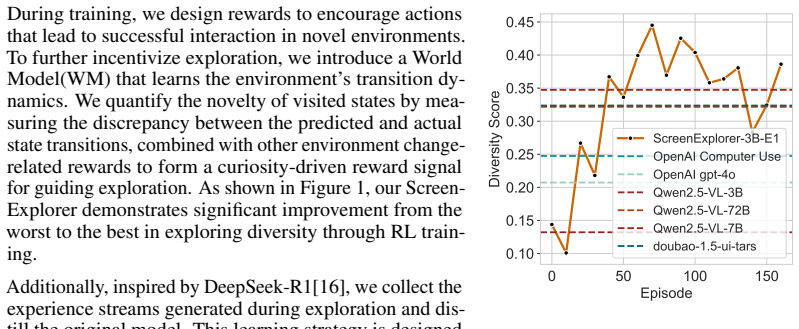
The paper's central claim is that a 3B-parameter VLM, trained in a real open GUI desktop environment with GRPO, a world-model curiosity reward, and experience stream distillation, develops better environmental adaptation and sustained exploration than static deployment models. Training rewards diverse, novel state changes and meaningful interaction, and the results show a notable jump in diversity scores versus the base Qwen2.5-VL-3B and versus larger static models such as gpt-4o, Qwen2.5-VL-72B, and GUI-specific agents like OpenAI Computer Use. The paper also finds that the world model's predicted-state discrepancy is the most critical reward component, accelerating effective exploration during the cold-start phase and smoothing gradient differentiation in GRPO.
Load-bearing premise
The claim that cosine similarity between VAE image embeddings and OCR text embeddings measures meaningful exploration diversity is load-bearing: it is used both inside the reward function and inside the evaluation metrics, and the paper does not validate it against human judgment or an external benchmark.
Editorial extensions
If this is right
- A 3B model can match or exceed exploration diversity of much larger models in a real desktop environment when trained online with a curiosity-driven reward and RL.
- World-model curiosity is a key ingredient for overcoming the cold-start exploration phase in open GUI environments.
- Self-collected exploration experience, without additional labels, can be distilled to improve exploration capabilities and sustain improvement.
- The training and distillation cycle offers a general recipe for reducing reliance on carefully curated human-annotated data in GUI agent development.
Reading between the lines
- The underlying mechanism might transfer to other open-ended environments beyond GUI, such as 3D worlds or web browsing, where a world model can predict next-state embeddings and quantify novelty from prediction error.
- A testable extension is to compare the cosine-similarity-based diversity scores with human judgments or task-completion statistics, to see whether the reported diversity improvements align with truly meaningful exploration.
- The paper's argument implies a major shift: for exploration-focused open environments, a small trainable model can outperform large frozen ones, which casts doubt on the assumption that raw scale alone is the main bottleneck in such settings.
Editorial analysis
A structured set of objections, weighed in public.
Referee Report
Summary. The paper introduces ScreenExplorer, a 3B-parameter vision-language model trained with GRPO in a real Linux GUI environment. The training reward combines a format reward, visual and textual state-change rewards, a world-model prediction-error curiosity reward, and intent-state alignment terms (Eq. (1)). After RL, the authors also distill the collected experience streams via SFT. The central claim is that this framework improves diverse exploration in open GUI environments, supported by Table 1, which reports trajectory-level and group-level diversity computed from cosine similarity of VAE image embeddings and OCR text embeddings (Eqs. (5)-(6)), plus qualitative case studies and ablations.
Significance. If the central claim were established, the contribution would be notable: it would show that a small 3B VLM, trained with a world-model curiosity reward and experience-stream distillation in a live GUI environment, can explore more diversely than much larger frozen models. The paper also ships source code, builds a real GUI RL environment, and includes ablation studies on reward components, which are concrete strengths. However, the quantitative evidence for the central claim is currently compromised because the evaluation metrics in Section 4.1 use the same cosine-similarity definitions that appear in the training reward in Eq. (1). The reported exploration gains may therefore reflect optimization of the training objective rather than meaningful exploration, so the significance of the claimed result is not yet established.
major comments (4)
- [Section 3.2, Eq. (1) and Section 4.1, Eqs. (5)-(6)] The evaluation metrics d_vis_seq, d_text_seq, D_vis_grp, and D_text_grp are average pairwise cosine dissimilarities of the same VAE image embeddings and OCR text embeddings that appear in the reward terms r_vis_seq and r_text_seq. Because GRPO directly maximizes Eq. (1), the improvement in Table 1 from average diversity 0.21/0.17 to 0.53/0.54 is partially by construction and does not by itself demonstrate meaningful exploration. Please report independent evaluation metrics, such as OS-level state coverage, number of distinct applications or windows visited, human diversity ratings, or held-out exploration tasks, and provide error bars over multiple seeds.
- [Table 1 and Section 4.4] The main comparison in Table 1 is against frozen, statically deployed models; the only RL-trained control appears in the ablation study of Section 4.4, but that control is not included in Table 1. Without a baseline trained under the same RL loop with, for example, only the format reward, the reported gains cannot be attributed to the exploration rewards rather than to RL in general or to reward hacking of the similarity metric.
- [Section 5] The paper admits that agents get stuck on perpetually novel stimuli such as news and video pages, which is exactly the behavior incentivized by reward terms that maximize pairwise dissimilarity of screen embeddings. This admission means the high d_seq and D_grp scores in Table 1 may reflect trivial novelty rather than useful exploration breadth. The paper should quantify the distribution of visited applications, domains, and action types, and separate useful exploration from the noisy-TV trap.
- [Section 4.2, Table 1] The evaluation is based on only 20 episodes of 10 steps each (200 frames) per model, and no standard deviations, confidence intervals, or significance tests are reported. Given the high variance of GUI exploration trajectories, single-run point estimates are not sufficient to support the claim that trained models outperform baselines across the board.
minor comments (6)
- [Section 4.3] The text refers to 'Equation 3.2' when discussing format reward penalties; the correct reference is Eq. (1).
- [Figure 2 caption] The caption says 'All 9 Rewards' but the list in Section 3.2 contains six bullet categories; please clarify how the nine individual reward terms map to the six categories.
- [Table 1] The caption mentions 'box indicates the lowest scores,' but no boxes are visible in the rendered table; please check the formatting or remove the reference.
- [Table 1] The 'Avg. Diversity' column is not defined; please state explicitly that it is the mean of the four preceding diversity columns.
- [Section 3.4, Eq. (3)] The GRPO advantage formula uses group normalization but the notation omits the group index in the mean and standard deviation; please clarify the grouping notation.
- [Section 4.3 and Figure 4] The claim that a high and oscillating world-model loss 'indicates sustained curiosity' is not self-evident; a persistently high reconstruction loss could also mean the world model is failing to learn, which should be discussed.
Circularity Check
Evaluation diversity metric is the training reward; the reported exploration gains are by construction.
-
self definitional
[Section 4.1 Evaluation Metrics (Eqs. 5-6) vs. Section 3.2 Reward Function (Eq. 1)]
"We use the cosine similarity sim(·,·) to measure the similarity between environmental states, as defined in subsection 3.2."
The reward in Eq. (1) includes rvis_seq and rtext_seq, defined as E_{i<t,j>t}[1−sim(o'_i,o'_j)] and E_{i<t,j>t}[1−sim(e'_i,e'_j)], plus instantaneous and world-model dissimilarities in the same VAE image and OCR text embedding spaces. The evaluation metrics in Eqs. (5)-(6), dvis_seq and Dvis_grp, are the same average pairwise dissimilarities over the same embeddings. Since GRPO directly maximizes these dissimilarity terms, the reported improvement from 0.21/0.17 to 0.53/0.54 is the expected consequence of optimizing the evaluation metric itself, not an independent measure of exploration quality. No external validation, such as OS-level state coverage, human judgment, or held-out task diversity, is reported.
-
fitted input called prediction
[Appendix E Experience Stream Distillation and Section 4.2/Table 1]
"We first filter the trajectories generated during RL training, identifying and retaining diverse exploration steps that successfully complete specific tasks. ... 3. Advantages greater than 0."
The automated filtering criterion keeps transitions with positive GRPO advantage, and advantages are computed from r in Eq. (1), which contains the same cosine-similarity exploration rewards used as evaluation metrics in Eqs. (5)-(6). Distillation therefore performs SFT on trajectories selected for high values of the very quantity used to score the resulting model. The further diversity gains reported for ScreenExplorer-3B-Distill in Table 1 are thus a selection artifact of the reward-defined filter as much as evidence of an independently improved exploration capability.
full rationale
The central claim—that ScreenExplorer achieves better 'diverse exploration' than static models—is measured with Eqs. (5)-(6), which are average pairwise cosine dissimilarities of VAE image and OCR text embeddings. The training reward in Eq. (1) directly maximizes the same family of dissimilarities (rvis_seq, rtext_seq, rvis_inst, rtext_inst, rvis_world, rtext_world). Consequently, the headline improvement from 0.21/0.17 to 0.53/0.54 is the expected result of optimizing the evaluation metric itself, not an independent confirmation of exploration quality. The distillation loop compounds this: experience streams are filtered by positive advantage computed from the same reward, then the distilled model is evaluated with the same cosine-similarity metrics. The paper's own Limitations section concedes that only screenshots and OCR text were used to measure state similarity, and no OS-level state coverage, human judgment, or held-out metric is provided. The self-citation to ScreenAgent is not load-bearing, and the world-model prediction error is a real additional signal, but it is scored in the same embedding spaces and does not break the reward-evaluation loop. Score 8 reflects that the central diversity result is largely forced by the definition of the metric as the training objective.
Assumptions & free parameters
assumptions (4)
- domain assumption Cosine similarity between learned embeddings measures GUI state diversity and novelty.
- domain assumption A single configured Linux desktop with internet access represents the open GUI world.
- ad hoc to paper The world model's prediction error is a useful curiosity signal that helps overcome cold start.
- domain assumption Pretrained VAE and text embedding models (Cosmos-Tokenizer, BGE-M3) faithfully represent screenshots and OCR text.
Cite this review
Pith. "Pith review of ScreenExplorer: Training a Vision-Language Model for Diverse Exploration in Open GUI World." pith.science (2026). https://pith.science/paper/B77TG5T2
@misc{pith2026250519095,
  author       = {Pith},
  title        = {Pith review of: ScreenExplorer: Training a Vision-Language Model for Diverse Exploration in Open GUI World},
  year         = {2026},
  howpublished = {\url{https://pith.science/paper/B77TG5T2}},
  note         = {Machine review of arXiv:2505.19095}
}
read the original abstract
The rapid progress of large language models (LLMs) has sparked growing interest in building Artificial General Intelligence (AGI) within Graphical User Interface (GUI) environments. However, existing GUI agents based on LLMs or vision-language models (VLMs) often fail to generalize to novel environments and rely heavily on manually curated, diverse datasets. To overcome these limitations, we introduce ScreenExplorer, a VLM trained via Group Relative Policy Optimization(GRPO) in real, dynamic, and open-ended GUI environments. Innovatively, we introduced a world-model-based curiosity reward function to help the agent overcome the cold-start phase of exploration. Additionally, distilling experience streams further enhances the model's exploration capabilities. Our training framework enhances model exploration in open GUI environments, with trained models showing better environmental adaptation and sustained exploration compared to static deployment models. Our findings offer a scalable pathway toward AGI systems with self-improving capabilities in complex interactive settings.
Figures


Figures from the paper (27 more)




Forward citations
Cited by 1 Pith paper
-
Generative Visual Code Mobile World Models
gWorld converts mobile GUI world modeling into renderable HTML generation, and its fine-tuned 8B and 32B VLMs outperform frontier open-weight models up to 50x larger on next-state accuracy.
Reference graph
Works this paper leans on
-
[1]
Sparks of artificial general intelligence: Early experiments with gpt-4, 2023
Sébastien Bubeck, Varun Chandrasekaran, Ronen Eldan, Johannes Gehrke, Eric Horvitz, Ece Kamar, Peter Lee, Yin Tat Lee, Yuanzhi Li, Scott Lundberg, Harsha Nori, Hamid Palangi, Marco Tulio Ribeiro, and Yi Zhang. Sparks of artificial general intelligence: Early experiments with gpt-4, 2023
2023
-
[2]
Large language model-brained gui agents: A survey, 2025
Chaoyun Zhang, Shilin He, Jiaxu Qian, Bowen Li, Liqun Li, Si Qin, Yu Kang, Minghua Ma, Guyue Liu, Qingwei Lin, Saravan Rajmohan, Dongmei Zhang, and Qi Zhang. Large language model-brained gui agents: A survey, 2025
work page 2025
-
[3]
Karlsson, Bo An, Shuicheng Yan, and Zongqing Lu
Weihao Tan, Wentao Zhang, Xinrun Xu, Haochong Xia, Ziluo Ding, Boyu Li, Bohan Zhou, Junpeng Yue, Jiechuan Jiang, Yewen Li, Ruyi An, Molei Qin, Chuqiao Zong, Longtao Zheng, Yujie Wu, Xiaoqiang Chai, Yifei Bi, Tianbao Xie, Pengjie Gu, Xiyun Li, Ceyao Zhang, Long Tian, Chaojie Wang, Xinrun Wang, Börje F. Karlsson, Bo An, Shuicheng Yan, and Zongqing Lu. Cradl...
arXiv 2024
-
[4]
UFO: A UI-Focused Agent for Windows OS Interaction.arXiv preprint arXiv:2402.07939, 2024
Chaoyun Zhang, Liqun Li, Shilin He, Xu Zhang, Bo Qiao, Si Qin, Minghua Ma, Yu Kang, Qingwei Lin, Saravan Rajmohan, Dongmei Zhang, and Qi Zhang. UFO: A UI-Focused Agent for Windows OS Interaction.arXiv preprint arXiv:2402.07939, 2024
arXiv 2024
-
[5]
UFO2: The Desktop AgentOS.arXiv preprint arXiv:2504.14603, 2025
Chaoyun Zhang, He Huang, Chiming Ni, Jian Mu, Si Qin, Shilin He, Lu Wang, Fangkai Yang, Pu Zhao, Chao Du, Liqun Li, Yu Kang, Zhao Jiang, Suzhen Zheng, Rujia Wang, Jiaxu Qian, Minghua Ma, Jian-Guang Lou, Qingwei Lin, Saravan Rajmohan, and Dongmei Zhang. UFO2: The Desktop AgentOS.arXiv preprint arXiv:2504.14603, 2025
arXiv 2025
-
[6]
Os-copilot: Towards generalist computer agents with self-improvement, 2024
Zhiyong Wu, Chengcheng Han, Zichen Ding, Zhenmin Weng, Zhoumianze Liu, Shunyu Yao, Tao Yu, and Lingpeng Kong. Os-copilot: Towards generalist computer agents with self-improvement, 2024
work page 2024
-
[7]
Agent S: An Open Agentic Framework that Uses Computers Like a Human
Saaket Agashe, Jiuzhou Han, Shuyu Gan, Jiachen Yang, Ang Li, and Xin Eric Wang. Agent S: An Open Agentic Framework that Uses Computers Like a Human. InInternational Conference on Learning Representations (ICLR), 2025
work page 2025
-
[8]
Agent s2: A compositional generalist-specialist framework for computer use agents, 2025
Saaket Agashe, Kyle Wong, Vincent Tu, Jiachen Yang, Ang Li, and Xin Eric Wang. Agent s2: A compositional generalist-specialist framework for computer use agents, 2025
2025
Show all 51 references
-
[9]
Cogagent: A visual language model for gui agents, 2024
Wenyi Hong, Weihan Wang, Qingsong Lv, Jiazheng Xu, Wenmeng Yu, Junhui Ji, Yan Wang, Zihan Wang, Yuxuan Zhang, Juanzi Li, Bin Xu, Yuxiao Dong, Ming Ding, and Jie Tang. Cogagent: A visual language model for gui agents, 2024
2024
-
[10]
Rico: A mobile app dataset for building data-driven design applications
Biplab Deka, Zifeng Huang, Chad Franzen, Joshua Hibschman, Daniel Afergan, Yang Li, Jeffrey Nichols, and Ranjitha Kumar. Rico: A mobile app dataset for building data-driven design applications. InProceedings of the 30th Annual ACM Symposium on User Interface Software and Techn...
2017
-
[11]
Xiaoyi Zhang, Lilian de Greef, Amanda Swearngin, Samuel White, Kyle Murray, Lisa Yu, Qi Shan, Jeffrey Nichols, Jason Wu, Chris Fleizach, Aaron Everitt, and Jeffrey P. Bigham. Screen recognition: Creating accessibility metadata for mobile applications from pixels, 2021. 10
2021
-
[12]
Mind2web: Towards a generalist agent for the web, 2023
Xiang Deng, Yu Gu, Boyuan Zheng, Shijie Chen, Samuel Stevens, Boshi Wang, Huan Sun, and Yu Su. Mind2web: Towards a generalist agent for the web, 2023
2023
-
[13]
Mobilevlm: A vision-language model for better intra- and inter-ui understanding, 2024
Qinzhuo Wu, Weikai Xu, Wei Liu, Tao Tan, Jianfeng Liu, Ang Li, Jian Luan, Bin Wang, and Shuo Shang. Mobilevlm: A vision-language model for better intra- and inter-ui understanding, 2024
2024
-
[14]
Screenagent: A vision language model-driven computer control agent
Runliang Niu, Jindong Li, Shiqi Wang, Yali Fu, Xiyu Hu, Xueyuan Leng, He Kong, Yi Chang, and Qi Wang. Screenagent: A vision language model-driven computer control agent. In Kate Larson, editor,Proceedings of the Thirty-Third International Joint Conference on Artificial Intel- ...
2024
-
[15]
Guicourse: From general vision language models to versatile gui agents, 2024
Wentong Chen, Junbo Cui, Jinyi Hu, Yujia Qin, Junjie Fang, Yue Zhao, Chongyi Wang, Jun Liu, Guirong Chen, Yupeng Huo, Yuan Yao, Yankai Lin, Zhiyuan Liu, and Maosong Sun. Guicourse: From general vision language models to versatile gui agents, 2024
2024
-
[16]
DeepSeek-AI, Daya Guo, Dejian Yang, Haowei Zhang, Junxiao Song, Ruoyu Zhang, Runxin Xu, Qihao Zhu, Shirong Ma, Peiyi Wang, Xiao Bi, Xiaokang Zhang, Xingkai Yu, Yu Wu, Z. F. Wu, Zhibin Gou, Zhihong Shao, Zhuoshu Li, Ziyi Gao, Aixin Liu, Bing Xue, Bingxuan Wang, Bochao Wu, Bei F...
2025
-
[17]
Exploration by random network distillation, 2018
Yuri Burda, Harrison Edwards, Amos Storkey, and Oleg Klimov. Exploration by random network distillation, 2018
2018
-
[18]
Noveld: A simple yet effective exploration criterion
Tianjun Zhang, Huazhe Xu, Xiaolong Wang, Yi Wu, Kurt Keutzer, Joseph E Gonzalez, and Yuandong Tian. Noveld: A simple yet effective exploration criterion. In M. Ranzato, A. Beygelz- imer, Y . Dauphin, P.S. Liang, and J. Wortman Vaughan, editors,Advances in Neural Information Pr...
2021
-
[19]
Diversity is all you need: Learning skills without a reward function, 2018
Benjamin Eysenbach, Abhishek Gupta, Julian Ibarz, and Sergey Levine. Diversity is all you need: Learning skills without a reward function, 2018
2018
-
[20]
Dynamics- aware unsupervised discovery of skills, 2020
Archit Sharma, Shixiang Gu, Sergey Levine, Vikash Kumar, and Karol Hausman. Dynamics- aware unsupervised discovery of skills, 2020. 11
2020
-
[21]
V oyager: An open-ended embodied agent with large language models, 2023
Guanzhi Wang, Yuqi Xie, Yunfan Jiang, Ajay Mandlekar, Chaowei Xiao, Yuke Zhu, Linxi Fan, and Anima Anandkumar. V oyager: An open-ended embodied agent with large language models, 2023
2023
-
[22]
Tenenbaum, Tim Rocktäschel, and Edward Grefenstette
Andres Campero, Roberta Raileanu, Heinrich Küttler, Joshua B. Tenenbaum, Tim Rocktäschel, and Edward Grefenstette. Learning with amigo: Adversarially motivated intrinsic goals, 2021
2021
-
[23]
Open-world reinforcement learning over long short-term imagination, 2025
Jiajian Li, Qi Wang, Yunbo Wang, Xin Jin, Yang Li, Wenjun Zeng, and Xiaokang Yang. Open-world reinforcement learning over long short-term imagination, 2025
2025
-
[24]
Huajian Xin, Z. Z. Ren, Junxiao Song, Zhihong Shao, Wanjia Zhao, Haocheng Wang, Bo Liu, Liyue Zhang, Xuan Lu, Qiushi Du, Wenjun Gao, Qihao Zhu, Dejian Yang, Zhibin Gou, Z. F. Wu, Fuli Luo, and Chong Ruan. Deepseek-prover-v1.5: Harnessing proof assistant feedback for reinforcem...
2024
-
[25]
Let’s verify step by step, 2023
Hunter Lightman, Vineet Kosaraju, Yura Burda, Harri Edwards, Bowen Baker, Teddy Lee, Jan Leike, John Schulman, Ilya Sutskever, and Karl Cobbe. Let’s verify step by step, 2023
2023
-
[26]
Mutual reasoning makes smaller llms stronger problem-solvers, 2024
Zhenting Qi, Mingyuan Ma, Jiahang Xu, Li Lyna Zhang, Fan Yang, and Mao Yang. Mutual reasoning makes smaller llms stronger problem-solvers, 2024
2024
-
[27]
Lan Pan, Hanbo Xie, and Robert C. Wilson. Large language models think too fast to explore effectively, 2025
2025
-
[28]
Improving rl exploration for llm reasoning through retrospective replay, 2025
Shihan Dou, Muling Wu, Jingwen Xu, Rui Zheng, Tao Gui, Qi Zhang, and Xuanjing Huang. Improving rl exploration for llm reasoning through retrospective replay, 2025
2025
-
[29]
Ragen: Understanding self-evolution in llm agents via multi-turn reinforcement learning, 2025
Zihan Wang, Kangrui Wang, Qineng Wang, Pingyue Zhang, Linjie Li, Zhengyuan Yang, Xing Jin, Kefan Yu, Minh Nhat Nguyen, Licheng Liu, Eli Gottlieb, Yiping Lu, Kyunghyun Cho, Jiajun Wu, Li Fei-Fei, Lijuan Wang, Yejin Choi, and Manling Li. Ragen: Understanding self-evolution in ll...
2025
-
[30]
Showui: One vision-language-action model for gui visual agent, 2024
Kevin Qinghong Lin, Linjie Li, Difei Gao, Zhengyuan Yang, Shiwei Wu, Zechen Bai, Weixian Lei, Lijuan Wang, and Mike Zheng Shou. Showui: One vision-language-action model for gui visual agent, 2024
2024
-
[31]
Foundations and recent trends in multimodal mobile agents: A survey.arXiv preprint arXiv:2411.02006, 2024
Biao Wu, Yanda Li, Meng Fang, Zirui Song, Zhiwei Zhang, Yunchao Wei, and Ling Chen. Foundations and recent trends in multimodal mobile agents: A survey.arXiv preprint arXiv:2411.02006, 2024
2024 arXiv
-
[32]
Mobile-agent: Autonomous multi-modal mobile device agent with visual perception, 2024
Junyang Wang, Haiyang Xu, Jiabo Ye, Ming Yan, Weizhou Shen, Ji Zhang, Fei Huang, and Jitao Sang. Mobile-agent: Autonomous multi-modal mobile device agent with visual perception, 2024
2024
-
[33]
Karlsson, Bo An, and Zongqing Lu
Weihao Tan, Ziluo Ding, Wentao Zhang, Boyu Li, Bohan Zhou, Junpeng Yue, Haochong Xia, Jiechuan Jiang, Longtao Zheng, Xinrun Xu, Yifei Bi, Pengjie Gu, Xinrun Wang, Börje F. Karlsson, Bo An, and Zongqing Lu. Towards general computer control: A multimodal agent for red dead redem...
2024
-
[34]
Digirl: Training in-the-wild device-control agents with autonomous reinforcement learning, 2024
Hao Bai, Yifei Zhou, Mert Cemri, Jiayi Pan, Alane Suhr, Sergey Levine, and Aviral Kumar. Digirl: Training in-the-wild device-control agents with autonomous reinforcement learning, 2024
2024
-
[35]
Au- tonomous evaluation and refinement of digital agents, 2024
Jiayi Pan, Yichi Zhang, Nicholas Tomlin, Yifei Zhou, Sergey Levine, and Alane Suhr. Au- tonomous evaluation and refinement of digital agents, 2024
2024
-
[36]
Distrl: An asynchronous distributed reinforcement learning framework for on-device control agents, 2025
Taiyi Wang, Zhihao Wu, Jianheng Liu, Jianye Hao, Jun Wang, and Kun Shao. Distrl: An asynchronous distributed reinforcement learning framework for on-device control agents, 2025
2025
-
[37]
Zhihong Shao, Peiyi Wang, Qihao Zhu, Runxin Xu, Junxiao Song, Xiao Bi, Haowei Zhang, Mingchuan Zhang, Y . K. Li, Y . Wu, and Daya Guo. Deepseekmath: Pushing the limits of mathematical reasoning in open language models, 2024. 12
2024
-
[38]
Lee, and Sanjeev Arora
Noam Razin, Zixuan Wang, Hubert Strauss, Stanley Wei, Jason D. Lee, and Sanjeev Arora. What makes a reward model a good teacher? an optimization perspective, 2025
2025
-
[39]
Mavor-Parker, Kimberly A
Augustine N. Mavor-Parker, Kimberly A. Young, Caswell Barry, and Lewis D. Griffin. How to stay curious while avoiding noisy tvs using aleatoric uncertainty estimation, 2024
2024
-
[40]
Space") Key(
Woosuk Kwon, Zhuohan Li, Siyuan Zhuang, Ying Sheng, Lianmin Zheng, Cody Hao Yu, Joseph E. Gonzalez, Hao Zhang, and Ion Stoica. Efficient memory management for large lan- guage model serving with pagedattention. InProceedings of the ACM SIGOPS 29th Symposium on Operating System...
2023
-
[42]
The intent text description should clearly indicate a specific action (e.g., click, type, scroll) and specify a target (e.g., an icon, button, field, or screen location)
-
[43]
The executed action should accomplish the goal described in the intent
-
[44]
In addition to manual filtering, we implemented an automated filtering process without human intervention, based on the following criteria:
The language in the intent should flow smoothly and contain no word repetitions. In addition to manual filtering, we implemented an automated filtering process without human intervention, based on the following criteria:
-
[45]
Begin from the 30-th episode
-
[46]
The output format is correct, wherer f ormat= 1
-
[47]
Advantages greater than0
-
[48]
The automated filtering employs the following prompts: You are evaluating whether an intent string clearly specifies a computer operation instruction
The intent text should clearly indicate a specific action, evaluated bygpt-4o-mini-2024-07- 18. The automated filtering employs the following prompts: You are evaluating whether an intent string clearly specifies a computer operation instruction. A good intent should:
2024
-
[49]
Clearly indicate a specific action (e.g., click, type, scroll)
-
[50]
Specify a target (e.g., an icon, button, field, or screen location)
-
[51]
Be unambiguous about what the user wants to accomplish
-
[52]
{{intent}}
The language flows smoothly and there are no words repeated. Intent to evaluate: "{{intent}}" If the intent meets the criteria above, rewrite it as a clear task objective. If the intent does not meet the criteria, mark it as not good and use an empty string as the task. Keep u...
Reviewed August 7, 2026 · model on record in the stance chip above.
Discussion (0). Continue with ORCID to comment.