REVIEW 4 major objections 6 minor 1 cited by
Misleading through Inconsistency: A Benchmark for Political Inconsistencies Detection
T0 review · 4 major / 6 minor · reviewed 2026-08-07 · deepseek-v4-flash
Pith's one-line read This paper introduces a benchmark for detecting inconsistent political statements and reports that off-the-shelf LLMs match or slightly exceed individual human annotators at predicting the crowd's majority label, while fine-grained…
desk verdict The dataset and taxonomy are a solid contribution; the abstract's 'better than humans' claim needs statistical support, not a desk reject. read the letter →
The pith
A machine-rendered reading of the paper's core claim, the machinery that carries it, and where it could break.
The reading
What carries the argument
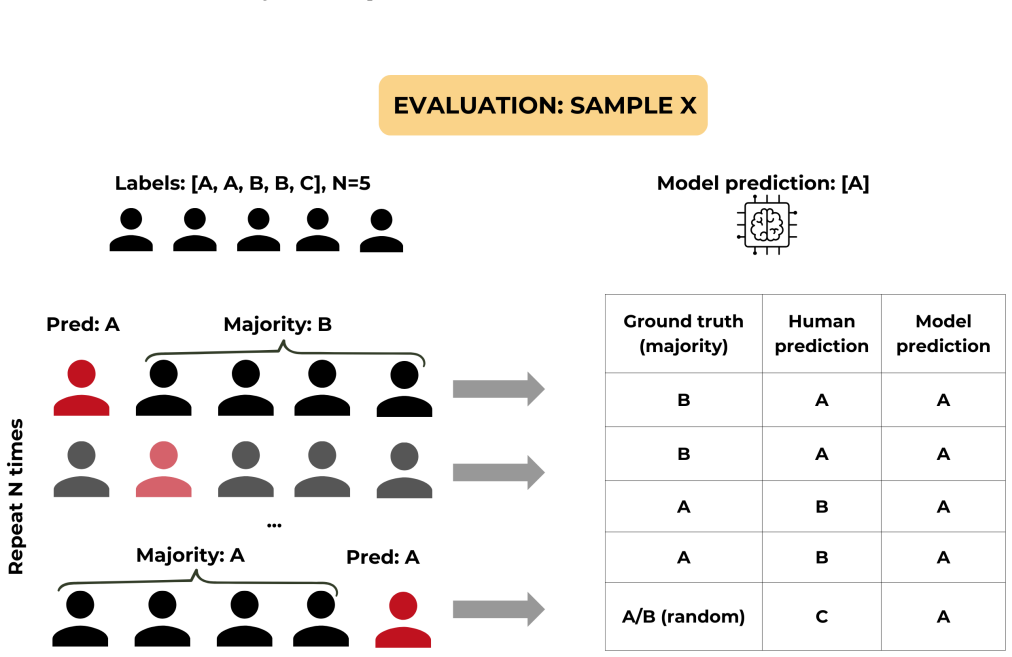
The load-bearing object is the dataset and its annotation protocol. Each of the 698 statement pairs was labeled by at least five crowd workers using a five-class scale: Unrelated, Consistent, Surface contradiction, Factual inconsistency, and Indirect (value) inconsistency, ordered by how much world knowledge is needed to see the conflict. Ground truth is the majority label, with roughly 16% of ties broken randomly; individual-human and model performance are measured by predicting that majority, and a bootstrap resampling of annotations estimates the ceiling imposed by labeling noise. This protocol is what makes the human-model comparison interpretable: it converts a subjective judgment task into a prediction task with a defined upper bound.
What would settle it
Re-annotate the 698 pairs with a fresh set of annotators, resolve all ties by expert adjudication instead of random selection, and recompute model-versus-human MCC in the three-class setting. If the top models' apparent advantage over individual humans disappears or reverses under this stricter ground truth, the central claim would fail.
Extended reading notes
Core claim
Stated on the paper's own terms, the discovery is that a large language model presented with a pair of political statements and the same annotation instructions given to crowd workers can predict the crowd's majority label about as well as an individual human can, and sometimes better. In the three-class version of the task (Unrelated, Consistent, Inconsistent), top models and humans both sit close to the estimated upper bound computed by bootstrapping annotators; LLaMA 70B reaches a Matthews correlation coefficient (MCC) of 0.525 for Unrelated, 0.707 for Consistent, and 0.633 for Inconsistent, against 0.503, 0.637, and 0.617 for individual humans. In the five-class version, performance on the fine-grained inconsistency types is markedly lower for everyone, models and humans alike, and remains far from the bootstrap upper bound, with LLaMA 70B's best subtype MCC at 0.388 for Surface contradiction versus a 0.675 upper bound. The paper reads this gap as inherent labeling subjectivity rather than a solvable model deficiency.
Load-bearing premise
The whole comparison rests on treating the crowd's majority answer as the truth, even though annotators only agree moderately and one sample in six was decided by a coin flip.
Editorial extensions
If this is right
- Off-the-shelf LLMs could serve as a low-cost first-pass filter that flags candidate inconsistent pairs for journalists, since three-class detection is close to the achievable upper bound.
- The five-class fine-grained typology is the open problem; all systems fall well below the bootstrap ceiling on Factual and Indirect inconsistency, so future work has a clear target.
- The released dataset, explanations, and self-reported political leaning of annotators enable studies of how political bias shapes inconsistency judgments.
- The bootstrap upper-bound estimate gives benchmark users a realistic accuracy ceiling, cautioning against treating 100% agreement as a sensible goal on a subjective task.
- A practical deployment would need to solve the pairing problem the benchmark sidesteps: deciding which statements to compare, not just classifying given pairs.
Reading between the lines
- The same-day, same-actor simplification likely makes the benchmark easier than real-world inconsistency, where a politician's statements are spread across time, platforms, and actions; a fielded system would need temporal alignment and topic prefiltering, which could change model rankings.
- Annotators' own switches between Factual and Indirect on repeated trials suggest these two categories may be better treated as a graded spectrum or as probabilistic labels rather than a forced discrete choice.
- Because 16% of ground-truth labels come from random tie-breaking, the small MCC differences between models and humans are vulnerable to noise; adjudicating ties with expert explanations or collecting more annotations could sharpen or overturn the ranking.
- A pure holdout of manually collected inconsistency examples, separated from LLM-assisted generation, would test whether models partly succeed by recognizing synthetic phrasing from their own training distribution.
Editorial analysis
A structured set of objections, weighed in public.
Referee Report
Summary. The paper introduces a benchmark dataset of 698 pairs of political statements, with crowd-sourced annotations across five classes (Unrelated, Consistent, Surface contradiction, Factual inconsistency, Indirect inconsistency) and free-text explanations for a subset of samples. The authors propose an inconsistency-detection task and a fine-grained typology, then evaluate four off-the-shelf LLMs (ChatGPT-4 turbo, ChatGPT-3.5 turbo, LLaMA3.3 70B, Llama3 8B) against individual human annotators using a leave-one-out majority-vote evaluation. The main claim is that current LLMs are about as good as humans at detecting inconsistencies and might outperform individual humans at predicting crowd-annotated ground truth, while the fine-grained five-class task remains unsolved. The paper also estimates a bootstrap-based upper bound on performance and releases the dataset and code.
Significance. If the dataset is reliable, it fills a real gap: there is no existing NLP resource for political inconsistency detection with a fine-grained typology, and the data is grounded in real voting-advice platforms. The annotation process is carefully described, with multiple annotations per item, practice sessions, comprehension checks, and manual validation, which are strengths. The paper also ships prompts, a bootstrap upper bound, and an ethics discussion, and it explicitly acknowledges subjectivity and labeling noise. However, the headline comparative result — that LLMs are as good as or better than individual humans — rests on small MCC differences (0.01–0.03) in a setting with substantial labeling noise, no confidence intervals, and an evaluation protocol that may be asymmetric. The dataset contribution is valuable, but the comparative claim needs stronger statistical support.
major comments (4)
- [Section 6, Table 3, Ethics Checklist 4(c)] The paper reports no error bars, confidence intervals, or significance tests for the model-versus-human comparisons. Given Krippendorff's alpha of 0.528 (5-class) and 0.507 (3-class), and 16% of ground-truth labels being randomly tie-broken, the observed MCC differences (e.g., LLaMA 70B 0.633 vs. humans 0.617 for the 3-class Inconsistent label; ChatGPT-4 turbo 0.548 vs. humans 0.503 for Unrelated) are within the noise of the labeling process. The abstract's statement that models 'might be even better than individual humans' is therefore not statistically supported. The authors should add bootstrap confidence intervals over annotators, tie-breaking seeds, and model runs, and perform a formal significance test (e.g., McNemar's test or a bootstrap difference test) before making such a claim.
- [Section 6, Figure 16] The evaluation protocol appears asymmetric between models and humans. For humans, each held-out annotation is scored against the majority of the other N−1 annotations, yielding one score per human annotation. For models, the paper says 'we use the same setting, comparing model output with N ground-truth labels per sample.' If this means each model prediction is compared against all N leave-one-out majority labels, then a model is credited for matching any of several noisy majority labels, while each human label is compared against only one majority (the one excluding that human). This asymmetry can inflate apparent model performance, especially for a model that simply predicts the plurality class. Please clarify the exact matching of folds and provide a matched comparison where models and humans are scored on identical folds.
- [Section 4, Appendix F, Section 6] Approximately 80 of the Factual and Indirect inconsistency samples were generated with GPT-4 and GPT-4o, and the benchmark then evaluates ChatGPT-4 turbo on the full dataset. If these synthetic samples are systematically easier for GPT-family models, the 'as good as humans' result could be inflated by leakage from the generation process. The paper dismisses this concern with a brief sentence in Section 4 but does not test it. Please report model and human performance separately for synthetically generated vs. non-synthetic samples, or otherwise demonstrate that the synthetic subset does not favor LLMs.
- [Section 5, Section 7] The ground-truth majority labels are unstable: Krippendorff's alpha is only about 0.53, and 16% of final labels are randomly tie-broken. The paper does not analyze how the comparative results in Tables 3 and 4 depend on the random tie-breaking or on the particular set of annotators. A sensitivity analysis (e.g., bootstrap over annotators and over random tie-breaking seeds, reporting the range of MCCs for both models and humans) is needed to establish whether the model/human ranking is meaningful at all. Without this, the 'better than individual humans' claim is not interpretable.
minor comments (6)
- [Section 8] The word 'scability' appears in the discussion of filtering strategies; it should be 'scalability'.
- [Section 7] The text states that 'Based on F1-score, ChatGPT-4 turbo and LLaMA 70B showed the best overall performance,' but Tables 3 and 4 report MCC; please reconcile this by referring to the F1 figures (Figure 4) explicitly or by reporting F1 in the tables.
- [Appendix F] The model identifier 'gpt-4o-2024-11-20|' contains a stray pipe character; this should be cleaned up.
- [Section 5] The sentence about the small subset with more than five annotations ('we randomly sampled 5 out of N samples to calculate the agreement') leaves it unclear whether ground-truth labels for the final dataset use all annotations or only five sampled ones; this should be clarified, since the class distribution in Table 2 is based on final annotations.
- [Section 4] The paper refers to 'Qual-O-Mat' in one place, while the original tool is 'Wahl-O-Mat'; please make the naming consistent.
- [Abstract] The sentence 'none of the model have reached the upper bound' contains a subject-verb agreement error; it should be 'none of the models has reached.'
Circularity Check
No significant circularity: the paper is an empirical benchmark with no fitted parameters, no self-citation chain, and no prediction that reduces to its construction inputs.
full rationale
The paper's central contribution is a crowd-annotated benchmark and an empirical comparison of off-the-shelf LLMs against human annotators. No parameter is fitted to the test data, no 'prediction' is derived from the ground-truth labels by construction, and no load-bearing claim is justified by a self-citation or an imported uniqueness theorem. The evaluation protocol defines ground truth operationally as the crowd majority with random tie-breaking and then measures humans and models against that same target, which is the standard construction of a benchmark rather than a circular derivation. The acknowledged use of GPT models to help generate Factual and Indirect inconsistency samples, offset by re-sampling from Wahl-O-Mat and X-stance and manual post-editing, is a potential data-contamination concern but not a by-construction reduction of the comparative claim. Similarly, the moderate Krippendorff alpha values and the absence of error bars, both explicitly disclosed, are statistical robustness concerns rather than logical circularity. The paper therefore contains no self-definitional, fitted-input, load-bearing self-citation, imported-uniqueness, or ansatz-smuggling step.
Assumptions & free parameters
assumptions (5)
- domain assumption Majority labels from at least 5 crowd annotators, with random tie-breaking, form a valid ground truth for political inconsistency.
- domain assumption Annotators' perception of inconsistency is a reasonable operationalization of the construct, despite subjectivity.
- domain assumption The proposed three-type taxonomy (surface, factual, indirect) is meaningful and applicable by non-experts after brief training.
- domain assumption Wahl-O-Mat and X-stance statements are representative of real-world political inconsistencies.
- standard math Standard statistical practices: N-1 majority-vote evaluation and bootstrap resampling provide meaningful estimates of human and model performance.
Cite this review
Pith. "Pith review of Misleading through Inconsistency: A Benchmark for Political Inconsistencies Detection." pith.science (2026). https://pith.science/paper/ZVZWCR6I
@misc{pith2026250519191,
  author       = {Pith},
  title        = {Pith review of: Misleading through Inconsistency: A Benchmark for Political Inconsistencies Detection},
  year         = {2026},
  howpublished = {\url{https://pith.science/paper/ZVZWCR6I}},
  note         = {Machine review of arXiv:2505.19191}
}
read the original abstract
Inconsistent political statements represent a form of misinformation. They erode public trust and pose challenges to accountability, when left unnoticed. Detecting inconsistencies automatically could support journalists in asking clarification questions, thereby helping to keep politicians accountable. We propose the Inconsistency detection task and develop a scale of inconsistency types to prompt NLP-research in this direction. To provide a resource for detecting inconsistencies in a political domain, we present a dataset of 698 human-annotated pairs of political statements with explanations of the annotators' reasoning for 237 samples. The statements mainly come from voting assistant platforms such as Wahl-O-Mat in Germany and Smartvote in Switzerland, reflecting real-world political issues. We benchmark Large Language Models (LLMs) on our dataset and show that in general, they are as good as humans at detecting inconsistencies, and might be even better than individual humans at predicting the crowd-annotated ground-truth. However, when it comes to identifying fine-grained inconsistency types, none of the model have reached the upper bound of performance (due to natural labeling variation), thus leaving room for improvement. We make our dataset and code publicly available.
Figures


Figures from the paper (13 more)


Forward citations
Cited by 1 Pith paper
-
A homotopy coherent Pontryagin-Thom isomorphism
There is a presentably symmetric monoidal stable infinity-category of homotopy-invariant Gysin sheaves whose unit is geometric cobordism and whose endomorphism E-infinity ring is the associated Thom spectrum.
Reference graph
Works this paper leans on
-
[1]
For most authors... (a) Would answering this research question advance sci- ence without violating social contracts, such as violat- ing privacy norms, perpetuating unfair profiling, exac- erbating the socio-economic divide, or implying disre- spect to societies or cultures? Yes (b) Do your main claims in the abstract and introduction accurately reflect t...
-
[2]
Additionally, if your study involves hypotheses testing... (a) Did you clearly state the assumptions underlying all theoretical results? N/A (b) Have you provided justifications for all theoretical re- sults? N/A (c) Did you discuss competing hypotheses or theories that might challenge or complement your theoretical re- sults? N/A (d) Have you considered ...
-
[3]
(a) Did you state the full set of assumptions of all theoret- ical results? N/A (b) Did you include complete proofs of all theoretical re- sults? N/A
Additionally, if you are including theoretical proofs... (a) Did you state the full set of assumptions of all theoret- ical results? N/A (b) Did you include complete proofs of all theoretical re- sults? N/A
-
[4]
Additionally, if you ran machine learning experiments... (a) Did you include the code, data, and instructions needed to reproduce the main experimental results (ei- ther in the supplemental material or as a URL)? Yes, we included prompts in Appendices F, H, and we make our dataset and code publically available (b) Did you specify all the training details ...
-
[5]
(a) If your work uses existing assets, did you cite the cre- ators? Yes, section 4
Additionally, if you are using existing assets (e.g., code, data, models) or curating/releasing new assets, without compromising anonymity... (a) If your work uses existing assets, did you cite the cre- ators? Yes, section 4. Sample generation (b) Did you mention the license of the assets? Yes, section
-
[6]
Model evaluation (f) Do you discuss what is “the cost“ of misclassification and fault (in)tolerance? No
-
[11]
We mentioned in the study description that we are con- ducting an Inconsistency detection task
Sample generation (c) Did you include any new assets in the supplemental material or as a URL? Yes, we included a link to our dataset and code in the abstract (d) Did you discuss whether and how consent was ob- tained from people whose data you’re using/curating? No, we didn’t explicitly ask for consent of annotators, however, we are not using the persona...
-
[12]
Additionally, if you used crowdsourcing or conducted research with human subjects, without compromising anonymity... (a) Did you include the full text of instructions given to participants and screenshots? Yes, Appendix G. An- notation guidelines (b) Did you describe any potential participant risks, with mentions of Institutional Review Board (IRB) ap- pr...
Show all 22 references
-
[13]
(Lin and Zhang 2023) Negation 1) Sally donated her kidney
Sally’s house is red. (Lin and Zhang 2023) Negation 1) Sally donated her kidney
2023
-
[14]
Sally never donated her kidney. (de Marneffe, Rafferty, and Manning 2008), (Sep´ulveda-Torres, Bonet-Jover, and Saquete 2023), (Li, Raheja, and Kumar 2024), (Sep´ulveda-Torres, Bonet-Jover, and Saquete 2021) Numeric 1) More than 50 civilians tragically died as a result of explosion
2008
-
[15]
The police found 32 confirmed dead so far. (de Marneffe, Rafferty, and Manning 2008), (Sep´ulveda-Torres, Bonet-Jover, and Saquete 2023), (Li, Raheja, and Kumar 2024), (Sep´ulveda-Torres, Bonet-Jover, and Saquete 2021), (Deußer et al. 2023) Antonyms 1) Capital punishment is a ...
2008
-
[16]
(de Marneffe, Rafferty, and Manning 2008) Content 1) She donated her kidney to a stranger
The Canadian parliament’s Ethics Commission accuses Judy Sgro. (de Marneffe, Rafferty, and Manning 2008) Content 1) She donated her kidney to a stranger
2008
-
[17]
(Li, Raheja, and Kumar 2024) Factive (Exaggeration) 1) Isuzu and V olvoagree to create a strategic alliance in heavy duty trucks
She donated her kidney to a close friend. (Li, Raheja, and Kumar 2024) Factive (Exaggeration) 1) Isuzu and V olvoagree to create a strategic alliance in heavy duty trucks
2024
-
[18]
(Sep´ulveda-Torres, Bonet-Jover, and Saquete 2023) Factual inconsistency Factual Abraham Lincoln is my mother
Isuzu and V olvocreate a strategic alliance in heavy duty trucks. (Sep´ulveda-Torres, Bonet-Jover, and Saquete 2023) Factual inconsistency Factual Abraham Lincoln is my mother. (de Marneffe, Rafferty, and Manning 2008) *, (Huntsman, Robinson, and Huntsman 2024)*, (Aharoni et a...
2023
-
[19]
(de Marneffe, Rafferty, and Manning 2008) Semantic 1) On 14th of March, 2020, we increased our capital by offering 5,000 new shares during a seasoned equity offering
Microsoft was established in 1989. (de Marneffe, Rafferty, and Manning 2008) Semantic 1) On 14th of March, 2020, we increased our capital by offering 5,000 new shares during a seasoned equity offering
1989
-
[20]
(Deußer et al
During 2020 we did not increase our total amount of equity and thus, it remained unchanged at $10,000,000. (Deußer et al. 2023) Causal 1) I slam the door
2020
-
[21]
(Li, Raheja, and Kumar 2024) Relation 1) Jane and Tom are a married couple
After I do that, the door opens. (Li, Raheja, and Kumar 2024) Relation 1) Jane and Tom are a married couple
2024
-
[22]
(Li, Raheja, and Kumar 2024) Value inconsistency Violation of expectations I didn’t attend the funeral, but I sent a nice letter saying I approved of it
Jane is Tom’s sister. (Li, Raheja, and Kumar 2024) Value inconsistency Violation of expectations I didn’t attend the funeral, but I sent a nice letter saying I approved of it. (Lin and Zhang 2023) Table 5: Types of Inconsistency in other literature. E Prompts for sample genera...
2024
-
[2008]
In Moore, J
Finding Contradictions in Text. In Moore, J. D.; Teufel, S.; Allan, J.; and Furui, S., eds., Proceedings of ACL-08: HLT, 1039–1047. Columbus, Ohio: Association for Computational Linguistics. DellaPosta, D.; Shi, Y .; and Macy, M. 2015. Why Do Lib- erals Drink Lattes? American ...
2015 arXiv
-
[2021]
Here Are the Rules: Ignore All Rules
“Here Are the Rules: Ignore All Rules”: Auto- matic Contradiction Detection in Spanish. Applied Sciences, 11(7): 3060. Sep´ulveda-Torres, R.; Bonet-Jover, A.; and Saquete, E
-
[2022]
Transactions of the Association for Computational Linguistics , 10: 163–177
SummaC: Re-Visiting NLI-based Models for Incon- sistency Detection in Summarization. Transactions of the Association for Computational Linguistics , 10: 163–177. Lattimer, B.; Chen, P. H.; Zhang, X.; and Yang, Y . 2023. Fast and Accurate Factual Inconsistency Detection Over Lo...
2023
-
[2023]
IEEE Ac- cess, 11: 72007–72026
Detecting Misleading Headlines Through the Auto- matic Recognition of Contradiction in Spanish. IEEE Ac- cess, 11: 72007–72026. Shan, G.; Zhou, L.; and Zhang, D. 2021. From conflicts and confusion to doubts: Examining review inconsistency for fake review detection. Decision Su...
2021 arXiv
Reviewed August 7, 2026 · model on record in the stance chip above.
Discussion (0). Continue with ORCID to comment.