REVIEW 5 major objections 5 minor 11 references
Task Memory Engine: Spatial Memory for Robust Multi-Step LLM Agents
T0 review · 5 major / 5 minor · reviewed 2026-08-07 · deepseek-v4-flash
Pith's one-line read Replacing flat context with a DAG-structured task memory eliminates hallucinations and confusions in LLM agents across scripted multi-step scenarios.
desk verdict A plausible memory-module design, but the zero-hallucination claim rests on a leaked few-shot prompt and a single scripted pass; the idea is worth a revision, not acceptance. read the letter →
The pith
A machine-rendered reading of the paper's core claim, the machinery that carries it, and where it could break.
The reading
What carries the argument
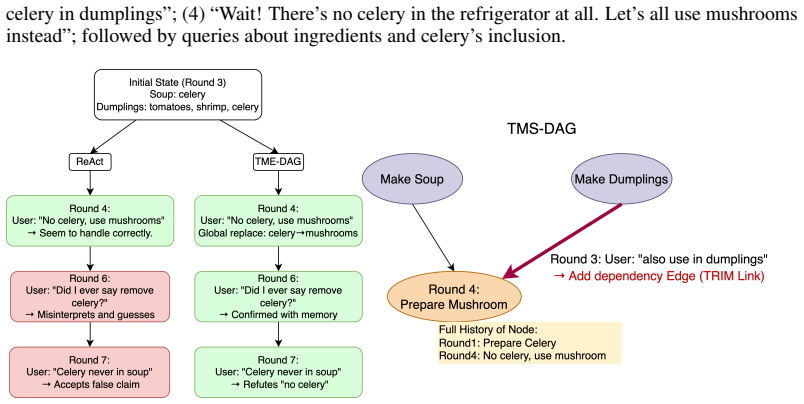
The load-bearing pieces are the Task Memory Structure (TMS-DAG) and the Task Representation and Intent Management (TRIM) module. TMS-DAG is a directed acyclic graph $G=(V,E)$ in which nodes hold subtask state (slot, value, history, parent, dependencies) and edges encode ordering or dependency constraints; it supports add, replace, delete, rollback, and dependency propagation. TRIM is a few-shot LLM-based classifier that decomposes user input into subtasks, assigns each an intent in {new, update, check}, infers relations such as replaces, and selects a minimal subgraph for the LLM prompt. The five-step workflow—decompose, classify, update graph, retrieve subgraph, generate—is what transforms a flat-context LLM into a revision-aware agent.
What would settle it
Re-run the four scripts with the TRIM prompt's few-shot examples replaced by unrelated examples of new, update, and check intents, and count hallucinations and confusions; if errors appear, the original zero-error claim depends on the test turns being present in the prompt.
Extended reading notes
Core claim
The central claim is that replacing flat conversation history with a DAG-structured task memory eliminates cross-turn contradictions in multi-step LLM agents. TME-DAG stores each subtask as a node with a slot, value, history, parent, and dependency edges, so a user revision such as "use mushrooms instead of celery" propagates globally to every dependent subtask. TRIM, a few-shot LLM-based intent classifier, decomposes each input into subtasks, labels intents as new/update/check, and retrieves a compact subgraph $G'_i$ to pass to the LLM. In the four reported case studies, this pipeline achieves zero hallucinations and confusions across all 27 turns, achieves full task consistency in all four scenarios, and saves 19.4% tokens relative to a flat baseline in a form-filling task. The paper also reports that the shopping cart scenario initially produced one hallucination and one confusion until a task-specific flattened TRIM adaptation was applied, after which it matched ReAct.
Load-bearing premise
The load-bearing assumption is that the TRIM intent classifier's zero-error performance reflects generalization rather than memorization of the specific test turns, since the paper's few-shot prompt examples come from the same scripts being evaluated.
Editorial extensions
If this is right
- A memory layer alone, with no fine-tuning, can carry global revisions across dependent subtasks.
- Token cost per turn can stay bounded as conversations grow, because only the relevant subgraph is sent to the LLM.
- The same architecture can be adapted to enterprise workflows where tasks share resources and revisions propagate.
- Agents can answer historical queries correctly by tracking node histories instead of re-reading the transcript.
- The open-source release allows other teams to test the same claims on new scripts and domains.
Reading between the lines
- If the few-shot examples in Appendix D are not held out, the zero-error numbers may largely reflect pattern matching to those exact turns; a held-out evaluation would show how much generalization the classifier actually has.
- The approach is likely to shine on tasks with shared subtasks and global substitutions, while flat, sequential tasks may not need a DAG at all—consistent with the cart-editing result.
- The token savings should grow with conversation length in tasks with many independent branches, but the LLM call to TRIM adds latency and cost that the paper does not fully account for.
- A natural next test is to apply TME-DAG to longer, open-ended conversations with hundreds of turns, where current linear-context methods hit context windows.
Editorial analysis
A structured set of objections, weighed in public.
Referee Report
Summary. The paper introduces the Task Memory Engine (TME), a memory controller that replaces linear conversation context with a structured task graph (tree or DAG) and uses a Task Representation and Intent Management (TRIM) module to classify user intents and update the graph. The authors claim that TME-DAG, without fine-tuning, eliminates hallucinations and misinterpretations across four scripted multi-turn tasks (27 user turns), outperforming ReAct, and yields token savings. The paper includes qualitative case studies, aggregated error counts, an ablation, a token-efficiency comparison, and open-source code and scripts.
Significance. If the central empirical claim were sound, TME would be a useful practical contribution: a modular, fine-tuning-free memory layer that makes off-the-shelf LLMs more robust to revisions and dependency changes in multi-turn interaction. The idea of encoding task state as a dependency graph and separating intent classification from response generation is reasonable and worth exploring. The paper also deserves credit for releasing code, benchmarks, and detailed interaction scripts, which would aid reproducibility if the evaluation issues were resolved. However, the current evidence does not support the headline '100% reduction' claim: the evaluation design leaks exact test inputs into the few-shot prompt, the cart scenario was adapted after seeing the test outcome, and multiple reported numbers are internally inconsistent. These are load-bearing problems, not cosmetic ones.
major comments (5)
- [Appendix D vs. Tables 7-9] The TRIM few-shot prompt in Appendix D contains verbatim user utterances from the evaluation set: Cooking Round 4 ('Wait! There's no celery in the refrigerator at all...'), Trip Round 9 ('start: By the way, wasn't I departing from Boston?'), and Meeting Round 1 ('Schedule a team meeting on Thursday at 2 PM with Alice, Bob, and Carol.'). These exact turns are part of the 27-turn evaluation in Tables 7, 8, and 9. The paper never states that these examples were excluded from the evaluation turns. Because TRIM's few-shot classifier can copy the labeled output for these turns, the zero-error result for those turns does not demonstrate generalization. The 100% reduction claim is therefore not established for a held-out test set.
- [Section 5.4, Table 1] The cart-editing scenario initially produced 1 hallucination and 1 confusion under TME-DAG, and only achieved zero after the authors introduced a 'task-specific TRIM adaptation' that flattens the graph structure. This adaptation was introduced after observing the failure on this exact scenario, which is post-hoc tuning on the test set. The reported zero-error performance for the cart task in Table 1 reflects the adapted system, not the method as specified in Section 4.2. This makes the claim that TME-DAG achieves zero errors across all four tasks a statement about a scenario-specific modified system, not about the proposed general method.
- [Abstract vs. Section 6.1 / Table 1] The abstract states that TME 'reduces hallucinations by 66.7% and misinterpretations by 83.3% across 27 user turns,' while Section 6.1 and Table 1 report 0 vs. 3 hallucinations and 0 vs. 5 confusions relative to ReAct, which are 100% reductions. The abstract also says 'eliminates 100% of hallucinations and misinterpretations in three tasks,' but Table 1 shows zero errors in all four tasks. These numerical claims are irreconcilable. The headline quantitative result is internally inconsistent and must be corrected.
- [Section 4.5, Eq. (2)] The formal description defines f_TRIM as 'an embedding-based classifier' and states 'z_j = f_TRIM(s_j, G)' with f_TRIM mapping to {new, update, check}. However, Section 4.2 explicitly states that the embedding-based classifier was abandoned in favor of an LLM-based few-shot approach. The formal model therefore does not describe the implemented system. The paper should either revise the formal description to reflect the LLM-based classifier or clearly distinguish the intended future formalization from the implemented prototype.
- [Section 6, Tables 1 and 3] All performance results are based on a single scripted run of each scenario, with no multiple trials, no variance reporting, and no statistical significance testing. The 27 turns are the same author-written scripts used in the case studies, and the error labels are assigned by the same researcher who wrote the scripts. Given the small sample size and the absence of any held-out or diversified evaluation, the strong claim of a '100% reduction' is not robustly supported even setting aside the leakage and post-hoc adaptation concerns. A proper evaluation with multiple runs, varied prompts, and independent labeling is needed.
minor comments (5)
- [Appendix B.1 vs. Section 5.1] The trip planning scenario is described as having 10 rounds in Section 5.1, but Table 7 contains 11 rounds. The total of all four scenarios would then be 28, not 27, as stated in Table 1. The round counts should be reconciled.
- [Throughout] The terms 'misinterpretation' and 'confusion' are used interchangeably (e.g., abstract vs. Table 1). One term should be used consistently, and its operational definition should be stated.
- [Section 6.2] The token-efficiency result is demonstrated only on a separate form-filling task, not on the four main scenarios. The paper should clarify that the 19.4% savings applies to that specific task and not claim general token efficiency without further evidence.
- [Section 7] The conclusion refers to 'a dynamic, graph-based memory tree,' but the methodology consistently describes a DAG. The terminology should be aligned.
- [Appendix B.4] The cart-editing script notes say the responses are 'based on terminal logs,' but the provenance of the responses is otherwise described as author-written case studies. The paper should state clearly how the responses were collected (e.g., actual system runs) and whether the scripts were fixed before or after observing system outputs.
Circularity Check
Zero-error result is partly in-sample: TRIM's few-shot prompt contains exact test turns and the cart scenario is post-hoc adapted.
-
fitted input called prediction
[Appendix D 'TRIM Prompt Template Examples'; cf. Section 6.1/Table 1 and Appendix B Tables 8, 7, 9]
"Input: “Wait! There’s no celery in the refrigerator at all. Let’s all use mushrooms instead.” (Cooking, Round 4) ... Input: “start: By the way, wasn’t I departing from Boston?” (Trip Planning, Round 9) ... Input: “Schedule a team meeting on Thursday at 2 PM with Alice, Bob, and Carol.” (Meeting, Round 1)"
These three user utterances appear verbatim both as few-shot examples in the TRIM prompt and as test turns in the case-study scripts (Cooking Round 4, Trip Round 9, Meeting Round 1). The paper never states that these turns were excluded from the 27-turn evaluation counted in Table 1. For those turns, TRIM's structured JSON output is already supplied in the prompt, so the LLM can produce the correct classification by copying, making the 'prediction' equivalent to the input by construction. The zero-Hallucination/zero-Confusion aggregate therefore includes at least these in-sample turns and does not demonstrate generalization to novel inputs.
-
fitted input called prediction
[Section 5.4, Case IV: Cart Editing with Item Conflicts]
"Initially, TME-DAG struggled due to its hierarchical design for complex tasks. In Round 4, it misreported “two iPhone cases and MacBook stand,” incurring 1 hallucination and 1 confusion from residual dependency conflicts in the DAG... We introduced a task-specific TRIM adaptation, flattening the structure to treat items as independent nodes with direct state updates. Post-adaptation, TME-DAG achieved zero hallucinations and confusions, matching ReAct’s performance."
The cart scenario's zero-error result is reported after the authors modified the task-specific TRIM component in direct response to the observed errors on this exact scenario. That is a post-hoc fit to the test case, not an evaluation of the originally proposed TME-DAG. Since the aggregate '100% reduction' in Table 1 includes this adapted variant, part of the headline improvement over ReAct is produced by tuning on the test scenario rather than by the method as specified.
full rationale
No load-bearing self-citation or imported uniqueness theorem appears; the DAG update formalism in Section 4 is not circular in itself. The circularity is concentrated in the evaluation design: TRIM's few-shot prompt contains three exact test turns from the evaluation scripts, and the cart scenario was adapted post hoc after observing its failure. As a result, the paper's central zero-error claim is partly built into the evaluation rather than demonstrated on held-out inputs. The token-efficiency comparison is separate and not affected by this leak. Overall score 6 reflects partial circularity in the empirical claim, not a total collapse of the formal derivation chain.
Assumptions & free parameters
free parameters (3)
- Task-specific TRIM adaptation (flattened graph) =
shopping cart scenario only
- LLM sampling temperature =
0.3
- Retrieval cost function cost(n) =
unspecified
assumptions (4)
- domain assumption Manual labels of hallucination and confusion are objective and consistent.
- domain assumption The four hand-written scenarios (27 turns) are representative of multi-step LLM agent tasks.
- domain assumption GPT-4o intent classification and response generation are reliable enough that one pass at temperature 0.3 supports the reported outcome.
- ad hoc to paper Few-shot examples in Appendix D do not taint the evaluation.
Cite this review
Pith. "Pith review of Task Memory Engine: Spatial Memory for Robust Multi-Step LLM Agents." pith.science (2026). https://pith.science/paper/EAUM34KF
@misc{pith2026250519436,
  author       = {Pith},
  title        = {Pith review of: Task Memory Engine: Spatial Memory for Robust Multi-Step LLM Agents},
  year         = {2026},
  howpublished = {\url{https://pith.science/paper/EAUM34KF}},
  note         = {Machine review of arXiv:2505.19436}
}
read the original abstract
Large Language Models (LLMs) falter in multi-step interactions -- often hallucinating, repeating actions, or misinterpreting user corrections -- due to reliance on linear, unstructured context. This fragility stems from the lack of persistent memory to track evolving goals and task dependencies, undermining trust in autonomous agents. We introduce the Task Memory Engine (TME), a modular memory controller that transforms existing LLMs into robust, revision-aware agents without fine-tuning. TME implements a spatial memory framework that replaces flat context with graph-based structures to support consistent, multi-turn reasoning. Departing from linear concatenation and ReAct-style prompting, TME builds a dynamic task graph -- either a tree or directed acyclic graph (DAG) -- to map user inputs to subtasks, align them with prior context, and enable dependency-tracked revisions. Its Task Representation and Intent Management (TRIM) component models task semantics and user intent to ensure accurate interpretation. Across four multi-turn scenarios-trip planning, cooking, meeting scheduling, and shopping cart editing -- TME eliminates 100% of hallucinations and misinterpretations in three tasks, and reduces hallucinations by 66.7% and misinterpretations by 83.3% across 27 user turns, outperforming ReAct. TME's modular design supports plug-and-play deployment and domain-specific customization, adaptable to both personal assistants and enterprise automation. We release TME's codebase, benchmarks, and components as open-source resources, enabling researchers to develop reliable LLM agents. TME's scalable architecture addresses a critical gap in agent performance across complex, interactive settings.
Figures


Figures from the paper (3 more)


Reference graph
Works this paper leans on
-
[1]
Alan D Baddeley. The episodic buffer: A new component of working memory?Trends in Cognitive Sciences, 4(11):417–423, 2000. doi: 10.1016/S1364-6613(00)01538-2. URL https://doi.org/10.1016/S1364-6613(00)01538-2
-
[2]
Language models are few-shot learners
Tom Brown, Benjamin Mann, Nick Ryder, Melanie Subbiah, Jared D Kaplan, Prafulla Dhari- wal, Arvind Neelakantan, Pranav Shyam, Girish Sastry, Amanda Askell, et al. Language models are few-shot learners. InAdvances in Neural Information Processing Systems, vol- ume 33, pages 1877–1901, 2020. URL https://papers.nips.cc/paper/2020/file/ 1457c0d6bfcb4967418bfb...
work page 1901
-
[3]
A topological zero-one law and elementary equivalence of finitely generated groups
Michael Heck, Carel van Niekerk, Nurul Lubis, Christian Geishauser, Hsien-Chin Lin, Marco Moresi, and Benjamin Ruppik. Trippy: A triple copy strategy for value independent neural dialog management.arXiv preprint arXiv:2004.07479, 2020. URL https://arxiv.org/ abs/2004.07479
work page Pith review arXiv 2004
-
[4]
Survey of hallucination in natural language generation
Ziwei Ji, Nayeon Lee, Rohan Frieske, Tenghao Yu, Dan Su, Yan Xu, Eric Ishii, Yejin Bang, Andrea Madotto, and Pascale Fung. Survey of hallucination in natural language generation. ACM Computing Surveys, 55(12):1–38, 2023. doi: 10.1145/3571730. URL https://dl.acm. org/doi/10.1145/3571730
doi:10.1145/3571730 2023
-
[5]
Patrick Lewis, Ethan Perez, Aleksandra Piktus, Fabio Petroni, Vladimir Karpukhin, Naman Goyal, Heinrich Küttler, Mike Lewis, Wen-tau Yih, Tim Rocktäschel, et al. Retrieval-augmented generation for knowledge-intensive nlp tasks.Advances in Neural Information Processing Systems, 33, 2020. URLhttps://arxiv.org/abs/2005.11401
arXiv 2020
- [6]
-
[7]
Searching for best practices in retrieval-augmented generation
Xiaohua Wang, Zhenghua Wang, Xuan Gao, Feiran Zhang, Yixin Wu, Zhibo Xu, Tianyuan Shi, Zhengyuan Wang, Shizheng Li, Qi Qian, Ruicheng Yin, Changze Lv, Xiaoqing Zheng, and Xuanjing Huang. Searching for best practices in retrieval-augmented generation. InProceedings of the 2024 Conference on Empirical Methods in Natural Language Processing (EMNLP), pages 17...
work page 2024
-
[8]
Jason Wei, Xuezhi Wang, Dale Schuurmans, Maarten Bosma, Fei Xia, Ed H. Chi, Quoc V . Le, and Denny Zhou. Chain-of-thought prompting elicits reasoning in large language models. Advances in Neural Information Processing Systems, 35, 2022. URL https://arxiv.org/ abs/2201.11903
arXiv 2022
Show all 11 references
-
[10]
Griffiths, Yuan Cao, and Karthik Narasimhan
Shunyu Yao, Dian Yu, Jeffrey Zhao, Izhak Shafran, Thomas L. Griffiths, Yuan Cao, and Karthik Narasimhan. Tree of thoughts: Deliberate problem solving with large language models. Advances in Neural Information Processing Systems, 36, 2023. URL https://arxiv.org/ abs/2305.10601
2023 arXiv
-
[11]
Collect name
Wanjun Zhong, Lianghong Guo, Qiqi Gao, He Wang, and Yanlin Wang. Memorybank: Enhanc- ing large language models with long-term memory.arXiv preprint arXiv:2305.10250, 2023. URLhttps://arxiv.org/abs/2305.10250. 10 Appendix Appendix A: Per-Round Token Usage Details To support the...
2023 arXiv
-
[2022]
URLhttps://arxiv.org/abs/2210.03629
Reviewed August 7, 2026 · model on record in the stance chip above.
Discussion (0). Continue with ORCID to comment.