REVIEW 3 major objections 5 minor 58 references
Training-Free Multi-Step Audio Source Separation
T0 review · 3 major / 5 minor · reviewed 2026-08-07 · deepseek-v4-flash
Pith's one-line read Pretrained one-step audio source separation models can be improved by iteratively remixing the input with their own output and selecting the best candidate by a quality metric, with no additional training.
desk verdict A simple, reproducible inference-time trick that gives modest but real gains; the paper oversells its theoretical guarantee, but the empirical core is worth refereeing. read the letter →
The pith
A machine-rendered reading of the paper's core claim, the machinery that carries it, and where it could break.
The reading
What carries the argument
The load-bearing object is the linear blending identity $x_t = r_t x_0 + (1 - r_t) y_{t-1}$ together with metric-based selection $r_t^* = \arg\max_k R(f(x_t^{(k)}))$. The blend interpolates between the original noisy mixture and the current estimate, so each candidate sits at a different point on a linear path and the model is asked to denoise that intermediate point. The selection rule guarantees the search metric does not drop, and Theorem 2 bounds the variance of $R(y_t)$ by $L_f^2 L_r^2 (x_0 - y_{t-1})^2 \varepsilon_r^2$, so errors shrink as the estimate approaches the target. The paper also identifies the audio separation training objective, with its random mixing of clean and noise signals, as proportional to a denoising diffusion bridge model objective, which explains why frozen models can denoise along these interpolated inputs.
What would settle it
On the VCTK-DEMAND test set, run Algorithm 1 with PESQ as the search metric and record SI-SNR at each step: Table 1 already shows SI-SNR dropping from 19.27 dB at step 0 to 18.69 dB at step 20, demonstrating that the guarantee applies only to the optimized metric. To isolate the role of the metric, repeat the loop with $R$ replaced by a random scorer: if true separation quality can decrease, the method's value in blind deployment rests entirely on the availability of a faithful non-intrusive metric.
Extended reading notes
Core claim
On the paper's own terms, the central discovery is that one-step separation models are not limited to one step: repeated application with a blend-and-select loop improves separation quality without retraining. The update is $x_t = r_t x_0 + (1 - r_t) y_{t-1}$, with $K$ candidate ratios in $[0,1]$; the winning ratio is chosen by maximizing the separation metric $R$ over $f(x_t^{(k)})$. Theorem 1 states that because the unmodified mixture, $r=1$, is among the available candidates, the metric value $R(y_t)$ is at least $R(y_0)$, so the loop is non-decreasing in the search metric. Empirically the authors report gains across speech enhancement and music source separation that often match or exceed scaling the model, adding training data, or using a trained multi-step diffusion model, while cautioning that one non-optimized metric, SI-SNR, can decline.
Load-bearing premise
The entire loop is steered by a quality metric that must be available at inference time and must rank candidate outputs in roughly the same order as true separation quality; if the metric is unavailable or misranks, the loop can lock onto worse outputs, as happens for SI-SNR when PESQ is used for search.
Editorial extensions
If this is right
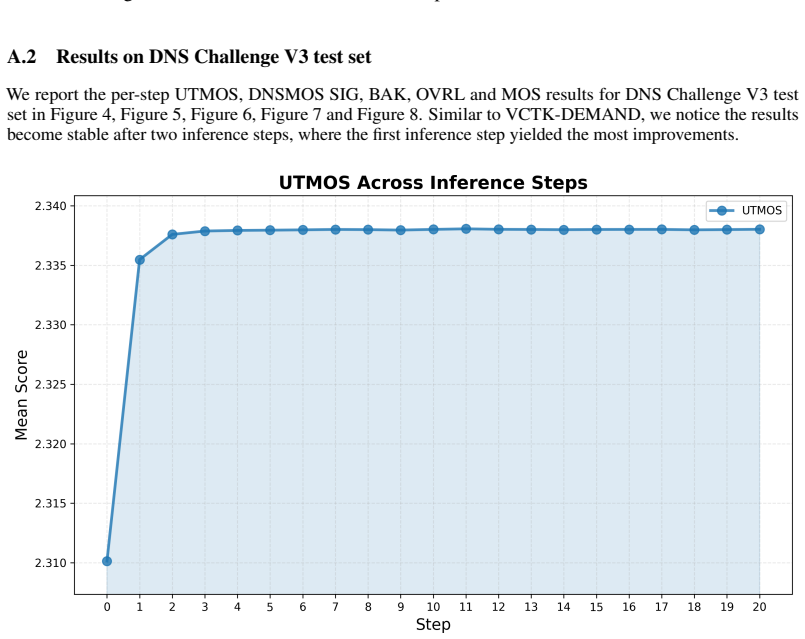
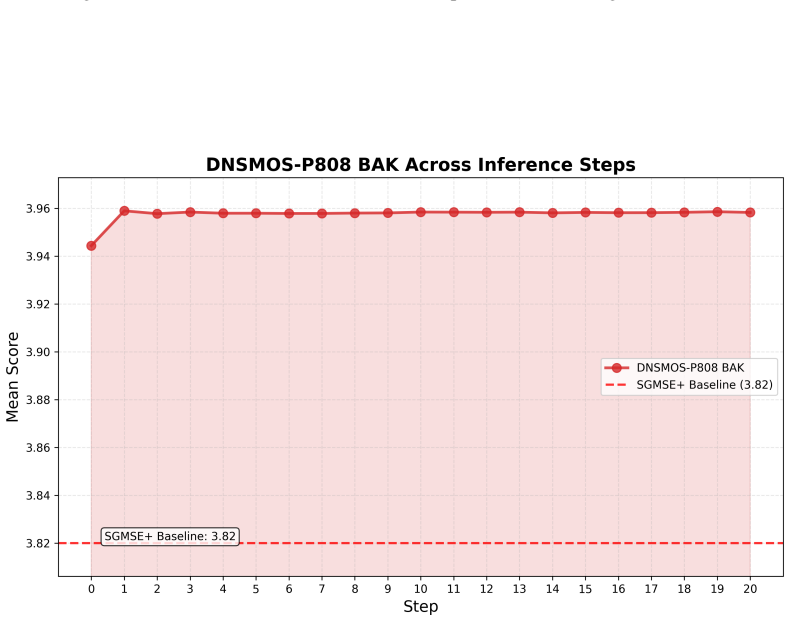
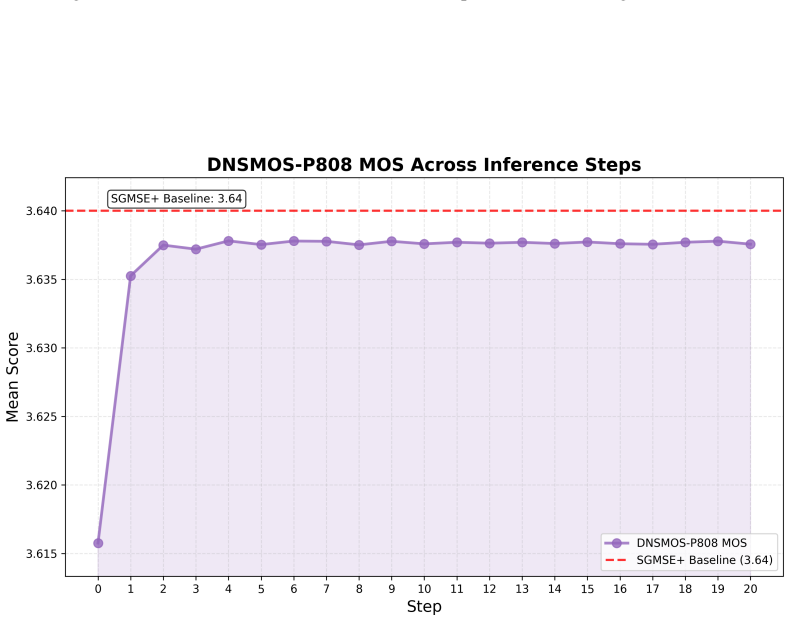
- Any frozen one-step separator can be upgraded at inference time: users can trade compute for quality without retraining, and the first extra step captures most of the gain.
- Inference-time scaling for audio can rival training-time scaling: the paper's medium model with multi-step inference beats its larger variants on several speech enhancement metrics.
- Models trained with random data mixing implicitly learn denoising along interpolation paths, so the same blend-and-select recipe should transfer to other models trained with interpolative augmentation.
- Non-optimized metrics usually improve as well, but not always: SI-SNR declined on VCTK-DEMAND when the search metric was perceptual, so the improvement is tied to the fidelity of the chosen metric.
Reading between the lines
- If the bridge-model equivalence holds, the recipe is not specific to audio: any regression model trained on convex mixtures of two distributions could be iteratively refined by blending its input with its estimate, making image restoration and speech dereverberation natural test beds.
- The proof of Theorem 1 depends on $r=1$ being available in the candidate grid; an implementation that samples ratios exclusively between 0 and 1 loses the formal guarantee, so endpoints should always be included.
- The observed SI-SNR decline suggests the search metric should match the deployment metric, and a learned reference-free estimator of the target metric would make the method usable in truly blind settings.
- Because gains concentrate in the first step, adaptive stopping or evaluating only steps 0 and 1 could deliver most of the benefit at a fraction of the computational cost.
Editorial analysis
A structured set of objections, weighed in public.
Referee Report
Summary. The paper proposes a training-free multi-step inference procedure for pretrained single-step audio source separation models. At each refinement step, the original mixture x0 and the previous estimate y_{t-1} are blended at K candidate ratios; the model is applied to each candidate, and the output with the highest value of a quality metric R is kept. The authors claim a non-decreasing guarantee on R (Theorem 1), an error bound based on Lipschitz smoothness and metric noise (Theorem 2), and a connection to denoising diffusion bridge models (Section 5). Experiments on VCTK-DEMAND, DNS Challenge V3, and MUSDB18-HQ show that most evaluated metrics improve, with the largest gains at the first refinement step, and that some gains are comparable to scaling model size or training data. One metric, SI-SNR, degrades on VCTK-DEMAND when PESQ is used as the search metric.
Significance. If the empirical findings hold, the method is a simple and practical way to extract additional performance from existing one-step separation models without retraining or architectural changes. The paper is commendable for releasing code, for evaluating on both speech and music tasks, and for including a comparison against larger model variants. However, the advertised theoretical guarantees are considerably weaker than claimed, and the empirical claims need to be restated as 'most metrics improve' rather than 'always improve.' The largest first-step gains are real and reproducible in the tables, but the paper's theoretical framing does not yet explain them, and the bridge-model derivation contains a mathematical error.
major comments (3)
- [§3.1, Theorem 1 and Eq. (5)] Theorem 1 does not prove improvement over one-step inference in the sense claimed in the abstract. Because the candidate set in Eq. (2) includes r=1, Eq. (1) yields x_t=x0 and hence f(x_t)=y0, so the inequality R(y_t)≥R(y0) holds by construction. This guarantees only non-degradation of the search metric R; it says nothing about strict improvement, about the true separation quality, or about any metric other than R. The abstract's 'always yield improvement over one-step inference' and the conclusion's 'consistent improvements ... in all but one case' are therefore overstatements. Table 1 shows SI-SNR falling monotonically from 19.2717 at step 0 to 18.6880 at step 20 when PESQ is the search metric, so the method can actively degrade a standard separation metric. In addition, Theorem 1 does not imply R(y_t)≥R(y_{t-1}), and Table 2 shows non-monotonic cSDR for the Drums and Other stems. The guarantee should be restated as non-degradation of the search metric, and the empirical claims should be limited to 'most metrics improve, with exceptions.'
- [§5, Eqs. (21)–(26) and Appendix C.2] The claimed equivalence L_DDBM ∝ L_sep is not supported by the algebra. With y=(1−σ)q+σp and hat p(y)=f(y), Eq. (26) gives E[ε^{-4}|y−hat p(y)|^2] after setting w(σ)=σ^2, whereas Eq. (15) defines L_sep=E|f(y)−p|^2=E|hat p(y)−p|^2. These two objectives are not proportional unless hat p(y)≈y, which is not the separation objective. The score parameterization in Eq. (21) and the approximation in Eq. (35) of Appendix C.2 are asserted rather than derived; in fact, with a perfectly trained separation model, f(y)−y=(1−σ)(p−q) while σ(p−y)=σ(1−σ)(p−q), so Eq. (35) is off by a factor σ. The DDBM connection is therefore constructed by choosing the score parameterization and weighting w(σ)=σ^2, and it cannot serve as an independent explanation of why multi-step inference helps.
- [§3.2, after Theorem 2] The error-bound analysis rests on Assumption 1, which asserts local differentiability and Lipschitz continuity of f and R with the justification that 'we assume both are likely true in reality.' This is not verified for the BSRNN/DTTNet models or for DNSMOS, UTMOS, PESQ, or SDR estimators. More importantly, the paragraph following Theorem 2 claims 'statistical convergence' and E[ΔQ_t]>0 'when averaged over the metric's noise distribution' without a proof; Eq. (8) simply postulates rt∼N(r*_t,ε_r^2), which does not follow from the deterministic arg-max search in Eq. (2). This convergence claim should be either proved under explicit conditions or removed, since as written it is an unsupported assertion.
minor comments (5)
- [Section 2] The Related Work section contains the dangling citation 'citehershey2016deep'; the intended reference is not formatted.
- [Section 4.1] The DNS Challenge v3 blind test set is cited as [3], but reference [3] is the DTTNet music separation paper; the correct DNS challenge reference should be used.
- [Tables 1 and 2] The tables report single-run point estimates without error bars or significance tests, making it difficult to assess whether small differences such as PESQ 3.2864 vs. 3.2867 are reliable.
- [Throughout] There are typographical issues including 'optimzed' in Section 3, 'V ocals' in Table 2, and 'W A' in the author affiliation; these should be cleaned up.
- [§3.1 proof] The proof of Theorem 1 is presented as 'Proof 1 for all t...'; it would read more clearly as a standard proof paragraph with explicit mention of the r=1 candidate.
Circularity Check
The 'always improve' theorem is a tautology of the arg-max selection rule, and the DDBM equivalence is manufactured by a chosen score parameterization and weighting; the empirical results remain partly independent.
-
self definitional
[Section 3.1, Theorem 1 and Proof 1; Algorithm 1 and Eq. (2)]
"r∗t = arg max k∈{1,...,K} R(f(x(k)t)). ... R (yt) = R [f (x∗t)] = R [f (r∗t x0 + (1 − r∗t )yt−1)] ≥ R [f (1 · x0 + 0 · yt−1)] = R [f (x0)] = R [y0]."
The candidate grid from Eq. (1) contains r=1, which reproduces the original mixture x0, and Eq. (2) selects whichever candidate maximizes R. Hence R(yt) ≥ R(f(x0)) = R(y0) follows directly from the definition of arg max plus the presence of the baseline in the grid; no property of the model or metric is needed. The 'always improvement over one-step inference' advertised in the abstract is therefore only a non-decrease on the optimized metric R, not a statement about true separation quality, and it does not imply step-to-step monotonicity. Table 1 shows SI-SNR falling from 19.27 dB at step 0 to 18.69 dB at step 20, so the theorem's guarantee is exactly the trivial selection guarantee, not an independent bound.
-
renaming known result
[Section 5, Eqs. (21)-(26), and Appendix C.2]
"Consider the case w(σ) = σ2: LDDBM(·) = E[1/ϵ4 |y − ˆp(y)|2]. Recall Equation 15, and as 1/ϵ4 is a constant, we establish a equivalence between the DDBM training objective and the audio source separation network, i.e. LDDBM(·) ∝ Lsep(·)."
The claimed proportionality is obtained by post-hoc choices: the score parameterization sω(y,p,σ) = (y−ˆp(y))/(ϵ2σ) is adopted (with justification deferred to the appendix), and the weighting w(σ)=σ2 is then selected so that the σ-dependence cancels. Eq. (15) is E|f(y)−p|2 while Eq. (26) is E|y−ˆp(y)|2; equating them requires identifying ˆp with f and assuming a relation between y, p and the estimate, which is not derived in the main text. Appendix C.2 supplies the needed relation by assuming 'For a well-trained model, we have the approximation: ˆp(x) − x ≈ t(p − x)', i.e. it assumes the very denoising-along-the-interpolation property the section aims to establish. The bridge-model connection is therefore a renaming/construction, not an independent first-principles derivation.
full rationale
The empirical core of the paper (Tables 1 and 2, MUSDB18-HQ, DNS Challenge V3) is independent, externally benchmarked work and is not circular: the improvements on PESQ, STOI, uSDR, and cSDR are measured against held-out data with pretrained checkpoints. However, two load-bearing 'theoretical' claims are circular/definitional. Theorem 1's guarantee R(yt) ≥ R(y0) is true by construction because the arg-max over candidates includes r=1 (the original mixture), so the 'always improvement' claim reduces to the definition of the selection rule; it does not establish improvement in true quality, and the paper's own SI-SNR column contradicts the unqualified wording. Section 5's equivalence L_DDBM ∝ L_sep is manufactured by choosing the score parameterization (Eq. 21) and weighting w(σ)=σ² after the fact, with Appendix C.2 justifying the parameterization by assuming the very interpolation-denosing property the section claims to prove. These two steps make the theoretical narrative partially circular, but the measured separation gains remain externally grounded, so a moderate score is appropriate.
Assumptions & free parameters
free parameters (4)
- K (number of blending ratio candidates per step) =
10
- T (number of refinement steps) =
20
- Search metric R =
task-specific (fast PESQ, UTMOS, modified SDR)
- DDBM weighting w(sigma) =
w(sigma)=sigma^2
assumptions (5)
- domain assumption Assumption 1: the separation function f and quality metric R are locally differentiable and Lipschitz continuous with constants L_f and L_r.
- ad hoc to paper The selected ratio r_t follows a Gaussian distribution centered at the optimal ratio r*_t with variance epsilon_r^2.
- domain assumption A quality metric that can be evaluated at inference time and that correlates with true separation quality is available.
- ad hoc to paper For a well-trained separation model, E[hat p(x_t)] = p and hat p(x) - x ~ t(p-x).
- domain assumption Training with data mixing exposes the model to all interpolation points between noise and clean distributions, so the model can denoise arbitrary blends along the bridge.
Cite this review
Pith. "Pith review of Training-Free Multi-Step Audio Source Separation." pith.science (2026). https://pith.science/paper/ZNKGBS3R
@misc{pith2026250519534,
  author       = {Pith},
  title        = {Pith review of: Training-Free Multi-Step Audio Source Separation},
  year         = {2026},
  howpublished = {\url{https://pith.science/paper/ZNKGBS3R}},
  note         = {Machine review of arXiv:2505.19534}
}
read the original abstract
Audio source separation aims to separate a mixture into target sources. Previous audio source separation systems usually conduct one-step inference, which does not fully explore the separation ability of models. In this work, we reveal that pretrained one-step audio source separation models can be leveraged for multi-step separation without additional training. We propose a simple yet effective inference method that iteratively applies separation by optimally blending the input mixture with the previous step's separation result. At each step, we determine the optimal blending ratio by maximizing a metric. We prove that our method always yield improvement over one-step inference, provide error bounds based on model smoothness and metric robustness, and provide theoretical analysis connecting our method to denoising along linear interpolation paths between noise and clean distributions, a property we link to denoising diffusion bridge models. Our approach effectively delivers improved separation performance as a "free lunch" from existing models. Our empirical results demonstrate that our multi-step separation approach consistently outperforms one-step inference across both speech enhancement and music source separation tasks, and can achieve scaling performance similar to training a larger model, using more data, or in some cases employing a multi-step training objective. These improvements appear not only on the optimization metric during multi-step inference, but also extend to nearly all non-optimized metrics (with one exception). We also discuss limitations of our approach and directions for future research.
Figures


Figures from the paper (10 more)





Reference graph
Works this paper leans on
-
[1]
Jacob Benesty, Shoji Makino, and Jingdong Chen. Speech enhancement. Springer Science & Business Media, 2006
work page 2006
-
[2]
Musical source separation: An introduction
Estefania Cano, Derry FitzGerald, Antoine Liutkus, Mark D Plumbley, and Fabian-Robert Stöter. Musical source separation: An introduction. IEEE Signal Processing Magazine, 36(1):31–40, 2018
work page 2018
-
[3]
Junyu Chen, Susmitha Vekkot, and Pancham Shukla. Music source separation based on a lightweight deep learning framework (dttnet: Dual-path tfc-tdf unet). In ICASSP 2024-2024 IEEE International Conference on Acoustics, Speech and Signal Processing (ICASSP), pages 656–660. IEEE, 2024
work page 2024
-
[4]
Zero-shot audio source separation through query-based learning from weakly-labeled data
Ke Chen, Xingjian Du, Bilei Zhu, Zejun Ma, Taylor Berg-Kirkpatrick, and Shlomo Dubnov. Zero-shot audio source separation through query-based learning from weakly-labeled data. In Proceedings of the AAAI Conference on Artificial Intelligence, volume 36, pages 4441–4449, 2022
work page 2022
-
[5]
Fundamentals, present and future perspectives of speech enhancement
Nabanita Das, Sayan Chakraborty, Jyotismita Chaki, Neelamadhab Padhy, and Nilanjan Dey. Fundamentals, present and future perspectives of speech enhancement. International Journal of Speech Technology, 24(4):883–901, 2021
work page 2021
-
[6]
Music source separation in the waveform domain
Alexandre Défossez, Nicolas Usunier, Léon Bottou, and Francis Bach. Music source separation in the waveform domain. arXiv preprint arXiv:1911.13254, 2019
arXiv 1911
-
[7]
The Sound Demixing Challenge 2023 $\unicode{x2013}$ Music Demixing Track
Giorgio Fabbro, Stefan Uhlich, Chieh-Hsin Lai, Woosung Choi, Marco Martínez-Ramírez, Weihsiang Liao, Igor Gadelha, Geraldo Ramos, Eddie Hsu, Hugo Rodrigues, et al. The sound demixing challenge 2023 music demixing track. arXiv preprint arXiv:2308.06979, 2023
work page Pith review arXiv 2023
-
[8]
Lipschitz regularized deep neural networks generalize and are adversarially robust, 2019
Chris Finlay, Jeff Calder, Bilal Abbasi, and Adam Oberman. Lipschitz regularized deep neural networks generalize and are adversarially robust, 2019
work page 2019
Show all 58 references
-
[9]
Scaling laws for reward model overoptimization
Leo Gao, John Schulman, and Jacob Hilton. Scaling laws for reward model overoptimization. In International Conference on Machine Learning, pages 10835–10866. PMLR, 2023
2023
-
[10]
Henry Gouk, Eibe Frank, Bernhard Pfahringer, and Michael J. Cree. Regularisation of neural networks by enforcing lipschitz continuity, 2020
2020
-
[11]
Denoising diffusion probabilistic models
Jonathan Ho, Ajay Jain, and Pieter Abbeel. Denoising diffusion probabilistic models. Advances in neural information processing systems, 33:6840–6851, 2020
2020
-
[12]
Why does music source separation benefit from cacophony? In 2024 IEEE International Conference on Acoustics, Speech, and Signal Processing Workshops (ICASSPW), pages 873–877
Chang-Bin Jeon, Gordon Wichern, François G Germain, and Jonathan Le Roux. Why does music source separation benefit from cacophony? In 2024 IEEE International Conference on Acoustics, Speech, and Signal Processing Workshops (ICASSPW), pages 873–877. IEEE, 2024
2024
-
[13]
Fastvoicegrad: One-step diffusion- based voice conversion with adversarial conditional diffusion distillation.arXiv preprint arXiv:2409.02245, 2024
Takuhiro Kaneko, Hirokazu Kameoka, Kou Tanaka, and Yuto Kondo. Fastvoicegrad: One-step diffusion- based voice conversion with adversarial conditional diffusion distillation.arXiv preprint arXiv:2409.02245, 2024
2024 arXiv
-
[14]
Scaling laws for neural language models
Jared Kaplan, Sam McCandlish, Tom Henighan, Tom B Brown, Benjamin Chess, Rewon Child, Scott Gray, Alec Radford, Jeffrey Wu, and Dario Amodei. Scaling laws for neural language models. arXiv preprint arXiv:2001.08361, 2020
2001 arXiv
-
[15]
Scaling speech enhancement in unseen environments with noise embeddings
Gil Keren, Jing Han, and Björn Schuller. Scaling speech enhancement in unseen environments with noise embeddings. arXiv preprint arXiv:1810.12757, 2018
2018 arXiv
-
[16]
End-to-end multi-task denoising for joint sdr and pesq optimization
Jaeyoung Kim, Mostafa El-Khamy, and Jungwon Lee. End-to-end multi-task denoising for joint sdr and pesq optimization. arXiv preprint arXiv:1901.09146, 2019
1901 arXiv
-
[17]
Decoupling magnitude and phase estimation with deep resunet for music source separation
Qiuqiang Kong, Yin Cao, Haohe Liu, Keunwoo Choi, and Yuxuan Wang. Decoupling magnitude and phase estimation with deep resunet for music source separation. arXiv preprint arXiv:2109.05418, 2021
2021 arXiv
-
[18]
Torchaudio-squim: Reference-less speech quality and intelligibility measures in torchaudio
Anurag Kumar, Ke Tan, Zhaoheng Ni, Pranay Manocha, Xiaohui Zhang, Ethan Henderson, and Buye Xu. Torchaudio-squim: Reference-less speech quality and intelligibility measures in torchaudio. In ICASSP 2023-2023 IEEE International Conference on Acoustics, Speech and Signal Process...
2023
-
[19]
Dds: A new device-degraded speech dataset for speech enhancement
Haoyu Li and Junichi Yamagishi. Dds: A new device-degraded speech dataset for speech enhancement. arXiv preprint arXiv:2109.07931, 2021
2021 arXiv
-
[20]
Let’s verify step by step
Hunter Lightman, Vineet Kosaraju, Yuri Burda, Harrison Edwards, Bowen Baker, Teddy Lee, Jan Leike, John Schulman, Ilya Sutskever, and Karl Cobbe. Let’s verify step by step. In The Twelfth International Conference on Learning Representations, 2023
2023
-
[21]
Flow matching for generative modeling
Yaron Lipman, Ricky TQ Chen, Heli Ben-Hamu, Maximilian Nickel, and Matt Le. Flow matching for generative modeling. arXiv preprint arXiv:2210.02747, 2022
2022 arXiv
-
[22]
Flow straight and fast: Learning to generate and transfer data with rectified flow
Xingchao Liu, Chengyue Gong, and Qiang Liu. Flow straight and fast: Learning to generate and transfer data with rectified flow. arXiv preprint arXiv:2209.03003, 2022
2022 arXiv
-
[23]
Music source separation with band-split rope transformer
Wei-Tsung Lu, Ju-Chiang Wang, Qiuqiang Kong, and Yun-Ning Hung. Music source separation with band-split rope transformer. In ICASSP 2024-2024 IEEE International Conference on Acoustics, Speech and Signal Processing (ICASSP), pages 481–485. IEEE, 2024
2024
-
[24]
Improve mathematical reasoning in language models by automated process supervision
Liangchen Luo, Yinxiao Liu, Rosanne Liu, Samrat Phatale, Meiqi Guo, Harsh Lara, Yunxuan Li, Lei Shu, Yun Zhu, Lei Meng, et al. Improve mathematical reasoning in language models by automated process supervision. arXiv preprint arXiv:2406.06592, 2024
2024 arXiv
-
[25]
Music source separation with band-split rnn
Yi Luo and Jianwei Yu. Music source separation with band-split rnn. IEEE/ACM Transactions on Audio, Speech, and Language Processing, 31:1893–1901, 2023
1901
-
[26]
Inference-time scaling for diffusion models beyond scaling denoising steps
Nanye Ma, Shangyuan Tong, Haolin Jia, Hexiang Hu, Yu-Chuan Su, Mingda Zhang, Xuan Yang, Yandong Li, Tommi Jaakkola, Xuhui Jia, et al. Inference-time scaling for diffusion models beyond scaling denoising steps. arXiv preprint arXiv:2501.09732, 2025
2025 arXiv
-
[27]
Whamr!: Noisy and reverberant single-channel speech separation
Matthew Maciejewski, Gordon Wichern, Emmett McQuinn, and Jonathan Le Roux. Whamr!: Noisy and reverberant single-channel speech separation. In ICASSP 2020-2020 IEEE International Conference on Acoustics, Speech and Signal Processing (ICASSP), pages 696–700. IEEE, 2020
2020
-
[28]
Improving source separation by explicitly modeling dependencies between sources
Ethan Manilow, Curtis Hawthorne, Cheng-Zhi Anna Huang, Bryan Pardo, and Jesse Engel. Improving source separation by explicitly modeling dependencies between sources. In ICASSP 2022-2022 IEEE International Conference on Acoustics, Speech and Signal Processing (ICASSP), pages 29...
2022
-
[29]
Multi-source diffusion models for simultaneous music generation and separation
Giorgio Mariani, Irene Tallini, Emilian Postolache, Michele Mancusi, Luca Cosmo, and Emanuele Rodolà. Multi-source diffusion models for simultaneous music generation and separation. arXiv preprint arXiv:2302.02257, 2023
2023 arXiv
-
[30]
Spectral normalization for generative adversarial networks, 2018
Takeru Miyato, Toshiki Kataoka, Masanori Koyama, and Yuichi Yoshida. Spectral normalization for generative adversarial networks, 2018
2018
-
[31]
s1: Simple test-time scaling
Niklas Muennighoff, Zitong Yang, Weijia Shi, Xiang Lisa Li, Li Fei-Fei, Hannaneh Hajishirzi, Luke Zettlemoyer, Percy Liang, Emmanuel Candès, and Tatsunori Hashimoto. s1: Simple test-time scaling. arXiv preprint arXiv:2501.19393, 2025
2025 arXiv
-
[32]
Musdb18-hq - an uncompressed version of musdb18, August 2019
Zafar Rafii, Antoine Liutkus, Fabian-Robert Stöter, Stylianos Ioannis Mimilakis, and Rachel Bittner. Musdb18-hq - an uncompressed version of musdb18, August 2019
2019
-
[33]
A scalable noisy speech dataset and online subjective test framework
Chandan KA Reddy, Ebrahim Beyrami, Jamie Pool, Ross Cutler, Sriram Srinivasan, and Johannes Gehrke. A scalable noisy speech dataset and online subjective test framework. arXiv preprint arXiv:1909.08050, 2019
1909 arXiv
-
[34]
Icassp 2021 deep noise suppression challenge
Chandan KA Reddy, Harishchandra Dubey, Vishak Gopal, Ross Cutler, Sebastian Braun, Hannes Gamper, Robert Aichner, and Sriram Srinivasan. Icassp 2021 deep noise suppression challenge. In ICASSP 2021-2021 IEEE International Conference on Acoustics, Speech and Signal Processing (...
2021
-
[35]
Dnsmos: A non-intrusive perceptual objective speech quality metric to evaluate noise suppressors
Chandan KA Reddy, Vishak Gopal, and Ross Cutler. Dnsmos: A non-intrusive perceptual objective speech quality metric to evaluate noise suppressors. In ICASSP 2021-2021 IEEE International Conference on Acoustics, Speech and Signal Processing (ICASSP), pages 6493–6497. IEEE, 2021
2021
-
[36]
The interspeech 2020 deep noise suppression challenge: Datasets, subjective testing framework, and challenge results
Chandan KA Reddy, Vishak Gopal, Ross Cutler, Ebrahim Beyrami, Roger Cheng, Harishchandra Dubey, Sergiy Matusevych, Robert Aichner, Ashkan Aazami, Sebastian Braun, et al. The interspeech 2020 deep noise suppression challenge: Datasets, subjective testing framework, and challeng...
2020 arXiv
-
[37]
Speech enhance- ment and dereverberation with diffusion-based generative models
Julius Richter, Simon Welker, Jean-Marie Lemercier, Bunlong Lay, and Timo Gerkmann. Speech enhance- ment and dereverberation with diffusion-based generative models. IEEE/ACM Transactions on Audio, Speech, and Language Processing, 31:2351–2364, 2023
2023
-
[38]
Utmos: Utokyo-sarulab system for voicemos challenge 2022
Takaaki Saeki, Detai Xin, Wataru Nakata, Tomoki Koriyama, Shinnosuke Takamichi, and Hiroshi Saruwatari. Utmos: Utokyo-sarulab system for voicemos challenge 2022. arXiv preprint arXiv:2204.02152, 2022. 11
2022 arXiv
-
[39]
Towards naturalistic voice conversion: Naturalvoices dataset with an automatic processing pipeline
Ali N Salman, Zongyang Du, Shreeram Suresh Chandra, Ismail Rasim Ulgen, Carlos Busso, and Berrak Sisman. Towards naturalistic voice conversion: Naturalvoices dataset with an automatic processing pipeline. arXiv preprint arXiv:2406.04494, 2024
2024 arXiv
-
[40]
Diffusion- based generative speech source separation
Robin Scheibler, Youna Ji, Soo-Whan Chung, Jaeuk Byun, Soyeon Choe, and Min-Seok Choi. Diffusion- based generative speech source separation. In ICASSP 2023-2023 IEEE International Conference on Acoustics, Speech and Signal Processing (ICASSP), pages 1–5. IEEE, 2023
2023
-
[41]
The sciences of the artificial
Herbert A Simon. The sciences of the artificial. 3rd, 1996
1996
-
[42]
Scaling llm test-time compute optimally can be more effective than scaling model parameters
Charlie Snell, Jaehoon Lee, Kelvin Xu, and Aviral Kumar. Scaling llm test-time compute optimally can be more effective than scaling model parameters. arXiv preprint arXiv:2408.03314, 2024
2024 arXiv
-
[43]
Deep unsupervised learning using nonequilibrium thermodynamics
Jascha Sohl-Dickstein, Eric Weiss, Niru Maheswaranathan, and Surya Ganguli. Deep unsupervised learning using nonequilibrium thermodynamics. In International conference on machine learning, pages 2256–2265. pmlr, 2015
2015
-
[44]
Wave-u-net: A multi-scale neural network for end-to- end audio source separation
Daniel Stoller, Sebastian Ewert, and Simon Dixon. Wave-u-net: A multi-scale neural network for end-to- end audio source separation. arXiv preprint arXiv:1806.03185, 2018
2018 arXiv
-
[45]
Attention is all you need in speech separation
Cem Subakan, Mirco Ravanelli, Samuele Cornell, Mirko Bronzi, and Jianyuan Zhong. Attention is all you need in speech separation. In ICASSP 2021-2021 IEEE International Conference on Acoustics, Speech and Signal Processing (ICASSP), pages 21–25. IEEE, 2021
2021
-
[46]
Dose: Diffusion dropout with adaptive prior for speech enhancement
Wenxin Tai, Yue Lei, Fan Zhou, Goce Trajcevski, and Ting Zhong. Dose: Diffusion dropout with adaptive prior for speech enhancement. Advances in Neural Information Processing Systems, 36:40272–40293, 2023
2023
-
[47]
The diverse environments multi-channel acoustic noise database (demand): A database of multichannel environmental noise recordings
Joachim Thiemann, Nobutaka Ito, and Emmanuel Vincent. The diverse environments multi-channel acoustic noise database (demand): A database of multichannel environmental noise recordings. In Proceedings of Meetings on Acoustics, volume 19. AIP Publishing, 2013
2013
-
[48]
The voice bank corpus: Design, collection and data analysis of a large regional accent speech database
Christophe Veaux, Junichi Yamagishi, and Simon King. The voice bank corpus: Design, collection and data analysis of a large regional accent speech database. In 2013 international conference oriental COCOSDA held jointly with 2013 conference on Asian spoken language research an...
2013
-
[49]
Self-consistency improves chain of thought reasoning in language models
Xuezhi Wang, Jason Wei, Dale Schuurmans, Quoc Le, Ed Chi, Sharan Narang, Aakanksha Chowdhery, and Denny Zhou. Self-consistency improves chain of thought reasoning in language models. arXiv preprint arXiv:2203.11171, 2022
2022 arXiv
-
[50]
Bss eval or peass? predicting the perception of singing-voice separation
Dominic Ward, Hagen Wierstorf, Russell D Mason, Emad M Grais, and Mark D Plumbley. Bss eval or peass? predicting the perception of singing-voice separation. In 2018 IEEE International Conference on Acoustics, Speech and Signal Processing (ICASSP), pages 596–600. IEEE, 2018
2018
-
[51]
Chain-of-thought prompting elicits reasoning in large language models
Jason Wei, Xuezhi Wang, Dale Schuurmans, Maarten Bosma, Fei Xia, Ed Chi, Quoc V Le, Denny Zhou, et al. Chain-of-thought prompting elicits reasoning in large language models. Advances in neural information processing systems, 35:24824–24837, 2022
2022
-
[52]
High fidelity speech enhancement with band-split rnn
Jianwei Yu, Yi Luo, Hangting Chen, Rongzhi Gu, and Chao Weng. High fidelity speech enhancement with band-split rnn. arXiv preprint arXiv:2212.00406, 2022
2022 arXiv
-
[53]
Flowsep: Language-queried sound separation with rectified flow matching
Yi Yuan, Xubo Liu, Haohe Liu, Mark D Plumbley, and Wenwu Wang. Flowsep: Language-queried sound separation with rectified flow matching. In ICASSP 2025-2025 IEEE International Conference on Acoustics, Speech and Signal Processing (ICASSP), pages 1–5. IEEE, 2025
2025
-
[54]
Singfake: Singing voice deepfake detection
Yongyi Zang, You Zhang, Mojtaba Heydari, and Zhiyao Duan. Singfake: Singing voice deepfake detection. In ICASSP 2024 - 2024 IEEE International Conference on Acoustics, Speech and Signal Processing (ICASSP), pages 12156–12160, 2024
2024
-
[55]
Beyond performance plateaus: A comprehensive study on scalability in speech enhancement
Wangyou Zhang, Kohei Saijo, Jee-weon Jung, Chenda Li, Shinji Watanabe, and Yanmin Qian. Beyond performance plateaus: A comprehensive study on scalability in speech enhancement. arXiv preprint arXiv:2406.04269, 2024
2024 arXiv
-
[56]
Urgent challenge: Universality, robustness, and generalizability for speech enhancement
Wangyou Zhang, Robin Scheibler, Kohei Saijo, Samuele Cornell, Chenda Li, Zhaoheng Ni, Anurag Kumar, Jan Pirklbauer, Marvin Sach, Shinji Watanabe, et al. Urgent challenge: Universality, robustness, and generalizability for speech enhancement. arXiv preprint arXiv:2406.04660, 2024
2024 arXiv
-
[57]
The lessons of developing process reward models in mathematical reasoning
Zhenru Zhang, Chujie Zheng, Yangzhen Wu, Beichen Zhang, Runji Lin, Bowen Yu, Dayiheng Liu, Jingren Zhou, and Junyang Lin. The lessons of developing process reward models in mathematical reasoning. arXiv preprint arXiv:2501.07301, 2025
2025 arXiv
-
[58]
V ocals” stem in the music source separation task. Figure 10: uSDR and cSDR performance across all inference steps for “Bass
Linqi Zhou, Aaron Lou, Samar Khanna, and Stefano Ermon. Denoising diffusion bridge models. arXiv preprint arXiv:2309.16948, 2023. 12 A Additional Details for Speech Enhancement A.1 Results on VCTK-DEMAND We report the per-step PESQ, STOI and SI-SNR results for VCTK-DEMAND in F...
2023 arXiv
Reviewed August 7, 2026 · model on record in the stance chip above.
Discussion (0). Continue with ORCID to comment.