REVIEW 4 major objections 6 minor 50 references
An Explainable Diagnostic Framework for Neurodegenerative Dementias via Reinforcement-Optimized LLM Reasoning
T0 review · 4 major / 6 minor · reviewed 2026-08-07 · deepseek-v4-flash
Pith's one-line read The paper claims that a lightweight language model fine-tuned with reinforcement learning, without expert-written reasoning traces, can match deep-learning classifiers in dementia-subtype diagnosis from structural MRI while producing an…
desk verdict Useful engineering, overclaimed explainability: the rationale attached to each diagnosis is chosen after the vote, so it cannot be the causal explanation the paper promises. read the letter →
The pith
A machine-rendered reading of the paper's core claim, the machinery that carries it, and where it could break.
The reading
What carries the argument
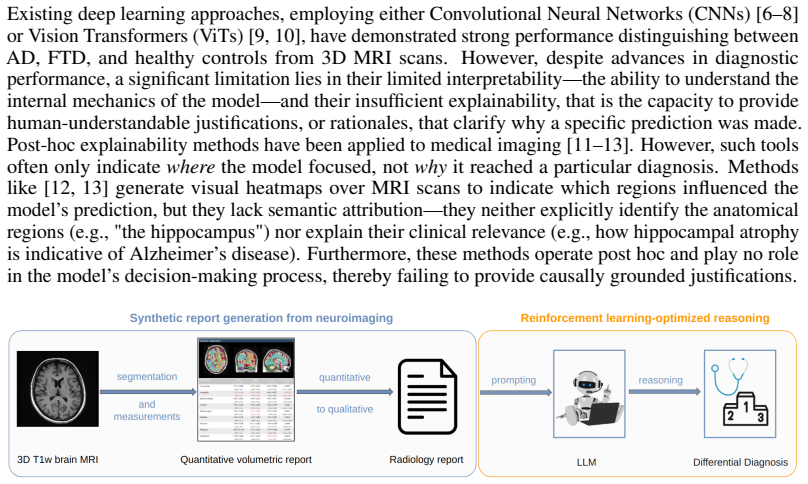
The load-bearing mechanism is a two-stage pipeline. Stage one converts an MRI into text: whole-brain segmentation yields over 132 anatomical structures, volumes are normalized by total intracranial volume, each structure's deviation from age- and sex-matched norms is expressed as a Structural Deviation Score, and those scores are mapped through a seven-point qualitative severity scale into a hierarchically structured radiology report. Stage two trains the diagnostic reasoner: Group Relative Policy Optimization (GRPO) samples a group of candidate outputs per report, scores each with a reward composed of a four-part format check and a binary top-1 accuracy check, and reinforces outputs whose group-relative advantage is positive. No reward term inspects the medical content of the reasoning block. The rationales, the JSON-ranked differential lists, and majority-vote aggregation over multiple paraphrased reports and sampled completions are the objects that carry the explainability and accuracy claims.
What would settle it
Take a correctly diagnosed test case, edit the synthetic report to remove the decisive atrophic finding (for example, change hippocampal atrophy to normal), and count how often the model's rationale and top diagnosis change accordingly; if the rationale stays fixed or the model still cites the removed finding, the causal-grounding claim fails.
Extended reading notes
Core claim
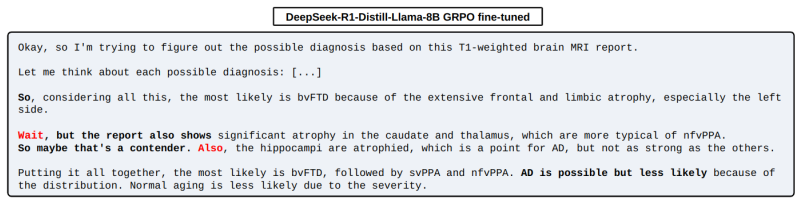
The framework's central claim is that Group Relative Policy Optimization (GRPO) fine-tuning alone, rewarding only output format and top-1 diagnostic accuracy, produces structured, anatomically specific rationales that support and guide the model's decision, generated at inference time rather than attached afterward. On the held-out test set spanning five classes, the best tuned 8-billion-parameter models reach macro-F1 scores of 65.09 and 61.88, comparable to the 62.84 macro-F1 of a 3D vision transformer and to a support-vector machine trained on the same volumetric features, while clearly surpassing the zero-shot performance of a much larger general-purpose proprietary model. The paper presents qualitative evidence that the models engage in hypothesis testing, revise earlier conclusions, reference expected anatomical atrophy patterns and asymmetry, and produce ranked differential diagnoses. The authors interpret these behaviors as causally grounded explanation rather than retrospective justification, because the reasoning precedes the final answer and is part of the same inference process.
Load-bearing premise
The rationales written inside the reasoning block are genuinely causally grounded in the imaging findings and faithful to the model's decision, even though no part of the training reward checks or rewards the medical validity of those rationales.
Editorial extensions
If this is right
- GRPO fine-tuning on 8-billion-parameter models reaches macro-F1 scores comparable to classification-only 3D vision transformers and support-vector machines, so readable explanations need not come at the cost of diagnostic accuracy.
- The same reward scheme, with no supervised reasoning traces, improves diagnostic performance over zero-shot use of the same models and of much larger models in several classes.
- Because synthetic reports alone support competitive zero-shot diagnoses, the MRI-to-text pipeline can serve as a stand-alone interpretable feature representation for downstream clinical tasks.
- The framework outputs ranked differential diagnoses rather than a single label, matching the multi-hypothesis structure of clinical dementia work-up.
- Training with format plus accuracy rewards produces longer and more elaborate reasoning on harder cases, which the paper reads as evidence of complexity-sensitive reasoning behavior.
Reading between the lines
- If the rationales are shown to be faithful by counterfactual tests, a direct extension would be to use the reasoning block itself as a decision aid: presenting clinicians with the rationale before the final ranked list could change diagnosis acceptance in ways the paper does not measure.
- The seven-point severity thresholds were fixed on statistical meaning rather than tuned to the dataset, so an unexamined corollary is that optimizing thresholds per class could further close the residual gap with vision transformers.
- The reward contains no penalty for reasoning that conflicts with the report; a testable extension would add a consistency reward between cited findings and the report text and observe whether accuracy and clinician trust improve.
- Because the pipeline is modular, the same report-generation and GRPO recipe could transfer to other neuroimaging differential diagnoses, such as parkinsonian syndromes, given new normative models and labels; the paper does not make this claim.
Editorial analysis
A structured set of objections, weighed in public.
Referee Report
Summary. The paper proposes a framework for differential diagnosis of neurodegenerative dementias that converts 3D T1-weighted MRIs into synthetic radiology reports via AssemblyNet segmentation, normative atrophy scoring, and a seven-point severity scale, then prompts LLMs to produce a ranked differential diagnosis with an explicit <think> reasoning block. The authors fine-tune several 8B open-weight LLMs with GRPO using a reward that combines format compliance and binary top-1 accuracy, and they compare the resulting models with zero-shot LLMs, a 3D vision transformer, and an SVM. The central claim is that the framework matches existing deep learning diagnostic performance while providing rationales that are generated as part of the inference process and are causally grounded in the imaging findings.
Significance. If the central claim were supported, this would be a valuable contribution: the modular pipeline makes each intermediate step inspectable, the GRPO training recipe does not require supervised reasoning traces, and the comparison spans a wide range of open LLMs plus two classification baselines. The paper also ships useful details on training dynamics and full reasoning examples in the appendices. However, the causal-grounding claim is the main advertised novelty, and it is not supported by the method as designed or by the evidence presented. The diagnostic accuracy results are plausible but would need uncertainty quantification to sustain the parity claim. The work is therefore of interest to the clinical LLM and interpretability communities, but in its current form the significance is substantially reduced because the headline explainability result is asserted rather than demonstrated.
major comments (4)
- [Section 3.2] The inference procedure described in the last paragraph of Section 3.2 states that final diagnoses are determined by majority vote across multiple reports and samples, 'with a supporting reasoning randomly selected from those aligning with the consensus.' This directly contradicts the abstract and Section 1 claim that rationales are 'produced as part of the inference process—producing causally grounded explanations that inform and guide the model's decision-making process.' Under the described procedure, the rationale shown to the clinician is selected after the aggregate decision is made and therefore cannot have caused or guided that aggregate decision. This is a load-bearing inconsistency: the paper's central explainability contribution, as stated, is invalidated by its own inference protocol. The authors should either change the inference procedure so that the delivered rationale is generated before and used for the final decision, or substantially reframe the claim as post-hoc rationale selection from multiple sampled explanations.
- [Section 3.3] The GRPO reward function contains only a format reward and a binary top-1 accuracy reward. Nothing in the reward measures whether the <think> reasoning is medically valid, consistent with the radiology report, or entailed by the findings. Consequently, a completion that reaches the correct diagnosis with fabricated or irrelevant reasoning receives exactly the same reward as one with faithful reasoning. The qualitative excerpts in Section 4.2 and Figure 5, described as showing 'hypothesis testing' and 'non-linear reasoning,' are therefore not evidence of causally grounded reasoning; they are consistent with post-hoc rationalization that happens to accompany correct answers. The authors need an external evaluation of reasoning quality (for example, clinician ratings, entailment checks against the report, or ablation of the rationales from the decision) to substantiate the explainability claim.
- [Table 3] The claim that the framework 'matches the diagnostic performance of existing deep learning methods' is not adequately supported by the reported numbers. The best GRPO model (LLaMA-3.1-Instruct GRPO) has macro-F1 65.09 versus 62.84 for the ViT, but it is substantially worse on AD (53.33 versus 72.50 for the ViT and 69.66 for the SVM). With test sizes of n=12 for nfvPPA and n=11 for svPPA, the class-wise F1 values are highly unstable, and no confidence intervals or statistical tests are provided anywhere in Section 4. The parity claim requires either confidence intervals, a paired statistical comparison, or a careful discussion of the clinical trade-off across classes.
- [Section 3.1] The seven-point SDS severity thresholds, which determine the qualitative radiology report, are hand-chosen. The manuscript states that the thresholds were 'chosen based on the statistical meaning of SDS magnitudes, rather than tuning to specific dataset distributions,' but it offers no evidence that these particular thresholds are clinically meaningful or generalizable. Because every downstream report, and therefore every LLM diagnosis in the paper, depends on these thresholds, this is a free parameter that should be validated. A sensitivity analysis over the threshold placements, or a comparison with a clinically established grading scheme, is needed to rule out that the reported results are an artifact of the chosen mapping.
minor comments (6)
- [Table 2] The header row places BACC under the 'class-wise F1' heading; the balanced accuracy column should be presented as a separate group, since it is not a class-wise F1 value.
- [Appendix C] Appendix C describes the full outputs as coming from 'a randomly sampled case' of bvFTD; the paper should state the sampling procedure and report how many cases were inspected in total, since qualitative selection of a single example is not a reproducible evaluation protocol.
- [Section 4.2] The statement that challenging cases elicit reasoning 'sometimes up to three times longer' is anecdotal; providing the actual token-length statistics across difficulty strata would make the claim testable.
- [Section 3.1] In the SDS formula, σ_norm(a,s) is described as 'the corresponding standard deviation from the normative distribution's 95% confidence interval,' which conflates a standard deviation with a confidence interval; please define the quantity precisely.
- [References] Reference [8] and reference [13] appear to be the same paper (Deep grading for MRI-based differential diagnosis of Alzheimer's disease and Frontotemporal dementia), cited with different entries; please consolidate.
- [Footnote 2] The statement that the framework 'will be available soon' at a URL provides no usable artifact; either provide a working link or state the intended release status without a placeholder.
Circularity Check
The central explainability claim reduces by construction: the displayed rationale is randomly selected after the majority vote, and the GRPO reward never checks reasoning validity, so the rationales validate themselves.
-
other
[Abstract and Section 3.2 (Prompting strategy)]
"Unlike post-hoc explainability methods that retrospectively justify model decisions, our framework generates diagnostic rationales as part of the inference process—producing causally grounded explanations that inform and guide the model's decision-making process. ... Final diagnoses are determined by majority vote on the top-ranked differential diagnosis from all aggregated samples, with a supporting reasoning randomly selected from those aligning with the consensus."
The abstract's central claim is that rationales are produced during inference and causally guide the decision. Section 3.2 specifies the opposite for the deployed system: the final diagnosis is the majority vote over aggregated samples, and the rationale actually delivered to the clinician is randomly drawn after the vote from outputs already aligned with the consensus. The selected rationale therefore cannot be the cause of the aggregate diagnosis; it is selected after the decision. The causal-grounding claim is not derived from the method—it is asserted despite the method severing the causal link by construction.
-
self definitional
[Abstract and Section 3.3 (Incentivizing diagnostic reasoning with GRPO)]
"our approach enables the emergence of structured diagnostic rationales grounded in neuroimaging findings ... We design our task-specific reward function to consist of two terms, a format and accuracy reward. ... A reward of 1.0 is given for a correct match, and 0.0 otherwise. ... Qualitative analysis of these outputs reveals several key reasoning behaviors."
The reward function contains no term measuring whether the <think> reasoning is true, clinically valid, or entailed by the report's findings; only tag structure, JSON parseability, class coverage, and final-label accuracy are rewarded. Hence a hallucinated or irrelevant rationale receives the same reward as a faithful one whenever the top label is correct. The paper then cites the model's own emitted rationales—'Qualitative analysis of these outputs reveals several key reasoning behaviors'—as evidence for 'structured diagnostic rationales grounded in neuroimaging findings.' The explanation property is thus validated with the very outputs the training signal never constrains; it is assumed by construction rather than measured.
full rationale
The accuracy comparisons in Tables 2 and 3 are anchored to external ground-truth labels and to independent ViT/SVM baselines, so the diagnostic-performance claims are not circular. The normative models [40] and segmentation pipeline [39] are cited prior work but are parameter-free components whose stated assumptions do not include the target explainability result; self-citation there is not load-bearing for this finding. However, the paper's central explainability contribution is not independently established. Section 3.2 makes the delivered rationale post-hoc with respect to the majority-vote decision, directly contradicting the abstract's 'causally grounded explanations that inform and guide the model's decision-making process.' Section 3.3 restricts the reward to format and top-1 accuracy, so reasoning faithfulness is never rewarded or checked; the qualitative excerpts in Section 4.2 then serve as their own evidence. This is a self-referential validation of the core claim: the existence of the generated text is taken as proof that the text is causally grounded. That is partial, not total, circularity—the classification numbers survive independently—so the appropriate score is 6.
Assumptions & free parameters
free parameters (1)
- SDS severity thresholds (seven-point scale) =
not disclosed
assumptions (4)
- domain assumption The normative lifespan trajectories from [40] are valid for the ADNI/NIFD subjects and do not overlap with the evaluation cohort.
- domain assumption AssemblyNet segmentations of the 132 brain structures are accurate on the T1-weighted MRIs used here.
- domain assumption The synthetic radiology reports preserve the clinically relevant information needed for differential diagnosis.
- ad hoc to paper The hand-chosen SDS severity thresholds are clinically meaningful and generalizable across datasets.
Cite this review
Pith. "Pith review of An Explainable Diagnostic Framework for Neurodegenerative Dementias via Reinforcement-Optimized LLM Reasoning." pith.science (2026). https://pith.science/paper/BZEHDUHY
@misc{pith2026250519954,
  author       = {Pith},
  title        = {Pith review of: An Explainable Diagnostic Framework for Neurodegenerative Dementias via Reinforcement-Optimized LLM Reasoning},
  year         = {2026},
  howpublished = {\url{https://pith.science/paper/BZEHDUHY}},
  note         = {Machine review of arXiv:2505.19954}
}
read the original abstract
The differential diagnosis of neurodegenerative dementias is a challenging clinical task, mainly because of the overlap in symptom presentation and the similarity of patterns observed in structural neuroimaging. To improve diagnostic efficiency and accuracy, deep learning-based methods such as Convolutional Neural Networks and Vision Transformers have been proposed for the automatic classification of brain MRIs. However, despite their strong predictive performance, these models find limited clinical utility due to their opaque decision making. In this work, we propose a framework that integrates two core components to enhance diagnostic transparency. First, we introduce a modular pipeline for converting 3D T1-weighted brain MRIs into textual radiology reports. Second, we explore the potential of modern Large Language Models (LLMs) to assist clinicians in the differential diagnosis between Frontotemporal dementia subtypes, Alzheimer's disease, and normal aging based on the generated reports. To bridge the gap between predictive accuracy and explainability, we employ reinforcement learning to incentivize diagnostic reasoning in LLMs. Without requiring supervised reasoning traces or distillation from larger models, our approach enables the emergence of structured diagnostic rationales grounded in neuroimaging findings. Unlike post-hoc explainability methods that retrospectively justify model decisions, our framework generates diagnostic rationales as part of the inference process-producing causally grounded explanations that inform and guide the model's decision-making process. In doing so, our framework matches the diagnostic performance of existing deep learning methods while offering rationales that support its diagnostic conclusions.
Figures


Figures from the paper (9 more)



Reference graph
Works this paper leans on
-
[40]
Manjón, and Alzheimer’s Disease Neuroimaging Initiative
Pierrick Coupé, Gwénaëlle Catheline, Enrique Lanuza, José V . Manjón, and Alzheimer’s Disease Neuroimaging Initiative. Towards a unified analysis of brain maturation and aging across the entire lifespan: A mri analysis.Human Brain Mapping, 38(11):5501–5518, November
-
[1]
Richard N. L. Lamptey, Bivek Chaulagain, Riddhi Trivedi, Avinash Gothwal, Buddhadev Layek, and Jagdish Singh. A review of the common neurodegenerative disorders: Current therapeutic approaches and the potential role of nanotherapeutics. International Journal of Molecular Sciences, 23(3):1851, 2022. doi: 10.3390/ijms23031851. URL https://www.ncbi.nlm.nih. ...
-
[2]
M. Crous-Bou, C. Minguillón, N. Gramunt, et al. Alzheimer’s disease prevention: from risk factors to early intervention. Alzheimer’s Research & Therapy , 9(1):71, 2017. doi: 10.1186/s13195-017-0297-z. URL https://doi.org/10.1186/s13195-017-0297-z
-
[3]
Celtia Domínguez-Fernández, June Egiguren-Ortiz, Jone Razquin, Margarita Gómez-Galán, Laura De las Heras-García, Elena Paredes-Rodríguez, Egoitz Astigarraga, Cristina Miguélez, and Gabriel Barreda-Gómez. Review of technological challenges in personalised medicine and early diagnosis of neurodegenerative disorders. International Journal of Molecular Scienc...
-
[4]
Leonidas Chouliaras and John T. O’Brien. The use of neuroimaging techniques in the early and differential diagnosis of dementia. Molecular Psychiatry, 28(10):4084–4097, October 2023. ISSN 1476-5578. doi: 10.1038/s41380-023-02215-8
-
[5]
An algorithmic approach to structural imaging in dementia
Lorna Harper, Frederik Barkhof, Philip Scheltens, Jonathan M Schott, and Nick C Fox. An algorithmic approach to structural imaging in dementia. Journal of Neurology, Neurosurgery & Psychiatry, 85(6):692–698, 2014. ISSN 0022-3050. doi: 10.1136/jnnp-2013-306285. URL https://jnnp.bmj.com/content/85/6/692
-
[6]
Jingjing Hu, Qing Zhao, Renyuan Liu, Xin Zhang, Pin Lv, Maoxue Wang, Yang Wang, Kelei He, Yang Gao, and Bing Zhang. Deep learning-based classification and voxel-based visualization of frontotemporal dementia and alzheimer’s disease. Frontiers in Neuroscience, 14:626154, 2021. doi: 10.3389/fnins.2020.626154
-
[8]
Deep grading for mri-based differential diagnosis of alzheimer’s disease and frontotemporal dementia
Huy-Dung Nguyen, Michaël Clément, Vincent Planche, Boris Mansencal, and Pierrick Coupé. Deep grading for mri-based differential diagnosis of alzheimer’s disease and frontotemporal dementia. Artificial Intelligence in Medicine, 140:102636, 2023. doi: 10.1016/j.artmed.2023. 102636
Show all 50 references
-
[9]
DiaMond: Dementia diagnosis with multi-modal vision transformers using MRI and PET, October 2024
Yitong Li, Morteza Ghahremani, Youssef Wally, and Christian Wachinger. DiaMond: Dementia diagnosis with multi-modal vision transformers using MRI and PET, October 2024
2024
-
[10]
3d transformer based on deformable patch location for differential diagnosis between alzheimer’s disease and frontotemporal dementia
Huy-Dung Nguyen, Michaël Clément, Boris Mansencal, and Pierrick Coupé. 3d transformer based on deformable patch location for differential diagnosis between alzheimer’s disease and frontotemporal dementia. In 14th International Workshop on Machine Learning in Medical Imaging (M...
2023 doi
-
[11]
Selvaraju, Abhishek Das, Ramakrishna Vedantam, Michael Cogswell, Devi Parikh, and Dhruv Batra
Ramprasaath R. Selvaraju, Abhishek Das, Ramakrishna Vedantam, Michael Cogswell, Devi Parikh, and Dhruv Batra. Grad-cam: Why did you say that? visual explanations from deep networks via gradient-based localization. CoRR, abs/1610.02391, 2016. URL http://arxiv. org/abs/1610.02391
-
[12]
Interpretable differential diagnosis for alzheimer’s disease and frontotemporal dementia
Huy-Dung Nguyen, Michaël Clément, Boris Mansencal, and Pierrick Coupé. Interpretable differential diagnosis for alzheimer’s disease and frontotemporal dementia. In Linwei Wang, Qi Dou, P. Thomas Fletcher, Stefanie Speidel, and Shuo Li, editors, Medical Image Computing and Comp...
2022
-
[13]
Deep grading for MRI-based differential diagnosis of Alzheimer’s disease and Frontotemporal dementia
Huy-Dung Nguyen, Michaël Clément, Vincent Planche, Boris Mansencal, and Pierrick Coupé. Deep grading for MRI-based differential diagnosis of Alzheimer’s disease and Frontotemporal dementia. Artificial Intelligence in Medicine, 144:102636, October 2023. ISSN 1873-2860. doi: 10....
2023
-
[14]
Vision-language models for medical report generation and visual question answering: a review
Iryna Hartsock and Ghulam Rasool. Vision-language models for medical report generation and visual question answering: a review. Frontiers in Artificial Intelligence, V olume 7 - 2024, 2024. ISSN 2624-8212. doi: 10.3389/frai.2024.1430984. URL https://www.frontiersin.org/ journa...
2024
-
[15]
Ct2rep: Automated radiology report generation for 3d medical imaging, 2024
Ibrahim Ethem Hamamci, Sezgin Er, and Bjoern Menze. Ct2rep: Automated radiology report generation for 3d medical imaging, 2024. URL https://arxiv.org/abs/2403.06801
2024 arXiv
-
[16]
Towards a holistic framework for multimodal llm in 3d brain ct radiology report generation
Cheng-Yi Li, Kao-Jung Chang, Cheng-Fu Yang, Hsin-Yu Wu, Wenting Chen, Hritik Bansal, Ling Chen, Yi-Ping Yang, Yu-Chun Chen, Shih-Pin Chen, Shih-Jen Chen, Jiing-Feng Lirng, Kai-Wei Chang, and Shih-Hwa Chiou. Towards a holistic framework for multimodal llm in 3d brain ct radiolo...
2025 doi
-
[17]
Hyland, Shruthi Bannur, Kenza Bouzid, Daniel C
Stephanie L. Hyland, Shruthi Bannur, Kenza Bouzid, Daniel C. Castro, Mercy Ranjit, Anton Schwaighofer, Fernando Pérez-García, Valentina Salvatelli, Shaury Srivastav, Anja Thieme, Noel Codella, Matthew P. Lungren, Maria Teodora Wetscherek, Ozan Oktay, and Javier Alvarez- Valle....
2024
-
[18]
DeepSeek-AI, Daya Guo, Dejian Yang, Haowei Zhang, Junxiao Song, Ruoyu Zhang, Runxin Xu, Qihao Zhu, Shirong Ma, Peiyi Wang, Xiao Bi, Xiaokang Zhang, Xingkai Yu, Yu Wu, Z. F. Wu, Zhibin Gou, Zhihong Shao, Zhuoshu Li, Ziyi Gao, Aixin Liu, Bing Xue, Bingxuan Wang, Bochao Wu, Bei F...
2025 arXiv
-
[19]
Zhihong Shao, Peiyi Wang, Qihao Zhu, Runxin Xu, Junxiao Song, Xiao Bi, Haowei Zhang, Mingchuan Zhang, Y . K. Li, Y . Wu, and Daya Guo. Deepseekmath: Pushing the limits of mathematical reasoning in open language models, 2024. URL https://arxiv.org/abs/ 2402.03300
2024 arXiv
-
[20]
Is Grad-CAM Ex- plainable in Medical Images? , page 124–135
Subhashis Suara, Aayush Jha, Pratik Sinha, and Arif Ahmed Sekh. Is Grad-CAM Ex- plainable in Medical Images? , page 124–135. Springer Nature Switzerland, 2024. ISBN 9783031581816. doi: 10.1007/978-3-031-58181-6_11. URL http://dx.doi.org/10. 1007/978-3-031-58181-6_11
2024 doi
-
[21]
Karan Singhal, Shekoofeh Azizi, Tao Tu, S. Sara Mahdavi, Jason Wei, Hyung Won Chung, Nathan Scales, Ajay Tanwani, Heather Cole-Lewis, Stephen Pfohl, Perry Payne, Martin Senevi- ratne, Paul Gamble, Chris Kelly, Abubakr Babiker, Nathanael Schärli, Aakanksha Chowdhery, Philip Man...
2023
-
[22]
Pfohl, Heather Cole-Lewis, Darlene Neal, Qazi Mamunur Rashid, Mike Schaekermann, Amy Wang, Dev Dash, Jonathan H
Karan Singhal, Tao Tu, Juraj Gottweis, Rory Sayres, Ellery Wulczyn, Mohamed Amin, Le Hou, Kevin Clark, Stephen R. Pfohl, Heather Cole-Lewis, Darlene Neal, Qazi Mamunur Rashid, Mike Schaekermann, Amy Wang, Dev Dash, Jonathan H. Chen, Nigam H. Shah, Sami Lachgar, Philip Andrew M...
2025
-
[23]
Patel and Kyle Lam
Sajan B. Patel and Kyle Lam. ChatGPT: The future of discharge summaries?The Lancet. Digital Health, 5(3):e107–e108, March 2023. ISSN 2589-7500. doi: 10.1016/S2589-7500(23)00021-3
2023 doi
-
[24]
Langlotz, Jason Hom, Sergios Gatidis, John Pauly, and Akshay S
Dave Van Veen, Cara Van Uden, Louis Blankemeier, Jean-Benoit Delbrouck, Asad Aali, Chris- tian Bluethgen, Anuj Pareek, Malgorzata Polacin, Eduardo Pontes Reis, Anna Seehofnerová, Nidhi Rohatgi, Poonam Hosamani, William Collins, Neera Ahuja, Curtis P. Langlotz, Jason Hom, Sergi...
2024 doi
-
[25]
Kim, Cordelia Orillac, Zane Schnurman, Christopher Livia, Hannah Weiss, David Kurland, Sean Neifert, Yosef Dastagirzada, Douglas Kondziolka, Alexander T
Lavender Yao Jiang, Xujin Chris Liu, Nima Pour Nejatian, Mustafa Nasir-Moin, Duo Wang, Anas Abidin, Kevin Eaton, Howard Antony Riina, Ilya Laufer, Paawan Punjabi, Madeline Miceli, Nora C. Kim, Cordelia Orillac, Zane Schnurman, Christopher Livia, Hannah Weiss, David Kurland, Se...
2023
-
[26]
Sara Mahdavi, Sushant Prakash, Anupam Pathak, Christopher Semturs, Shwetak Patel, Dale R
Daniel McDuff, Mike Schaekermann, Tao Tu, Anil Palepu, Amy Wang, Jake Garrison, Karan Singhal, Yash Sharma, Shekoofeh Azizi, Kavita Kulkarni, Le Hou, Yong Cheng, Yun Liu, S. Sara Mahdavi, Sushant Prakash, Anupam Pathak, Christopher Semturs, Shwetak Patel, Dale R. Webster, Ewa ...
2023
-
[27]
Adams, Jens-Michalis Papaioannou, Paul Grundmann, Tom Oberhauser, Alexei Figueroa, Alexander Löser, Daniel Truhn, and Keno K
Tianyu Han, Lisa C. Adams, Jens-Michalis Papaioannou, Paul Grundmann, Tom Oberhauser, Alexei Figueroa, Alexander Löser, Daniel Truhn, and Keno K. Bressem. MedAlpaca – An Open-Source Collection of Medical Conversational AI Models and Training Data, March 2025
2025
-
[28]
BioBERT: A pre-trained biomedical language representation model for biomedical text mining, October 2019
Jinhyuk Lee, Wonjin Yoon, Sungdong Kim, Donghyeon Kim, Sunkyu Kim, Chan Ho So, and Jaewoo Kang. BioBERT: A pre-trained biomedical language representation model for biomedical text mining, October 2019
2019
-
[29]
BioGPT: Generative pre-trained transformer for biomedical text generation and mining
Renqian Luo, Liai Sun, Yingce Xia, Tao Qin, Sheng Zhang, Hoifung Poon, and Tie-Yan Liu. BioGPT: Generative pre-trained transformer for biomedical text generation and mining. Briefings in Bioinformatics, 23(6):bbac409, November 2022. ISSN 1477-4054. doi: 10.1093/ bib/bbac409
2022
-
[30]
Domain-Specific Language Model Pretraining for Biomedical Natural Language Processing, September 2021
Yu Gu, Robert Tinn, Hao Cheng, Michael Lucas, Naoto Usuyama, Xiaodong Liu, Tristan Naumann, Jianfeng Gao, and Hoifung Poon. Domain-Specific Language Model Pretraining for Biomedical Natural Language Processing, September 2021
2021
-
[31]
Med-Flamingo: A Multimodal Medical Few-shot Learner
Michael Moor, Qian Huang, Shirley Wu, Michihiro Yasunaga, Yash Dalmia, Jure Leskovec, Cyril Zakka, Eduardo Pontes Reis, and Pranav Rajpurkar. Med-Flamingo: A Multimodal Medical Few-shot Learner. In Proceedings of the 3rd Machine Learning for Health Symposium, pages 353–367. PM...
2023
-
[32]
LLaV A-Med: Training a Large Language-and- Vision Assistant for Biomedicine in One Day, June 2023
Chunyuan Li, Cliff Wong, Sheng Zhang, Naoto Usuyama, Haotian Liu, Jianwei Yang, Tristan Naumann, Hoifung Poon, and Jianfeng Gao. LLaV A-Med: Training a Large Language-and- Vision Assistant for Biomedicine in One Day, June 2023
2023
-
[33]
Khaled Saab, Tao Tu, Wei-Hung Weng, Ryutaro Tanno, David Stutz, Ellery Wulczyn, Fan Zhang, Tim Strother, Chunjong Park, Elahe Vedadi, Juanma Zambrano Chaves, Szu-Yeu Hu, Mike Schaekermann, Aishwarya Kamath, Yong Cheng, David G. T. Barrett, Cathy Cheung, Basil Mustafa, Anil Pal...
2024
-
[34]
Lin Yang, Shawn Xu, Andrew Sellergren, Timo Kohlberger, Yuchen Zhou, Ira Ktena, Atilla Kiraly, Faruk Ahmed, Farhad Hormozdiari, Tiam Jaroensri, Eric Wang, Ellery Wulczyn, Fayaz Jamil, Theo Guidroz, Chuck Lau, Siyuan Qiao, Yun Liu, Akshay Goel, Kendall Park, Arnav Agharwal, Nic...
2024
-
[35]
Savage, A
T. Savage, A. Nayak, R. Gallo, et al. Diagnostic reasoning prompts reveal the potential for large language model interpretability in medicine. npj Digital Medicine , 7:20, 2024. doi: 10.1038/s41746-024-01010-1. URL https://doi.org/10.1038/s41746-024-01010-1
2024 doi
-
[36]
Melton, James Zou, and Rui Zhang
Shuang Zhou, Mingquan Lin, Sirui Ding, Jiashuo Wang, Canyu Chen, Genevieve B. Melton, James Zou, and Rui Zhang. Explainable differential diagnosis with dual-inference large language models. npj Health Systems , 2(1):12, 2025. ISSN 3005-1959. doi: 10.1038/ s44401-025-00015-6. U...
2025 doi
-
[37]
Large language models are clinical reasoners: Reasoning-aware diagnosis framework with prompt-generated 13 rationales
Taeyoon Kwon, Kai Tzu-iunn Ong, Dongjin Kang, Seungjun Moon, Jeong Ryong Lee, Dosik Hwang, Beomseok Sohn, Yongsik Sim, Dongha Lee, and Jinyoung Yeo. Large language models are clinical reasoners: Reasoning-aware diagnosis framework with prompt-generated 13 rationales. Proceedin...
2024 doi
-
[38]
Med-r1: Reinforcement learning for generalizable medical reasoning in vision-language models, 2025
Yuxiang Lai, Jike Zhong, Ming Li, Shitian Zhao, and Xiaofeng Yang. Med-r1: Reinforcement learning for generalizable medical reasoning in vision-language models, 2025. URL https: //arxiv.org/abs/2503.13939
2025
-
[39]
Pierrick Coupé, Boris Mansencal, Michaël Clément, Rémi Giraud, Baudouin Denis de Sen- neville, Vinh-Thong Ta, Vincent Lepetit, and José V . Manjon. Assemblynet: A large en- semble of cnns for 3d whole brain mri segmentation. NeuroImage, 219:117026, 2020. ISSN 1053-8119. doi: h...
2020
-
[41]
Jack, Matt A
Clifford R. Jack, Matt A. Bernstein, Nick C. Fox, Paul Thompson, Gene Alexander, Danielle Harvey, Bret Borowski, Paula J. Britson, Jennifer L. Whitwell, Chadwick Ward, Anders M. Dale, Joel P. Felmlee, Jeffrey L. Gunter, Derek L.G. Hill, Ron Killiany, Norbert Schuff, Sabrina Fo...
2008
-
[42]
OpenAI, Josh Achiam, Steven Adler, Sandhini Agarwal, Lama Ahmad, Ilge Akkaya, Flo- rencia Leoni Aleman, Diogo Almeida, Janko Altenschmidt, Sam Altman, Shyamal Anadkat, Red Avila, Igor Babuschkin, Suchir Balaji, Valerie Balcom, Paul Baltescu, Haiming Bao, Mohammad Bavarian, Jef...
2024
-
[43]
Openbiollms: Advancing open-source large lan- guage models for healthcare and life sciences
Malaikannan Sankarasubbu Ankit Pal. Openbiollms: Advancing open-source large lan- guage models for healthcare and life sciences. https://huggingface.co/aaditya/ OpenBioLLM-Llama3-70B, 2024
2024
-
[44]
Aaron Grattafiori, Abhimanyu Dubey, Abhinav Jauhri, Abhinav Pandey, Abhishek Kadian, Ah- mad Al-Dahle, Aiesha Letman, Akhil Mathur, Alan Schelten, Alex Vaughan, Amy Yang, Angela Fan, Anirudh Goyal, Anthony Hartshorn, Aobo Yang, Archi Mitra, Archie Sravankumar, Artem Korenev, A...
2024 arXiv
-
[45]
Qwen2.5 technical report, 2025
Qwen, :, An Yang, Baosong Yang, Beichen Zhang, Binyuan Hui, Bo Zheng, Bowen Yu, Chengyuan Li, Dayiheng Liu, Fei Huang, Haoran Wei, Huan Lin, Jian Yang, Jianhong Tu, 16 Jianwei Zhang, Jianxin Yang, Jiaxi Yang, Jingren Zhou, Junyang Lin, Kai Dang, Keming Lu, Keqin Bao, Kexin Yan...
2025 arXiv
-
[46]
Qwen3 technical report, 2025
An Yang, Anfeng Li, Baosong Yang, Beichen Zhang, Binyuan Hui, Bo Zheng, Bowen Yu, Chang Gao, Chengen Huang, Chenxu Lv, Chujie Zheng, Dayiheng Liu, Fan Zhou, Fei Huang, Feng Hu, Hao Ge, Haoran Wei, Huan Lin, Jialong Tang, Jian Yang, Jianhong Tu, Jianwei Zhang, Jianxin Yang, Jia...
2025 arXiv
-
[47]
Gonzalez, Hao Zhang, and Ion Stoica
Woosuk Kwon, Zhuohan Li, Siyuan Zhuang, Ying Sheng, Lianmin Zheng, Cody Hao Yu, Joseph E. Gonzalez, Hao Zhang, and Ion Stoica. Efficient memory management for large lan- guage model serving with pagedattention. In Proceedings of the ACM SIGOPS 29th Symposium on Operating Syste...
2023
-
[48]
Hu, Yelong Shen, Phillip Wallis, Zeyuan Allen-Zhu, Yuanzhi Li, Shean Wang, Lu Wang, and Weizhu Chen
Edward J. Hu, Yelong Shen, Phillip Wallis, Zeyuan Allen-Zhu, Yuanzhi Li, Shean Wang, Lu Wang, and Weizhu Chen. Lora: Low-rank adaptation of large language models, 2021. URL https://arxiv.org/abs/2106.09685
2021 arXiv
-
[49]
Understanding r1-zero-like training: A critical perspective, 2025
Zichen Liu, Changyu Chen, Wenjun Li, Penghui Qi, Tianyu Pang, Chao Du, Wee Sun Lee, and Min Lin. Understanding r1-zero-like training: A critical perspective, 2025. URL https: //arxiv.org/abs/2503.20783
2025 arXiv
-
[50]
Da Ma, Donghuan Lu, Karteek Popuri, Lei Wang, Mirza Faisal Beg, and Alzheimer’s Dis- ease Neuroimaging Initiative. Differential Diagnosis of Frontotemporal Dementia, Alzheimer’s Disease, and Normal Aging Using a Multi-Scale Multi-Type Feature Generative Adversarial Deep Neural...
2020
- [2017]
Reviewed August 7, 2026 · model on record in the stance chip above.
Discussion (0). Sign in to comment.