REVIEW 3 major objections 5 minor 1 cited by
EmoNet-Face: An Expert-Annotated Benchmark for Synthetic Emotion Recognition
T0 review · 3 major / 5 minor · reviewed 2026-08-07 · deepseek-v4-flash
Pith's one-line read This paper introduces EMONET-FACE, a 40-category synthetic-face benchmark with expert labels, and shows that a compact SigLIP2-plus-MLP model reaches the same agreement with human experts as experts reach with each other, while…
desk verdict A substantial synthetic FER benchmark with a careful headline result, but the stimulus validity of the 40 emotion categories is assumed rather than shown; deserves serious review. read the letter →
The pith
A machine-rendered reading of the paper's core claim, the machinery that carries it, and where it could break.
The reading
What carries the argument
The central objects are the 40-category EMONET-FACE taxonomy, derived from the Handbook of Emotions and refined by psychologists, and the training pipeline for EmpathicInsight-Face: a SigLIP2-400M backbone produces 1152-dimensional embeddings, and 40 separate MLP heads (1.8M or 151k parameters each) predict continuous 0–7 scores for each emotion. The models are pre-trained on EMONET-FACEBIG with Gemini-generated labels, then fine-tuned on EMONET-FACEBINARY with human triple-consensus binary labels, with a neutral-expression offset subtraction to calibrate scores. Agreement is measured with quadratic-weighted kappa on EMONET-FACEHQ, where four experts per image rated all 40 emotions.
What would settle it
Ask raters who have never seen the generation prompts to sort a random sample of EMONET-FACEHQ faces into the 40 emotion categories; if performance is near chance for emotions with low expert agreement, the benchmark is measuring image artifacts or ambiguity, not a shared emotion signal.
Extended reading notes
Core claim
On its own benchmark, the paper's EmpathicInsight-Face models reach human-level performance: the distribution of pairwise weighted kappa scores between model and expert raters is not significantly different from the distribution between expert raters (Δ = 0.019, p = 0.103), and the model significantly outperforms HumeFace, zero-shot and multi-shot VLMs, and random guessing (p < 0.001). The underlying discovery is that a frozen SigLIP2 vision encoder with per-emotion MLP regression heads, pre-trained on 203k Gemini-labeled synthetic faces and fine-tuned on 20k triple-consensus expert binary labels, captures fine-grained emotion signal that general-purpose models miss. The paper also reports that human experts themselves agree only moderately (mean Krippendorff's α ≈ 0.19 on a 0–7 scale), which it interprets as inherent ambiguity in facial emotion rather than annotation noise.
Load-bearing premise
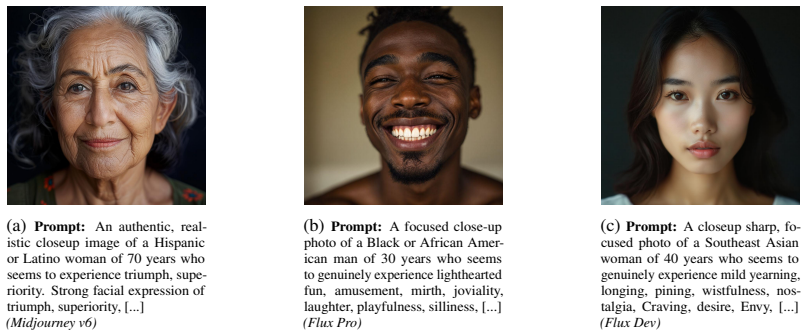
The whole benchmark rests on the assumption that the text-to-image models produce faces that actually express the 40 prompted emotions in a way human experts can recognize, so the expert ratings measure emotion rather than quirks of synthetic faces.
Editorial extensions
If this is right
- The released EMONET-FACE suite gives researchers a 40-dimension testbed, so model comparisons no longer stop at the six-to-eight basic emotions.
- Specialized models can reach expert-level agreement on synthetic faces with a simple architecture, meaning the bottleneck is data construction and calibration, not model scale.
- General-purpose VLMs fail to produce reliable, parseable emotion annotations on this benchmark, so practitioners should not assume zero-shot VLM ratings are usable for fine-grained affect.
- Because expert annotators disagree strongly on some categories, the benchmark supports distribution-based or context-sensitive label targets rather than a single ground truth.
- The demographic control of the synthetic datasets reduces confounding from web-scraped imagery, at the cost of testing generalization to real faces.
Reading between the lines
- If the human-level agreement transfers to real faces, EMONET-FACE could serve as a low-cost label source; a direct test would be fine-tuning the same SigLIP2-plus-MLP architecture on AffectNet and comparing with models trained on real images.
- The low inter-annotator agreement suggests the benchmark's 'ground truth' encodes average expert opinion; a more informative evaluation might compare models against individual-rater distributions rather than a median.
- The claimed human-level result could partly reflect the fact that both experts and the model are reading the same synthetic image artifacts; an independent action-unit or physiological validation of the generated expressions would clarify this.
- If VLMs improve, their inconsistency on this benchmark offers a concrete diagnostic signal for alignment work: models that cannot even agree with themselves across prompt variants are unlikely to be reliable annotators.
Editorial analysis
A structured set of objections, weighed in public.
Referee Report
Summary. The paper introduces EMONET-FACE, a benchmark suite for fine-grained facial emotion recognition built from synthetic images. It comprises a 40-category emotion taxonomy derived from the Handbook of Emotions, three datasets (EMONET-FACEHQ with 2,500 continuous expert-rated images, EMONET-FACEBINARY with about 20,000 triple-consensus binary expert-annotated images, and EMONET-FACEBIG with 203,201 Gemini-annotated pretraining images), and two SigLIP2-plus-MLP baseline models named EMPATHICINSIGHT-FACE. The central empirical claim is that the large model's agreement with human experts on EMONET-FACEHQ is statistically indistinguishable from human-human agreement (reported delta = 0.019, p = 0.103), while significantly outperforming proprietary models, VLMs, and random baselines. The paper also reports low inter-annotator reliability (mean Krippendorff's alpha about 0.19 on HQ and 0.09 on BINARY) and attributes it to stimulus ambiguity.
Significance. If the central claims survive scrutiny, the paper would provide a useful public resource: a demographically controlled synthetic face dataset, expert labels on a broad emotion taxonomy, and a reproducible baseline that can be compared against. The transparent reporting of inter-annotator agreement and the release of prompts, data, and code are strengths. However, the paper's significance hinges on two unresolved points. First, the benchmark's validity assumes that the text-to-image models actually render each of the 40 prompted emotions as distinct, recognizable facial expressions; the paper does not test this. Second, the headline 'human-level' claim rests on a small-sample non-significance test rather than a proper equivalence analysis, and the pretraining labels contain a hinting-induced circularity. These issues are load-bearing because they affect the interpretation of the model-human agreement, the VLM comparison, and the benchmark's usefulness for emotion research.
major comments (3)
- [Section 3 (Image Generation and Selection Methodology; Inter-Annotator Agreement)] The benchmark's validity rests on the untested assumption that the T2I models render each of the 40 prompted emotions as a distinct, recognizable facial expression. Manual screening for artifacts cannot establish this; low agreement is equally consistent with confabulation or blending of subtle expressions. The reported mean Krippendorff's alpha of 0.19 on HQ and 0.09 on BINARY, with negative alphas for Interest (-0.08), Concentration (-0.02), and Contemplation (-0.02) shown in Figure 9, are exactly the pattern one would expect if many stimuli do not display the target emotion. The paper's attribution of low agreement to 'stimulus ambiguity' is asserted rather than tested. I would need a stimulus-level validation—for example action-unit coding, per-emotion forced-choice recognition against chance, or comparison with real-face stimuli rated by the same annotators—before the 'human-level' claim can be interpreted as a claim about emotion recognition rather than about annotation of synthetic artifacts.
- [Appendix B.1 (Construction of EMONET-FACEBIG)] The pretraining labels are produced by Gemini with a 'hinting' strategy that explicitly suggests the generation-prompt emotion for each targeted image, and roughly 50% of hinted images receive a non-zero score for the hinted dimension. This makes the EMONET-FACEBIG labels strongly correlated with the prompt templates and with any visual artifacts associated with those templates. Because the final model is pretrained on BIG and then fine-tuned on BINARY, it may learn prompt-correlated features rather than emotion-specific features, and those features may transfer to the HQ images generated by the same pipeline. At a minimum, the authors should ablate the pretraining stage (for example, training from BINARY alone) and evaluate on images generated by a different T2I model or on real faces to demonstrate that the pretraining signal generalizes beyond the specific generation pipeline.
- [Section 4.2, Table 6, App. A.4] The headline 'statistically indistinguishable' is based on a non-significant Mann–Whitney U comparison, but with only 28 human-human pairwise kappa values (for 8 human annotators) and 8 model-human pairwise values, p = 0.103 is not evidence of equivalence; it may simply reflect low statistical power. Moreover, the pairwise kappa observations are non-independent because the same annotators and images contribute to many pairs. I request an equivalence test (e.g., TOST) or a cluster bootstrap by annotator and image, and a clear statement of the effect size (delta = 0.019 relative to which distribution). Note also that the model mean in Table 6 (0.1795) is close to but slightly below the human mean computed from that table (about 0.181), so the 'indistinguishable' wording should be supported by confidence intervals rather than by a failed rejection of a difference.
minor comments (5)
- [Section 3 and Figures 9/Table 6] The text says each HQ image received four ratings, but Figure 9 and Table 6 list eight human annotators; please clarify how the four ratings per image relate to the eight annotators and how annotator assignments were made.
- [Table 3] The note that Gemini 2.5 Pro 03-25 was discontinued after evaluating 1847 of 2500 images is important; please state explicitly how the 653 missing images are handled in the aggregate statistics and significance tests.
- [Appendix B.2] The SigLIP2-400M embedding model is used centrally but no citation is provided; please add the appropriate reference.
- [Figure 15 caption] The caption contains a duplicated word ('of of'); please correct it.
- [Figure 7 and Section 3] The distinction between the full hierarchical taxonomy used for HQ annotations and the descriptive-term-only protocol used for BINARY annotations is described only in the appendix; it should be stated in the main text because it affects how the two datasets should be interpreted.
Circularity Check
No significant circularity: the central human-level claim is evaluated against independent expert annotations, not against the model's own training labels.
full rationale
The paper's main claim—that EmpathicInsight-Face is statistically indistinguishable from human annotators on EMONET-FACEHQ—is grounded in held-out human expert ratings on the HQ benchmark. The model is pretrained on EMONET-FACEBIG (synthetically labeled by Gemini, with a hinting strategy that may introduce prompt-derived bias) and then fine-tuned on EMONET-FACEBINARY (triple-consensus human labels), but the final evaluation uses separate HQ human continuous ratings. The hinting strategy affects the quality and independence of the pretraining labels, but it does not make the evaluation circular: the reported agreement is computed against human judgments that are not derived from the model's outputs or from the pretraining labels. The paper also acknowledges in its Limitations that generalization to real-world images is not established, which is a validity threat rather than a circularity. No load-bearing self-citations, imported uniqueness theorems, or fitted parameters renamed as predictions were found. The benchmark construction, annotation protocol, and evaluation are sufficiently independent for the central claim to stand as an empirical result, even if the stimulus validity of the synthetic faces remains an open scientific question.
Assumptions & free parameters
free parameters (4)
- Per-emotion neutral-face calibration offset =
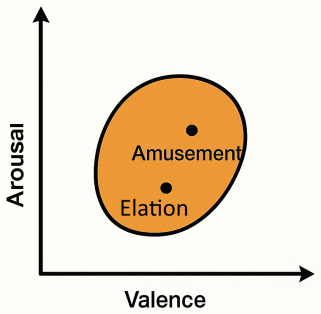
values not reported; one per emotion head
- Balanced-bucket sampling cap (stumbling strategy) =
25% of average per-bucket count
- Gemini salient-dimension count for BIG annotation =
5 dimensions per image
- Hinting bias in targeted BIG annotation =
approximately 50% non-zero response rate for hinted emotions
assumptions (4)
- domain assumption The 40 emotion categories are perceptually distinguishable in static faces, so experts can score each on a 0-7 scale.
- domain assumption Midjourney v6 and Flux Dev/Pro render each prompted emotion as a recognizable, distinct facial expression.
- domain assumption Expert annotators recruited via Upwork and following written guidelines produce a usable ground truth.
- domain assumption Theory of Constructed Emotion: emotions are constructed culturally, so multi-label plausible ratings are the correct annotation target.
invented entities (1)
-
The 40-category EmoNet-Face emotion taxonomy
independent evidence
Cite this review
Pith. "Pith review of EmoNet-Face: An Expert-Annotated Benchmark for Synthetic Emotion Recognition." pith.science (2026). https://pith.science/paper/GTJ4VFB6
@misc{pith2026250520033,
  author       = {Pith},
  title        = {Pith review of: EmoNet-Face: An Expert-Annotated Benchmark for Synthetic Emotion Recognition},
  year         = {2026},
  howpublished = {\url{https://pith.science/paper/GTJ4VFB6}},
  note         = {Machine review of arXiv:2505.20033}
}
read the original abstract
Effective human-AI interaction relies on AI's ability to accurately perceive and interpret human emotions. Current benchmarks for vision and vision-language models are severely limited, offering a narrow emotional spectrum that overlooks nuanced states (e.g., bitterness, intoxication) and fails to distinguish subtle differences between related feelings (e.g., shame vs. embarrassment). Existing datasets also often use uncontrolled imagery with occluded faces and lack demographic diversity, risking significant bias. To address these critical gaps, we introduce EmoNet Face, a comprehensive benchmark suite. EmoNet Face features: (1) A novel 40-category emotion taxonomy, meticulously derived from foundational research to capture finer details of human emotional experiences. (2) Three large-scale, AI-generated datasets (EmoNet HQ, Binary, and Big) with explicit, full-face expressions and controlled demographic balance across ethnicity, age, and gender. (3) Rigorous, multi-expert annotations for training and high-fidelity evaluation. (4) We built EmpathicInsight-Face, a model achieving human-expert-level performance on our benchmark. The publicly released EmoNet Face suite - taxonomy, datasets, and model - provides a robust foundation for developing and evaluating AI systems with a deeper understanding of human emotions.
Figures


Figures from the paper (13 more)



Forward citations
Cited by 1 Pith paper
-
AV-EMO-Reasoning: Benchmarking Emotional Reasoning Capabilities in Omni-modal LLMS with Audio-visual Cues
Current omni-modal LLMs underperform on audio-visual emotional reasoning, and automatic scores diverge from human perceptual judgments; AV-EMO-Reasoning provides a benchmark to measure this.
Reference graph
Works this paper leans on
-
[1]
Learning to generate 3d stylized character expressions from humans
Deepali Aneja, Bhaswar Chaudhuri, Alex Colburn, Gary Faigin, Linda Shapiro, and Barbara Mones. Learning to generate 3d stylized character expressions from humans. In2018 IEEE Winter Conference on Applications of Computer Vision (WACV), pages 160–169. IEEE, 2018
2018
-
[2]
Modeling stylized character expressions via deep learning
Deepali Aneja, Alex Colburn, Gary Faigin, Linda Shapiro, and Barbara Mones. Modeling stylized character expressions via deep learning. InAsian Conference on Computer Vision, pages 136–153. Springer, 2016
2016
-
[3]
Are emotions natural kinds?Perspectives on Psychological Science, 1(1):28–58, 2006
Lisa Feldman Barrett. Are emotions natural kinds?Perspectives on Psychological Science, 1(1):28–58, 2006
2006
-
[4]
Houghton Mifflin Harcourt, 2017
Lisa Feldman Barrett.How Emotions Are Made: The Secret Life of the Brain. Houghton Mifflin Harcourt, 2017
2017
-
[5]
Fabian Benitez-Quiroz, Ramprakash Srinivasan, and Aleix M
C. Fabian Benitez-Quiroz, Ramprakash Srinivasan, and Aleix M. Martinez. Emotionet: An accurate, real-time algorithm for the automatic annotation of a million facial expressions in the wild. InIEEE Conference on Computer Vision and Pattern Recognition (CVPR), 2016
2016
-
[6]
Flux.1-dev
Black Forest Labs. Flux.1-dev. https://huggingface.co/black-forest-labs/FLUX. 1-dev, 2024. Accessed: 12-05-2025
2024
-
[7]
Umiltà, and Vittorio Gallese
Marta Calbi, Katrin Heimann, Daniel Barratt, Francesca Siri, Maria A. Umiltà, and Vittorio Gallese. How context influences our perception of emotional faces: A behavioral study on the kuleshov effect.Frontiers in Psychology, 10:611, 2019
2019
-
[8]
Daryl Cameron and Michael Inzlicht
C. Daryl Cameron and Michael Inzlicht. Empathy is hard work: People choose to avoid empathy because of its cognitive costs.Journal of Experimental Psychology: General, 2019
2019
Show all 91 references
-
[9]
Character Technologies
Inc. Character Technologies. Character.ai: Conversational ai agents. https://character.ai,
-
[10]
Rijul Chaturvedi, Sanjeev Verma, Ronnie Das, and Yogesh K. Dwivedi. Social companionship with artificial intelligence: Recent trends and future avenues.Technological Forecasting and Social Change, 2023
2023
-
[11]
Cowen and Dacher Keltner
Alan S. Cowen and Dacher Keltner. Self-report captures 27 distinct categories of emo- tion bridged by continuous gradients.Proceedings of the National Academy of Sciences, 114(38):E7900–E7909, 2017
2017
-
[12]
Davidson
Richard J. Davidson. Affective neuroscience and psychophysiology: Toward a synthesis. Psychophysiology, 40(5):655–665, 2003
2003
-
[13]
An argument for basic emotions.Cognition and Emotion, 1992
Paul Ekman. An argument for basic emotions.Cognition and Emotion, 1992
1992
-
[14]
Basic emotions
Paul Ekman. Basic emotions. InHandbook of Cognition and Emotion. American Psychologic Association, 1999
1999
-
[15]
What people think ai should infer from faces
Severin Engelmann, Chiara Ullstein, Orestis Papakyriakopoulos, and Jens Grossklags. What people think ai should infer from faces. InProceedings of the 2022 ACM Conference on Fairness, Accountability, and Transparency, pages 1–14. ACM, 2022
2022
-
[16]
How well does chatgpt perform on the united states medical licensing examination? the implications of large language models for medical education and knowledge assessment
Aaron Gilson, Chris Safranek, Thomas Huang, V Socrates, Joyce Chi, Richard Taylor, and James Yuan. How well does chatgpt perform on the united states medical licensing examination? the implications of large language models for medical education and knowledge assessment. PLOS D...
2023
-
[17]
Multi-pie.Image and Vision Computing, 28(5):807–813, 2010
Ralph Gross, Iain Matthews, Jeffrey Cohn, Takeo Kanade, and Simon Baker. Multi-pie.Image and Vision Computing, 28(5):807–813, 2010
2010
-
[18]
Identifying implicit social biases in vision-language models
Kimia Hamidieh, Haoran Zhang, Walter Gerych, Thomas Hartvigsen, and Marzyeh Ghassemi. Identifying implicit social biases in vision-language models. InProceedings of the 2024 AAAI/ACM Conference on AI, Ethics, and Society, 2024
2024
-
[19]
A chinese face dataset with dynamic expressions and diverse ages synthesized by deep learning
Shangfeng Han, Yanliang Guo, Xinyi Zhou, Junlong Huang, Linlin Shen, and Yuejia Luo. A chinese face dataset with dynamic expressions and diverse ages synthesized by deep learning. Sci. Data, 10(1):878, December 2023
2023
-
[20]
Izard.The Face of Emotion
Carroll E. Izard.The Face of Emotion. Appleton-Century-Crofts, 1971
1971
-
[21]
Izard.The Psychology of Emotions
Carroll E. Izard.The Psychology of Emotions. Springer, 1991
1991
-
[22]
Kajiwoto: Create custom ai companions
Kajiwoto. Kajiwoto: Create custom ai companions. https://www.kajiwoto.com, 2022. Accessed: 2025-05-13
2022
-
[23]
Chatgpt and mental health: Friends or foes?Health Science Reports, 2024
Khondoker Tashya Kalam, Jannatul Mabia Rahman, Md Rabiul Islam, and Syed Masudur Rah- man Dewan. Chatgpt and mental health: Friends or foes?Health Science Reports, 2024
2024
-
[24]
Alvarez, Adria Recasens, and Agata Lapedriza
Ronak Kosti, Jose M. Alvarez, Adria Recasens, and Agata Lapedriza. Emotic: Emotions in context dataset. InIEEE Conference on Computer Vision and Pattern Recognition Workshops (CVPRW), 2017
2017
-
[25]
Orpheus: Emotionally expressive speech ai
Canopy Labs. Orpheus: Emotionally expressive speech ai. https://canopylabs.ai/ orpheus, 2024. Accessed: 2024
2024
-
[26]
Lazarus.Emotion and Adaptation
Richard S. Lazarus.Emotion and Adaptation. Oxford University Press, 1991
1991
-
[27]
Lewis, J
M. Lewis, J. M. Haviland-Jones, and L. F. Barrett.Handbook of Emotions. Guilford Press, 4th edition, 2016
2016
-
[28]
Cohn, Takeo Kanade, Jason Saragih, Zara Ambadar, and Iain Matthews
Patrick Lucey, Jeffrey F. Cohn, Takeo Kanade, Jason Saragih, Zara Ambadar, and Iain Matthews. The extended cohn-kanade dataset (ck+): A complete dataset for action unit and emotion- specified expression. InIEEE Conference on Computer Vision and Pattern Recognition Work- shops ...
2010
-
[29]
Inc. Luka. Replika: Ai companion.https://replika.ai, 2023. Accessed: 2024. 11
2023
-
[30]
Coding facial expressions with gabor wavelets
Michael Lyons, Shigeru Akamatsu, Miyuki Kamachi, and Jiro Gyoba. Coding facial expressions with gabor wavelets. InProceedings of the Third IEEE International Conference on Automatic Face and Gesture Recognition, 1998
1998
-
[31]
Dataset diversity: Measuring and mitigating geographical bias in image search and retrieval
Abhishek Mandal, Susan Leavy, and Suzanne Little. Dataset diversity: Measuring and mitigating geographical bias in image search and retrieval. InProceedings of the 1st International Workshop on Trustworthy AI for Multimedia Computing, pages 19–25, 2021
2021
-
[32]
Midjourney
Inc. Midjourney. Midjourney v6: Ai image generation. https://midjourney.com, 2024. Accessed: 2024
2024
-
[33]
Ali Mollahosseini, Behzad Hasani, and Mohammad H. Mahoor. Affectnet: A database for facial expression, valence, and arousal computing in the wild.IEEE Transactions on Affective Computing, 10(1):18–31, 2017
2017
-
[34]
Chatgpt.https://openai.com/chatgpt, 2023
OpenAI. Chatgpt.https://openai.com/chatgpt, 2023. Accessed: 2024
2023
-
[35]
Gpt-4o: Advanced multimodal ai
OpenAI. Gpt-4o: Advanced multimodal ai. https://openai.com/gpt-4o, May 2024. Accessed: 2024
2024
-
[36]
Clore, and Allan Collins.The cognitive structure of emotions
Andrew Ortony, Gerald L. Clore, and Allan Collins.The cognitive structure of emotions. Cambridge University Press, 1990
1990
-
[37]
Oxford University Press, 1998
Jaak Panksepp.Affective Neuroscience: The Foundations of Human and Animal Emotions. Oxford University Press, 1998
1998
-
[38]
Gerrod Parrott.Emotions in Social Psychology
W. Gerrod Parrott.Emotions in Social Psychology. Psychology Press, 2001
2001
-
[39]
Picard.Affective Computing
Rosalind W. Picard.Affective Computing. MIT Press, 1997
1997
-
[40]
Academic Press, 1980
Robert Plutchik.A General Psychoevolutionary Theory of Emotion. Academic Press, 1980
1980
-
[41]
Two contrasting data annotation paradigms for subjective nlp tasks
Paul Röttger, Bertie Vidgen, Dirk Hovy, and Janet Pierrehumbert. Two contrasting data annotation paradigms for subjective nlp tasks. InProceedings of the 2022 Conference of the North American Chapter of the Association for Computational Linguistics: Human Language Technologies, 2022
2022
-
[42]
Msts: A multimodal safety test suite for vision-language models, 2025
Paul Röttger, Giuseppe Attanasio, Felix Friedrich, Janis Goldzycher, Alicia Parrish, Rishabh Bhardwaj, Chiara Di Bonaventura, Roman Eng, Gaia El Khoury Geagea, Sujata Goswami, Jieun Han, Dirk Hovy, Seogyeong Jeong, Paloma Jeretiˇc, Flor Miriam Plaza del Arco, Donya Rooein, Pat...
2025
-
[43]
Stanley Schachter and Jerome E. Singer. Cognitive, social, and physiological determinants of emotional state.Psychological Review, 69(5):379–399, 1962
1962
-
[44]
Sesame: Conversational speech model
Sesame. Sesame: Conversational speech model. https://sesame.com, 2024. Accessed: 2024
2024
-
[45]
Shiota, Samantha L
Michelle N. Shiota, Samantha L. Neufeld, Alexander F. Danvers, Elizabeth A. Osborne, Oliver Sng, and Cindy I. Yee. Positive emotion differentiation: A functional approach.Social and Personality Psychology Compass, 2017
2017
-
[46]
Ai for mental health: A systematic review of affect recognition techniques.IEEE Transactions on Affective Computing, 14(1):3–20, 2023
Michel Valstar, Björn Schuller, Nicholas Cummins, and Maja Pantic. Ai for mental health: A systematic review of affect recognition techniques.IEEE Transactions on Affective Computing, 14(1):3–20, 2023
2023
-
[47]
Chatgpt: Opportunities, risks and priorities for psychiatry.Asian Journal of Psychiatry, 2023
Yaohui Wei, Lei Guo, Cheng Lian, and Jue Chen. Chatgpt: Opportunities, risks and priorities for psychiatry.Asian Journal of Psychiatry, 2023
2023
-
[48]
Weidman and Jessica L
Aaron C. Weidman and Jessica L. Tracy. Picking up good vibrations: Discrete positive emotions and their experiential content.Emotion, 2020. 12
2020
-
[49]
The influence of background on facial emotion perception: A psychophysical study.i-Perception, 14(2), 2023
Ying Wu, Wen Chen, Hong Li, and Xiaolan Fu. The influence of background on facial emotion perception: A psychophysical study.i-Perception, 14(2), 2023
2023
-
[50]
emotion circuits
Jialin Yang, Ru Li, Shuai Xiao, Wenming Li, Wei-Long Zheng, and Bao-Liang Lu. Findingemo: An image dataset for emotion recognition in the wild.IEEE Transactions on Multimedia, 23:2033–2045, 2021. 13 A Appendices A.1 Theories of Emotion: From Universal Programs to Constructed E...
2021
-
[51]
Amusement ’lighthearted fun’, ’amusement’, ’mirth’, ’joviality’, ’laughter’, ’playful- ness’, ’silliness’, ’jesting’
-
[52]
Elation ’happiness’, ’excitement’, ’joy’, ’exhilaration’, ’delight’, ’jubilation’, ’bliss’, ’Cheerfulness’
-
[53]
Pleasure/Ecstasy ’ecstasy’, ’pleasure’, ’bliss’, ’rapture’, ’Beatitude’
-
[54]
Contentment ’contentment’, ’relaxation’, ’peacefulness’, ’calmness’, ’satisfaction’, ’Ease’, ’Serenity’, ’fulfillment’, ’gladness’, ’lightness’, ’serenity’, ’tran- quility’
-
[55]
Thankful- ness/Gratitude ’thankfulness’, ’gratitude’, ’appreciation’, ’gratefulness’
-
[56]
Affection ’sympathy’, ’compassion’, ’warmth’, ’trust’, ’caring’, ’Clemency’, ’forgive- ness’, ’Devotion’, ’Tenderness’, ’Reverence’ Continued on next page 15 Table 4 – continued from previous page Category Name Associated Descriptive Words
-
[57]
Infatuation ’infatuation’, ’having a crush’, ’romantic desire’, ’fondness’, ’butterflies in the stomach’, ’adoration’
-
[58]
Hope/Optimism ’hope’, ’enthusiasm’, ’optimism’, ’Anticipation’, ’Courage’, ’Encourage- ment’, ’Zeal’, ’fervor’, ’inspiration’, ’Determination’
-
[59]
Triumph ’triumph’, ’superiority’
-
[60]
Pride ’pride’, ’dignity’, ’self-confidently’, ’honor’, ’self-consciousness’
-
[61]
Interest ’interest’, ’fascination’, ’curiosity’, ’intrigue’
-
[62]
Awe ’awe’, ’awestruck’, ’wonder’
-
[63]
Astonish- ment/Surprise ’astonishment’, ’surprise’, ’amazement’, ’shock’, ’startlement’
-
[64]
Concentration ’concentration’, ’deep focus’, ’engrossment’, ’absorption’, ’attention’
-
[65]
Contemplation ’contemplation’, ’thoughtfulness’, ’pondering’, ’reflection’, ’meditation’, ’Brooding’, ’Pensiveness’
-
[66]
Relief ’relief’, ’respite’, ’alleviation’, ’solace’, ’comfort’, ’liberation’
-
[67]
Longing ’yearning’, ’longing’, ’pining’, ’wistfulness’, ’nostalgia’, ’Craving’, ’desire’, ’Envy’, ’homesickness’, ’saudade’
-
[68]
Teasing ’teasing’, ’bantering’, ’mocking playfully’, ’ribbing’, ’provoking lightly’
-
[69]
Impatience and Irritability ’impatience’, ’irritability’, ’irritation’, ’restlessness’, ’short-temperedness’, ’exasperation’
-
[70]
Sexual Lust ’sexual lust’, ’carnal desire’, ’lust’, ’feeling horny’, ’feeling turned on’
-
[71]
Doubt ’doubt’, ’distrust’, ’suspicion’, ’skepticism’, ’uncertainty’, ’Pessimism’
-
[72]
Fear ’fear’, ’terror’, ’dread’, ’apprehension’, ’alarm’, ’horror’, ’panic’, ’nervous- ness’
-
[73]
Distress ’worry’, ’anxiety’, ’unease’, ’anguish’, ’trepidation’, ’Concern’, ’Upset’, ’pessimism’, ’foreboding’
-
[74]
Confusion ’confusion’, ’bewilderment’, ’flabbergasted’, ’disorientation’, ’Perplexity’
-
[75]
Embarrassment ’embarrassment’, ’shyness’, ’mortification’, ’discomfiture’, ’awkwardness’, ’Self-Consciousness’
-
[76]
Shame ’shame’, ’guilt’, ’remorse’, ’humiliation’, ’contrition’
-
[77]
Disappointment ’disappointment’, ’regret’, ’dismay’, ’letdown’, ’chagrin’
-
[78]
Sadness ’sadness’, ’sorrow’, ’grief’, ’melancholy’, ’Dejection’, ’Despair’, ’Self-Pity’, ’Sullenness’, ’heartache’, ’mournfulness’, ’misery’
-
[79]
Bitterness ’resentment’, ’acrimony’, ’bitterness’, ’cynicism’, ’rancor’
-
[80]
Contempt ’contempt’, ’disapproval’, ’scorn’, ’disdain’, ’loathing’, ’Detestation’
-
[81]
Disgust ’disgust’, ’revulsion’, ’repulsion’, ’abhorrence’, ’loathing’
-
[82]
Anger ’anger’, ’rage’, ’fury’, ’hate’, ’irascibility’, ’enragement’, ’Vexation’, ’Wrath’, ’Peevishness’, ’Annoyance’
-
[83]
Malevo- lence/Malice ’spite’, ’sadism’, ’malevolence’, ’malice’, ’desire to harm’, ’schadenfreude’
-
[84]
Sourness ’sourness’, ’tartness’, ’acidity’, ’acerbity’, ’sharpness’
-
[85]
Pain ’physical pain’, ’suffering’, ’torment’, ’ache’, ’agony’
-
[86]
Fatigue/Exhaustion ’fatigue’, ’exhaustion’, ’weariness’, ’lethargy’, ’burnout’, ’Weariness’
Helplessness ’helplessness’, ’powerlessness’, ’desperation’, ’submission’ 37. Fatigue/Exhaustion ’fatigue’, ’exhaustion’, ’weariness’, ’lethargy’, ’burnout’, ’Weariness’
-
[87]
Emotional Numbness ’numbness’, ’detachment’, ’insensitivity’, ’emotional blunting’, ’apathy’, ’existential void’, ’boredom’, ’stoicism’, ’indifference’
-
[88]
Intoxica- tion/Altered States ’being drunk’, ’stupor’, ’intoxication’, ’disorientation’, ’altered perception’
-
[89]
16 Figure 6: Heatmap of Average Pairwise Weighted Kappa (κw, quadratic weights) Across All Emotions
Jealousy & Envy ’jealousy’, ’envy’, ’covetousness’ A.5 Detailed Image Generation Models and Reproducibility For transparency and reproducibility in the generation of the EMONET-FACEdatasets, all prompt texts and specific model identifiers used for image creation will be releas...
2000
-
[90]
embarrassment
Targeted Image Generation:We utilized the Flux-Dev model to generate new images. The prompts for Flux-Dev were specifically designed to elicit facial expressions corresponding to the underrepresented emotions. For instance, prompts targeted the generation of images depicting "...
-
[91]
hint" was provided to the model. For example, if an image was generated with
Annotation with a Hinting Strategy:These newly generated, targeted images were subsequently annotated using Gemini Flash 2.0. The selection of Gemini Flash 2.0 for this phase was partly influenced by more favorable API rate limits available at the time of data collection, whic...
Reviewed August 7, 2026 · model on record in the stance chip above.
Discussion (0). Continue with ORCID to comment.