REVIEW 3 major objections 5 minor 31 references
Catoni-Style Change Point Detection for Regret Minimization in Non-Stationary Heavy-Tailed Bandits
T0 review · 3 major / 5 minor · reviewed 2026-08-07 · deepseek-v4-flash
Pith's one-line read Heavy-tailed bandits with changing means get a near-optimal algorithm, the paper claims.
desk verdict Both the confidence sequence and the lower bound fail on inspection; the combination is worth a referee, but the version as written doesn't stand. read the letter →
The pith
A machine-rendered reading of the paper's core claim, the machinery that carries it, and where it could break.
The reading
What carries the argument
The load-bearing object is the Catoni-FCS-detector: a repeated-FCS-detector whose confidence intervals are defined through the Catoni influence function $\phi_\epsilon(u)=\log\left(1+|u|+\frac{|u|^{1+\epsilon}}{1+\epsilon}\right)$ and predictable weights, with the confidence level stitched over an exponential grid. At every round a new confidence sequence for the mean is opened, all open sequences are updated with the new sample, and a change is declared when the intersection of all open intervals becomes empty. The detector converts mean-estimation concentration into a sequential change-point test that works for infinite-variance observations; the bandit algorithm adds cyclic uniform exploration so every arm has enough fresh samples for the detector, and resets the policy when a change is declared.
What would settle it
Compute directly: for $p=v^{-1/\epsilon}\Delta^{(1+\epsilon)/\epsilon}$, let $X=0$ with probability $1-p$ and $X=v^{1/\epsilon}\Delta^{-1/\epsilon}$ with probability $p$. Then $E|X-EX|^{1+\epsilon}=v(1-p)(p^\epsilon+(1-p)^\epsilon)$, which exceeds $v$ for $\epsilon\in(0,1)$ and small $\Delta$. A reader who evaluates this for, say, $v=1$, $\epsilon=1/2$, $\Delta=1/10$ settles whether the lower bound's hard instances are admissible.
Extended reading notes
Core claim
The central claim is that heavy-tailed piecewise-stationary bandits admit a change-point detection method with finite-time guarantees and that this detector can be embedded in a bandit algorithm whose regret matches a new minimax lower bound. Specifically, Catoni-FCS-detector, an instantiation of repeated-FCS-detector using Catoni-style confidence sequences, is shown to detect a mean shift of size $\delta$ with high-probability delay $O(v^{1/\epsilon}\log(T)/\delta^{(1+\epsilon)/\epsilon})$ and false-alarm probability $O(1/T)$. Wrapped around a stationary heavy-tailed bandit sub-routine and a cyclic uniform-exploration schedule, this yields Robust-CPD-UCB; Theorem 4.8 decomposes its regret into detection-delay, stationary-policy, and exploration terms, and Corollary 4.11 concludes that, under an epoch-length assumption, the regret is $\widetilde{O}((K\Upsilon)^{\epsilon/(1+\epsilon)}(vT)^{1/(1+\epsilon)})$, matching the lower bound of Theorem 2.5 up to logarithmic factors.
Load-bearing premise
The proof that the algorithm is nearly optimal depends on the lower-bound construction $\rho_\Delta$ belonging to the heavy-tailed class $H(v,\epsilon)$, meaning $E|X-EX|^{1+\epsilon}\le v$; for $\epsilon\in(0,1)$ and small $\Delta$ this can be false, so the hard instance may lie outside the class the bound claims to cover.
Editorial extensions
If this is right
- If the bounds are correct, a learner needs only the horizon $T$ to run the algorithm, not the number of change points, their magnitudes, or the suboptimality gaps, and still achieves the claimed minimax rate.
- The stated lower bound would mean the cost of non-stationarity is exactly a factor $\Upsilon^{\epsilon/(1+\epsilon)}$ on top of the stationary heavy-tailed rate, combining the known $\Omega(K^{\epsilon/(1+\epsilon)}T^{1/(1+\epsilon)})$ and $\Omega(\sqrt{K\Upsilon T})$ bounds.
- Catoni-FCS-detector is a standalone finite-time tool: it detects mean shifts in infinite-variance streams with high-probability delay bounds and false-alarm control, independent of the bandit application.
- Using Robust UCB with a median-of-means estimator as the stationary sub-routine yields both instance-dependent and instance-independent regret bounds, so the framework can exploit known problem constants when they are available.
Reading between the lines
- The claimed near-optimality is only as solid as the lower-bound construction. If, as a direct computation suggests, the two-point distributions used in Theorem 2.5 fail the moment condition $E|X-EX|^{1+\epsilon}\le v$ for $\epsilon\in(0,1)$, then the lower bound does not currently cover the class it claims to cover, and the matching claim would need a corrected construction.
- A plausible repair is to replace the two-point distribution with a scaled Pareto-type or other heavy-tailed law whose exact centered $(1+\epsilon)$-moment equals $v$ and whose mean shift is $\Delta$, preserving the likelihood-ratio comparison while staying inside the distribution class.
- The increasing exploration schedule that removes knowledge of $\Upsilon$ from the algorithm suggests an adaptive variant that estimates the recent change-point rate online and sets the exploration level accordingly; the paper does not analyze such a rule.
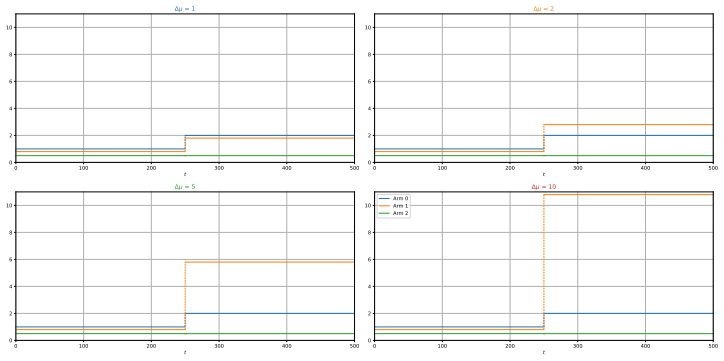
- Experiments compare the detector against an empirical-Bernstein confidence-sequence detector on Gaussian and Laplace streams; testing on heavier-tailed streams such as log-normal or $\alpha$-stable laws across a grid of tail indices and shift sizes would give a sharper practical picture.
Editorial analysis
A structured set of objections, weighed in public.
Referee Report
Summary. The paper studies regret minimization in piecewise-stationary bandits with heavy-tailed rewards, where each epoch's reward distributions satisfy a centered absolute moment condition E|X-E[X]|^{1+epsilon} <= v. It introduces Catoni-FCS-detector, a change-point detector based on Catoni-style confidence sequences, and combines it with a stationary robust bandit subroutine in an algorithm called Robust-CPD-UCB. The paper claims a minimax lower bound on regret for this setting, an upper bound for R-CPD-UCB, near-optimality up to log factors, and supporting numerical experiments on synthetic and real data. The main theoretical results are Theorem 2.5 (lower bound), Proposition 4.2 (detection delay), Theorem 4.8 (regret decomposition), and Corollaries 4.10-4.11 (instance-dependent and near-optimal regret bounds).
Significance. If the theoretical claims were valid, this would be a useful first treatment of piecewise-stationary heavy-tailed bandits, and the Catoni-FCS-detector would be an interesting standalone contribution. The paper is well structured, the experiments are clearly described, and the dependency of the regret bound on T, K, Upsilon, and v is the right target for this setting. The reduction of change-point detection to confidence sequences is borrowed from published work, and the paper's analysis is not circular with respect to those results. However, the validity of the central claims is undermined by a load-bearing error in the Catoni confidence-sequence construction and by an invalid lower-bound hard instance. As a result, the paper's main theoretical conclusions are not currently supported.
major comments (3)
- [Section 4.1, Eq. (3), Eq. (5), and Appendix B, Steps 1-3] The Catoni influence function is defined as phi_epsilon(x) = log(1 + |x| + |x|^{1+epsilon}/(1+epsilon)), which is even and nonnegative. Consequently, the estimating equation sum_{i=1}^t phi_epsilon(lambda_i(X_i - m)) = 0 has no solution unless every observed X_i equals m, so the Catoni estimator and the 'random solution of f_t(m)=0' used in Step 3 do not exist for a non-degenerate sample. The proof in Step 1 additionally claims E[exp(phi(lambda(X-mu)) - lambda^{1+epsilon} v/(1+epsilon))] <= E[1 + lambda(X-mu) + lambda^{1+epsilon}(X-mu)^{1+epsilon}/(1+epsilon)] exp(-lambda^{1+epsilon} v/(1+epsilon)), but exp(phi(u)) = 1 + |u| + |u|^{1+epsilon}/(1+epsilon), which is not bounded by 1+u+u^{1+epsilon}/(1+epsilon) for negative u, and the centered-moment assumption controls E|X-mu|^{1+epsilon}, not E[(X-mu)^{1+epsilon}]. Step 3 also asserts that f_t(m) is non-increasing in m, which is false for the even function phi. These errors invalidate the confidence-sequence construction, and therefore Proposition 4.2, Theorem 4.8, and Corollaries 4.10-4.11 are unsupported.
- [Section 2.3 and Appendix B, proof of Theorem 2.5] The two-point hard-instance distribution rho_y is asserted to belong to H(v,epsilon), but with the parameters chosen in the proof it does not satisfy the centered moment condition. For the suboptimal arm with y = Delta, writing p = v^{-1/epsilon} Delta^{(1+epsilon)/epsilon} and r = v^{1/epsilon} Delta^{-1/epsilon}, the centered (1+epsilon)-moment equals E|X-EX|^{1+epsilon} = v (1-p)(p^epsilon + (1-p)^epsilon). When Delta is set as in the proof, p = 2 log(2) K Upsilon / (16 T), which is small for large T. For epsilon in (0,1), the function f(p) = (1-p)(p^epsilon + (1-p)^epsilon) satisfies f(0)=1 and f'(0+)=+infinity, so f(p) > 1 for all sufficiently small p>0; hence E|X-EX|^{1+epsilon} > v, contradicting membership in H(v,epsilon). The same issue affects the good arm with y = 2^{epsilon/(1+epsilon)} Delta, whose p is 2 log(2) K Upsilon / (16 T). Thus the hard instances are outside the stated class and the lower bound of Theorem 2.5 is not established. The proof also states 'rho_y in H(1,epsilon)' rather than H(v,epsilon), and uses y = 2^{epsilon/(1+epsilon)} Delta even though the preceding sentence restricts y to [0,Delta].
- [Appendix B, Step 5 and Lemma B.2] The detection-delay proof and the regret proof rely on controlling the widths of all initialized confidence sequences simultaneously and on a union bound over O(T^2) events. The stated probability P(W_{1:t}) >= 1 - t(t+1)gamma/8 and the subsequent bound P(W_{a:b}) >= 1 - T(T+1)gamma/8 do not follow from the previous width bound when gamma = 2/T^3, because T(T+1)gamma/8 = O(1/T) is acceptable only if the union bound constant is correct; moreover the width bound itself depends on the invalid Step 3. Since Step 3 is the foundation for the width, the finite-time delay bound in Proposition 4.2 and the regret bound in Theorem 4.8 cannot be repaired without reworking the confidence-sequence construction.
minor comments (5)
- [Abstract and Section 2.1] The abstract cites 'heavy-tailed bandits, introduced by 7' instead of the proper reference; the author-year citation should be restored.
- [Eq. (5)] The interval notation with '\mp' and '\pm' is ambiguous and appears to be a typesetting artifact; the endpoints of the confidence interval should be written explicitly with a lower bound and an upper bound.
- [Section 5.2 and Appendix C.2] The main text refers to 'Figure 5' for the regret plots on Gaussian and Pareto rewards, but the corresponding figures in the text are labeled differently; the figure numbering should be made consistent.
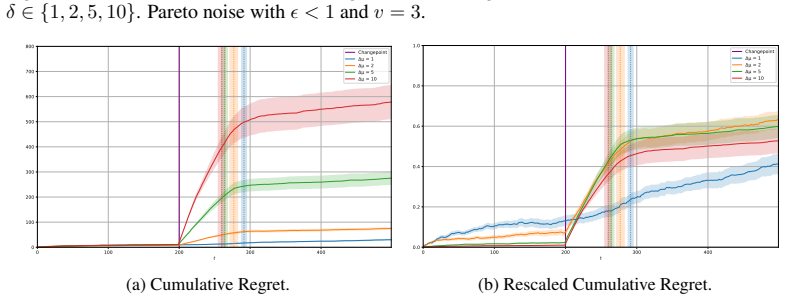
- [Appendix C.3] The caption of Figure 8 states epsilon < 1 and v = 3, while the text of C.3 says v = 1; these values should be reconciled.
- [Section 5.2] The phrase 'we have delta_min = 0, i.e., and some actions may not change' contains a typo; it should read 'i.e., some actions may not change.'
Circularity Check
No significant circularity: the regret bounds are derived from in-place proofs plus external confidence-sequence and change-point results; the coauthor self-citations are supporting and not load-bearing.
full rationale
The derivation chain is not circular. Theorem 4.8 decomposes the regret of R-CPD-UCB into detection delay (A), stationary regret (B), and forced exploration (C), and each term is bounded by in-place arguments: Proposition 4.2 and Appendix B prove the Catoni-FCS detection-delay bound, Lemma B.2 controls the failure event, and Corollaries 4.9-4.11 combine these with the external Robust-UCB guarantees of Bubeck et al. [7] and the repeated-FCS framework of Shekhar and Ramdas [26]. No parameter is fitted to a subset of data and then renamed as a prediction; the exploration schedule η_j is fixed a priori and the matching rate in Equation (11) follows algebraically from the earlier bounds under the stated explicit conditions. Theorem 2.5's lower bound is a standard two-point/Pinsker construction whose 'easy to verify' membership claim is a mathematical assertion, not a definitional identity with the upper bound. Self-citations exist ([5], [6], [12]), but they are not the load-bearing justification for the central claim: the Catoni CS width is re-derived in Appendix B rather than imported solely from [6], and [12] is used only as one technique in the lower-bound proof. Correctness concerns raised about the Catoni influence function being even and nonnegative, or about the heavy-tailed moment condition in the two-point construction, are substantive correctness risks but do not exhibit any equation that is equal to another by construction or any fitted input renamed as a prediction. The paper is therefore self-contained for the purpose of circularity analysis, and no circular step is exhibited.
Assumptions & free parameters
free parameters (1)
- uniform exploration coefficient η =
not fitted; user-specified or set to the schedule η0 sqrt(jK log(T)/T)
assumptions (4)
- domain assumption Reward distributions satisfy E[|X - E[X]|^{1+ε}] ≤ v for known ε ∈ (0,1] and v > 0.
- domain assumption Every epoch is long enough that Assumption 4.7 holds: |E_j| ≥ 2 n_min + 2⌈L_j K/η⌉.
- ad hoc to paper The two-point hard-instance distributions ρ_y in the lower-bound proof belong to H(v,ε).
- standard math The stationary policy π_s (Robust UCB with median-of-means) has the regret bounds of Bubeck et al. 2013, Theorem 3 and Proposition 1.
Cite this review
Pith. "Pith review of Catoni-Style Change Point Detection for Regret Minimization in Non-Stationary Heavy-Tailed Bandits." pith.science (2026). https://pith.science/paper/WB6MGRFK
@misc{pith2026250520051,
  author       = {Pith},
  title        = {Pith review of: Catoni-Style Change Point Detection for Regret Minimization in Non-Stationary Heavy-Tailed Bandits},
  year         = {2026},
  howpublished = {\url{https://pith.science/paper/WB6MGRFK}},
  note         = {Machine review of arXiv:2505.20051}
}
abstract
Regret minimization in stochastic non-stationary bandits gained popularity over the last decade, as it can model a broad class of real-world problems, from advertising to recommendation systems. Existing literature relies on various assumptions about the reward-generating process, such as Bernoulli or subgaussian rewards. However, in settings such as finance and telecommunications, heavy-tailed distributions naturally arise. In this work, we tackle the heavy-tailed piecewise-stationary bandit problem. Heavy-tailed bandits, introduced by Bubeck et al., 2013, operate on the minimal assumption that the finite absolute centered moments of maximum order $1+\epsilon$ are uniformly bounded by a constant $v<+\infty$, for some $\epsilon \in (0,1]$. We focus on the most popular non-stationary bandit setting, i.e., the piecewise-stationary setting, in which the mean of reward-generating distributions may change at unknown time steps. We provide a novel Catoni-style change-point detection strategy tailored for heavy-tailed distributions that relies on recent advancements in the theory of sequential estimation, which is of independent interest. We introduce Robust-CPD-UCB, which combines this change-point detection strategy with optimistic algorithms for bandits, providing its regret upper bound and an impossibility result on the minimum attainable regret for any policy. Finally, we validate our approach through numerical experiments on synthetic and real-world datasets.
Figures


Figures from the paper (6 more)



Reference graph
Works this paper leans on
-
[5]
Piecewise stationary bandits under risk criteria
Sujay Bhatt, Guanhua Fang, and Ping Li. Piecewise stationary bandits under risk criteria. In International Conference on Artificial Intelligence and Statistics, pages 4313–4335. PMLR, 2023
work page 2023
-
[1]
Improved algorithms for linear stochastic bandits
Yasin Abbasi-Yadkori, D´avid P ´al, and Csaba Szepesv ´ari. Improved algorithms for linear stochastic bandits. Advances in neural information processing systems, 24, 2011
work page 2011
-
[2]
Adaptively tracking the best bandit arm with an unknown number of distribution changes
Peter Auer, Pratik Gajane, and Ronald Ortner. Adaptively tracking the best bandit arm with an unknown number of distribution changes. In Conference on Learning Theory, pages 138–158. PMLR, 2019
work page 2019
-
[3]
Stochastic multi-armed-bandit problem with non-stationary rewards
Omar Besbes, Yonatan Gur, and Assaf Zeevi. Stochastic multi-armed-bandit problem with non-stationary rewards. Advances in neural information processing systems, 27, 2014
2014
-
[4]
Efficient change-point detection for tackling piecewise-stationary bandits
Lilian Besson, Emilie Kaufmann, Odalric-Ambrym Maillard, and Julien Seznec. Efficient change-point detection for tackling piecewise-stationary bandits. Journal of Machine Learning Research, 23(77):1–40, 2022
work page 2022
-
[6]
Catoni-style Confidence Sequences under Infinite Variance
Sujay Bhatt, Guanhua Fang, Ping Li, and Gennady Samorodnitsky. Catoni-style confidence sequences under infinite variance. arXiv preprint arXiv:2208.03185, 2022
work page Pith review arXiv 2022
-
[7]
S´ebastien Bubeck, Nicolo Cesa-Bianchi, and G ´abor Lugosi. Bandits with heavy tail. IEEE Transactions on Information Theory, 59(11):7711–7717, 2013
work page 2013
-
[8]
Nearly optimal adaptive procedure with change detection for piecewise-stationary bandit
Yang Cao, Zheng Wen, Branislav Kveton, and Yao Xie. Nearly optimal adaptive procedure with change detection for piecewise-stationary bandit. In The 22nd International Conference on Artificial Intelligence and Statistics, pages 418–427. PMLR, 2019
work page 2019
Show all 31 references
-
[9]
Challenging the empirical mean and empirical variance: a deviation study
Olivier Catoni. Challenging the empirical mean and empirical variance: a deviation study. In Annales de l’IHP Probabilit´es et statistiques, volume 48, pages 1148–1185, 2012
2012
-
[10]
Explore first, exploit next: The true shape of regret in bandit problems
Aur´elien Garivier, Pierre M´enard, and Gilles Stoltz. Explore first, exploit next: The true shape of regret in bandit problems. Mathematics of Operations Research, 44(2):377–399, 2019
2019
-
[11]
On upper-confidence bound policies for switching bandit problems
Aur´elien Garivier and Eric Moulines. On upper-confidence bound policies for switching bandit problems. In International conference on algorithmic learning theory, pages 174–188. Springer, 2011
2011
-
[12]
(ϵ, u)-adaptive regret minimization in heavy-tailed bandits
Gianmarco Genalti, Lupo Marsigli, Nicola Gatti, and Alberto Maria Metelli. (ϵ, u)-adaptive regret minimization in heavy-tailed bandits. In The Thirty Seventh Annual Conference on Learning Theory, pages 1882–1915. PMLR, 2024
1915
-
[13]
Graph-triggered rising bandits
Gianmarco Genalti, Marco Mussi, Nicola Gatti, Marcello Restelli, Matteo Castiglioni, and Alberto Maria Metelli. Graph-triggered rising bandits. In Forty-first International Conference on Machine Learning, 2024
2024
-
[14]
Change point detection and meta-bandits for online learning in dynamic environments
C´edric Hartland, Nicolas Baskiotis, Sylvain Gelly, Michele Sebag, and Olivier Teytaud. Change point detection and meta-bandits for online learning in dynamic environments. In CAp 2007: 9`e Conf´erence francophone sur l’apprentissage automatique, pages 237–250, 2007
2007
-
[15]
Tight policy regret bounds for improving and decaying bandits
Hoda Heidari, Michael J Kearns, and Aaron Roth. Tight policy regret bounds for improving and decaying bandits. In IJCAI, pages 1562–1570, 2016
2016
-
[16]
Time-uniform, nonparametric, nonasymptotic confidence sequences
Steven R Howard, Aaditya Ramdas, Jon McAuliffe, and Jasjeet Sekhon. Time-uniform, nonparametric, nonasymptotic confidence sequences. The Annals of Statistics, 49(2), 2021
2021
-
[17]
Discounted ucb
Levente Kocsis and Csaba Szepesv´ari. Discounted ucb. In 2nd PASCAL Challenges Workshop, volume 2, pages 51–134, 2006
2006
-
[18]
Bandit algorithms
Tor Lattimore and Csaba Szepesv ´ari. Bandit algorithms. Cambridge University Press, 2020
2020
-
[19]
Minimax optimal bandits for heavy tail rewards
Kyungjae Lee and Sungbin Lim. Minimax optimal bandits for heavy tail rewards. IEEE Transactions on Neural Networks and Learning Systems, 35(4):5280–5294, 2022. 10
2022
-
[20]
A change-detection based framework for piecewise- stationary multi-armed bandit problem
Fang Liu, Joohyun Lee, and Ness Shroff. A change-detection based framework for piecewise- stationary multi-armed bandit problem. In Proceedings of the AAAI Conference on Artificial Intelligence, volume 32, 2018
2018
-
[21]
Procedures for reacting to a change in distribution
Gary Lorden. Procedures for reacting to a change in distribution. The annals of mathematical statistics, pages 1897–1908, 1971
1908
-
[22]
Stochastic rising bandits
Alberto Maria Metelli, Francesco Trovo, Matteo Pirola, and Marcello Restelli. Stochastic rising bandits. In International Conference on Machine Learning, pages 15421–15457. PMLR, 2022
2022
-
[23]
Model selection test for the heavy-tailed distributions under censored samples with application in financial data
Hanieh Panahi. Model selection test for the heavy-tailed distributions under censored samples with application in financial data. International Journal of Financial Studies, 4(4):24, 2016
2016
-
[24]
Rotting bandits are no harder than stochastic ones
Julien Seznec, Andrea Locatelli, Alexandra Carpentier, Alessandro Lazaric, and Michal Valko. Rotting bandits are no harder than stochastic ones. In The 22nd International Conference on Artificial Intelligence and Statistics, pages 2564–2572. PMLR, 2019
2019
-
[25]
A single algorithm for both restless and rested rotting bandits
Julien Seznec, Pierre Menard, Alessandro Lazaric, and Michal Valko. A single algorithm for both restless and rested rotting bandits. In International Conference on Artificial Intelligence and Statistics, pages 3784–3794. PMLR, 2020
2020
-
[26]
Reducing sequential change detection to sequential estimation
Shubhanshu Shekhar and Aaditya Ramdas. Reducing sequential change detection to sequential estimation. arXiv preprint arXiv:2309.09111, 2023
2023 arXiv
-
[27]
Sequential changepoint detection via backward confidence sequences
Shubhanshu Shekhar and Aaditya Ramdas. Sequential changepoint detection via backward confidence sequences. In International Conference on Machine Learning, pages 30908–30930. PMLR, 2023
2023
-
[28]
Catoni-style confidence sequences for heavy-tailed mean estimation
Hongjian Wang and Aaditya Ramdas. Catoni-style confidence sequences for heavy-tailed mean estimation. Stochastic Processes and Their Applications, 163:168–202, 2023
2023
-
[29]
Piecewise-stationary bandit problems with side observations
Jia Yuan Yu and Shie Mannor. Piecewise-stationary bandit problems with side observations. In Proceedings of the 26th annual international conference on machine learning, pages 1177–1184, 2009
2009
-
[30]
N (j) i |Ej| # − 1 K KX i=1 E(i∗ −j ,0)
Xiaotian Yu, Han Shao, Michael R Lyu, and Irwin King. Pure exploration of multi-armed bandits with heavy-tailed payoffs. In UAI, pages 937–946, 2018. 11 A Additional Related Works on Non-Stationary MABs In this appendix, we discuss more in detail the related works on non-stati...
2018
-
[31]
Then, there exists a predictable sequence {λi}T i=1 s.t
Set γ = 2 T 3 . Then, there exists a predictable sequence {λi}T i=1 s.t. Catoni-FCS-detector enjoys (i) Ptc (τ − tc)+ ≤ O v 1 ϵ log(T ) δ 1+ϵ ϵ ≥ 1 − 14 T and (ii) Ptc (τ < tc) ≤ 14 T . Proof. Due to its length, we divided this proof into several steps. In Steps 1-3 we extend ...
Reviewed August 7, 2026 · model on record in the stance chip above.
Discussion (0). Sign in to comment.