REVIEW 2 major objections 4 minor 35 references
DRAGyS -- A comprehensive tool to extract scattering phase functions in protoplanetary disks
T0 review · 2 major / 4 minor · reviewed 2026-08-07 · deepseek-v4-flash
Pith's one-line read DRAGyS claims that the geometry of ring-shaped protoplanetary disks can be estimated directly from scattered-light images by ellipse-fitting brightness peaks, and that the scattering phase function can then be extracted and corrected for…
desk verdict Useful pipeline with solid synthetic validation, but the limb-brightening formula as printed cannot produce the claimed 10–30% corrections; that needs fixing before this is publishable as is. read the letter →
The pith
A machine-rendered reading of the paper's core claim, the machinery that carries it, and where it could break.
The reading
What carries the argument
The mechanical core is the assumption that the brightness peaks of a ring outline the ellipse of the disk scattering surface: least-squares ellipse fitting gives the semi-major axis $M$, semi-minor axis $m$, ellipse-center offset $D$, and position angle, from which the inclination follows as $i=\cos^{-1}(m/M)$ and the aspect ratio as $h/r=D/(M\sin i)$ under the flaring law $h(r)=h_{\rm ref}(r/r_{\rm ref})^{\chi}$. The scattering angle at each pixel is then computed with $\cos(\Psi)=\cos(\gamma)\cos(\phi)\sin(i)+\sin(\gamma)\cos(i)$, where $\gamma=h/r$, and the limb-brightening correction applies the ratio $\mathrm{LB} = \frac{\cos\gamma\,\sin(\gamma'-\gamma)}{\cos\gamma\,\sin(\gamma'-\gamma)+\cos i\,\cos(\gamma'-\gamma)-\sin\gamma'\,\cos\Psi}$ with $\gamma'=\chi h/r$. This formula carries the geometric correction that turns the observed near-side-brightened SPF into the intrinsic one, with uncertainties propagated through the fitted parameters.
What would settle it
Run DRAGyS on synthetic images with known intrinsic SPFs while varying the flaring exponent (for example $\chi$ = 0.5 or 1.5) or using an eccentric ring; if the limb-brightening-corrected SPF departs from the intrinsic one by more than the few-percent recovery claimed for circular, $\chi\approx1$ disks, the assumed single circular scattering surface is falsified. The same test applies to low-dust-mass models, where the brightness peak no longer traces the effective scattering surface, a case the paper itself shows in its Appendix D.
Extended reading notes
Core claim
The central claim is that a disk's scattering phase function can be extracted from an image through a purely geometric pipeline that assumes only that the disk is circular and that the brightness maxima of a ring trace the disk scattering surface. Fitting an ellipse to those maxima yields the inclination and position angle directly, while the offset between the ellipse center and the star gives the scattering surface height under the power-law flaring model $h(r)=h_{\rm ref}(r/r_{\rm ref})^{\chi}$. The scattering angle at each pixel follows from the projected geometry, and a published limb-brightening formula, evaluated with the fitted aspect ratio and an assumed flaring exponent near unity, corrects the extracted SPF for the near-side/far-side brightness asymmetry. The paper reports that the limb-brightening-corrected SPF is a much better match to the expected SPF from the model, and that on real observations the differences with reference SPFs are between 2 and 18 percent, while the limb-brightening effect itself can shift the SPF by up to about 30 percent.
Load-bearing premise
The method depends on the assumption that each disk's ring is a perfect circle lying on a single smooth, tilted surface whose height above the midplane rises as a fixed power of radius; if the ring is off-circle, the surface height follows a different law, or the bright arc does not mark the effective scattering surface, the geometry that feeds the correction is biased.
Editorial extensions
If this is right
- Large archival samples of ringed disks observed with high-contrast polarimeters can be processed quickly, giving SPFs for many disks without per-disk radiative transfer fits.
- SPFs corrected for limb brightening will be systematically shallower than uncorrected ones, so dust grain sizes and compositions inferred from uncorrected curves will need revision.
- Because the tool extracts SPFs globally or per sector, brightness asymmetries of the kind highlighted for HD 163296 and RX J1615 can be identified automatically and either excluded or analyzed separately.
- The method allows each ring in a multi-ring disk to be treated separately, so radial trends in dust properties can be probed without assuming one SPF for the whole disk.
Reading between the lines
- A natural extension the paper does not quantify is to run the same pipeline on simulated eccentric rings and measure at what eccentricity the extracted SPF departs from the intrinsic curve.
- The reported weak dependence of limb brightening on the flaring exponent suggests a two-parameter variant could fit $\chi$ itself rather than fixing it near unity, which might reduce bias in strongly flared disks.
- The same ellipse-plus-offset machinery could plausibly be applied to debris disks or other scattered-light nebulae where brightness peaks trace a single scattering surface, though the paper does not claim this.
- Combining sector-by-sector SPF extraction with radiative transfer models could separate genuine dust-asymmetry signals from the geometric limb-brightening effect, which the paper motivates but does not pursue.
Signed reviews
Editorial analysis
A structured set of objections, weighed in public.
Referee Report
Summary. DRAGyS is a purely geometric pipeline for ring-shaped protoplanetary disks: it detects intensity peaks, fits an ellipse, converts the ellipse parameters into inclination, position angle, and scattering-surface aspect ratio h/r, and extracts total and polarized scattering phase functions. It also applies a limb-brightening correction following Tazaki et al. (2023). The method is validated on noiseless MCFOST images with known geometry and intrinsic SPF, then applied to nine archival SPHERE/IRDIS polarized-intensity images of six disks. The paper claims recovery of inclination within about 2 degrees, position angle within about 1.5 degrees, SPFs consistent with the reference Diskmap method to 2-18 percent, and limb-brightening corrections that can reach about 30 percent.
Significance. The tool addresses a real need: fast SPF extraction for large samples without per-target radiative transfer modeling. The synthetic validation is well designed because the input geometry and intrinsic SPF are known from MCFOST, and the authors make the code publicly available. The sector-based extraction for asymmetric disks is a useful feature. If the limb-brightening correction is correctly implemented, the tool would be a valuable complement to Diskmap. However, the printed limb-brightening formula and the assumed flaring exponent are internally inconsistent, so the quantitative limb-brightening result is not reproducible as written.
major comments (2)
- [Section 3.3, Eq. (3)] As written, the limb-brightening correction is inconsistent with the text. Setting chi=1 gives gamma'=gamma, hence sin(gamma'-gamma)=0 and LB=0 identically; for chi=1.00001 the correction is numerically negligible. The text says a fixed flaring exponent 'close to unity' is adopted, yet Section 4 reports corrections of about 10 percent on average and up to about 30 percent, and Fig. 4 shows a substantial correction. Concretely, for i=70 deg, h/r=0.15, chi=1.1, Eq. (3) gives at most about 8 percent; for the real geometries in Table 2 the correction stays below about 10 percent even for chi=1.2. A 30 percent correction would require chi well above the values shown in Fig. 5, which are 1.00001, 1.1, and 1.2. The adopted chi value must be stated explicitly, or the equation must be corrected, and the corrected SPFs in Figs. 4 and 7 must be reproducible from the text and the code.
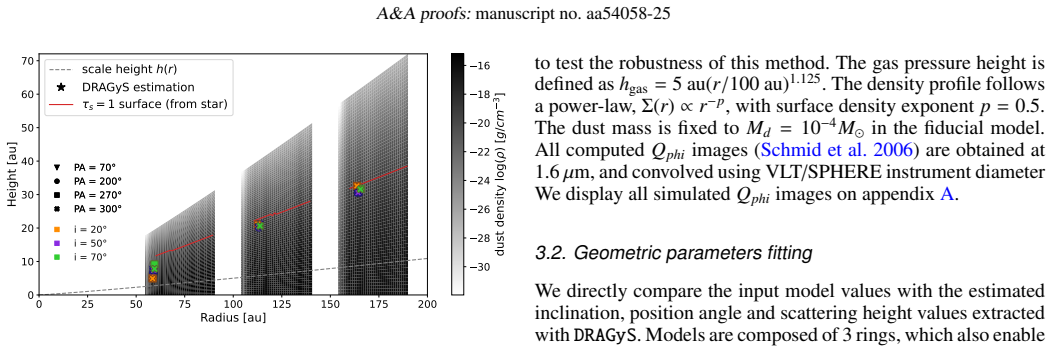
- [Section 3.3 and Appendix D] The limb-brightening correction and the scattering-angle mapping assume that the detected ring traces the tau_s=1 surface and that h(r) follows Eq. (1) with a fixed flaring exponent. Appendix D shows that for low dust masses (10^-6 and 10^-7 M_sun per ring) the surface measured by DRAGyS lies below the tau_s=1 surface, and no test in the paper varies the true flaring exponent of the input model. Since the correction depends on chi, the paper should state the range of disk parameters for which the assumption holds, demonstrate that the corrected SPF is not biased by an incorrect chi, or provide a way to estimate chi from the data.
minor comments (4)
- [Fig. 5] The curve with chi=1.00001 is effectively identical to unity under Eq. (3) and adds no information; it should be replaced by a realistic chi value or removed.
- [Fig. 7] The percentage offsets between SPFs are given without error bars; the uncertainty propagation described in Section 2.3 should be applied to these numbers so the reader can judge whether the differences are significant.
- [Section 2.2] The position-angle convention is described as measured from the horizontal left axis counter-clockwise; because PA is normally quoted from north to east, please clarify how this convention relates to the values in Table 2 and to the reference values.
- [Section 4] The text says the sample is six disks observed in J and/or H bands, while the abstract says 'nine images for six disks'; please make the count explicit in the main text to avoid confusion.
Circularity Check
No circularity: the geometry and SPF are checked against independent MCFOST ground truth and Diskmap benchmarks; the one co-authored citation (Eq. 3) is external support, not a fitted input.
full rationale
The derivation chain is not circular. DRAGyS estimates i, PA, and h/r by least-squares ellipse fitting to brightness peaks (Section 2.2); none of these inputs is the SPF being predicted. The SPF is then produced by directly binning pixel fluxes by the scattering angle computed from Eq. (2), not by fitting a model SPF. In the synthetic tests the extracted SPF is compared with the MCFOST theoretical intrinsic SPF, which is computed independently from the dust properties, so agreement is a genuine external check. The limb-brightening correction (Eq. 3) is imported from Tazaki et al. (2023), one of whose authors is a co-author here, but it is a published formula with stated geometric assumptions, and the paper applies it using the fitted h/r and a fixed flaring exponent; the corrected SPF is then judged against the same independent intrinsic SPF, so the correction is not a fit to the target. The real-data comparison against Diskmap/Ginski et al. (2023) is likewise an external benchmark rather than a self-fit. The only caveat is a reproducibility/consistency concern, not a circularity one: with the printed Eq. (3), LB vanishes for chi=1 and is tiny for chi=1.00001, so the plotted 10-30% corrections require either a different implemented expression or a larger chi than the text's 'close to unity'. That is a verification issue, not evidence that outputs are equivalent to inputs by construction.
Assumptions & free parameters
free parameters (3)
- Scattering surface flaring exponent chi =
about 1 (assumed, not fitted)
- Extraction zone inner and outer radii (R_in, R_out) =
Per object, e.g., HD 163296 H: 55-75 au; taken from Ginski et al. (2023) for observations
- Peak detection filtering thresholds (spatial averaging and intensity filtering) =
Not quantified in the paper
assumptions (7)
- domain assumption Disks are circular; rings project as ellipses.
- domain assumption Maximum flux comes from the disk scattering surface (tau_s=1), not from the inner rim or other rings.
- domain assumption The scattering surface height follows a power law h(r)=h_ref (r/r_ref)^chi with chi fixed near unity.
- domain assumption The limb brightening formula of Tazaki et al. (2023), Eq. (3), correctly describes the geometric bias.
- domain assumption Multiple scattering does not significantly distort the extracted polarized SPF for the tested conditions.
- standard math Halir and Flusser (1998) least-squares ellipse fitting provides unbiased parameter estimates.
- domain assumption MCFOST simulations reproduce the relevant single and multiple scattering physics.
Cite this review
Pith. "Pith review of DRAGyS -- A comprehensive tool to extract scattering phase functions in protoplanetary disks." pith.science (2026). https://pith.science/paper/VIRBVBBZ
@misc{pith2026250520070,
  author       = {Pith},
  title        = {Pith review of: DRAGyS -- A comprehensive tool to extract scattering phase functions in protoplanetary disks},
  year         = {2026},
  howpublished = {\url{https://pith.science/paper/VIRBVBBZ}},
  note         = {Machine review of arXiv:2505.20070}
}
read the original abstract
The early stages of planet formation, involving dust grain growth and planetesimals formation, remain shrouded in mystery. The analysis of the Scattering Phase Function (SPF) measured in disks surrounding young stars holds great potential for revealing crucial information about dust grain properties. Given the increasing number of high-quality datasets available, an efficient method to extract the SPF is required. DRAGyS is a tool designed for the quick and comprehensive analysis of ring-shaped protoplanetary disks. It directly estimates the disk geometry and extracts the total and polarized SPF from scattered light images, without requiring any radiative transfer modeling, a limitation of previous efforts. Key disk parameters (inclination, position angle, aspect ratio) are obtained by fitting ellipses to the disk intensity peaks from the ring surface, assuming the disks are circular. We validated the method using simulated disk images and then applied it to archival polarized-intensity images of nine images for six protoplanetary disks. DRAGyS provides a method to correct for the effect of limb brightening on the SPF. DRAGyS recovers well the injected geometry and the SPF from synthetic images where the parameters are known. When compared to previously published results extracted from images without considering limb brightening, DRAGyS yields similar results for the inclination, position angle, and SPF. We show that the effect of limb brightening on the SPF is significant, with consequences for the inference of dust properties. DRAGyS takes advantage of a fast and purely geometrical approach to estimate ringed-disk geometries. It allows the efficient extraction of SPF either globally or by sectors, allowing it to deal with disk asymmetries. By bypassing the need for a full modeling of the disk geometry before SPF extraction, DRAGyS is well suited to study large samples of disk images.
Figures


Figures from the paper (4 more)


Reference graph
Works this paper leans on
-
[1]
Avenhaus, H., Quanz, S. P., Garufi, A., et al. 2018, The Astrophysical Journal, 863, 44
work page 2018
-
[2]
2023, Optical and Near -infrared View of Planet -forming Disks and Protoplanets , version Number: 1
Benisty, M., Dominik, C., Follette, K., et al. 2023, Optical and Near -infrared View of Planet -forming Disks and Protoplanets , version Number: 1
work page 2023
-
[3]
H.-M., Avenhaus, H., Casassus, S., et al
Bertrang, G. H.-M., Avenhaus, H., Casassus, S., et al. 2018, Monthly Notices of the Royal Astronomical Society, 474, 5105
work page 2018
-
[4]
2019, Astronomy & Astrophysics, 631, A155
Beuzit, J.-L., Vigan, A., Mouillet, D., et al. 2019, Astronomy & Astrophysics, 631, A155
work page 2019
-
[5]
d., Salter, G., Benisty, M., et al
Boer, J. d., Salter, G., Benisty, M., et al. 2016, Astronomy & Astrophysics, 595, A114, publisher: EDP Sciences
work page 2016
-
[6]
Bohren, C. F. & Huffman, D. R. 1983, Absorption and scattering of light by small particles (New York Chichester Brisbane [Australia] [etc.]: J. Wiley & sons)
work page 1983
- [7]
-
[8]
Chiang, E. I., Joung, M. K., Creech-Eakman, M. J., et al. 2001, The Astrophysical Journal, 547, 1077
work page 2001
Show all 35 references
-
[9]
2008, in The infra-red dual imaging and spectrograph for SPHERE : design and performance, ed
Dohlen, K., Langlois, M., Saisse, M., et al. 2008, in The infra-red dual imaging and spectrograph for SPHERE : design and performance, ed. I. S. McLean & M. M. Casali, Marseille, France, 70143L
2008
-
[10]
Dohnanyi, J. S. 1969, Journal of Geophysical Research, 74, 2531
1969
-
[11]
Draine, B. T. & Lee, H. M. 1984, The Astrophysical Journal, 285, 89
1984
-
[12]
2022, Planet Formation Theory in the Era of ALMA and Kepler : from Pebbles to Exoplanets
Drazkowska, J., Bitsch, B., Lambrechts, M., et al. 2022, Planet Formation Theory in the Era of ALMA and Kepler : from Pebbles to Exoplanets
2022
-
[13]
2016, Astronomy & Astrophysics, 595, A112
Ginski, C., Stolker, T., Pinilla, P., et al. 2016, Astronomy & Astrophysics, 595, A112
2016
-
[14]
2023, The Astrophysical Journal, 953, 92
Ginski, C., Tazaki, R., Dominik, C., & Stolker, T. 2023, The Astrophysical Journal, 953, 92
2023
-
[15]
& Flusser, J
Hal r, R. & Flusser, J. 1998
1998
-
[16]
2014, in Protostars and Planets VI (University of Arizona Press)
Johansen, A., Blum, J., Tanaka, H., et al. 2014, in Protostars and Planets VI (University of Arizona Press)
2014
-
[17]
2018, Astronomy & Astrophysics, 617, A44
Keppler, M., Benisty, M., M \"u ller, A., et al. 2018, Astronomy & Astrophysics, 617, A44
2018
-
[18]
2006, Science, 314, 621
Lagage, P.-O., Doucet, C., Pantin, E., et al. 2006, Science, 314, 621
2006
-
[19]
Marel, N. v. d., Dong, R., Francesco, J. d., Williams, J., & Tobin, J. 2019, The Astrophysical Journal, 872, 112, arXiv:1901.03680 [astro-ph]
2019 arXiv
-
[20]
2017, Astronomy & Astrophysics, 599, A108
Milli, J., Vigan, A., Mouillet, D., et al. 2017, Astronomy & Astrophysics, 599, A108
2017
-
[21]
D., Harries, T
Monnier, J. D., Harries, T. J., Aarnio, A., et al. 2017, The Astrophysical Journal, 838, 20
2017
-
[22]
A., Dominik, C., Waters, L
Muro-Arena, G. A., Dominik, C., Waters, L. B. F. M., et al. 2018, Astronomy & Astrophysics, 614, A24
2018
-
[23]
J., Min, M., et al
Pinte, C., Harries, T. J., Min, M., et al. 2009, Astronomy & Astrophysics, 498, 967
2009
-
[24]
2006, Astronomy & Astrophysics, 459, 797
Pinte, C., M \'e nard, F., Duch \^e ne, G., & Bastien, P. 2006, Astronomy & Astrophysics, 459, 797
2006
-
[25]
J., M \'e nard, F., et al
Pinte, C., Price, D. J., M \'e nard, F., et al. 2018, The Astrophysical Journal Letters, 860, L13
2018
-
[26]
A., Kastner, J
Rapson, V. A., Kastner, J. H., Millar-Blanchaer, M. A., & Dong, R. 2015, The Astrophysical Journal, 815, L26
2015
-
[27]
M., Joos, F., & Tschan, D
Schmid, H. M., Joos, F., & Tschan, D. 2006, Astronomy & Astrophysics, 452, 657
2006
-
[28]
2016, Astronomy & Astrophysics, 596, A70
Stolker, T., Dominik, C., Min, M., et al. 2016, Astronomy & Astrophysics, 596, A70
2016
-
[29]
2023, The Astrophysical Journal Letters, 944, L43
Tazaki, R., Ginski, C., & Dominik, C. 2023, The Astrophysical Journal Letters, 944, L43
2023
-
[30]
A., Birnstiel, T., & Foreman-Mackey, D
Teague, R., Bae, J., Bergin, E. A., Birnstiel, T., & Foreman-Mackey, D. 2018, The Astrophysical Journal Letters, 860, L12
2018
-
[31]
2016, The Astrophysical Journal Letters, 828, L17
Thalmann, C., Janson, M., Garufi, A., et al. 2016, The Astrophysical Journal Letters, 828, L17
2016
-
[32]
2022, Astronomy & Astrophysics, 666, A68
Tobon Valencia, V., Geffrin, J.-M., M \'e nard, F., et al. 2022, Astronomy & Astrophysics, 666, A68
2022
-
[33]
2024, Astronomy & Astrophysics, 688, A70
Tobon Valencia, V., Geffrin, J.-M., M \'e nard, F., et al. 2024, Astronomy & Astrophysics, 688, A70
2024
-
[34]
, " * write output.state after.block = add.period write newline
ENTRY address archiveprefix author booktitle chapter edition editor howpublished institution eprint journal key month note number organization pages publisher school series title type volume year label extra.label sort.label short.list INTEGERS output.state before.all mid.sent...
-
[35]
write newline
" write newline "" before.all 'output.state := FUNCTION n.dashify 't := "" t empty not t #1 #1 substring "-" = t #1 #2 substring "--" = not "--" * t #2 global.max substring 't := t #1 #1 substring "-" = "-" * t #2 global.max substring 't := while if t #1 #1 substring * t #2 gl...
Reviewed August 7, 2026 · model on record in the stance chip above.
Discussion (0). Continue with ORCID to comment.