REVIEW 5 major objections 5 minor 1 cited by
THiNK: Can Large Language Models Think-aloud?
T0 review · 5 major / 5 minor · reviewed 2026-08-07 · deepseek-v4-flash
Pith's one-line read This paper claims that iterative feedback-driven revision of math word problems reveals and improves higher-order thinking in LLMs, while a persistent gap remains at applying knowledge to realistic contexts.
desk verdict Interesting framework, but the composite quality score as defined cannot produce the reported numbers, so the quantitative results are not reproducible. read the letter →
The pith
A machine-rendered reading of the paper's core claim, the machinery that carries it, and where it could break.
The reading
What carries the argument
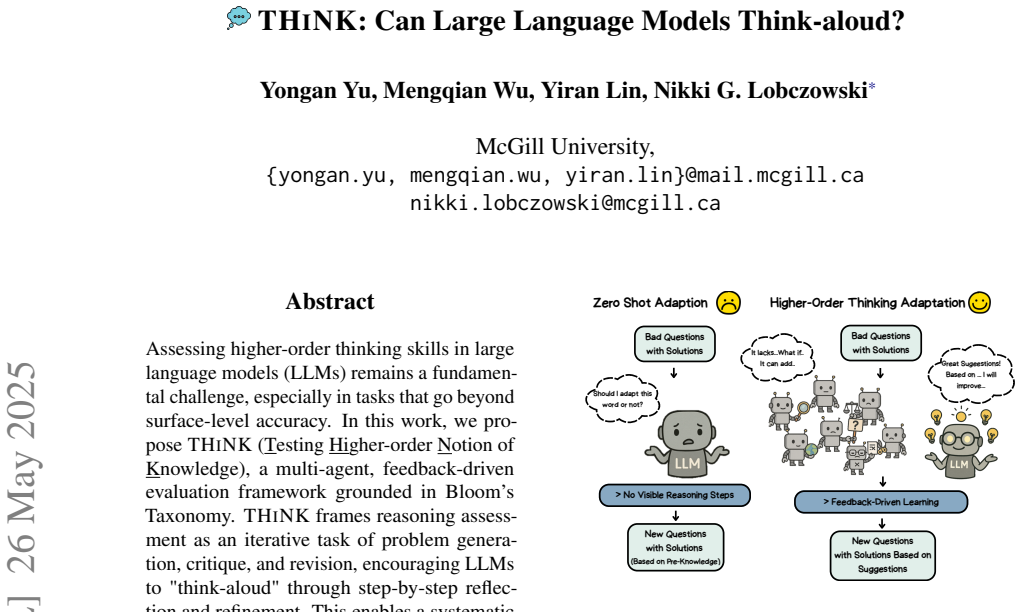
The load-bearing mechanism is a parallel multi-agent evaluation stage in which six agents (A1–A6) each score problems against one Bloom's Taxonomy level—remembering, understanding, applying, analyzing, evaluating, creating—using chain-of-thought prompting, while a seventh holistic agent (A7) scores lexical and syntactic quality and emits improvement suggestions. All judgments are anchored to a 'Five Keys' rubric: math concepts and domains, prerequisite skills, mathematical representations, alternative values, and narrative stories. Each agent returns a performance score and a confidence score, which feed a composite quality score $Q(p_i) = 0.5 \cdot \mathrm{PR} + 0.3 \cdot \mathrm{AA} + 0.2 \cdot \mathrm{AC}$; problems below the $Q > 85$ threshold cycle back to the model with the A7 suggestions, and the loop runs up to $R$ iterations. The iteration count and the score trajectory across rounds are themselves treated as measurements of the model's revision ability and reasoning depth.
What would settle it
Recruit a panel of mathematics educators to blind-score the original, zero-shot, and THiNK-revised problems using the same Five Keys rubric, and compare their rankings to the GPT-4O agents' rankings. If human experts do not systematically rank the THiNK-guided outputs higher—or if their scores diverge sharply from the agent scores—the claim that structured feedback improves higher-order thinking is not supported.
Extended reading notes
Core claim
On the paper's own terms, the central discovery is that LLM reasoning is systematically uneven across Bloom's Taxonomy levels, and that this unevenness only becomes visible when evaluation is iterative rather than single-turn. Across seven models, average scores are high for Remembering (88.48) and Understanding (76.02) but fall to 71.15 for Applying, and that drop appears in nearly every model tested. When the same models revise their problems in response to structured feedback, higher-order scores rise—GPT-4O gains 4.21 points in Analyzing and 2.92 in Evaluating—while smaller open models like Mistral-8B keep a wide gap between surface fluency (91.62 in Remembering, 66.92 in Applying). The paper reads this as evidence that feedback-driven refinement exercises cognitive abilities that single-turn benchmarks never reach, and that instruction-tuned closed-source models benefit most from structured revision.
Load-bearing premise
The whole evaluation depends on the assumption that the 'Five Keys' rubric, as applied by GPT-4O judge agents, measures genuine higher-order thinking; if the judge's scores merely reward outputs that resemble the judge's own style, the reported improvements say more about self-consistency than about reasoning ability.
Editorial extensions
If this is right
- LLM evaluation should shift from single-turn accuracy benchmarks to iterative feedback loops that expose how a model responds to critique and revision.
- The consistent drop in the Applying category identifies a concrete target: transferring learned procedures into realistic contexts remains unsolved by current instruction tuning.
- The same loop that diagnoses cognitive levels also produces improved problems, so evaluation doubles as a refinement pipeline for generating higher-quality educational content.
- Instruction-tuned closed-source models show the narrowest performance band across all six levels, making them the strongest candidates for tutor-like applications, while small open models converge faster but cap at lower final quality.
Reading between the lines
- A competing explanation for the measured gains is rubric conformity: GPT-4O both scores the revisions and produces them, so 'improvement' may track how well the model imitates its own judge's preferences rather than genuine cognitive growth; the paper's Limitations section concedes that no external experts verified outputs.
- The critique-revise loop is domain-general in principle: the same think-aloud protocol could probe abstraction and transfer in code generation, scientific explanation, or legal reasoning, where applying knowledge to realistic contexts is a documented bottleneck.
- A decisive test would decouple judge from examinee—for instance, scoring with a different model family or with human raters—to see whether the reported improvement survives the separation; if it does not, the framework measures self-consistency rather than higher-order thinking.
Editorial analysis
A structured set of objections, weighed in public.
Referee Report
Summary. This paper introduces THiNK, a multi-agent evaluation framework that asks LLMs to iteratively revise flawed math word problems under feedback from six Bloom's-taxonomy-aligned agents plus a holistic agent. The composite quality score Q, defined as a weighted sum of pass rate, inter-agent agreement, and average confidence, determines success and drives the refinement loop. The authors apply THiNK to seven LLMs, reporting that models are strong at lower-order levels, weak at Applying, and improve in higher-order levels with feedback; a qualitative example from Qwen2.5-14B is used to illustrate domain-appropriate reasoning.
Significance. If the framework were valid, it would offer a theory-grounded, automated alternative to accuracy-only benchmarks for probing reasoning, and the released code would be a useful community resource. The paper targets a real evaluation gap, and the educational grounding in Bloom's Taxonomy is a reasonable starting point. However, the quantitative claims rest on a scoring protocol whose printed definition cannot produce the reported numbers, and the evaluation loop has GPT-4O serving as judge, generator of synthetic inputs, and evaluated subject without external validation. These issues are not presentation-level; they undermine the central empirical claim as written.
major comments (5)
- [§3.3, Q definition and success rule] Q as defined is arithmetically inconsistent with the success rule. PR is defined as the average of indicators 1(PS_j(pi)>tau), hence lies in [0,1]; AA is Cohen's Kappa, in [-1,1]; AC lies in [0,100]. With alpha=0.5, beta=0.3, gamma=0.2, the maximum possible Q is 0.5*1 + 0.3*1 + 0.2*100 = 20.8, so the condition Q>85 can never be satisfied. Yet Table 2 reports Qavg values of 71-82 and Rpass approximately 2, which requires problems to pass. The manuscript must state an explicit normalization for PR and AA (e.g., percentages) or correct the threshold; without this, Tables 1-2 are not reproducible from the paper as written.
- [§3.3, §4.1, Algorithm 1] The symbol tau is used both as the per-agent passing threshold inside PR and as the quality threshold in Algorithm 1's while loop, and no value is reported for either. A separate condition 'Success(pi)=1(Q(pi)>85)' is introduced without connecting it to tau. In addition, Rpass(pi) is defined as min{r | A(p_i^(r)) > tau}, although A denotes the set of agents rather than a scalar quality score; this should presumably be Q(p_i^(r)). The ambiguity makes the pass/fail loops and the reported rounds-to-pass values impossible to interpret.
- [§3.2.2, §4.2, Limitation] The evaluation is self-referential for GPT-4O: GPT-4O generates the synthetic bad questions, instantiates all six Bloom agents and the holistic agent A7, and is itself one of the seven evaluated models. For GPT-4O, the examiner and the examinee share the same inductive biases, so reported improvements may reflect conformity to the judge's own criteria rather than independent gains in higher-order thinking. The Limitation section acknowledges the absence of external expert verification and the risk of rubric overfitting but does not address this judge-overlap. A minimal remedy would be a human-scored sample or a second independent judge model with agreement statistics.
- [§3.3, AA definition] Cohen's Kappa is defined for two raters, but AA is computed over seven agents. The manuscript does not specify whether pairwise kappa values are averaged, whether Fleiss' kappa is used, or how negative kappa values enter a weighted sum that also includes PR in [0,1]. This makes the AA component ill-defined and further blocks reproduction of Q.
- [§4.3, Table 4, Limitation] The qualitative validation is under-reported and internally inconsistent with the Limitation statement. The contributions claim validation 'by a human expert,' and Table 4 is labeled 'Human Expert Quality Evaluation,' but the Limitation section says no external experts were recruited; only one example (Qwen2.5-14B) is shown, with no annotation protocol, rater count, or inter-rater agreement. The qualitative claims in the abstract and conclusion are therefore not substantiated.
minor comments (5)
- [Table 1] The arrow notation (e.g., '86.92↑26.92') is not defined in the text; it appears to report a final score and a change from the previous round, but the reader must infer this.
- [Figure 2] The figure contains several typos and unclear labels ('No able to sovle it.', 'Great Sugeestions!', 'THINK' vs 'THiNK'); please correct and harmonize.
- [§4.1] The Rpass formula uses A(p_i^(r)) > tau where A is the agent set; use the composite quality score Q(p_i^(r)) or define a new symbol.
- [§3.4] The claimed mapping from LLM text generation to a think-aloud protocol should be justified more carefully; generating a revised problem after reading feedback is not the same as real-time articulation of thought.
- [§3.2.1, Appendix B.1] Dataset construction details are incomplete: the total number of problems in D is not explicitly stated, and the generation process for the 100 synthetic questions is only summarized; include full prompts and counts if space permits.
Circularity Check
The central 'structured feedback improves higher-order thinking' result is partly self-confirming: the GPT-4O agents that write the feedback also define the score through one unvalidated rubric, and the paper itself concedes that no external experts validated the outputs.
-
self definitional
[Section 3.2.2, Section 3.3, Algorithm 1, Section 4.3, Limitation]
"the holistic evaluation agent A7 further outputs an improvement suggestion: A7(pi) = (P S7(pi), CS7(pi), IS(pi)) ... This feedback assesses whether the problem satisfies the 'Five Keys' components ... Q(pi) = α · P R(pi) + β · AA(pi) + γ · AC(pi) ... Success(pi) = 1(Q(pi) > 85) ... pi ← LLM(pi, IS)"
The criterion being measured ('higher-order thinking performance') is operationalized by the same multi-agent rubric that produces the improvement suggestions. Algorithm 1 feeds rubric-derived suggestions back into the LLM and then recomputes Q with the same rubric, so the reported improvement is partly convergence to the judge's own criteria rather than an external measure of reasoning.
full rationale
The main empirical claim is that structured feedback loops significantly improve reasoning performance, especially higher-order thinking. In this framework, the feedback is generated by GPT-4O agents using the paper's 'Five Keys' rubric, and the quality score Q is computed by the same rubric. Thus the intervention and the outcome share the same unvalidated measurement construct; a model that follows the suggestions is rewarded by the very criteria embedded in those suggestions. The paper's own Limitation explicitly acknowledges the lack of external expert verification and the risk of rubric overfitting, which supports this partial-circularity finding. This is not a case of a maliciously fitted parameter or a self-citation chain; the rubric is an authored input rather than a fitted output, and the task retains independent mathematical constraints. Separately, the printed Q formula is arithmetically inconsistent with the reported numbers: with PR in [0,1], AA as Cohen's Kappa in [-1,1], and AC in [0,100], the maximum possible Q is about 20.8, far below the required threshold of 85. That is a reproducibility blocker rather than a circularity, but it compounds the difficulty of verifying the claimed improvements. The self-citation to Wolcott and Lobczowski (2021) for the think-aloud protocol is not load-bearing, since this is a standard method with independent support. On balance, the central improvement claim is partially circular by construction, but the framework also contains independent empirical content, so a score of 6 is appropriate.
Assumptions & free parameters
free parameters (3)
- Composite quality weights (alpha, beta, gamma) =
0.5, 0.3, 0.2
- Success threshold =
85 (composite Q)
- Agent-level passing threshold tau =
Not reported
assumptions (4)
- domain assumption Bloom's Taxonomy is a valid model for assessing LLM cognitive skills.
- ad hoc to paper The 'Five Keys' components capture the relevant dimensions of math word problem quality.
- ad hoc to paper GPT-4O-based agents produce reliable performance and confidence scores without human calibration.
- ad hoc to paper Iterative text generation instantiates a think-aloud protocol.
invented entities (2)
-
The 'Five Keys' rubric
-
Synthetic flawed problems generated by GPT-4O
Cite this review
Pith. "Pith review of THiNK: Can Large Language Models Think-aloud?." pith.science (2026). https://pith.science/paper/OTFG2SJS
@misc{pith2026250520184,
  author       = {Pith},
  title        = {Pith review of: THiNK: Can Large Language Models Think-aloud?},
  year         = {2026},
  howpublished = {\url{https://pith.science/paper/OTFG2SJS}},
  note         = {Machine review of arXiv:2505.20184}
}
read the original abstract
Assessing higher-order thinking skills in large language models (LLMs) remains a fundamental challenge, especially in tasks that go beyond surface-level accuracy. In this work, we propose THiNK (Testing Higher-order Notion of Knowledge), a multi-agent, feedback-driven evaluation framework grounded in Bloom's Taxonomy. THiNK frames reasoning assessment as an iterative task of problem generation, critique, and revision, encouraging LLMs to think-aloud through step-by-step reflection and refinement. This enables a systematic evaluation of both lower-order (e.g., remember, understand) and higher-order (e.g., evaluate, create) thinking skills. We apply THiNK to seven state-of-the-art LLMs and perform a detailed cognitive analysis of their outputs. Results reveal that while models reliably perform lower-order categories well, they struggle with applying knowledge in realistic contexts and exhibit limited abstraction. Structured feedback loops significantly improve reasoning performance, particularly in higher-order thinking. Qualitative evaluations further confirm that THiNK-guided outputs better align with domain logic and problem structure. The code of our framework provides a scalable methodology for probing and enhancing LLM reasoning, offering new directions for evaluation grounded in learning science, which is available at our GitHub repository.
Figures


Forward citations
Cited by 1 Pith paper
-
Mechanistic Interpretability of Cognitive Complexity in LLMs via Linear Probing using Bloom's Taxonomy
Linear probes on LLM residual streams classify Bloom's Taxonomy levels with high accuracy, but the result may reflect prompt lexico-semantic cues rather than a general cognitive-complexity representation.
Reference graph
Works this paper leans on
-
[1]
Math Concepts and Domains: This dimension identifies the core mathematical ideas underlying a task, such as algebraic structures, number theory, or geometry. By analyzing which concepts are invoked, we assess the knowledge dimension activated during problem-solving and whether the LLM navigates these domains coherently
-
[2]
Thilo Hagendorff, Sarah Fabi, and Michal Kosinski
Has the creativity of large-language models peaked? an analysis of inter- and intra-llm variability. Thilo Hagendorff, Sarah Fabi, and Michal Kosinski
-
[3]
Representations are critical for logical coherence and traceability in reasoning
Mathematical Representations: These include formal expressions (e.g., symbolic notation, equa- tions), diagrams, or stepwise procedures. Representations are critical for logical coherence and traceability in reasoning. Evaluating this component helps identify whether an LLM applies opera- tions in a structured and intelligible manner
-
[4]
Alternative Values: This refers to variations in the input parameters of a problem that preserve its underlying structure. A model’s ability to adapt its reasoning across such variants reflects generalization ability—an essential attribute of HOT
-
[5]
Narrative Stories: Embedding problems in real-world or socio-cultural contexts situates abstract mathematical reasoning within meaningful scenarios. This component supports engagement and contextual transfer, and allows us to probe whether the LLM can maintain reasoning integrity when the task is couched in diverse narrative frames. By formally integratin...
-
[6]
In 2023 IEEE International Con- ference On Artificial Intelligence Testing (AITest) , pages 169–171
Leveraging cognitive science for testing large language models. In 2023 IEEE International Con- ference On Artificial Intelligence Testing (AITest) , pages 169–171. IEEE. Aarohi Srivastava, Abhinav Rastogi, Abhishek Rao, Abu Awal Md Shoeb, Abubakar Abid, Adam Fisch, Adam R Brown, Adam Santoro, Aditya Gupta, Adrià Garriga-Alonso, and 1 others. 2022. Beyond...
arXiv 2023
-
[8]
Assessing and understanding creativity in large language models. ArXiv, abs/2401.12491. Lianmin Zheng, Wei-Lin Chiang, Ying Sheng, Siyuan Zhuang, Zhanghao Wu, Yonghao Zhuang, Zi Lin, Zhuohan Li, Dacheng Li, Eric Xing, and 1 others
-
[9]
Judging llm-as-a-judge with mt-bench and chatbot arena. Advances in Neural Information Pro- cessing Systems, 36:46595–46623. Qingyu Zhou and Danqing Huang. 2019. Towards gen- erating math word problems from equations and top- ics. In Proceedings of the 12th international confer- ence on natural language generation, pages 494–503. Anat Zohar and Yehudit J ...
work page 2019
Show all 34 references
-
[11]
These skills serve as proxies for prior knowledge and inform whether the LLM draws upon relevant background competence
Prerequisite Skills: This component captures the foundational knowledge—both conceptual and procedural—that a learner or model must possess to attempt a solution. These skills serve as proxies for prior knowledge and inform whether the LLM draws upon relevant background competence
-
[15]
You should try to understand and retrieve the specific mathematical information in it such as facts, patterns, objects, or contextual information, and decipher these meanings
Analyze the generated problem of the last round. You should try to understand and retrieve the specific mathematical information in it such as facts, patterns, objects, or contextual information, and decipher these meanings
-
[16]
It includes understanding and organizing information, analyzing relationships, drawing conclusions, and distinguishing nuances
Use cognitive skills essential for processing and applying information effectively. It includes understanding and organizing information, analyzing relationships, drawing conclusions, and distinguishing nuances. Additionally, you should evaluate ideas critically
-
[17]
These new expressions should have the same form as the given expressions in the previous generated math problem
Generate mathematical expressions for the new problems. These new expressions should have the same form as the given expressions in the previous generated math problem. They must have the same complexity as well. Choose values to substitute into the expression, and calculate t...
-
[18]
The generated stories must be a mathematical word problem with the corresponding expressions
Generate stories for these mathematical expressions with the appropriate questions based on the chosen values. The generated stories must be a mathematical word problem with the corresponding expressions. The story must be creative and unique
-
[19]
question
Following and combining the previous steps, and you will generate a new creative version of the given math problem. Review the generated new version math problem, ensuring all the criteria are satisfied and double check it. Provide your evaluation in JSON format with these exa...
-
[20]
Ambiguous wording or missing critical information
-
[21]
Unrealistic assumptions or scenarios
-
[22]
Multiple possible interpretations
-
[23]
Contradictory information
-
[24]
ID": null,
Unclear requirements or expectations The question should follow this format: {{ "ID": null, "question": "The question text", "LaTeX question": "The question text with LaTeX formatting", "solution": "Explanation of why the question is flawed and what information is missing or a...
-
[25]
Math concepts and domains
-
[26]
Required skills to solve the problem
-
[27]
Math expressions as sequence of operations
-
[28]
Values that substitute into expressions
-
[29]
The narrative story based on real-life socio-cultural experiences **Step 2: Lexical and Syntactic Complexity Analysis** - Type-Token Ratio (TTR) - Yngve Score - Frazier Score - Frazier–Roark Score - Developmental Level - Syntactic Frequency - Mean Dependency Distance (MDD) - S...
-
[30]
Lexical and Syntactic Complexity
-
[31]
Error Count and Severity
-
[32]
Clarity and Solvability
-
[33]
Answerability Penalty
-
[34]
performance_score
Structural Consistency and Creativity **Scoring Guidance:** - 90–100: Clear, simple, and error-free problem. - 70–89: Minor complexity or errors that slightly impact clarity. - 50–69: Moderate complexity and multiple identifiable issues. - 0–49: Significant errors, ambiguity, ...
-
[2010]
English language teaching, 3(4):237– 248
Vygotsky’s zone of proximal development: Instructional implications and teachers’ professional development. English language teaching, 3(4):237– 248. Ramya Srinivasan, Hiroya Inakoshi, and Kanji Uchino
-
[2018]
Inter- national journal of social sciences and humanities, 2(1):24–32
Higher order thinking skills assessment to- wards critical thinking on mathematics lesson. Inter- national journal of social sciences and humanities, 2(1):24–32. Michael D Wolcott and Nikki G Lobczowski. 2021. Us- ing cognitive interviews and think-aloud protocols to understan...
2021 arXiv
-
[2023]
Nature Computational Science, 3(10):833–838
Human-like intuitive behavior and reasoning biases emerged in large language models but disap- peared in chatgpt. Nature Computational Science, 3(10):833–838. Yinghui He, Yufan Wu, Yilin Jia, Rada Mihalcea, Yu- long Chen, and Naihao Deng. 2023. Hi-tom: A benchmark for evaluati...
2023 arXiv
-
[2024]
TOFEDU: The Future of Education Journal, 3(5):1488–1499
Enhancing higher order thinking skills (hots) in education: Strategies and outcomes. TOFEDU: The Future of Education Journal, 3(5):1488–1499. Steffen Saifer. 2018. HOT skills: Developing higher- order thinking in young learners. Redleaf Press. Nicy Scaria, Suma Chenna, and Dee...
2018
-
[2025]
In Proceedings of the 2025 CHI Conference on Human Factors in Computing Systems, pages 1–23
Think together and work better: Combining humans’ and llms’ think-aloud outcomes for effective text evaluation. In Proceedings of the 2025 CHI Conference on Human Factors in Computing Systems, pages 1–23. Jacob Cohen. 1960. A coefficient of agreement for nominal scales. Educat...
2025 arXiv
Reviewed August 7, 2026 · model on record in the stance chip above.
Discussion (0). Sign in to comment.