REVIEW 2 major objections 5 minor 3 cited by
A frequentist view on the two-body decaying dark matter model
T0 review · 2 major / 5 minor · reviewed 2026-08-07 · deepseek-v4-flash
Pith's one-line read This paper argues that Bayesian constraints on two-body decaying dark matter are distorted by prior volume effects, and that a frequentist analysis of Planck data favours decay parameters that lower $S_8$ to about 0.70.
desk verdict A self-aware frequentist reanalysis of DDM that makes the volume-effect point clearly, but the headline Planck numbers sit on an emulator extrapolation the authors themselves flag. read the letter →
The pith
A machine-rendered reading of the paper's core claim, the machinery that carries it, and where it could break.
The reading
What carries the argument
The load-bearing tool is the profile likelihood, $L_p(\alpha)=\max_\theta L(\alpha,\theta)$, which fixes the parameters of interest $\alpha$ and maximises over every other parameter, producing prior-independent confidence intervals through $\Delta\chi^2$ thresholds. The analysis applies it to the two-body DDM model, whose nonlinear matter power spectrum is written as $P^{\Lambda\mathrm{DDM}}_{\mathrm{NL}}(k,z) = P^{\Lambda\mathrm{CDM}}_{\mathrm{NL}}(k,z)\times S_{\Gamma,v}(k,z)$, where the suppression factor $S_{\Gamma,v}$ comes from the DMemu emulator trained on N-body simulations. Comparing the resulting 1$\sigma$ frequentist contour with Bayesian posteriors is what exposes the volume effect.
What would settle it
Recompute the frequentist 68% contour using an emulator or N-body calibration that covers $\log_{10}\Gamma\in[-4,-0.5]$ and $\log_{10}v\in[1.5,4]$, and check whether the best fit at $\Gamma=0.10\,\mathrm{Gyr}^{-1}$, $v=1250\,\mathrm{km/s}$ remains a local minimum. If the minimum shifts to the $\Lambda$CDM limit ($\Gamma\to0$ or $v\to0$) or the improvement over $\Lambda$CDM drops below $\Delta\chi^2\approx1$, the claimed $S_8=0.70$ preference would not survive.
Extended reading notes
Core claim
On its own terms, the central discovery is that the two-body decaying dark matter model is weakly favoured by Planck CMB, BAO, and supernova data once prior volume effects are removed. The profile likelihood yields 68% confidence intervals $t_{1/2} = 6.93^{+7.88}_{-2.85}$ Gyr and $v = 1250^{+1450}_{-1000}$ km/s, with a best fit at $\Gamma = 0.10\,\mathrm{Gyr}^{-1}$ and $v = 1250\,\mathrm{km/s}$ that predicts $S_8 = 0.70$. This value lies below the Planck $\Lambda$CDM value and matches the KiDS-1000/DES-Y3 measurements within about $1.5\sigma$, whereas the Bayesian posterior from the same data keeps $S_8$ near $0.816$ because the prior volume penalises the decay region. The authors conclude that the apparent weakness of DDM in earlier analyses is largely a prior-volume artefact, and that the model genuinely can lower $S_8$ while fitting the CMB.
Load-bearing premise
The result relies on the emulator that predicts how decay changes the clustering of matter being accurate at the Planck best-fit decay rate and velocity kick, even though the paper states that this best-fit and part of the 1$\sigma$ region lie outside the range the emulator was trained on.
Editorial extensions
If this is right
- At 68% confidence the frequentist region for $(\Gamma,v)$ is a closed contour around the best fit, while the Bayesian posterior is pulled toward the $\Lambda$CDM limit; the two approaches agree only at 95% confidence, where volume effects become negligible.
- If the best fit is correct, roughly three-quarters of the initial DDM particles have decayed by today, and the model predicts $S_8=0.70$, reconciling Planck with KiDS-1000 and DES-Y3 at about $1.5\sigma$ without needing the full-shape galaxy power spectrum.
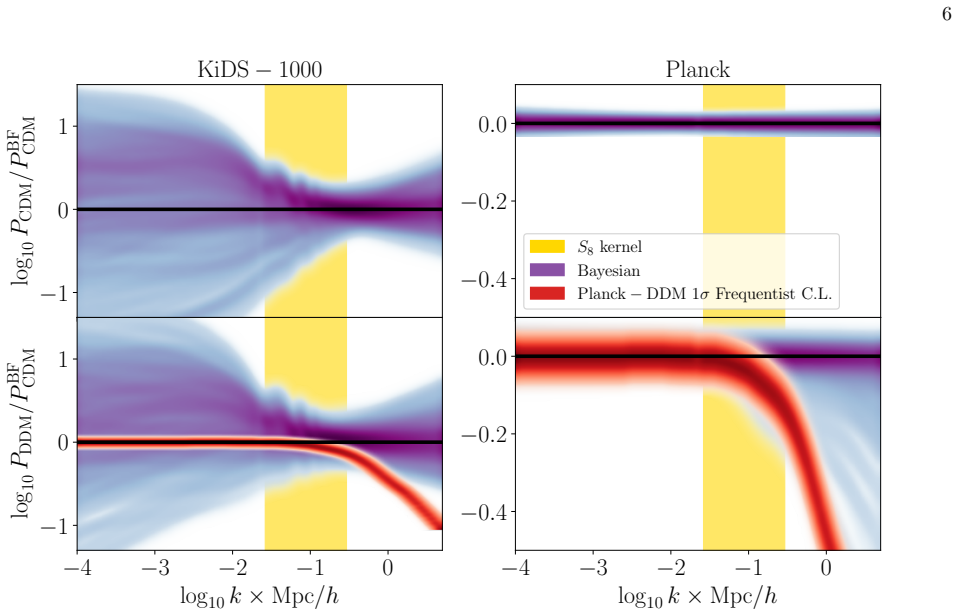
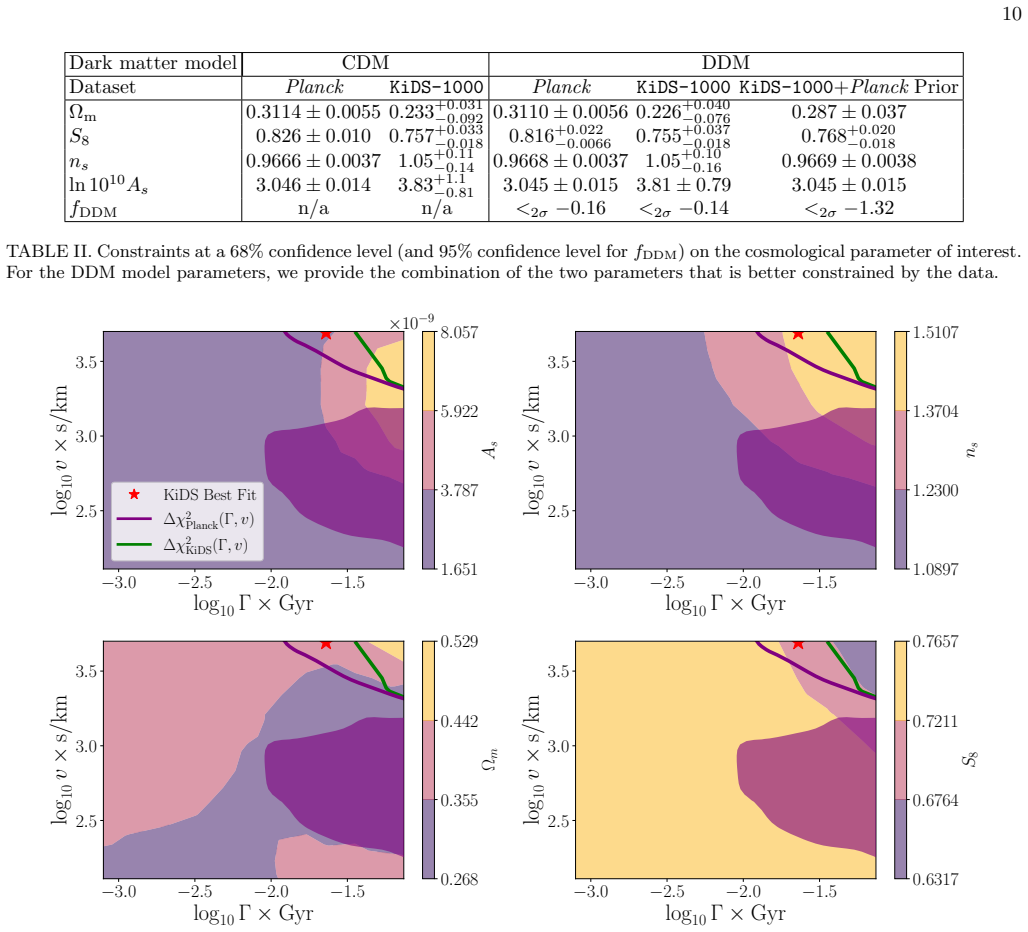
- KiDS-1000 alone, with broad priors on $A_s$ and $n_s$, does not constrain $\Gamma$ and $v$; earlier DDM constraints from that survey were produced by narrow priors on the primordial parameters, so they should not be read as data-driven exclusions.
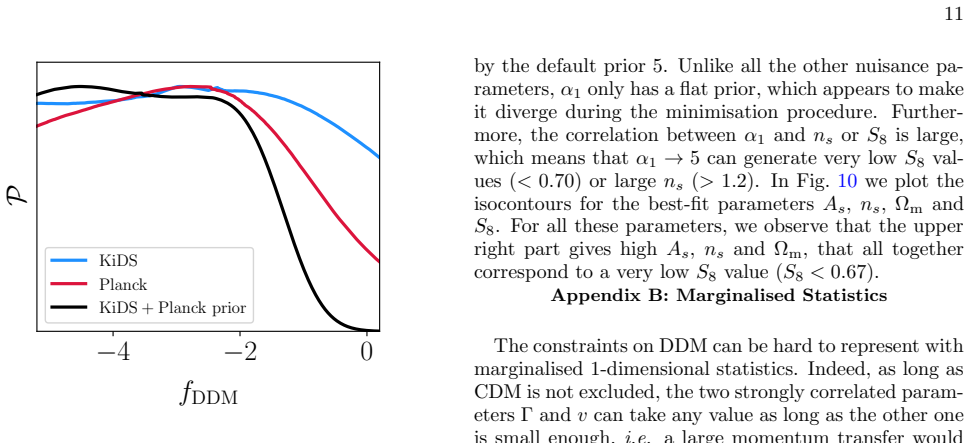
- Combining KiDS-1000 with Planck-informed priors on $A_s$ and $n_s$ excludes large decay rates and velocity kicks but leaves the 68% frequentist region from Planck alive, so multi-scale data are needed to settle the model.
- Forecast studies cited in the paper indicate that Euclid will tighten constraints on the DDM parameter space by up to an order of magnitude, providing a definitive test of the scenario.
Reading between the lines
- Beyond the paper: any weakly constrained new-physics parameter in cosmology is vulnerable to the same prior-volume effect, so Bayesian upper limits from CMB-only analyses should be cross-checked with profile likelihoods before being treated as exclusions.
- Beyond the paper: a decisive test is to extend the DMemu emulator or run matched N-body simulations at $(\Gamma,v)=(0.10\,\mathrm{Gyr}^{-1},1250\,\mathrm{km/s})$; if the predicted suppression factor changes materially outside the trained domain, the $S_8=0.70$ prediction would move with it.
- Beyond the paper: because KiDS-1000 mostly constrains scales around $k\sim0.3\,h\,\mathrm{Mpc}^{-1}$ rather than the $S_8$ kernel, future model comparisons should use the full lensing likelihood; a compressed $S_8$ statistic alone could misjudge a model that suppresses power at slightly different scales.
- Beyond the paper: a discriminating observation would be the scale-dependent matter power spectrum from galaxy clustering or CMB lensing; a step-like suppression at the free-streaming scale would corroborate the frequentist preference, while a smooth CDM-like spectrum would push $\Gamma$ and $v$ back toward the $\Lambda$CDM limit.
Editorial analysis
A structured set of objections, weighed in public.
Referee Report
Summary. The paper presents Bayesian and frequentist profile-likelihood analyses of the two-body decaying dark matter (DDM) model, characterized by decay rate Γ and velocity kick v, using Planck 2018 CMB plus BAO and Pantheon-Plus supernovae ('Planck') and KiDS-1000 cosmic shear. For the Planck data, the authors report a global best fit Γ = 0.10 Gyr^-1, v = 1250 km/s with S8 = 0.70 and Δχ² = -2.66 relative to ΛCDM, and 68% profile-likelihood intervals (Eq. 13) that they argue differ from Bayesian posteriors due to prior volume effects. They also show that KiDS-1000 alone, with broad priors on As and ns, does not constrain the DDM parameters, and that previously reported KiDS-1000 constraints were largely driven by those priors. A central caveat, acknowledged by the authors in Section IV.A, is that the Planck-DDM best fit and part of the corresponding 1σ region lie outside the domain covered by the DMemu nonlinear emulator used for the predictions.
Significance. If valid, the paper would be the first frequentist analysis of the two-body DDM model, providing prior-independent constraints and a concrete illustration that prior volume effects can change the qualitative interpretation of Bayesian DDM constraints. The demonstration of an As-ns degeneracy in KiDS-1000 and the warning against substituting S8 constraints for the full likelihood are useful and well-illustrated contributions. The paper is transparent about its main limitation, and it builds on public codes and published simulations. However, the headline quantitative claims—the 68% intervals in Eq. (13) and the S8 = 0.70 prediction—are obtained in a parameter region where the emulator is explicitly untrained; until that extrapolation is validated or the claims are restricted to the trained domain, the significance remains conditional.
major comments (2)
- [Section IV.A and Eqs. (9)–(13)] The central result is not supported within the emulator's trained domain. Eq. (9) gives log10 Γ ∈ [-4, -1.13] for DMemu, while the Planck best fit (Eq. 12) has log10 Γ = -1.0 and the 1σ upper limit in Eq. (13) extends to log10 Γ ≈ -0.57. The paper itself states in Section IV.A that 'the Planck-DDM best-fit and part of the corresponding 1σ frequentist confidence region' lie outside the emulator domain. Since the DDM improvement over ΛCDM is only Δχ² = -2.66 (Eq. 11), a modest error in the extrapolated suppression factor could move the minimum and alter the conclusion that the Bayesian and frequentist intervals 'strongly differ.' Please validate DMemu at the best-fit parameters (e.g., with DDM N-body simulations at Γ = 0.10 Gyr^-1, v = 1250 km/s) or, failing that, restrict the reported profile-likelihood constraints to the trained domain and state that the global best fit cannot be characterized with the current emulator.
- [Abstract, Eq. (12), Section III.B.1] The abstract's statement that the frequentist best fit S8 = 0.70 agrees with KiDS-1000 and DES-Y3 at ~1.5σ needs substantiation. A direct comparison of S8 = 0.70 with the KiDS-1000 value S8 = 0.759^{+0.024}_{-0.021} reported in the paper corresponds to a roughly 2.5σ difference. If the intended claim is that the 68% frequentist region in (Γ, v) contains models whose S8 is compatible with the weak-lensing measurements, the paper should state and justify that metric, and report the range of S8 over that region; otherwise the abstract overstates the agreement.
minor comments (5)
- [Appendix B, Eq. (B1)] In the sentence following Eq. (B1), 'where Γ0 and v are arbitrary normalization values' should read 'where Γ0 and v0 are arbitrary normalization values', since v0 is the normalization used in the definition.
- [Abstract and Section IV.A] The abstract says the scales best measured by KiDS-1000 are 'centred around k ∼ 0.3 h/Mpc', while Section IV.A states 'a kernel centred around k ∼ 0.5 h/Mpc'; these numbers should be reconciled.
- [Section IV.A, Fig. 5 reference] The text says 'In Fig. 5, the overlap between the 1σ region and the trained domain of SΓ,v is shown as a purple contour', but the Fig. 5 caption describes KiDS-1000 posterior contours with Planck profile contours overlaid; please specify exactly which panel or overlay is meant.
- [Table II and Eq. (B1)] The row for fDDM in Table II ('<2σ −0.16', etc.) is difficult to parse; please state explicitly that these are 95% upper limits on the combination defined in Eq. (B1), and include the normalization values Γ0 and v0 in the table caption.
- [Section III.B.1, Eq. (13)] The interval for N0^DDM/Nini is reported without derivation; please state that this ratio is exp(-Γ t0) in the two-body DDM model, or cite the equation where it is defined.
Circularity Check
No significant circularity: the frequentist analysis is built on external likelihoods and an independently calibrated emulator; the out-of-domain extrapolation is a modeling limitation, not a circular step.
full rationale
The paper's central result, a frequentist profile-likelihood analysis of the two-body DDM model, is derived from external datasets (Planck 2018, BAO, PantheonPlus, KiDS-1000) and from the DMemu nonlinear suppression factor S_Γ,v(k,z), which is calibrated on independent N-body simulations in Ref. [30] and is not fitted to the data analyzed here. The comparison between Bayesian and frequentist intervals is a legitimate statistical exercise applied to the same model and data; it does not define the target conclusion in terms of its own output. The authors' admitted statement that 'the Planck-DDM best-fit and part of the corresponding 1σ frequentist confidence region identified in Section III B lie outside the domain covered by the emulator SΓ,v' (Section IV A) is a substantive modeling limitation that could weaken the robustness of the quoted best-fit and S8 value, but it is not a circularity: extrapolating a calibrated emulator is an assumption, not a reduction of the result to its inputs. Self-citations to the authors' earlier work (e.g., Refs. [25,47,87]) provide the public CLASS implementation and previous constraints, but these are reproducible codes and external comparisons, not uniqueness theorems or fitted parameters renamed as predictions. No step in the derivation chain equates the predicted quantities with the inputs by construction, and no load-bearing argument reduces to an unverified self-citation. Therefore no significant circularity is present.
Assumptions & free parameters
free parameters (2)
- decay rate Gamma =
0.10 Gyr^-1 (best fit)
- velocity kick v =
1250 km/s (best fit)
assumptions (4)
- domain assumption Flat LCDM with six parameters and Gaussian adiabatic primordial perturbations (power-law spectrum As, ns-1).
- domain assumption The DMemu emulator S_{Gamma,v} (Ref. [30]) gives accurate nonlinear matter power spectra for the f=1 two-body DDM model over the full parameter range used for Planck.
- domain assumption The simulated annealing minimization of Ref. [83] converges to the global maximum of the likelihood.
- domain assumption Kinematic relation epsilon = 1/2(1 - M_WDM^2/M_CDM^2) and v = epsilon c with f=1.
Cite this review
Pith. "Pith review of A frequentist view on the two-body decaying dark matter model." pith.science (2026). https://pith.science/paper/IXT7DCDT
@misc{pith2026250520193,
  author       = {Pith},
  title        = {Pith review of: A frequentist view on the two-body decaying dark matter model},
  year         = {2026},
  howpublished = {\url{https://pith.science/paper/IXT7DCDT}},
  note         = {Machine review of arXiv:2505.20193}
}
abstract
Decaying dark matter (DDM) has emerged as an interesting framework to extend the $\Lambda$-cold-dark-matter (LCDM) model, as many particle physics models predict that dark matter may not be stable over cosmic time and can impact structure formation. In particular, a model in which DDM decays at a rate $\Gamma$ and imprints a velocity kick $v$ onto its decay products leads to a low amplitude of fluctuations, as quantified by the parameter $S_8$, in better agreement with that measured by some weak lensing surveys. Bayesian analyses have provided mixed conclusions regarding its viability, with a reconstructed clustering amplitude only slightly below the standard LCDM value. In this paper, we contrast previous results with a frequentist analysis of Planck and SDSS BAO data. We find that the $68\%$ confidence level region corresponds to a decay half-life of $6.93^{+7.88}_{-2.85}$Gyr and a velocity kick of $1250^{+1450}_{-1000}$~km/s. These $1\sigma$ constraints strongly differ from their Bayesian counterparts, indicating the presence of volume effect in the Bayesian analysis. Moreover, we find that under the DDM model, the frequentist analysis predicts lower values of $S_8$, in agreement with those found by KiDS-1000 and DES-Y3 at $\sim 1.5\sigma$. We further show that previously derived KiDS-1000 constraints that appeared to exclude the best-fit model from Planck data were driven by priors on the primordial amplitude $A_s$ and spectral index $n_s$. When those are removed from the analysis, KiDS-1000 constraints on the DDM parameters are fully relaxed. It is only when applying Planck-informed priors on $A_s$ and $n_s$ to the KiDS-1000 analysis that one can constrain the model. We note that without such priors, the scales best measured by KiDS-1000 do not exactly match the $S_8$ kernel, so $S_8$ constraints should not be applied directly to a model in place of the full likelihood.
Figures


Figures from the paper (6 more)


Forward citations
Cited by 3 Pith papers
-
Cosmological evolution with decaying dark matter: an integral-equation approach
CLASSIER-DDM evaluates generic two-body decaying dark matter perturbations via iterative integral equations at O(0.1%) accuracy and O(1 min) cost without a Boltzmann hierarchy or fluid approximation.
-
Decaying Dark Matter Halo Abundance from a Revised Spherical Collapse Model
A mass-dependent collapse threshold from a revised spherical collapse model predicts the decaying-dark-matter halo mass function, matching N-body simulations at z≈1 and for mild kicks at z=0.
-
Neutrino mass limits and decaying dark matter: background evolution versus perturbations
Decaying dark matter can hide neutrino mass from expansion-history data, but CMB lensing unmasks it and restores ∑mν ≲ 0.079 eV.
Reference graph
Works this paper leans on
-
[30]
H. Tanimura, M. Douspis, N. Aghanim, and J. Kuruvilla, Astron. Astrophys. 674, A222 (2023), arXiv:2301.03939 [astro-ph.CO]
work page Pith review arXiv 2023
-
[1]
2, we show the profile likelihood as a function of Γ and v on the first and second columns, respectively, by using Eq
1-dimensional profile In Fig. 2, we show the profile likelihood as a function of Γ and v on the first and second columns, respectively, by using Eq. (10). The top and bottom panels show respectively the ∆χ2 and the derived parameter S8 com- puted at the maximum likelihood θmax. We show the reconstructed value of S8 in the KiDS-1000 analysis as a blue band...
-
[2]
from KiDS-1000 alone
2-dimensional profile We show in Fig. 3 the comparison between Bayesian and frequentist intervals reconstructed from the analy- sis of Planck data in the 2-dimensional {log10 Γ, log10 v} plane, as well as in the 1-dimensional case for each param- eter. In the frequentist case, shown in purple, we display the 2-dimensional confidence intervals derived with...
2018
-
[3]
N. Aghanim et al. (Planck), Astron. Astrophys. 641, A6 (2020), [Erratum: Astron.Astrophys. 652, C4 (2021)], arXiv:1807.06209 [astro-ph.CO]
arXiv 2020
-
[4]
K. Kuijken et al. , Astron. Astrophys. 625, A2 (2019), arXiv:1902.11265 [astro-ph.GA]
arXiv 2019
-
[5]
B. Giblin et al. , Astron. Astrophys. 645, A105 (2021), arXiv:2007.01845 [astro-ph.CO]
arXiv 2021
-
[6]
A. Amon et al. (DES), Phys. Rev. D 105, 023514 (2022), arXiv:2105.13543 [astro-ph.CO]
arXiv 2022
-
[7]
T. Hamana et al., Publ. Astron. Soc. Jap. 72, 16 (2020), [Erratum: Publ.Astron.Soc.Jap. 74, 488-491 (2022)], arXiv:1906.06041 [astro-ph.CO]
arXiv 2020
Show all 91 references
-
[8]
J. L. v. d. Busch et al. , Astron. Astrophys. 664, A170 (2022), arXiv:2204.02396 [astro-ph.CO]
2022 arXiv
-
[9]
T. M. C. Abbott et al. (DES), Phys. Rev. D 105, 023520 (2022), arXiv:2105.13549 [astro-ph.CO]
2022 arXiv
-
[10]
St¨ olzner et al
B. St¨ olzner et al. , (2025), arXiv:2503.19442 [astro- ph.CO]
2025
-
[11]
Ivezi´ cet al
v. Ivezi´ cet al. (LSST), Astrophys. J. 873, 111 (2019), arXiv:0805.2366 [astro-ph]. 12
2019 arXiv
-
[12]
Mellier et al
Y. Mellier et al. (Euclid), Astron. Astrophys. 697, A1 (2025), arXiv:2405.13491 [astro-ph.CO]
2025
-
[13]
Spergel et al., (2015), arXiv:1503.03757 [astro-ph.IM]
D. Spergel et al., (2015), arXiv:1503.03757 [astro-ph.IM]
2015 arXiv
-
[14]
Y. Gong, X. Liu, Y. Cao, X. Chen, Z. Fan, R. Li, X.-D. Li, Z. Li, X. Zhang, and H. Zhan, Astrophys. J. 883, 203 (2019), arXiv:1901.04634 [astro-ph.CO]
2019 arXiv
-
[15]
Stahl, B
C. Stahl, B. Famaey, R. Ibata, O. Hahn, N. Martinet, and T. Montandon, Phys. Rev. D 110, 063501 (2024), arXiv:2404.03244 [astro-ph.CO]
2024 arXiv
-
[16]
T. Tan, D. Zuercher, J. Fluri, A. Refregier, F. Tarsitano, and T. Kacprzak, Mon. Not. Roy. Astron. Soc. 522, 3766 (2023), arXiv:2207.03598 [astro-ph.CO]
2023 arXiv
-
[17]
Amon and G
A. Amon and G. Efstathiou, Mon. Not. Roy. Astron. Soc. 516, 5355 (2022), arXiv:2206.11794 [astro-ph.CO]
2022 arXiv
-
[18]
Aric` o, R
G. Aric` o, R. E. Angulo, M. Zennaro, S. Contreras, A. Chen, and C. Hern´ andez-Monteagudo, Astron. Astro- phys. 678, A109 (2023), arXiv:2303.05537 [astro-ph.CO]
2023 arXiv
-
[19]
Schneider, A
A. Schneider, A. Refregier, S. Grandis, D. Eckert, N. Stoira, T. Kacprzak, M. Knabenhans, J. Stadel, and R. Teyssier, JCAP 04, 020 (2020), arXiv:1911.08494 [astro-ph.CO]
2020 arXiv
-
[20]
Heimersheim, N
S. Heimersheim, N. Sch¨ oneberg, D. C. Hooper, and J. Lesgourgues, JCAP 12, 016 (2020), arXiv:2008.08486 [astro-ph.CO]
2020 arXiv
-
[21]
Joseph, D
M. Joseph, D. Aloni, M. Schmaltz, E. N. Sivarajan, and N. Weiner, Phys. Rev. D 108, 023520 (2023), arXiv:2207.03500 [astro-ph.CO]
2023 arXiv
-
[22]
Poulin, J
V. Poulin, J. L. Bernal, E. D. Kovetz, and M. Kamionkowski, Phys. Rev. D 107, 123538 (2023), arXiv:2209.06217 [astro-ph.CO]
2023 arXiv
-
[23]
Ferlito, S
F. Ferlito, S. Vagnozzi, D. F. Mota, and M. Baldi, Mon. Not. Roy. Astron. Soc. 512, 1885 (2022), arXiv:2201.04528 [astro-ph.CO]
2022 arXiv
-
[24]
Enqvist, S
K. Enqvist, S. Nadathur, T. Sekiguchi, and T. Taka- hashi, JCAP 09, 067 (2015), arXiv:1505.05511 [astro- ph.CO]
2015 arXiv
-
[25]
Enqvist, S
K. Enqvist, S. Nadathur, T. Sekiguchi, and T. Taka- hashi, JCAP 04, 015 (2020), arXiv:1906.09112 [astro- ph.CO]
2020 arXiv
-
[26]
Murgia, A
R. Murgia, A. Merle, M. Viel, M. Totzauer, and A. Schneider, JCAP 11, 046 (2017), arXiv:1704.07838 [astro-ph.CO]
2017 arXiv
-
[27]
Franco Abell´ an, R
G. Franco Abell´ an, R. Murgia, and V. Poulin, Phys. Rev. D 104, 123533 (2021), arXiv:2102.12498 [astro-ph.CO]
2021 arXiv
-
[28]
Chen et al
A. Chen et al. (DES), Phys. Rev. D 103, 123528 (2021), arXiv:2011.04606 [astro-ph.CO]
2021 arXiv
-
[29]
Choi and T
G. Choi and T. T. Yanagida, Phys. Lett. B 827, 136954 (2022), arXiv:2104.02958 [hep-ph]
2022 arXiv
-
[31]
Bucko, S
J. Bucko, S. K. Giri, and A. Schneider, Astron. Astro- phys. 672, A157 (2023), arXiv:2211.14334 [astro-ph.CO]
2023 arXiv
-
[32]
Bucko, S
J. Bucko, S. K. Giri, F. H. Peters, and A. Schneider, Astron. Astrophys. 683, A152 (2024), arXiv:2307.03222 [astro-ph.CO]
2024 arXiv
-
[33]
Hambye, PoS IDM2010, 098 (2011), arXiv:1012.4587 [hep-ph]
T. Hambye, PoS IDM2010, 098 (2011), arXiv:1012.4587 [hep-ph]
2011 arXiv
-
[34]
K. N. Abazajian et al., (2012), arXiv:1204.5379 [hep-ph]
2012 arXiv
-
[35]
Drewes et al., JCAP 01, 025 (2017), arXiv:1602.04816 [hep-ph]
M. Drewes et al., JCAP 01, 025 (2017), arXiv:1602.04816 [hep-ph]
2017 arXiv
-
[36]
A. G. Doroshkevich and M. Y. Khlopov, Yad. Fiz. 39, 869 (1984)
1984
-
[37]
A. G. Doroshkevich, M. Khlopov, and A. A. Klypin, Mon. Not. Roy. Astron. Soc. 239, 923 (1989)
1989
-
[38]
M. Y. Khlopov, in 30th Rencontres de Moriond: Eurocon- ferences: Dark Matter in Cosmology, Clocks and Tests of Fundamental Laws (1995) pp. 133–138
1995
-
[39]
Berezinsky, A
V. Berezinsky, A. Masiero, and J. W. F. Valle, Phys. Lett. B 266, 382 (1991)
1991
-
[40]
L. Covi, J. E. Kim, and L. Roszkowski, Phys. Rev. Lett. 82, 4180 (1999), arXiv:hep-ph/9905212
1999 arXiv
- [41]
-
[42]
Chou and K.-W
C.-H. Chou and K.-W. Ng, Phys. Lett. B 594, 1 (2004), arXiv:astro-ph/0306437
2004 arXiv
-
[43]
J. L. Feng, A. Rajaraman, and F. Takayama, Phys. Rev. D 68, 063504 (2003), arXiv:hep-ph/0306024
2003 arXiv
-
[44]
Ghosh, A
A. Ghosh, A. Kar, and B. Mukhopadhyaya, JCAP 09, 003 (2020), arXiv:2001.08235 [hep-ph]
2020 arXiv
-
[45]
Dutta, A
K. Dutta, A. Ghosh, A. Kar, and B. Mukhopadhyaya, JCAP 09, 005 (2022), arXiv:2204.06024 [hep-ph]
2022 arXiv
-
[46]
L. Fuß, M. Garny, and A. Ibarra, JCAP 01, 055 (2025), arXiv:2403.15543 [hep-ph]
2025 arXiv
-
[47]
Nygaard, T
A. Nygaard, T. Tram, and S. Hannestad, JCAP 05, 017 (2021), arXiv:2011.01632 [astro-ph.CO]
2021 arXiv
-
[48]
E. B. Holm, L. Herold, S. Hannestad, A. Nygaard, and T. Tram, Phys. Rev. D 107, L021303 (2023), arXiv:2211.01935 [astro-ph.CO]
2023 arXiv
-
[49]
Simon, G
T. Simon, G. Franco Abell´ an, P. Du, V. Poulin, and Y. Tsai, Phys. Rev. D 106, 023516 (2022), arXiv:2203.07440 [astro-ph.CO]
2022 arXiv
-
[50]
Wang and A
M.-Y. Wang and A. R. Zentner, Phys. Rev. D 85, 043514 (2012), arXiv:1201.2426 [astro-ph.CO]
2012 arXiv
-
[51]
A. H. G. Peter and A. J. Benson, Phys. Rev. D82, 123521 (2010), arXiv:1009.1912 [astro-ph.GA]
2010 arXiv
-
[52]
Cheng, M
D. Cheng, M. C. Chu, and J. Tang, JCAP 07, 009 (2015), arXiv:1503.05682 [astro-ph.CO]
2015 arXiv
-
[53]
Mau et al
S. Mau et al. (DES), Astrophys. J. 932, 128 (2022), arXiv:2201.11740 [astro-ph.CO]
2022 arXiv
-
[54]
M.-Y. Wang, R. A. C. Croft, A. H. G. Peter, A. R. Zent- ner, and C. W. Purcell, Phys. Rev. D 88, 123515 (2013), arXiv:1309.7354 [astro-ph.CO]
2013 arXiv
- [55]
-
[56]
Nygaard, E
A. Nygaard, E. B. Holm, S. Hannestad, and T. Tram, JCAP 11, 064 (2023), arXiv:2308.06379 [astro-ph.CO]
2023 arXiv
-
[57]
D. J. Fixsen, Astrophys. J. 707, 916 (2009), arXiv:0911.1955 [astro-ph.CO]
2009 arXiv
-
[58]
Akrami et al
Y. Akrami et al. (Planck), Astron. Astrophys. 641, A9 (2020), arXiv:1905.05697 [astro-ph.CO]
2020 arXiv
-
[59]
Akrami et al
Y. Akrami et al. (Planck), Astron. Astrophys. 641, A10 (2020), arXiv:1807.06211 [astro-ph.CO]
2020 arXiv
-
[60]
Blackadder and S
G. Blackadder and S. M. Koushiappas, Phys. Rev. D 90, 103527 (2014), arXiv:1410.0683 [astro-ph.CO]
2014 arXiv
-
[61]
Lesgourgues, (2011), arXiv:1104.2932 [astro-ph.IM]
J. Lesgourgues, (2011), arXiv:1104.2932 [astro-ph.IM]
2011 arXiv
-
[62]
D. Blas, J. Lesgourgues, and T. Tram, JCAP 07, 034 (2011), arXiv:1104.2933 [astro-ph.CO]
2011 arXiv
-
[63]
Takahashi, M
R. Takahashi, M. Sato, T. Nishimichi, A. Taruya, and M. Oguri, Astrophys. J.761, 152 (2012), arXiv:1208.2701 [astro-ph.CO]
2012 arXiv
-
[64]
R. E. Smith, J. A. Peacock, A. Jenkins, S. D. M. White, C. S. Frenk, F. R. Pearce, P. A. Thomas, G. Efstathiou, and H. M. P. Couchmann (VIRGO Consortium), Mon. Not. Roy. Astron. Soc. 341, 1311 (2003), arXiv:astro- ph/0207664
2003
-
[65]
S. K. Giri and A. Schneider, JCAP 12, 046 (2021), arXiv:2108.08863 [astro-ph.CO]. 13
2021 arXiv
-
[66]
T. M. C. Abbott et al. (Kilo-Degree Survey, DES), Open J. Astrophys. 6, 2305.17173 (2023), arXiv:2305.17173 [astro-ph.CO]
2023 arXiv
-
[67]
A. Mead, S. Brieden, T. Tr¨ oster, and C. Hey- mans, Mon. Not. Roy. Astron. Soc. 502, 1401 (2021), arXiv:2009.01858 [astro-ph.CO]
2021 arXiv
-
[68]
Asgari et al
M. Asgari et al. (KiDS), Astron. Astrophys. 645, A104 (2021), arXiv:2007.15633 [astro-ph.CO]
2021 arXiv
-
[69]
Joachimi et al., Astron
B. Joachimi et al., Astron. Astrophys. 646, A129 (2021), arXiv:2007.01844 [astro-ph.CO]
2021 arXiv
-
[70]
Aghanim et al
N. Aghanim et al. (Planck), Astron. Astrophys. 641, A5 (2020), arXiv:1907.12875 [astro-ph.CO]
2020 arXiv
-
[71]
Aghanim et al
N. Aghanim et al. (Planck), Astron. Astrophys. 641, A8 (2020), arXiv:1807.06210 [astro-ph.CO]
2020 arXiv
-
[72]
Beutler, C
F. Beutler, C. Blake, M. Colless, D. H. Jones, L. Staveley- Smith, L. Campbell, Q. Parker, W. Saunders, and F. Watson, Mon. Not. Roy. Astron. Soc. 416, 3017 (2011), arXiv:1106.3366 [astro-ph.CO]
2011 arXiv
-
[73]
A. J. Ross, L. Samushia, C. Howlett, W. J. Percival, A. Burden, and M. Manera, Mon. Not. Roy. Astron. Soc. 449, 835 (2015), arXiv:1409.3242 [astro-ph.CO]
2015 arXiv
-
[74]
Alam et al
S. Alam et al. (BOSS), Mon. Not. Roy. Astron. Soc. 470, 2617 (2017), arXiv:1607.03155 [astro-ph.CO]
2017 arXiv
-
[75]
Brout et al
D. Brout et al. , Astrophys. J. 938, 110 (2022), arXiv:2202.04077 [astro-ph.CO]
2022 arXiv
-
[76]
Schneider, T
P. Schneider, T. Eifler, and E. Krause, Astron. Astro- phys. 520, A116 (2010), arXiv:1002.2136 [astro-ph.CO]
2010 arXiv
-
[77]
Asgari, P
M. Asgari, P. Schneider, and P. Simon, Astron. Astro- phys. 542, A122 (2012), arXiv:1201.2669 [astro-ph.CO]
2012 arXiv
-
[78]
Asgari, C
M. Asgari, C. Heymans, C. Blake, J. Harnois-Deraps, P. Schneider, and L. Van Waerbeke, Mon. Not. Roy. Astron. Soc. 464, 1676 (2017), arXiv:1601.00115 [astro- ph.CO]
2017 arXiv
-
[79]
Metropolis, A
N. Metropolis, A. W. Rosenbluth, M. N. Rosenbluth, A. H. Teller, and E. Teller, J. Chem. Phys. 21, 1087 (1953)
1953
-
[80]
W. K. Hastings, Biometrika 57, 97 (1970)
1970
-
[81]
Brinckmann and J
T. Brinckmann and J. Lesgourgues, Phys. Dark Univ. 24, 100260 (2019), arXiv:1804.07261 [astro-ph.CO]
2019 arXiv
-
[82]
Audren, J
B. Audren, J. Lesgourgues, K. Benabed, and S. Prunet, JCAP 02, 001 (2013), arXiv:1210.7183 [astro-ph.CO]
2013 arXiv
-
[83]
Zuntz, M
J. Zuntz, M. Paterno, E. Jennings, D. Rudd, A. Man- zotti, S. Dodelson, S. Bridle, S. Sehrish, and J. Kowalkowski, Astron. Comput. 12, 45 (2015), arXiv:1409.3409 [astro-ph.CO]
2015 arXiv
-
[84]
Franco Abell´ an, R
G. Franco Abell´ an, R. Murgia, V. Poulin, and J. Lavalle, Phys. Rev. D 105, 063525 (2022), arXiv:2008.09615 [astro-ph.CO]
2022 arXiv
- [85]
-
[86]
A. H. Wright et al. , (2025), arXiv:2503.19441 [astro- ph.CO]
2025 arXiv
-
[87]
Heymans et al., Astron
C. Heymans et al., Astron. Astrophys. 646, A140 (2021), arXiv:2007.15632 [astro-ph.CO]
2021 arXiv
-
[88]
Neyman, Phil
J. Neyman, Phil. Trans. Roy. Soc. Lond. A 236, 333 (1937)
1937
-
[89]
Simon, P
T. Simon, P. Zhang, V. Poulin, and T. L. Smith, Phys. Rev. D 107, 063505 (2023), arXiv:2208.05930 [astro- ph.CO]
2023 arXiv
-
[90]
Lesgourgues et al
J. Lesgourgues et al. (Euclid), Astron. Astrophys. 693, A249 (2025), arXiv:2406.18274 [astro-ph.CO]
2025
-
[91]
Franco Abell´ an, G
G. Franco Abell´ an, G. C. n. Herrera, M. Martinelli, O. Savchenko, D. Sciotti, and C. Weniger, JCAP 11, 057 (2024), arXiv:2403.14750 [astro-ph.CO]
2024 arXiv
Reviewed August 7, 2026 · model on record in the stance chip above.
Discussion (0). Sign in to comment.