REVIEW 4 major objections 4 minor 41 references
DiSA: Diffusion Step Annealing in Autoregressive Image Generation
T0 review · 4 major / 4 minor · reviewed 2026-08-07 · deepseek-v4-flash
Pith's one-line read Later tokens in autoregressive image generation are easier to sample, so the number of diffusion steps can drop as generation proceeds, yielding up to 10x faster inference with no quality loss.
desk verdict DiSA's core observation is sound and the method is a useful training-free trick, but the headline 5-10x speedup mostly comes from reducing autoregressive steps, not from the annealing itself. read the letter →
The pith
A machine-rendered reading of the paper's core claim, the machinery that carries it, and where it could break.
The reading
What carries the argument
The load-bearing object is the annealed diffusion step schedule $T(k) = T_{\mathrm{early}} + (T_{\mathrm{late}} - T_{\mathrm{early}}) \times k/K$ (the linear scheduler, Eq. 7), together with a time offset that starts MAR's denoising at $t = 950$ instead of $t = 999$ to avoid the inaccurate high-noise regime. The schedule is justified by two measured quantities: the variance of diffusion-sampled tokens at each autoregressive step (Fig. 3a-b) and the straightness of the denoising path $S(\{x_t\}, z)$, computed via velocity-prediction cosine similarity (Eqs. 4-5). These metrics are the empirical evidence that later tokens are easier to sample, and they make the training-free reduction of steps safe.
What would settle it
For a pretrained MAR-B on ImageNet 256x256, run the reversed schedule 5-to-50 (5 diffusion steps for the first autoregressive half, 50 for the second) at the same total compute as DiSA's 50-to-5. If this reversed schedule matches DiSA's FID, the directional claim that later tokens are easier to sample is falsified. A milder check: compute per-step denoising straightness on a diverse prompt set and look for autoregressive steps where straightness decreases; if such steps are common, the fixed schedule will misallocate steps.
Extended reading notes
Core claim
The central discovery is that the difficulty of the diffusion sampling problem inside an autoregressive image model decreases monotonically along the generation sequence. As the condition vector summarizes more generated tokens, the next-token distribution becomes more constrained, the denoising trajectory from noise to the token is closer to a straight line, and a lightweight MLP can predict the outcome more accurately. Consequently, the same model quality can be obtained with far fewer diffusion steps at late stages. DiSA exploits this by setting the diffusion step count at autoregressive step $k$ to a linear or cosine interpolation between $T_{\mathrm{early}}$ (e.g., 50) and $T_{\mathrm{late}}$ (e.g., 5), and the paper shows that such a schedule preserves FID and IS while cutting latency by up to an order of magnitude on MAR and by 1.4-2.5x on FlowAR and xAR.
Load-bearing premise
The load-bearing premise is that the empirical regularity measured across many images—that later tokens have lower variance, straighter denoising paths, and higher MLP predictability—holds reliably enough across different prompts and model architectures that a fixed annealed schedule preserves quality without content-specific adaptation.
Editorial extensions
If this is right
- For MAR-B with 64 autoregressive steps, the 50-to-5 DiSA schedule holds FID at 2.31 (identical to the 100-step baseline) while cutting per-image latency from 0.650 s to 0.114 s, a 5.7x speedup; with 32 AR steps and 25-to-5 diffusion steps the speedup reaches 11.3x at FID 2.35.
- DiSA composes with standard diffusion accelerators: time offset plus DiSA reaches FID 4.17 in 17.0 s, beating time-offset-only (FID 4.61 at 16.8 s), and DDIM plus DiSA reaches FID 4.00 in 17.9 s versus DDIM alone at FID 4.06 in 22.1 s.
- On FlowAR-H, DiSA achieves a 2.5x speedup with FID moving only from 1.67 to 1.69; on xAR-L, DiSA improves FID from 1.28 to 1.23 while cutting latency 1.5x.
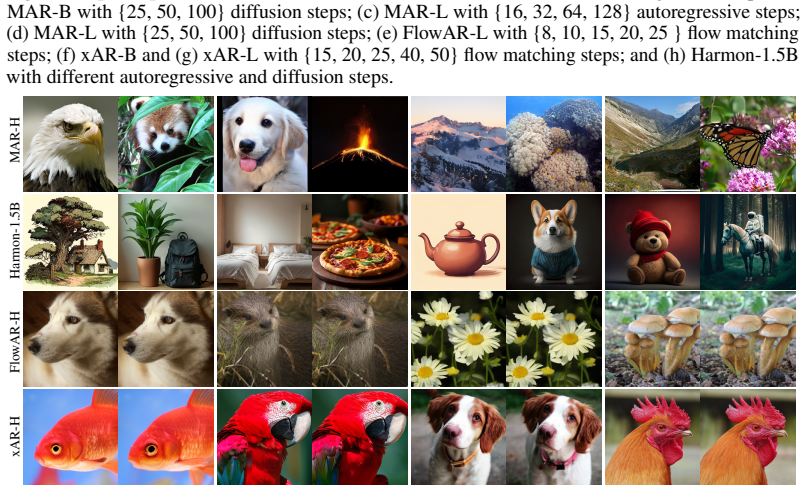
- On the text-to-image model Harmon, DiSA reduces generation time from 12 s to 8 s per image (and from 40 s to 24 s at 100 diffusion steps) with essentially unchanged GenEval accuracy.
- A corollary of the predictability evidence noted in the paper is that late-stage autoregressive generation behaves like masked autoencoding: the remaining tokens are nearly determined by the already-generated context.
Reading between the lines
- The monotone decrease in difficulty suggests that autoregressive generation transitions from genuine generation at early steps to near-deterministic decoding at late steps; if the trend continues, the final tokens might be producible with a single Euler step, turning the diffusion head into an effectively deterministic predictor.
- A content-adaptive scheduler that measures per-step variance or straightness online could allocate diffusion steps where they matter most, potentially improving on the fixed linear schedule that DiSA uses.
- The same annealing principle should transfer to other conditional sequential generative settings, such as long-form video, audio, or multimodal generation, where later tokens are conditioned on more generated context; the paper does not test these settings.
Editorial analysis
A structured set of objections, weighed in public.
Referee Report
Summary. The paper studies autoregressive image generation models that use diffusion to sample continuous tokens (MAR, FlowAR, xAR, Harmon). It observes that late in the autoregressive process, next-token distributions become more constrained and therefore require fewer diffusion steps. Based on this observation, it proposes DiSA, a training-free schedule that linearly (or with other schedulers) reduces the number of diffusion steps over the course of generation. The method is evaluated on ImageNet 256x256 and GenEval, reporting speedups of 5-10x for MAR/Harmon and 1.4-2.5x for FlowAR/xAR while maintaining FID or GenEval accuracy. The paper also introduces a time-offset trick for MAR and shows that DiSA can be combined with existing diffusion accelerators such as DDIM and DPM-Solver.
Significance. The underlying observation is plausible and is supported by three independent measurements: MLP predictability of later tokens, decreasing token variance, and increasing denoising-path straightness. If the effect is robust, DiSA is a simple, training-free, and broadly applicable acceleration that is orthogonal to diffusion-solver improvements. The paper provides code and uses standard benchmarks, which strengthens reproducibility. However, the headline speedups combine DiSA with autoregressive-step reduction, and several table entries are internally inconsistent, so the exact contribution of DiSA needs to be re-estimated before the central claim can be accepted at face value.
major comments (4)
- [Abstract and Table 1] The claim that DiSA 'achieves 5-10x faster inference for MAR' is not attributable to DiSA alone. For MAR-B, the matched-AR-step comparison is 64 AR steps / 50 diffusion steps at 0.134 s versus 64 AR steps / 50→5 at 0.114 s, a 1.18x speedup; MAR-L and MAR-H give 1.16x and 1.14x, respectively. The reported 5.7x, 5.1x, and 4.8x values are computed against the 256-AR-step / 100-diffusion-step baseline, so most of the gain comes from reducing the number of autoregressive steps, which is not a mechanism introduced by DiSA. Please report the annealing-only speedup at fixed AR steps as the primary claim, and present the system-level comparison separately.
- [Table 2 (Harmon on GenEval)] The row with 64 AR steps and 25 uniform diffusion steps reports an overall accuracy of 0.01, while 64 AR steps with the 25→5 annealed schedule reports 0.75. Both schedules give the first tokens 25 diffusion steps, so if 25 uniform steps were catastrophic, the annealed schedule should also fail in early stages. This is not explained and appears to contradict the paper's own motivation; please clarify the experimental setup or correct the row.
- [Section 3.3 and Table 3] The time-offset modification (starting diffusion at t=950) is folded into the MAR results without a clean ablation. Table 3 shows that time offset alone changes FID from 6.78 to 4.61 at 25 steps, so it is a substantial intervention. Table 1 does not state whether the DiSA rows use the offset; if they do, the quality maintenance relative to the 64/50 baseline is confounded. Please provide DiSA with and without time offset at matched AR steps.
- [Table 3 vs Table 1] For MAR-B with 64 AR steps and 50 diffusion steps, Table 1 reports FID 2.39 while Table 3 reports FID 4.30 for 'Original 50'. Similarly, 100 diffusion steps give 2.31 (Table 1, 256 AR steps) versus 4.38 (Table 3, 64 AR steps). The large discrepancy indicates unreported differences in sampling configuration (e.g., classifier-free guidance, noise schedule, or evaluation protocol). Please document these settings so that the complementary-method comparisons in Table 3 can be interpreted.
minor comments (4)
- [Section 1] There are typos: 'autoregressve' should be 'autoregressive', and 'shapely' should be 'sharply'.
- [Figure 3 caption] The caption contains 'stright line'; it should be 'straight line'.
- [Equation (7)] The linear scheduler is defined as T(k) = Tearly + (Tlate - Tearly) * k/K; please state the range of k (e.g., k = 0, ..., K-1) so that the final autoregressive step reaches the intended Tlate value after rounding.
- [Table 1] The entries with a dagger (†) are tested with a batch of 128 images instead of 256; please state whether this affects the timing comparison, and mark the LazyMAR estimated times consistently in the table footnote.
Circularity Check
No significant circularity: DiSA's annealing schedule is an empirically motivated, training-free heuristic evaluated against external benchmarks and independent baselines.
full rationale
The paper's central derivation—later autoregressive tokens are easier to sample, hence fewer diffusion steps can be used late in generation—is not circular. The three probes (MLP predictability, token variance, denoising path straightness) are measured empirically on pretrained models, and the resulting two-stage/linear/cosine schedulers in Eqs. (6)-(8) are heuristics applied to external benchmarks (ImageNet 256x256, GenEval). The reported FID, IS, precision/recall, and latencies are outputs of running those schedules, not quantities used to fit the schedule constants by construction. Choosing Tearly and Tlate (e.g., 50→5) on the same benchmark is ordinary hyperparameter selection, not a fitted input being renamed as a prediction. The only self-citation ([40]) appears in a future-work remark about Gaussian mixture token models and is not load-bearing for DiSA. Separate concerns—the headline 5–10x speedup is computed against a 256-AR-step/100-diffusion-step baseline and is partly due to reducing AR steps, and the t=950 time offset is folded into the MAR results—are attribution/overclaim issues rather than definitional circularity, because the comparisons themselves are externally measured. No step in the derivation reduces to its own input by construction.
Assumptions & free parameters
free parameters (3)
- Tearly =
50 for MAR and Harmon; 25 for FlowAR-S/L and xAR; 25 for FlowAR-H
- Tlate =
5 for MAR and Harmon; 15 for FlowAR and xAR
- start_t (time offset) =
950 for MAR (instead of 999)
assumptions (3)
- standard math The autoregressive factorization p(x) = product_i p(x_i | x_<i) with a conditional diffusion head for each token (Eq. 1).
- domain assumption Straighter denoising paths require fewer discretization steps, as established by rectified flow (Liu et al., 2022).
- domain assumption The difficulty of sampling a token decreases monotonically and smoothly with autoregressive step index, so a one-dimensional annealed schedule is sufficient.
Cite this review
Pith. "Pith review of DiSA: Diffusion Step Annealing in Autoregressive Image Generation." pith.science (2026). https://pith.science/paper/VV5AR2DB
@misc{pith2026250520297,
  author       = {Pith},
  title        = {Pith review of: DiSA: Diffusion Step Annealing in Autoregressive Image Generation},
  year         = {2026},
  howpublished = {\url{https://pith.science/paper/VV5AR2DB}},
  note         = {Machine review of arXiv:2505.20297}
}
abstract
An increasing number of autoregressive models, such as MAR, FlowAR, xAR, and Harmon adopt diffusion sampling to improve the quality of image generation. However, this strategy leads to low inference efficiency, because it usually takes 50 to 100 steps for diffusion to sample a token. This paper explores how to effectively address this issue. Our key motivation is that as more tokens are generated during the autoregressive process, subsequent tokens follow more constrained distributions and are easier to sample. To intuitively explain, if a model has generated part of a dog, the remaining tokens must complete the dog and thus are more constrained. Empirical evidence supports our motivation: at later generation stages, the next tokens can be well predicted by a multilayer perceptron, exhibit low variance, and follow closer-to-straight-line denoising paths from noise to tokens. Based on our finding, we introduce diffusion step annealing (DiSA), a training-free method which gradually uses fewer diffusion steps as more tokens are generated, e.g., using 50 steps at the beginning and gradually decreasing to 5 steps at later stages. Because DiSA is derived from our finding specific to diffusion in autoregressive models, it is complementary to existing acceleration methods designed for diffusion alone. DiSA can be implemented in only a few lines of code on existing models, and albeit simple, achieves $5-10\times$ faster inference for MAR and Harmon and $1.4-2.5\times$ for FlowAR and xAR, while maintaining the generation quality.
Figures


Figures from the paper (3 more)


Reference graph
Works this paper leans on
-
[1]
Diffusion models beat gans on image synthesis
Prafulla Dhariwal and Alexander Nichol. Diffusion models beat gans on image synthesis. Advances in neural information processing systems, 34:8780–8794, 2021. 5, 7
work page 2021
-
[2]
Taming transformers for high-resolution image synthesis
Patrick Esser, Robin Rombach, and Bjorn Ommer. Taming transformers for high-resolution image synthesis. In Proceedings of the IEEE/CVF conference on computer vision and pattern recognition , pages 12873–12883, 2021. 2
work page 2021
-
[3]
Geneval: An object-focused framework for evaluating text-to-image alignment
Dhruba Ghosh, Hannaneh Hajishirzi, and Ludwig Schmidt. Geneval: An object-focused framework for evaluating text-to-image alignment. Advances in Neural Information Processing Systems, 36:52132–52152,
-
[4]
Infinity: Scaling bitwise autoregressive modeling for high-resolution image synthesis
Jian Han, Jinlai Liu, Yi Jiang, Bin Yan, Yuqi Zhang, Zehuan Yuan, Bingyue Peng, and Xiaobing Liu. Infinity: Scaling bitwise autoregressive modeling for high-resolution image synthesis. arXiv preprint arXiv:2412.04431, 2024. 2
arXiv 2024
-
[5]
Fast autoregressive models for continuous latent generation
Tiankai Hang, Jianmin Bao, Fangyun Wei, and Dong Chen. Fast autoregressive models for continuous latent generation. arXiv preprint arXiv:2504.18391, 2025. 3, 7, 8
arXiv 2025
-
[6]
Masked autoencoders are scalable vision learners
Kaiming He, Xinlei Chen, Saining Xie, Yanghao Li, Piotr Dollár, and Ross Girshick. Masked autoencoders are scalable vision learners. In Proceedings of the IEEE/CVF conference on computer vision and pattern recognition, pages 16000–16009, 2022. 6
work page 2022
-
[7]
Martin Heusel, Hubert Ramsauer, Thomas Unterthiner, Bernhard Nessler, and Sepp Hochreiter. Gans trained by a two time-scale update rule converge to a local nash equilibrium.Advances in neural information processing systems, 30, 2017. 6, 7
work page 2017
-
[8]
An algorithmic introduction to numerical simulation of stochastic differential equations
Desmond J Higham. An algorithmic introduction to numerical simulation of stochastic differential equations. SIAM review, 43(3):525–546, 2001. 8
work page 2001
Show all 41 references
-
[9]
Denoising diffusion probabilistic models
Jonathan Ho, Ajay Jain, and Pieter Abbeel. Denoising diffusion probabilistic models. Advances in neural information processing systems, 33:6840–6851, 2020. 3
2020
-
[10]
Auto-encoding variational bayes, 2013
Diederik P Kingma, Max Welling, et al. Auto-encoding variational bayes, 2013. 3
2013
-
[11]
Autoregressive image generation using residual quantization
Doyup Lee, Chiheon Kim, Saehoon Kim, Minsu Cho, and Wook-Shin Han. Autoregressive image generation using residual quantization. In Proceedings of the IEEE/CVF Conference on Computer Vision and Pattern Recognition, pages 11523–11532, 2022. 2
2022
-
[12]
Autoregressive image generation without vector quantization
Tianhong Li, Yonglong Tian, He Li, Mingyang Deng, and Kaiming He. Autoregressive image generation without vector quantization. Advances in Neural Information Processing Systems , 37:56424–56445, 2024. 1, 2, 3, 7
2024
-
[13]
Common diffusion noise schedules and sample steps are flawed
Shanchuan Lin, Bingchen Liu, Jiashi Li, and Xiao Yang. Common diffusion noise schedules and sample steps are flawed. In Proceedings of the IEEE/CVF winter conference on applications of computer vision , pages 5404–5411, 2024. 6
2024
-
[14]
Pseudo numerical methods for diffusion models on manifolds
Luping Liu, Yi Ren, Zhijie Lin, and Zhou Zhao. Pseudo numerical methods for diffusion models on manifolds. arXiv preprint arXiv:2202.09778, 2022. 6
2022 arXiv
-
[15]
Flow straight and fast: Learning to generate and transfer data with rectified flow
Xingchao Liu, Chengyue Gong, and Qiang Liu. Flow straight and fast: Learning to generate and transfer data with rectified flow. arXiv preprint arXiv:2209.03003, 2022. 2, 3, 5
2022 arXiv
-
[16]
Semantic-guided diffusion model for single-step image super-resolution
Zihang Liu, Zhenyu Zhang, and Hao Tang. Semantic-guided diffusion model for single-step image super-resolution. arXiv preprint arXiv:2505.07071, 2025. 7
2025 arXiv
-
[17]
Dpm-solver: A fast ode solver for diffusion probabilistic model sampling in around 10 steps
Cheng Lu, Yuhao Zhou, Fan Bao, Jianfei Chen, Chongxuan Li, and Jun Zhu. Dpm-solver: A fast ode solver for diffusion probabilistic model sampling in around 10 steps. Advances in Neural Information Processing Systems, 35:5775–5787, 2022. 2, 8
2022
-
[18]
Dpm-solver++: Fast solver for guided sampling of diffusion probabilistic models
Cheng Lu, Yuhao Zhou, Fan Bao, Jianfei Chen, Chongxuan Li, and Jun Zhu. Dpm-solver++: Fast solver for guided sampling of diffusion probabilistic models. arXiv preprint arXiv:2211.01095, 2022. 2, 8 10
2022 arXiv
-
[19]
Sit: Exploring flow and diffusion-based generative models with scalable interpolant transformers
Nanye Ma, Mark Goldstein, Michael S Albergo, Nicholas M Boffi, Eric Vanden-Eijnden, and Saining Xie. Sit: Exploring flow and diffusion-based generative models with scalable interpolant transformers. In European Conference on Computer Vision, pages 23–40. Springer, 2024. 3
2024
-
[20]
Continuous markov processes and stochastic equations
Gisiro Maruyama. Continuous markov processes and stochastic equations. Rendiconti del Circolo Matematico di Palermo, 4:48–90, 1955. 8
1955
-
[21]
Improved denoising diffusion probabilistic models
Alexander Quinn Nichol and Prafulla Dhariwal. Improved denoising diffusion probabilistic models. In International conference on machine learning , pages 8162–8171. PMLR, 2021. 3
2021
-
[22]
Scalable diffusion models with Transformers
William Peebles and Saining Xie. Scalable diffusion models with Transformers. In ICCV, 2023. 7
2023
-
[23]
Generating diverse high-fidelity images with vq-vae-2
Ali Razavi, Aaron Van den Oord, and Oriol Vinyals. Generating diverse high-fidelity images with vq-vae-2. Advances in neural information processing systems , 32, 2019. 2
2019
-
[24]
Flowar: Scale-wise autoregressive image generation meets flow matching
Sucheng Ren, Qihang Yu, Ju He, Xiaohui Shen, Alan Yuille, and Liang-Chieh Chen. Flowar: Scale-wise autoregressive image generation meets flow matching. arXiv preprint arXiv:2412.15205, 2024. 1, 2, 7
2024 arXiv
-
[25]
Beyond next-token: Next-x prediction for autoregressive visual generation
Sucheng Ren, Qihang Yu, Ju He, Xiaohui Shen, Alan Yuille, and Liang-Chieh Chen. Beyond next-token: Next-x prediction for autoregressive visual generation. arXiv preprint arXiv:2502.20388, 2025. 1, 2, 3, 7
2025 arXiv
-
[26]
High-resolution image synthesis with latent diffusion models
Robin Rombach, Andreas Blattmann, Dominik Lorenz, Patrick Esser, and Björn Ommer. High-resolution image synthesis with latent diffusion models. In Proceedings of the IEEE/CVF conference on computer vision and pattern recognition, pages 10684–10695, 2022. 3
2022
-
[27]
High-resolution image synthesis with latent diffusion models
Robin Rombach, Andreas Blattmann, Dominik Lorenz, Patrick Esser, and Björn Ommer. High-resolution image synthesis with latent diffusion models. In CVPR, 2022. 7
2022
-
[28]
Improved techniques for training gans
Tim Salimans, Ian Goodfellow, Wojciech Zaremba, Vicki Cheung, Alec Radford, and Xi Chen. Improved techniques for training gans. Advances in neural information processing systems , 29, 2016. 6, 7
2016
-
[29]
Denoising diffusion implicit models
Jiaming Song, Chenlin Meng, and Stefano Ermon. Denoising diffusion implicit models. arXiv preprint arXiv:2010.02502, 2020. 2, 6, 8
2010 arXiv
-
[30]
Generative modeling by estimating gradients of the data distribution
Yang Song and Stefano Ermon. Generative modeling by estimating gradients of the data distribution. Advances in neural information processing systems , 32, 2019. 5
2019
-
[31]
Score-based generative modeling through stochastic differential equations
Yang Song, Jascha Sohl-Dickstein, Diederik P Kingma, Abhishek Kumar, Stefano Ermon, and Ben Poole. Score-based generative modeling through stochastic differential equations. arXiv preprint arXiv:2011.13456, 2020. 5
2011 arXiv
-
[32]
Depthmaster: Taming diffusion models for monocular depth estimation
Ziyang Song, Zerong Wang, Bo Li, Hao Zhang, Ruijie Zhu, Li Liu, Peng-Tao Jiang, and Tianzhu Zhang. Depthmaster: Taming diffusion models for monocular depth estimation. arXiv preprint arXiv:2501.02576,
-
[33]
Visual autoregressive modeling: Scalable image generation via next-scale prediction
Keyu Tian, Yi Jiang, Zehuan Yuan, Bingyue Peng, and Liwei Wang. Visual autoregressive modeling: Scalable image generation via next-scale prediction. Advances in neural information processing systems , 37:84839–84865, 2024. 3
2024
-
[34]
Visual autoregressive modeling: Scalable image generation via next-scale prediction
Keyu Tian, Yi Jiang, Zehuan Yuan, Bingyue Peng, and Liwei Wang. Visual autoregressive modeling: Scalable image generation via next-scale prediction. Advances in neural information processing systems , 37:84839–84865, 2025. 7
2025
-
[35]
GIVT: Generative infinite-vocabulary Trans- formers
Michael Tschannen, Cian Eastwood, and Fabian Mentzer. GIVT: Generative infinite-vocabulary Trans- formers. arXiv:2312.02116, 2023. 2, 7
2023 arXiv
-
[36]
Diffusers: State-of-the-art diffusion models
Patrick von Platen, Suraj Patil, Anton Lozhkov, Pedro Cuenca, Nathan Lambert, Kashif Rasul, Mishig Davaadorj, Dhruv Nair, Sayak Paul, William Berman, Yiyi Xu, Steven Liu, and Thomas Wolf. Diffusers: State-of-the-art diffusion models. https://github.com/huggingface/diffusers, 2022. 6
2022
-
[37]
Continuous speculative decoding for autoregressive image generation
Zili Wang, Robert Zhang, Kun Ding, Qi Yang, Fei Li, and Shiming Xiang. Continuous speculative decoding for autoregressive image generation. arXiv preprint arXiv:2411.11925, 2024. 2, 7, 8
2024 arXiv
-
[38]
Harmonizing visual representations for unified multimodal understanding and genera- tion
Size Wu, Wenwei Zhang, Lumin Xu, Sheng Jin, Zhonghua Wu, Qingyi Tao, Wentao Liu, Wei Li, and Chen Change Loy. Harmonizing visual representations for unified multimodal understanding and genera- tion. arXiv preprint arXiv:2503.21979, 2025. 1, 2, 3, 6, 7
2025 arXiv
-
[39]
Lazymar: Accelerating masked autoregressive models via feature caching
Feihong Yan, Qingyan Wei, Jiayi Tang, Jiajun Li, Yulin Wang, Xuming Hu, Huiqi Li, and Linfeng Zhang. Lazymar: Accelerating masked autoregressive models via feature caching. arXiv preprint arXiv:2503.12450, 2025. 2, 7, 8
2025 arXiv
-
[40]
Arinar: Bi-level autoregressive feature-by-feature generative models
Qinyu Zhao, Stephen Gould, and Liang Zheng. Arinar: Bi-level autoregressive feature-by-feature generative models. arXiv preprint arXiv:2503.02883, 2025. 7
2025 arXiv
-
[41]
Generative edge detection with stable diffusion
Caixia Zhou, Yaping Huang, Mochu Xiang, Jiahui Ren, Haibin Ling, and Jing Zhang. Generative edge detection with stable diffusion. arXiv preprint arXiv:2410.03080, 2024. 7 11
2024 arXiv
Reviewed August 7, 2026 · model on record in the stance chip above.
Discussion (0). Sign in to comment.