REVIEW 2 major objections 4 minor 78 references
Let's Get You Hired: A Job Seeker's Perspective on Multi-Agent Recruitment Systems for Explaining Hiring Decisions
T0 review · 2 major / 4 minor · reviewed 2026-08-07 · deepseek-v4-flash
Pith's one-line read A multi-agent LLM system that explains hiring decisions to job seekers was rated significantly more actionable, trustworthy, and fair than conventional recruitment methods in a 20-participant interview study.
desk verdict A useful multi-agent XAI artifact with strong qualitative findings, but the headline quantitative comparison rests on a memory-based baseline and an unpaired test; treat the numbers as exploratory. read the letter →
The pith
A machine-rendered reading of the paper's core claim, the machinery that carries it, and where it could break.
The reading
What carries the argument
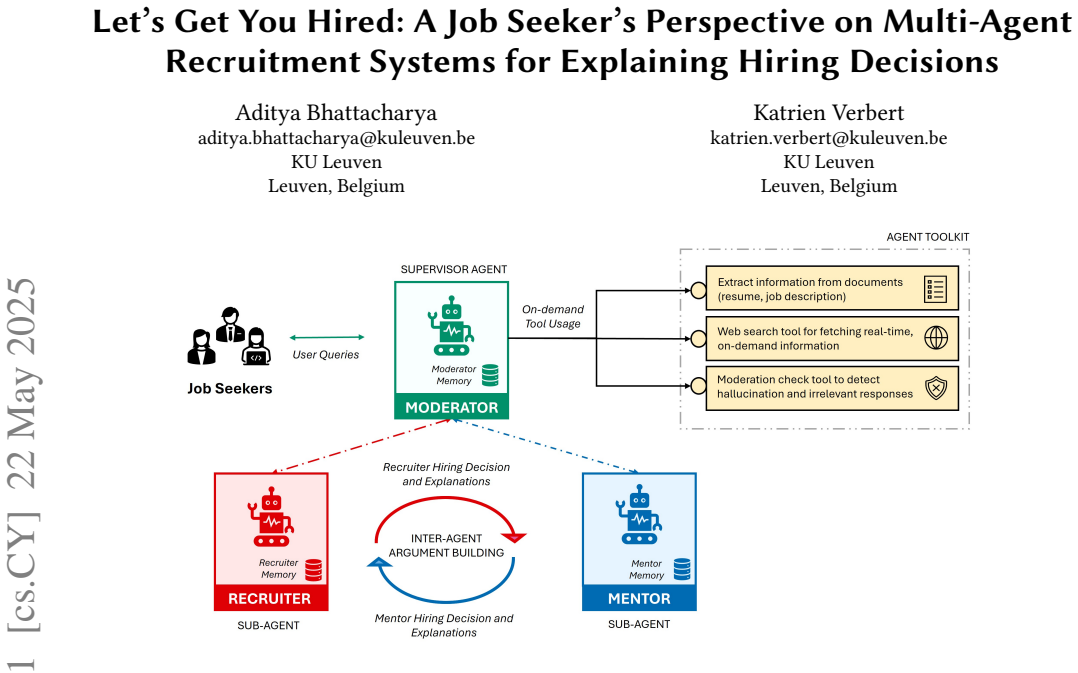
The load-bearing mechanism is a supervisory multi-agent architecture with three specialized LLM agents: a recruiter agent that gives a critical, score-based assessment of candidate-job fit; a mentor agent that gives supportive, actionable coaching; and a moderator agent that orchestrates the user's conversation, decides which sub-agents to engage, validates and synthesizes their responses, and delivers the final explanation. Tool access—parsing resumes and job descriptions, performing web searches, and applying moderation checks—is deliberately centralized in the moderator, while the sub-agents receive contextual information from it. Memory is also centrally managed so the conversation stays coherent. The authors argue that the specific agent roles and interface features, such as quick insights and quick questions, were derived from an iterative user-centered design process rather than from an existing framework, and that this is what made the feedback feel actionable and fair to participants.
What would settle it
A preregistered study in which new job seekers are randomly assigned to either the multi-agent system or a conventional, standardized feedback process using the same resume and job description would settle the claim: if the median actionability, trust, and fairness scores are not significantly higher for the multi-agent system, the paper's recalled-baseline comparison would be unsupported.
Extended reading notes
Core claim
The paper's central discovery, stated on its own terms, is that job seekers perceive an LLM-based multi-agent conversation interface as more actionable, trustworthy, and fair than the traditional methods they have experienced. In the authors' evaluation with 20 participants, the prototype's median scores exceeded recalled conventional baselines by 34% for actionability, 30% for trust, and 40% for fairness, all at p < .001. The qualitative findings attribute these perceptions to concrete features: a quantitative match score accompanied by plain-language justification; a clear separation between must-have and good-to-have skills; tailored suggestions for resume changes and interview preparation; and the presence of both a critical recruiter voice and an encouraging mentor voice, with a moderator synthesizing the two. The authors additionally observed no hallucinated responses in the logged conversations, but did observe short-term memory lapses, which they name the 'amnestic syndrome of LLM agents' and present as a limitation distinct from hallucination.
Load-bearing premise
The quantitative result depends on participants' recalled experiences with conventional hiring methods being a valid baseline; if those memories are vague or systematically negative, the reported 30-40% advantages could reflect baseline distortion rather than the multi-agent system's true effect.
Editorial extensions
If this is right
- If job seekers' perceptions are stable beyond this study, a multi-agent conversational interface can serve as a practical way to give rejected applicants specific, personalized reasons for screening decisions rather than a generic rejection.
- The positive correlations between actionability, trust, and fairness suggest that improving the concreteness of feedback may simultaneously raise users' trust and fairness perceptions in similar explanation systems.
- The observed short-term memory lapses imply that multi-agent systems need memory-management design, not just hallucination mitigation, to remain reliable during long conversations.
- The user-centered design sequence—exploratory co-design, low-fidelity testing, high-fidelity evaluation—could be reused by other teams to define agent roles and communication protocols for multi-agent explainable AI systems.
Reading between the lines
- Editorial inference: A controlled A/B comparison against a single-agent chatbot with identical content would isolate whether the three-agent structure itself, rather than explanation quality or interface polish, drives the 30-40% gains.
- Editorial inference: The recalled-baseline design means the absolute magnitudes (34%, 30%, 40%) should be read as upper bounds; a prospective within-subjects comparison with a standardized conventional feedback condition would give a harder number.
- Editorial inference: The 'amnestic syndrome' finding suggests that session length and memory load are testable predictors of response quality; logging conversation length versus memory-lapse frequency across domains would show whether this is a general multi-agent phenomenon.
- Editorial inference: The architecture could be ported to other high-stakes explanation contexts, such as loan denials or healthcare decisions, where users similarly need a critical assessment, a supportive interpretation, and a moderated synthesis; each domain would require its own user-centered derivation of agent roles.
Editorial analysis
A structured set of objections, weighed in public.
Referee Report
Summary. The paper presents a multi-agent LLM-based recruitment support system with three specialized agents (recruiter, mentor, moderator) and evaluates it with 20 active job seekers using pre-task and post-task questionnaires plus semi-structured interviews. The authors report that participants perceived the system as significantly more actionable, trustworthy, and fair than conventional hiring methods, and they offer design implications for user-aligned multi-agent explainable AI systems.
Significance. The work has clear strengths: the prototype and system prompts are open-sourced, the design process is genuinely user-centered, the qualitative analysis is rich and carefully reported, and the paper explicitly acknowledges several limitations, including the subjective recall bias in the quantitative comparison. The proposed phenomenon of an 'amnestic syndrome of LLM agents' is a useful and memorable observation that goes beyond the usual hallucination-focused discussion. If the quantitative claim were properly supported, the paper would be a valuable empirical contribution to XAI and multi-agent system design for recruitment and beyond.
major comments (2)
- [Sections 5.1.1, 5.2.1, 5.3.1 and 6.6(3)] The central comparative claim that the system was perceived as significantly more actionable, trustworthy, and fair rests on a baseline that is not a standardized conventional condition but participants' recalled experiences with prior hiring processes, as described in Section 4.4. The paper itself concedes in Section 6.6(3) that these comparisons 'should not be interpreted as objective performance data' and may be influenced by subjective recall bias. Because this concern applies directly to the headline result in the abstract, the quantitative comparison cannot be presented as established evidence. The authors should either add a controlled or prospective comparison, or explicitly reframe the quantitative results as exploratory and adjust the abstract and research-question summaries accordingly.
- [Section 4.5 and Sections 5.1.1, 5.2.1, 5.3.1] The pre-task and post-task scores come from the same 20 participants, so the two sets of observations are dependent, yet the analysis uses the Mann-Whitney U test, which assumes independent samples. A paired test such as the Wilcoxon signed-rank test should be used, and the reported p-values and U statistics should be recomputed accordingly. In addition, the paper reports only percentage differences in medians; it should also report an effect size, such as a matched-pairs rank-biserial correlation or Cliff's delta, and ideally confidence intervals, to allow readers to assess the magnitude of the differences.
minor comments (4)
- [Section 5.1.4] The sentence 'This feature could potentially reduce their perceived task load and enhance the overall user experience. This feature could further improve their perceived task load and improve the overall user experience' is duplicated and should be rewritten.
- [Figures 5, 6, and 7] Since the comparison is within participants, the box plots would be more informative if they included paired individual data points or connected lines between pre-task and post-task scores, making the dependence in the data visible.
- [Sections 5.1.2, 5.2.2, and 5.3.2] The notation '<16 /user>' is unclear; please use a clearer format such as '16/20 participants' throughout the qualitative themes.
- [Sections 5.2.3 and 5.3.3] The paper states that no hallucinated responses were observed, but the method for determining this from the logged conversations is not described; please specify the coding or verification procedure used to make this claim.
Circularity Check
No circularity: the quantitative comparison is empirical self-report data with an acknowledged baseline limitation, not a derivation from fitted inputs.
full rationale
This paper reports a user study rather than a derivation. The central claim—that participants perceived the multi-agent system as significantly more actionable, trustworthy, and fair than conventional methods—rests on pre/post self-report questionnaires analyzed with Mann-Whitney U tests (Section 5). No model parameter is fitted to the outcome and then relabeled as a prediction; the perceived-actionability, trust, and fairness scores come from validated external instruments (Singh et al., Jian et al.) and direct participant ratings, so the result could in principle have gone against the authors' claim. The main validity threat is the uncontrolled, memory-based baseline: Section 4.4 asks participants to reflect on their experiences with conventional methods to establish essential baseline scores, and Section 6.6(3) concedes that participants were not exposed to a standardized conventional hiring system and that the comparative feedback should not be interpreted as objective performance data. That is an internal-validity limitation, not a circularity: the comparison is not equivalent to its inputs by construction. The paper's self-citations (e.g., Bhattacharya et al. [4] informing interview questions) are not load-bearing for the quantitative or qualitative findings, and no uniqueness theorem, ansatz, or known result is imported via self-citation. The analysis is otherwise self-contained: thematic analysis (Braun and Clarke) was applied to transcripts, and the quantitative tests compare two sets of scores directly. I therefore find no significant circularity.
Assumptions & free parameters
free parameters (1)
- Job fit score weighting =
equal weights (arithmetic mean of recruiter and mentor sub-scores)
assumptions (5)
- domain assumption Validated questionnaires for actionability (Singh et al.) and trust (Jian et al.) measure the constructs as defined in this recruitment context.
- domain assumption Recalled experiences of conventional hiring provide a comparison baseline comparable to the controlled prototype experience.
- domain assumption Review of conversation logs can reliably detect hallucinations and bias in agent responses.
- domain assumption Thematic analysis by the authors yields reliable and valid themes.
- domain assumption Feedback from four exploratory participants is sufficient to determine the three-agent architecture and agent roles.
invented entities (1)
-
Amnestic syndrome of LLM agents
Cite this review
Pith. "Pith review of Let's Get You Hired: A Job Seeker's Perspective on Multi-Agent Recruitment Systems for Explaining Hiring Decisions." pith.science (2026). https://pith.science/paper/J2SKSR26
@misc{pith2026250520312,
  author       = {Pith},
  title        = {Pith review of: Let's Get You Hired: A Job Seeker's Perspective on Multi-Agent Recruitment Systems for Explaining Hiring Decisions},
  year         = {2026},
  howpublished = {\url{https://pith.science/paper/J2SKSR26}},
  note         = {Machine review of arXiv:2505.20312}
}
read the original abstract
During job recruitment, traditional applicant selection methods often lack transparency. Candidates are rarely given sufficient justifications for recruiting decisions, whether they are made manually by human recruiters or through the use of black-box Applicant Tracking Systems (ATS). To address this problem, our work introduces a multi-agent AI system that uses Large Language Models (LLMs) to guide job seekers during the recruitment process. Using an iterative user-centric design approach, we first conducted a two-phased exploratory study with four active job seekers to inform the design and development of the system. Subsequently, we conducted an in-depth, qualitative user study with 20 active job seekers through individual one-to-one interviews to evaluate the developed prototype. The results of our evaluation demonstrate that participants perceived our multi-agent recruitment system as significantly more actionable, trustworthy, and fair compared to traditional methods. Our study further helped us uncover in-depth insights into factors contributing to these perceived user experiences. Drawing from these insights, we offer broader design implications for building user-aligned, multi-agent explainable AI systems across diverse domains.
Figures


Figures from the paper (4 more)


Reference graph
Works this paper leans on
-
[1]
Omer Aydin, Enis Karaarslan, Fatih Safa Erenay, and Nebojsa Bacanin. 2025. Generative AI in Academic Writing: A Comparison of DeepSeek, Qwen, ChatGPT, Gemini, Llama, Mistral, and Gemma. arXiv:2503.04765 [cs.CY] https://arxiv.org/ abs/2503.04765
arXiv 2025
- [2]
-
[3]
Aditya Bhattacharya. 2024. Towards Directive Explanations: Crafting Explainable AI Systems for Actionable Human-AI Interactions. In Extended Abstracts of the CHI Conference on Human Factors in Computing Systems (CHI EA ’24) (Honolulu, HI, USA) (CHI EA ’24) . ACM, New York, NY, USA, 6. https://doi.org/10.1145/ 3613905.3638177
-
[4]
Aditya Bhattacharya, Jeroen Ooge, Gregor Stiglic, and Katrien Verbert. 2023. Directive Explanations for Monitoring the Risk of Diabetes Onset: Introducing Directive Data-Centric Explanations and Combinations to Support What-If Ex- plorations. In Proceedings of the 28th International Conference on Intelligent User Interfaces (Sydney, NSW, Australia)(IUI ’2...
arXiv 2023
-
[5]
Aditya Bhattacharya, Simone Stumpf, Robin De Croon, and Katrien Verbert
-
[6]
Aditya Bhattacharya, Simone Stumpf, Lucija Gosak, Gregor Stiglic, and Katrien Verbert. 2024. EXMOS: Explanatory Model Steering Through Multifaceted Expla- nations and Data Configurations. In Proceedings of the CHI Conference on Human Factors in Computing Systems (Honolulu, HI, USA) (CHI ’24). Association for Com- puting Machinery, New York, NY, USA. https...
arXiv 2024
-
[7]
Aditya Bhattacharya, Tim Vanherwegen, and Katrien Verbert. 2025. “Show Me How”: Benefits and Challenges of Agent-Augmented Counterfactual Explanations for Non-Expert Users. InProceedings of the 33rd ACM Conference on User Modeling, Adaptation and Personalization (UMAP ’25) (New York City, NY, USA). ACM, 11 pages. https://doi.org/10.1145/3699682.3728321
arXiv 2025
-
[8]
How Good Is Your Explana- tion?
Aditya Bhattacharya and Katrien Verbert. 2024. "How Good Is Your Explana- tion?": Towards a Standardised Evaluation Approach for Diverse XAI Methods on Multiple Dimensions of Explainability. In Adjunct Proceedings of the 32nd ACM Conference on User Modeling, Adaptation and Personalization (Cagliari, Italy) (UMAP Adjunct ’24). Association for Computing Mac...
arXiv 2024
Show all 78 references
-
[9]
Muhammad Shahrul Zaim bin Ahmad and Kazuhiro Takemoto. 2024. Large-scale moral machine experiment on large language models. arXiv:2411.06790 [cs.CY] https://arxiv.org/abs/2411.06790
2024 arXiv
-
[10]
Bo, Sophia Wan, and Ashton Anderson
Jessica Y. Bo, Sophia Wan, and Ashton Anderson. 2025. To Rely or Not to Rely? Evaluating Interventions for Appropriate Reliance on Large Language Models. arXiv:2412.15584 [cs.HC] https://arxiv.org/abs/2412.15584
2025
-
[11]
Virginia Braun and Victoria Clarke. 2012. Thematic Analysis. In APA Handbook of Research Methods in Psychology, Vol 2: Research Designs: Quantitative, Quali- tative, Neuropsychological, and Biological. American Psychological Association, Washington, DC, US, 57–71. https://doi....
2012 doi
-
[12]
Arthur Caetano, Kavya Verma, Atieh Taheri, Radha Kumaran, Zichen Chen, Jiaao Chen, Tobias Höllerer, and Misha Sra. 2025. Agentic Workflows for Con- versational Human-AI Interaction Design. arXiv:2501.18002 [cs.HC] https: //arxiv.org/abs/2501.18002
2025 arXiv
-
[13]
Vera Liao, Jennifer Wortman Vaughan, and Gagan Bansal
Valerie Chen, Q. Vera Liao, Jennifer Wortman Vaughan, and Gagan Bansal. 2023. Understanding the Role of Human Intuition on Reliance in Human-AI Decision- Making with Explanations. arXiv:2301.07255 [cs.HC] https://arxiv.org/abs/2301. 07255
2023 arXiv
-
[14]
Konstantina Christakopoulou, Shibl Mourad, and Maja Matarić. 2024. Agents Thinking Fast and Slow: A Talker-Reasoner Architecture. arXiv:2410.08328 [cs.AI] https://arxiv.org/abs/2410.08328
2024 arXiv
-
[15]
N’yoma Diamond and Soumya Banerjee. 2024. On the Ethical Considerations of Generative Agents. arXiv:2411.19211 [cs.CY] https://arxiv.org/abs/2411.19211
2024 arXiv
-
[16]
Adam Fourney, Gagan Bansal, Hussein Mozannar, Cheng Tan, Eduardo Salinas, Erkang, Zhu, Friederike Niedtner, Grace Proebsting, Griffin Bassman, Jack Gerrits, Jacob Alber, Peter Chang, Ricky Loynd, Robert West, Victor Dibia, Ahmed Awadal- lah, Ece Kamar, Rafah Hosn, and Saleema ...
2024 arXiv
-
[17]
Arturo Fredes and Jordi Vitria. 2024. Using LLMs for Explaining Sets of Counterfactual Examples to Final Users. arXiv:2408.15133 [cs.LG] https: //arxiv.org/abs/2408.15133
2024 arXiv
-
[18]
Freed and an O’Reilly Media Company Safari
A. Freed and an O’Reilly Media Company Safari. 2021. Conversational AI. Man- ning Publications. https://books.google.be/books?id=wtKAzwEACAAJ
2021
-
[19]
Chengguang Gan, Qinghao Zhang, and Tatsunori Mori. 2024. Application of LLM Agents in Recruitment: A Novel Framework for Resume Screening. arXiv:2401.08315 [cs.CL] https://arxiv.org/abs/2401.08315
2024 arXiv
-
[20]
Yunfan Gao, Yun Xiong, Xinyu Gao, Kangxiang Jia, Jinliu Pan, Yuxi Bi, Yi Dai, Jiawei Sun, Meng Wang, and Haofen Wang. 2024. Retrieval-Augmented Generation for Large Language Models: A Survey. arXiv:2312.10997 [cs.CL] https://arxiv.org/abs/2312.10997
2024 arXiv
-
[21]
Chawla, Olaf Wiest, and Xiangliang Zhang
Taicheng Guo, Xiuying Chen, Yaqi Wang, Ruidi Chang, Shichao Pei, Nitesh V. Chawla, Olaf Wiest, and Xiangliang Zhang. 2024. Large Language Model based Multi-Agents: A Survey of Progress and Challenges. arXiv:2402.01680 [cs.CL] https://arxiv.org/abs/2402.01680
2024 arXiv
-
[22]
Shanshan Han, Qifan Zhang, Yuhang Yao, Weizhao Jin, Zhaozhuo Xu, and Chaoyang He. 2024. LLM Multi-Agent Systems: Challenges and Open Prob- lems. arXiv:2402.03578 [cs.MA] https://arxiv.org/abs/2402.03578
2024 arXiv
-
[23]
Hart and Lowell E
Sandra G. Hart and Lowell E. Staveland. 1988. Development of NASA-TLX (Task Load Index): Results of Empirical and Theoretical Research. In Human Mental Workload, Peter A. Hancock and Najmedin Meshkati (Eds.). Advances in Psychology, Vol. 52. North-Holland, 139–183. https://doi...
1988 doi
-
[24]
Gaole He, Gianluca Demartini, and Ujwal Gadiraju. 2025. Plan-Then-Execute: An Empirical Study of User Trust and Team Performance When Using LLM Agents As A Daily Assistant. In CHI Conference on Human Factors in Computing Systems (CHI ’25) (Yokohama, Japan) (CHI ’25). ACM, New ...
2025
-
[25]
My agent understands me better
Yuki Hou, Haruki Tamoto, and Homei Miyashita. 2024. "My agent understands me better": Integrating Dynamic Human-like Memory Recall and Consolidation in LLM-Based Agents. In Extended Abstracts of the CHI Conference on Human Factors in Computing Systems (Honolulu, HI, USA) (CHI ...
2024
-
[26]
Lei Huang, Weijiang Yu, Weitao Ma, Weihong Zhong, Zhangyin Feng, Haotian Wang, Qianglong Chen, Weihua Peng, Xiaocheng Feng, Bing Qin, and Ting Liu. 2023. A Survey on Hallucination in Large Language Models: Principles, Taxonomy, Challenges, and Open Questions. arXiv:2311.05232 ...
2023 arXiv
-
[27]
Anna-Lena Hunkenschroer and Christoph Luetge. 2022. Ethics of AI-Enabled Recruiting and Selection: A Review and Research Agenda. Journal of Business Ethics 178 (2022), 977–1007. https://doi.org/10.1007/s10551-022-05049-6
2022 doi
-
[28]
Jiun-Yin Jian, Ann Bisantz, and Colin Drury. 2000. Foundations for an Empirically Determined Scale of Trust in Automated Systems. International Journal of Cogni- tive Ergonomics 4 (03 2000), 53–71. https://doi.org/10.1207/S15327566IJCE0401_04
2000 doi
-
[29]
Sunnie S. Y. Kim, Jennifer Wortman Vaughan, Q. Vera Liao, Tania Lombrozo, and Olga Russakovsky. 2025. Fostering Appropriate Reliance on Large Language Models: The Role of Explanations, Sources, and Inconsistencies. In Proceedings of the CHI Conference on Human Factors in Compu...
2025
-
[30]
Jenny Kunz and Marco Kuhlmann. 2024. Properties and Challenges of LLM- Generated Explanations. InProceedings of the Third Workshop on Bridging Human– Computer Interaction and Natural Language Processing , Su Lin Blodgett, Amanda Cercas Curry, Sunipa Dev, Michael Madaio, Ani Ne...
2024 doi
-
[31]
Andreas Köchling and Marius C. Wehner. 2020. Discriminated by an algorithm: a systematic review of discrimination and fairness by algorithmic decision-making in the context of HR recruitment and HR development. Business Research 13 (2020), 795–848. https://doi.org/10.1007/s406...
2020 doi
-
[32]
Himabindu Lakkaraju, Dylan Slack, Yuxin Chen, Chenhao Tan, and Sameer Singh
-
[33]
LangChain. 2025. . LangChain. https://www.langchain.com Accessed: 2025-01- 21
2025
-
[34]
Truong, and Alex Mariakakis
Brenna Li, Ofek Gross, Noah Crampton, Mamta Kapoor, Saba Tauseef, Mohit Jain, Khai N. Truong, and Alex Mariakakis. 2024. Beyond the Waiting Room: Patient’s Perspectives on the Conversational Nuances of Pre-Consultation Chatbots. In Proceedings of the 2024 CHI Conference on Hum...
2024
-
[35]
X. Li, S. Wang, S. Zeng, et al. 2024. A survey on LLM-based multi-agent systems: workflow, infrastructure, and challenges. Vicinagearth 1, 9 (2024). https://doi. org/10.1007/s44336-024-00009-2
2024 doi
-
[36]
Yi Liu, Gelei Deng, Yuekang Li, Kailong Wang, Zihao Wang, Xiaofeng Wang, Tianwei Zhang, Yepang Liu, Haoyu Wang, Yan Zheng, and Yang Liu. 2024. Prompt Injection attack against LLM-integrated Applications. arXiv:2306.05499 [cs.CR] https://arxiv.org/abs/2306.05499
2024 arXiv
-
[37]
Jieting Luo, Thomas Studer, and Mehdi Dastani. 2023. Providing personalized Explanations: a Conversational Approach. arXiv:2307.11452 [cs.MA] https: //arxiv.org/abs/2307.11452
2023
-
[38]
Lin Luo, Yuri Nakao, Mathieu Chollet, Hiroya Inakoshi, and Simone Stumpf
-
[39]
Mariani, Novin Hashemi, and Jochen Wirtz
Marcello M. Mariani, Novin Hashemi, and Jochen Wirtz. 2023. Artificial in- telligence empowered conversational agents: A systematic literature review and research agenda. Journal of Business Research 161 (2023), 113838. https: //doi.org/10.1016/j.jbusres.2023.113838
2023
-
[40]
Evie McCrum-Gardner. 2008. Which is the correct statistical test to use? British Journal of Oral and Maxillofacial Surgery 46, 1 (Jan. 2008), 38–41. https://doi. org/10.1016/j.bjoms.2007.09.002
2008 doi
-
[41]
Proceedings of the ACM on UIST ’25, September 28 – October 1, 2025, Busan, South Korea Bhattacharya and Verbert Human-Computer Interaction 9, 2 (April 2025), 37
EARN Fairness: Explaining, Asking, Reviewing, and Negotiating Artificial Intelligence Fairness Metrics Among Stakeholders. Proceedings of the ACM on UIST ’25, September 28 – October 1, 2025, Busan, South Korea Bhattacharya and Verbert Human-Computer Interaction 9, 2 (April 202...
2025 doi
- [42]
-
[43]
Yuri Nakao, Simone Stumpf, Subeida Ahmed, Aisha Naseer, and Lorenzo Strap- pelli. 2022. Toward Involving End-users in Interactive Human-in-the-loop AI Fairness. ACM Trans. Interact. Intell. Syst. 12, 3, Article 18 (July 2022), 30 pages. https://doi.org/10.1145/3514258
2022 doi
-
[44]
Jonker, and Myrthe L
Siddharth Mehrotra, Chadha Degachi, Oleksandra Vereschak, Catholijn M. Jonker, and Myrthe L. Tielman. 2024. A Systematic Review on Fostering Appropriate Trust in Human-AI Interaction: Trends, Opportunities and Challenges. ACM J. Responsib. Comput. 1, 4, Article 26 (Nov. 2024),...
2024
-
[45]
Oxford University Press. 2014. Zero-sum game. https://www.oxfordreference. com/display/10.1093/acref/9780199670840.001.0001/acref-9780199670840-e- 1491 Accessed: 2025-03-29
2014
-
[46]
Samir Passi and Mihaela Vorvoreanu. 2022. Overreliance on AI: Literature Review. Microsoft Technical Report MSR-TR-2022-12. Microsoft Corpora- tion. https://www.microsoft.com/en-us/research/uploads/prod/2022/06/Aether- Overreliance-on-AI-Review-Final-6.21.22.pdf
2022
-
[47]
OpenAI. 2025. . OpenAI. https://openai.com/index/openai-api/ Accessed: 2025-01-21
2025
-
[48]
2014.User-Centered Systems Design: A Brief History
Frank Ritter, Gordon Baxter, and Elizabeth Churchill. 2014.User-Centered Systems Design: A Brief History . Springer, 33–54. https://doi.org/10.1007/978-1-4471- 5134-0_2
2014 doi
-
[49]
Seyed Amir Ahmad Safavi-Naini, Shuhaib Ali, Omer Shahab, Zahra Shahho- seini, Thomas Savage, Sara Rafiee, Jamil S Samaan, Reem Al Shabeeb, Farah Ladak, Jamie O Yang, Juan Echavarria, Sumbal Babar, Aasma Shaukat, Samuel Margolis, Nicholas P Tatonetti, Girish Nadkarni, Bara El K...
-
[50]
Bellemare
Nate Rahn, Pierluca D’Oro, and Marc G. Bellemare. 2024. Controlling Large Lan- guage Model Agents with Entropic Activation Steering. arXiv:2406.00244 [cs.CL] https://arxiv.org/abs/2406.00244
2024 arXiv
-
[51]
Ashish Sharma, Sudha Rao, Chris Brockett, Akanksha Malhotra, Nebojsa Jojic, and Bill Dolan. 2024. Investigating Agency of LLMs in Human-AI Collaboration Tasks. In Proceedings of the 18th Conference of the European Chapter of the Association for Computational Linguistics (Volum...
2024
-
[52]
Hua Shen, Chieh-Yang Huang, Tongshuang Wu, and Ting-Hao ’Kenneth’ Huang
-
[53]
S. J. Shoemaker, M. S. Wolf, and C. Brach. 2014. Development of the patient educa- tion materials assessment tool (PEMAT): a new measure of understandability and actionability for print and audiovisual patient information. Patient Education and Counseling 96, 3 (Sep 2014), 395...
2014 doi
-
[54]
Schiller
Christian A. Schiller. 2024. The Human Factor in Detecting Errors of Large Lan- guage Models: A Systematic Literature Review and Future Research Directions. arXiv:2403.09743 [cs.CL] https://arxiv.org/abs/2403.09743
2024 arXiv
-
[55]
Dylan Slack, Satyapriya Krishna, Himabindu Lakkaraju, and Sameer Singh
- [56]
-
[57]
Stone and Saul Shiffman
Arthur A. Stone and Saul Shiffman. 2002. Capturing momentary, self-report data: A proposal for reporting guidelines. Annals of Behavioral Medicine 24, 3 (2002), 236–243. https://doi.org/10.1207/S15324796ABM2403_09
2002 doi
-
[58]
Streamlit. 2025. . Streamlit. https://streamlit.io Accessed: 2025-01-21
2025
-
[59]
Bonnie Talbert. 2017. Overthinking and Other Minds: The Analysis Paralysis. Social Epistemology 31 (07 2017), 1–12. https://doi.org/10.1080/02691728.2017. 1346933
2017
-
[60]
Ronal Singh, Tim Miller, Liz Sonenberg, Eduardo Velloso, Frank Vetere, Piers Howe, and Paul Dourish. 2024. An Actionability Assessment Tool for Explainable AI. arXiv:2407.09516 [cs.HC] https://arxiv.org/abs/2407.09516
2024 arXiv
-
[61]
Khanh-Tung Tran, Dung Dao, Minh-Duong Nguyen, Quoc-Viet Pham, Barry O’Sullivan, and Hoang D. Nguyen. 2025. Multi-Agent Collaboration Mechanisms: A Survey of LLMs. arXiv:2501.06322 [cs.AI] https://arxiv.org/abs/2501.06322
2025 arXiv
-
[62]
Nature Machine Intelligence (27 Jul 2023)
Explaining machine learning models with interactive natural language conversations using TalkToModel. Nature Machine Intelligence (27 Jul 2023). https://doi.org/10.1038/s42256-023-00692-8
2023 doi
-
[63]
Weisz, Jessica He, Michael Muller, Gabriela Hoefer, Rachel Miles, and Werner Geyer
Justin D. Weisz, Jessica He, Michael Muller, Gabriela Hoefer, Rachel Miles, and Werner Geyer. 2024. Design Principles for Generative AI Applications. In Pro- ceedings of the CHI Conference on Human Factors in Computing Systems . ACM, New York, NY, USA, 1–22. https://doi.org/10...
2024
- [64]
-
[65]
Ziwei Xu, Sanjay Jain, and Mohan Kankanhalli. 2024. Hallucination is Inevitable: An Innate Limitation of Large Language Models. arXiv:2401.11817 [cs.CL] https://arxiv.org/abs/2401.11817
2024 arXiv
-
[66]
Xi Yang and Marco Aurisicchio. 2021. Designing Conversational Agents: A Self- Determination Theory Approach. In Proceedings of the 2021 CHI Conference on Human Factors in Computing Systems (Yokohama, Japan) (CHI ’21). Association for Computing Machinery, New York, NY, USA, Art...
2021
-
[67]
Lindia Tjuatja, Valerie Chen, Tongshuang Wu, Ameet Talwalkwar, and Graham Neubig. 2024. Do LLMs Exhibit Human-like Response Biases? A Case Study in Survey Design. Transactions of the Association for Computational Linguistics 12 (2024), 1011–1026. https://doi.org/10.1162/tacl_a_00685
2024 doi
-
[68]
Cheng Zhai, Syamsul Wibowo, and L.D. Li. 2024. The effects of over-reliance on AI dialogue systems on students’ cognitive abilities: a systematic review. Smart Learning Environments 11 (2024). https://doi.org/10.1186/s40561-024-00316-7
2024 doi
-
[69]
Chi, Quoc V
Jason Wei, Xuezhi Wang, Dale Schuurmans, Maarten Bosma, Brian Ichter, Fei Xia, Ed H. Chi, Quoc V. Le, and Denny Zhou. 2022. Chain-of-thought prompting elicits reasoning in large language models. InProceedings of the 36th International Conference on Neural Information Processin...
2022
-
[70]
Zeyu Zhang, Xiaohe Bo, Chen Ma, Rui Li, Xu Chen, Quanyu Dai, Jieming Zhu, Zhenhua Dong, and Ji-Rong Wen. 2024. A Survey on the Memory Mechanism of Large Language Model based Agents. arXiv:2404.13501 [cs.AI] https://arxiv.org/ abs/2404.13501
2024 arXiv
-
[71]
Xing, Hao Zhang, Joseph E
Lianmin Zheng, Wei-Lin Chiang, Ying Sheng, Siyuan Zhuang, Zhanghao Wu, Yonghao Zhuang, Zi Lin, Zhuohan Li, Dacheng Li, Eric P. Xing, Hao Zhang, Joseph E. Gonzalez, and Ion Stoica. 2023. Judging LLM-as-a-Judge with MT-Bench and Chatbot Arena. arXiv:2306.05685 [cs.CL] https://ar...
2023 arXiv
-
[74]
Shunyu Yao, Jeffrey Zhao, Dian Yu, Nan Du, Izhak Shafran, Karthik Narasimhan, and Yuan Cao. 2023. ReAct: Synergizing Reasoning and Acting in Language Models. In International Conference on Learning Representations (ICLR)
2023
-
[76]
Jessie Yang, and Boyang Li
Tong Zhang, X. Jessie Yang, and Boyang Li. 2024. May I Ask a Follow-up Question? Understanding the Benefits of Conversations in Neural Network Explainability. arXiv:2309.13965 [cs.HC] https://arxiv.org/abs/2309.13965
2024 arXiv
-
[1987]
https://aclanthology.org/2024.eacl-long.119/
2024
-
[2022]
arXiv:2202.01875 [cs.LG]
Rethinking Explainability as a Dialogue: A Practitioner’s Perspective. arXiv:2202.01875 [cs.LG]
-
[2023]
arXiv:2305.09770 [cs.HC] https://arxiv
ConvXAI: Delivering Heterogeneous AI Explanations via Conversations to Support Human-AI Scientific Writing. arXiv:2305.09770 [cs.HC] https://arxiv. org/abs/2305.09770
-
[2024]
arXiv:2409.00084 [cs.CL] https://arxiv.org/abs/2409.00084
Vision-Language and Large Language Model Performance in Gastroen- terology: GPT, Claude, Llama, Phi, Mistral, Gemma, and Quantized Models. arXiv:2409.00084 [cs.CL] https://arxiv.org/abs/2409.00084
-
[2025]
In CHI Conference on Human Factors in Computing Systems (CHI ’25) (Yokohama, Japan)
Explanatory Debiasing: Involving Domain Experts in the Data Generation Process to Mitigate Representation Bias in AI Systems. In CHI Conference on Human Factors in Computing Systems (CHI ’25) (Yokohama, Japan). ACM, New York, NY, USA, 20. https://doi.org/10.1145/3706598.3713497
Reviewed August 7, 2026 · model on record in the stance chip above.
Discussion (0). Sign in to comment.