Latent Trajectory Dynamics in Large Language Models: A Manifold Evolution Framework with Empirical Validation
Pith reviewed 2026-05-19 12:51 UTC · model grok-4.3
The pith
Latent trajectories on a semantic manifold predict LLM generation quality across models.
A machine-rendered reading of the paper's core claim, the machinery that carries it, and where it could break.
Core claim
Dynamical Manifold Evolution Theory models LLM generation as a first-order ODE on a semantic manifold. Three proxy metrics of the resulting trajectories—state continuity C, attractor clustering quality Q, and topological persistence P—predict log-perplexity, grammaticality, and cross-sentence coherence. Online monitoring of C yields an adaptive controller that lowers perplexity from 48.5 to 14.6 compared with a fixed baseline.
What carries the argument
Dynamical Manifold Evolution Theory (DMET) that treats generation as controlled dynamics along a trajectory on a semantic manifold, with three proxy metrics targeting local, meso-scale, and global aspects of trajectory geometry.
Load-bearing premise
The metrics reflect genuine properties of evolving trajectories on the manifold rather than artifacts from how the text distributions or experimental conditions are structured.
What would settle it
Finding no predictive relationship between the three metrics and text quality measures in a new set of models or tasks after applying the same statistical corrections and ablations.
Figures


read the original abstract
Understanding how latent representations evolve during generation is a central open problem in large language model interpretability. We introduce \textbf{Dynamical Manifold Evolution Theory} (DMET), a phenomenological framework that models LLM generation as a controlled dynamical system evolving along a trajectory on a low-dimensional semantic manifold. DMET formalizes the structural correspondence between Transformer components and a first-order ODE governed by a semantic potential $V$, and characterizes trajectory geometry through three falsifiable proxy metrics: state continuity $C$, attractor clustering quality $Q$, and topological persistence $P$, targeting local smoothness, meso-scale basin structure, and global topological organization, respectively. Across six model architectures, four task types, and 1,080 experimental runs, all three metrics consistently predict text quality outcomes -- log-perplexity, grammaticality, and cross-sentence coherence -- after controlling for decoding parameters, with associations surviving Benjamini--Hochberg correction. Ablation and sanity-check experiments confirm that the effects arise from genuine trajectory structure rather than static distributional artefacts. Furthermore, online monitoring of $C$ drives an adaptive decoding controller that reduces perplexity from 48.5 to 14.6 relative to a fixed-parameter baseline, demonstrating that latent dynamics characterization translates directly into actionable generation control.
Editorial analysis
A structured set of objections, weighed in public.
Referee Report
Summary. The manuscript introduces Dynamical Manifold Evolution Theory (DMET), framing LLM generation as a controlled dynamical system evolving along trajectories on a low-dimensional semantic manifold according to a first-order ODE governed by a semantic potential V. It defines three falsifiable proxy metrics—state continuity C, attractor clustering quality Q, and topological persistence P—targeting local smoothness, meso-scale basin structure, and global topological organization. Across six model architectures, four task types, and 1,080 runs, the authors report that C, Q, and P consistently predict log-perplexity, grammaticality, and cross-sentence coherence after controlling for decoding parameters, with associations surviving Benjamini-Hochberg correction. Ablations and sanity checks are stated to confirm that effects arise from genuine trajectory structure rather than static artefacts. The work further demonstrates that online monitoring of C enables an adaptive decoding controller reducing perplexity from 48.5 to 14.6 relative to a fixed baseline.
Significance. If the central empirical claims hold after addressing the ablation details, the work would offer a dynamical-systems lens on LLM generation with implications for interpretability and controllable decoding. Strengths include the scale of validation (six architectures, 1,080 runs), survival of multiple-testing correction, and the concrete demonstration of an adaptive controller that improves a key quality metric. The framework's emphasis on falsifiable metrics and the reported performance gain provide a basis for further development in monitoring latent dynamics.
major comments (1)
- [Abstract and ablation results] Abstract and results sections on ablations: the assertion that 'Ablation and sanity-check experiments confirm that the effects arise from genuine trajectory structure rather than static distributional artefacts' is load-bearing for the claim that C, Q, and P capture manifold trajectory geometry. However, the manuscript does not provide explicit descriptions of the ablation procedures (e.g., whether they preserve marginal hidden-state statistics while destroying temporal order, or compare against non-sequential baselines), leaving open the possibility that the metrics track static properties such as average norms or token frequencies that independently correlate with the quality outcomes after the reported controls.
minor comments (2)
- [Methods] The structural correspondence between Transformer components and the first-order ODE is stated in the abstract but would benefit from an explicit mapping table or diagram in the methods to clarify how attention, feed-forward layers, and residual connections instantiate the controlled dynamical system.
- [Introduction and metric definitions] Notation for the metrics C, Q, and P is introduced without immediate reference to their precise mathematical definitions; adding the defining equations (e.g., for state continuity C) immediately after their first mention would improve readability.
Simulated Author's Rebuttal
We thank the referee for the constructive feedback and for recognizing the scale of our empirical validation and the potential implications of the DMET framework. We address the single major comment below and will revise the manuscript to improve clarity on the ablation procedures.
read point-by-point responses
-
Referee: [Abstract and ablation results] Abstract and results sections on ablations: the assertion that 'Ablation and sanity-check experiments confirm that the effects arise from genuine trajectory structure rather than static distributional artefacts' is load-bearing for the claim that C, Q, and P capture manifold trajectory geometry. However, the manuscript does not provide explicit descriptions of the ablation procedures (e.g., whether they preserve marginal hidden-state statistics while destroying temporal order, or compare against non-sequential baselines), leaving open the possibility that the metrics track static properties such as average norms or token frequencies that independently correlate with the quality outcomes after the reported controls.
Authors: We agree that the current high-level statement in the abstract and results is insufficient without explicit procedural details, and that this weakens the ability to rule out static artefacts. The manuscript does report that ablations and sanity checks were performed across the 1,080 runs, but we acknowledge the lack of step-by-step descriptions of how temporal order was disrupted while preserving marginal statistics, or how non-sequential baselines were constructed. In the revised manuscript we will add a dedicated subsection (likely in Methods and an expanded Results section) that explicitly describes: (i) the sequence-shuffling ablation that retains per-layer hidden-state marginal distributions but removes temporal dependencies; (ii) comparisons to static baselines such as token-frequency-matched random embeddings and norm-controlled averages; and (iii) additional controls for average hidden-state norms and token-type frequencies. We will also report quantitative outcomes of these ablations (e.g., degradation in predictive power of C, Q, and P) to demonstrate that the original associations are driven by trajectory geometry rather than static properties. These additions will be placed after the main correlation results and before the adaptive-controller demonstration. revision: yes
Circularity Check
No circularity; metrics defined independently then validated empirically
full rationale
The paper introduces DMET as a phenomenological framework, defines three proxy metrics C, Q, P to characterize trajectory geometry on the semantic manifold, and reports post-hoc empirical correlations with quality outcomes across 1080 runs after controlling for decoding parameters. Ablations are invoked to rule out static artefacts. No equations or definitions in the abstract reduce the metrics to the quality outcomes by construction, nor is there a fitted-input-called-prediction pattern or self-citation load-bearing step. The central claim rests on measured associations rather than tautological re-expression of inputs.
Axiom & Free-Parameter Ledger
axioms (1)
- domain assumption LLM generation can be modeled as a controlled dynamical system evolving along trajectories on a low-dimensional semantic manifold governed by a first-order ODE with semantic potential V.
invented entities (2)
-
semantic manifold
no independent evidence
-
semantic potential V
no independent evidence
Lean theorems connected to this paper
-
IndisputableMonolith/Cost/FunctionalEquation.leanwashburn_uniqueness_aczel unclear?
unclearRelation between the paper passage and the cited Recognition theorem.
models LLM generation as a controlled dynamical system evolving along a trajectory on a low-dimensional semantic manifold... first-order ODE governed by a semantic potential V
-
IndisputableMonolith/Foundation/AlexanderDuality.leanalexander_duality_circle_linking unclear?
unclearRelation between the paper passage and the cited Recognition theorem.
state continuity C, attractor clustering quality Q, and topological persistence P
What do these tags mean?
- matches
- The paper's claim is directly supported by a theorem in the formal canon.
- supports
- The theorem supports part of the paper's argument, but the paper may add assumptions or extra steps.
- extends
- The paper goes beyond the formal theorem; the theorem is a base layer rather than the whole result.
- uses
- The paper appears to rely on the theorem as machinery.
- contradicts
- The paper's claim conflicts with a theorem or certificate in the canon.
- unclear
- Pith found a possible connection, but the passage is too broad, indirect, or ambiguous to say the theorem truly supports the claim.
Reference graph
Works this paper leans on
- [1]
-
[2]
The Claude 3 model family: Opus, sonnet, haiku.arXiv preprint arXiv:2402.19143,
Anthropic. The Claude 3 model family: Opus, sonnet, haiku.arXiv preprint arXiv:2402.19143,
-
[3]
Yang Dai, Jacob Andreas, and Catherine Olsson
doi: 10.1007/ s00454-006-1276-5. Yang Dai, Jacob Andreas, and Catherine Olsson. Representation elbow: A method for guiding subspace selection in probing. InProceedings of the 2023 Conference on Empirical Methods in Natural Language Processing,
work page 2023
-
[4]
arXiv preprint arXiv:2603.01326 , year=
URLhttps://arxiv.org/abs/2603.01326. Emilien Dupont, Arnaud Doucet, and Yee Whye Teh. Augmented neural ODEs. InAdvances in Neural Information Processing Systems,
-
[5]
Lampinen, Ishita Dasgupta, and Jean-R´emi King
Gabriel Hernandez, B´eryl Gauthier, Andrew K. Lampinen, Ishita Dasgupta, and Jean-R´emi King. The thought manifold of language models.arXiv preprint arXiv:2404.10856,
-
[6]
John Hewitt and Christopher D. Manning. A structural probe for finding syntax in word representations. InProceedings of the 2019 Conference of the North American Chapter of the Association for Computational Linguistics: Human Language Technologies,
work page 2019
-
[7]
Arthur Jacot, Franck Gabriel, and Cl´ement Hongler
URL https://arxiv.org/abs/ 2601.00638. Arthur Jacot, Franck Gabriel, and Cl´ement Hongler. Neural tangent kernel: Convergence and generalization in neural networks. InAdvances in Neural Information Processing Systems,
-
[8]
Yuxian Li, Ge Meng, Jiacheng Chen, Xiaofei Wu, Jixing Su, Jiaxu Zhou, and Yu He
URL https://arxiv.org/abs/ 2402.12865. Yuxian Li, Ge Meng, Jiacheng Chen, Xiaofei Wu, Jixing Su, Jiaxu Zhou, and Yu He. On the stability of fine-tuning BERT: Misconceptions, explanations, and strong baselines. InThe Eleventh International Conference on Learning Representations,
-
[9]
FActScore: Fine-grained atomic evaluation of factual precision in long form text generation
Sewon Min, Kalpesh Krishna, Yejin Lyu, Mike Lewis, Hannaneh Hajishirzi, Pang Wei Huang, Luke Zettlemoyer, and Yejin Choi. FActScore: Fine-grained atomic evaluation of factual precision in long form text generation. InProceedings of the 2023 Conference on Empirical Methods in Natural Language Processing,
work page 2023
- [10]
- [11]
-
[12]
Francis Santos, David Macˆedo, Cleber Medeiros, and Artur Ziviani. A lyapunov theory for the analysis of the global convergence of deep learning.arXiv preprint arXiv:2310.19702,
-
[13]
Hajime Shimao, Warut Khern am nuai, and Sung Joo Kim
URLhttps://arxiv.org/abs/2510.11278. Hajime Shimao, Warut Khern am nuai, and Sung Joo Kim. Chaotic dynamics in multi-llm deliberation,
-
[14]
Collective AI can amplify tiny perturbations into divergent decisions
URLhttps://arxiv.org/abs/2603.09127. Steven H. Strogatz.Nonlinear Dynamics and Chaos: With Applications to Physics, Biology, Chemistry, and Engineering. Addison-Wesley, Reading, MA,
work page internal anchor Pith review Pith/arXiv arXiv
-
[15]
Hypothesis-Driven Feature Manifold Analysis in LLMs via Supervised Multi-Dimensional Scaling
URLhttps://arxiv.org/abs/2510.01025. Ashish Vaswani, Noam Shazeer, Niki Parmar, Jakob Uszkoreit, Llion Jones, Aidan N. Gomez, Łukasz Kaiser, and Illia Polosukhin. Attention is all you need. InAdvances in Neural Information Processing Systems,
work page internal anchor Pith review Pith/arXiv arXiv
-
[16]
Time evolution of tacit knowledge in language models.arXiv preprint arXiv:2402.17410,
Yizhong Wang, Wen-tau Yih, Siva Reddy Aluru, and Jordan Chou. Time evolution of tacit knowledge in language models.arXiv preprint arXiv:2402.17410,
-
[17]
URL https://arxiv. org/abs/2603.22386. Alper Yıldırım. The geometric inductive bias of grokking: Bypassing phase transitions via architectural topology,
-
[18]
The Geometric Inductive Bias of Grokking: Bypassing Phase Transitions via Architectural Topology
URLhttps://arxiv.org/abs/2603.05228. Weichen Zhang, Yuxin Zhou, Ge Luo, Yuting Wang, Zhaofeng Wang, and Hong Xu. Gen- erative language models as a markov decision process.arXiv preprint arXiv:2404.14589,
work page internal anchor Pith review Pith/arXiv arXiv
-
[19]
Judging LLM-as-a-Judge with MT-Bench and Chatbot Arena
Lianmin Zheng, Wei-Lin Chiang, Ying Sheng Sheng, Siyuan Zhuang, Zhanghao Wu, Yong- hao Zhuang, Zi Lin, Zhuohan Li, Dacheng Brooks, Eric Xing, Joseph E. Gonzalez, and Ion Stoica. Judging LLM-as-a-Judge with MT-Bench and Chatbot Arena.arXiv preprint arXiv:2306.05685,
work page internal anchor Pith review Pith/arXiv arXiv
-
[20]
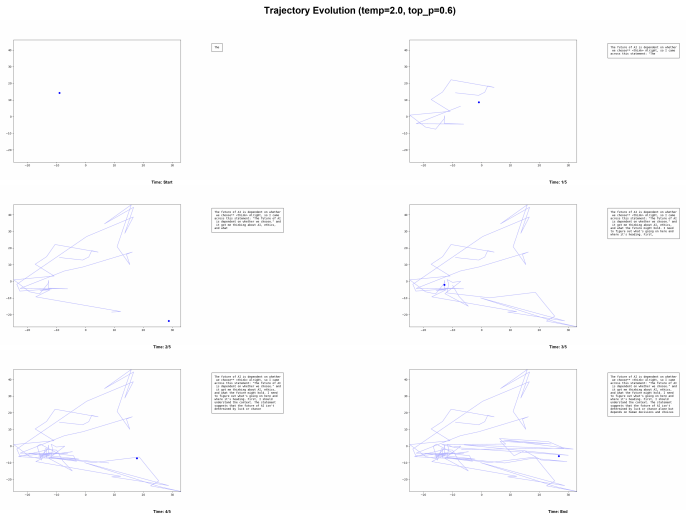
The coherent fan-shaped geometry supports the low-dimensional manifold hypothesis (A1)
to red (token 100). The coherent fan-shaped geometry supports the low-dimensional manifold hypothesis (A1). Table 6: Direction of partial regression coefficients for log-PPL across 9 experimental suites.+ (−) indicates positive (negative) significant coefficient (p< 0.05, BH-corrected); ◦ indicates non-significant. SuiteC Q P DeepSeek-R1 / Factual+− − Dee...
work page 2007
discussion (0)
Sign in with ORCID, Apple, or X to comment. Anyone can read and Pith papers without signing in.