REVIEW 5 major objections 5 minor 39 references
LLM-Guided Reinforcement Learning: Addressing Training Bottlenecks through Policy Modulation
T0 review · 5 major / 5 minor · reviewed 2026-08-07 · deepseek-v4-flash
Pith's one-line read The paper claims that a large language model can identify critical states from a sub-optimal agent's text-rendered trajectories and modulate the MDP with suggested actions and implicit rewards, outperforming learned-mask…
desk verdict A genuinely novel LLM-for-critical-states idea, but an unspecified continuous-state lookup table and thin experimental reporting leave the central claims unsupported. read the letter →
The pith
A machine-rendered reading of the paper's core claim, the machinery that carries it, and where it could break.
The reading
What carries the argument
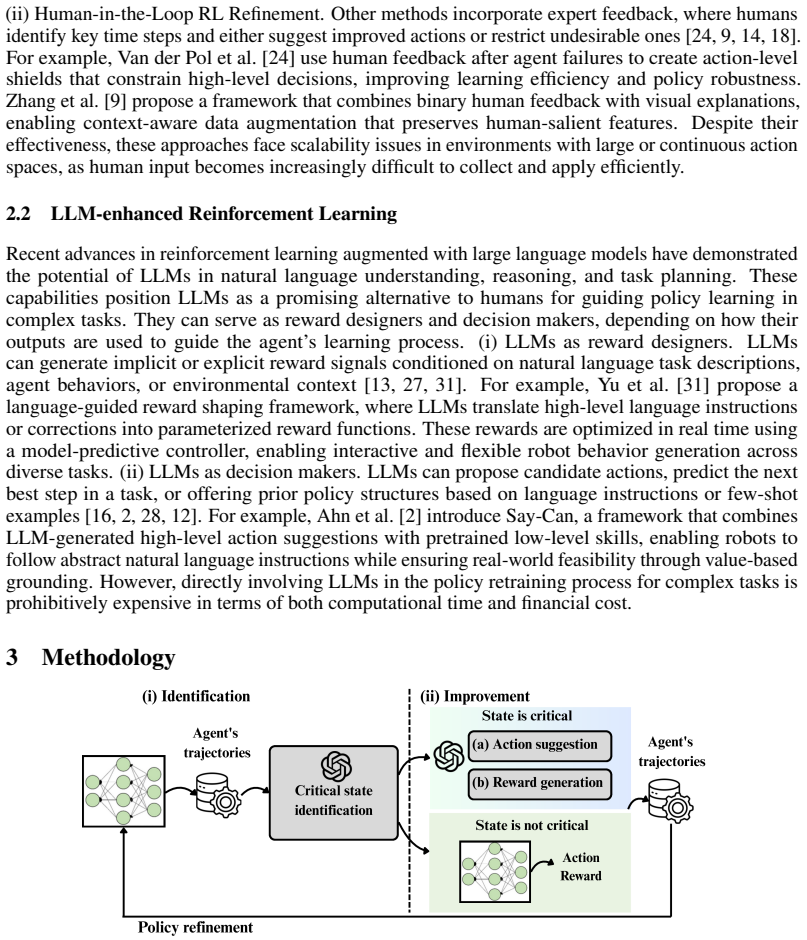
The load-bearing mechanism is the critical state and the LLM prompt pipeline built around it. A critical state is defined as a state at which the agent's action has a significant influence on future rewards. The framework's state interpretation function converts numerical trajectories (positions, velocities, contacts, angles) into natural-language descriptions; a structured prompt then asks the LLM to estimate motion, identify critical states with a rationale, suggest corrected actions, and produce a case analysis of effective versus sub-optimal behavior. The suggested actions go into a lookup table that overrides the agent's policy at matching critical states, and the case analysis is distilled into a scalar reward $\alpha r^{\text{LLM}}_t$ added only at critical states. This combination lets the LLM modulate two components of the MDP—action selection and reward—without retraining a separate model.
What would settle it
A concrete test: in Pong, re-run ULTRA-RA with a trajectory description that omits the ball's y-position trend, so the LLM cannot infer whether the ball is moving toward or away from the racket; if the return stays near 0.8 rather than falling toward the baseline 0.3, then the critical-state identification is not relying on the dynamics the paper says it reads.
Extended reading notes
Core claim
The central claim is that LLM-based explanations are a sufficient substitute for both learned critical-state masks and human feedback in RL policy refinement. Given a pre-trained sub-optimal PPO policy, the authors collect trajectories, convert each numerical state transition into a natural-language description, and prompt an LLM to identify critical states—states where the agent's action significantly influences future return. At those states the LLM proposes corrective actions stored in a lookup table and assigns an implicit reward that is added to the environment reward with a coefficient $\alpha$, yielding $r_t = r^{\text{Env}}_t + \alpha r^{\text{LLM}}_t$ at critical states and the environment reward elsewhere. The paper's experiments report that all three variants (actions only, rewards only, and both) beat RICE, LIR, and human-designed reward shaping, and that the combined ULTRA-RA achieves the best returns: 0.8 on Pong versus 0.3–0.35 for baselines, and average improvements of 7.68%, 13.77%, and 5.55% on Hopper, Walker2d, and Ant.
Load-bearing premise
The framework assumes that turning each numerical trajectory into plain-language text preserves enough physical detail—positions, velocities, angles, contacts—for the LLM to correctly judge which states matter and what the right action is.
Editorial extensions
If this is right
- Practitioners can drop the trained critical-state network: LLM-based identification replaces learned masks such as StateMask with no auxiliary model training.
- LLM-generated implicit rewards at critical states are more informative than novelty-driven intrinsic rewards or coarse human-shaped rewards, according to the reported ablations.
- Action suggestion and reward generation are complementary; the combined ULTRA-RA consistently beats either alone.
- The same pipeline works in a sparse-reward game (Pong) and dense-reward continuous control tasks (Hopper, Walker2d, Ant), suggesting the approach is not tied to one reward structure.
- Policy refinement happens through fine-tuning a PPO agent on new data, so the benefit is achieved without full retraining from scratch.
Reading between the lines
- A natural extension is to use the LLM's critical-state explanations to weight prioritization in experience replay; the paper does not test this, but its lookup-table design suggests the explanation could do more work than action override alone.
- Because ULTRA depends on the LLM's pretrained world knowledge, a stricter test would apply it to a novel game or simulator the LLM has never seen; the reported Pong gains may partly reflect the LLM's familiarity with Atari Pong.
- If critical states rarely repeat exactly, the lookup table will rarely fire, so a residual policy that learns from the LLM's suggested corrections could generalize better to unseen states than exact state matching.
Editorial analysis
A structured set of objections, weighed in public.
Referee Report
Summary. The paper proposes ULTRA, an LLM-guided policy modulation framework for RL. The method first collects trajectories from a pre-trained suboptimal PPO policy, converts them into natural-language descriptions, and prompts GPT-4o to identify critical states. It then uses the LLM to suggest corrective actions, generate implicit rewards, or both, during a PPO fine-tuning phase. Three variants (ULTRA-A, ULTRA-R, ULTRA-RA) are evaluated on Pong, Hopper, Walker2d, and Ant against RICE, LIR, and an HLC baseline, and the paper claims consistent improvements over all baselines.
Significance. If the approach works, it offers a practical way to inject LLM knowledge into RL training without training auxiliary explanation networks and while retaining interpretable rationales for policy corrections. The paper usefully provides full prompt templates in Appendix B and qualitative case analyses in Section 4.4 and Appendix C, which are strengths for reproducibility of the prompting side. However, the central claim is not yet established: the action-correction mechanism is underspecified for continuous MuJoCo states, the statistical reporting is incomplete, hyperparameters are tuned on the evaluation tasks, and the headline improvement numbers in Table 1 are not reproducible from the reported values. These issues are load-bearing and require substantial revision.
major comments (5)
- [§3.4, Eq. (1), Algorithm 1] The action-suggestion mechanism as written requires the agent to check whether the current continuous state s_t appears in the lookup table L of LLM-identified critical states. In Hopper, Walker2d, and Ant, states are high-dimensional real-valued vectors (e.g., 11-dimensional in Hopper), so exact set membership will almost never occur in new rollouts; the paper never specifies a discretization, tolerance, hashing, or nearest-neighbor rule. Consequently, as described, ULTRA-A and the action component of ULTRA-RA are vacuous in exactly the environments where the largest gains are claimed, and the MuJoCo improvements would have to come solely from reward shaping. If a matching rule is used, it must be stated; otherwise the results are not reproducible.
- [§4.1 Implementation] The paper states that α and the learning rate were chosen "by testing the performance under different hyperparameter settings" on the evaluation tasks, with α tried on [0.1, 0.5, 1.0] and learning rate on [1e-3, 1e-4, 1e-5]. Selecting hyperparameters using the test tasks can inflate reported performance and risks overfitting to the evaluation environments; a validation split or a sensitivity analysis is needed before the "outperforms" claim can be accepted.
- [§4.1 Evaluation Metrics / Table 1] The number of random seeds is never reported, despite the statement that results are averaged over multiple seeds, and no significance tests are given. In Table 1, several MuJoCo differences are comparable to the reported standard deviations (for example, ULTRA-A versus LIR in Hopper differs by 63.81 with standard deviations around 56 to 70), so without seed counts or statistical tests it is impossible to tell whether the observed differences are reliable.
- [Table 1] The "Improvement" row is not reproducible from the numbers in the table. For Hopper, (3986.52 − 3571.68) / 3571.68 ≈ 11.6%, not 7.68%; the average improvement over RICE and LIR is about 5.8%, and HLC has no Hopper or Walker2d entry. The formula used to compute the row should be stated, and the HLC baseline should be run on all environments or the claim of outperforming all baselines should be softened.
- [§3.3] The state interpretation function that converts numerical trajectories into natural-language descriptions is never defined. The prompt excerpts in Appendix B show environment information and instructions, but the actual text template for a trajectory and the level of numerical precision preserved in the rendering are omitted. Since the LLM's critical-state identification, and therefore every downstream component, depends on this rendering, the method is not fully reproducible without this specification.
minor comments (5)
- [Abstract] The phrase "a framework ofutilizing" should read "a framework utilizing".
- [§4.1] "encironments" should be "environments".
- [§4.3] The heading "Abaltion Study" should be "Ablation Study".
- [§3.4] Equations (1) and (2) contain "ifs" instead of "if" with a space; the same formatting issue appears in Algorithm 1.
- [References / §4.1] Reference [15] contains "V ehicles" with a stray space, and the HLC baseline for Ant is attributed to [19], which is an episodic-curiosity method rather than a human-in-the-loop reward design; this should be clarified.
Circularity Check
No significant circularity: ULTRA's reported gains are empirical outcomes of LLM-generated actions/rewards plus PPO fine-tuning, not derived from the paper's own inputs.
full rationale
The central claim (Table 1: ULTRA variants outperform PPO/RICE/LIR/HLC) is an experimental result. The derivation chain is: collect trajectories from a suboptimal policy, prompt an LLM to identify critical states, store LLM-suggested actions in a lookup table (Eq. 1), combine LLM-generated implicit rewards with environment rewards (Eq. 2), and fine-tune with PPO (Algorithm 1). None of these equations define the test-time return in terms of the LLM prompts or fitted coefficients. Eq. 2's alpha is a hyperparameter tuned per environment ('tested among [0.1, 0.5, 1.0]'), not a parameter fit to the reported evaluation returns, so this is not a fitted-input-called-prediction. The only self-citation [22] is background on traffic-control applications and is not load-bearing for the framework or results. The exact-match lookup check in Algorithm 1 on continuous MuJoCo states is an implementation/correctness risk (no discretization or tolerance is specified), but it is not circularity: even if the action-suggestion branch rarely fired, the ULTRA-R variant's reward-shaping path is independent of that mechanism, and the reported gains are empirical rather than constructed from the method's definitions. The Appendix C 'LLM-generated strategies consistent with our design' passage is a weak self-consistency check, not a derivation step, and does not force the central comparison. Overall, no equation or fitted quantity in the paper reduces the claimed improvement to its own input.
Assumptions & free parameters
free parameters (2)
- alpha (LLM reward weight) =
0.5 for Pong, 0.1 for MuJoCo
- learning rate =
1e-4
assumptions (3)
- domain assumption The state interpretation function preserves information needed for LLM reasoning (Section 3.3).
- domain assumption The LLM (GPT-4o) reliably identifies critical states and provides useful actions and rewards given textual trajectories (Section 3.3 and 3.4).
- standard math PPO with a shallow MLP converges in these fine-tuning ranges (Section 3.4, Algorithm 1).
Cite this review
Pith. "Pith review of LLM-Guided Reinforcement Learning: Addressing Training Bottlenecks through Policy Modulation." pith.science (2026). https://pith.science/paper/QLUR2MTA
@misc{pith2026250520671,
  author       = {Pith},
  title        = {Pith review of: LLM-Guided Reinforcement Learning: Addressing Training Bottlenecks through Policy Modulation},
  year         = {2026},
  howpublished = {\url{https://pith.science/paper/QLUR2MTA}},
  note         = {Machine review of arXiv:2505.20671}
}
read the original abstract
While reinforcement learning (RL) has achieved notable success in various domains, training effective policies for complex tasks remains challenging. Agents often converge to local optima and fail to maximize long-term rewards. Existing approaches to mitigate training bottlenecks typically fall into two categories: (i) Automated policy refinement, which identifies critical states from past trajectories to guide policy updates, but suffers from costly and uncertain model training; and (ii) Human-in-the-loop refinement, where human feedback is used to correct agent behavior, but this does not scale well to environments with large or continuous action spaces. In this work, we design a large language model-guided policy modulation framework that leverages LLMs to improve RL training without additional model training or human intervention. We first prompt an LLM to identify critical states from a sub-optimal agent's trajectories. Based on these states, the LLM then provides action suggestions and assigns implicit rewards to guide policy refinement. Experiments across standard RL benchmarks demonstrate that our method outperforms state-of-the-art baselines, highlighting the effectiveness of LLM-based explanations in addressing RL training bottlenecks.
Figures


Figures from the paper (2 more)


Reference graph
Works this paper leans on
-
[1]
Reincarnating reinforcement learning: Reusing prior computation to accelerate progress
Rishabh Agarwal, Max Schwarzer, Pablo Samuel Castro, Aaron C Courville, and Marc Belle- mare. Reincarnating reinforcement learning: Reusing prior computation to accelerate progress. Advances in neural information processing systems, 35:28955–28971, 2022
2022
-
[2]
Michael Ahn, Anthony Brohan, Noah Brown, Yevgen Chebotar, Omar Cortes, Byron David, Chelsea Finn, Chuyuan Fu, Keerthana Gopalakrishnan, Karol Hausman, et al. Do as i can, not as i say: Grounding language in robotic affordances.arXiv preprint arXiv:2204.01691, 2022
arXiv 2022
-
[3]
Openai gym.arXiv preprint arXiv:1606.01540, 2016
Greg Brockman, Vicki Cheung, Ludwig Pettersson, Jonas Schneider, John Schulman, Jie Tang, and Wojciech Zaremba. Openai gym.arXiv preprint arXiv:1606.01540, 2016
arXiv 2016
-
[4]
Exploration by random network distillation.arXiv preprint arXiv:1810.12894, 2018
Yuri Burda, Harrison Edwards, Amos Storkey, and Oleg Klimov. Exploration by random network distillation.arXiv preprint arXiv:1810.12894, 2018
arXiv 2018
-
[5]
Xin-Qiang Cai, Yu-Jie Zhang, Chao-Kai Chiang, and Masashi Sugiyama. Imitation learning from vague feedback.Advances in Neural Information Processing Systems, 36:48275–48292, 2023
work page 2023
-
[6]
Zelei Cheng, Xian Wu, Jiahao Yu, Wenhai Sun, Wenbo Guo, and Xinyu Xing. Statemask: Explaining deep reinforcement learning through state mask.Advances in Neural Information Processing Systems, 36:62457–62487, 2023
work page 2023
-
[7]
RICE: Breaking Through the Training Bottlenecks of Reinforcement Learning with Explanation
Zelei Cheng, Xian Wu, Jiahao Yu, Sabrina Yang, Gang Wang, and Xinyu Xing. Rice: Breaking through the training bottlenecks of reinforcement learning with explanation.arXiv preprint arXiv:2405.03064, 2024
work page Pith review arXiv 2024
-
[8]
Prasoon Goyal, Scott Niekum, and Raymond J Mooney. Using natural language for reward shaping in reinforcement learning.arXiv preprint arXiv:1903.02020, 2019
arXiv 1903
Show all 39 references
-
[9]
Lin Guan, Mudit Verma, Suna Sihang Guo, Ruohan Zhang, and Subbarao Kambhampati. Widening the pipeline in human-guided reinforcement learning with explanation and context- aware data augmentation.Advances in Neural Information Processing Systems, 34:21885– 21897, 2021
2021
-
[10]
Edge: Explaining deep reinforcement learning policies.Advances in Neural Information Processing Systems, 34:12222–12236, 2021
Wenbo Guo, Xian Wu, Usmann Khan, and Xinyu Xing. Edge: Explaining deep reinforcement learning policies.Advances in Neural Information Processing Systems, 34:12222–12236, 2021
2021
-
[11]
Uncertainty-aware reinforcement learning for autonomous driving with multimodal digital driver guidance
Wenhui Huang, Zitong Shan, Shanhe Lou, and Chen Lv. Uncertainty-aware reinforcement learning for autonomous driving with multimodal digital driver guidance. In2024 IEEE International Conference on Robotics and Automation (ICRA), pages 18355–18361. IEEE, 2024
2024
-
[12]
Inner monologue: Embodied reasoning through planning with language models.arXiv preprint arXiv:2207.05608, 2022
Wenlong Huang, Fei Xia, Ted Xiao, Harris Chan, Jacky Liang, Pete Florence, Andy Zeng, Jonathan Tompson, Igor Mordatch, Yevgen Chebotar, et al. Inner monologue: Embodied reasoning through planning with language models.arXiv preprint arXiv:2207.05608, 2022
2022 arXiv
-
[13]
Reward design with language models.arXiv preprint arXiv:2303.00001, 2023
Minae Kwon, Sang Michael Xie, Kalesha Bullard, and Dorsa Sadigh. Reward design with language models.arXiv preprint arXiv:2303.00001, 2023
2023 arXiv
-
[14]
A survey on enhancing reinforcement learning in complex environments: Insights from human and llm feedback.arXiv preprint arXiv:2411.13410, 2024
Alireza Rashidi Laleh and Majid Nili Ahmadabadi. A survey on enhancing reinforcement learning in complex environments: Insights from human and llm feedback.arXiv preprint arXiv:2411.13410, 2024
2024 arXiv
-
[15]
Traj-llm: A new exploration for empowering trajectory prediction with pre-trained large language models
Zhengxing Lan, Lingshan Liu, Bo Fan, Yisheng Lv, Yilong Ren, and Zhiyong Cui. Traj-llm: A new exploration for empowering trajectory prediction with pre-trained large language models. IEEE Transactions on Intelligent V ehicles, 2024. 10
2024
-
[16]
Pre-trained language models for interactive decision-making.Advances in Neural Information Processing Systems, 35:31199–31212, 2022
Shuang Li, Xavier Puig, Chris Paxton, Yilun Du, Clinton Wang, Linxi Fan, Tao Chen, De-An Huang, Ekin Akyürek, Anima Anandkumar, et al. Pre-trained language models for interactive decision-making.Advances in Neural Information Processing Systems, 35:31199–31212, 2022
2022
-
[17]
Utility: Utilizing explainable reinforcement learning to improve reinforcement learning
Shicheng Liu and Minghui Zhu. Utility: Utilizing explainable reinforcement learning to improve reinforcement learning. InThe Thirteenth International Conference on Learning Representations, 2025
2025
-
[18]
Mapping out the space of human feedback for reinforcement learning: A conceptual framework.arXiv preprint arXiv:2411.11761, 2024
Yannick Metz, David Lindner, Raphaël Baur, and Mennatallah El-Assady. Mapping out the space of human feedback for reinforcement learning: A conceptual framework.arXiv preprint arXiv:2411.11761, 2024
2024 arXiv
-
[19]
Episodic curiosity through reachability.arXiv preprint arXiv:1810.02274, 2018
Nikolay Savinov, Anton Raichuk, Raphaël Marinier, Damien Vincent, Marc Pollefeys, Tim- othy Lillicrap, and Sylvain Gelly. Episodic curiosity through reachability.arXiv preprint arXiv:1810.02274, 2018
2018 arXiv
-
[20]
Proximal policy optimization algorithms.arXiv preprint arXiv:1707.06347, 2017
John Schulman, Filip Wolski, Prafulla Dhariwal, Alec Radford, and Oleg Klimov. Proximal policy optimization algorithms.arXiv preprint arXiv:1707.06347, 2017
2017 arXiv
-
[21]
Perceiver-actor: A multi-task transformer for robotic manipulation
Mohit Shridhar, Lucas Manuelli, and Dieter Fox. Perceiver-actor: A multi-task transformer for robotic manipulation. InConference on Robot Learning, pages 785–799. PMLR, 2023
2023
-
[22]
Joint rebalancing and charging for shared electric micromobility vehicles with energy-informed demand
Heng Tan, Yukun Yuan, Shuxin Zhong, and Yu Yang. Joint rebalancing and charging for shared electric micromobility vehicles with energy-informed demand. InProceedings of the 32nd ACM International Conference on Information and Knowledge Management, pages 2392–2401, 2023
2023
-
[23]
Mujoco: A physics engine for model-based control
Emanuel Todorov, Tom Erez, and Yuval Tassa. Mujoco: A physics engine for model-based control. In2012 IEEE/RSJ international conference on intelligent robots and systems, pages 5026–5033. IEEE, 2012
2012
-
[24]
Correct me if i’m wrong: Using non-experts to repair reinforcement learning policies
Sanne Van Waveren, Christian Pek, Jana Tumova, and Iolanda Leite. Correct me if i’m wrong: Using non-experts to repair reinforcement learning policies. In2022 17th ACM/IEEE International Conference on Human-Robot Interaction (HRI), pages 493–501. IEEE, 2022
2022
-
[25]
Grandmaster level in starcraft ii using multi-agent reinforcement learning.nature, 575(7782):350–354, 2019
Oriol Vinyals, Igor Babuschkin, Wojciech M Czarnecki, Michaël Mathieu, Andrew Dudzik, Jun- young Chung, David H Choi, Richard Powell, Timo Ewalds, Petko Georgiev, et al. Grandmaster level in starcraft ii using multi-agent reinforcement learning.nature, 575(7782):350–354, 2019
2019
-
[26]
Steca: Step-level trajectory calibration for llm agent learning.arXiv preprint arXiv:2502.14276, 2025
Hanlin Wang, Jian Wang, Chak Tou Leong, and Wenjie Li. Steca: Step-level trajectory calibration for llm agent learning.arXiv preprint arXiv:2502.14276, 2025
2025 arXiv
-
[27]
Read and reap the rewards: Learning to play atari with the help of instruction manuals.Advances in Neural Information Processing Systems, 36:1009–1023, 2023
Yue Wu, Yewen Fan, Paul Pu Liang, Amos Azaria, Yuanzhi Li, and Tom M Mitchell. Read and reap the rewards: Learning to play atari with the help of instruction manuals.Advances in Neural Information Processing Systems, 36:1009–1023, 2023
2023
-
[28]
Keep calm and explore: Language models for action generation in text-based games.arXiv preprint arXiv:2010.02903, 2020
Shunyu Yao, Rohan Rao, Matthew Hausknecht, and Karthik Narasimhan. Keep calm and explore: Language models for action generation in text-based games.arXiv preprint arXiv:2010.02903, 2020
2010 arXiv
-
[29]
Offline imitation learning through graph search and retrieval
Zhao-Heng Yin and Pieter Abbeel. Offline imitation learning through graph search and retrieval. arXiv preprint arXiv:2407.15403, 2024
2024 arXiv
-
[30]
{AIRS}: Expla- nation for deep reinforcement learning based security applications
Jiahao Yu, Wenbo Guo, Qi Qin, Gang Wang, Ting Wang, and Xinyu Xing. {AIRS}: Expla- nation for deep reinforcement learning based security applications. In32nd USENIX Security Symposium (USENIX Security 23), pages 7375–7392, 2023
2023
-
[31]
Language to rewards for robotic skill synthesis.arXiv preprint arXiv:2306.08647, 2023
Wenhao Yu, Nimrod Gileadi, Chuyuan Fu, Sean Kirmani, Kuang-Huei Lee, Montse Gonzalez Arenas, Hao-Tien Lewis Chiang, Tom Erez, Leonard Hasenclever, Jan Humplik, et al. Language to rewards for robotic skill synthesis.arXiv preprint arXiv:2306.08647, 2023
2023 arXiv
-
[32]
+ str(e) +
Zeyu Zheng, Junhyuk Oh, and Satinder Singh. On learning intrinsic rewards for policy gradient methods.Advances in neural information processing systems, 31, 2018. 11 A. Details of Evaluation A1. Baseline Implementation. Regarding the baseline RICE [7], which combines the criti...
2018
-
[33]
We should introduce a mechanism to reinforce learning during critical times while undermining actions leading to unfavorable outcomes
State Space Exploration: The agent needs to better learn from critical moments where its position affects its ability to intercept the ball. We should introduce a mechanism to reinforce learning during critical times while undermining actions leading to unfavorable outcomes. 17
-
[34]
The policy should focus on maintaining positional advantage to intercept the ball efficiently
Action and Reward Policy: The actions that lead to the ball being missed should carry negative rewards or penalties propor- tionate to the failure severity. The policy should focus on maintaining positional advantage to intercept the ball efficiently
-
[35]
Introduction of Prioritized Experience Replay: Maintain a buffer of experiences and prioritize replaying experiences where the agent failed to intercept since these are more informative toward improving policies and actions in critical states
-
[36]
Adaptive Step Sizes: Offer dynamic action adjustments, especially in moments approaching ball interception, to ensure more responsive movement based on the ball’s trajectory
-
[37]
Implementing a mechanism that prioritizes actions based on proximity to the ball in the x-coordinates can significantly improve action selection during critical moments
Improve State Evaluation: The agent should better differentiate between critical and uncritical states by enhancing its state evaluation function. Implementing a mechanism that prioritizes actions based on proximity to the ball in the x-coordinates can significantly improve ac...
-
[38]
Action Quality Updates: Update the action-value estimates (Q-values) more aggressively when the agent takes actions in critical states. This can be implemented by increasing the learning rate when the ball is close by, ensuring actions leading to successful interceptions are r...
-
[39]
Reward Shaping: Increase reward granularity around the critical states. If the agent successfully aligns with the ball’s trajectory, it receives a more structured reward, not just a binary success/failure, to encourage better learning curves and intermediary success tracking. 18
Reviewed August 7, 2026 · model on record in the stance chip above.
Discussion (0). Sign in to comment.