REVIEW 3 major objections 5 minor 1 cited by
Can we Debias Social Stereotypes in AI-Generated Images? Examining Text-to-Image Outputs and User Perceptions
T0 review · 3 major / 5 minor · reviewed 2026-08-07 · deepseek-v4-flash
Pith's one-line read Prompt refinement guided by a stereotype rubric can cut stereotypical cues in AI-generated images by 51-69 percent, while users often still prefer the stereotyped versions.
desk verdict The audit and user study are worth a look, but the headline debiasing effect sizes rest on a same-model evaluation loop and need independent verification before the numbers can be trusted. read the letter →
The pith
A machine-rendered reading of the paper's core claim, the machinery that carries it, and where it could break.
The reading
What carries the argument
The load-bearing device is the Social Stereotype Index (SSI), a normalized score $\mathrm{SSI} = \frac{1}{N}\sum_{i=1}^{N} x_i$, where $x_i$ is 1 if a rubric item is judged present and 0 otherwise. The rubric itself is a set of per-category binary questions, covering gender, skin tone, clothing, props and objects, background, profession, lifestyle, power dynamics, and similar dimensions, separately defined for geocultural, occupational, and adjectival queries. GPT-4o plays a double role: it applies the rubric to score each image, and it generates the refined prompts by following instructions that list the identified stereotypes and demand their removal while keeping the original prompt's core meaning. Prompt refinement therefore operates entirely at the interaction layer, with no access to model weights or training data.
What would settle it
Have independent human raters who have never seen the rubric or the refined prompts score a random sample of the 1,200 initial and refined images on the same stereotype dimensions; if their aggregate scores fail to show the reported 51-69% drops, the measured debiasing is an artifact of the evaluator rather than a property of the images.
Extended reading notes
Core claim
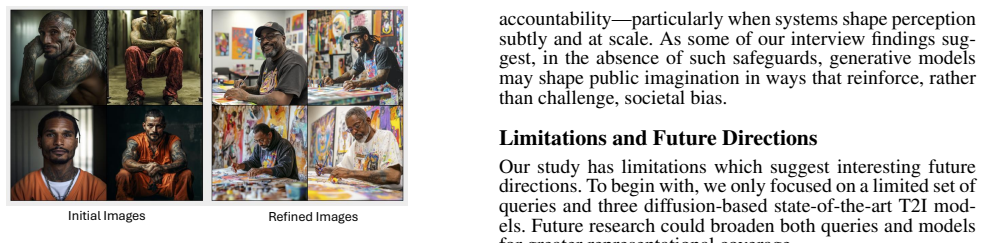
The paper's central claim is that social stereotypes in text-to-image outputs are detectable through a structured rubric and can be substantially reduced by automatic prompt refinement. Auditing 1,200 images from three major T2I models with 100 queries, the authors report that initial outputs carry stereotypical cues such as gendered professions, cultural markers, and Western beauty norms; after GPT-4o rewrites each prompt with instructions to minimize the rubric's stereotype dimensions while preserving the original query, the mean SSI drops from 0.36 to 0.14 for geocultural queries, 0.35 to 0.11 for occupational queries, and 0.37 to 0.18 for adjectival queries, all significant at $p<0.001$. The authors also claim, based on an expert evaluation of 90 image sets, that GPT-4o's rubric labels match human expert labels with about 88% accuracy. In the user study, they find a split preference (47% refined, 43% initial, 10% undecided) and report that users value inclusivity while often treating stereotypical cues as contextually appropriate. The upshot is framed as a tension rather than a clean fix: prompt refinement reduces measurable stereotype cues but can dilute cultural specificity and does not fully remove identity-based biases in the focal subject.
Load-bearing premise
The load-bearing premise, which the paper's Limitations section concedes, is that GPT-4o's binary rubric judgments are a valid measure of social stereotypes; the expert check confirms the model follows the rubric, not that the rubric itself or the model's application of it is unbiased.
Editorial extensions
If this is right
- Debiasing can be deployed as a wrapper around any closed or open T2I API, since the intervention never touches model internals.
- The SSI and rubric give a replicable audit protocol that can be applied to new models or new query sets without retraining a detector.
- Refinement mainly removes setting-level and surface cues such as clothing, background, and props; gender and race of the central subject often persist, so prompt rewriting alone is not a complete fix.
- Because user preference is roughly split, shipping debiased outputs by default may clash with user satisfaction, suggesting a need for side-by-side or user-controllable presentation.
- Lower SSI can come with a cost: more neutral, culturally flattened imagery that may reduce contextual alignment with the original query.
Reading between the lines
- A direct extension is to package the refinement step as an on-by-default or user-toggle plugin in image-generation interfaces; the reported reductions suggest it would work on future black-box models without modification.
- The finding that surface cues drop more than focal-subject identity implies that pairing prompt rewriting with subject-level interventions, such as explicit demographic balancing in the prompt or post-hoc auditing, would address the residual bias the paper documents.
- The paper's own caveat that SSI embeds assumptions about what counts as stereotypical points toward culturally contextualized rubrics: the same queries scored by region-specific questionnaires could yield different reduction rates and more authentic representations.
- A testable extension of the user-study result is that showing users initial and refined images together, as the rapid-fire task did, may increase acceptance of less stereotypical outputs; a controlled experiment could measure whether presentation order changes preference.
Editorial analysis
A structured set of objections, weighed in public.
Referee Report
Summary. This paper proposes a theory-driven rubric and a Social Stereotype Index (SSI) for measuring social stereotypes in text-to-image outputs, audits three T2I models (DALL-E-3, Midjourney-6.1, Stability AI Core) on 100 queries across three categories, and evaluates an LLM-based prompt-refinement intervention that reportedly reduces SSI by 61% (geocultural), 69% (occupational), and 51% (adjectival). The authors also conduct a qualitative user study with 17 participants, finding that prompt refinement can reduce stereotypical cues but may dilute contextual specificity, and that users often prefer stereotypical images as more closely aligned with their expectations. The paper's central quantitative claim is that prompt refinement substantially and significantly reduces social stereotypes, while the qualitative contribution reveals a tension between ethical debiasing and contextual relevance.
Significance. If the central claim is valid, the paper offers a lightweight, model-agnostic, interaction-layer debiasing intervention that could complement model-level fairness work, and its mixed-method design usefully foregrounds user perceptions and the tradeoff between stereotype reduction and contextual fidelity. The transparent reporting of the rubric items and the exact prompts used for evaluation and refinement is a strength. However, the quantitative result is weakened by a circularity: GPT-4o is used both to generate refined prompts explicitly instructed to minimize the rubric's stereotype items and to score the resulting images with the same rubric, while the human validation only checks whether GPT-4o follows that same rubric rather than whether the rubric captures an externally valid stereotype construct. Since the abstract's headline reductions rest on this self-confirmation loop, the quantitative contribution requires an independent, blind evaluation before the central claim can be accepted.
major comments (3)
- [Section 4, Eq. (1), Appendix Tables A1 and A2, Table 4] The central before/after comparison is not an independent measurement of stereotype reduction. GPT-4o generates refined prompts that are instructed to 'eliminate or minimizes specific stereotypes identified in your analysis' using the rubric items [S] (Table A2), and the same model then scores the regenerated images on that same rubric while being given the refined prompt [Q] (Table A1). The expert validation in Table 3 reports agreement between human raters and GPT-4o on the same rubric, but it does not establish that the rubric items track a stereotyping construct that is independent of the intervention, and the validation description does not state that evaluators were blind to condition or to the role of the rubric in prompt refinement. The paper's Limitations section itself concedes that SSI 'depends on predefined rubrics that may miss subtler forms of bias or embed assumptions about what counts as stereotypical.' Consequently, the 51-69% reductions in Table 4 could partly measure how well refined prompts satisfy the scoring rubric rather than how much socially meaningful stereotyping was reduced. Please provide a blind, independent human evaluation of stereotype presence on a sample of initial and refined images, with evaluators unaware of condition and of the rubric's role, or an alternative non-GPT-4o measure, and report the results as the primary evidence for the debiasing claim.
- [Table 2 and Section 5 (geocultural results)] Several rubric items appear to conflate harmful stereotyping with contextually meaningful cultural representation. For example, the geocultural rubric flags 'clothing styles,' 'food habits or cultural cuisine,' and 'traditional or modern lifestyle,' yet the paper's own Discussion acknowledges that 'not all stereotypical cues are inherently harmful; many function as contextually meaningful signals.' Refining a query for 'a photo of a French person' to remove all clothing or food markers may lower SSI simply by making the image culturally generic rather than by removing a negative stereotype. The SSI therefore embeds an assumption about which cultural markers count as stereotypes, and the paper does not validate that assumption independently of the rubric's authors. Please justify the item wording and thresholds with a construct definition or show that the reported results are robust to an alternative, independently developed rubric.
- [Table 4 and Section 4 (statistical analysis)] The paired t-tests in Table 4 are reported without stating the unit of analysis. If individual images (1,200 per condition) are treated as independent observations, the tests ignore clustering by query (100 queries, with four images per query per model), which would inflate the significance levels. Please specify whether the unit is the query, the image, or the query-by-model cell, and use a clustered or mixed-effects analysis (or present query-level paired tests) to confirm that the reported p<0.001 results are not artifacts of pseudoreplication.
minor comments (5)
- [Section 5, first paragraph] The sentence 'Table 3 provides a few examples of the initial and refined outputs' appears to refer to Figure 3, since Table 3 reports expert-evaluation accuracy; please correct the cross-reference.
- [Table 3] The table layout is confusing: the repeated 'Initial' and 'Refined' column headers are not nested under model names, and the caption does not explain what 'accuracy' means (e.g., agreement with expert labels, or fraction of GPT-4o labels judged correct). Please restructure the table and add a precise definition.
- [Section 4 and Appendix Table A2] The refinement instructions in Table A2 say to format the final prompt as '[Q] [additional refined context]', but the example in Section 4 changes the initial prompt 'A photo of a Bangladeshi person' into 'A portrait of a confident Bangladeshi person standing in an urban environment...', which alters the noun phrase rather than simply appending context. Please clarify the transformation grammar.
- [Section 3] The full list of 100 queries is not provided in the paper or appendix; including the complete query set would substantially improve reproducibility and enable others to retest the intervention.
- [Section 4] Please report the LLM configuration used for GPT-4o (e.g., temperature, max tokens, API version and snapshot date), since the rubric-based scoring and prompt refinement may be sensitive to decoding settings.
Circularity Check
The headline SSI reductions are partly a self-confirmation loop: GPT-4o writes the refined prompt, is iteratively tuned to remove the same rubric items it later scores, and the expert check validates only agreement on that same rubric.
-
fitted input called prediction
[Section 4, LLM-Powered Prompt Refinement; Appendix Table A2; Table 4]
"We developed the set of instruction prompt iteratively through trial and error to ensure effectiveness and clarity. ... Given the initial query:[Q]and the image[I]generated with this query, generate a new image prompt that addresses any potential negative social stereotypes [S]. ... 1) Eliminates or minimizes specific stereotypes identified in your analysis."
The headline SSI drops in Table 4 are measured by GPT-4o using the same rubric the refinement was tuned against. The paper says the refinement prompt was developed iteratively through trial and error until it worked, and the prompt instructs GPT-4o to eliminate the exact stereotype items [S] it identifies. Then the same GPT-4o, using the same rubric, assigns the binary xi values that define SSI in Eq. 1. The before/after difference is therefore at least in part a measure of the model following its own instruction, so the reported prediction of reduced bias is not independent of the intervention's fit to the evaluation.
-
self definitional
[Section 4, Rubric-based Audit and LLM-powered Automated Evaluations; Eq. 1; Appendix Table A1]
"we employed our rubric to automatically evaluate our T2I dataset. For this purpose, we leveraged the GPT-4o model... we framed each item in our rubric as a question and presented the LLM alongside the image to be evaluated. ... Evaluate a set of[I]generated with the prompt[Q]] for potential social stereotypical biases based on predefined questions[R]."
SSI is defined as the mean of GPT-4o's binary judgments on the paper's own rubric items, and the evaluator is shown the exact prompt [Q] that generated each image. Since the refined prompts were produced by GPT-4o to remove the same rubric items, the evaluator is not blind to the intervention; it sees the refined, rubric-satisfying query and is likely to score those images as less stereotypical. The metric and the intervention therefore share the same definition of stereotype, making the comparison circular rather than an external validation.
1 more flagged steps
-
other
[Section 4, Expert Evaluation; Table 3; Limitations]
"To assess the reliability of our automated bias identification process, we conducted a manual evaluation of GPT-4o's stereotype labels. The second and third authors independently reviewed a random sample of 90 image sets—45 each from initial and refined sets... ourSSImetric, though quantitative, depends on predefined rubrics that may miss subtler forms of bias or embed assumptions about what counts as stereotypical."
The expert validation only demonstrates that human raters and GPT-4o apply the same rubric similarly (88% agreement); it does not validate the rubric against an independent measure of stereotyping, and the raters knew whether an image set was initial or refined. The paper's own limitation concedes that SSI depends on predefined rubrics that may embed assumptions about what counts as stereotypical. Thus the validation cannot break the self-confirmation loop connecting the refinement instruction to the SSI measurement.
full rationale
The paper's central quantitative claim—that prompt refinement reduces SSI by 51–69%—is supported by a chain in which GPT-4o both generates the debiasing prompt and scores the resulting images. The refinement instruction explicitly asks the model to eliminate the stereotypes it identified using the rubric, and the scoring prompt asks the same model to judge the same rubric items while showing it the exact query used to generate each image. The expert evaluation checks only that human raters and GPT-4o agree on applying that rubric, not that the rubric corresponds to an independent, externally validated stereotype construct. The paper itself acknowledges that the SSI metric depends on predefined rubrics that may embed assumptions about what counts as stereotypical. Because the intervention was iteratively tuned until it was effective and the evaluation is conducted by the same model on the same criteria, the reported effect sizes are at least partly forced by construction. The user study provides some independent evidence, but it measures preference rather than stereotype content and does not resolve the self-confirmation issue. Overall, this is partial circularity in the central claim, not a fully tautological derivation.
Assumptions & free parameters
free parameters (2)
- Rubric item sets
- Refinement instruction template
assumptions (4)
- domain assumption The rubric items adequately operationalize social stereotypes in images.
- domain assumption GPT-4o can reliably identify the presence of rubric attributes in images.
- domain assumption The 100 queries are representative of how users invoke T2I models.
- domain assumption Self-reported user preferences in a one-hour interview reflect real-world reactions to AI-generated imagery.
Cite this review
Pith. "Pith review of Can we Debias Social Stereotypes in AI-Generated Images? Examining Text-to-Image Outputs and User Perceptions." pith.science (2026). https://pith.science/paper/3WH3E7TB
@misc{pith2026250520692,
  author       = {Pith},
  title        = {Pith review of: Can we Debias Social Stereotypes in AI-Generated Images? Examining Text-to-Image Outputs and User Perceptions},
  year         = {2026},
  howpublished = {\url{https://pith.science/paper/3WH3E7TB}},
  note         = {Machine review of arXiv:2505.20692}
}
read the original abstract
Recent advances in generative AI have enabled visual content creation through text-to-image (T2I) generation. However, despite their creative potential, T2I models often replicate and amplify societal stereotypes -- particularly those related to gender, race, and culture -- raising important ethical concerns. This paper proposes a theory-driven bias detection rubric and a Social Stereotype Index (SSI) to systematically evaluate social biases in T2I outputs. We audited three major T2I model outputs -- DALL-E-3, Midjourney-6.1, and Stability AI Core -- using 100 queries across three categories -- geocultural, occupational, and adjectival. Our analysis reveals that initial outputs are prone to include stereotypical visual cues, including gendered professions, cultural markers, and western beauty norms. To address this, we adopted our rubric to conduct targeted prompt refinement using LLMs, which significantly reduced bias -- SSI dropped by 61% for geocultural, 69% for occupational, and 51% for adjectival queries. We complemented our quantitative analysis through a user study examining perceptions, awareness, and preferences around AI-generated biased imagery. Our findings reveal a key tension -- although prompt refinement can mitigate stereotypes, it can limit contextual alignment. Interestingly, users often perceived stereotypical images to be more aligned with their expectations. We discuss the need to balance ethical debiasing with contextual relevance and call for T2I systems that support global diversity and inclusivity while not compromising the reflection of real-world social complexity.
Figures


Figures from the paper (1 more)
Forward citations
Cited by 1 Pith paper
-
VideoGuard: Protecting Video Content from Unauthorized Editing
VideoGuard adds joint, motion-aware perturbations to videos to block unauthorized diffusion-model editing.
Reference graph
Works this paper leans on
-
[1]
Al Sahili, Z.; Patras, I.; and Purver, M. 2024. Faircot: Enhancing fairness in text-to-image generation via chain of thought reasoning with multimodal large language models. arXiv preprint arXiv:2406.09070
work page Pith review arXiv 2024
-
[2]
Amershi, S.; Weld, D.; Vorvoreanu, M.; Fourney, A.; Nushi, B.; Collisson, P.; Suh, J.; Iqbal, S.; Bennett, P. N.; Inkpen, K.; et al. 2019. Guidelines for human-AI interaction. In Proceedings of the 2019 chi conference on human factors in computing systems, 1--13
work page 2019
-
[3]
S.; Meira Jr, W.; and Almeida, V
Ara \'u jo, C. S.; Meira Jr, W.; and Almeida, V. 2016. Identifying stereotypes in the online perception of physical attractiveness. In International Conference on Social Informatics, 419--437
work page 2016
-
[4]
Banaji, M. R.; Fiske, S. T.; and Massey, D. S. 2021. Systemic racism: individuals and interactions, institutions and society. Cognitive research: principles and implications, 6(1): 82
work page 2021
-
[5]
Barlas, P.; Kyriakou, K.; Guest, O.; Kleanthous, S.; and Otterbacher, J. 2021. To" see" is to stereotype: Image tagging algorithms, gender recognition, and the accuracy-fairness trade-off. Proceedings of the ACM on Human-Computer Interaction, 4(CSCW3): 1--31
work page 2021
-
[6]
Bianchi, F.; Kalluri, P.; Durmus, E.; Ladhak, F.; Cheng, M.; Nozza, D.; Hashimoto, T.; Jurafsky, D.; Zou, J.; and Caliskan, A. 2023. Easily accessible text-to-image generation amplifies demographic stereotypes at large scale. In Proceedings of the 2023 ACM Conference on Fairness, Accountability, and Transparency, 1493--1504
work page 2023
-
[7]
Binns, R. 2018. Algorithmic accountability and public reason. Philosophy & technology, 31(4): 543--556
work page 2018
-
[8]
Bird, C.; Ungless, E.; and Kasirzadeh, A. 2023. Typology of risks of generative text-to-image models. In Proceedings of the 2023 AAAI/ACM Conference on AI, Ethics, and Society, 396--410
work page 2023
Show all 76 references
-
[9]
Blum, L. 2004. Stereotypes and stereotyping: A moral analysis. Philosophical papers, 33(3): 251--289
2004
-
[10]
Boyarskaya, M.; Olteanu, A.; and Crawford, K. 2020. Overcoming failures of imagination in AI infused system development and deployment. arXiv preprint arXiv:2011.13416
2020 arXiv
-
[11]
E.; and Keswani, V
Celis, L. E.; and Keswani, V. 2020. Implicit diversity in image summarization. Proceedings of the ACM on Human-Computer Interaction, 4(CSCW2): 1--28
2020
-
[12]
L.; Caine, E
Chancellor, S.; Birnbaum, M. L.; Caine, E. D.; Silenzio, V. M.; and De Choudhury, M. 2019. A taxonomy of ethical tensions in inferring mental health states from social media. In Proceedings of the conference on fairness, accountability, and transparency
2019
-
[13]
Coston, A.; Kawakami, A.; Zhu, H.; Holstein, K.; and Heidari, H. 2023. A validity perspective on evaluating the justified use of data-driven decision-making algorithms. In 2023 IEEE conference on secure and trustworthy machine learning (SaTML)
2023
-
[14]
Das Swain, V.; and Saha, K. 2024. Teacher, trainer, counsel, spy: How generative AI can bridge or widen the gaps in worker-centric digital phenotyping of Wellbeing. In Proceedings of the 3rd Annual Meeting of the Symposium on Human-Computer Interaction for Work, 1--13
2024
-
[15]
Ehsan, U.; Saha, K.; De Choudhury, M.; and Riedl, M. O. 2023. Charting the sociotechnical gap in explainable ai: A framework to address the gap in xai. Proceedings of the ACM on human-computer interaction, 7(CSCW1): 1--32
2023
-
[16]
I always assumed that I wasn't really that close to [her]
Eslami, M.; Rickman, A.; Vaccaro, K.; Aleyasen, A.; Vuong, A.; Karahalios, K.; Hamilton, K.; and Sandvig, C. 2015. " I always assumed that I wasn't really that close to [her]" Reasoning about Invisible Algorithms in News Feeds. In Proceedings of the 33rd annual ACM conference ...
2015
-
[17]
Floridi, L.; Cowls, J.; Beltrametti, M.; Chatila, R.; Chazerand, P.; Dignum, V.; Luetge, C.; Madelin, R.; Pagallo, U.; Rossi, F.; et al. 2018. AI4People—an ethical framework for a good AI society: opportunities, risks, principles, and recommendations. Minds and machines, 28: 689--707
2018
-
[18]
Friedrich, F.; Brack, M.; Struppek, L.; Hintersdorf, D.; Schramowski, P.; Luccioni, S.; and Kersting, K. 2024. Auditing and instructing text-to-image generation models on fairness. AI and Ethics, 1--21
2024
-
[19]
Garcia, N.; Hirota, Y.; Wu, Y.; and Nakashima, Y. 2023. Uncurated image-text datasets: Shedding light on demographic bias. In Proceedings of the IEEE/CVF Conference on Computer Vision and Pattern Recognition, 6957--6966
2023
-
[20]
C.; and Laurin, K
Gaucher, D.; Kay, A. C.; and Laurin, K. 2011. The power of the status quo: Consequences for maintaining and perpetuating inequality. In The psychology of justice and legitimacy
2011
-
[21]
W.; Wallach, H.; Iii, H
Gebru, T.; Morgenstern, J.; Vecchione, B.; Vaughan, J. W.; Wallach, H.; Iii, H. D.; and Crawford, K. 2021. Datasheets for datasets. Communications of the ACM, 64(12): 86--92
2021
-
[22]
Ghosh, S. 2024. Interpretations, Representations, and Stereotypes of Caste within Text-to-Image Generators. In Proceedings of the AAAI/ACM Conference on AI, Ethics, and Society
2024
-
[23]
Ghosh, S.; and Caliskan, A. 2023. Chatgpt perpetuates gender bias in machine translation and ignores non-gendered pronouns: Findings across bengali and five other low-resource languages. In Proceedings of the 2023 AAAI/ACM Conference on AI, Ethics, and Society, 901--912
2023
-
[24]
Heilman, M. E. 2012. Gender stereotypes and workplace bias. Research in organizational Behavior
2012
-
[25]
Jaiswal, S.; Ganai, A.; Dash, A.; Ghosh, S.; and Mukherjee, A. 2024. Breaking the global north stereotype: A global south-centric benchmark dataset for auditing and mitigating biases in facial recognition systems. In Proceedings of the AAAI/ACM Conference on AI, Ethics, and So...
2024
-
[26]
Jakesch, M.; Bu c inca, Z.; Amershi, S.; and Olteanu, A. 2022. How different groups prioritize ethical values for responsible AI. In Proceedings of the 2022 ACM conference on fairness, accountability, and transparency, 310--323
2022
-
[27]
Jha, A.; Prabhakaran, V.; Denton, R.; Laszlo, S.; Dave, S.; Qadri, R.; Reddy, C.; and Dev, S. 2024. ViSAGe: A Global-Scale Analysis of Visual Stereotypes in Text-to-Image Generation. In Proceedings of the 62nd Annual Meeting of the Association for Computational Linguistics (Vo...
2024
-
[28]
T.; Liao, Q
Kawakami, A.; Chowdhary, S.; Iqbal, S. T.; Liao, Q. V.; Olteanu, A.; Suh, J.; and Saha, K. 2023. Sensing Wellbeing in the Workplace, Why and For Whom? Envisioning Impacts with Organizational Stakeholders. Proceedings of the ACM on Human-Computer Interaction (CSCW)
2023
-
[29]
Kay, M.; Matuszek, C.; and Munson, S. A. 2015. Unequal representation and gender stereotypes in image search results for occupations. In Proceedings of the 33rd annual acm conference on human factors in computing systems, 3819--3828
2015
-
[30]
Ko, D.; Jo, S.; Lee, D.; Park, N.; and Kim, J. 2024. DiffInject: Revisiting Debias via Synthetic Data Generation using Diffusion-based Style Injection. arXiv preprint arXiv:2406.06134
2024 arXiv
-
[31]
Kopeinik, S.; Mara, M.; Ratz, L.; Krieg, K.; Schedl, M.; and Rekabsaz, N. 2023. Show me a ``male nurse''! how gender bias is reflected in the query formulation of search engine users. In Proceedings of the 2023 CHI Conference on Human Factors in Computing Systems
2023
-
[32]
S.; Gupta, A.; Zhang, Y.; Narayanan, D.; Teufel, H.; Bellagente, M.; et al
Lee, T.; Yasunaga, M.; Meng, C.; Mai, Y.; Park, J. S.; Gupta, A.; Zhang, Y.; Narayanan, D.; Teufel, H.; Bellagente, M.; et al. 2023. Holistic evaluation of text-to-image models. Advances in Neural Information Processing Systems, 36: 69981--70011
2023
-
[33]
V.; Gruen, D.; and Miller, S
Liao, Q. V.; Gruen, D.; and Miller, S. 2020. Questioning the AI: informing design practices for explainable AI user experiences. In Proceedings of the 2020 CHI Conference on Human Factors in Computing Systems, 1--15
2020
-
[34]
M.; Tanneru, S
Lin, A.; Paes, L. M.; Tanneru, S. H.; Srinivas, S.; and Lakkaraju, H. 2023. Word-level explanations for analyzing bias in text-to-image models. arXiv preprint arXiv:2306.05500
2023 arXiv
-
[35]
Liu, Z.; Schaldenbrand, P.; Okogwu, B.-C.; Peng, W.; Yun, Y.; Hundt, A.; Kim, J.; and Oh, J. 2024. SCoFT: Self-contrastive fine-tuning for equitable image generation. In Proceedings of the IEEE/CVF Conference on Computer Vision and Pattern Recognition, 10822--10832
2024
-
[36]
Luccioni, S.; Akiki, C.; Mitchell, M.; and Jernite, Y. 2023. Stable bias: Evaluating societal representations in diffusion models. Advances in Neural Information Processing Systems
2023
-
[37]
Madaio, M.; Egede, L.; Subramonyam, H.; Wortman Vaughan, J.; and Wallach, H. 2022. Assessing the Fairness of AI Systems: AI Practitioners' Processes, Challenges, and Needs for Support. Proceedings of the ACM on Human-Computer Interaction, 6(CSCW1): 1--26
2022
-
[38]
S.; Meira Jr, W.; and Almeida, V
Magno, G.; Ara \'u jo, C. S.; Meira Jr, W.; and Almeida, V. 2016. Stereotypes in search engine results: understanding the role of local and global factors. arXiv preprint arXiv:1609.05413
2016 arXiv
-
[39]
Mandal, A.; Leavy, S.; and Little, S. 2023. Multimodal composite association score: Measuring gender bias in generative multimodal models. arXiv preprint arXiv:2304.13855
2023 arXiv
-
[40]
Mannering, H. 2023. Analysing Gender Bias in Text-to-Image Models using Object Detection. arXiv preprint arXiv:2307.08025
2023 arXiv
-
[41]
Mehrabi, N.; Morstatter, F.; Saxena, N.; Lerman, K.; and Galstyan, A. 2021. A survey on bias and fairness in machine learning. ACM computing surveys (CSUR), 54(6): 1--35
2021
-
[42]
J.; and Flanagin, A
Metzger, M. J.; and Flanagin, A. J. 2013. Credibility and trust of information in online environments: The use of cognitive heuristics. Journal of pragmatics, 59: 210--220
2013
-
[43]
D.; and Gebru, T
Mitchell, M.; Wu, S.; Zaldivar, A.; Barnes, P.; Vasserman, L.; Hutchinson, B.; Spitzer, E.; Raji, I. D.; and Gebru, T. 2019. Model cards for model reporting. In Proceedings of the conference on fairness, accountability, and transparency, 220--229
2019
-
[44]
D.; Allo, P.; Taddeo, M.; Wachter, S.; and Floridi, L
Mittelstadt, B. D.; Allo, P.; Taddeo, M.; Wachter, S.; and Floridi, L. 2016. The ethics of algorithms: Mapping the debate. Big Data & Society, 3(2): 2053951716679679
2016
-
[45]
L.; Whitman, C
Nadal, K. L.; Whitman, C. N.; Davis, L. S.; Erazo, T.; and Davidoff, K. C. 2016. Microaggressions toward lesbian, gay, bisexual, transgender, queer, and genderqueer people: A review of the literature. The journal of sex research, 53(4-5): 488--508
2016
-
[46]
Naik, R.; and Nushi, B. 2023. Social biases through the text-to-image generation lens. In Proceedings of the 2023 AAAI/ACM Conference on AI, Ethics, and Society, 786--808
2023
-
[47]
Noble, S. U. 2018. Algorithms of oppression: How search engines reinforce racism. In Algorithms of oppression
2018
-
[48]
Norman, D. A. 2014. Some observations on mental models. In Mental models, 7--14. Psychology Press
2014
-
[49]
Otterbacher, J. 2018. Addressing social bias in information retrieval. In International Conference of the Cross-Language Evaluation Forum for European Languages, 121--127. Springer
2018
-
[50]
Otterbacher, J.; Bates, J.; and Clough, P. 2017. Competent men and warm women: Gender stereotypes and backlash in image search results. In Proceedings of the 2017 chi conference on human factors in computing systems, 6620--6631
2017
-
[51]
Otterbacher, J.; Checco, A.; Demartini, G.; and Clough, P. 2018. Investigating user perception of gender bias in image search: the role of sexism. In The 41st International ACM SIGIR conference on research & development in information retrieval, 933--936
2018
-
[52]
Pennycook, G.; and Rand, D. G. 2019. Lazy, not biased: Susceptibility to partisan fake news is better explained by lack of reasoning than by motivated reasoning. Cognition, 188: 39--50
2019
-
[53]
D.; Kumar, I
Raji, I. D.; Kumar, I. E.; Horowitz, A.; and Selbst, A. 2022. The Fallacy of AI Functionality. In ACM FAccT
2022
-
[54]
D.; Smart, A.; White, R
Raji, I. D.; Smart, A.; White, R. N.; Mitchell, M.; Gebru, T.; Hutchinson, B.; Smith-Loud, J.; Theron, D.; and Barnes, P. 2020. Closing the AI accountability gap: Defining an end-to-end framework for internal algorithmic auditing. In Proceedings of the 2020 conference on fairn...
2020
-
[55]
Ramesh, A.; Dhariwal, P.; Nichol, A.; Chu, C.; and Chen, M. 2022. Hierarchical text-conditional image generation with clip latents. arXiv preprint arXiv:2204.06125, 1(2): 3
2022 arXiv
-
[56]
Reuel-Lamparth, A.; Hardy, A.; Smith, C.; Lamparth, M.; Hardy, M.; and Kochenderfer, M. J. 2024. BetterBench: Assessing AI Benchmarks, Uncovering Issues, and Establishing Best Practices. Advances in Neural Information Processing Systems
2024
-
[57]
Rombach, R.; Blattmann, A.; Lorenz, D.; Esser, P.; and Ommer, B. 2022. High-resolution image synthesis with latent diffusion models. In Proceedings of the IEEE/CVF conference on computer vision and pattern recognition, 10684--10695
2022
-
[58]
L.; Ghasemipour, K.; Gontijo Lopes, R.; Karagol Ayan, B.; Salimans, T.; et al
Saharia, C.; Chan, W.; Saxena, S.; Li, L.; Whang, J.; Denton, E. L.; Ghasemipour, K.; Gontijo Lopes, R.; Karagol Ayan, B.; Salimans, T.; et al. 2022. Photorealistic text-to-image diffusion models with deep language understanding. Advances in neural information processing syste...
2022
-
[59]
Sandvig, C.; Hamilton, K.; Karahalios, K.; and Langbort, C. 2014. Auditing algorithms: Research methods for detecting discrimination on internet platforms. Data and discrimination: converting critical concerns into productive inquiry, 22(2014): 4349--4357
2014
-
[60]
Shatz, I. 2017. Fast, free, and targeted: Reddit as a source for recruiting participants online. Social Science Computer Review
2017
-
[61]
Shen, X.; Du, C.; Pang, T.; Lin, M.; Wong, Y.; and Kankanhalli, M. 2023. Finetuning text-to-image diffusion models for fairness. arXiv preprint arXiv:2311.07604
2023 arXiv
-
[62]
K.; Chayko, M.; Inamdar, R.; and Floegel, D
Singh, V. K.; Chayko, M.; Inamdar, R.; and Floegel, D. 2020. Female librarians and male computer programmers? Gender bias in occupational images on digital media platforms. Journal of the Association for Information Science and Technology
2020
-
[63]
Sokol, K.; and Flach, P. 2020. Explainability fact sheets: a framework for systematic assessment of explainable approaches. In Proceedings of the 2020 Conference on Fairness, Accountability, and Transparency, 56--67
2020
-
[64]
Struppek, L.; Hintersdorf, D.; Friedrich, F.; Schramowski, P.; Kersting, K.; et al. 2023. Exploiting cultural biases via homoglyphs in text-to-image synthesis. Journal of Artificial Intelligence Research
2023
-
[65]
Subramonian, A.; Yuan, X.; Daum \'e III, H.; and Blodgett, S. L. 2023. It Takes Two to Tango: Navigating Conceptualizations of NLP Tasks and Measurements of Performance. In Findings of the Association for Computational Linguistics: ACL 2023, 3234--3279
2023
-
[66]
Tsvetkov, Y.; Schneider, N.; Hovy, D.; Bhatia, A.; Faruqui, M.; and Dyer, C. 2014. Augmenting E nglish Adjective Senses with Supersenses. In Calzolari, N.; Choukri, K.; Declerck, T.; Loftsson, H.; Maegaard, B.; Mariani, J.; Moreno, A.; Odijk, J.; and Piperidis, S., eds., Proce...
2014
-
[67]
Veale, M.; Van Kleek, M.; and Binns, R. 2018. Fairness and accountability design needs for algorithmic support in high-stakes public sector decision-making. In Proceedings of the 2018 chi conference on human factors in computing systems, 1--14
2018
-
[68]
Wagner, C.; Strohmaier, M.; Olteanu, A.; K c man, E.; Contractor, N.; and Eliassi-Rad, T. 2021. Measuring algorithmically infused societies. Nature, 595(7866): 197--204
2021
-
[69]
Walsh, J. P. 2020. Social media and moral panics: Assessing the effects of technological change on societal reaction. International Journal of Cultural Studies, 23(6): 840--859
2020
-
[70]
Wan, Y.; and Chang, K.-W. 2024. The Male CEO and the Female Assistant: Evaluation and Mitigation of Gender Biases in Text-To-Image Generation of Dual Subjects. arXiv preprint arXiv:2402.11089
2024 arXiv
-
[71]
Wan, Y.; Subramonian, A.; Ovalle, A.; Lin, Z.; Suvarna, A.; Chance, C.; Bansal, H.; Pattichis, R.; and Chang, K.-W. 2024. Survey of bias in text-to-image generation: Definition, evaluation, and mitigation. arXiv preprint arXiv:2404.01030
2024 arXiv
-
[72]
G.; Di, Z.; Liu, Y.; and Wang, X
Wang, J.; Liu, X. G.; Di, Z.; Liu, Y.; and Wang, X. E. 2023. T2IAT: Measuring Valence and Stereotypical Biases in Text-to-Image Generation. In The 61st Annual Meeting Of The Association For Computational Linguistics
2023
-
[73]
Zhang, Y.; Jiang, L.; Turk, G.; and Yang, D. 2024. Auditing gender presentation differences in text-to-image models. In Proceedings of the 4th ACM Conference on Equity and Access in Algorithms, Mechanisms, and Optimization, 1--10
2024
-
[74]
G.; and De Choudhury, M
Zhou, J.; Zhang, Y.; Luo, Q.; Parker, A. G.; and De Choudhury, M. 2023. Synthetic lies: Understanding ai-generated misinformation and evaluating algorithmic and human solutions. In Proceedings of the 2023 CHI conference on human factors in computing systems
2023
-
[75]
, " * write output.state after.block = add.period write newline
ENTRY address archivePrefix author booktitle chapter edition editor eid eprint howpublished institution isbn journal key month note number organization pages publisher school series title type volume year label extra.label sort.label short.list INTEGERS output.state before.all...
-
[76]
write newline
" write newline "" before.all 'output.state := FUNCTION n.dashify 't := "" t empty not t #1 #1 substring "-" = t #1 #2 substring "--" = not "--" * t #2 global.max substring 't := t #1 #1 substring "-" = "-" * t #2 global.max substring 't := while if t #1 #1 substring * t #2 gl...
Reviewed August 7, 2026 · model on record in the stance chip above.
Discussion (0). Sign in to comment.