REVIEW 3 major objections 6 minor 17 references
Violation of weak cosmic censorship by the Oppenheimer-Snyder collapse
T0 review · 3 major / 6 minor · reviewed 2026-08-07 · deepseek-v4-flash
Pith's one-line read The paper claims that in the Oppenheimer-Snyder collapse model, no physically viable classical model forms a naked singularity without either an unphysical metric ansatz or a thin shell that violates the null energy condition.
desk verdict Honest negative-result paper: no classical WCC violation found, but the title oversells and the 'must violate NEC' claim rests on a narrow ws=-1 scan. read the letter →
The pith
A machine-rendered reading of the paper's core claim, the machinery that carries it, and where it could break.
The reading
What carries the argument
The central machinery is the junction-condition calculation that matches a closed perfect-fluid interior to a static spherically symmetric exterior across a time-like boundary. In the generalized exterior, the matching equations (25)-(27) are used to conclude that a shell-free match forces Phi'=0, which is why a thin shell is introduced. With a thin shell, the junction equations (28)-(34) relate the shell's tension sigma and pressure lambda to the exterior metric, and the conditions sigma>=0 and w_s>=-1 encode the null energy condition that the Janis-Newman-Winicour collapse must satisfy. The Janis-Newman-Winicour solution supplies the exact naked-singularity exterior used to test the shell case.
What would settle it
Integrate the shell-free junction equations (26)-(27) for an exterior with Phi'(r) nonzero and check whether a real trajectory r(tau) exists with $\sqrt$($rdot^{2}$+f)=cos(chi0); if one does, the no-shell impossibility claim is false. Equally decisive would be an exact Einstein solution with a naked singularity and a non-constant Phi that satisfies the null energy condition and admits a shell-free Oppenheimer-Snyder matching.
Extended reading notes
Core claim
The paper's central claim is a no-go result with a constructive boundary: in the Oppenheimer-Snyder collapse with a perfect-fluid interior, the original shell-free matching cannot be carried over to an arbitrary static spherically symmetric exterior, because the junction conditions force the exterior metric function Phi to be constant. For a naked-singularity exterior that is a genuine solution of the Einstein equations, introducing a thin shell makes collapse to a naked singularity dynamically possible, but the shell's tension and pressure must eventually violate the null energy condition. An auxiliary metric ansatz can avoid that violation only because the ansatz is not a solution of any known matter field equations. The paper therefore concludes that a classical, physically viable Oppenheimer-Snyder-type collapse that violates weak cosmic censorship was not found; the best classical outcome is an arbitrarily close approach to the singularity, which could be interpreted as an effective violation if the singularity has a quantum-gravity size.
Load-bearing premise
The argument that a thin shell is unavoidable rests on a matching calculation that forces the exterior metric's redshift function Phi to be constant; if that calculation has a loophole, shell-free collapse to a naked singularity may be possible in exact static exteriors, and the paper's main negative conclusion would fail.
Editorial extensions
If this is right
- Any attempt to violate weak cosmic censorship through an Oppenheimer-Snyder collapse must place the violation either in an unphysical metric ansatz or in the thin shell's energy conditions.
- If a modified-gravity theory supplies a solution of the form ds^2=-f(r)dt^2+f(r)^{-1}dr^2+r^2dOmega^2 with a naked singularity, the Oppenheimer-Snyder collapse would go through without a shell and produce a genuine classical violation.
- For the Janis-Newman-Winicour exterior, the shell can be tuned to reach arbitrarily close to the singularity while keeping sigma>=0 and w_s>=-1, so only the final approach forces the null energy condition to break.
- The junction-equation method gives a constructive test that can be applied to other exact naked-singularity solutions to see whether energy-condition violation is generic.
- The paper's results indicate why classical weak cosmic censorship is difficult to evade: the obstruction appears at the matter boundary, not in the interior fluid.
Reading between the lines
- If the displayed junction equations (26)-(27) do not actually force Phi'=0, exact static exteriors with non-constant Phi might admit shell-free Oppenheimer-Snyder collapse, making the paper's blanket claim that a thin shell is unavoidable too strong; a direct integration check would settle this.
- The toy-ansatz route suggests a targeted search in modified gravity for actions whose spherically symmetric solutions realize M(r)=(2M0/pi)arctan(r/r0); such a theory would turn the toy model into a genuine weak-cosmic-censorship-violating collapse.
- If quantum tunneling lets the shell cross the potential barrier, the null energy condition violation could be confined to sub-Planckian radii, effectively hiding it from classical physics and making 'effective weak cosmic censorship violation' a precise, testable notion.
Editorial analysis
A structured set of objections, weighed in public.
Referee Report
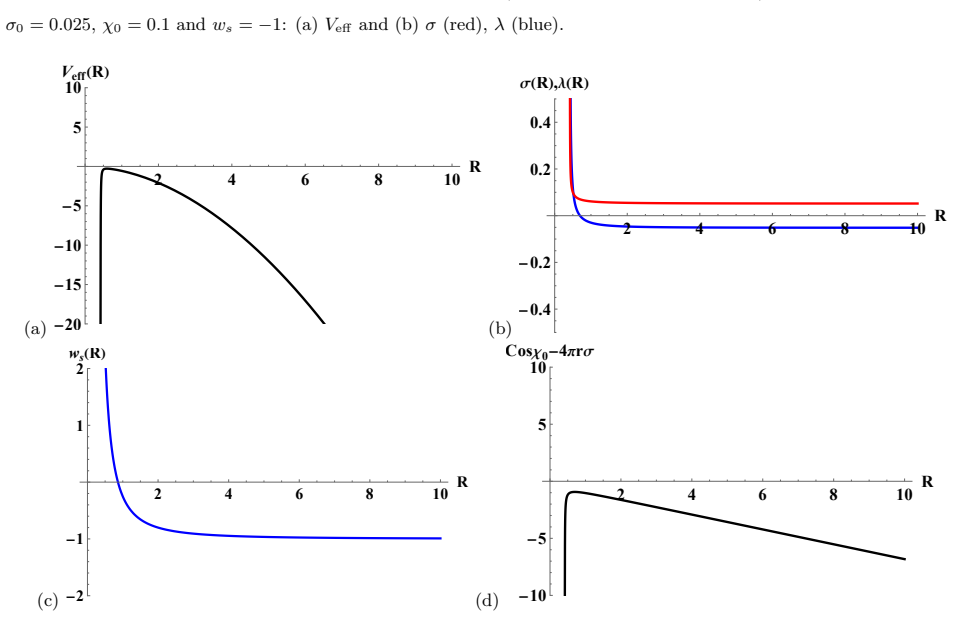
Summary. The paper studies whether the Oppenheimer-Snyder (OS) collapse model can classically produce a naked singularity. It first argues that for a general static spherically symmetric exterior of the form (20), the no-shell OS matching forces Φ'=0, so a thin shell is unavoidable for non-Schwarzschild-like exteriors. It then considers two exterior models: a toy mass function M(r)=(2M0/π)tan^{-1}(r/r0) that is not a solution of Einstein's equations but allows a no-shell collapse to a naked singularity while satisfying the null energy condition; and the Janis-Newman-Winicour (JNW) scalar-field solution matched to the interior through a thin shell. For the JNW exterior with shell equation of state w_s=-1, numerical examples show the shell either reaches σ→-∞ (NEC violation) or the solution becomes invalid because cosχ0-4πrσ changes sign. The paper concludes that no physically viable classical model violating weak cosmic censorship was found.
Significance. If the conclusions hold, the paper offers a useful constructive framework for probing weak cosmic censorship in collapse models, combining an exact exterior solution (JNW) with the OS interior and thin-shell junction conditions. The explicit attention to energy conditions and the honest distinction between toy and exact backgrounds are strengths. However, the main negative claim is broader than the evidence presented: the numerical evidence for unavoidable NEC violation in the thin-shell case is limited to w_s=-1, and the scalar-field junction conditions are not addressed. With those gaps closed, the paper could provide a solid reference point for future tests of cosmic censorship.
major comments (3)
- [IV.B/V, Eq. (65)] The conclusion that the thin shell 'must' violate the null energy condition is not established. The numerical integrations in Figs. 2-4 and the classification in Sec. IV.B are all performed with the shell equation of state w_s=-1. In Eq. (65), the first term -2(1+w_s)σ dr/(r dR) is positive during collapse for w_s>-1 and σ>0, and it can compete with the second term, so the behavior may differ qualitatively for other equations of state. No scan over w_s≥-1 is reported and no analytic argument (e.g., a monotonicity or comparison theorem) excludes trajectories that reach the singular center with σ≥0 and cosχ0-4πrσ>0. Until such an analysis is provided, the abstract and Sec. V should be weakened to a statement about the specific w_s=-1 cases examined.
- [II.C/IV.B] The JNW exterior is a solution of the Einstein-scalar equations, but the paper imposes only metric junction conditions; the scalar field's junction conditions across the shell are not specified or solved. If the scalar field is nonzero on the exterior and absent (or different) in the interior, the jump in φ or its normal derivative contributes to the surface stress-energy tensor and modifies the physical interpretation of S_ab and its equation of state. As written, the model is not demonstrated to be a solution of the full field equations, which weakens the claim that the JNW example is a genuine exact-solution-based test.
- [IV.A] The general assertion that 'if the original metric satisfies the null energy condition, the corresponding star interior also satisfies the null energy condition' is justified only by showing that the marginal conditions for the two inequalities coincide (Eq. (60) and its derivative). This does not prove the implication for the non-marginal inequalities. The specific arctan metric is verified numerically (Fig. 1 and Eq. (59)), so the toy-model conclusion is unaffected, but the general statement should either be proved or removed.
minor comments (6)
- [II.B] The derivation of Φ'=0 should be shown explicitly: differentiating √(ṙ²+f)=cosχ0 with respect to proper time gives r̈+f'/2=0 for ṙ≠0, and combining this with Eq. (26) yields Φ'=0. The phrase 'it is easy to show' is too terse for a load-bearing step.
- [IV.B] Equation (65) is used in the numerical integration but the explicit form of Φ (or dΦ/dR) for the JNW metric is not given in the paper; the reader cannot reproduce the results without consulting Ref. [9]. Please provide the explicit expression.
- [IV.B] The two-type classification of the shell behavior is described from numerical examples, but the parameter space (σ0, χ0, A, m) is not scanned systematically; for instance, moderate σ0 values between the two illustrated examples are not shown. A short table of the behavior across the parameter plane would strengthen the claim.
- [I/III] The paper cites Ref. [9] for details of the JNW solution and the shell formalism; please state explicitly which results are taken from that reference and which are new in this paper.
- [III.A] In Eq. (37), the Kretschmann scaling is written as r^{2n}/r^6; this is correct as a scaling statement but the notation could be cleaned up to avoid the impression of an equality.
- [V] The phrase 'must violate the null energy condition at the singularity eventually' is ambiguous because the singularity is not a point on the shell's trajectory; clarify whether the violation occurs before the shell reaches r=0 or only in the limit.
Circularity Check
No significant circularity: the paper's central negative conclusion is supported by standard junction conditions and the exact JNW solution, not by its own definitions or fitted inputs.
full rationale
I walked the paper's derivation chain. The no-shell OS construction in Sec. II.A is solved from the junction conditions (13)-(15), not from a fitted output; the later claim that Phi'=0 is required in Sec. II.B is derived via Eq. (26), and even if that derivation were debatable, it is a correctness concern, not a circular one. The toy metric M(r)=2M0/pi arctan(r/r0) in Sec. III.B is explicitly labeled an ansatz ('Just an ansatz'), and the paper openly concedes it is not a known solution of the Einstein equation, so its use is a self-admitted toy model rather than a prediction disguised as a first-principles result. The JNW analysis in Sec. IV.B uses an externally known exact solution, standard thin-shell junction equations (28)-(34), and a numerical integration with a specified equation of state ws=-1; the conclusion that the shell must eventually violate the null energy condition is reported as an outcome of the investigated cases, not inserted as an assumption. Self-citations are abundant and include Ref. [9] for the JNW shell equations in R-coordinates, but those equations are coordinate-level consequences of the displayed junction formalism and do not import the paper's conclusion. No step reduces to its inputs by construction, no fitted parameter is renamed as a prediction, and no uniqueness or authority claim is used to force the central result.
Assumptions & free parameters
free parameters (7)
- M0 =
1 (chosen in examples)
- r0 =
5 (chosen in examples)
- chi0 =
0.1, 0.01, etc. (chosen)
- sigma0 =
0.015, 0.025, 0.055 (chosen)
- w_s =
-1
- A =
0.1 or 0.2 (chosen in examples)
- m =
1 (chosen in examples)
assumptions (6)
- standard math Israel junction conditions for thin shells
- domain assumption Oppenheimer-Snyder collapse treats the interior as a homogeneous FRW perfect fluid
- domain assumption The null energy condition is a criterion for physical viability
- standard math The JNW metric is an exact solution of the Einstein-scalar field equations
- domain assumption The thin shell can be described by a time-like hypersurface with equation of state w_s
- ad hoc to paper No-shell OS matching is impossible unless Phi'=0
Cite this review
Pith. "Pith review of Violation of weak cosmic censorship by the Oppenheimer-Snyder collapse." pith.science (2026). https://pith.science/paper/FHYCHPWB
@misc{pith2026250520724,
  author       = {Pith},
  title        = {Pith review of: Violation of weak cosmic censorship by the Oppenheimer-Snyder collapse},
  year         = {2026},
  howpublished = {\url{https://pith.science/paper/FHYCHPWB}},
  note         = {Machine review of arXiv:2505.20724}
}
read the original abstract
We consider the possibility that the weak cosmic censorship conjecture can be violated using the Oppenheimer-Snyder collapse model with a perfect fluid star interior. Metric models with a naked singularity can be used, and the Oppenheimer-Snyder collapse might be possible; the null energy condition is also satisfied in these models. However, this is just a toy model because no known model as a solution to the Einstein equation. To avoid this problem, we can consider a naked singularity solution as a proper solution of the Einstein equation, but in this case, we need to introduce a thin-shell on top of the perfect fluid star. In this case, gravitational collapse is allowed, but the null energy condition should be violated at the thin-shell. In conclusion, we could not find a physically viable model that violates weak cosmic censorship, but it opens a window to study the properties of cosmic censorship constructively. The violation of weak cosmic censorship might be possible if a modified gravity model provides a solution that allows the Oppenheimer-Snyder collapse without a shell. Also, regarding the thin-shell case, the shell approaches the naked singularity closer without violating the null energy condition, although it must violate the null energy condition at the singularity eventually; this might be regarded as an effective violation of cosmic censorship in some sense.
Figures


Figures from the paper (1 more)
Reference graph
Works this paper leans on
-
[1]
S. W. Hawking and R. Penrose, Proc. Roy. Soc. Lond. A 314, 529-548 (1970)
work page 1970
- [2]
-
[3]
H. Reissner, Annal. Phys. 50, 9 (1916), 106-120; G. Nordstrom, Verhandl. Koninkl. Ned. Akad. Wetenschap., Afdel. Natuurk., Amsterdam, 26 (1918), 1201-1208
work page 1916
-
[4]
S. E. Hong, D. i. Hwang, E. D. Stewart and D. Yeom, Class. Quant. Grav. 27, 045014 (2010) [arXiv:0808.1709 [gr-qc]]; D. Hwang and D. Yeom, Phys. Rev. D 84 (2011), 064020 [arXiv:1010.2585 [gr-qc]]
arXiv 2010
-
[5]
Dynamical formation and evolution of (2+1)-dimensional charged black holes
D. Hwang, H. B. Kim and D. Yeom, Class. Quant. Grav. 29 (2012), 055003 [arXiv:1105.1371 [gr-qc]]
work page Pith review arXiv 2012
-
[6]
Inside and outside stories of black-branes in anti de Sitter space
J. Hansen, B. H. Lee, C. Park and D. Yeom, Class. Quant. Grav. 30 (2013), 235022 [arXiv:1307.0266 [hep-th]]
work page Pith review arXiv 2013
-
[7]
J. R. Oppenheimer and H. Snyder, Phys. Rev. 56, 455-459 (1939)
work page 1939
-
[8]
W. Israel, Nuovo Cim. B 44S10, 1 (1966) [erratum: Nuovo Cim. B 48, 463 (1967)]
work page 1966
Show all 17 references
-
[9]
X. Y. Chew, I. G. Choi, H. J. Kim and D. Yeom, [arXiv:2408.03016 [gr-qc]]. 14
-
[10]
A. I. Janis, E. T. Newman and J. Winicour, Phys. Rev. Lett. 20 (1968), 878-880
1968
-
[11]
A Relativist’s toolkit: the mathematics of black-hole mechanics,
E. Poisson, “ A Relativist’s toolkit: the mathematics of black-hole mechanics,” Cambridge University Press (2009)
2009
-
[12]
Brahma and D
S. Brahma and D. Yeom, Class. Quant. Grav. 35 (2018) no.20, 205007 [arXiv:1804.02821 [gr-qc]]
2018 arXiv
-
[13]
N. M. Garcia, F. S. N. Lobo and M. Visser, Phys. Rev. D 86 (2012), 044026 [arXiv:1112.2057 [gr-qc]]
2012 arXiv
-
[14]
Bouhmadi-L´ opez, S
M. Bouhmadi-L´ opez, S. Brahma, C. Y. Chen, P. Chen and D. Yeom, JCAP07 (2020), 066 [arXiv:2004.13061 [gr-qc]]
2020 arXiv
-
[15]
C. W. Misner and D. H. Sharp, Phys. Rev. 136, B571-B576 (1964)
1964
-
[16]
A. B. Nielsen and D. Yeom, Int. J. Mod. Phys. A 24, 5261-5285 (2009) [arXiv:0804.4435 [gr-qc]]
2009 arXiv
-
[17]
Dymnikova, Gen
I. Dymnikova, Gen. Rel. Grav. 24, 235-242 (1992); S. A. Hayward, Phys. Rev. Lett. 96, 031103 (2006) [arXiv:gr-qc/0506126 [gr-qc]]; S. Ansoldi, [arXiv:0802.0330 [gr-qc]]
1992 arXiv
Reviewed August 7, 2026 · model on record in the stance chip above.
Discussion (0). Continue with ORCID to comment.