REVIEW 3 major objections 5 minor 46 references
Detecting Informative Channels: ActionFormer
T0 review · 3 major / 5 minor · reviewed 2026-08-07 · deepseek-v4-flash
Pith's one-line read This paper claims that reweighting feature channels with a squeeze-and-excitation-style module raises ActionFormer's average mAP on wearable inertial data from 57.26 to 73.27 at clip length 0.5.
desk verdict A modest but honest SE-style extension of ActionFormer for inertial HAR; the reported 16-point gain is plausible but not yet established because the evaluation protocol is under-specified. read the letter →
The pith
A machine-rendered reading of the paper's core claim, the machinery that carries it, and where it could break.
The reading
What carries the argument
The adaptive channel-wise enhancement module is the mechanism that carries the argument. Given features $X$ of shape (batch, channels, time), it computes channel weights $W_C = \mathrm{sigmoid}(\mathrm{conv}_2(\mathrm{swish}(\mathrm{conv}_1(\mathrm{avgPool}(X)))))$, reweights the features, and passes them through a $1\times1$ convolution; the average pooling squeezes each channel to one scalar, the reduction factor 16 keeps the gate cheap, and swish is chosen over ReLU so that negative values—directional information in acceleration—are retained. A MaxPool variant for video replaces average pooling with local max pooling and interpolates the weights back to the original sequence length. This module is the only architectural change relative to the baseline, so the reported gains are attributed to it.
What would settle it
Re-run the inertial WEAR experiments with at least five random seeds and a fixed validation split, selecting hyperparameters (swish beta, reduction factor, module placement) only on validation data; if CE-ActionFormer's average mAP advantage over 1D-ActionFormer at clip length 0.5 does not reproduce consistently, or vanishes when hyperparameters are not chosen on the test set, the central claim is refuted.
Extended reading notes
Core claim
The central claim is that on inertial data, the most useful cues for activity recognition and boundary localization are concentrated in a few feature channels, so reweighting channels explicitly improves temporal action localization. The paper shows that replacing the naive equal treatment of channels with a lightweight gate—adaptive average pooling to a per-channel scalar, a two-layer bottleneck with reduction factor 16, swish activation, and a sigmoid gate—yields a 16.01 percentage-point average mAP gain over the 1D-ActionFormer baseline on the WEAR dataset at clip length 0.5, including a 37.23 percentage-point gain at tIoU 0.7. The authors further claim that this module reduces the model's defects in capturing temporal dynamics and spatiotemporal interdependencies, and they verify the approach on a convolutional detector (CE-TriDet) and on video inputs.
Load-bearing premise
The reported 16.01 percentage-point gain assumes a fair and stable evaluation protocol, since the paper selects the swish beta, reduction factor, and module placement based on test results and reports a single run without multiple seeds, error bars, or a stated train/test split.
Editorial extensions
If this is right
- At CL=0.5 and tIoU=0.7, CE-ActionFormer reaches 68.14 mAP versus the baseline's 30.91, so the gain is concentrated where boundary localization is hardest.
- The module adds only 7.8% parameters (26.56M to 28.64M) and about 5% execution time, making the improvement inexpensive.
- Applying the same gating to TriDet lifts its average mAP from 63.98 to 70.61 at CL=0.5, showing the mechanism transfers to convolutional detectors.
- On WEAR video features, an adaptive-average-pool variant improves ActionFormer from 54.44 to 62.24 average mAP, suggesting the channel-reweighting idea generalizes beyond inertial signals.
- Ablations show swish alone slightly hurts (57.11) and SE alone helps (68.07), so the full module's gain comes from combining SE-style gating with swish's retention of negative-range information.
Reading between the lines
- Because the improvement concentrates at high tIoU, a natural testable extension is whether the channel weights sharpen boundary predictions, e.g., by measuring predicted-to-ground-truth boundary distance with and without the module.
- The 'channel' notion maps directly to sensor axes (four IMUs times three axes); combining the module with axis-wise normalization or permutation augmentation—both designed to preserve channel-specific information—could compound the gains.
- The module also helps on video features, which hints that suppressing redundant channels in the feature pyramid is the underlying mechanism, so it may complement other temporal action localization improvements such as relative boundary modeling rather than replace them.
Editorial analysis
A structured set of objections, weighed in public.
Referee Report
Summary. The paper proposes a channel-wise enhancement module for ActionFormer-based human activity recognition from inertial sensor signals. The module (CE-ActionFormer) performs adaptive average pooling over the feature sequence, passes the channel descriptors through two convolutions with a swish activation, and rescales the original features; a max-pooling variant is proposed for video features. On the WEAR dataset, the authors report an average mAP of 73.27 for inertial data at CL=0.5, which is 16.01 points above their 1D-ActionFormer baseline, and also report gains for CE-TriDet. The paper includes ablations (SE, swish, SE+swish), an efficiency analysis, confusion-matrix-based error analysis, and an appendix with video experiments.
Significance. If the reported results are reproducible, the proposed module is a simple and parameter-efficient extension (a 7.8% parameter increase) that could meaningfully improve temporal action localization on inertial data, and the video variant shows consistent if smaller gains across several datasets. The paper provides a clear ablation structure and a computational efficiency comparison, which are useful. However, the evaluation protocol is not robust: no train/validation/test split, no random seeds, no repeated runs, explicit test-set hyperparameter selection, and inconsistent baseline numbers across tables. The central quantitative claim is therefore not yet established to the stated precision.
major comments (3)
- [Section 3.2 and Section 4.3] The central claim of a 16.01-point improvement (Section 4.4, Table 1) is not yet established because the evaluation protocol does not support it. Section 3.2 states that the swish beta value was 'finalize[d] to use ... 1.0 based on the test results,' and the reduction factor of 16 and module placement are also hand-chosen. Section 4.3 does not report the train/validation/test split, random seed, or number of repeated runs. The reported single-run numbers could therefore reflect selection bias on the test set or a single favorable initialization rather than the effect of the module. Please report the exact split, select hyperparameters on a validation set only, and report means and standard deviations over multiple seeds.
- [Tables 1, 3, and 4] The same TriDet baseline at CL=0.5 is reported with an average mAP of 55.56 in Table 1 but 63.98 in Table 3 (and again 63.98 in Table 4). Under an identical protocol these values should coincide; a difference of 8.42 average-mAP points indicates that the evaluation conditions are not stable enough to verify even adjacent numbers. Please reconcile the two baseline values and specify the exact feature extraction, data split, and evaluation protocol used in each table.
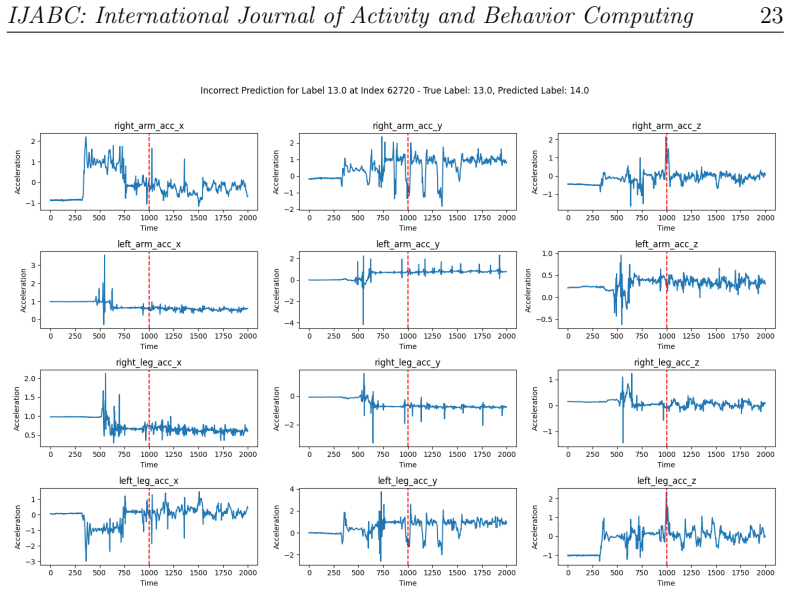
- [Section 4.8] The error analysis does not support the claim that the module 'decrease[s] these defects' in capturing temporal dynamics and spatiotemporal interdependencies. The confusion matrices for the original and proposed models are presented, but the text only gives error proportions for the proposed model (e.g., label 1 predicted as label 3 with proportion 0.085). No quantitative comparison is made between the baseline and the proposed model's confusion matrices. Please provide a per-class comparison of confusion-matrix entries or an aggregate error-rate table showing the change in misclassification rates for the similar-activity pairs discussed.
minor comments (5)
- [Abstract and Section 1] The phrase 'Sequence-and-Excitation strategy' should be 'Squeeze-and-Excitation strategy'; this typo appears in the abstract, Section 1, and Section 5. In addition, the abstract contains incomplete sentences beginning with 'Based on the report of high temporal dynamics ...' that should be rewritten for clarity.
- [Table 2] The '↑16.01%' and similar values in Table 2 are absolute percentage-point differences in average mAP (e.g., 73.27 − 57.26 = 16.01 points), not relative percentage improvements. Please label them as percentage points or provide relative improvement percentages to avoid overstating the magnitude.
- [Section 4.5] Section 4.5, 'Verify Our Method on TriDet', contains no text or results; it is followed immediately by Section 4.6. Either remove the empty section or move the CE-TriDet results here with the experimental conditions described.
- [Appendix A] The appendix uses placeholder citations '[?]' for THUMOS14, I3D, TSP, ActivityNet-1.3, and EPIC-Kitchens 100, and the term 'CE-HAR' appears without definition. Please fill in the missing references and define all model names.
- [Table 1] Several rows in Table 1 have missing spaces between CL and the mAP values (e.g., 'AFSESwish (Ours) 0.578.15 76.5971.20 ...'), making the table difficult to read. Please reformat the table entries.
Circularity Check
No circularity: the proposed channel-wise enhancement is an empirical SE-style modification evaluated on WEAR, and no claimed result reduces by construction to its own inputs.
full rationale
The paper's central claim is an empirical mAP improvement of CE-ActionFormer over 1D-ActionFormer on WEAR inertial data. The module is defined by Equations (1)-(2), which compute a channel weight from adaptive average pooling, two convolutions, and swish; this is not derived from the reported mAP values, and the baseline and proposed models are separately evaluated. The design choices (reduction factor 16, swish over ReLU, module placement) are motivated heuristically and by prior work [21, 34], not by fitting the evaluation metric into the model definition. There is no self-citation chain that carries the argument, no imported uniqueness theorem, and no renaming of a known result as a new derivation. The only passage that raises a concern is Section 3.2, where the swish beta value is 'finalize[d] to use ... 1.0 based on the test results'; this is test-set hyperparameter selection, which weakens the reliability of the 16.01% gain as an unbiased estimate, but it is an evaluation-protocol limitation rather than a circularity of the claimed derivation. The reported result is not identical to a fitted parameter by construction, and the paper does not present the gain as a prediction forced by its assumptions. Therefore, no significant circularity is present.
Assumptions & free parameters
free parameters (3)
- SE reduction factor r =
16
- swish beta =
1.0 (SiLU)
- max pooling kernel and stride for video variant =
kernel 3, stride 2
assumptions (4)
- standard math The SE module formulation of Hu et al. [21] is valid and transferable to 1D transformer features
- domain assumption Each feature dimension after feature extraction can be treated as an independent channel whose importance weighting improves HAR
- domain assumption WEAR inertial features extracted by DeepConvLSTM and Attend-and-Discriminate are fixed and sufficient for activity localization
- domain assumption The WEAR train/test split and evaluation code used by the baseline are reproduced correctly
Cite this review
Pith. "Pith review of Detecting Informative Channels: ActionFormer." pith.science (2026). https://pith.science/paper/B7B3KXNS
@misc{pith2026250520739,
  author       = {Pith},
  title        = {Pith review of: Detecting Informative Channels: ActionFormer},
  year         = {2026},
  howpublished = {\url{https://pith.science/paper/B7B3KXNS}},
  note         = {Machine review of arXiv:2505.20739}
}
read the original abstract
Human Activity Recognition (HAR) has recently witnessed advancements with Transformer-based models. Especially, ActionFormer shows us a new perspectives for HAR in the sense that this approach gives us additional outputs which detect the border of the activities as well as the activity labels. ActionFormer was originally proposed with its input as image/video. However, this was converted to with its input as sensor signals as well. We analyze this extensively in terms of deep learning architectures. Based on the report of high temporal dynamics which limits the model's ability to capture subtle changes effectively and of the interdependencies between the spatial and temporal features. We propose the modified ActionFormer which will decrease these defects for sensor signals. The key to our approach lies in accordance with the Sequence-and-Excitation strategy to minimize the increase in additional parameters and opt for the swish activation function to retain the information about direction in the negative range. Experiments on the WEAR dataset show that our method achieves substantial improvement of a 16.01\% in terms of average mAP for inertial data.
Figures


Figures from the paper (8 more)




Reference graph
Works this paper leans on
-
[1]
Alireza Abedin, Mahsa Ehsanpour, Qinfeng Shi, Hamid Rezatofighi, and Damith C Ranasinghe. Attend and discrimi- nate: Beyond the state-of-the-art for human activity recognition using wearable sensors.Proceedings of the ACM on Interactive, Mobile, Wearable and Ubiquitous Technologies, 5(1):1–22, 2021
work page 2021
-
[2]
Squeeze-and-excitation on spatial and temporal deep feature space for action recognition
Gaoyun An, Wen Zhou, Yuxuan Wu, Zhenxing Zheng, and Yong- wen Liu. Squeeze-and-excitation on spatial and temporal deep feature space for action recognition. In2018 14th IEEE Interna- tional Conference on Signal Processing (ICSP), pages 648–653. IEEE, 2018
work page 2018
-
[3]
Shaojie Bai, J Zico Kolter, and Vladlen Koltun. An empirical evaluation of generic convolutional and recurrent networks for sequence modeling.arXiv preprint arXiv:1803.01271, 2018
arXiv 2018
-
[4]
Lawrence Zitnick, Kavita Bala, and Ross Girshick
Sean Bell, C. Lawrence Zitnick, Kavita Bala, and Ross Girshick. Inside-outside net: Detecting objects in context with skip pooling and recurrent neural networks, 2015
work page 2015
-
[5]
Improving deep learning for har with shallow lstms
Marius Bock, Alexander H¨ olzemann, Michael Moeller, and Kristof Van Laerhoven. Improving deep learning for har with shallow lstms. InProceedings of the 2021 ACM International Symposium on Wearable Computers, pages 7–12, 2021
work page 2021
-
[6]
WEAR: An Outdoor Sports Dataset for Wearable and Egocentric Activity Recognition
Marius Bock, Hilde Kuehne, Kristof Van Laerhoven, and Michael Moeller. Wear: An outdoor sports dataset for wearable and ego- centric activity recognition.arXiv preprint arXiv:2304.05088, 2023
work page Pith review arXiv 2023
-
[7]
Gcnet: Non-local networks meet squeeze-excitation networks and beyond
Yue Cao, Jiarui Xu, Stephen Lin, Fangyun Wei, and Han Hu. Gcnet: Non-local networks meet squeeze-excitation networks and beyond. InProceedings of the IEEE/CVF international confer- ence on computer vision workshops, pages 0–0, 2019
work page 2019
-
[8]
Fused behavior recognition model based on attention mechanism
Lei Chen, Rui Liu, Dongsheng Zhou, Xin Yang, and Qiang Zhang. Fused behavior recognition model based on attention mechanism. Visual Computing for Industry, Biomedicine, and Art, 3:1–10, 2020
work page 2020
Show all 46 references
-
[9]
Esenet: A human behavior recognition model based on extended squeeze-and-excitation network
Lei Chen, Rui Liu, Dongsheng Zhou, Xin Yang, Qiang Zhang, and Xiaopeng Wei. Esenet: A human behavior recognition model based on extended squeeze-and-excitation network. InCom- puter Animation and Social Agents: 33rd International Confer- Detecting Informative Channels: ActionF...
2020
-
[10]
Probabilistic forecasting with temporal convolutional neural net- work.Neurocomputing, 399:491–501, 2020
Yitian Chen, Yanfei Kang, Yixiong Chen, and Zizhuo Wang. Probabilistic forecasting with temporal convolutional neural net- work.Neurocomputing, 399:491–501, 2020
2020
-
[11]
Learning phrase representations using rnn encoder- decoder for statistical machine translation.arXiv preprint arXiv:1406.1078, 2014
Kyunghyun Cho, Bart Van Merri¨ enboer, Caglar Gulcehre, Dzmitry Bahdanau, Fethi Bougares, Holger Schwenk, and Yoshua Bengio. Learning phrase representations using rnn encoder- decoder for statistical machine translation.arXiv preprint arXiv:1406.1078, 2014
2014 arXiv
-
[12]
Leveraging large language models for activity recognition in smart environments
Ian Cleland, Luke Nugent, Federico Cruciani, and Chris Nu- gent. Leveraging large language models for activity recognition in smart environments. In2024 International Conference on Ac- tivity and Behavior Computing (ABC), pages 1–8, 2024
2024
-
[13]
Finding structure in time.Cognitive science, 14(2):179–211, 1990
Jeffrey L Elman. Finding structure in time.Cognitive science, 14(2):179–211, 1990
1990
-
[14]
Using k-nearest neighbours feature selection for activity recogni- tion
Bj¨ orn Friedrich, Tetchi Ange-Michel Orsot, and Andreas Hein. Using k-nearest neighbours feature selection for activity recogni- tion. In Md Atiqur Rahman Ahad, Sozo Inoue, Daniel Roggen, and Kaori Fujinami, editors,Sensor- and Video-Based Activ- ity and Behavior Computing, p...
2022
-
[15]
Deep sparse rectifier neural networks
Xavier Glorot, Antoine Bordes, and Yoshua Bengio. Deep sparse rectifier neural networks. InProceedings of the fourteenth inter- national conference on artificial intelligence and statistics, pages 315–323. JMLR Workshop and Conference Proceedings, 2011
2011
-
[16]
Deep residual learning for image recognition
Kaiming He, Xiangyu Zhang, Shaoqing Ren, and Jian Sun. Deep residual learning for image recognition. InProceedings of the IEEE conference on computer vision and pattern recognition, pages 770–778, 2016
2016
-
[18]
Long short-term memory.Neural Computation MIT-Press, 1997
S Hochreiter. Long short-term memory.Neural Computation MIT-Press, 1997
1997
-
[19]
Zhiqing Hong, Zelong Li, Shuxin Zhong, Wenjun Lyu, Haotian Wang, Yi Ding, Tian He, and Desheng Zhang. Crosshar: Gener- alizing cross-dataset human activity recognition via hierarchical Detecting Informative Channels: ActionFormer IJABC: International Journal of Activity and Be...
2024
-
[20]
Ta-da!- improving activity recognition using temporal adapters and data augmentation
Maximilian Hopp, Helge Hartleb, and Robin Burchard. Ta-da!- improving activity recognition using temporal adapters and data augmentation. InCompanion of the 2024 on ACM International Joint Conference on Pervasive and Ubiquitous Computing, pages 551–554, 2024
2024
-
[21]
Squeeze-and-excitation networks
Jie Hu, Li Shen, and Gang Sun. Squeeze-and-excitation networks. InProceedings of the IEEE conference on computer vision and pattern recognition, pages 7132–7141, 2018
2018
-
[22]
Xinxiang Hua. Drn-seam: A deep residual network based on squeeze-and-excitation attention mechanism for motion recogni- tion in education.Computer Science and Information Systems, 19(3):1427–1444, 2022
2022
-
[23]
Batch normalization: Accelerating deep network training by reducing internal covariate shift.arXiv preprint arXiv:1502.03167, 2015
Sergey Ioffe. Batch normalization: Accelerating deep network training by reducing internal covariate shift.arXiv preprint arXiv:1502.03167, 2015
2015 arXiv
-
[24]
Spatial transformer networks, 2016
Max Jaderberg, Karen Simonyan, Andrew Zisserman, and Koray Kavukcuoglu. Spatial transformer networks, 2016
2016
-
[25]
En- hancing aerial human action recognition through gan-boosted resnext architecture with squeeze-and-excitation network
Surbhi Kapoor, Akashdeep Sharma, and Amandeep Verma. En- hancing aerial human action recognition through gan-boosted resnext architecture with squeeze-and-excitation network. 2023
2023
-
[26]
Reformer: The efficient transformer.arXiv preprint arXiv:2001.04451, 2020
Nikita Kitaev, Lukasz Kaiser, and Anselm Levskaya. Reformer: The efficient transformer.arXiv preprint arXiv:2001.04451, 2020
2001 arXiv
-
[27]
Hmdb: a large video database for human motion recognition
Hildegard Kuehne, Hueihan Jhuang, Est ´ ıbaliz Garrote, Tomaso Poggio, and Thomas Serre. Hmdb: a large video database for human motion recognition. In2011 International conference on computer vision, pages 2556–2563. IEEE, 2011
2011
-
[28]
Enhancing the locality and breaking the memory bottleneck of transformer on time series forecasting.Advances in neural information processing systems, 32, 2019
Shiyang Li, Xiaoyong Jin, Yao Xuan, Xiyou Zhou, Wenhu Chen, Yu-Xiang Wang, and Xifeng Yan. Enhancing the locality and breaking the memory bottleneck of transformer on time series forecasting.Advances in neural information processing systems, 32, 2019
2019
-
[29]
Temporal fusion transformers for interpretable multi-horizon time series forecasting.International Journal of Forecasting, 37(4):1748–1764, 2021
Bryan Lim, Sercan ¨O Arık, Nicolas Loeff, and Tomas Pfis- ter. Temporal fusion transformers for interpretable multi-horizon time series forecasting.International Journal of Forecasting, 37(4):1748–1764, 2021. Detecting Informative Channels: ActionFormer IJABC: International Jo...
2021
-
[30]
End-to-end temporal action detection with 1b parame- ters across 1000 frames
Shuming Liu, Chen-Lin Zhang, Chen Zhao, and Bernard Ghanem. End-to-end temporal action detection with 1b parame- ters across 1000 frames. InProceedings of the IEEE/CVF Confer- ence on Computer Vision and Pattern Recognition, pages 18591– 18601, 2024
2024
-
[31]
Decoupled weight decay reg- ularization.arXiv preprint arXiv:1711.05101, 2017
Ilya Loshchilov and Frank Hutter. Decoupled weight decay reg- ularization.arXiv preprint arXiv:1711.05101, 2017
2017 arXiv
-
[32]
Stacked hourglass networks for human pose estimation, 2016
Alejandro Newell, Kaiyu Yang, and Jia Deng. Stacked hourglass networks for human pose estimation, 2016
2016
-
[33]
Recognition of endotracheal suctioning activities: A feature extraction and ensemble learning approach based on pose esti- mation data
Hoang Khang Phan, Tu Nhat Khang Nguyen, Truong Vi Bui, Khuong Cong Duy Nguyen, Tuan Phong Nguyen, and Nhat Tan Le. Recognition of endotracheal suctioning activities: A feature extraction and ensemble learning approach based on pose esti- mation data. In2024 International Confe...
2024
-
[34]
Searching for activation functions.arXiv preprint arXiv:1710.05941, 2017
Prajit Ramachandran, Barret Zoph, and Quoc V Le. Searching for activation functions.arXiv preprint arXiv:1710.05941, 2017
2017 arXiv
-
[35]
Tridet: Temporal action detection with relative boundary modeling
Dingfeng Shi, Yujie Zhong, Qiong Cao, Lin Ma, Jia Li, and Dacheng Tao. Tridet: Temporal action detection with relative boundary modeling. InProceedings of the IEEE/CVF Conference on Computer Vision and Pattern Recognition (CVPR), pages 18857–18866, 6 2023
2023
-
[36]
Expansion- squeeze-excitation fusion network for elderly activity recognition
Xiangbo Shu, Jiawen Yang, Rui Yan, and Yan Song. Expansion- squeeze-excitation fusion network for elderly activity recognition. IEEE Transactions on Circuits and Systems for Video Technol- ogy, 32(8):5281–5292, 2022
2022
-
[37]
Ucf101: A dataset of 101 human actions classes from videos in the wild.arXiv preprint arXiv:1212.0402, 2012
K Soomro. Ucf101: A dataset of 101 human actions classes from videos in the wild.arXiv preprint arXiv:1212.0402, 2012
2012 arXiv
-
[38]
Going deeper with convolutions
Christian Szegedy, Wei Liu, Yangqing Jia, Pierre Sermanet, Scott Reed, Dragomir Anguelov, Dumitru Erhan, Vincent Vanhoucke, and Andrew Rabinovich. Going deeper with convolutions. In Proceedings of the IEEE conference on computer vision and pat- tern recognition, pages 1–9, 2015
2015
-
[39]
Mingxing Tan and Quoc V. Le. Efficientnet: Rethinking model scaling for convolutional neural networks, 2020
2020
-
[40]
Wavenet: A generative model for raw audio.arXiv preprint arXiv:1609.03499, 12, 2016
Aaron Van Den Oord, Sander Dieleman, Heiga Zen, Karen Si- monyan, Oriol Vinyals, Alex Graves, Nal Kalchbrenner, Andrew Detecting Informative Channels: ActionFormer IJABC: International Journal of Activity and Behavior Computing33 Senior, Koray Kavukcuoglu, et al. Wavenet: A ge...
2016 arXiv
-
[41]
Attention is all you need.Advances in Neural Infor- mation Processing Systems, 2017
A Vaswani. Attention is all you need.Advances in Neural Infor- mation Processing Systems, 2017
2017
-
[42]
Action-net: Mul- tipath excitation for action recognition
Zhengwei Wang, Qi She, and Aljosa Smolic. Action-net: Mul- tipath excitation for action recognition. InProceedings of the IEEE/CVF conference on computer vision and pattern recogni- tion, pages 13214–13223, 2021
2021
-
[43]
Beibei Zhang, Hongji Xu, Hailiang Xiong, Xiaojie Sun, Leixin Shi, Shidi Fan, and Juan Li. A spatiotemporal multi-feature ex- traction framework with space and channel based squeeze-and- excitation blocks for human activity recognition.Journal of Ambient Intelligence and Humani...
2021
-
[44]
Actionformer: Local- izing moments of actions with transformers
Chen-Lin Zhang, Jianxin Wu, and Yin Li. Actionformer: Local- izing moments of actions with transformers. InEuropean Con- ference on Computer Vision, pages 492–510. Springer, 2022
2022
-
[45]
Temporal squeeze-and- excitation networks for skeleton-based action recognition
Yapeng Zhang and Gaochang Wu. Temporal squeeze-and- excitation networks for skeleton-based action recognition. In2023 5th International Conference on Industrial Artificial Intelligence (IAI), pages 1–6. IEEE, 2023
2023
-
[46]
Informer: Beyond efficient transformer for long sequence time-series forecasting
Haoyi Zhou, Shanghang Zhang, Jieqi Peng, Shuai Zhang, Jianxin Li, Hui Xiong, and Wancai Zhang. Informer: Beyond efficient transformer for long sequence time-series forecasting. InProceed- ings of the AAAI conference on artificial intelligence, volume 35, pages 11106–11115, 2021
2021
-
[47]
Sensor data augmentation from skeleton pose sequences for improving human activity recogni- tion
Parham Zolfaghari, Vitor Fortes Rey, Lala Ray, Hyun Kim, Sungho Suh, and Paul Lukowicz. Sensor data augmentation from skeleton pose sequences for improving human activity recogni- tion. In2024 International Conference on Activity and Behavior Computing (ABC), pages 1–8, 2024. ...
2024
Reviewed August 7, 2026 · model on record in the stance chip above.
Discussion (0). Continue with ORCID to comment.