REVIEW 4 major objections 6 minor 71 references
GET: Goal-directed Exploration and Targeting for Large-Scale Unknown Environments
T0 review · 4 major / 6 minor · reviewed 2026-08-07 · deepseek-v4-flash
Pith's one-line read This paper proposes GET, pairing an LLM proposer with an external geometric evaluator and probabilistic memory to cut large-scale object-search path lengths by up to 57 percent in real-world experiments.
desk verdict Real field results and a useful experience-map idea, but the headline claim about LLM-only baselines is untested. read the letter →
The pith
A machine-rendered reading of the paper's core claim, the machinery that carries it, and where it could break.
The reading
What carries the argument
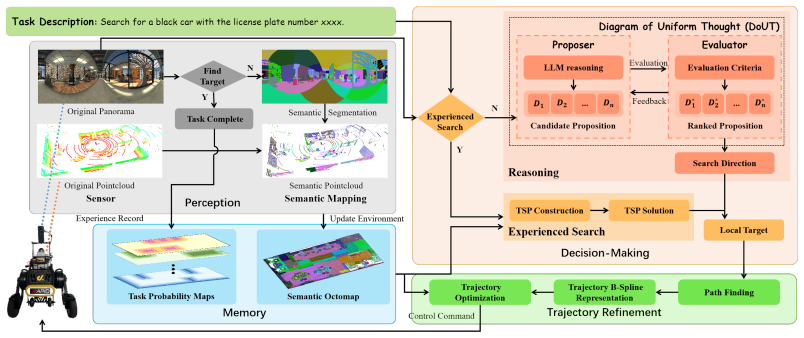
The central mechanism is DoUT (Diagram of Unified Thought), a two-role reasoning loop in which the LLM Proposer generates candidate propositions and an external Evaluator re-ranks them. The Evaluator applies Mandatory Criteria (proposition format and proposition-count checks) and Advisory Criteria, computing a score from four weighted terms: original order, a quadratic obstacle-proximity penalty, an explored-area overlap penalty, and a direction-change penalty, with weights $\lambda_1=2.5$, $\lambda_2=10.0$, $\lambda_3=3.0$, and $\lambda_4=1.5$ in the experiments. The ranked list becomes both the robot's next heading and structured feedback that trains the LLM toward the evaluator's ordering. The second mechanism is the Gaussian-mixture task probability map, which stores each target's historical locations as weighted Gaussian components, merges new findings into existing components, normalizes weights, and thereby fades outdated information; in experienced search these components seed a traveling-salesman tour that visits likely target locations first.
What would settle it
Run GET in an environment where targets are deliberately placed near obstacles or inside previously explored dead-ends, and compare its path length and time-to-find against a frontier-exploration baseline; if GET no longer improves, the evaluator's advisory criteria are not tracking target likelihood and the reported gains cannot be attributed to DoUT's feedback.
Extended reading notes
Core claim
GET's central claim is that LLM-based reasoning can be grounded for real-time robot search by separating proposing from evaluating. An LLM acts as Proposer, reading a segmented panorama and task description and emitting a ranked list of candidate headings; an external Evaluator, using the semantic octomap and a sparse roadmap, re-ranks those headings with mandatory format checks and advisory penalties for obstacle proximity, repeated exploration, and direction change, and feeds the ranked list back to the LLM. This loop is DoUT. For repeated tasks, a Gaussian-mixture task probability map records and gradually fades object-location priors, and a traveling-salesman tour visits likely locations first. In the reported experiments, first-time search in Scene 1 averaged 390.41 m of travel, 25.2 percent shorter than the Sem baseline and 57.2 percent shorter than EFP; Scene 2 averaged 191.97 m. Repeated same-task search shortened Scene 1 to 353.67 m and Scene 2 to 179.88 m, and changed-target searches stayed near those levels. The authors read these results as evidence that an external evaluator can close the LLM's spatial-grounding gap and that probabilistic experience memory transfers across tasks.
Load-bearing premise
The load-bearing assumption is that the evaluator's fixed scoring criteria—stay away from obstacles, avoid already-explored areas, keep moving consistently—rank the LLM's proposed headings in a way that correlates with where the target actually is; if those scores do not track target presence, the feedback loop can only make the LLM better at following a useless ranking.
Editorial extensions
If this is right
- If GET is right, task-specific fine-tuning is not required to make an LLM useful for embodied search; a hand-specified evaluator and a feedback loop are enough to ground it.
- First-time search in unknown large environments can be planned by semantic reasoning rather than exhaustive frontier expansion, with reported path savings of roughly 25 to 57 percent depending on baseline and scene.
- Repeated and changed-task searches inherit history through a compact probabilistic memory, so average path length and variance drop as the same environment is searched again.
- Because the same evaluator design improved alignment for several different LLMs, the approach appears model-agnostic and could be paired with cheaper or faster language models.
Reading between the lines
- Editorial inference: the evaluator's weights are hand-set rather than derived from target-location statistics, so reporting an ablation of $\lambda_1$ through $\lambda_4$, or learning them from data, would reveal how much of the gain is the feedback loop itself versus the underlying LLM prior.
- Editorial inference: the loop can only be as good as the evaluator's criteria; if those criteria reward obstacle avoidance and exploration coverage but not semantic likelihood, the LLM could converge to a safe, efficient policy that is not actually object-directed.
- Editorial inference: the GMM memory assumes target locations are stable enough across tasks to be worth revisiting; for moving targets or uncorrelated placements, the experience map could actively mislead, and a novelty or forgetfulness mechanism would be needed.
- Editorial inference: the proposer/evaluator separation is general and could be tested in other LLM-guided navigation decisions, such as multi-robot coordination or semantic mapping, wherever a cheap geometric check can score language-generated options.
Editorial analysis
A structured set of objections, weighed in public.
Referee Report
Summary. The paper proposes GET, a framework for object search in large-scale unknown environments that combines an LLM-based Proposer with an external Evaluator module (DoUT) that gives feedback and ranks direction proposals, and a GMM-based task probability map that stores experience for repeated searches. The authors report real-world experiments in two large scenes (an outdoor campus and four interconnected semi-open buildings) comparing GET with Sem, FAEL, EFP, and TARE on path length and search time for first-time, same-task repeated, and changed-task searches. They also evaluate DoUT's effect on several LLMs using cosine similarity between the LLM's proposals and the Evaluator's ranked proposals. The paper claims that GET significantly outperforms heuristic and LLM-only baselines and improves search efficiency and robustness across multiple LLMs and task settings.
Significance. If the reported results hold, GET would be a practically useful contribution to autonomous object search in large unstructured environments. The paper has real strengths: the experiments are conducted on a real robot in two large scenes with moving pedestrians and vehicles; the comparison against four non-LLM exploration heuristics (Sem, FAEL, EFP, TARE) follows their open-source recommendations; the GMM-based experience model is a clean, compact mechanism for exploiting repeated tasks; and the authors explicitly acknowledge that reasoning search cannot guarantee complete coverage and fall back to a TSP-based coverage strategy. These elements support a conditional claim that GET improves upon the tested heuristic baselines. However, the load-bearing evidence for the DoUT component and for the claim of superiority over 'LLM-only baselines' is missing or circular, and no statistical significance tests are reported. The significance of the paper therefore depends on additional experiments or a substantial tempering of the claims.
major comments (4)
- [Abstract, Section 4.2, Tables 1 and 2] The central claim that GET 'significantly outperform[s] heuristic and LLM-only baselines' is not supported by the experiments because no LLM-only baseline appears anywhere in the paper. All comparisons in Tables 1 and 2 are against Sem, FAEL, EFP, and TARE, none of which use an LLM. To support the claim, the authors should add an LLM-only control, for example the same LLM Proposer without the DoUT evaluator feedback or with no evaluator at all, and report path length and time for that control. If such experiments are not feasible, the abstract and conclusion should be revised to restrict the claim to the non-LLM heuristics actually tested.
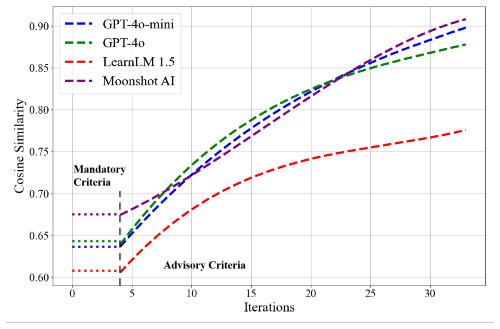
- [Appendix A.5, Eq. (12), Eq. (11)] The multi-LLM evaluation of DoUT is circular in a way that does not establish improved search. Figure 7 and the surrounding text measure cosine similarity between the LLM's candidate propositions D and the Evaluator's ranked propositions D*, but D* is produced by the same hand-designed Evaluator that supplies the feedback, so high similarity only shows that the LLM learned to comply with the Evaluator, not that it found targets faster. This concern is compounded by Eq. (11), where the score includes lambda1 * Order(i), i.e., the LLM's own initial ordering, so D* is partly self-referential. The paper needs an independent validation of the Evaluator's ranking, such as comparing the top-ranked directions against ground-truth target locations in held-out episodes, or an end-to-end ablation with and without DoUT feedback reporting actual search path length and success rate.
- [Tables 1 and 2, Section 4.2] The word 'significantly' is used throughout, but no statistical significance tests are reported. The tables give averages and standard deviations but not the number of experimental runs or per-run values, so a reader cannot determine whether the reported reductions, such as the 25.2% path-length reduction over Sem in Scene 1, are reliable. The authors should report n, individual run results, and appropriate significance tests (e.g., paired bootstrap or Wilcoxon signed-rank tests) for the path-length and time comparisons.
- [Eqs. (8)-(11), Section 4.1, Eq. (1)] The Evaluator's ranking criteria are hand-set and untested as predictors of target location. The weights lambda1=2.5, lambda2=10.0, lambda3=3.0, lambda4=1.5, the safety distance dsafe, and the scaling factor beta are neither derived from target-location statistics nor ablated. If these criteria do not track where objects tend to be, the DoUT feedback loop could align the LLM to a ranking that has no relationship to search success. The paper should provide either an ablation of the criteria/weights or a direct validation that the Evaluator's top-ranked directions are more likely to contain the target than lower-ranked directions.
minor comments (6)
- [Section 1, Contributions] The final contribution bullet contains the typo 'environments' should be 'environments'.
- [Section 3.4] The notation D_t = {D0, D2, ...} should be D_t = {D0, D1, ...}; also 'LimitationsNotably' is missing a space and should be 'Limitations. Notably, ...'.
- [Section 3.6] The ESDF is said to be 'periodically cleared and rebuilt ... after the robot has traveled a certain distance', but that distance is never specified; please give the exact trigger condition.
- [Appendix A.4] The heading 'Compariton between DoUT and DoT' contains a typo; it should be 'Comparison'.
- [References [50], [51]] Reference [50] lists 'Jurenka and et al.' and reference [51] gives only 'Moonshot AI. Kimi, 2023. Accessed: 2025-01-15' without a URL; both entries need complete citation information.
- [Table 3, Section 4.2] The timing table lists panoramic segmentation at 1850.47 ms, GPT-4 response at 527.82 ms, and network delay at 43.15 ms per cycle, which together exceed the stated 2 s semantic-matching interval; please clarify how these modules are pipelined or executed concurrently to maintain real-time operation.
Circularity Check
DoUT's multi-LLM evidence measures cosine similarity to the evaluator's own ranking, which is partly built from the LLM's original ordering, so the claimed 'reasoning accuracy' gain is self-referential.
-
self definitional
[Appendix A.5.1, Eqs. (11)-(12); Section 3.3]
"Ci =λ1Order(i) +λ2Cs,i +λ3Cr,i +λ4Cd,i, ... Order(i) denotes the original index of Di in the list of candidate propositions D generated by the Proposer. ... The cosine similarity metric is used to measure the alignment between the candidate propositions D generated by the LLMs and the ranked propositions D∗ provided by the Evaluator."
The ranked propositions D∗ are produced by the Evaluator using Eq. (11), whose score explicitly includes Order(i), the LLM's own original index of each candidate in D. Therefore D∗ is not an independent ground truth; it is a deterministic function of D plus hand-designed penalties. Eq. (12) then measures DoUT's learning success by the cosine similarity between D and D∗. High similarity is thus partly guaranteed by construction, because D∗ inherits the LLM's original ordering through the λ1Order(i) term.
full rationale
The headline search-efficiency result is not circular: Tables 1 and 2 compare GET against Sem, FAEL, EFP, and TARE, which are independent, non-LLM exploration baselines with identical hardware and parameter settings, and the reported path-length reductions are external empirical outcomes. The GMM-based task probability map is also straightforwardly a memory mechanism: it is updated from successful target finds (Appendix A.1.2) and later used to plan repeated searches, which is an explicit use of history rather than a prediction masquerading as first principles. The main circularity sits in the DoUT evaluation. The paper's evidence that DoUT improves LLM reasoning and generalizes across multiple LLMs is cosine similarity between the LLM's candidate propositions D and the evaluator's ranked propositions D∗ (Eq. 12). But D∗ is generated by Eq. (11), which scores each D_i using a weighted sum that includes Order(i), the LLM's own original ordering. Thus D∗ is partly a function of D itself, and measuring similarity between D and D∗ is, to that extent, measuring self-agreement, not agreement with any independent ground truth about where targets actually are. The paper also claims in the abstract to outperform 'LLM-only baselines,' but no LLM-only control or DoUT-ablation appears in Tables 1-2; that is an evidentiary gap rather than circularity, but it reinforces that the self-referential DoUT metric is the only direct support for the claim that the reasoning loop itself contributes. Overall, because the central efficiency gains are benchmarked externally while the multi-LLM robustness evidence is self-referential, a moderate partial circularity score of 4 is appropriate.
Assumptions & free parameters
free parameters (7)
- lambda_1 =
2.5
- lambda_2 =
10.0
- lambda_3 =
3.0
- lambda_4 =
1.5
- dsafe =
1 m
- beta =
not specified
- N (panorama segments) =
11
assumptions (4)
- domain assumption Grounded-SAM and RAM produce accurate enough semantic masks and labels for target detection in the test scenes.
- domain assumption The evaluator's weighted linear score (Eq. 11) is a valid proxy for which search direction is best.
- domain assumption FAEL, TARE, EFP, and Sem baselines are meaningfully representative of current non-LLM search methods and were implemented per their open-source defaults.
- domain assumption The sparse roadmap from FAEL [35] correctly estimates explored free space for the repeated-exploration penalty (Eq. 9).
Cite this review
Pith. "Pith review of GET: Goal-directed Exploration and Targeting for Large-Scale Unknown Environments." pith.science (2026). https://pith.science/paper/RMUAZ7CP
@misc{pith2026250520828,
  author       = {Pith},
  title        = {Pith review of: GET: Goal-directed Exploration and Targeting for Large-Scale Unknown Environments},
  year         = {2026},
  howpublished = {\url{https://pith.science/paper/RMUAZ7CP}},
  note         = {Machine review of arXiv:2505.20828}
}
read the original abstract
Object search in large-scale, unstructured environments remains a fundamental challenge in robotics, particularly in dynamic or expansive settings such as outdoor autonomous exploration. This task requires robust spatial reasoning and the ability to leverage prior experiences. While Large Language Models (LLMs) offer strong semantic capabilities, their application in embodied contexts is limited by a grounding gap in spatial reasoning and insufficient mechanisms for memory integration and decision consistency.To address these challenges, we propose GET (Goal-directed Exploration and Targeting), a framework that enhances object search by combining LLM-based reasoning with experience-guided exploration. At its core is DoUT (Diagram of Unified Thought), a reasoning module that facilitates real-time decision-making through a role-based feedback loop, integrating task-specific criteria and external memory. For repeated tasks, GET maintains a probabilistic task map based on a Gaussian Mixture Model, allowing for continual updates to object-location priors as environments evolve.Experiments conducted in real-world, large-scale environments demonstrate that GET improves search efficiency and robustness across multiple LLMs and task settings, significantly outperforming heuristic and LLM-only baselines. These results suggest that structured LLM integration provides a scalable and generalizable approach to embodied decision-making in complex environments.
Figures


Figures from the paper (6 more)




Reference graph
Works this paper leans on
-
[1]
Ali Jaboob, Omar Durrah, and Aziza Chakir. Artificial intelligence: An overview.Engineering applications of artificial intelligence, pages 3–22, 2024
work page 2024
-
[2]
Ignacio Martinez-Alpiste, Gelayol Golcarenarenji, Qi Wang, and Jose Maria Alcaraz-Calero. Search and rescue operation using uavs: A case study.Expert Systems with Applications, 178:114937, 2021
work page 2021
-
[3]
Luíza Caetano Garaffa, Maik Basso, Andréa Aparecida Konzen, and Edison Pignaton de Freitas. Reinforcement learning for mobile robotics exploration: A survey.IEEE Transactions on Neural Networks and Learning Systems, 34(8):3796–3810, 2021
work page 2021
-
[4]
A survey of object goal navigation.IEEE Trans
Jingwen Sun, Jing Wu, Ze Ji, and Yu-Kun Lai. A survey of object goal navigation.IEEE Trans. Autom. Sci. Eng., 2024
work page 2024
-
[5]
Online object searching by a humanoid robot in an unknown environment.IEEE Robot
Masato Tsuru, Adrien Escande, Arnaud Tanguy, Kevin Chappellet, and Kensuke Harad. Online object searching by a humanoid robot in an unknown environment.IEEE Robot. Autom. Lett., 6(2):2862–2869, 2021
work page 2021
-
[6]
Yiming Luo, Zixuan Zhuang, Neng Pan, Chen Feng, Shaojie Shen, Fei Gao, Hui Cheng, and Boyu Zhou. Star-searcher: A complete and efficient aerial system for autonomous target search in complex unknown environments.IEEE Robot. Autom. Lett., 9(5):4329–4336, 2024
work page 2024
-
[7]
Hierarchical semantic knowledge-based object search method for household robots.IEEE Trans
Mengyang Zhang, Guohui Tian, Yongcheng Cui, Ying Zhang, and Zhenhua Xia. Hierarchical semantic knowledge-based object search method for household robots.IEEE Trans. Emerg. Top. Comput. Intell., 8(1):930–941, 2024
work page 2024
-
[8]
Tejas D Kulkarni, Karthik R Narasimhan, Ardavan Saeedi, and Joshua B Tenenbaum. Hierar- chical deep reinforcement learning: integrating temporal abstraction and intrinsic motivation. InProc. 30th Int. Conf. Neural Inf. Process. Syst., pages 3682–3690, 2016
work page 2016
Show all 71 references
-
[9]
Efficient robotic object search via hiem: Hierarchical policy learning with intrinsic-extrinsic modeling.IEEE Robot
Xin Ye and Yezhou Yang. Efficient robotic object search via hiem: Hierarchical policy learning with intrinsic-extrinsic modeling.IEEE Robot. Autom. Lett., 6(3):4425–4432, 2021
2021
-
[10]
Goat-bench: A benchmark for multi-modal lifelong navigation
Mukul Khanna, Ram Ramrakhya, Gunjan Chhablani, Sriram Yenamandra, Theophile Gervet, Matthew Chang, Zsolt Kira, Devendra Singh Chaplot, Dhruv Batra, and Roozbeh Mottaghi. Goat-bench: A benchmark for multi-modal lifelong navigation. InProc. IEEE/CVF Conf. Comput. Vis. Pattern Re...
2024
-
[11]
Do as i can, not as i say: Grounding language in robotic affordances
Anthony Brohan, Yevgen Chebotar, Chelsea Finn, Karol Hausman, Alexander Herzog, Daniel Ho, Julian Ibarz, Alex Irpan, Eric Jang, Ryan Julian, et al. Do as i can, not as i say: Grounding language in robotic affordances. InConference on robot learning, pages 287–318. PMLR, 2023
2023
-
[12]
Pre-trained language models for interactive decision-making.Advances in Neural Information Processing Systems, 35:31199–31212, 2022
Shuang Li, Xavier Puig, Chris Paxton, Yilun Du, Clinton Wang, Linxi Fan, Tao Chen, De-An Huang, Ekin Akyürek, Anima Anandkumar, et al. Pre-trained language models for interactive decision-making.Advances in Neural Information Processing Systems, 35:31199–31212, 2022
2022
-
[13]
Retrieval-augmented generation for large language models: A survey.arXiv preprint arXiv:2312.10997, 2023
Yunfan Gao, Yun Xiong, Xinyu Gao, Kangxiang Jia, Jinliu Pan, Yuxi Bi, Yi Dai, Jiawei Sun, Meng Wang, and Haofen Wang. Retrieval-augmented generation for large language models: A survey.arXiv preprint arXiv:2312.10997, 2023
2023 arXiv
-
[14]
Larimar: Large language models with episodic memory control.arXiv preprint arXiv:2403.11901, 2024
Payel Das, Subhajit Chaudhury, Elliot Nelson, Igor Melnyk, Sarath Swaminathan, Sihui Dai, Aurélie Lozano, Georgios Kollias, Vijil Chenthamarakshan, Soham Dan, et al. Larimar: Large language models with episodic memory control.arXiv preprint arXiv:2403.11901, 2024. 10
2024 arXiv
-
[15]
Autonomous exploration in a cluttered environment for a mobile robot with 2d-map segmentation and object detection
Hyungseok Kim, Hyeongjin Kim, Seonil Lee, and Hyeonbeom Lee. Autonomous exploration in a cluttered environment for a mobile robot with 2d-map segmentation and object detection. IEEE Robot. Autom. Lett., 7(3):6343–6350, 2022
2022
-
[16]
Autonomous exploration and simultane- ous object search using aerial robots
Tung Dang, Christos Papachristos, and Kostas Alexis. Autonomous exploration and simultane- ous object search using aerial robots. InProc. IEEE Aerosp. Conf., pages 1–7, 2018
2018
-
[17]
Finding things in the unknown: Semantic object-centric exploration with an mav
Sotiris Papatheodorou, Nils Funk, Dimos Tzoumanikas, Christopher Choi, Binbin Xu, and Stefan Leutenegger. Finding things in the unknown: Semantic object-centric exploration with an mav. InProc. IEEE Int. Conf. Robot. Autom., pages 3339–3345, 2023
2023
-
[18]
Autonomous teamed exploration of subterranean environments using legged and aerial robots
Mihir Kulkarni, Mihir Dharmadhikari, Marco Tranzatto, Samuel Zimmermann, Victor Reijgwart, Paolo De Petris, Huan Nguyen, Nikhil Khedekar, Christos Papachristos, Lionel Ott, et al. Autonomous teamed exploration of subterranean environments using legged and aerial robots. InProc...
2022
-
[19]
Trajectory planning and the target search by the mobile robot in an environment using a behavior-based neural network approach.Robotica, 38(9):1627–1641, 2020
Krishna Kant Pandey and Dayal R Parhi. Trajectory planning and the target search by the mobile robot in an environment using a behavior-based neural network approach.Robotica, 38(9):1627–1641, 2020
2020
-
[20]
Real- time object detection network in uav-vision based on cnn and transformer.IEEE Trans
Tao Ye, Wenyang Qin, Zongyang Zhao, Xiaozhi Gao, Xiangpeng Deng, and Yu Ouyang. Real- time object detection network in uav-vision based on cnn and transformer.IEEE Trans. Instrum. Meas., 72:1–13, 2023
2023
-
[21]
Goat: Go to any thing.arXiv preprint arXiv:2311.06430, 2023
Matthew Chang, Theophile Gervet, Mukul Khanna, Sriram Yenamandra, Dhruv Shah, So Yeon Min, Kavit Shah, Chris Paxton, Saurabh Gupta, Dhruv Batra, et al. Goat: Go to any thing.arXiv preprint arXiv:2311.06430, 2023
2023 arXiv
-
[22]
Visual navigation with multiple goals based on deep reinforcement learning.IEEE Trans
Zhenhuan Rao, Yuechen Wu, Zifei Yang, Wei Zhang, Shijian Lu, Weizhi Lu, and ZhengJun Zha. Visual navigation with multiple goals based on deep reinforcement learning.IEEE Trans. Neural Netw. Learn. Syst., 32(12):5445–5455, 2021
2021
-
[23]
Deep reinforcement learning based computation offloading and trajectory planning for multi-uav cooperative target search.IEEE J
Quyuan Luo, Tom H Luan, Weisong Shi, and Pingzhi Fan. Deep reinforcement learning based computation offloading and trajectory planning for multi-uav cooperative target search.IEEE J. Sel. Areas Commun., 41(2):504–520, 2022
2022
-
[24]
Target-driven visual navigation in indoor scenes using deep reinforcement learning
Yuke Zhu, Roozbeh Mottaghi, Eric Kolve, Joseph J Lim, Abhinav Gupta, Li Fei-Fei, and Ali Farhadi. Target-driven visual navigation in indoor scenes using deep reinforcement learning. In Proc. IEEE Int. Conf. Robot. Autom., pages 3357–3364, 2017
2017
-
[25]
Target-driven visual navigation in indoor scenes using reinforcement learning and imitation learning.CAAI Trans
Qiang Fang, Xin Xu, Xitong Wang, and Yujun Zeng. Target-driven visual navigation in indoor scenes using reinforcement learning and imitation learning.CAAI Trans. Intell. Technol., 7(2):167–176, 2022
2022
-
[26]
Drl-searcher: A unified approach to multirobot efficient search for a moving target.IEEE Trans
Hongliang Guo, Qihang Peng, Zhiguang Cao, and Yaochu Jin. Drl-searcher: A unified approach to multirobot efficient search for a moving target.IEEE Trans. Neural Netw. Learn. Syst., 35(3):3215–3228, 2024
2024
-
[27]
Vision-and-language navigation: Interpreting visually-grounded navigation instructions in real environments
Peter Anderson, Qi Wu, Damien Teney, Jake Bruce, Mark Johnson, Niko Sünderhauf, Ian Reid, Stephen Gould, and Anton Van Den Hengel. Vision-and-language navigation: Interpreting visually-grounded navigation instructions in real environments. InProc. IEEE Conf. Comput. Vis. Patte...
2018
-
[28]
Soat: A scene-and object-aware transformer for vision-and-language navigation.Adv
Abhinav Moudgil, Arjun Majumdar, Harsh Agrawal, Stefan Lee, and Dhruv Batra. Soat: A scene-and object-aware transformer for vision-and-language navigation.Adv. Neural Inf. Process. Syst., 34:7357–7367, 2021
2021
-
[29]
Envedit: Environment editing for vision-and-language navigation
Jialu Li, Hao Tan, and Mohit Bansal. Envedit: Environment editing for vision-and-language navigation. InProc. IEEE/CVF Conf. Comput. Vis. Pattern Recognit., pages 15407–15417, 2022
2022
-
[30]
Kerm: Knowledge enhanced reasoning for vision-and-language navigation
Xiangyang Li, Zihan Wang, Jiahao Yang, Yaowei Wang, and Shuqiang Jiang. Kerm: Knowledge enhanced reasoning for vision-and-language navigation. InProc. IEEE/CVF Conf. Comput. Vis. Pattern Recognit., pages 2583–2592, 2023. 11
2023
-
[31]
Learning hierarchical interactive multi-object search for mobile manipulation.IEEE Robot
Fabian Schmalstieg, Daniel Honerkamp, Tim Welschehold, and Abhinav Valada. Learning hierarchical interactive multi-object search for mobile manipulation.IEEE Robot. Autom. Lett., 8(12):8549–8556, 2023
2023
-
[32]
Language-grounded dynamic scene graphs for interactive object search with mobile manipulation.IEEE Robot
Daniel Honerkamp, Martin Büchner, Fabien Despinoy, Tim Welschehold, and Abhinav Val- ada. Language-grounded dynamic scene graphs for interactive object search with mobile manipulation.IEEE Robot. Autom. Lett., 9(10):8298–8305, 2024
2024
-
[33]
V oxposer: Composable 3d value maps for robotic manipulation with language models
Wenlong Huang, Chen Wang, Ruohan Zhang, Yunzhu Li, Jiajun Wu, and Li Fei-Fei. V oxposer: Composable 3d value maps for robotic manipulation with language models. InConf. Robot Learn., pages 540–562, 2023
2023
-
[34]
cat-shaped mug
Vishnu Sashank Dorbala, James F Mullen Jr, and Dinesh Manocha. Can an embodied agent find your “cat-shaped mug”? llm-based zero-shot object navigation.IEEE Robot. Autom. Lett., 9(5):4083–4090, 2024
2024
-
[35]
Fael: fast autonomous exploration for large-scale environments with a mobile robot
Junlong Huang, Boyu Zhou, Zhengping Fan, Yilin Zhu, Yingrui Jie, Longwei Li, and Hui Cheng. Fael: fast autonomous exploration for large-scale environments with a mobile robot. IEEE Robot. Autom. Lett., 8(3):1667–1674, 2023
2023
-
[36]
Tare: A hierarchical framework for efficiently exploring complex 3d environments
Chao Cao, Hongbiao Zhu, Howie Choset, and Ji Zhang. Tare: A hierarchical framework for efficiently exploring complex 3d environments. InProc. Robot.: Sci. and Syst., July 2021
2021
-
[37]
Efp: Efficient frontier-based autonomous uav exploration strategy for unknown environments.IEEE Robotics and Automation Letters, 9(3):2941–2948, 2024
Hong Zhang, Songyan Wang, Yuanshuai Liu, Pengtao Ji, Runzhuo Yu, and Tao Chao. Efp: Efficient frontier-based autonomous uav exploration strategy for unknown environments.IEEE Robotics and Automation Letters, 9(3):2941–2948, 2024
2024
-
[38]
Seal: Self-supervised embodied active learning using exploration and 3d consistency
Devendra Singh Chaplot, Murtaza Dalal, Saurabh Gupta, Jitendra Malik, and Russ R Salakhut- dinov. Seal: Self-supervised embodied active learning using exploration and 3d consistency. Adv. Neural Inf. Process. Syst., 34:13086–13098, 2021
2021
-
[39]
Vision–language navigation with beam-constrained global normalization.IEEE Trans
Liang Xie, Meishan Zhang, You Li, Wei Qin, Ye Yan, and Erwei Yin. Vision–language navigation with beam-constrained global normalization.IEEE Trans. Neural Netw. Learn. Syst., 35(1):1352–1363, 2022
2022
-
[40]
Towards learning a generalist model for embodied navigation
Duo Zheng, Shijia Huang, Lin Zhao, Yiwu Zhong, and Liwei Wang. Towards learning a generalist model for embodied navigation. InProc. IEEE/CVF Conf. Comput. Vis. Pattern Recognit., pages 13624–13634, 2024
2024
-
[41]
Grounded sam: Assembling open-world models for diverse visual tasks, 2024
Tianhe Ren, Shilong Liu, Ailing Zeng, Jing Lin, Kunchang Li, He Cao, Jiayu Chen, Xinyu Huang, Yukang Chen, Feng Yan, et al. Grounded sam: Assembling open-world models for diverse visual tasks, 2024
2024
-
[42]
Recognize anything: A strong image tagging model
Youcai Zhang, Xinyu Huang, Jinyu Ma, Zhaoyang Li, Zhaochuan Luo, Yanchun Xie, Yuzhuo Qin, Tong Luo, Yaqian Li, Shilong Liu, et al. Recognize anything: A strong image tagging model. InProc. IEEE/CVF Conf. Comput. Vis. Pattern Recognit., pages 1724–1732, 2024
2024
-
[43]
Semantic octree mapping and shannon mutual information computation for robot exploration.IEEE Trans
Arash Asgharivaskasi and Nikolay Atanasov. Semantic octree mapping and shannon mutual information computation for robot exploration.IEEE Trans. Robot., 39(3):1910–1928, 2023
1910
-
[44]
Gaussian mixture models.Encycl
Douglas A Reynolds et al. Gaussian mixture models.Encycl. Biometrics, 741(659-663), 2009
2009
-
[45]
On the diagram of thought.arXiv preprint arXiv:2409.10038, 2024
Yifan Zhang, Yang Yuan, and Andrew Chi-Chih Yao. On the diagram of thought.arXiv preprint arXiv:2409.10038, 2024
2024 arXiv
-
[46]
Robust and efficient quadrotor trajectory generation for fast autonomous flight.IEEE Robot
Boyu Zhou, Fei Gao, Luqi Wang, Chuhao Liu, and Shaojie Shen. Robust and efficient quadrotor trajectory generation for fast autonomous flight.IEEE Robot. Autom. Lett., 4(4):3529–3536, 2019
2019
-
[47]
Fast-lio2: Fast direct lidar-inertial odometry.IEEE Trans
Wei Xu, Yixi Cai, Dongjiao He, Jiarong Lin, and Fu Zhang. Fast-lio2: Fast direct lidar-inertial odometry.IEEE Trans. Robot., 38(4):2053–2073, 2022
2022
-
[48]
Gpt-4 tech
Josh Achiam, Steven Adler, Sandhini Agarwal, Lama Ahmad, Ilge Akkaya, Florencia Leoni Aleman, Diogo Almeida, Janko Altenschmidt, Sam Altman, Shyamal Anadkat, et al. Gpt-4 tech. report.arXiv preprint arXiv:2303.08774, 2023. 12
2023 arXiv
-
[49]
Probabilistic robotics.Commun
Sebastian Thrun. Probabilistic robotics.Commun. ACM, 45(3):52–57, 2002
2002
-
[50]
Towards responsible development of generative ai for education: An evaluation-driven approach
Irina Jurenka and et al. Towards responsible development of generative ai for education: An evaluation-driven approach. Tech. report, Google, 2024
2024
-
[51]
Kimi, 2023
Moonshot AI. Kimi, 2023. Accessed: 2025-01-15. A Technical Appendices and Supplementary Material A.1 Task Probability Map The Task Probability Map utilizes the Gaussian Mixture Model (GMM) at each layer to represent the probability distribution of target locations, with each G...
2023
-
[52]
Adding a New Gaussian ComponentA new Gaussian componentG new ={π new, µnew,Σ new} is added to the model. Its parameters are defined as: µnew =p, Σnew =σ 2I, πnew = 1 m+ 1 , (5) where m is the number of existing components in the GMM, and σ2 is proportional to the object’s size...
-
[53]
Merging Gaussian ComponentsIf the Euclidean distance ∥µnew −µ i∥ between the new component Gnew and an existing component Gi is smaller than the sum of their standard deviations, they are merged. The updated parameters of the Gaussian componentG ′ i are: µ′ i = πi ·µ i +π new ...
-
[54]
With each new experience, it updates the target object’s location while reducing the influence of outdated data
Gaussian Component Weight NormalizationThe weights of all components are normalized as follows: πj = πjPm k=1 πk .(7) This process allows the GMM to dynamically adapt to environmental changes. With each new experience, it updates the target object’s location while reducing the...
-
[55]
Proposition Format:In its initial attempts, the Proposer may fail to generate propositions in the structured format required by the Evaluator, such as D={D 0;D 1;D 2;· · · }, as shown in Fig. 2 (c1). In such cases, the Evaluator provides direct feedback specifying the expected...
-
[56]
2 (c2) and Fig
Proposition Mismatch:If the number of items in the candidate propositions D generated by the Proposer does not match the number of segments derived from the environmental panorama, the Evaluator flags this inconsistency and provides corrective feedback, as shown in Fig. 2 (c2)...
-
[57]
The real- time point cloud is divided into N regions, each uniquely corresponding to a candidate proposition Di ∈ Dfrom the environmental panorama
Security CriteriaThis penalizes propositions that bring the robot closer to obstacles. The real- time point cloud is divided into N regions, each uniquely corresponding to a candidate proposition Di ∈ Dfrom the environmental panorama. For each region, the distance di to the ne...
-
[58]
To quantify the degree of redundancy, a sparse roadmap [35] is constructed for the obstacle-free regions the robot has already traversed
Repeated Exploration CriteriaThis penalizes propositions that lead the robot toward previously explored areas. To quantify the degree of redundancy, a sparse roadmap [35] is constructed for the obstacle-free regions the robot has already traversed. The areas enclosed by the ed...
-
[59]
The penalty Cd,i for candidateD i is: Cd,i = 1−cos(θ i −θ t−1)(10) whereθ i is the direction ofD i, andθ t−1 is the direction at the previous timestep
Direction Change PenaltyThis penalizes propositions where the direction at timestep t deviates significantly from the robot’s movement direction at t−1 , causing frequent changes in movement direction, which can lead to inefficiencies or excessive energy consumption. The penal...
-
[60]
If D∗ fails to meet the criteria below, the next best-ranked direction in D∗ is selected as the newD ∗
Top-ranked directionThe highest-ranked direction D∗ is initially chosen as the robot’s intended movement. If D∗ fails to meet the criteria below, the next best-ranked direction in D∗ is selected as the newD ∗
-
[61]
Additionally, the distance from the target cell to the nearest occupied cell must exceed the robot’s size, providing sufficient clearance for safe navigation
ReachabilityThe selected direction must lead to a free cell in the semantic octomap, ensuring accessibility to avoid collisions with static or dynamic obstacles. Additionally, the distance from the target cell to the nearest occupied cell must exceed the robot’s size, providin...
-
[62]
This ensures sufficient travel distance and prevents the robot from halting upon reaching the local target during DoUT reasoning cycles, thereby maintaining continuous movement
Continuous MovementThe local target should maintain an appropriate distance from the robot’s current position, ideally positioned at the center of the designated direction D∗. This ensures sufficient travel distance and prevents the robot from halting upon reaching the local t...
-
[63]
Time-Intensive Reasoning:The iterative nature of DoT requires multiple reasoning cycles for each task, introducing delays in decision-making and slowing down the robot’s response time, which limits its real-time adaptability
-
[64]
Compromised Integrity:Changing search targets or adapting to new objectives often requires reconfiguring the Critic’s evaluation criteria. Such frequent modifications to the internal structure of the LLM risk disrupting its overall integrity, potentially leading to unpredictab...
-
[65]
This dependence increases system complexity and reduces reasoning efficiency, as the model must continuously retrieve and process external data
Application-Specific Coupling:Many critics rely heavily on external resources, such as maps, requiring frequent access to external memory. This dependence increases system complexity and reduces reasoning efficiency, as the model must continuously retrieve and process external data
-
[66]
This limitation restricts the robot’s ability to respond effectively to rapidly changing conditions
Challenges in Adaptive Response:Robotic applications inherently involve uncertainty [ 49], but DoT’s single-reasoning approach lacks the adaptability required for time-sensitive and dynamic environments. This limitation restricts the robot’s ability to respond effectively to r...
-
[67]
Integrity:By centralizing the evaluation process within an external Evaluator, DoUT eliminates the need for internal modifications of the LLM’s evaluation criteria, thereby preserving its integrity
-
[68]
This design achieves decoupling, reduces system complexity, and mitigates risks associated with unauthorized or inconsistent memory access
Decoupling:The Evaluator centralizes and standardizes memory access, avoiding direct access by the LLM. This design achieves decoupling, reduces system complexity, and mitigates risks associated with unauthorized or inconsistent memory access
-
[69]
This approach enhances decision-making speed and accelerates robotic responses
Parallel Acceleration:DoUT replaces iterative critique with parallel evaluation, significantly reducing the number of reasoning iterations. This approach enhances decision-making speed and accelerates robotic responses
-
[70]
Improved Spatial Awareness:The Evaluator compensates for the Proposer’s limitations, enhanc- ing overall performance in 3D environments
-
[71]
Flexible Output:Through a scoring mechanism, the Evaluator provides a ranked list of candidate propositions, allowing the robot to dynamically adjust its decisions in real-time based on the actual environmental conditions. DoUT provides a streamlined and adaptive solution that...
Reviewed August 7, 2026 · model on record in the stance chip above.
Discussion (0). Continue with ORCID to comment.