REVIEW 3 major objections 5 minor 54 references
Unified Alignment Protocol: Making Sense of the Unlabeled Data in New Domains
T0 review · 3 major / 5 minor · reviewed 2026-08-07 · deepseek-v4-flash
Pith's one-line read A communication-free feature-alignment protocol lets unlabeled clients generalize to unseen domains in semi-supervised federated learning.
desk verdict A genuinely new federated problem setting with a plausible method and large claimed gains, but the evidence as presented is too uneven to accept the SOTA claim at face value. read the letter →
The pith
A machine-rendered reading of the paper's core claim, the machinery that carries it, and where it could break.
The reading
What carries the argument
The load-bearing object is the per-class dynamic Gaussian distribution $q_k = N(w_k^G, \lambda I)$ built from the server classifier's weight vectors. Contrastive Domain Discrepancy (CDD) loss, a class-conditioned maximum mean discrepancy, pulls server features toward $q_k$ while pushing different classes apart, and a covariance matching loss $L_{\text{COV}}$ pushes both server and client feature covariances toward a diagonal reference $\gamma\Sigma_k$. The trick that makes the protocol communication-free is that the client never needs the mean vector $\mu_k$ sent separately: the protocol assumes the classifier weights end up equal to the feature means, so the weights themselves are the distribution parameters.
What would settle it
Measure the distance between each trained classifier weight vector and the true mean of its class's server features, on any standard DG dataset, at the end of Stage-I. If that distance is comparable to the within-class feature spread, clients reconstruct a distribution the server features do not actually follow, and UAP's gains should shrink toward the SSFL baseline; conversely, a near-zero distance would confirm the mechanism.
Extended reading notes
Core claim
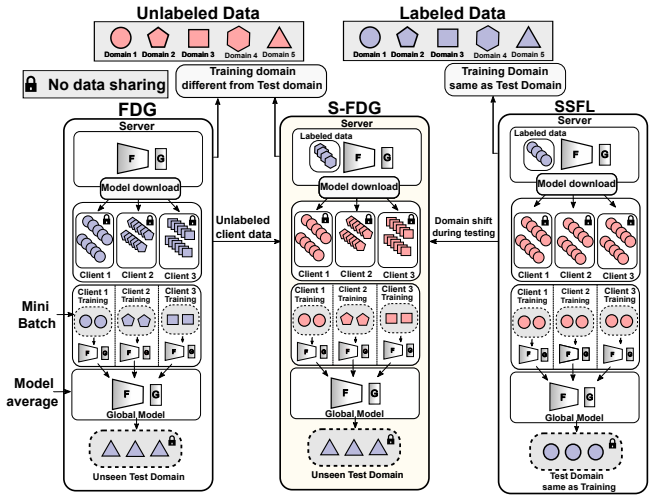
On the paper's own terms, the central discovery is that a semi-supervised federated system can generalize to unseen domains if the server's per-class features are shaped into a known parametric distribution whose parameters ride for free inside the already-sent model weights. The server trains with $L_{\text{CE}} + \alpha L_{\text{CDD}} + \beta L_{\text{COV}}$ so that classifier weight $w_k^G$ equals the class-$k$ feature mean $\mu_k$ and the class covariance collapses to $\lambda I$; clients then reconstruct $N(w_k^G, \lambda I)$ as the server feature distribution, pseudo-label their unlabeled data, and minimize the same CDD and covariance losses against it. The result is a training protocol that claims state-of-the-art S-FDG performance, with the headline PACS gain from 52.20% to 75.73% on the Art Painting test domain compared to the SOTA SSFL method.
Load-bearing premise
The whole protocol assumes that after server training the classifier weight $w_k^G$ actually equals the per-class feature mean $\mu_k$, but no loss term explicitly enforces that equality; it is only encouraged indirectly by pulling features toward the current weights.
Editorial extensions
If this is right
- This is the first formulation of S-FDG; the paper's evaluation setup, with one labeled server domain, unlabeled client domains, and an unseen test domain, gives future work a concrete benchmark to compare against.
- UAP consistently improves unseen-domain accuracy over SSFL baselines across PACS, VLCS, OfficeHome, RotatedMNIST, and TerraIncognita, and across VGG11, ResNet18, DenseNet121, and DeiT-B architectures.
- The alignment costs no additional communication overhead, so the generalization gains come within the same bandwidth budget as a plain SSFL training round.
- The combination of CDD and covariance matching is robust to noisy pseudo-labels; ablation results show each loss component contributes to the final gain.
- The method is insensitive to the number of clients in the tested range, with only a small drop as decentralization increases, matching the usual federated learning trend.
Reading between the lines
- If the weight-mean equality is only approximate, one could add an explicit loss term that pulls $w_k^G$ toward the feature means, which would likely strengthen the client-side alignment; the paper's own sensitivity to $\lambda$ suggests the margin in the current protocol is testable.
- The same embedding trick could generalize to other parametric families, such as mixture models or von Mises-Fisher distributions for directional features, letting clients reconstruct richer server distributions at zero communication cost.
- In cross-institution healthcare deployment, the protocol suggests that unlabeled hospital clients could improve a shared model's performance on new patient populations without sharing raw data; a natural next test is on medical imaging benchmarks with stricter privacy guarantees.
Editorial analysis
A structured set of objections, weighed in public.
Referee Report
Summary. The paper introduces a new problem setting, Semi-Supervised Federated Domain Generalization (S-FDG), in which a central server has limited labeled data, clients have unlabeled data, and the deployed model must generalize to an unseen domain. The proposed Unified Alignment Protocol (UAP) alternates between two stages: Stage-I trains the server so that per-class feature distributions become Gaussian with mean equal to the classifier weight vector and a known diagonal covariance; Stage-II trains clients, using pseudo-labels, to align their feature distributions to the same parametric distribution. The authors claim that the server feature distribution can be transferred to clients at zero additional communication cost because the classifier weights themselves are the distribution means. Experiments on PACS, VLCS, OfficeHome, RotatedMNIST, and TerraIncognita report large gains over SSFL and FDG baselines, including a roughly 37% absolute accuracy improvement on an unseen PACS domain.
Significance. If the central mechanism is sound, UAP addresses a real and under-studied gap between SSFL and FDG, with a communication-efficient way to share distributional information. The paper is the first to formulate S-FDG, and it evaluates across multiple datasets and architectures, which is a useful contribution. However, the central technical premise—that classifier weights equal per-class feature means after server training—is asserted rather than enforced or verified, and the reported experimental numbers are internally inconsistent. These issues must be resolved before the claimed SOTA results can be relied upon. The paper currently does not ship code, multiple seeds, or error bars, so the magnitude of the reported improvements cannot be independently assessed.
major comments (3)
- [4.1, Eq. (2)] The assertion that after Stage-I training the classifier weights satisfy w_k^G = mu_k for all k is not enforced by any term in the server loss L_server = L_CE + alpha*L_CDD + beta*L_COV. L_CDD pulls features toward the dynamic Gaussian N(w_k^G, lambda*I), but nothing pulls the weights toward the empirical feature means. For a softmax classifier trained with cross-entropy, the optimal weight vector is not generally the class-mean vector; the identity holds only under restrictive conditions (e.g., spherical class-conditional Gaussians with equal priors and a specific bias, or terminal-phase neural collapse, which is not demonstrated here). Since this equality is the basis for the zero-communication transfer of the distribution parameters, the authors must either add an explicit loss term penalizing ||w_k^G - mu_k||, provide empirical measurements showing that the mismatch is negligible, and/or analyze how a residual mismatch affects the client alignment objective. Without this, the central premise of the method is unverified.
- [Tables 1, 2, 5, 15] The reported UAP results on PACS are internally inconsistent. Table 1 reports UAP accuracy on the unseen Art Painting domain as 64.84 for Photo and 61.67 for Sketch, while Table 5 reports 64.40 for Photo and 67.92 for Sketch for the same experimental setting (server trained on Photo/Sketch, test on Art Painting). Table 15 lists Sketch=67.92 for the gamma=1.0 row, which conflicts with Table 1. The abstract and Section 1 also cite a ~37% improvement based on these numbers, but the gain depends on which table entry is used. The authors should reconcile these numbers and state explicitly whether different seeds, training configurations, or table construction errors are responsible.
- [5 and 6] The experimental evaluation reports no error bars, no multiple seeds, and no code release. Given that the claimed gains are large (e.g., average improvements of 22-33% over SSFL on several domains) and that the method has several hyperparameters (alpha, beta, lambda, gamma), single-run results are insufficient to support the SOTA claim. The paper should report mean and standard deviation over at least three independent runs with different seeds, and ideally release code to enable verification.
minor comments (5)
- [5] The hyperparameter values are inconsistent: Section 5 states gamma=100, but the ablation in Table 15 uses gamma values of 0.5, 1.0, and 2.0, with the main UAP results corresponding to gamma=1.0. Please clarify the actual value used in the main experiments.
- [Figure 2 caption] The caption contains a typo: 'Sever Feature Alignment' should be 'Server Feature Alignment'.
- [References] Reference [7] is incomplete ('Enmao Diao and et al.'); the full author list should be provided.
- [4.2] The pseudo-label generation via weighted k-means clustering is mentioned but not described; details on how the clustering is performed in the federated setting, how initial centroids are selected, and how the 'weighted' aspect is implemented would improve reproducibility.
- [4.1, Eq. (4)] The reference covariance matrix Sigma is defined vaguely: the text says Sigma = gamma*Sigma_k, but Sigma_k is not defined. Clarify whether it is the per-class covariance, a fixed diagonal matrix, or the empirical covariance of the current mini-batch.
Circularity Check
Zero-overhead distribution transfer is self-definitional: clients align to a Gaussian target whose mean is the server's own classifier weights.
-
self definitional
[Section 4.1 (Eq. 2) and Section 4.2 (Client Feature Alignment)]
"we generate the server feature distributions per class using the classifier weight w_G as follows p_s(z|y=k) = N_k(w_k^G, λ·I), ∀k ∈ C"
In Stage-II the distribution that clients are told to match is not the measured or estimated server feature distribution; it is defined, via Eq. (2), as the Gaussian q_k = N_k(w_k^G, λI) whose mean is the server classifier weight vector. The paper then renames this constructed target as p_s(z|y=k). Consequently, the 'no additional communication overhead' claim follows immediately from the definition (the parameters are the already-transmitted weights) rather than from any learned or measured distribution. Client alignment to p_s is alignment to a self-defined target, and the asserted equality w_k^G = μ_k is only an indirect consequence of L_CDD, with no explicit loss term penalizing the weight-mean difference.
full rationale
The paper does not rely on self-citations; the SOTA generalization results are evaluated on unseen test domains against external baselines, so the central empirical claim is independently grounded. However, the much-emphasized zero-overhead communication of the server feature distribution is self-definitional: the 'server distribution' is defined as N(w_k^G, λI), i.e., in terms of the classifier weights that are already communicated. The paper's own Eq. (2) sets q_k = N_k(w_k^G, λI), and Stage-II simply relabels this target as p_s(z|y=k). Thus the zero-overhead mechanism is true by construction, and the asserted identity w_k^G = μ_k is an unverified premise rather than a derived result. This is a partial, self-referential circularity in the protocol's justification, but it does not invalidate the external performance comparisons, so the overall circularity score is moderate rather than high.
Assumptions & free parameters
free parameters (4)
- alpha (L_CDD weight) =
1.0
- beta (L_COV weight) =
1.0
- lambda (Gaussian covariance scale) =
0.01
- gamma (reference covariance scale) =
100 (with lambda=0.01, effective scale 1.0)
assumptions (4)
- domain assumption Server per-class features p_s(z|y=k) can be represented as a multivariate Gaussian N(mu_k, Sigma_k).
- ad hoc to paper After server training, classifier weights equal the class feature means: w_k^G = mu_k for all k.
- domain assumption Client covariance matrices can be regularized toward a shared diagonal reference matrix to improve generalization and reduce pseudo-label noise.
- domain assumption Pseudo-labels generated by weighted k-means centroids are reliable enough for per-class alignment under domain shift.
Cite this review
Pith. "Pith review of Unified Alignment Protocol: Making Sense of the Unlabeled Data in New Domains." pith.science (2026). https://pith.science/paper/ABCUPXMI
@misc{pith2026250521010,
  author       = {Pith},
  title        = {Pith review of: Unified Alignment Protocol: Making Sense of the Unlabeled Data in New Domains},
  year         = {2026},
  howpublished = {\url{https://pith.science/paper/ABCUPXMI}},
  note         = {Machine review of arXiv:2505.21010}
}
read the original abstract
Semi-Supervised Federated Learning (SSFL) is gaining popularity over conventional Federated Learning in many real-world applications. Due to the practical limitation of limited labeled data on the client side, SSFL considers that participating clients train with unlabeled data, and only the central server has the necessary resources to access limited labeled data, making it an ideal fit for real-world applications (e.g., healthcare). However, traditional SSFL assumes that the data distributions in the training phase and testing phase are the same. In practice, however, domain shifts frequently occur, making it essential for SSFL to incorporate generalization capabilities and enhance their practicality. The core challenge is improving model generalization to new, unseen domains while the client participate in SSFL. However, the decentralized setup of SSFL and unsupervised client training necessitates innovation to achieve improved generalization across domains. To achieve this, we propose a novel framework called the Unified Alignment Protocol (UAP), which consists of an alternating two-stage training process. The first stage involves training the server model to learn and align the features with a parametric distribution, which is subsequently communicated to clients without additional communication overhead. The second stage proposes a novel training algorithm that utilizes the server feature distribution to align client features accordingly. Our extensive experiments on standard domain generalization benchmark datasets across multiple model architectures reveal that proposed UAP successfully achieves SOTA generalization performance in SSFL setting.
Figures

Reference graph
Works this paper leans on
-
[37]
Gradient Masked Averaging for Federated Learning
Irene Tenison, Sai Aravind Sreeramadas, Vaikkunth Mugun- than, Edouard Oyallon, Eugene Belilovsky, and Irina Rish. Gradient masked averaging for federated learning.arXiv preprint arXiv:2201.11986, 2022. 1, 2, 3, 4, 7, 8
work page Pith review arXiv 2022
-
[1]
Better pseudo-label: Joint domain-aware label and dual- classifier for semi-supervised domain generalization.Pattern Recognition, 133:108987, 2023. 6
work page 2023
-
[2]
Recognition in terra incognita
Sara Beery, Grant Van Horn, and Pietro Perona. Recognition in terra incognita. InProceedings of the European confer- ence on computer vision (ECCV), pages 456–473, 2018. 6, 1, 2
work page 2018
-
[3]
Keith Bonawitz, Hubert Eichner, Wolfgang Grieskamp, Dzmitry Huba, Alex Ingerman, Vladimir Ivanov, Chloe Kid- don, Jakub Kone ˇcn`y, Stefano Mazzocchi, Brendan McMa- han, et al. Towards federated learning at scale: System de- sign.Proceedings of machine learning and systems, 1:374– 388, 2019. 1
work page 2019
-
[4]
Michael Cogswell, Faruk Ahmed, Ross Girshick, Larry Zitnick, and Dhruv Batra. Reducing overfitting in deep networks by decorrelating representations.arXiv preprint arXiv:1511.06068, 2015. 6
arXiv 2015
-
[5]
Ittai Dayan, Holger R Roth, Aoxiao Zhong, Ahmed Harouni, Amilcare Gentili, Anas Z Abidin, Andrew Liu, Anthony Beardsworth Costa, Bradford J Wood, Chien-Sung Tsai, et al. Federated learning for predicting clinical out- comes in patients with covid-19.Nature medicine, 27(10): 1735–1743, 2021. 3
work page 2021
-
[6]
Li Deng. The mnist database of handwritten digit images for machine learning research.IEEE Signal Processing Maga- zine, 29(6):141–142, 2012. 1
work page 2012
-
[7]
Semifl: Semi-supervised feder- ated learning for unlabeled clients with alternate training
Enmao Diao and et al. Semifl: Semi-supervised feder- ated learning for unlabeled clients with alternate training. Advances in Neural Information Processing Systems, 35: 17871–17884, 2022. 1, 2, 3, 4, 7, 8
work page 2022
Show all 54 references
-
[8]
Source-free domain adaptation via distri- bution estimation
Ning Ding, Yixing Xu, Yehui Tang, Chao Xu, Yunhe Wang, and Dacheng Tao. Source-free domain adaptation via distri- bution estimation. In2022 IEEE/CVF Conference on Com- puter Vision and Pattern Recognition (CVPR), pages 7202– 7212, 2022. 5
2022
-
[9]
Rockmore
Chen Fang, Ye Xu, and Daniel N. Rockmore. Unbiased met- ric learning: On the utilization of multiple datasets and web images for softening bias. In2013 IEEE International Con- ference on Computer Vision, pages 1657–1664, 2013. 6, 1, 3
2013
-
[10]
Semi-fedser: Semi- supervised learning for speech emotion recognition on fed- erated learning using multiview pseudo-labeling.arXiv preprint arXiv:2203.08810, 2022
Tiantian Feng and Shrikanth Narayanan. Semi-fedser: Semi- supervised learning for speech emotion recognition on fed- erated learning using multiview pseudo-labeling.arXiv preprint arXiv:2203.08810, 2022. 1
2022 arXiv
-
[11]
Domain-adversarial train- ing of neural networks.The journal of machine learning research, 17(1):2096–2030, 2016
Yaroslav Ganin, Evgeniya Ustinova, Hana Ajakan, Pas- cal Germain, Hugo Larochelle, Franc ¸ois Laviolette, Mario Marchand, and Victor Lempitsky. Domain-adversarial train- ing of neural networks.The journal of machine learning research, 17(1):2096–2030, 2016. 1
2016
-
[12]
Federated semi-supervised learning with inter- client consistency & disjoint learning.arXiv preprint arXiv:2006.12097, 2020
Wonyong Jeong, Jaehong Yoon, Eunho Yang, and Sung Ju Hwang. Federated semi-supervised learning with inter- client consistency & disjoint learning.arXiv preprint arXiv:2006.12097, 2020. 1, 2
2006 arXiv
-
[13]
Contrastive adaptation network for unsupervised do- main adaptation
Guoliang Kang, Lu Jiang, Yi Yang, and Alexander G Haupt- mann. Contrastive adaptation network for unsupervised do- main adaptation. InProceedings of the IEEE/CVF con- ference on computer vision and pattern recognition, pages 4893–4902, 2019. 5
2019
-
[14]
Efficiently assemble normalization layers and regularization for federated domain generalization
Khiem Le, Long Ho, Cuong Do, Danh Le-Phuoc, and Kok- Seng Wong. Efficiently assemble normalization layers and regularization for federated domain generalization. InPro- ceedings of the IEEE/CVF Conference on Computer Vision and Pattern Recognition (CVPR), pages 6027–6036, 2024. 7
2024
-
[15]
Haoliang Li, Sinno Jialin Pan, Shiqi Wang, and Alex C. Kot. Domain generalization with adversarial feature learning. In Proceedings of the IEEE Conference on Computer Vision and Pattern Recognition (CVPR), 2018. 1
2018
-
[16]
Semi-supervised domain adaptation by covariance matching.IEEE transactions on pattern analysis and machine intelligence, 41(11):2724– 2739, 2018
Limin Li and Zhenyue Zhang. Semi-supervised domain adaptation by covariance matching.IEEE transactions on pattern analysis and machine intelligence, 41(11):2724– 2739, 2018. 6
2018
-
[17]
Class balanced adap- tive pseudo labeling for federated semi-supervised learning
Ming Li, Qingli Li, and Yan Wang. Class balanced adap- tive pseudo labeling for federated semi-supervised learning. InProceedings of the IEEE/CVF conference on computer vi- sion and pattern recognition, pages 16292–16301, 2023. 7, 8, 2
2023
-
[18]
Transferable semantic augmenta- tion for domain adaptation
Shuang Li, Mixue Xie, Kaixiong Gong, Chi Harold Liu, Yulin Wang, and Wei Li. Transferable semantic augmenta- tion for domain adaptation. InProceedings of the IEEE/CVF Conference on Computer Vision and Pattern Recognition (CVPR), pages 11516–11525, 2021. 5
2021
-
[19]
Fedbn: Federated learning on non-iid features via local batch normalization.arXiv preprint arXiv:2102.07623, 2021
Xiaoxiao Li, Meirui Jiang, Xiaofei Zhang, Michael Kamp, and Qi Dou. Fedbn: Federated learning on non-iid features via local batch normalization.arXiv preprint arXiv:2102.07623, 2021. 1
2021 arXiv
-
[20]
Do we really need to access the source data? source hypothesis transfer for un- supervised domain adaptation
Jian Liang, Dapeng Hu, and Jiashi Feng. Do we really need to access the source data? source hypothesis transfer for un- supervised domain adaptation. InInternational Conference on Machine Learning (ICML), pages 6028–6039, 2020. 4, 6
2020
-
[21]
Rscfed: Random sampling consensus federated semi-supervised learning
Xiaoxiao Liang, Yiqun Lin, Huazhu Fu, Lei Zhu, and Xi- aomeng Li. Rscfed: Random sampling consensus federated semi-supervised learning. InProceedings of the IEEE/CVF conference on computer vision and pattern recognition, pages 10154–10163, 2022. 7, 8, 2
2022
-
[22]
Semifed: Semi-supervised federated learning with consistency and pseudo-labeling.arXiv preprint arXiv:2108.09412, 2021
Haowen Lin, Jian Lou, Li Xiong, and Cyrus Sha- habi. Semifed: Semi-supervised federated learning with consistency and pseudo-labeling.arXiv preprint arXiv:2108.09412, 2021. 1
2021 arXiv
-
[23]
Feddg: Federated domain generalization on medical image segmentation via episodic learning in continuous fre- quency space
Quande Liu, Cheng Chen, Jing Qin, Qi Dou, and Pheng-Ann Heng. Feddg: Federated domain generalization on medical image segmentation via episodic learning in continuous fre- quency space. InProceedings of the IEEE/CVF Conference on Computer Vision and Pattern Recognition, pages ...
2021
-
[24]
Feddg: Federated domain generalization on medical image segmentation via episodic learning in continuous fre- quency space
Quande Liu, Cheng Chen, Jing Qin, Qi Dou, and Pheng-Ann Heng. Feddg: Federated domain generalization on medical image segmentation via episodic learning in continuous fre- quency space. InProceedings of the IEEE/CVF Conference on Computer Vision and Pattern Recognition, pages ...
2021
-
[25]
Fedcon: A contrastive framework for federated semi-supervised learning.arXiv preprint arXiv:2109.04533, 2021
Zewei Long, Jiaqi Wang, Yaqing Wang, Houping Xiao, and Fenglong Ma. Fedcon: A contrastive framework for federated semi-supervised learning.arXiv preprint arXiv:2109.04533, 2021. 1
2021 arXiv
-
[26]
Federated learn- ing with server learning: Enhancing performance for non-iid data.arXiv preprint arXiv:2210.02614, 2022
Van Sy Mai, Richard J La, and Tao Zhang. Federated learn- ing with server learning: Enhancing performance for non-iid data.arXiv preprint arXiv:2210.02614, 2022. 1
2022 arXiv
-
[27]
Communication- efficient learning of deep networks from decentralized data
Brendan McMahan, Eider Moore, Daniel Ramage, Seth Hampson, and Blaise Aguera y Arcas. Communication- efficient learning of deep networks from decentralized data. InArtificial intelligence and statistics, pages 1273–1282. PMLR, 2017. 1
2017
-
[28]
Domain generalization via invariant fea- ture representation
Krikamol Muandet, David Balduzzi, and Bernhard Sch¨olkopf. Domain generalization via invariant fea- ture representation. InInternational conference on machine learning, pages 10–18. PMLR, 2013. 1
2013
-
[29]
A comprehensive review of federated learning for covid-19 de- tection.International Journal of Intelligent Systems, 37(3): 2371–2392, 2022
Sadaf Naz, Khoa T Phan, and Yi-Ping Phoebe Chen. A comprehensive review of federated learning for covid-19 de- tection.International Journal of Intelligent Systems, 37(3): 2371–2392, 2022. 1
2022
-
[30]
Domain invariant representation learning with do- main density transformations.Advances in Neural Informa- tion Processing Systems, 34:5264–5275, 2021
A Tuan Nguyen, Toan Tran, Yarin Gal, and Atilim Gunes Baydin. Domain invariant representation learning with do- main density transformations.Advances in Neural Informa- tion Processing Systems, 34:5264–5275, 2021. 1
2021
-
[31]
Kl guided domain adaptation.arXiv preprint arXiv:2106.07780, 2021
A Tuan Nguyen, Toan Tran, Yarin Gal, Philip HS Torr, and Atılım G ¨unes ¸ Baydin. Kl guided domain adaptation.arXiv preprint arXiv:2106.07780, 2021. 1
2021 arXiv
-
[32]
Tuan Nguyen, Philip Torr, and Ser-Nam Lim
A. Tuan Nguyen, Philip Torr, and Ser-Nam Lim. FedSR: A simple and effective domain generalization method for feder- ated learning. InAdvances in Neural Information Processing Systems, 2022. 1, 2, 3, 7
2022
-
[33]
Stablefdg: style and attention based learning for federated domain general- ization.Advances in Neural Information Processing Systems, 36, 2024
Jungwuk Park, Dong-Jun Han, Jinho Kim, Shiqiang Wang, Christopher Brinton, and Jaekyun Moon. Stablefdg: style and attention based learning for federated domain general- ization.Advances in Neural Information Processing Systems, 36, 2024. 7
2024
-
[34]
Scale-rotation- equivariant lie group convolution neural networks (lie group- cnns).arXiv preprint arXiv:2306.06934, 2023
Wei-Dong Qiao, Yang Xu, and Hui Li. Scale-rotation- equivariant lie group convolution neural networks (lie group- cnns).arXiv preprint arXiv:2306.06934, 2023. 6, 1
2023 arXiv
-
[35]
Deep coral: Correlation alignment for deep domain adaptation
Baochen Sun and Kate Saenko. Deep coral: Correlation alignment for deep domain adaptation. InComputer Vision– ECCV 2016 Workshops: Amsterdam, The Netherlands, Oc- tober 8-10 and 15-16, 2016, Proceedings, Part III 14, pages 443–450. Springer, 2016. 6
2016
-
[36]
Deep coral: Correlation alignment for deep domain adaptation
Baochen Sun and Kate Saenko. Deep coral: Correlation alignment for deep domain adaptation. InComputer Vision– ECCV 2016 Workshops: Amsterdam, The Netherlands, Oc- tober 8-10 and 15-16, 2016, Proceedings, Part III 14, pages 443–450. Springer, 2016. 1
2016
-
[38]
Privacy-preserving speech emotion recognition through semi-supervised federated learning
Vasileios Tsouvalas, Tanir Ozcelebi, and Nirvana Merat- nia. Privacy-preserving speech emotion recognition through semi-supervised federated learning. In2022 IEEE Interna- tional Conference on Pervasive Computing and Communica- tions Workshops and other Affiliated Events (PerC...
2022
-
[39]
Deep hashing network for unsupervised domain adaptation
Hemanth Venkateswara, Jose Eusebio, Shayok Chakraborty, and Sethuraman Panchanathan. Deep hashing network for unsupervised domain adaptation. InProceedings of the IEEE conference on computer vision and pattern recogni- tion, pages 5018–5027, 2017. 6, 1, 3
2017
-
[40]
Gpl: Generative pseudo labeling for unsuper- vised domain adaptation of dense retrieval.arXiv preprint arXiv:2112.07577, 2021
Kexin Wang, Nandan Thakur, Nils Reimers, and Iryna Gurevych. Gpl: Generative pseudo labeling for unsuper- vised domain adaptation of dense retrieval.arXiv preprint arXiv:2112.07577, 2021. 6
2021 arXiv
-
[41]
Deep domain adaptation by geodesic distance minimization
Yifei Wang, Wen Li, Dengxin Dai, and Luc Van Gool. Deep domain adaptation by geodesic distance minimization. In Proceedings of the IEEE International Conference on Com- puter Vision Workshops, pages 2651–2657, 2017. 6
2017
-
[42]
Implicit semantic data augmenta- tion for deep networks
Yulin Wang, Xuran Pan, Shiji Song, Hong Zhang, Gao Huang, and Cheng Wu. Implicit semantic data augmenta- tion for deep networks. InAdvances in Neural Information Processing Systems. Curran Associates, Inc., 2019. 5
2019
-
[43]
Federated semi-supervised learning with class dis- tribution mismatch.arXiv preprint arXiv:2111.00010, 2021
Zhiguo Wang, Xintong Wang, Ruoyu Sun, and Tsung-Hui Chang. Federated semi-supervised learning with class dis- tribution mismatch.arXiv preprint arXiv:2111.00010, 2021. 1
2021 arXiv
-
[44]
Pacs: A dataset for physical audiovisual commonsense reasoning
Samuel Yu, Peter Wu, Paul Pu Liang, Ruslan Salakhutdinov, and Louis-Philippe Morency. Pacs: A dataset for physical audiovisual commonsense reasoning. InEuropean Confer- ence on Computer Vision, pages 292–309. Springer, 2022. 6, 8, 1, 2
2022
-
[45]
Federated learning with domain generalization
Liling Zhang, Xinyu Lei, Yichun Shi, Hongyu Huang, and Chao Chen. Federated learning with domain generalization. arXiv preprint arXiv:2111.10487, 2021. 2, 3
2021 arXiv
-
[46]
Federated domain general- ization with generalization adjustment
Ruipeng Zhang, Qinwei Xu, Jiangchao Yao, Ya Zhang, Qi Tian, and Yanfeng Wang. Federated domain general- ization with generalization adjustment. InProceedings of the IEEE/CVF Conference on Computer Vision and Pattern Recognition (CVPR), pages 3954–3963, 2023. 7, 1
2023
-
[47]
Federated domain general- ization with generalization adjustment
Ruipeng Zhang, Qinwei Xu, Jiangchao Yao, Ya Zhang, Qi Tian, and Yanfeng Wang. Federated domain general- ization with generalization adjustment. InProceedings of the IEEE/CVF Conference on Computer Vision and Pattern Recognition, pages 3954–3963, 2023. 1, 2, 3, 4, 8
2023
-
[48]
Gonzalez, Kannan Ramchandran, and Michael W
Zhengming Zhang, Yaoqing Yang, Zhewei Yao, Yujun Yan, Joseph E. Gonzalez, Kannan Ramchandran, and Michael W. Mahoney. Improving semi-supervised federated learning by reducing the gradient diversity of models. In2021 IEEE In- ternational Conference on Big Data (Big Data), pages...
2021
-
[49]
The details of these benchmark datasets are listed below
Datasets We assessed the performance of our proposed UAP on five widely used visual benchmarks commonly used for evalu- ating domain generalization methods. The details of these benchmark datasets are listed below. PACS [44]:This dataset is a collection of 9,991 images with fo...
-
[50]
More concretely, in a dataset with Mdomains, one domain is used for the server, another for testing, and the rest,M−2domains, are distributed amongM−2clients
Implementation Details For performance evaluation, we allocated one domain as the server dataset and another as the unseen test domain for the final global model, assigning the remaining domains to individual clients. More concretely, in a dataset with Mdomains, one domain is ...
-
[51]
There are 6 domains in Ro- tatedMNIST dataset:M 0, M15, M30, M45, M60, andM 75
Results on RotatedMNIST The evaluation of UAP is presented in Tables 9, 10 and 11 on the RotatedMNIST dataset. There are 6 domains in Ro- tatedMNIST dataset:M 0, M15, M30, M45, M60, andM 75. For reporting result of each combination, we allocated one domain as the server traini...
-
[52]
We report performance of global model on the unseen Art domain of OfficeHome [44] dataset in Table 12 and on L100 test domain of TerraIncognita [2] dataset in Ta- ble 13
Comparison with SSFL and FDG Methods Here, we compare our proposed UAP with SOTA SSFL methods [7, 17, 21] as well as SOTA FDG methods [23, 32, 37, 47]. We report performance of global model on the unseen Art domain of OfficeHome [44] dataset in Table 12 and on L100 test domain...
-
[53]
Effect of differentα&β: In Table 14a, we present the impact of varyingαandβrespectively
Abltation Study All our ablation studies for hyperparameters are conducted using the PACS [44] benchmark dataset, with Art Painting as the unseen test domain and Cartoon and Photo as the server domains. Effect of differentα&β: In Table 14a, we present the impact of varyingαand...
-
[54]
From the results we see that the general- ization performance of UAP degrades slightly with sketch as test domain
Remaining Results PACS:The evaluation of UAP is presented in Table 16 on the PACS dataset. From the results we see that the general- ization performance of UAP degrades slightly with sketch as test domain. Again this can be attributed to the weaker Table 15.Ablation study on t...
Reviewed August 7, 2026 · model on record in the stance chip above.
Discussion (0). Sign in to comment.