REVIEW 4 major objections 6 minor 75 references
A Cross Modal Knowledge Distillation & Data Augmentation Recipe for Improving Transcriptomics Representations through Morphological Features
T0 review · 4 major / 6 minor · reviewed 2026-08-07 · deepseek-v4-flash
Pith's one-line read Freezing a pretrained microscopy encoder and training only a small gene-expression adapter — Semi-Clipped — distills morphology into transcriptomics under weak pairing, and PEA augmentation lifts recall of known biology on unseen datasets.
desk verdict Solid empirical recipe for distilling morphology into transcriptomics, but the load-bearing weak-pairing assumption is only indirectly tested; a permutation-pairing control would settle it. read the letter →
The pith
A machine-rendered reading of the paper's core claim, the machinery that carries it, and where it could break.
The reading
What carries the argument
The load-bearing object is the Semi-Clipped objective: the CLIP contrastive loss computed between frozen teacher embeddings $z_T$ (microscopy) and adapted student embeddings $h_S = f_S(z_S)$, where the adapter $f_S$ — a three-layer MLP — is the only trainable component. Training nothing on the image side enforces one-way knowledge transfer and prevents mutual drift between modalities that share little information. The second mechanism is PEA (Perturbation Embedding Augmentation), a stochastic function $A$ drawn from a set of batch-correction transformations — centering, center-scaling, and Typical Variation Normalization (TVN) — applied to student embeddings during training, with a random subset of correction steps dropped and a random subset of control samples used for the correction. This repurposes a standard post-processing cleanup step as a source of controlled training variation, while a fixed TVN correction is applied to the teacher embeddings and to all embeddings at evaluation time.
What would settle it
Replace the random within-group pairing with replicate-matched pairing (image and expression from the same biological replicate) and retrain: if known-relationship recall does not rise, the weak pairing was not what carried the signal. A second check is to compare adapter outputs with the mean embedding of each (cell line, perturbation) batch, since a collapse toward batch-level averages would show that PEA's batch corrections, not biological alignment, explain the gains.
Extended reading notes
Core claim
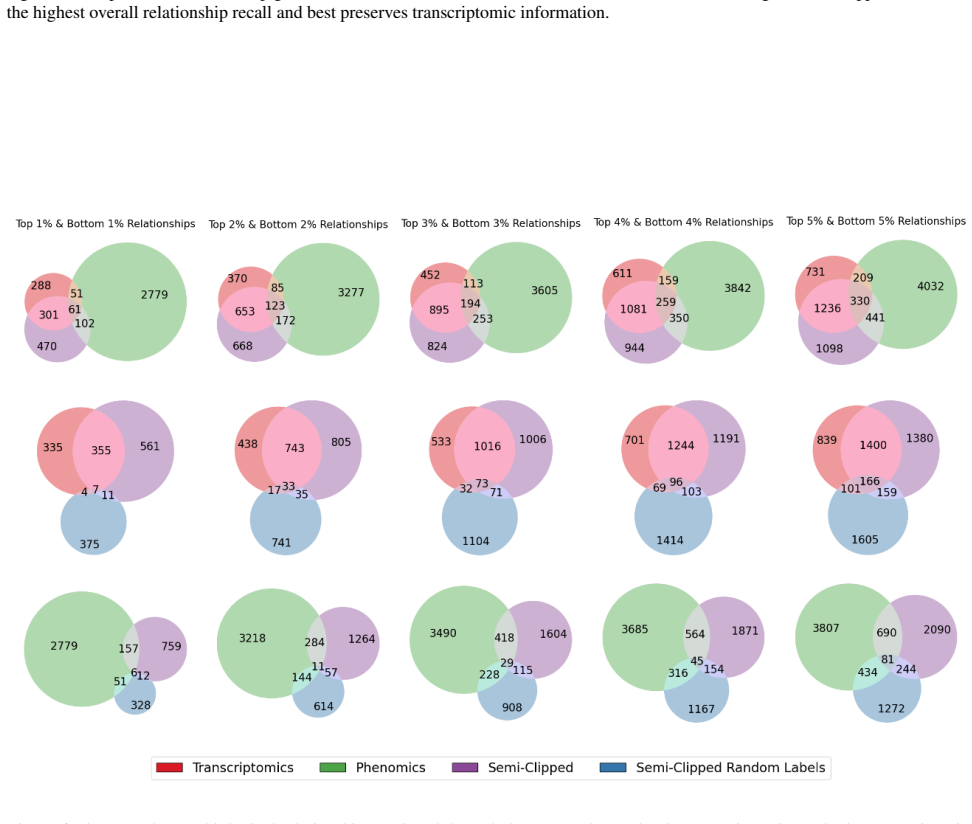
The central claim is that a label-free distillation recipe, Semi-Clipped, outperforms both label-supervised distillation methods and other multimodal alignment baselines at enriching transcriptomics representations with morphology, and that the gains survive large distribution shifts. The teacher is the frozen Phenom-1 microscopy encoder; the student is a frozen transcriptomics encoder (scVI, an scVI-like MLP, or scGPT) whose embeddings pass through a three-layer adapter trained with the CLIP loss against the teacher space. Pairing is deliberately weak: each epoch, one transcriptomics sample and one microscopy image are matched at random solely because they share cell line and perturbation. On retrieval of known biological relationships, Semi-Clipped leads on HUVEC-KO and SC-RPE1, matches the best unsupervised methods on LINCS, and stays close to the unimodal baseline on transcriptomic interpretability. PEA alone improves relationship recall over no augmentation by 17% on HUVEC-KO, 55% on LINCS, and 20% on SC-RPE1; stacking it on top of all compared augmentations raises those gains to 25%, 69%, and 26%. The paper further claims that Semi-Clipped, uniquely among the compared methods, retrieves relationships absent from both unimodal modalities, with enriched cell-cycle and post-translational-modification pathways.
Load-bearing premise
The load-bearing premise is that randomly pairing one gene-expression sample with one microscopy image per epoch — matched only by shared cell line and perturbation, not by biological replicate — gives the training enough signal to transfer real morphological knowledge into gene expression; the paper itself concedes that such random pairing may dilute representation quality when subtle differences exist within a treatment group.
Editorial extensions
If this is right
- Representations produced by the recipe improve known-biological-relationship recall on out-of-distribution data: unseen CRISPR knockouts in HUVEC-KO, the L1000 assay in LINCS, and single-cell transcriptomics in SC-RPE1.
- Label-free distillation beats label-supervised distillation (KD, SHAKE, C2KD) in this setting, which suggests that weak biological labels are too coarse to serve as the training signal for cross-modal transfer.
- Because only a small adapter is trained, the recipe is inexpensive: 1.3 million weakly paired samples distill in about 19 hours on a single GPU, so the method can scale as weakly paired multimodal datasets grow.
- PEA is a drop-in augmentation: it improves KD, SHAKE, and VICReg as well as Semi-Clipped, with statistically significant gains across all three out-of-distribution datasets.
- The distilled representations recover relationships that neither unimodal modality retrieves on its own, enriched for cell-cycle and post-translational-modification pathways, indicating synergy rather than purely additive transfer.
Reading between the lines
- Extension: the same frozen-teacher, trainable-adapter recipe should apply to other modality pairs, such as proteomics or metabolomics as students of microscopy, whenever weakly paired batches share a biological state.
- Extension: random pairing sets the method's ceiling, so replacing it with concentration- or time-matched pairing is the most direct untested route to higher recall, and the paper's own Discussion points to within-group dilution as the residual error source.
- Extension: the emergent cell-cycle enrichment invites a dissection the paper does not perform — ablating only the random control-subset sampling inside PEA, with all other components fixed, would test whether that specific stochasticity exposes the cross-modal synergy.
- Extension: the benchmarks measure recall of already-annotated relationships, so a prospective test of whether enriched embeddings improve a real drug-discovery decision, such as hit ranking in a screening campaign, remains open.
Editorial analysis
A structured set of objections, weighed in public.
Referee Report
Summary. This paper proposes and evaluates a recipe for improving transcriptomics representations by distilling knowledge from microscopy images under weakly paired, data-scarce conditions. The method, Semi-Clipped, freezes a pretrained microscopy encoder (Phenom-1) and a transcriptomics encoder (scVI or scGPT) and trains only an adapter with a CLIP-style contrastive loss, using one randomly chosen microscopy image per transcriptomics sample per epoch as a positive pair. The paper also introduces PEA, which stochastically applies batch-correction transformations (centering, scaling, TVN) as data augmentation during adapter training. Evaluations on three OOD transcriptomics datasets (HUVEC-KO, LINCS, SC-RPE1) report improved Known Biological Relationship Recall while largely preserving Transcriptomic Interpretability, with 15-seed averages and Wilcoxon tests in Table 1 and a monotonic PEA-component ablation in Table 2. The authors claim that the approach achieves state-of-the-art cross-modal distillation and that PEA synergizes with existing augmentations.
Significance. If the claims hold, the paper offers a computationally efficient and practical recipe: it transfers morphological information into a unimodal transcriptomics representation, works under data scarcity, and improves OOD relationship recall. The empirical backbone is credible: 15-seed averages with standard deviations, Wilcoxon signed-rank tests, and a monotonic PEA ablation. The main weakness is that the central mechanism—random weak pairing as a carrier of morphology-to-transcriptomics signal—is not directly tested, and some interpretability claims are contradicted by Table 1. With a pairing control and corrected claims, this would be a solid contribution.
major comments (4)
- [Section 4, Algorithm 1, Section 6] The core claim that Semi-Clipped transfers morphological knowledge depends on positive pairs in Algorithm 1 carrying information beyond the shared condition label. Since pairs are formed by randomly sampling one microscopy image per transcriptomics sample per epoch based only on cell line, perturbation, and concentration, the method could reduce to aligning treatment/concentration categories. The Discussion (Section 6) concedes that random pairing may dilute representation quality when subtle intra-group differences exist. The null experiments in Figures 6 and 7 permute perturbation labels of an already trained model and therefore do not test whether training-time pair assignments matter. I recommend a control experiment that breaks pairing at training time—e.g., permuting image embeddings across perturbations while keeping all other hyperparameters fixed—and reporting whether relationship recall drops. If it does not drop, the reported gains should be attributed to regularization/distribution alignment rather than morphological distillation.
- [Section 5.2, Table 1] The statement that 'PEA consistently enhances performance across all three OOD datasets for every distillation approach' and that it 'significantly improves Transcriptomic Interpretability' is contradicted by Table 1: for SC-RPE1, SHAKE+PEA decreases Tx Preservation from 36.95±0.46 to 36.15±0.51 and VICReg+PEA decreases it from 36.75±0.17 to 36.33±0.22. Please restrict the claim to Known Relationship Recall or define an aggregate metric with a significance test; as written, the interpretability-preservation claim is overbroad.
- [Reproducibility] The manuscript does not provide code, trained adapters, or public access to the HUVEC-CMPD training data. Because the method is an empirical recipe with no formal guarantees, the central results cannot be independently reproduced or stress-tested by reviewers. At minimum, release the training and evaluation code, and provide a data-sharing or re-creation plan for the training set.
- [Section 5.3, Table 3] The emergent-synergy claim is based on GSEA p-values without multiple-testing correction; Table 3 lists dozens of pathways, several with p-values around 0.03–0.05, and the claim that KD, SHAKE, and VICReg 'fail to significantly enrich any biological pathway' may reflect threshold effects. Report corrected q-values (e.g., BH-FDR) and the number of gene sets tested, or temper the synergy claim.
minor comments (6)
- [Figure 2] Add error bars or confidence intervals to the 5-seed results; as shown, the visual comparisons do not convey variance.
- [Algorithm 1] The line 'Apply TVN correction to teacher embeddings: zb S = B(zT)' uses the student subscript for a teacher quantity; rename to avoid confusion.
- [Section 4] Clarify whether the one randomly selected pair per epoch is sampled with or without replacement within a batch, and whether the 20,000 microscopy images are reused across epochs; this affects interpretation of the weak-pairing signal.
- [Figure 4 caption] The word 'Detailled' should be 'Detailed'.
- [Related Works] The XKD reference (Sarkar & Etemad) lacks a year and venue; complete the citation.
- [Table 1 caption] State that the reported p-values apply only to improvements; the two decreases in Tx Preservation for SC-RPE1 are not covered by the significance claim.
Circularity Check
No significant circularity: the distillation and augmentation results are not pre-wired to the evaluation metric, and the self-cited benchmark is externally validated.
full rationale
I find no step in the derivation chain that reduces to its own inputs. Semi-Clipped optimizes a standard CLIP contrastive loss (Algorithm 1) between a trainable student adapter output h_S and frozen teacher embeddings z_T; the teacher encoder is fixed before training, and the evaluation metric (Known Biological Relationship Recall) is never used as a training objective, so the reported gains are not fitted by construction. PEA is an input-space stochastic batch-correction augmentation rather than a fit to the benchmark; its components are standard centering, scaling, and TVN. The evaluation framework is taken from the authors' prior work (Bendidi et al., 2024b), but that self-citation is not load-bearing: the benchmark is validated against external databases (CORUM, HuMAP, StringDB, Reactome, SIGNOR) and is applied uniformly to all baselines and to the proposed method, so it does not smuggle in the conclusion. The Discussion's caveat that random pairing within treatment groups may dilute representation quality is a genuine validation risk and would be best addressed by a permutation-pairing control, but it is not a circularity: random weak pairing is an input assumption, not a quantity derived from the evaluation metric. Minor self-citations exist, but none carries the argument by itself; the central claim has independent empirical content.
Assumptions & free parameters
free parameters (6)
- CLIP temperature tau =
0.1
- Adapter learning rate =
0.001
- Batch size =
1024
- Training epochs =
150
- Adapter architecture dimensions =
256 input, 512 and 1024 hidden, 768 output
- PEA step-drop and control-sampling randomization =
not specified numerically
assumptions (4)
- domain assumption Samples sharing cell line, perturbation, and concentration are weakly paired and represent comparable biological states.
- domain assumption Frozen pretrained encoders provide embedding spaces that are compatible enough for a small MLP adapter to align transcriptomics to microscopy.
- domain assumption Batch correction using control samples removes technical variation while preserving perturbation signal.
- domain assumption Known relationship recall on top and bottom 5% cosine similarities of aggregated gene embeddings is a valid proxy for biological utility.
Cite this review
Pith. "Pith review of A Cross Modal Knowledge Distillation & Data Augmentation Recipe for Improving Transcriptomics Representations through Morphological Features." pith.science (2026). https://pith.science/paper/4SOTNR5A
@misc{pith2026250521317,
  author       = {Pith},
  title        = {Pith review of: A Cross Modal Knowledge Distillation & Data Augmentation Recipe for Improving Transcriptomics Representations through Morphological Features},
  year         = {2026},
  howpublished = {\url{https://pith.science/paper/4SOTNR5A}},
  note         = {Machine review of arXiv:2505.21317}
}
read the original abstract
Understanding cellular responses to stimuli is crucial for biological discovery and drug development. Transcriptomics provides interpretable, gene-level insights, while microscopy imaging offers rich predictive features but is harder to interpret. Weakly paired datasets, where samples share biological states, enable multimodal learning but are scarce, limiting their utility for training and multimodal inference. We propose a framework to enhance transcriptomics by distilling knowledge from microscopy images. Using weakly paired data, our method aligns and binds modalities, enriching gene expression representations with morphological information. To address data scarcity, we introduce (1) Semi-Clipped, an adaptation of CLIP for cross-modal distillation using pretrained foundation models, achieving state-of-the-art results, and (2) PEA (Perturbation Embedding Augmentation), a novel augmentation technique that enhances transcriptomics data while preserving inherent biological information. These strategies improve the predictive power and retain the interpretability of transcriptomics, enabling rich unimodal representations for complex biological tasks.
Figures


Figures from the paper (4 more)



Reference graph
Works this paper leans on
-
[1]
write newline
" write newline "" before.all 'output.state := FUNCTION n.dashify 't := "" t empty not t #1 #1 substring "-" = t #1 #2 substring "--" = not "--" * t #2 global.max substring 't := t #1 #1 substring "-" = "-" * t #2 global.max substring 't := while if t #1 #1 substring * t #2 global.max substring 't := if while FUNCTION format.date year duplicate empty "emp...
-
[2]
Rotation-agnostic image representation learning for digital pathology
Alfasly, S., Shafique, A., Nejat, P., Khan, J., Alsaafin, A., Alabtah, G., and Tizhoosh, H. Rotation-agnostic image representation learning for digital pathology. In CVPR, 2024
work page 2024
-
[3]
Ando, D. M., McLean, C. Y., and Berndl, M. Improving phenotypic measurements in high-content imaging screens. bioRxiv, July 2017
work page 2017
-
[4]
Vicreg: Variance-invariance-covariance regularization for self-supervised learning
Bardes, A., Ponce, J., and LeCun, Y. Vicreg: Variance-invariance-covariance regularization for self-supervised learning. In ICLR, 2022
work page 2022
-
[5]
No free lunch in self supervised representation learning, 2023
Bendidi, I., Bardes, A., Cohen, E., Lamiable, A., Bollot, G., and Genovesio, A. No free lunch in self supervised representation learning, 2023
work page 2023
-
[6]
Exploring self-supervised learning biases for microscopy image representation
Bendidi, I., Bardes, A., Cohen, E., Lamiable, A., Bollot, G., and Genovesio, A. Exploring self-supervised learning biases for microscopy image representation. Biological Imaging, 4, 2024 a . doi:10.1017/S2633903X2400014X
-
[7]
Bendidi, I., Whitfield, S., Kenyon-Dean, K., Yedder, H. B., Mesbahi, Y. E., Noutahi, E., and Denton, A. K. Benchmarking transcriptomics foundation models for perturbation analysis : one pca still rules them all. In NeurIPS AIDrugX Workshop, 2024 b
work page 2024
-
[8]
Bourriez, N., Bendidi, I., Cohen, E., Watkinson, G., Sanchez, M., Bollot, G., and Genovesio, A. ChAda-ViT : Channel Adaptive Attention for Joint Representation Learning of Heterogeneous Microscopy Image . In CVPR, 2024
work page 2024
Show all 75 references
-
[9]
Integrating single-cell transcriptomics with cellular phenotypes: cell morphology, ca2+ imaging and electrophysiology
Camunas-Soler, J. Integrating single-cell transcriptomics with cellular phenotypes: cell morphology, ca2+ imaging and electrophysiology. Biophys. Rev., 16 0 (1): 0 89--107, February 2024
2024
-
[10]
E., Jones, T
Carpenter, A. E., Jones, T. R., Lamprecht, M. R., Clarke, C., Kang, I. H., Friman, O., Guertin, D. A., Chang, J. H., Lindquist, R. A., Moffat, J., Golland, P., and Sabatini, D. M. CellProfiler : image analysis software for identifying and quantifying cell phenotypes. Genome Bi...
2006
-
[11]
M., Lazar, N
Celik, S., Hütter, J.-C., Carlos, S. M., Lazar, N. H., Mohan, R., Tillinghast, C., Biancalani, T., Fay, M. M., Earnshaw, B. A., and Haque, I. S. Building, benchmarking, and exploring perturbative maps of transcriptional and morphological data. PLOS Computational Biology, 20 0 ...
2024 doi
-
[12]
N., Ackerman, J., Alix, E., Ando, D
Chandrasekaran, S. N., Ackerman, J., Alix, E., Ando, D. M., Arevalo, J., Bennion, M., Boisseau, N., Borowa, A., Boyd, J. D., Brino, L., Byrne, P. J., Ceulemans, H., Ch'ng, C., Cimini, B. A., Clevert, D.-A., Deflaux, N., Doench, J. G., Dorval, T., Doyonnas, R., Dragone, V., Eng...
2023
-
[13]
J., Ding, T., Lu, M
Chen, R. J., Ding, T., Lu, M. Y., Williamson, D. F. K., Jaume, G., Song, A. H., Chen, B., Zhang, A., Shao, D., Shaban, M., Williams, M., Oldenburg, L., Weishaupt, L. L., Wang, J. J., Vaidya, A., Le, L. P., Gerber, G., Sahai, S., Williams, W., and Mahmood, F. Towards a general-...
2024
-
[14]
W., Gaffney, D
Conesa, A., Madrigal, P., Tarazona, S., Gomez-Cabrero, D., Cervera, A., McPherson, A., Szcze \'s niak, M. W., Gaffney, D. J., Elo, L. L., Zhang, X., and Mortazavi, A. A survey of best practices for RNA-seq data analysis. Genome Biol., 17 0 (1), December 2016
2016
-
[15]
Diffdock: Diffusion steps, twists, and turns for molecular docking
Corso, G., Stärk, H., Jing, B., Barzilay, R., and Jaakkola, T. Diffdock: Diffusion steps, twists, and turns for molecular docking. In ICLR, 2023
2023
-
[16]
scGPT : toward building a foundation model for single-cell multi-omics using generative AI
Cui, H., Wang, C., Maan, H., Pang, K., Luo, F., Duan, N., and Wang, B. scGPT : toward building a foundation model for single-cell multi-omics using generative AI . Nat. Methods, 21 0 (8): 0 1470--1480, August 2024
2024
-
[17]
and Taylor, G
DeVries, T. and Taylor, G. W. Dataset augmentation in feature space, 2017
2017
-
[18]
Protein complex prediction with AlphaFold-Multimer
Evans, R., O'Neill, M., Pritzel, A., Antropova, N., Senior, A., Green, T., Z \' dek, A., Bates, R., Blackwell, S., Yim, J., Ronneberger, O., Bodenstein, S., Zielinski, M., Bridgland, A., Potapenko, A., Cowie, A., Tunyasuvunakool, K., Jain, R., Clancy, E., Kohli, P., Jumper, J....
2021
-
[19]
Compressing visual-linguistic model via knowledge distillation
Fang, Z., Wang, J., Hu, X., Wang, L., Yang, Y., and Liu, Z. Compressing visual-linguistic model via knowledge distillation. In ICCV, 2021
2021
-
[20]
M., Kraus, O., Victors, M., Arumugam, L., Vuggumudi, K., Urbanik, J., Hansen, K., Celik, S., Cernek, N., Jagannathan, G., Christensen, J., Earnshaw, B
Fay, M. M., Kraus, O., Victors, M., Arumugam, L., Vuggumudi, K., Urbanik, J., Hansen, K., Celik, S., Cernek, N., Jagannathan, G., Christensen, J., Earnshaw, B. A., Haque, I. S., and Mabey, B. Rxrx3: Phenomics map of biology. bioRxiv, 2023. doi:10.1101/2023.02.07.527350
2023 doi
-
[21]
How molecules impact cells: Unlocking contrastive phenomolecular retrieval
Fradkin, P., Azadi, P., Suri, K., Wenkel, F., Bashashati, A., Sypetkowski, M., and Beaini, D. How molecules impact cells: Unlocking contrastive phenomolecular retrieval. In NeurIPS, 2024
2024
-
[22]
Cross modal distillation for supervision transfer
Gupta, S., Hoffman, J., and Malik, J. Cross modal distillation for supervision transfer. In CVPR, 2016
2016
-
[23]
J., and Rueckert, D
Hager, P., Menten, M. J., and Rueckert, D. Best of Both Worlds: Multimodal Contrastive Learning with Tabular and Imaging Data . In CVPR, pp.\ 23924--23935, Los Alamitos, CA, USA, June 2023. IEEE Computer Society. doi:10.1109/CVPR52729.2023.02291. URL https://doi.ieeecomputerso...
2023
-
[24]
P., and Topcu, U
han Li, P., Chinchali, S. P., and Topcu, U. Csa: Data-efficient mapping of unimodal features to multimodal features, 2024
2024
-
[25]
Distilling the knowledge in a neural network
Hinton, G., Vinyals, O., and Dean, J. Distilling the knowledge in a neural network. In NeurIPS Deep Learning Workshop, 2015
2015
-
[26]
Knowledge distillation from a stronger teacher
Huang, T., You, S., Wang, F., Qian, C., and Xu, C. Knowledge distillation from a stronger teacher. In NeurIPS, 2022
2022
-
[27]
C2kd: Bridging the modality gap for cross-modal knowledge distillation
Huo, F., Xu, W., Guo, J., Wang, H., and Guo, S. C2kd: Bridging the modality gap for cross-modal knowledge distillation. In CVPR, 2024
2024
-
[28]
Jumper, J., Evans, R., Pritzel, A., Green, T., Figurnov, M., Ronneberger, O., Tunyasuvunakool, K., Bates, R., Z \'i dek, A., Potapenko, A., Bridgland, A., Meyer, C., Kohl, S. A. A., Ballard, A. J., Cowie, A., Romera-Paredes, B., Nikolov, S., Jain, R., Adler, J., Back, T., Pete...
2021
-
[29]
J., Urbanik, J., Donhauser, K., Hartford, J., Saberian, S., Sahin, N., Bendidi, I., Celik, S., Fay, M., Vera, J
Kenyon-Dean, K., Wang, Z. J., Urbanik, J., Donhauser, K., Hartford, J., Saberian, S., Sahin, N., Bendidi, I., Celik, S., Fay, M., Vera, J. S. R., Haque, I. S., and Kraus, O. Vitally consistent: Scaling biological representation learning for cell microscopy. In ICML, 2025
2025
-
[30]
Kharchenko, P. V. The triumphs and limitations of computational methods for scRNA-seq . Nat. Methods, 18 0 (7): 0 723--732, July 2021
2021
-
[31]
Augmentation of transcriptomic data for improved classification of patients with respiratory diseases of viral origin
Kircher, M., Chludzinski, E., Krepel, J., Saremi, B., Beineke, A., and Jung, K. Augmentation of transcriptomic data for improved classification of patients with respiratory diseases of viral origin. Int. J. Mol. Sci., 23 0 (5): 0 2481, February 2022
2022
-
[32]
V., Morse, K., Makes, M., Mabey, B., and Earnshaw, B
Kraus, O., Kenyon-Dean, K., Saberian, S., Fallah, M., McLean, P., Leung, J., Sharma, V., Khan, A., Balakrishnan, J., Celik, S., Beaini, D., Sypetkowski, M., Cheng, C. V., Morse, K., Makes, M., Mabey, B., and Earnshaw, B. Masked autoencoders for microscopy are scalable learners...
2024
-
[33]
Lafarge, M. W. and Koelzer, V. H. Rotation invariance and extensive data augmentation: A strategy for the mitosis domain generalization (midog) challenge. In Biomedical Image Registration, Domain Generalisation and Out-of-Distribution Analysis, pp.\ 62--67, Cham, 2022. Springe...
2022
-
[34]
Multimodal emotion recognition using deep generalized canonical correlation analysis with an attention mechanism
Lan, Y.-T., Liu, W., and Lu, B.-L. Multimodal emotion recognition using deep generalized canonical correlation analysis with an attention mechanism. In IJCNN, 2020. doi:10.1109/IJCNN48605.2020.9207625
2020
-
[35]
Decomposed cross-modal distillation for rgb-based temporal action detection
Lee, P., Kim, T., Shim, M., Wee, D., and Byun, H. Decomposed cross-modal distillation for rgb-based temporal action detection. In CVPR, 2023
2023
-
[36]
Exploring representation-level augmentation for code search, 2022
Li, H., Miao, C., Leung, C., Huang, Y., Huang, Y., Zhang, H., and Wang, Y. Exploring representation-level augmentation for code search, 2022
2022
-
[37]
and Zhe, J
Li, L. and Zhe, J. Shadow knowledge distillation: Bridging offline and online knowledge transfer. In NeurIPS, 2022
2022
-
[38]
Mdwgan-gp: data augmentation for gene expression data based on multiple discriminator WGAN-GP
Li, R., Wu, J., Li, G., Liu, J., Xuan, J., and Zhu, Q. Mdwgan-gp: data augmentation for gene expression data based on multiple discriminator WGAN-GP . BMC Bioinformatics, 24 0 (1): 0 427, November 2023
2023
-
[39]
Evaluating the utilities of foundation models in single-cell data analysis
Liu, T., Li, K., Wang, Y., Li, H., and Zhao, H. Evaluating the utilities of foundation models in single-cell data analysis. bioRxiv, September 2023
2023
-
[40]
B., Jordan, M
Lopez, R., Regier, J., Cole, M. B., Jordan, M. I., and Yosef, N. Deep generative modeling for single-cell transcriptomics. Nature Methods, 15 0 (12): 0 1053--1058, 2018
2018
-
[41]
Integrative analysis methods for spatial transcriptomics
Lu, S., F \"u rth, D., and Gillis, J. Integrative analysis methods for spatial transcriptomics. Nat. Methods, 18 0 (11): 0 1282--1283, November 2021
2021
-
[42]
D., McMahon, A
Miao, Z., Humphreys, B. D., McMahon, A. P., and Kim, J. Multi-omics integration in the age of million single-cell data. Nat. Rev. Nephrol., 17 0 (11): 0 710--724, November 2021
2021
-
[43]
You don t need domain-specific data augmentations when scaling self-supervised learning
Moutakanni, T., Oquab, M., Szafraniec, M., Vakalopoulou, M., and Bojanowski, P. You don t need domain-specific data augmentations when scaling self-supervised learning. In NeurIPS, 2024
2024
-
[44]
Single-cell RNA-seq data augmentation using generative fourier transformer
Nouri, N. Single-cell RNA-seq data augmentation using generative fourier transformer. Commun. Biol., 8 0 (1): 0 113, January 2025
2025
-
[45]
Relational knowledge distillation
Park, W., Kim, D., Lu, Y., and Cho, M. Relational knowledge distillation. In CVPR, June 2019
2019
-
[46]
and Plummer, B
Pham, C. and Plummer, B. A. Enhancing feature diversity boosts channel-adaptive vision transformers. In NeurIPS, 2024
2024
-
[47]
W., Hallacy, C., Ramesh, A., Goh, G., Agarwal, S., Sastry, G., Askell, A., Mishkin, P., Clark, J., Krueger, G., and Sutskever, I
Radford, A., Kim, J. W., Hallacy, C., Ramesh, A., Goh, G., Agarwal, S., Sastry, G., Askell, A., Mishkin, P., Clark, J., Krueger, G., and Sutskever, I. Learning transferable visual models from natural language supervision. In NeurIPS, 2021
2021
-
[48]
M., Saunders, R
Replogle, J. M., Saunders, R. A., Pogson, A. N., Hussmann, J. A., Lenail, A., Guna, A., Mascibroda, L., Wagner, E. J., Adelman, K., Lithwick-Yanai, G., Iremadze, N., Oberstrass, F., Lipson, D., Bonnar, J. L., Jost, M., Norman, T. M., and Weissman, J. S. Mapping information-ric...
2022
-
[49]
The chemical space project
Reymond, J.-L. The chemical space project. Acc. Chem. Res., 48 0 (3): 0 722--730, March 2015
2015
-
[50]
S., Krim, H., and Dai, L
Roheda, S., Riggan, B. S., Krim, H., and Dai, L. Cross-modality distillation: A case for conditional generative adversarial networks. In ICASSP, 2018. doi:10.1109/ICASSP.2018.8462082
2018
-
[51]
R., and Leskovec, J
Rosen, Y., Roohani, Y., Agarwal, A., Samotor c an, L., Tabula Sapiens Consortium , Quake, S. R., and Leskovec, J. Universal cell embeddings: A foundation model for cell biology. bioRxiv, November 2023
2023
-
[52]
Optimizing Transformations for Contrastive Learning in a Differentiable Framework, pp.\ 96–105
Ruppli, C., Gori, P., Ardon, R., and Bloch, I. Optimizing Transformations for Contrastive Learning in a Differentiable Framework, pp.\ 96–105. Springer Nature Switzerland, 2022. ISBN 9783031167607. doi:10.1007/978-3-031-16760-7_10. URL http://dx.doi.org/10.1007/978-3-031-16760-7_10
2022 doi
-
[53]
H-optimus-0, 2024
Saillard, C., Jenatton, R., Llinares-López, F., Mariet, Z., Cahané, D., Durand, E., and Vert, J.-P. H-optimus-0, 2024. URL https://github.com/bioptimus/releases/tree/main/models/h-optimus/v0
2024
-
[54]
Large scale cell painting guided compound selection reveals activity cliffs and functional relationships
Sanchez, M., Bourriez, N., Bendidi, I., Cohen, E., Svatko, I., Del Nery, E., Tajmouati, H., Bollot, G., Calzone, L., and Genovesio, A. Large scale cell painting guided compound selection reveals activity cliffs and functional relationships. May 2025
2025
-
[55]
CLOOME : contrastive learning unlocks bioimaging databases for queries with chemical structures
Sanchez-Fernandez, A., Rumetshofer, E., Hochreiter, S., and Klambauer, G. CLOOME : contrastive learning unlocks bioimaging databases for queries with chemical structures. Nat. Commun., 14 0 (1): 0 7339, November 2023
2023
-
[56]
and Etemad, A
Sarkar, P. and Etemad, A. Xkd: Cross-modal knowledge distillation with domain alignment for video representation learning. Proceedings of the AAAI Conference on Artificial Intelligence, 38. doi:10.1609/aaai.v38i13.29407
-
[57]
K., Mukherjee, S., Ebert, B
Subramanian, A., Tamayo, P., Mootha, V. K., Mukherjee, S., Ebert, B. L., Gillette, M. A., Paulovich, A., Pomeroy, S. L., Golub, T. R., Lander, E. S., and Mesirov, J. P. Gene set enrichment analysis: A knowledge-based approach for interpreting genome-wide expression profiles. P...
2005
-
[58]
M., Peck, D
Subramanian, A., Narayan, R., Corsello, S. M., Peck, D. D., Natoli, T. E., Lu, X., Gould, J., Davis, J. F., Tubelli, A. A., Asiedu, J. K., Lahr, D. L., Hirschman, J. E., Liu, Z., Donahue, M., Julian, B., Khan, M., Wadden, D., Smith, I. C., Lam, D., Liberzon, A., Toder, C., et ...
2017
-
[59]
V., Xiao, L., Chopra, A., Chaffin, M
Theodoris, C. V., Xiao, L., Chopra, A., Chaffin, M. D., Al Sayed, Z. R., Hill, M. C., Mantineo, H., Brydon, E. M., Zeng, Z., Liu, X. S., and Ellinor, P. T. Transfer learning enables predictions in network biology. Nature, 618 0 (7965): 0 616--624, June 2023
2023
-
[60]
H., Wu, Y., Salakhutdinov, R., and Morency, L.-P
Tsai, Y.-H. H., Wu, Y., Salakhutdinov, R., and Morency, L.-P. Self-supervised learning from a multi-view perspective, 2021. URL https://arxiv.org/abs/2006.05576
2021 arXiv
-
[61]
K., Kunz, J
Vorontsov, E., Bozkurt, A., Casson, A., Shaikovski, G., Zelechowski, M., Liu, S., Severson, K., Zimmermann, E., Hall, J., Tenenholtz, N., Fusi, N., Mathieu, P., van Eck, A., Lee, D., Viret, J., Robert, E., Wang, Y. K., Kunz, J. D., Lee, M. C. H., Bernhard, J., Godrich, R. A., ...
2024 arXiv
-
[62]
Multimodal adaptive distillation for leveraging unimodal encoders for vision-language tasks, 2022
Wang, Z., Codella, N., Chen, Y.-C., Zhou, L., Dai, X., Xiao, B., Yang, J., You, H., Chang, K.-W., fu Chang, S., and Yuan, L. Multimodal adaptive distillation for leveraging unimodal encoders for vision-language tasks, 2022. URL https://arxiv.org/abs/2204.10496
2022 arXiv
-
[63]
Weakly supervised cross-modal learning in high-content screening
Watkinson, G., Cohen, E., Bourriez, N., Bendidi, I., Bollot, G., and Genovesio, A. Weakly supervised cross-modal learning in high-content screening. In ISBI, 2024. doi:10.1109/ISBI56570.2024.10635200
2024
-
[64]
Cell PLM : Pre-training of cell language model beyond single cells
Wen, H., Tang, W., Dai, X., Ding, J., Jin, W., Xie, Y., and Tang, J. Cell PLM : Pre-training of cell language model beyond single cells. In The Twelfth International Conference on Learning Representations, 2024. URL https://openreview.net/forum?id=BKXvPDekud
2024
-
[65]
T., Bendidi, I., Russell, C., Hodgson, L., Mesbahi, Y
Wenkel, F., Tu, W., Masschelein, C., Shirzad, H., Eastwood, C., Whitfield, S. T., Bendidi, I., Russell, C., Hodgson, L., Mesbahi, Y. E., Ding, J., Fay, M. M., Earnshaw, B., Noutahi, E., and Denton, A. K. Txpert: Leveraging biochemical relationships for out-of-distribution tran...
2025
-
[66]
S., Wang, X., Chao, H., and Hu, H
Wu, K., Peng, H., Zhou, Z., Xiao, B., Liu, M., Yuan, L., Xuan, H., Valenzuela, M., Chen, X. S., Wang, X., Chao, H., and Hu, H. Tinyclip: Clip distillation via affinity mimicking and weight inheritance. In ICCV, 2023
2023
-
[67]
Propensity score alignment of unpaired multimodal data
Xi, J., Osea, J., Xu, Z., and Hartford, J. Propensity score alignment of unpaired multimodal data. In NeurIPS, 2024
2024
-
[68]
W., Perciani, C., MacParland, S., WANG, B., and Bader, G
Xie, R., Pang, K., Chung, S. W., Perciani, C., MacParland, S., WANG, B., and Bader, G. Spatially resolved gene expression prediction from histology images via bi-modal contrastive learning. In Thirty-seventh Conference on Neural Information Processing Systems, 2023. URL https:...
2023
-
[70]
Clip-kd: An empirical study of clip model distillation
Yang, C., An, Z., Huang, L., Bi, J., Yu, X., Yang, H., Diao, B., and Xu, Y. Clip-kd: An empirical study of clip model distillation. In CVPR, 2024
2024
-
[71]
scBERT as a large-scale pretrained deep language model for cell type annotation of single-cell RNA-seq data
Yang, F., Wang, W., Wang, F., Fang, Y., Tang, D., Huang, J., Lu, H., and Yao, J. scBERT as a large-scale pretrained deep language model for cell type annotation of single-cell RNA-seq data. Nat. Mach. Intell., 4 0 (10): 0 852--866, September 2022
2022
-
[72]
Weakly supervised set-consistency learning improves morphological profiling of single-cell images
Yao, H., Hanslovsky, P., Huetter, J.-C., Hoeckendorf, B., and Richmond, D. Weakly supervised set-consistency learning improves morphological profiling of single-cell images. In CVPR Workshops, 2024
2024
-
[73]
J., Neri, M., Yang, C., Kulkarni, T., Randhawa, R., Henault, M., Mostacci, N., Farmer, P., Renner, S., Ihry, R., Mansur, L., Keller, C
Ye, C., Ho, D. J., Neri, M., Yang, C., Kulkarni, T., Randhawa, R., Henault, M., Mostacci, N., Farmer, P., Renner, S., Ihry, R., Mansur, L., Keller, C. G., McAllister, G., Hild, M., Jenkins, J., and Kaykas, A. DRUG-seq for miniaturized high-throughput transcriptome profiling in...
2018
-
[74]
Sigmoid loss for language image pre-training
Zhai, X., Mustafa, B., Kolesnikov, A., and Beyer, L. Sigmoid loss for language image pre-training. In ICCV, 2023
2023
-
[75]
Zhou, Y., Badgery, H., Read, M., Bailey, J., and Davey, C. E. Dda: Dimensionality driven augmentation search for contrastive learning in laparoscopic surgery, 2024. URL https://arxiv.org/abs/2406.00907
2024 arXiv
-
[76]
and Wang, Y
Zhu, Y. and Wang, Y. Student customized knowledge distillation: Bridging the gap between student and teacher. In ICCV, 2021. doi:10.1109/ICCV48922.2021.00501
2021
Reviewed August 7, 2026 · model on record in the stance chip above.
Discussion (0). Sign in to comment.