REVIEW 4 major objections 4 minor 21 references
A Hyperbolic Approximation of the Nonlinear Schr\"odinger Equation
T0 review · 4 major / 4 minor · reviewed 2026-08-07 · deepseek-v4-flash
Pith's one-line read The paper establishes that the two-component hyperbolic system NLSH is strictly hyperbolic, conserves three NLS-like quantities, and its explicit standing-wave families converge uniformly at rate $O(\tau)$ to NLS ground states as $\tau\to…
desk verdict A credible and useful hyperbolization of NLS with clean conservation results and explicit standing waves; the AP analysis is formal and needs scrutiny, but the paper deserves journal review. read the letter →
The pith
A machine-rendered reading of the paper's core claim, the machinery that carries it, and where it could break.
The reading
What carries the argument
The central object is the NLSH system (2), $i\partial_t q_0+\partial_x q_1=-\kappa|q_0|^2q_0$ and $i\tau\partial_t q_1=\partial_x q_0-q_1$. The second equation is a relaxation law that drives $q_1$ toward $\partial_x q_0$ on a fast time scale, so substituting $q_1=\partial_x q_0$ into the first equation recovers NLS; strict hyperbolicity follows because the coefficient matrix $A^{-1}B$ has distinct real eigenvalues $\pm\tau^{-1/2}$. The proof machinery for the numerical results is the ImEx-RK splitting (36), which treats the cubic term explicitly and the linear terms implicitly, followed by a Hilbert expansion in $\tau$ that shows the discrete limiting scheme is exactly the same ImEx-RK method applied to NLS. Discrete mass conservation is obtained from a skew-hermitian spatial differentiation matrix together with relaxation in time, choosing the parameter $\gamma^n$ to enforce the discrete mass identity.
What would settle it
Take a Type II globally stiffly accurate ImEx-RK method, fix $\Delta t$ small, set $\tau=10^{-8}$, and choose initial data that is not well-prepared, for instance $q_1(0)=0$ while $q_0(0)$ is a smooth NLS soliton. If the numerical $q_0$ at a fixed time does not approach the NLS solution as $\tau\to 0$, the claimed asymptotic-preserving property for general data fails; the same experiment with well-prepared data should maintain the predicted $O(\Delta t^p)$ stiff-limit error.
Extended reading notes
Core claim
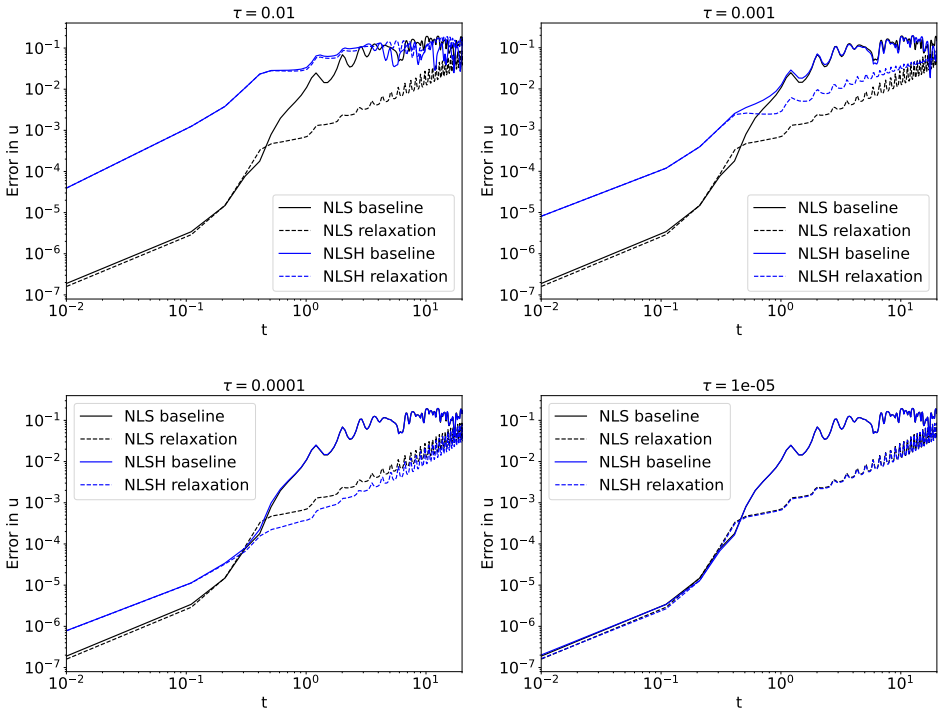
The central claim is that the relaxation system (2) is a valid first-order hyperbolic approximation of NLS in the following precise sense: it is strictly hyperbolic, its modified Hamiltonian and two first integrals $\bar{H}$, $\bar{I}_1$, $\bar{I}_2$ reduce to the corresponding NLS invariants in the formal limit, and its explicit standing-wave families (22) and (31) converge uniformly and linearly in $\tau$ to the NLS ground states (12). The same limit is compatible with discretization: for the proposed splitting, Type I ImEx-RK methods are asymptotic preserving for the primary component $q_0$, and globally stiffly accurate methods are asymptotic preserving for both components, with error $O(\Delta t^p)$ in the stiff limit. The paper exhibits numerical evidence, including two- and three-soliton bound states and a defocusing Riemann problem, that the hyperbolic system tracks the NLS solution closely as $\tau\to 0$.
Load-bearing premise
The paper's general claims assume that solutions of the hyperbolic system vary smoothly as the relaxation parameter shrinks, in the sense that power-series expansions in that parameter are valid, and, for Type II methods, that the initial data is 'well-prepared' so the auxiliary field starts at its limiting value; convergence is proven only for the explicit standing-wave solutions, not for arbitrary data.
Editorial extensions
If this is right
- The NLSH system approximates both focusing and defocusing NLS, including regimes where the earlier Madelung-based hyperbolization of [9] does not apply.
- Because the hyperbolic part is linear and symmetric, the system is amenable to non-reflecting boundary treatments and to first-order hyperbolic solvers, which the paper identifies as a practical motivation.
- The explicit standing-wave formulas (22) and (31) give exact benchmark solutions for NLSH whose uniform $O(\tau)$ distance from NLS ground states can be used to calibrate the relaxation parameter.
- Globally stiffly accurate ImEx-RK methods, applied with the proposed splitting and well-prepared initial data, preserve their temporal order in the stiff limit for both $q_0$ and $q_1$, so accurate NLS approximation does not require resolving the $\tau$-scale.
Reading between the lines
- Beyond the paper, a testable extension is to apply the same relaxation-plus-ImEx construction to other dispersive equations and check whether the three conserved quantities and $O(\tau)$ standing-wave convergence persist; the mechanism is not obviously tied to the specific form of NLS beyond its Hamiltonian and ground states.
- Beyond the paper, the Hilbert-expansion argument suggests that non-well-prepared initial data could spoil asymptotic preservation for Type II methods; a practical follow-up would be a short projection step that maps arbitrary $q_1(0)$ onto $\partial_x q_0(0)$ before the main computation.
- Beyond the paper, if NLSH possesses additional conserved quantities beyond the three found here, the hyperbolization could inherit more of NLS's integrable structure; the paper leaves the existence of further invariants open.
Editorial analysis
A structured set of objections, weighed in public.
Referee Report
Summary. The manuscript studies the first-order hyperbolic relaxation system (2), called NLSH, as an approximation of the nonlinear Schrödinger equation (1). It proves strict hyperbolicity, exhibits a modified Hamiltonian structure, identifies three conserved quantities, constructs explicit standing front and solitary wave families, and states uniform O(τ) convergence of those families to NLS ground states (Propositions 1 and 2). It then develops implicit-explicit Runge-Kutta discretizations claimed to be mass-conserving, asymptotic preserving (AP), and asymptotically accurate (AA), with numerical experiments in both focusing and defocusing regimes.
Significance. If the main claims hold, NLSH is an attractive structure-preserving hyperbolic surrogate for NLS: the linear hyperbolic part is simple, three invariants are conserved, and explicit standing-wave families are available for both focusing and defocusing cases. The conservation-law computations and the numerical AP tables are concrete strengths, and the paper gives clear credit to the earlier proposal of (2) in [15]. However, the AP/AA theorems rely on formal Hilbert expansions that are not justified, the proof of Proposition 2 is omitted, and the explicit q1 solution in (31b) contains a coefficient error. These issues affect load-bearing claims and require repair before the paper can be accepted.
major comments (4)
- [§3.2, Eq. (31b)] Equation (31b) does not satisfy the ODE (15a). Since q0 in (31a) equals √2σ sech(√(µ(1−µτ))x ± K1), the relation q0' = (1−µτ)q1 gives q1 = −√2 σ√µ / √(1−µτ) sech(...)tanh(...), whereas (31b) contains −√2 µσ / √(1−µτ). With σ = √(µ/κ), the printed coefficient differs from the correct one by a factor √µ. Consequently the τ→0 limit of (31b) is −√2 µσ sech(...)tanh(...), not (u+)' = −√2 σ√µ sech(...)tanh(...), so Proposition 2 is not correct for the q1 component as stated. The 'exact' q1 used in the AA experiments of Section 5.2 must also be recomputed.
- [§4.3, Eqs. (44)–(45), Theorems 3–4] The proofs of Theorems 3 and 4 assume the Hilbert expansions (44)–(45) for q0^n, q1^n, and the stage vectors, but no function space, boundedness, or uniformity in τ is established for these expansions. This is not a purely technical gap: linearizing (2) about a constant state gives the dispersion relation τω² + ω − k² = 0, whose second branch has frequency ω ≈ −1/τ − k². Non-well-prepared data therefore generate components of the form e^{±it/τ}, which are not analytic in τ at τ = 0 and cannot be represented by a power series (44)–(45). The leading-order relations (47) and (60) are thus not established for general initial data. The theorems should either be restricted to well-prepared smooth data with the required a priori estimates proved, or the AP/AA claims should be presented as formal asymptotic results.
- [§3.2, Proposition 2] Proposition 2, one of the two main continuum-limit results, is not proved. The text says only that 'Proceeding as in the previous section, the following proposition can be proven.' The uniform-in-x control of the sech² factor for the focusing case requires an argument analogous to (24)–(30), and the q1 component must be checked against the correct expression (see the first major comment). As it stands, the proposition is an assertion rather than a demonstrated result.
- [§4.3, after Eq. (75)] The induction step in the proof of Theorem 4 is not justified. The text states that if the well-preparedness condition (41) holds at n = 0, then ' (4) (for n = 0)' guarantees the solution remains well-prepared at step n = 1, but Eq. (4) is the definition of the NLS Hamiltonian, not the NLSH evolution. No argument is given that the fully discrete update preserves q1^{n+1} = ∂x q0^{n+1} + O(τ) to the needed order. Since propagation of well-preparedness is exactly what the GSA mechanism is intended to ensure, this step should be proved explicitly.
minor comments (4)
- [§4.4, Eq. (78)] The definition of the inner-product-like symbol {A,B} is malformed: it reads '{A,B} ≡ (⟨A,B⟩+⟨A,B⟩)', which is presumably meant to be ⟨A,B⟩+⟨B,A⟩. The surrounding formula for γ_n should be cleaned up and the notation defined precisely.
- [§5.1.1] There is a typo: 'gauranteed' should be 'guaranteed'.
- [§5.1.2] The sentence 'It is notable that Table 1 and Table 5 show almost identical results' should presumably refer to Table 2 and Table 5, since Table 1 lists methods rather than numerical errors.
- [§4.3, Eqs. (66a), (71), (72b)] The expressions involving the explicit RK coefficients contain repeated factors such as κ \hat{\tilde b}\hat{\tilde b}\hat{\tilde b}^T; these appear to be typographical errors and should be corrected to the intended matrix-vector products.
Circularity Check
Formal tau->0 equivalence is built into the defining relaxation equation, but all substantive theorems are independently derived.
-
self definitional
[Section 1, after Eq. (2)]
"Formally, as τ→0, we have q1 → ∂xq0 and then (2a) becomes equivalent to (1) with q0 ≈ u."
Equation (2b), iτ∂t q1 = ∂xq0 - q1, is the defining relaxation relation of the NLSH system. Setting τ=0 gives the algebraic constraint q1 = ∂xq0; substituting into (2a), i∂t q0 + ∂xq1 = -κ|q0|^2 q0, yields the NLS equation iut + uxx + κ|u|^2 u = 0. Thus the claim that NLSH is 'formally equivalent to NLS in the relaxation limit' is a restatement of the construction of NLSH, not an independently derived prediction. The paper labels this as formal and all other results are proved independently.
full rationale
The paper's substantive claims are derived from the NLSH equations rather than assumed. Theorem 1 (strict hyperbolicity and three conserved quantities) is verified by direct computation. Propositions 1-2 prove uniform O(tau) convergence of explicit standing-wave families to NLS ground states by elementary estimates; the solutions are constructed by solving the reduced ODE (15), not fitted. The AP results in Theorems 3-4 show that the stiff limit of the ImEx discretization of NLSH matches the same RK scheme applied to NLS; this is a mathematical reduction, not circular, though it relies on the asserted Hilbert expansions (44)-(45), whose regularity is not proved -- a rigor gap rather than circularity. The NLSH system originated in the authors' prior work [15], but that citation is historical and not load-bearing for the present theorems. No parameter fitting occurs, and the external benchmark (NLS) is only used for comparison. The only by-construction element is the formal tau->0 equivalence, which is built into equation (2b) and stated as such.
Assumptions & free parameters
assumptions (5)
- domain assumption Solutions of NLSH admit convergent Hilbert expansions in powers of tau for fixed discretization parameters (Eqs. (44)-(45)).
- domain assumption Type II ImEx-RK AP property requires well-prepared initial data q0^0 = u0 + O(tau), q1^0 = u0_x + O(tau) (Eq. (41)).
- domain assumption Sufficient decay or periodic boundary conditions so that boundary terms vanish in the conservation-law computations (Eqs. (10a)-(10b)).
- standard math The cited implicit-explicit Runge-Kutta methods have their stated orders and are stable when applied to the semi-discrete NLS obtained in the tau to 0 limit.
- standard math The NLS ground-state formulas (12) from [21] are accepted as known.
invented entities (1)
-
Auxiliary complex field q1(x,t)
Cite this review
Pith. "Pith review of A Hyperbolic Approximation of the Nonlinear Schr\"odinger Equation." pith.science (2026). https://pith.science/paper/B6APMNPH
@misc{pith2026250521424,
  author       = {Pith},
  title        = {Pith review of: A Hyperbolic Approximation of the Nonlinear Schr\"odinger Equation},
  year         = {2026},
  howpublished = {\url{https://pith.science/paper/B6APMNPH}},
  note         = {Machine review of arXiv:2505.21424}
}
read the original abstract
We study a first-order hyperbolic approximation of the nonlinear Schr\"odinger (NLS) equation. We show that the system is strictly hyperbolic and possesses a modified Hamiltonian structure, along with at least three conserved quantities that approximate those of NLS. We provide families of explicit standing-wave solutions to the hyperbolic system, which are shown to converge uniformly to ground-state solutions of NLS in the relaxation limit. The system is formally equivalent to NLS in the relaxation limit, and we develop asymptotic preserving discretizations that tend to a consistent discretization of NLS in that limit, while also conserving mass. Examples for both the focusing and defocusing regimes demonstrate that the numerical discretization provides an accurate approximation of the NLS solution.
Figures


Figures from the paper (5 more)



Reference graph
Works this paper leans on
-
[15]
David I Ketcheson and Abhijit Biswas. Approximation of arbitrarily high-order PDEs by first-order hyperbolic relaxation.Nonlinearity, 38(5):055002, 2025
work page 2025
-
[1]
Uri M Ascher, Steven J Ruuth, and Raymond J Spiteri. Implicit-explicit Runge-Kutta methods for time-dependent partial differential equations.Applied Numerical Mathematics, 25(2):151–167, 1997
work page 1997
-
[2]
Christophe Besse, Sergey Gavrilyuk, Maria Kazakova, and Pascal Noble. Perfectly matched layers methods for mixed hyperbolic–dispersive equations.Water Waves, 4(3):313–343, 2022
work page 2022
-
[3]
Abhijit Biswas and David I Ketcheson. Multiple-relaxation Runge-Kutta methods for conservative dynamical systems.Journal of Scientific Computing, 97(1):4, 2023
work page 2023
-
[4]
Abhijit Biswas and David I Ketcheson. Accurate solution of the nonlinear Schr¨ odinger equa- tion via conservative multiple-relaxation ImEx methods.SIAM Journal on Scientific Computing, 46(6):A3827–A3848, 2024
work page 2024
-
[5]
Ketcheson, Hendrik Ranocha, and Jochen Sch¨ utz
Abhijit Biswas, David I. Ketcheson, Hendrik Ranocha, and Jochen Sch¨ utz. Traveling-wave solutions and structure-preserving numerical methods for a hyperbolic approximation of the Korteweg-de Vries equation.Journal of Scientific Computing, 103(3):90, 2025
work page 2025
-
[6]
Sebastiano Boscarino, Lorenzo Pareschi, and Giovanni Russo.Implicit-Explicit Methods for Evo- lutionary Partial Differential Equations, volume 24 ofMathematical Modeling and Computation. SIAM, 2024
work page 2024
-
[7]
Sebastiano Boscarino and Giovanni Russo. Asymptotic preserving methods for quasilinear hyperbolic systems with stiff relaxation: a review.SeMA, 81(3):3–49, 2024
work page 2024
Show all 21 references
-
[8]
Hyperbolic model for free surface shallow water flows with effects of dispersion, vorticity and topography.Computers & Fluids, 189:13–23, 2019
Alexander Chesnokov and Trieu Hai Nguyen. Hyperbolic model for free surface shallow water flows with effects of dispersion, vorticity and topography.Computers & Fluids, 189:13–23, 2019
2019
-
[9]
Extended Lagrangian approach for the defocusing nonlinear Schr¨ odinger equation.Studies in Applied Mathematics, 142(3):336–358, 2019
Firas Dhaouadi, Nicolas Favrie, and Sergey Gavrilyuk. Extended Lagrangian approach for the defocusing nonlinear Schr¨ odinger equation.Studies in Applied Mathematics, 142(3):336–358, 2019
2019
-
[10]
The numerical integration of relative equilibrium solu- tions
Angel Dur´ an and Jesus Maria Sanz-Serna. The numerical integration of relative equilibrium solu- tions. the nonlinear Schr¨ odinger equation.IMA journal of numerical analysis, 20(2), 2000
2000
-
[11]
Hyperbolic approximation of the BBM equation.Nonlin- earity, 35(3):1447, 2022
Sergey Gavrilyuk and Keh-Ming Shyue. Hyperbolic approximation of the BBM equation.Nonlin- earity, 35(3):1447, 2022
2022
-
[12]
Asymptotic-preserving (AP) schemes for multiscale kinetic equations: A unified approach
Shi Jin and Lorenzo Pareschi. Asymptotic-preserving (AP) schemes for multiscale kinetic equations: A unified approach. In Heinrich Freist¨ uhler and Gerald Warnecke, editors,Hyperbolic Problems: The- ory, Numerics, Applications, volume 141 ofISNM International Series of Numeri...
2001
-
[13]
C. A. Kennedy and M. H. Carpenter. Additive Runge-Kutta schemes for convection-diffusion- reaction equations.Applied Numerical Mathematics, 44:139–181, 2003. 21
2003
-
[14]
Ketcheson
David I. Ketcheson. Relaxation Runge–Kutta methods: Conservation and stability for inner-product norms.SIAM Journal on Numerical Analysis, 57(6):2850–2870, 2019
2019
-
[16]
Cornelius Lanczos.The variational principles of mechanics. Univ. of Toronto Press, 1949
1949
-
[17]
A first-order hyperbolic system approach for dispersion.J
Alireza Mazaheri, Mario Ricchiuto, and Hiroaki Nishikawa. A first-order hyperbolic system approach for dispersion.J. Comput. Phys., 321(Supplement C):593–605, 2016
2016
-
[18]
Ketcheson
Hendrik Ranocha, Lajos L´ oczi, and David I. Ketcheson. General relaxation methods for initial-value problems with application to multistep schemes.Numerische Mathematik, 146:875–906, October 2020
2020
-
[19]
Ketcheson
Hendrik Ranocha, Mohammed Sayyari, Lisandro Dalcin, Matteo Parsani, and David I. Ketcheson. Relaxation Runge-Kutta methods: Fully-discrete explicit entropy-stable schemes for the compress- ible Euler and Navier-Stokes equations.SIAM Journal on Scientific Computing, 42(2):A612–...
2020
-
[20]
Advection-diffusion-reaction equations: hyperbolization and high-order ADER discretizations.SIAM Journal on Scientific Computing, 36(5):A2423–A2457, 2014
Eleuterio F Toro and Gino I Montecinos. Advection-diffusion-reaction equations: hyperbolization and high-order ADER discretizations.SIAM Journal on Scientific Computing, 36(5):A2423–A2457, 2014
2014
-
[21]
SIAM, 2010
Jianke Yang.Nonlinear waves in integrable and nonintegrable systems. SIAM, 2010. 22
2010
Reviewed August 7, 2026 · model on record in the stance chip above.
Discussion (0). Sign in to comment.