REVIEW 5 major objections 6 minor 38 references
VoxAging: Continuously Tracking Speaker Aging with a Large-Scale Longitudinal Dataset in English and Mandarin
T0 review · 5 major / 6 minor · reviewed 2026-08-07 · deepseek-v4-flash
Pith's one-line read The paper introduces VoxAging, a 17-year weekly voice dataset, and shows speaker-verification error climbs steadily with age.
desk verdict Dense longitudinal speaker dataset is a real gap, but the weekly-sampling claim rests on unvalidated timestamps and the age analysis on model-estimated labels—useful resource, not yet a trustworthy benchmark. read the letter →
The pith
A machine-rendered reading of the paper's core claim, the machinery that carries it, and where it could break.
The reading
What carries the argument
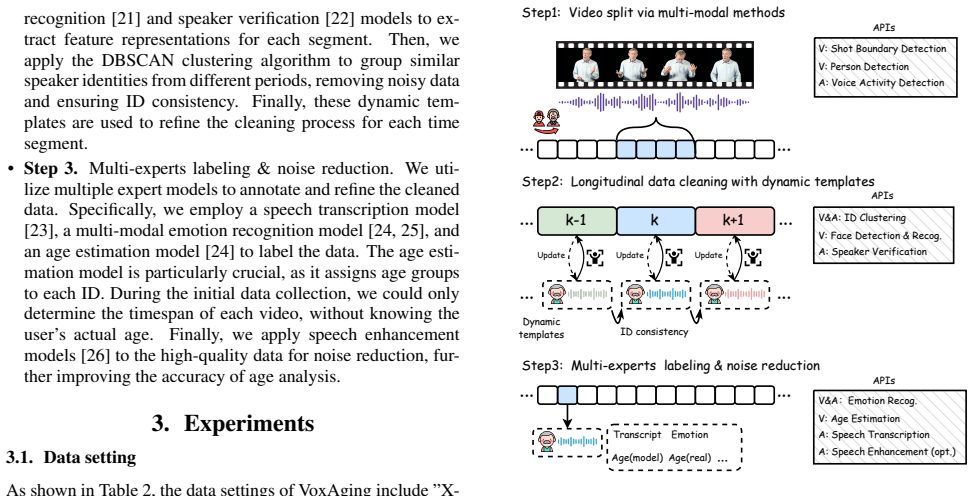
The carrier of the argument is the dataset itself, built by a multi-modal cleaning pipeline. Videos are split into segments using shot-boundary detection, person detection, and voice activity detection; dynamic identity templates are then maintained across time by clustering face-recognition and speaker-verification embeddings with DBSCAN, so that identity consistency is checked against age-updated references rather than a single static template. Age groups come from an automated facial-age estimation model, and a speech-enhancement step is applied before evaluation. The measure that turns the corpus into a scientific claim is time-span stratified equal error rate: each speaker is enrolled at time zero and tested at N years later, producing monotonic error-vs-time curves for English, Mandarin, age groups, and genders.
What would settle it
Re-estimate the English and Mandarin EER-versus-timespan curves using only segments recorded on the same device and in the same environment for each speaker; if the monotonic rise largely disappears, the paper's aging effect is actually channel drift. A complementary check is to replace facial-age labels with documented birth dates and see whether the 40-50 and female trends survive.
Extended reading notes
Core claim
The central claim is that speaker aging is a measurable, monotonic force on modern speaker-verification systems, and VoxAging provides the dense longitudinal data to see it. On the English subset, every evaluated model's equal error rate increases from enrollment year to year over a ten-year horizon; the strongest evaluated model rises from 2.89% to 3.87%, while weaker models rise by nearly three percentage points. Mandarin speech starts higher and deteriorates faster within a four-year horizon. The paper further reports that the 40-50 age group has the steepest error growth (a 1.67 percentage-point increase over ten years) and that female speakers rise from 4.15% to 6.77% compared with male speakers' 3.54% to 4.09%. Speaker-similarity scores follow cubic-polynomial decay curves, crossing the 0.5 threshold at roughly 500 weeks for English and 400 weeks for Mandarin.
Load-bearing premise
The load-bearing premise is that the uploaded videos give regularly spaced, acoustically comparable voice samples of the same person under roughly stable recording conditions, and that the automated facial-age labels are accurate enough to sort speakers into age groups; if either fails, the weekly-interval characterization and the age-group equal-error-rate table confound aging with channel drift or label noise.
Editorial extensions
If this is right
- Voice-based authentication will need periodic re-enrollment: equal error rate rises steadily even for the best evaluated model, so a template from ten years ago is materially less secure.
- Improved models mitigate aging but do not remove it; the ranking of models by clean-data accuracy largely matches their ranking by aging robustness.
- Mandarin speaker verification faces a larger aging penalty in this data, so aging-aware training or calibration may be especially important for non-English deployments.
- Middle-aged (40-50) and female speakers show the largest error growth, pointing to demographics that should be prioritized in aging-robustness test sets.
- The weekly density allows estimating time-to-threshold, e.g., roughly 500 weeks (English) and 400 weeks (Mandarin) for speaker similarity to fall below 0.5, giving concrete template-refresh intervals.
Reading between the lines
- If the weekly sampling is genuinely continuous, the dataset enables per-speaker aging trajectories rather than sparse snapshots, which would let future work predict a voice's 'expiration date' for a given security threshold.
- The Mandarin-vs-English gap may partly reflect a recording-era confound, because Mandarin collection mostly starts after 2017; matching device and recording year across languages would test whether the gap is physiological or technological.
- The dynamic-template cleaning pipeline, which updates identity references as the speaker ages, could be reused as a general method for constructing longitudinal biometric datasets from uncontrolled uploads.
- A natural extension is to derive age-conditioned score calibration, using the fitted decay curves to adjust verification thresholds by time-since-enrollment, which the paper's similarity-score data would support directly.
Editorial analysis
A structured set of objections, weighed in public.
Referee Report
Summary. This paper introduces VoxAging, a longitudinal speaker dataset collected from YouTube and Bilibili, claiming weekly recordings for 293 speakers over up to 17 years, with 2,629,100 segments and 7,522 hours of audio-visual data. The authors evaluate seven speaker verification models and a face recognition baseline, reporting that EER rises with time span, with greater deterioration for Mandarin, the 40-50 age group, and female speakers. The paper positions VoxAging as the first densely sampled long-term corpus for speaker aging research.
Significance. If the dataset's temporal and age metadata are validated, VoxAging could fill a clear gap in speaker aging research: existing datasets are either sparse over long spans (TCDSA) or dense over short spans (MARP, CSLT-Chronos). The benchmark across multiple modern speaker verification systems and the inclusion of both English and Mandarin are useful contributions. However, the central value proposition depends on the weekly-interval claim and the accuracy of model-estimated age labels, both of which are currently unvalidated. With proper metadata release, validation of age labels, and statistical rigor, this could become a valuable community resource.
major comments (5)
- [Sections 2.2 and 2.3] The claim of weekly recordings is not supported. The abstract states "For each speaker, the data were recorded at weekly intervals" and Table 1 lists "Session Intervals: 1 week," but the collection pipeline in Section 2.3 only describes segmenting videos, clustering by identity, and labeling; it does not define or validate a recording timestamp. YouTube and Bilibili provide upload dates, not recording dates, and a consistent weekly cadence across 293 channels over up to 17 years is implausible without verification. The authors should provide per-segment timestamps or at least per-speaker statistics of inter-session intervals; otherwise the time-span axis in Table 3 and Figure 4 conflates aging with changes in recording equipment, channel style, and content type.
- [Section 2.3, Step 3] Age group labels are model estimates, not ground truth. The authors state "During the initial data collection, we could only determine the timespan of each video, without knowing the user's actual age." The LightFace model is then used to assign each speaker to an age group for Table 4. Any bias in LightFace (e.g., systematic over- or under-estimation for certain demographics) directly corrupts the age-group comparisons, including the headline conclusion that the 40-50 age group shows the strongest deterioration. The authors should validate age labels on a subset with known birth dates (e.g., from public profiles) or report how sensitive the Table 4 trends are to plausible age-label errors.
- [Sections 3.1-3.2 and Tables 3-4] The evaluation protocol is under-specified and lacks uncertainty quantification. The paper does not describe how enrollment segments and test trials are constructed (e.g., duration of enrollment, number of test segments per speaker, whether trials are same-speaker pairs across time spans), and no confidence intervals or significance tests are reported. The EER differences are often small (e.g., ERes2Net-large deterioration of 0.98% over 10 years in Table 3); without error bars, the claimed monotonic increase and the cross-condition differences (English vs Mandarin, age groups, gender) cannot be considered statistically established. Provide bootstrap confidence intervals or a statistical test such as McNemar's or DeLong's.
- [Section 2.3 Step 2 vs Section 3.2] There is a circularity concern between the cleaning pipeline and the evaluation. Data cleaning uses speaker verification (ECAPA-TDNN [22]) and face recognition (ArcFace) models to filter segments and remove noisy data, while the experimental section benchmarks the same family of models (including ECAPA-TDNN and other models trained on VoxCeleb-style data). The cleaning may preferentially retain segments that are easy for these models to verify, inflating performance and potentially masking aging effects. The authors should discuss this bias or evaluate at least one model that was not used in the cleaning process.
- [Section 2.3, Step 3] Speech enhancement is applied to all data before experiments. The paper applies speech enhancement models for noise reduction but does not analyze the effect of enhancement on aging measurements. If older recordings are noisier and receive stronger enhancement, the EER trends could reflect enhancement artifacts rather than vocal aging. The authors should either report results on raw audio for a subset or analyze how enhancement changes time-domain and embedding statistics across time spans.
minor comments (6)
- [Table 2] The header "# of Trails" should be "# of Trials," and the gender row "Male 114 1.2MFamale 112" contains a typo ("Famale" should be "Female").
- [Figure 4] The x-axis uses irregular spacing (0, 52, 200, 500, 800 weeks); specify whether the axis is linear or categorical and add tick labels for clarity.
- [Section 4.2] The statement "randomly selected 10 English and 10 Mandarin speakers" lacks a fixed random seed or selection criterion; specify the procedure for reproducibility.
- [References] References [3] and [16] are the same work (X. Qin et al., "Investigating long-term and short-term time-varying speaker verification"); merge or disambiguate them.
- [Figure 1 caption] The caption "Previous short-term datasets have continuous intervals but limited time spans" is confusing because Table 1 labels such datasets as "Continuous"; clarify the terminology.
- [Section 4.3] The claim that the 40-50 age group shows the most pronounced deterioration rests on a 0.17% difference from the 30-40 group; note that this is within the range of likely statistical uncertainty.
Circularity Check
No significant circularity: the paper reports empirical aging trends on externally pretrained models and does not derive its conclusions from fitted parameters, its own citations, or definitional identities.
full rationale
The paper's central claims are (i) construction of VoxAging, a longitudinal corpus from YouTube/Bilibili, and (ii) measured EER trends of pretrained speaker/face recognition models over increasing time spans. Neither claim is derived by construction from its inputs. Section 2.3 uses face recognition (ArcFace) and speaker verification (ECAPA-TDNN) embeddings plus DBSCAN to clean the corpus; Section 4 then evaluates several externally pretrained models, including ArcFace and ECAPA-TDNN, on the cleaned corpus. This shared-model design could introduce optimistic bias, but it is a validity concern, not circularity: the aging trend (EER rising with time span) is not a mathematical consequence of the cleaning step, and no equation in the paper reduces the reported EERs to the cleaning model's outputs. The age-group analysis in Table 4 uses age labels from the LightFace estimator rather than known birth dates; again this is a proxy-label validity issue, not a circular derivation, because the age-group EER differences are measured, not implied by the labeling model. The 'weekly intervals' characterization is asserted rather than validated with timestamp metadata, but no passage shows the interval variable being defined as the model output or vice versa. There are no load-bearing self-citations or imported uniqueness theorems. Under the requirement to exhibit a specific reduction (Eq. X = Eq. Y by construction, or a fitted parameter renamed as a prediction), no circular step can be identified; the correct finding is no significant circularity.
Assumptions & free parameters
free parameters (1)
- cubic polynomial coefficients for similarity decay fits =
not reported
assumptions (3)
- domain assumption Age labels assigned by the LightFace age estimation model are accurate enough for age group analysis.
- domain assumption YouTube and Bilibili upload cadence yields approximately weekly longitudinal samples representative of each speaker's voice.
- domain assumption Filtering the dataset with speaker verification and face recognition models does not bias downstream evaluation of those same model families.
Cite this review
Pith. "Pith review of VoxAging: Continuously Tracking Speaker Aging with a Large-Scale Longitudinal Dataset in English and Mandarin." pith.science (2026). https://pith.science/paper/MVLWZSHV
@misc{pith2026250521445,
  author       = {Pith},
  title        = {Pith review of: VoxAging: Continuously Tracking Speaker Aging with a Large-Scale Longitudinal Dataset in English and Mandarin},
  year         = {2026},
  howpublished = {\url{https://pith.science/paper/MVLWZSHV}},
  note         = {Machine review of arXiv:2505.21445}
}
read the original abstract
The performance of speaker verification systems is adversely affected by speaker aging. However, due to challenges in data collection, particularly the lack of sustained and large-scale longitudinal data for individuals, research on speaker aging remains difficult. In this paper, we present VoxAging, a large-scale longitudinal dataset collected from 293 speakers (226 English speakers and 67 Mandarin speakers) over several years, with the longest time span reaching 17 years (approximately 900 weeks). For each speaker, the data were recorded at weekly intervals. We studied the phenomenon of speaker aging and its effects on advanced speaker verification systems, analyzed individual speaker aging processes, and explored the impact of factors such as age group and gender on speaker aging research.
Figures


Figures from the paper (1 more)

Reference graph
Works this paper leans on
-
[22]
The multi-session audio research project (marp) corpus: goals, design and initial findings,
A. D. Lawson, A. R. Stauffer, E. J. Cupples, S. J. Wenndt, W. P. Bray, and J. J. Grieco, “The multi-session audio research project (marp) corpus: goals, design and initial findings,” in Interspeech 2009, 2009, pp. 1811–1814
work page 2009
-
[1]
However, both face challenges related to aging [3, 4, 5]
Introduction Speaker recognition (SR) and face recognition (FR) are widely used biometric technologies for identity authentication [1, 2]. However, both face challenges related to aging [3, 4, 5]. As people age, physiological changes in the face and vocal tract lead to gradual alterations in their features, negatively affecting the accuracy of SR and FR s...
arXiv 2025
-
[2]
VoxAging Dataset 2.1. Previous speaker aging datasets As shown in Table 1, existing speaker aging datasets can be classified into two types: discrete and continuous, based on ses- sion intervals. Discrete datasets [4, 9, 8] have long session in- tervals and limited samples per speaker, spanning several years to two decades. For instance, TCDSA [4] include...
work page 2017
-
[3]
Experiments 3.1. Data setting As shown in Table 2, the data settings of V oxAging include ”X- Independent” and ”X-Dependent” configurations. • The ”X-Independent” setting consists of two subsets: V oxAging-EN (English speakers) and V oxAging-ZH (Man- darin speakers). This setup investigates the impact of aging on speaker verification systems. V oxAging-EN...
-
[4]
Results 4.1. Impact of speaker aging on advanced speaker verifica- tion systems Table 3 shows the impact of speaker aging on advanced speaker verification systems. These models perform differently on the general test set V ox-O [17], and we use Equal Error Rate (EER) to evaluate the effect of aging on the V oxAging-EN and V oxAging-ZH subsets. As the time...
-
[5]
Conclusions In this paper, we present V oxAging, a large-scale longitudinal dataset. It includes recordings from 293 speakers (226 English and 67 Mandarin) over a span of 17 years, totaling 7,522 hours, with weekly samples. Our analysis of speaker aging reveals that the performance of speaker verification systems deterio- rates with age. Improving the per...
-
[6]
Evaluation and calibration of short- term aging effects in speaker verification,
F. Kelly and J. H. L. Hansen, “Evaluation and calibration of short- term aging effects in speaker verification,” in Interspeech 2015, 2015, pp. 224–228
work page 2015
-
[7]
Face recognition: A literature survey,
W. Zhao, R. Chellappa, P. J. Phillips, and A. Rosenfeld, “Face recognition: A literature survey,” ACM computing surveys (CSUR), vol. 35, no. 4, pp. 399–458, 2003
work page 2003
Show all 38 references
-
[8]
A survey of speaker recognition: Fundamental theories, recogni- tion methods and opportunities,
M. M. Kabir, M. F. Mridha, J. Shin, I. Jahan, and A. Q. Ohi, “A survey of speaker recognition: Fundamental theories, recogni- tion methods and opportunities,”IEEE Access, vol. 9, pp. 79 236– 79 263, 2021
2021
-
[9]
Investigating long-term and short-term time-varying speaker verification,
X. Qin, N. Li, S. Duan, and M. Li, “Investigating long-term and short-term time-varying speaker verification,” IEEE/ACM Trans- actions on Audio, Speech, and Language Processing, vol. 32, pp. 3408–3423, 2024
2024
-
[10]
Speaker verification with long-term ageing data,
F. Kelly, A. Drygajlo, and N. Harte, “Speaker verification with long-term ageing data,” in 2012 5th IAPR international confer- ence on biometrics (ICB). IEEE, 2012, pp. 478–483
2012
-
[11]
Age invariant face recognition methods: A review,
K. Baruni, N. Mokoena, M. Veeraragoo, and R. Holder, “Age invariant face recognition methods: A review,” in 2021 Interna- tional Conference on Computational Science and Computational Intelligence (CSCI). IEEE, 2021, pp. 1657–1662
2021
-
[12]
Effects of physiological aging on selected acoustic characteristics of voice,
L. A. Ramig and R. L. Ringel, “Effects of physiological aging on selected acoustic characteristics of voice,” Journal of Speech, Language, and Hearing Research, vol. 26, no. 1, pp. 22–30, 1983
1983
-
[13]
Score-aging calibration for speaker verification,
F. Kelly and J. H. Hansen, “Score-aging calibration for speaker verification,” IEEE/ACM Transactions on Audio, Speech, and Language Processing, vol. 24, no. 12, pp. 2414–2424, 2016
2016
-
[14]
Cross-age speaker verification: Learning age-invariant speaker embeddings,
X. Qin, N. Li, W. Chao, D. Su, and M. Li, “Cross-age speaker verification: Learning age-invariant speaker embeddings,” in In- terspeech 2022, 2022, pp. 1436–1440
2022
-
[15]
Speaker verification across ages: Investigating deep speaker embedding sensitivity to age mismatch in enrollment and test speech,
V . P. Singh, M. Sahidullah, and T. Kinnunen, “Speaker verification across ages: Investigating deep speaker embedding sensitivity to age mismatch in enrollment and test speech,” inInterspeech 2023, 2023, pp. 1948–1952
2023
-
[16]
V ocal aging effects on f0 and the first formant: A longitudinal analysis in adult speakers,
“V ocal aging effects on f0 and the first formant: A longitudinal analysis in adult speakers,”Speech Communication, vol. 52, no. 7, pp. 638–651, 2010
2010
-
[17]
The role of age in factor analysis for speaker identification,
Y . Lei and J. H. Hansen, “The role of age in factor analysis for speaker identification,” in Tenth Annual Conference of the Inter- national Speech Communication Association, 2009
2009
-
[18]
Cn-celeb- av: A multi-genre audio-visual dataset for person recognition,
L. Li, X. Li, H. Jiang, C. Chen, R. Hou, and D. Wang, “Cn-celeb- av: A multi-genre audio-visual dataset for person recognition,” in Interspeech 2023, 2023, pp. 2118–2122
2023
-
[19]
Speaker veri- fication using adapted gaussian mixture models,
D. A. Reynolds, T. F. Quatieri, and R. B. Dunn, “Speaker veri- fication using adapted gaussian mixture models,” Digital signal processing, vol. 10, no. 1-3, pp. 19–41, 2000
2000
-
[20]
The intersection of visual and audio boundaries is then calculated to define each seg- ment
to isolate speech segments. The intersection of visual and audio boundaries is then calculated to define each seg- ment. • Step 2. Longitudinal data cleaning with dynamic templates. We employ dynamic templates for data cleaning and use face 3https://github.com/aizhiqi-work/vox...
-
[21]
Improving speaker verification performance against long-term speaker vari- ability,
L. Wang, J. Wang, L. Li, T. F. Zheng, and F. K. Soong, “Improving speaker verification performance against long-term speaker vari- ability,”Speech Communication, vol. 79, pp. 14–29, 2016
2016
-
[23]
Investigating long-term and short-term time-varying speaker verification,
X. Qin, N. Li, S. Duan, and M. Li, “Investigating long-term and short-term time-varying speaker verification,” IEEE/ACM Trans- actions on Audio, Speech, and Language Processing, 2024
2024
-
[24]
V oxceleb: A large- scale speaker identification dataset,
A. Nagrani, J. S. Chung, and A. Zisserman, “V oxceleb: A large- scale speaker identification dataset,” in Interspeech 2017, 2017, pp. 2616–2620
2017
-
[25]
Yolo- world: Real-time open-vocabulary object detection,
T. Cheng, L. Song, Y . Ge, W. Liu, X. Wang, and Y . Shan, “Yolo- world: Real-time open-vocabulary object detection,” in Proceed- ings of the IEEE/CVF Conference on Computer Vision and Pat- tern Recognition, 2024, pp. 16 901–16 911
2024
-
[26]
Funasr: A fundamental end-to-end speech recognition toolkit,
Z. Gao, Z. Li, J. Wang, H. Luo, X. Shi, M. Chen, Y . Li, L. Zuo, Z. Du, and S. Zhang, “Funasr: A fundamental end-to-end speech recognition toolkit,” in Interspeech 2023, 2023, pp. 1593–1597
2023
-
[27]
Arcface: Additive angular margin loss for deep face recognition,
J. Deng, J. Guo, X. Niannan, and S. Zafeiriou, “Arcface: Additive angular margin loss for deep face recognition,” in CVPR, 2019
2019
-
[28]
Ecapa-tdnn: Emphasized channel attention, propagation and aggregation in tdnn based speaker verification,
B. Desplanques, J. Thienpondt, and K. Demuynck, “Ecapa-tdnn: Emphasized channel attention, propagation and aggregation in tdnn based speaker verification,” in Interspeech 2020, 2020, pp. 3830–3834
2020
-
[29]
Robust speech recognition via large-scale weak supervision,
A. Radford, J. W. Kim, T. Xu, G. Brockman, C. McLeavey, and I. Sutskever, “Robust speech recognition via large-scale weak supervision,” in International conference on machine learning . PMLR, 2023, pp. 28 492–28 518
2023
-
[30]
Hyperextended lightface: A facial attribute analysis framework,
S. I. Serengil and A. Ozpinar, “Hyperextended lightface: A facial attribute analysis framework,” in 2021 International Conference on Engineering and Emerging Technologies (ICEET) . IEEE, 2021, pp. 1–4
2021
-
[31]
Emobox: Multilingual multi-corpus speech emotion recognition toolkit and benchmark,
Z. Ma, M. Chen, H. Zhang, Z. Zheng, W. Chen, X. Li, J. Ye, X. Chen, and T. Hain, “Emobox: Multilingual multi-corpus speech emotion recognition toolkit and benchmark,” in Inter- speech 2024, 2024, pp. 1580–1584
2024
-
[32]
Separate what you describe: Language-queried audio source separation,
X. Liu, H. Liu, Q. Kong, X. Mei, J. Zhao, Q. Huang, M. D. Plumbley, and W. Wang, “Separate what you describe: Language-queried audio source separation,” arXiv preprint arXiv:2203.15147, 2022
2022 arXiv
-
[33]
3d-speaker: A large-scale multi-device, multi-distance, and multi-dialect cor- pus for speech representation disentanglement,
S. Zheng, L. Cheng, Y . Chen, H. Wang, and Q. Chen, “3d-speaker: A large-scale multi-device, multi-distance, and multi-dialect cor- pus for speech representation disentanglement,” arXiv preprint arXiv:2306.15354, 2023
2023 arXiv
-
[34]
Pushing the limits of self-supervised speaker verification using regular- ized distillation framework,
Y . Chen, S. Zheng, H. Wang, L. Cheng, and Q. Chen, “Pushing the limits of self-supervised speaker verification using regular- ized distillation framework,” in ICASSP 2023-2023 IEEE Inter- national Conference on Acoustics, Speech and Signal Processing (ICASSP). IEEE, 2023
2023
-
[35]
X-vectors: Robust dnn embeddings for speaker recognition,
D. Snyder, D. Garcia-Romero, G. Sell, D. Povey, and S. Khudan- pur, “X-vectors: Robust dnn embeddings for speaker recognition,” in 2018 IEEE international conference on acoustics, speech and signal processing (ICASSP). IEEE, 2018, pp. 5329–5333
2018
-
[36]
Self-distillation prototypes network: Learning ro- bust speaker representations without supervision,
Y . Chen, S. Zheng, H. Wang, L. Cheng, Q. Chen, S. Zhang, and W. Wang, “Self-distillation prototypes network: Learning ro- bust speaker representations without supervision,” arXiv preprint arXiv:2406.11169, 2024
2024 arXiv
-
[37]
Cam++: A fast and efficient network for speaker verification using context- aware masking,
H. Wang, S. Zheng, Y . Chen, L. Cheng, and Q. Chen, “Cam++: A fast and efficient network for speaker verification using context- aware masking,” arXiv preprint arXiv:2303.00332, 2023
2023 arXiv
-
[38]
An enhanced res2net with local and global feature fusion for speaker verification,
Y . Chen, S. Zheng, H. Wang, L. Cheng, Q. Chen, and J. Qi, “An enhanced res2net with local and global feature fusion for speaker verification,” in Interspeech 2023, 2023, pp. 2228–2232
2023
Reviewed August 7, 2026 · model on record in the stance chip above.
Discussion (0). Sign in to comment.