REVIEW 3 major objections 5 minor 15 references
Understanding the learned look-ahead behavior of chess neural networks
T0 review · 3 major / 5 minor · reviewed 2026-08-07 · deepseek-v4-flash
Pith's one-line read This paper claims that the Leela Chess Zero policy network, a transformer that reads a chessboard as a sequence of 64 squares, represents board states up to seven moves ahead when picking its next move.
desk verdict Credible multi-method extension of Jenner et al. to 5th/7th moves and alternative branches, but the 7th-move claim hinges on an untested identification of Lichess PVs with the model's internal line. read the letter →
The pith
A machine-rendered reading of the paper's core claim, the machinery that carries it, and where it could break.
The reading
What carries the argument
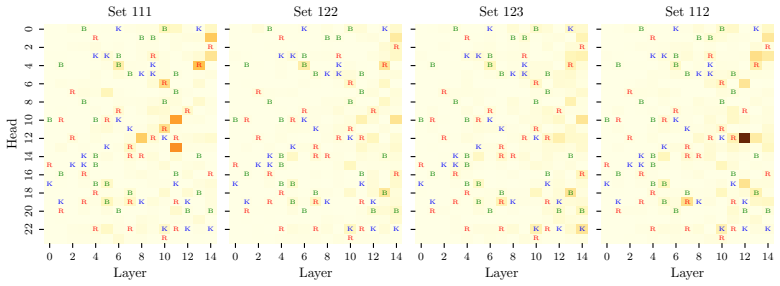
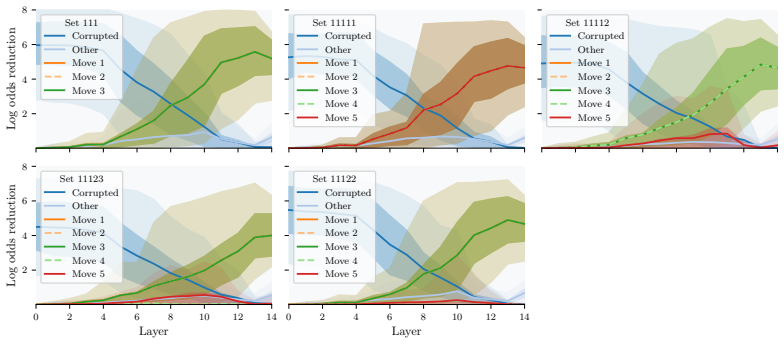
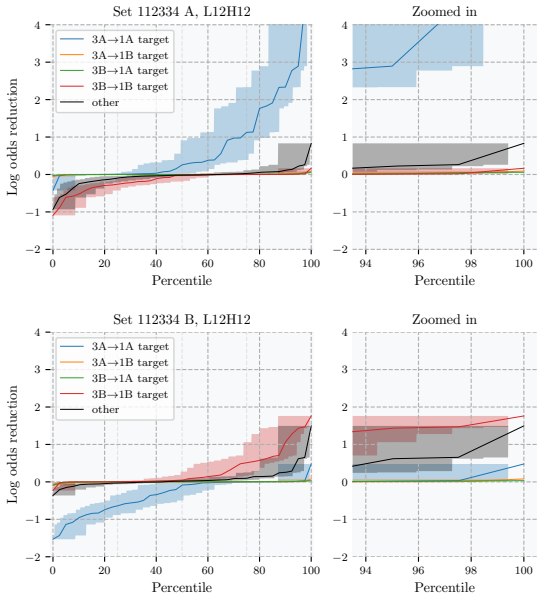
The load-bearing objects are the puzzle-set notation and the trio of interpretability interventions. Puzzle-set notation labels each puzzle by the sequence of destination squares of its principal variation, so 112 means the first two moves go to the same square and the third to a new one, while letters such as A, B, and C abstract distinct squares in patterns like AAC, ABC, and ACC. Activation patching measures the causal importance of a board square by replacing its activations with those from a minimally corrupted position and recording the log-odds reduction of the correct move; linear probing decodes whether a future move's destination square is linearly readable from the residual stream; and zero ablation removes attention-head weights to identify which heads move which information. Together they show that future-move destination squares are causally relevant, that their information is encoded, and that specific heads, notably L12H12, implement the backward-in-time copying of future-square information to the first-move square, with the square-repetition pattern determining which head engages.
What would settle it
Build a test set of positions where the same AAC destination-square pattern is preserved but the future line no longer leads to the advertised outcome, such as a seventh move square that becomes losing, then patch that square: if the log-odds reduction persists unchanged, the effect is pattern-triggered rather than line-tracking; if it collapses, the model encodes the actual future sequence.
Extended reading notes
Core claim
The central discovery is that a single forward pass of the Leela policy network encodes and uses the destination squares of moves up to seven plies ahead, not just the immediate next move. The evidence is that patching the residual-stream activation at a future move square, say the fifth or seventh, reduces the log odds of the correct next move, and linear probes decode the future square's identity from intermediate layers, with accuracy declining toward the seventh move. The strongest single mechanism is attention head L12H12, which copies information backward in time from a future square to an earlier one, third to first, fifth to first, or seventh to first, depending on the pattern of square repetitions; this pattern sensitivity is time-insensitive, so the same AAC, ABC, and ACC templates apply at different move offsets. The model also tracks alternative branches: when two first moves are nearly tied, patching the alternative branch's third-move square increases the probability of the main first move, indicating simultaneous evaluation of multiple lines. The author interprets this as learned look-ahead behavior with specialized, context-dependent circuitry, while conceding that the experiments cannot fully rule out pattern matching over memorized tactical motifs.
Load-bearing premise
The central assumption is that the fine-tuned, history-free version of Leela, judged against the Lichess principal variation, is still doing the same look-ahead computation the original engine does, so that the patched attention to fifth- and seventh-move squares reflects forward planning rather than memorized tactical motifs.
Editorial extensions
If this is right
- The policy network itself performs a form of multi-step planning: information about the fifth and seventh future moves is present and causally relevant in the same forward pass, so search-based engines are not the only way to achieve look-ahead.
- Look-ahead is branch-aware: the model assigns probability across at least two alternative sequences and shifts its choice when one branch's future square is corrupted, so a single-line description of its planning is inadequate.
- The internal machinery generalizes across time: the same attention head that copies third-move information to the first-move square also copies fifth- and seventh-move information under the same square-pattern rules, implying a time-insensitive planning mechanism.
- Any mechanistic account of chess transformers must be position-type-specific, because checkmate positions recruit L12H12 while non-checkmate positions rely more on L12H17, and different square patterns produce different effect sizes.
- The combined patching, probing, and ablation protocol, with puzzle-set notation, is a transferable recipe for detecting look-ahead in other transformer policies trained on sequential decision tasks.
Reading between the lines
- If the seven-move horizon reflects this model's depth and training distribution rather than a universal ceiling, one direct extension would be to measure whether deeper or longer-trained chess transformers push the horizon further; the paper does not test this.
- The AAC, ABC, and ACC sensitivity raises the possibility that the network has learned tactical geometry templates, and a decisive test would be to see whether patching a future square still matters when the pattern is preserved but the line stops being winning.
- The backward-in-time copying performed by L12H12 resembles a broadcasting operation that other planning networks might share, so looking for analogous future-square heads in transformer policies for Sokoban or maze-solving is a natural next test.
- The alternative-branch result suggests the model's probability mass itself encodes a small search tree, so one could try to decode the full tree from the residual stream rather than only pairwise branch comparisons.
Editorial analysis
A structured set of objections, weighed in public.
Referee Report
Summary. The paper studies the Leela Chess Zero policy network and asks whether its internal representations encode and causally use information about board states several moves ahead. Extending the framework of Jenner et al. (2024), the author introduces a puzzle-set notation based on destination-square patterns, curates 3-, 5-, and 7-move Lichess puzzle datasets, and applies activation patching, linear probing, and attention-head ablation to measure the importance of future-move squares. The central claims are that the model processes information about the 5th and 7th future moves (with decreasing strength), that this look-ahead behavior is highly context-dependent across puzzle sets, that specific attention heads such as L12H12 move information backward in time from future to current move squares in a pattern-sensitive, time-insensitive way, and that the model evaluates multiple alternative move branches simultaneously.
Significance. If the central claims hold, the paper would be a valuable mechanistic-interpretability contribution: it extends the known 3-move look-ahead result to longer horizons, identifies candidate attention-head circuits, provides evidence for multiple-branch consideration, and combines three complementary analysis techniques with confidence intervals and random-model baselines. The paper is also reasonably candid about its limitations, explicitly conceding in Section 5 that it cannot distinguish true planning from sophisticated pattern matching. However, the significance is currently conditional because the headline claim depends on identifying the Lichess principal variation with the model's internal future line, an identification that is asserted rather than tested.
major comments (3)
- [Section 3 (Figs. 2, 3, 13, 14)] The claim that the model 'can process information about board states up to seven moves ahead' equates the Lichess-annotated principal-variation destination squares with the model's own internally planned future line. This identification is load-bearing for the headline result, but the paper provides no control using model-derived future lines: Appendix F (Fig. 29) shows cases where Leela does not choose the PV first move, and Section 5 concedes that the observed behavior could be sophisticated pattern matching rather than forward simulation. Because the 5th and 7th PV destination squares are often the squares on which the tactical motif lands (mating square, capture square, escape square), the observed probing and patching salience may be confounded with tactically salient geometry. The authors should add a control in which the target future squares are produced by the model's own policy (e.g., high-probability rollouts or MCTS continuations) rather than by the Lichess annotation, and show that the same salience pattern appears for those squares; alternatively, they should weaken the claim to 'squares of the annotated PV are represented' and discuss the confound explicitly.
- [Section 2.1 and Appendix H] All activation-patching, probing, and ablation experiments use a fine-tuned, history-free variant of Leela that is asserted to maintain 'equivalent performance' to the original model, but no quantitative comparison is provided: there is no reported policy accuracy, puzzle solve rate, or game-play strength for the fine-tuned variant versus the original. The appendix also omits code and checkpoint identifiers (the link is 'omitted for review'). Without this information, the reader cannot verify that the circuit-level findings transfer to the actual Leela engine. The authors should report concrete performance metrics for both models on the puzzle datasets and release the exact fine-tuned checkpoint and analysis code.
- [Section 3, Fig. 3, and Appendix H] The evidence for the 7th-move claim is weak by the paper's own reporting: the probe accuracy for the 7th move is described as 'considerably low' and only slightly above the random-model baseline in Fig. 3, and the patching effect sizes in Fig. 14 are small and vary across sets. The 7-move dataset also uses relaxed filtering criteria (Appendix H), and it is selected for puzzles where Leela already assigns at least 50% probability to the first three PV moves. Given these conditions, the marginal signal at move 7 is thin, yet the abstract and Section 3 state the finding as a central result. The authors should provide a statistical comparison of the 7th-move probing/patching signal against a proper null (e.g., a matched non-PV future-square control) and quantify effect sizes across all 7-move pattern sets, or explicitly reframe the conclusion as preliminary evidence of a near-limit signal.
minor comments (5)
- [Fig. 2 caption] The word 'accross' should be 'across'.
- [Fig. 25 caption] The phrase 'In the bottow row' contains a typo: it should be 'bottom row'.
- [Section 3, 'The model processes 3rd, 5th, and 7th moves similarly'] The sentence 'In we particular, we note that patching shows...' is grammatically broken and should be rewritten, for example as 'In particular, we note that patching shows...'.
- [Appendix H, Eq. (1)] Equation (1) defines the log odds change with a sign convention in which negative values indicate reduced preference for the correct move, while the main text refers to 'log odds reduction' and presents positive values as harmful in the figures; the sign convention should be stated consistently in the main text.
- [Section 2.4 and Appendix B, Hypothesis 1] Hypothesis 1 is introduced after observing the data and is then confirmed on related puzzle sets; the paper should state more explicitly that this ordering is a post-hoc pattern with a pre-registered prediction only for future work, and should note that no correction for multiple comparisons is applied across the many pattern sets analyzed.
Circularity Check
No circular derivation found: the 7-move look-ahead evidence is measured against externally defined Lichess PV squares, and the principal caveats are validity/generality rather than definitional circularity.
full rationale
The paper's central claim is that the Leela policy network internally processes information about board squares of future moves up to the 7th move. The supporting evidence (activation patching, probing, and zero-ablation of attention heads) is measured on destination squares taken from Lichess principal variations, which are external labels and not functions of the model's own outputs. The dataset in Appendix H is filtered so that the Leela model already assigns at least 50% probability to the 1st, 2nd, and 3rd PV moves, but this selection does not force the observed salience of the 5th or 7th move squares; those distant squares are not the corrupted squares in the patching setup, and their probe accuracy is compared against a random-model baseline. The 'alternative move' analysis similarly constructs puzzles where the model is roughly 50/50 between two branches, yet the mechanistic finding (patching the alternative branch's 3rd-move square shifts the model's odds) is not entailed by that selection. The finetuned history-free variant and the identification of the Lichess PV with the model's internal future line are unvalidated assumptions, and Section 5 explicitly concedes that true planning cannot be distinguished from sophisticated pattern matching; these are correctness and generalization risks, not cases where a conclusion is equivalent to its input by construction. The paper builds on Jenner et al. (2024), but that is prior work by different authors, and no uniqueness theorem, ansatz, or fitted parameter is imported to force the result. No circular step meeting the quote-and-reduce bar was found.
Assumptions & free parameters
free parameters (3)
- Puzzle-set minimum sample threshold =
50 puzzles
- Alternative-branch selection thresholds =
p >= 0.3 for each first move; p >= 0.7 for second and third moves; principal variation must be one branch…
- 7-move dataset relaxed criteria =
weaker-model first-move probability up to 0.20; no weaker-model second-move constraint; Leela probability >= 0.5 on…
assumptions (6)
- domain assumption Activation patching traces causal contribution by replacing a single component's clean activation with a corrupted one, assuming effects are sufficiently localized and additive.
- domain assumption The Lichess puzzle principal variation is the true optimal future sequence and the network's look-ahead targets are defined by these annotated moves.
- domain assumption The fine-tuned history-free Leela variant preserves the look-ahead behavior of the original model.
- domain assumption Starting squares can be ignored when categorizing moves, based on the null direct-patching results in Appendix A.
- domain assumption Linear probes measure whether information is explicitly encoded in the residual stream.
- domain assumption The random chess model provides an appropriate baseline for probe accuracy.
Cite this review
Pith. "Pith review of Understanding the learned look-ahead behavior of chess neural networks." pith.science (2026). https://pith.science/paper/WTU6GIEN
@misc{pith2026250521552,
  author       = {Pith},
  title        = {Pith review of: Understanding the learned look-ahead behavior of chess neural networks},
  year         = {2026},
  howpublished = {\url{https://pith.science/paper/WTU6GIEN}},
  note         = {Machine review of arXiv:2505.21552}
}
read the original abstract
We investigate the look-ahead capabilities of chess-playing neural networks, specifically focusing on the Leela Chess Zero policy network. We build on the work of Jenner et al. (2024) by analyzing the model's ability to consider future moves and alternative sequences beyond the immediate next move. Our findings reveal that the network's look-ahead behavior is highly context-dependent, varying significantly based on the specific chess position. We demonstrate that the model can process information about board states up to seven moves ahead, utilizing similar internal mechanisms across different future time steps. Additionally, we provide evidence that the network considers multiple possible move sequences rather than focusing on a single line of play. These results offer new insights into the emergence of sophisticated look-ahead capabilities in neural networks trained on strategic tasks, contributing to our understanding of AI reasoning in complex domains. Our work also showcases the effectiveness of interpretability techniques in uncovering cognitive-like processes in artificial intelligence systems.
Figures


Figures from the paper (31 more)






Reference graph
Works this paper leans on
-
[2]
Nonetheless, the contribution of L12H12 is relatively limited
Both options reinforce the choice of the first move square. Nonetheless, the contribution of L12H12 is relatively limited. 38 H Implementation details Our implementation is heavily based on the implementation described in Jenner et al. [2024], and previously made available at https://github.com/HumanCompatibleAI/leela-interp. For the activation patching, ...
work page 2024
-
[3]
• The puzzle’s PV must not be a checkmate
This is in order to simplify the analysis, and remove higher future move squares from consideration. • The puzzle’s PV must not be a checkmate. In practice, we observe that not only does the model treat different puzzle sets differently, but it also seems to have a different behavior when a checkmate in 2 is a likely option, even if not the most likely. W...
work page 2024
-
[4]
Reasoning with language model is planning with world model
Shibo Hao, Yi Gu, Haodi Ma, Joshua Jiahua Hong, Zhen Wang, Daisy Zhe Wang, and Zhiting Hu. Reasoning with language model is planning with world model. arXiv preprint arXiv:2305.14992,
-
[5]
Designing and interpreting probes with control tasks
John Hewitt and Percy Liang. Designing and interpreting probes with control tasks. In Proceedings of the 2019 Conference on Empirical Methods in Natural Language Processing and the 9th International Joint Conference on Natural Language Processing (EMNLP-IJCNLP),
work page 2019
-
[7]
Emergent linear representations in world models of self-supervised sequence models
Neel Nanda, Andrew Lee, and Martin Wattenberg. Emergent linear representations in world models of self-supervised sequence models. arXiv preprint arXiv:2309.00941,
-
[8]
Future lens: Anticipating subsequent tokens from a single hidden state
Koyena Pal, Jiuding Sun, Andrew Yuan, Byron C Wallace, and David Bau. Future lens: Anticipating subsequent tokens from a single hidden state. arXiv preprint arXiv:2311.04897,
-
[9]
URL https://arxiv.org/abs/2402.04494. David Silver, Thomas Hubert, Julian Schrittwieser, Ioannis Antonoglou, Matthew Lai, Arthur Guez, Marc Lanctot, Laurent Sifre, Dharshan Kumaran, Thore Graepel, et al. A general reinforcement learning algorithm that masters chess, shogi, and go through self-play. Science, 362(6419): 1140–1144,
-
[11]
Alpine: Un- veiling the planning capability of autoregressive learning in language models
Siwei Wang, Yifei Shen, Shi Feng, Haoran Sun, Shang-Hua Teng, and Wei Chen. Alpine: Un- veiling the planning capability of autoregressive learning in language models. arXiv preprint arXiv:2405.09220,
Show all 15 references
-
[12]
Do language models plan ahead for future tokens? arXiv preprint arXiv:2404.00859,
Wilson Wu, John X Morris, and Lionel Levine. Do language models plan ahead for future tokens? arXiv preprint arXiv:2404.00859,
-
[112]
Corrupted
This consistency across different starting square configurations suggests that the starting squares do not play a critical direct role in the model’s decision-making process for these puzzles. Based on these findings, we concluded that it was unnecessary to disentangle the eff...
2024
-
[2020]
Label words are anchors: An information flow perspective for understanding in-context learning
Lean Wang, Lei Li, Damai Dai, Deli Chen, Hao Zhou, Fandong Meng, Jie Zhou, and Xu Sun. Label words are anchors: An information flow perspective for understanding in-context learning. arXiv preprint arXiv:2305.14160,
-
[2021]
Dissecting recall of factual associations in auto-regressive language models
Mor Geva, Jasmijn Bastings, Katja Filippova, and Amir Globerson. Dissecting recall of factual associations in auto-regressive language models. arXiv preprint arXiv:2304.14767,
-
[2022]
URL https://www.pnas.org/doi/abs/10.1073/ pnas.2206625119
doi: 10.1073/pnas.2206625119. URL https://www.pnas.org/doi/abs/10.1073/ pnas.2206625119. Thomas McGrath, Matthew Rahtz, Janos Kramar, Vladimir Mikulik, and Shane Legg. The hydra effect: Emergent self-repair in language model computations. arXiv preprint arXiv:2307.15771,
-
[2023]
Finding neurons in a haystack: Case studies with sparse probing
Wes Gurnee, Neel Nanda, Matthew Pauly, Katherine Harvey, Dmitrii Troitskii, and Dimitris Bertsimas. Finding neurons in a haystack: Case studies with sparse probing. arXiv preprint arXiv:2305.01610,
-
[2024]
Damai Dai, Li Dong, Yaru Hao, Zhifang Sui, Baobao Chang, and Furu Wei
URL https://arxiv.org/abs/2304.14918. Damai Dai, Li Dong, Yaru Hao, Zhifang Sui, Baobao Chang, and Furu Wei. Knowledge neurons in pretrained transformers. In Annual Meeting of the Association for Computational Linguistics (ACL),
Reviewed August 7, 2026 · model on record in the stance chip above.
Discussion (0). Sign in to comment.