REVIEW 4 major objections 5 minor 49 references
Diffusion Model-based Activity Completion for AI Motion Capture from Videos
T0 review · 4 major / 5 minor · reviewed 2026-08-07 · deepseek-v4-flash
Pith's one-line read A small diffusion model can stitch any two human motion clips into one smooth, arbitrarily long sequence.
desk verdict Close HumanMAC variant with two small tweaks and a smaller model, but the central arbitrary-length and cross-action claims are untested and the ablation is confounded. read the letter →
The pith
A machine-rendered reading of the paper's core claim, the machinery that carries it, and where it could break.
The reading
What carries the argument
The central object is a masked denoising network operating in the DCT domain. Human motion frames are transformed to frequency-domain coefficients, noise is added, and the network denoises them while a mask keeps the observed history and future frames fixed, so the network only fills the middle gap. Two modules carry the argument: a gate module that computes a sigmoid-weighted sum of self-attention and feed-forward outputs, blending global and local features, and a position-time embedding module that encodes temporal location at multiple scales. The implementation uses four stacked modules with skip connections, compared with eight in HumanMAC, which is the source of the smaller parameter count.
What would settle it
Record a subject performing two scripted actions back-to-back with a marker-based motion capture system, feed the same boundary frames used by the paper into MDC-Net, and compare the generated bridge to the recorded bridge with ADE and FDE; if the errors match HumanMAC's on those pairs, or if a joint-angle plausibility check flags the generated frames, the claimed generalization to arbitrary stitching is not supported.
Extended reading notes
Core claim
The paper's central claim is that motion completion can be reduced to a masked inpainting problem in the DCT frequency domain: a small diffusion network with a gate module and a position-time embedding can generate the middle 90 frames of a 125-frame window from the first 10 and last 15 observed frames, and this mechanism extends to stitching two arbitrary action clips by padding the gap with the boundary frames. In the quantitative comparison on Human3.6M, MDC-Net reports lower ADE (0.2195 vs 0.2352) and FDE (0.0769 vs 0.0839) than HumanMAC, essentially ties it on MMADE (0.5716 vs 0.5718), and is slightly worse on MMFDE (0.8077 vs 0.7946), while using 16.84M parameters against HumanMAC's 28.40M. The same generated skeleton is then converted to an SMPL mesh and run through a simulated IMU module to output synthetic acceleration and angular velocity for a chosen joint.
Load-bearing premise
The whole product rests on the assumption that a smooth, physically natural bridge between two unrelated actions can be predicted from just the boundary frames of each, since the model is trained only on single-action inpainting and the cross-action case is evaluated without ground truth.
Editorial extensions
If this is right
- Any two clips from the training distribution can be concatenated into one long clip, so a virtual character can run indefinitely or move from running to sitting without the full sequence being predefined.
- Because the completion window can be slid and re-applied, the generated sequence can be extended to arbitrary lengths by repeatedly feeding the last frames of the completed motion as the new history.
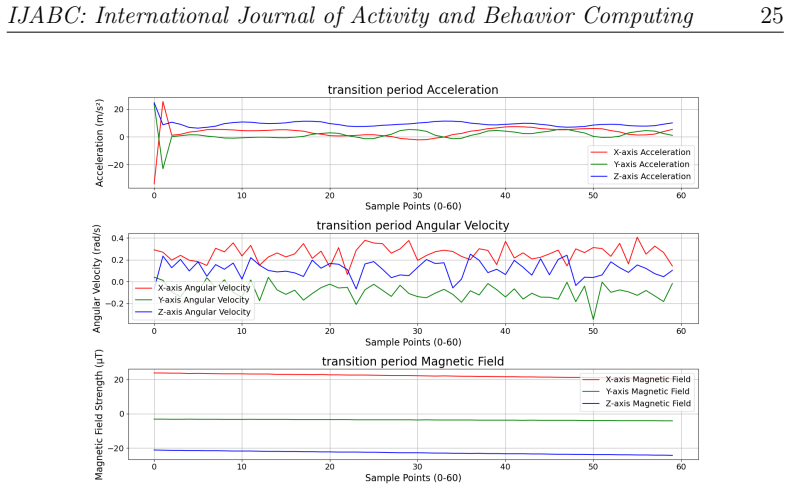
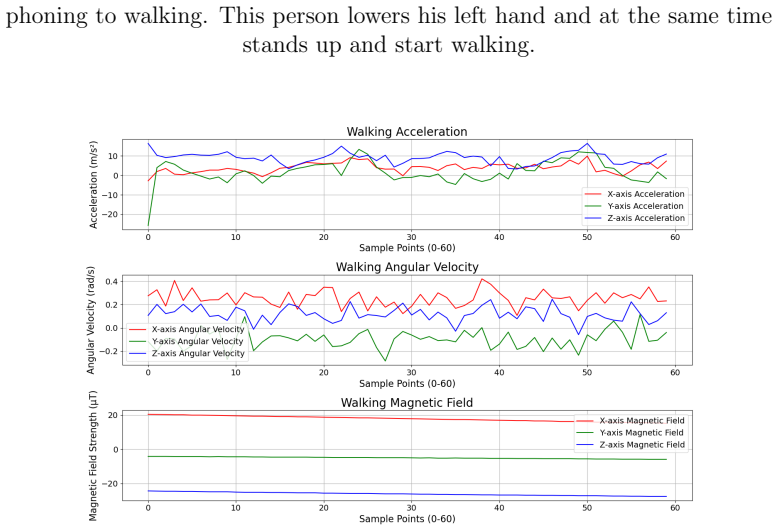
- Synthetic IMU signals for any joint, such as the left wrist, can be produced from the generated skeleton through SMPL mesh normals and a simulated IMU module, removing the need for physical inertial sensors.
- The 16.84M-parameter model reports better ADE, FDE, and MMADE than the 28.40M-parameter HumanMAC on Human3.6M, implying that the gate and time-embedding modules recover the accuracy lost by using half the number of modules.
Reading between the lines
- If the boundary-frame premise holds beyond Human3.6M actions, the same masked-completion recipe could be applied to other periodic or quasi-periodic signals, such as audio or sensor streams, where a smooth transition between two observed segments is needed.
- The paper's own limitation that some transitions violate physical plausibility suggests that adding explicit biomechanical constraints, like joint-angle limits or foot-ground contact, would be a natural next step for making the arbitrary-length stitching usable in production animation.
- Because cross-action stitching is not evaluated against ground truth, a direct test would be to record a subject performing two scripted actions back-to-back and compare the generated bridge to the actual recorded bridge; the authors did not report such a comparison.
Editorial analysis
A structured set of objections, weighed in public.
Referee Report
Summary. The paper proposes MDC-Net, a diffusion-based motion completion network built on the HumanMAC architecture, augmented with a gate module and a position-time embedding module, to generate transition motion sequences connecting two motion fragments and to extract synthetic IMU data from the resulting motion. Experiments on Human3.6M report lower ADE, FDE, and MMADE than HumanMAC and MDM, a smaller model size (16.84M vs. 28.40M), and qualitative demonstrations of cross-action stitching. The paper claims that MDC-Net accepts motion sequences of any length and generates sequences of arbitrary length, requires less training time than HumanMAC, and supports a pipeline from skeleton to SMPL mesh to simulated IMU signals.
Significance. If the central claims held, MDC-Net would be a lightweight plug-in for extending motion-capture sequences and for generating synthetic IMU training data, which is an appealing practical direction. The paper follows standard Human3.6M train/test splits and reports a concrete parameter-count reduction. However, the significance is currently limited by three factors: the reported metric gains over HumanMAC are marginal and are reported without error bars; the layer-count ablation is confounded with the noise schedule; and the headline capabilities of arbitrary-length generation and cross-action stitching are not supported by any quantitative evaluation. The IMU extraction component is also presented only through qualitative plots, without comparison to real IMU measurements.
major comments (4)
- [Section 5.2, Table 1] The claimed quantitative superiority over HumanMAC is not established. The MMADE difference is 0.0002 (0.5716 vs. 0.5718), and MMFDE is worse for MDC-Net (0.8077 vs. 0.7946). No error bars or multiple-run statistics are reported, so the ADE and FDE improvements (0.2195 vs. 0.2352 and 0.0769 vs. 0.0839) may be within run-to-run variation. Additionally, the Conclusion states that MDC-Net outperforms FlowMDM and HumanMAC, but Table 1 does not include FlowMDM. The abstract and conclusion should be tempered or supported with statistically meaningful comparisons.
- [Section 5.3, Tables 2 and 3] The layer-count ablation is confounded with the noise schedule. The 4-layer row in Table 2 (ADE 0.2195, FDE 0.0769, MMADE 0.5716, MMFDE 0.8077) is identical to the cosine row of Table 3, and the 8-layer row (ADE 0.5544, FDE 0.3730, MMADE 0.7964, MMFDE 0.8217) is identical to the sqrt row. Therefore the conclusion that 4 layers outperform 8 layers cannot be attributed to the number of layers; the experiment must vary the layer count while keeping the noise schedule fixed.
- [Section 5.1 and Contributions] All quantitative experiments use a fixed 125-frame window (10 history frames, 90 prediction frames, and 15 future frames, as stated in Section 5.1). The central contribution claim that MDC-Net 'accepts motion sequences of any length as input and generates motion sequences of arbitrary length' is therefore never tested. No experiment varies the context length or the prediction length, and the cross-action demonstrations in Section 5.4 also use a fixed 125-frame completion. The arbitrary-length claim is unsupported by the reported evidence.
- [Section 5.4 and Limitations] The motivating application of stitching two different actions (e.g., Sitting to Walking, Greeting to Phoning) is evaluated only with sampled-frame visualizations and qualitative descriptions. No quantitative metrics are reported for cross-action transitions, and the Limitations section explicitly acknowledges that some generated transitions deviate from realistic human movement and physical laws (e.g., legs extending downward instead of the upper body rising). Since the model is trained to inpaint the middle of a single recorded action, the premise stated in Section 1 that a transition can be predicted from the final frames of H1 and the initial frames of H2 remains a load-bearing but untested assumption. The central product claim collapses if this generalization fails.
minor comments (5)
- [Section 6.1, Table 5] The GreetingToPhoning row reports 340 total points, but the sum of used points (35) and generated points (90) is 125; this is internally inconsistent. There is also a typo 'Human3.8M' in the table caption.
- [Section 4.2, TimeEmbedding] The position-time embedding module is described only vaguely as 'incorporating information from different time scales'; the exact encoding construction, dimensionality, and how it is combined with the transformer input are not specified, making the module difficult to reproduce.
- [Section 5.3, Table 4] The Baseline row in Table 4 has the same values as the HumanMAC row in Table 1 (APD 3.3563, ADE 0.2352, FDE 0.0839, MMADE 0.5718, MMFDE 0.7946), but the text does not state whether the baseline is the unmodified HumanMAC or MDC-Net without the proposed modules; this should be clarified.
- [Contributions and Section 5] The contribution bullet claiming 'less training time compared to HumanMAC' is not supported by any reported training-time measurement; please include training-time comparisons or remove the claim.
- [Section 6.3] The sentence 'The plot illustrates the acceleration and angular velocity of the left wrist when a person does actions from phoning to walking and from phoning to walking' repeats the same transition pair; presumably one of the two should refer to a different pair of actions.
Circularity Check
No significant circularity: MDC-Net's benchmark results are empirical train/test comparisons, not derivations from its inputs.
full rationale
MDC-Net's central benchmark claims (Section 5.2, Table 1) are empirical train/test comparisons on held-out Human3.6M middle frames, measured with ADE/FDE/MMADE against ground truth. The masking/padding construction in Eq. (3) preserves known H1/H2 frames and lets the diffusion denoiser produce the unknown P; no equation defines the predicted P as a deterministic function of the H1/H2 endpoints, so the reported errors are not forced by construction. The only author self-citation ([1], a pose-estimation paper) appears in a general related-work list and is not load-bearing. The 'arbitrary length' and cross-action stitching claims are only weakly supported—Section 5.1 uses a fixed 125-frame window, Section 5.4 is qualitative, and the Limitations section admits physically implausible transitions—but these are validation/correctness gaps, not circular derivations. No fitted parameter is renamed as a prediction, no uniqueness theorem is imported from the authors' prior work, and no known result is merely relabeled.
Assumptions & free parameters
free parameters (5)
- Noise schedule =
cosine
- Context window split =
10 history / 90 prediction / 15 future frames (and 15/20 in Table 5)
- Number of stacked modules N =
4
- Left wrist vertex index =
2208
- Learning rate and training epochs =
0.0003, 1000 epochs
assumptions (5)
- domain assumption The transition between two motion fragments can be predicted from only the final frames of H1 and the initial frames of H2, relying on human motion periodicity.
- domain assumption A model trained to inpaint middle segments of single Human3.6M action sequences generalizes to stitching pairs of different action classes.
- domain assumption SMPL, MotionBERT, and NeuralBody provide sufficiently accurate body meshes and vertex normals for simulating IMU signals.
- domain assumption The MATLAB IMU module output is a valid proxy for real IMU sensor readings.
- standard math Standard DDPM forward/reverse process definitions and DCT/iDCT linearity hold.
invented entities (2)
-
Gate fusion module (sigmoid-weighted sum of attention and FFN outputs)
-
Position-time embedding module
Cite this review
Pith. "Pith review of Diffusion Model-based Activity Completion for AI Motion Capture from Videos." pith.science (2026). https://pith.science/paper/J7V4WDDV
@misc{pith2026250521566,
  author       = {Pith},
  title        = {Pith review of: Diffusion Model-based Activity Completion for AI Motion Capture from Videos},
  year         = {2026},
  howpublished = {\url{https://pith.science/paper/J7V4WDDV}},
  note         = {Machine review of arXiv:2505.21566}
}
read the original abstract
AI-based motion capture is an emerging technology that offers a cost-effective alternative to traditional motion capture systems. However, current AI motion capture methods rely entirely on observed video sequences, similar to conventional motion capture. This means that all human actions must be predefined, and movements outside the observed sequences are not possible. To address this limitation, we aim to apply AI motion capture to virtual humans, where flexible actions beyond the observed sequences are required. We assume that while many action fragments exist in the training data, the transitions between them may be missing. To bridge these gaps, we propose a diffusion-model-based action completion technique that generates complementary human motion sequences, ensuring smooth and continuous movements. By introducing a gate module and a position-time embedding module, our approach achieves competitive results on the Human3.6M dataset. Our experimental results show that (1) MDC-Net outperforms existing methods in ADE, FDE, and MMADE but is slightly less accurate in MMFDE, (2) MDC-Net has a smaller model size (16.84M) compared to HumanMAC (28.40M), and (3) MDC-Net generates more natural and coherent motion sequences. Additionally, we propose a method for extracting sensor data, including acceleration and angular velocity, from human motion sequences.
Figures


Figures from the paper (14 more)


Reference graph
Works this paper leans on
-
[1]
Im- provement of Human Action Recognition Using 3D Pose Estima- tion, pages 21–37
Kohei Adachi, Paula Lago, Tsuyoshi Okita, and Sozo Inoue. Im- provement of Human Action Recognition Using 3D Pose Estima- tion, pages 21–37. Springer Singapore, Singapore, 2021
work page 2021
-
[2]
German Barquero, Sergio Escalera, and Cristina Palmero. Seam- less human motion composition with blended positional encod- Diffusion Model-based Activity Completion for AI Motion Capture from Videos IJABC: International Journal of Activity and Behavior Computing 27 ings. In Proceedings of the IEEE/CVF Conference on Computer Vision and Pattern Recognition ...
work page 2024
-
[3]
Real- time multi-person 2d pose estimation using part affinity fields
Zhe Cao, Tomas Simon, Shih-En Wei, and Yaser Sheikh. Real- time multi-person 2d pose estimation using part affinity fields. In Proceedings of the IEEE conference on computer vision and pattern recognition, pages 7291–7299, 2017
work page 2017
-
[4]
Bodiffusion: Diffusing sparse observations for full-body human motion synthesis
Angela Castillo, Maria Escobar, Guillaume Jeanneret, Albert Pumarola, Pablo Arbel´ aez, Ali Thabet, and Artsiom Sanakoyeu. Bodiffusion: Diffusing sparse observations for full-body human motion synthesis. In Proceedings of the IEEE/CVF International Conference on Computer Vision , pages 4221–4231, 2023
work page 2023
-
[5]
Humanmac: Masked motion completion for human motion prediction
Ling-Hao Chen, Jiawei Zhang, Yewen Li, Yiren Pang, Xiaobo Xia, and Tongliang Liu. Humanmac: Masked motion completion for human motion prediction. In Proceedings of the IEEE/CVF International Conference on Computer Vision , pages 9544–9555, 2023
work page 2023
-
[6]
Pose2mesh: Graph convolutional network for 3d human pose and mesh recovery from a 2d human pose
Hongsuk Choi, Gyeongsik Moon, and Kyoung Mu Lee. Pose2mesh: Graph convolutional network for 3d human pose and mesh recovery from a 2d human pose. InComputer Vision–ECCV 2020: 16th European Conference, Glasgow, UK, August 23–28, 2020, Proceedings, Part VII 16 , pages 769–787. Springer, 2020
work page 2020
-
[7]
Alphapose: Whole- body regional multi-person pose estimation and tracking in real- time
Hao-Shu Fang, Jiefeng Li, Hongyang Tang, Chao Xu, Haoyi Zhu, Yuliang Xiu, Yong-Lu Li, and Cewu Lu. Alphapose: Whole- body regional multi-person pose estimation and tracking in real- time. IEEE Transactions on Pattern Analysis and Machine In- telligence, 45(6):7157–7173, 2022
work page 2022
-
[8]
Generative adversarial networks
Ian Goodfellow, Jean Pouget-Abadie, Mehdi Mirza, Bing Xu, David Warde-Farley, Sherjil Ozair, Aaron Courville, and Yoshua Bengio. Generative adversarial networks. Communications of the ACM, 63(11):139–144, 2020
2020
Show all 49 references
-
[9]
Momask: Generative masked modeling of 3d human motions
Chuan Guo, Yuxuan Mu, Muhammad Gohar Javed, Sen Wang, and Li Cheng. Momask: Generative masked modeling of 3d human motions. In Proceedings of the IEEE/CVF Conference on Computer Vision and Pattern Recognition , pages 1900–1910, 2024
1900
-
[10]
Deep residual learning for image recognition
Kaiming He, Xiangyu Zhang, Shaoqing Ren, and Jian Sun. Deep residual learning for image recognition. In Proceedings of the Diffusion Model-based Activity Completion for AI Motion Capture from Videos IJABC: International Journal of Activity and Behavior Computing 28 IEEE confer...
2016
-
[11]
Denoising diffusion probabilistic models
Jonathan Ho, Ajay Jain, and Pieter Abbeel. Denoising diffusion probabilistic models. Advances in neural information processing systems, 33:6840–6851, 2020
2020
-
[12]
Video diffusion models
Jonathan Ho, Tim Salimans, Alexey Gritsenko, William Chan, Mohammad Norouzi, and David J Fleet. Video diffusion models. Advances in Neural Information Processing Systems , 35:8633– 8646, 2022
2022
-
[13]
Phase-functioned neural networks for character control
Daniel Holden, Taku Komura, and Jun Saito. Phase-functioned neural networks for character control. ACM Transactions on Graphics (TOG), 36(4):1–13, 2017
2017
-
[14]
Winnet: Wavelet- inspired invertible network for image denoising
Jun-Jie Huang and Pier Luigi Dragotti. Winnet: Wavelet- inspired invertible network for image denoising. IEEE Trans- actions on Image Processing , 31:4377–4392, 2022
2022
-
[15]
Catalin Ionescu, Dragos Papava, Vlad Olaru, and Cristian Smin- chisescu. Human3. 6m: Large scale datasets and predictive meth- ods for 3d human sensing in natural environments. IEEE trans- actions on pattern analysis and machine intelligence , 36(7):1325– 1339, 2013
2013
-
[16]
Alias-free generative adversarial networks
Tero Karras, Miika Aittala, Samuli Laine, Erik H¨ ark¨ onen, Janne Hellsten, Jaakko Lehtinen, and Timo Aila. Alias-free generative adversarial networks. Advances in neural information processing systems, 34:852–863, 2021
2021
-
[17]
Plan, posture and go: Towards open-world text-to-motion generation
Jinpeng Liu, Wenxun Dai, Chunyu Wang, Yiji Cheng, Yansong Tang, and Xin Tong. Plan, posture and go: Towards open-world text-to-motion generation. arXiv preprint arXiv:2312.14828 , 2023
2023 arXiv
-
[18]
Aggregated multi-gans for controlled 3d human motion prediction
Zhenguang Liu, Kedi Lyu, Shuang Wu, Haipeng Chen, Yanbin Hao, and Shouling Ji. Aggregated multi-gans for controlled 3d human motion prediction. In Proceedings of the AAAI conference on artificial intelligence , volume 35, pages 2225–2232, 2021
2021
-
[19]
Smpl: A skinned multi-person linear model
Matthew Loper, Naureen Mahmood, Javier Romero, Gerard Pons-Moll, and Michael J Black. Smpl: A skinned multi-person linear model. In Seminal Graphics Papers: Pushing the Bound- aries, Volume 2 , pages 851–866. 2023. Diffusion Model-based Activity Completion for AI Motion Captur...
2023
-
[20]
3d human mesh estimation from virtual mark- ers
Xiaoxuan Ma, Jiajun Su, Chunyu Wang, Wentao Zhu, and Yizhou Wang. 3d human mesh estimation from virtual mark- ers. In Proceedings of the IEEE/CVF Conference on Computer Vision and Pattern Recognition , pages 534–543, 2023
2023
-
[21]
Generative ai for recognizing nurse training activities in skeleton-based video data
Md Ibrahim Mamun, Shahera Hossain, Md Baharul Islam, and Md Atiqur Rahman Ahad. Generative ai for recognizing nurse training activities in skeleton-based video data. International Journal of Activity and Behavior Computing , 2024(3):1–20, 2024
2024
-
[22]
On hu- man motion prediction using recurrent neural networks
Julieta Martinez, Michael J Black, and Javier Romero. On hu- man motion prediction using recurrent neural networks. In Pro- ceedings of the IEEE conference on computer vision and pattern recognition, pages 2891–2900, 2017
2017
-
[23]
Nerf: Representing scenes as neural radiance fields for view synthesis
Ben Mildenhall, Pratul P Srinivasan, Matthew Tancik, Jonathan T Barron, Ravi Ramamoorthi, and Ren Ng. Nerf: Representing scenes as neural radiance fields for view synthesis. Communications of the ACM , 65(1):99–106, 2021
2021
-
[24]
Posefix: Model-agnostic general human pose refinement network
Gyeongsik Moon, Ju Yong Chang, and Kyoung Mu Lee. Posefix: Model-agnostic general human pose refinement network. In Pro- ceedings of the IEEE/CVF Conference on Computer Vision and Pattern Recognition, pages 7773–7781, 2019
2019
-
[25]
Accurate 3d hand pose estimation for whole-body 3d human mesh estima- tion
Gyeongsik Moon, Hongsuk Choi, and Kyoung Mu Lee. Accurate 3d hand pose estimation for whole-body 3d human mesh estima- tion. In Proceedings of the IEEE/CVF Conference on Computer Vision and Pattern Recognition , pages 2308–2317, 2022
2022
-
[26]
A metaverse: Taxonomy, components, applications, and open challenges
Sang-Min Park and Young-Gab Kim. A metaverse: Taxonomy, components, applications, and open challenges. IEEE access , 10:4209–4251, 2022
2022
-
[27]
3d human pose estimation in video with temporal convolutions and semi-supervised training
Dario Pavllo, Christoph Feichtenhofer, David Grangier, and Michael Auli. 3d human pose estimation in video with temporal convolutions and semi-supervised training. In Proceedings of the IEEE/CVF conference on computer vision and pattern recogni- tion, pages 7753–7762, 2019
2019
-
[28]
Neural body: Implicit neural representations with structured latent codes for novel view synthesis of dynamic humans
Sida Peng, Yuanqing Zhang, Yinghao Xu, Qianqian Wang, Qing Shuai, Hujun Bao, and Xiaowei Zhou. Neural body: Implicit neural representations with structured latent codes for novel view synthesis of dynamic humans. In Proceedings of the IEEE/CVF Conference on Computer Vision and...
2021
-
[29]
Recognition of endotracheal suctioning activities: A feature extraction and ensemble learning approach based on pose esti- mation data
Hoang Khang Phan, Tu Nhat Khang Nguyen, Truong Vi Bui, Khuong Cong Duy Nguyen, Tuan Phong Nguyen, and Nhat Tan Le. Recognition of endotracheal suctioning activities: A feature extraction and ensemble learning approach based on pose esti- mation data. In 2024 International Conf...
2024
-
[30]
Stylegan-v: A continuous video generator with the price, image quality and perks of stylegan2
Ivan Skorokhodov, Sergey Tulyakov, and Mohamed Elhoseiny. Stylegan-v: A continuous video generator with the price, image quality and perks of stylegan2. In Proceedings of the IEEE/CVF conference on computer vision and pattern recognition , pages 3626–3636, 2022
2022
-
[31]
Score-based generative modeling through stochastic differential equations.arXiv preprint arXiv:2011.13456, 2020
Yang Song, Jascha Sohl-Dickstein, Diederik P Kingma, Abhishek Kumar, Stefano Ermon, and Ben Poole. Score-based generative modeling through stochastic differential equations.arXiv preprint arXiv:2011.13456, 2020
2011 arXiv
-
[32]
Deepphase: Periodic autoencoders for learning motion phase manifolds
Sebastian Starke, Ian Mason, and Taku Komura. Deepphase: Periodic autoencoders for learning motion phase manifolds. ACM Transactions on Graphics (TOG) , 41(4):1–13, 2022
2022
-
[33]
Deep high- resolution representation learning for human pose estimation
Ke Sun, Bin Xiao, Dong Liu, and Jingdong Wang. Deep high- resolution representation learning for human pose estimation. In Proceedings of the IEEE/CVF conference on computer vision and pattern recognition, pages 5693–5703, 2019
2019
-
[34]
Augmented reality and robotics: A sur- vey and taxonomy for ar-enhanced human-robot interaction and robotic interfaces
Ryo Suzuki, Adnan Karim, Tian Xia, Hooman Hedayati, and Nicolai Marquardt. Augmented reality and robotics: A sur- vey and taxonomy for ar-enhanced human-robot interaction and robotic interfaces. In Proceedings of the 2022 CHI Conference on Human Factors in Computing Systems , ...
2022
-
[35]
From screen to re- ality: Exploring the evolution and integration of motion capture technology for virtual digital humans
JiChu Tang, KiHong Kim, and KaiXing Wang. From screen to re- ality: Exploring the evolution and integration of motion capture technology for virtual digital humans. 2024
2024
-
[36]
Human motion diffusion model
Guy Tevet, Sigal Raab, Brian Gordon, Yonatan Shafir, Daniel Cohen-Or, and Amit H Bermano. Human motion diffusion model. arXiv preprint arXiv:2209.14916 , 2022
2022 arXiv
-
[37]
Learning from synthetic humans
Gul Varol, Javier Romero, Xavier Martin, Naureen Mahmood, Michael J Black, Ivan Laptev, and Cordelia Schmid. Learning from synthetic humans. In Proceedings of the IEEE conference on computer vision and pattern recognition, pages 109–117, 2017. Diffusion Model-based Activity Co...
2017
-
[38]
Attention is all you need
Ashish Vaswani, Noam Shazeer, Niki Parmar, Jakob Uszkoreit, Llion Jones, Aidan N Gomez, Lukasz Kaiser, and Illia Polosukhin. Attention is all you need. Advances in neural information pro- cessing systems, 30, 2017
2017
-
[39]
Diffusion- phase: Motion diffusion in frequency domain
Weilin Wan, Yiming Huang, Shutong Wu, Taku Komura, Wen- ping Wang, Dinesh Jayaraman, and Lingjie Liu. Diffusion- phase: Motion diffusion in frequency domain. arXiv preprint arXiv:2312.04036, 2023
2023 arXiv
-
[40]
Free- man: Towards benchmarking 3d human pose estimation in the wild
Jiong Wang, Fengyu Yang, Wenbo Gou, Bingliang Li, Danqi Yan, Ailing Zeng, Yijun Gao, Junle Wang, and Ruimao Zhang. Free- man: Towards benchmarking 3d human pose estimation in the wild. arXiv preprint arXiv:2309.05073 , 2023
2023 arXiv
-
[41]
Actformer: A gan-based transformer to- wards general action-conditioned 3d human motion generation
Liang Xu, Ziyang Song, Dongliang Wang, Jing Su, Zhicheng Fang, Chenjing Ding, Weihao Gan, Yichao Yan, Xin Jin, Xi- aokang Yang, et al. Actformer: A gan-based transformer to- wards general action-conditioned 3d human motion generation. In Proceedings of the IEEE/CVF Internation...
2023
-
[42]
Using ai motion capture systems to capture race walking technol- ogy at a race scene: A comparative experiment
Dongtao Zhang, Zhongqiu Ji, Guiping Jiang, and Weiwei Jiao. Using ai motion capture systems to capture race walking technol- ogy at a race scene: A comparative experiment. Applied Sciences, 13(1):113, 2022
2022
-
[43]
Mode- adaptive neural networks for quadruped motion control
He Zhang, Sebastian Starke, Taku Komura, and Jun Saito. Mode- adaptive neural networks for quadruped motion control. ACM Transactions on Graphics (TOG) , 37(4):1–11, 2018
2018
-
[44]
Motiondiffuse: Text- driven human motion generation with diffusion model
Mingyuan Zhang, Zhongang Cai, Liang Pan, Fangzhou Hong, Xinying Guo, Lei Yang, and Ziwei Liu. Motiondiffuse: Text- driven human motion generation with diffusion model. arXiv preprint arXiv:2208.15001, 2022
2022 arXiv
-
[45]
Dstformer: 3d human pose estimation with a dual-scale spatial and temporal transformer network
Shaokun Zhang, Xinde Li, Chuanfei Hu, Jianping Xu, and Huap- ing Liu. Dstformer: 3d human pose estimation with a dual-scale spatial and temporal transformer network. In 2024 International Conference on Advanced Robotics and Mechatronics (ICARM) , pages 484–489. IEEE, 2024
2024
-
[46]
Shenhao Zhu, Junming Leo Chen, Zuozhuo Dai, Zilong Dong, Yinghui Xu, Xun Cao, Yao Yao, Hao Zhu, and Siyu Zhu. Champ: Controllable and consistent human image animation with 3d Diffusion Model-based Activity Completion for AI Motion Capture from Videos IJABC: International Journ...
2024
-
[47]
Motionbert: A unified perspective on learning human motion representations
Wentao Zhu, Xiaoxuan Ma, Zhaoyang Liu, Libin Liu, Wayne Wu, and Yizhou Wang. Motionbert: A unified perspective on learning human motion representations. In Proceedings of the IEEE/CVF International Conference on Computer Vision, pages 15085–15099, 2023
2023
-
[48]
Human motion generation: A survey
Wentao Zhu, Xiaoxuan Ma, Dongwoo Ro, Hai Ci, Jinlu Zhang, Jiaxin Shi, Feng Gao, Qi Tian, and Yizhou Wang. Human motion generation: A survey. IEEE Transactions on Pattern Analysis and Machine Intelligence , 2023
2023
-
[49]
Sensor data augmentation from skeleton pose sequences for improving human activity recogni- tion
Parham Zolfaghari, Vitor Fortes Rey, Lala Ray, Hyun Kim, Sungho Suh, and Paul Lukowicz. Sensor data augmentation from skeleton pose sequences for improving human activity recogni- tion. In 2024 International Conference on Activity and Behavior Computing (ABC) , pages 1–8, 2024...
2024
Reviewed August 7, 2026 · model on record in the stance chip above.
Discussion (0). Sign in to comment.