REVIEW 5 major objections 5 minor 1 cited by
AITEE -- Agentic Tutor for Electrical Engineering
T0 review · 5 major / 5 minor · reviewed 2026-08-07 · deepseek-v4-flash
Pith's one-line read A tutoring agent that retrieves lecture context by circuit shape and verifies computations with SPICE simulation lifts LLM accuracy on first-semester DC circuit problems from around 0.5 to 0.85–0.96.
desk verdict A promising prototype with an unvalidated retriever; the headline gains are conditional until the GNN similarity is measured directly. read the letter →
The pith
A machine-rendered reading of the paper's core claim, the machinery that carries it, and where it could break.
The reading
What carries the argument
The central mechanism is a circuit-similarity measure built from GraphSAGE graph embeddings combined with hand-designed metadata features: a sigmoid of component count, a linear source-type term, and a binary single/multiple-source flag, all normalized and concatenated. Cosine similarity between these embeddings tells which eight circuit classes a given circuit belongs to, and those embeddings index lecture units through multi-representation indexing, where each unit is represented by example netlists. The other load-bearing tool is PySpice, which takes the reconstructed netlist and returns exact voltages and currents, letting the LLM focus on method. The similarity measure carries the argument: when it retrieves the right unit, even a 70B model performs at tutor level; without it, advanced RAG over text chunks fails to beat prompting alone.
What would settle it
Run AITEE's task set three ways: with the GNN-retrieved unit, with a randomly chosen unit, and with the oracle (hand-picked) correct unit. If random-chunk performance is close to GNN-retrieved performance, retrieval is not the cause of the gains; if oracle is much higher, retrieval is still a bottleneck. Also directly test retrieval on out-of-distribution circuits and report precision@1 against a labeled ground-truth unit; the central claim collapses if retrieval accuracy is at chance.
Extended reading notes
Core claim
On the paper's own terms, the discovery is that the bottleneck in LLM-based circuit tutoring is not parametric knowledge of electric circuit fundamentals but the inability to map a concrete circuit—especially an unfamiliar or complex one—to the right solution method. AITEE attacks this with a graph neural network that embeds circuits so cosine similarity between embeddings reflects whether two circuits share a solution approach, and with multi-representation indexing that uses those embeddings to retrieve the relevant lecture unit. Adding a SPICE simulation to offload arithmetic lifts accuracy to near-optimal on most circuit classes; only superposition tasks with current-direction mismatches remain error-prone.
Load-bearing premise
The GNN similarity measure, trained on only 150 netlists and combined with hand-set metadata rules, reliably retrieves the correct lecture unit for any circuit a student draws, including circuits outside that small training distribution; the paper never measures retrieval accuracy directly.
Editorial extensions
If this is right
- The full agentic pipeline makes medium-sized open-source LLMs (Llama 3.1 70B) competitive with large closed models on first-semester DC circuit analysis tasks.
- Prompt engineering alone and text-chunk RAG approaches (RAPTOR, RAG-Fusion, HyDE) do not reliably solve Class 7 bridge or Class 6/8 superposition circuits; the graph-indexed retrieval is what unlocks those classes.
- Hand-drawn circuits become usable input through YOLOv8 detection plus a line-loss validated inter-node connection method, so students can sketch circuits naturally.
- With instruction prompting, all models except the smallest follow Socratic dialogue and do not give away solutions; robustness against false student statements also improves.
- Remaining known limits are arithmetic inconsistencies in superposition tasks due to current-direction conventions and a need for real classroom validation.
Reading between the lines
- The paper does not directly measure retrieval accuracy; a fair test would compare AITEE's retrieval against an oracle-chunk condition and against a random-chunk condition on the same tasks, to see how much of the gain is really attributable to the GNN similarity versus the simulation and prompt structure.
- The GNN was trained on only 150 netlists from the same eight-class taxonomy used to define the heatmap evaluation, so its behavior on out-of-distribution circuits (different component values, unusual topologies, or reconstruction errors from handwriting) is untested; the system's promise depends on that generalization.
- The Socratic-dialogue evaluation uses only five dialogues per model with one intentional misinformation insertion, so robustness claims are plausible but not yet established at scale.
- The same design pattern—embed a domain artifact, index lecture units by artifact exemplars, and offload arithmetic to a simulator—could transfer to other engineering diagram domains such as logic circuits or control block diagrams whenever a simulator and a similarity notion exist.
Editorial analysis
A structured set of objections, weighed in public.
Referee Report
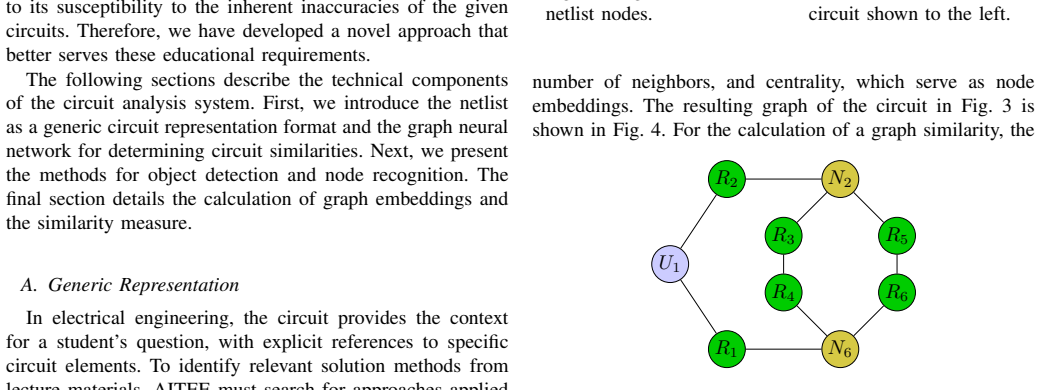
Summary. This paper presents AITEE, an agentic tutoring system for first-semester electrical engineering. The system detects circuit components and connections from digital or hand-drawn images with YOLOv8, converts the circuit to a netlist and a graph, and computes a similarity between circuits using a GraphSAGE embedding combined with hand-crafted metadata features (component counts, source configuration). The similarity is used in a multi-representation-indexing RAG scheme: each lecture unit is indexed by representative netlists ('index-circuits'), and the most similar unit is retrieved for the LLM prompt. A PySpice simulation of the netlist is added to validate arithmetic results. Four LLMs (Llama 3.1 8B/70B/405B, Claude 3.5 Sonnet) are evaluated on netlist understanding and on solving DC circuit tasks under various prompting and retrieval strategies. The authors report large accuracy gains from 1-Shot-CoT+MRI+Sim over prompting-only baselines, and a separate evaluation of Socratic dialogue and robustness to misinformation. The dataset of 831 hand-drawn resistor circuits is released.
Significance. If the reported gains are reliable, AITEE would be a valuable contribution to intelligent tutoring for electrical engineering: it combines a practical input modality (hand-drawn circuits), a domain-specific retrieval mechanism, and simulation-based grounding, and it shows that mid-size open-weight LLMs can reach near the level of the best closed-source model on the evaluated tasks. The paper also contributes a new labeled dataset of European-symbol circuit diagrams. However, the central empirical claims currently rest on a small evaluation set with no statistical analysis, and the retrieval component that drives the main improvement is never directly measured. These gaps should be addressed before the paper can be accepted.
major comments (5)
- [Section III-C, Section IV-B3, Figure 8] The retrieval quality of the GNN-based similarity measure is never directly evaluated. The only evidence is the cosine similarity heatmap in Figure 8 for 2 circuits per class drawn from the same taxonomy used to define the eight classes, and the MRI experiments in Section IV-B3 fold retrieval accuracy into end-task accuracy. Because Section IV-B2 shows that wrong retrieved context can degrade performance (Naive RAG), the Table V gains for 1-Shot-CoT+MRI and +Sim depend entirely on the retriever returning the correct lecture unit. I ask for a direct retrieval evaluation: hit rate at k, mean reciprocal rank, or similar, on held-out circuits, including circuits that are not near-duplicates of the index-circuits generated for each lecture unit.
- [Section IV-B, Table V] The comparison between 1-Shot-CoT+MRI and the baseline conditions is confounded by the number of CoT examples. The table compares 1-Shot-CoT+MRI/+Sim against 3-Shot-CoT without MRI, but a 1-Shot-CoT-only control is never reported. Since the paper states the number of exemplars was empirically set to three for CoT prompting, the improvement attributed to MRI could partly be an effect of changing the shot count. Please add a 1-Shot-CoT-only condition or use 3-Shot-CoT+MRI, so that the MRI contribution is isolated.
- [Section IV-B, Table V, Figure 11] The evaluation set is too small to support the word 'significantly' in the abstract and conclusions. Section IV-B reports 'one or two tasks for a subset of circuit classes' (five class groups in Figure 11), with a single accuracy number per model-condition cell. No confidence intervals, bootstrap estimates, or significance tests are reported. I request the exact number of tasks and subtasks, and a statistical analysis (e.g., paired bootstrap or Wilcoxon test over tasks) to justify the claim of significant outperformance.
- [Section III-C, Equations (5)-(6)] The relative contribution of the learned graph embedding and the hand-set metadata features to the similarity measure is never disentangled. The sigmoid constants (c1=1, c2=7.5) and the source combination weights (0.33, 0.66, 0.01) are chosen ad hoc, and the GNN classification accuracy on the 30-netlist validation set is not reported. Without an ablation (embedding-only vs. metadata-only vs. both) and without the GNN validation accuracy, it is unclear whether the GraphSAGE component adds anything over the simple metadata counts. Please report the retrieval/classification performance for each component separately.
- [Section IV-A, Section IV-B] The reliability of the evaluation is not established. Table IV relies on GPT-4.0 as a judge with no validation against human raters, and the task accuracy numbers in Table V come from manual scoring with no inter-rater reliability reported, despite the statement that 'the achievable partial points were defined in advance.' I recommend including the detailed scoring rubric in the appendix, having a second rater score a random subset, and reporting agreement (e.g., Cohen's kappa), or at least reporting a comparison of the GPT-4.0 judge with human ratings.
minor comments (5)
- [Section III-C, Eq. (4)] The notation N − b,k is typeset awkwardly; please define it unambiguously as the number of interval points excluding those inside component bounding boxes.
- [Section IV-B, Figure 11] The figure caption calls it a 'stacked bar histogram,' but the plot appears to be a grouped bar chart; please correct the caption.
- [Section II, Fig. 2] The abbreviation 'MRI' and the 'Sim' tool are not labeled in the architecture figure; labeling them would help readers map the figure to Section IV-B3.
- [Section III-B] The heuristic threshold for the line-loss metric is described only qualitatively; reporting the threshold value and a sensitivity check would improve reproducibility.
- [Section IV-C] The dialogue dataset size is unclear. The text says 'each question–circuit pair ... extended to include five user queries and five system responses' and then 'this methodology results in five dialogs,' which is ambiguous about how many initial questions were used. Please state the exact number of dialogues.
Circularity Check
No significant circularity: the central Table V accuracy gains are not forced by construction, though the retriever is never directly validated.
full rationale
The paper's central claim is an end-to-end accuracy comparison on first-semester DC circuit tasks, and the final evaluations are not tautological: solutions were checked manually with pre-defined partial points, independent of the retrieval definitions. The MRI+Sim gain in Table V is also not an identity, because the paper itself shows that adding retrieval can hurt performance (3-Shot-CoT + Naive RAG drops Llama 3.1 70B from 0.57 to 0.38), so the benefit of the GNN-based retriever is an empirical outcome rather than a consequence of how the embedding or metadata functions are defined. Equations (5) and (6) are fixed hand-set scalars inside the embedding; they are not fitted to the evaluation tasks and do not by themselves determine whether a circuit is solved correctly. The only self-citation is [29], a released dataset used to train the YOLO component detector; it supplies no theorem, uniqueness claim, or ansatz that forces the main result, and the object-detection component is not where the headline accuracy claim is established. The legitimate concern raised by the paper's own evidence is an evaluation gap: Section III-C2 validates the graph embeddings only through Figure 8, a class-separation heatmap on the same eight-class taxonomy used to define the lecture-index netlists, and no direct retrieval hit rate or MRR is reported for Section IV-B3. That means the conclusion in Section V that the 'graph-based similarity measure effectively retrieves relevant contextual information' is under-supported, and the contribution of retrieval to the Table V gains is not isolated. Under-support and risk of near-duplicate test/index circuits are correctness concerns, not circular reductions: no equation or fitted parameter in the paper is shown to equal its own predicted output by construction. Accordingly, the circularity score is low.
Assumptions & free parameters
free parameters (6)
- GraphSAGE network weights theta =
trained on 150 netlists, specifics not reported
- Metadata sigmoid constants c1, c2 =
c1=1, c2=7.5
- Metadata source-combination weights =
0.33 (voltage), 0.66 (current), 0.01 (interaction)
- Inter-node connection line-loss threshold =
not reported
- YOLOv8 detector weights =
trained on 831 student-drawn circuits, mAP0.5 0.971 for YOLOv8s
- Retrieval top-k chunks =
3 chunks
assumptions (5)
- ad hoc to paper The eight circuit classes in Table III cover the methodological variation in first-semester EE circuit analysis.
- ad hoc to paper Cosine similarity between learned graph embeddings and hand-crafted metadata features is a valid measure of methodological similarity between circuits.
- ad hoc to paper Each lecture unit can be indexed by one or more 'typical' representative circuits such that the retrieved unit contains the correct solution method for a similar query circuit.
- domain assumption GPT-4.0 as an LLM judge provides a valid scoring of netlist descriptions for the purpose of comparing models.
- standard math Kirchhoff's laws and linear algebra correctly describe the DC circuits used in the tasks.
invented entities (1)
-
Index-circuits
Cite this review
Pith. "Pith review of AITEE -- Agentic Tutor for Electrical Engineering." pith.science (2026). https://pith.science/paper/G3X4ZJNP
@misc{pith2026250521582,
  author       = {Pith},
  title        = {Pith review of: AITEE -- Agentic Tutor for Electrical Engineering},
  year         = {2026},
  howpublished = {\url{https://pith.science/paper/G3X4ZJNP}},
  note         = {Machine review of arXiv:2505.21582}
}
read the original abstract
Intelligent tutoring systems combined with large language models offer a promising approach to address students' diverse needs and promote self-efficacious learning. While large language models possess good foundational knowledge of electrical engineering basics, they remain insufficiently capable of addressing specific questions about electrical circuits. In this paper, we present AITEE, an agent-based tutoring system for electrical engineering designed to accompany students throughout their learning process, offer individualized support, and promote self-directed learning. AITEE supports both hand-drawn and digital circuits through an adapted circuit reconstruction process, enabling natural interaction with students. Our novel graph-based similarity measure identifies relevant context from lecture materials through a retrieval augmented generation approach, while parallel Spice simulation further enhances accuracy in applying solution methodologies. The system implements a Socratic dialogue to foster learner autonomy through guided questioning. Experimental evaluations demonstrate that AITEE significantly outperforms baseline approaches in domain-specific knowledge application, with even medium-sized LLM models showing acceptable performance. Our results highlight the potential of agentic tutors to deliver scalable, personalized, and effective learning environments for electrical engineering education.
Figures


Figures from the paper (8 more)


Forward citations
Cited by 1 Pith paper
-
Designing Needs- and Attention-Aware AI Learning Tools for Engineering Education: Insights from Psychological Outcomes
Engineering students perceive AI chatbots as most helpful for relieving competence frustration, less for autonomy, and least for relatedness; inattention weakens those perceived benefits.
Reference graph
Works this paper leans on
-
[1]
Are We There Yet? - A Systematic Literature Review on Chatbots in Education,
S. Wollny, J. Schneider, D. Di Mitri, J. Weidlich, M. Rittberger, and H. Drachsler, “Are We There Yet? - A Systematic Literature Review on Chatbots in Education,” Frontiers in Artificial Intelligence, vol. 4, p. 654924, Jul. 2021
work page 2021
-
[2]
Online self-organizing social systems: The decentralized future of online learning,
D. A. Wiley and E. Edwards, “Online self-organizing social systems: The decentralized future of online learning,” The Quarterly Review of Distance Education, 2002
work page 2002
-
[3]
Role of ai chatbots in education: systematic literature review,
L. Labadze, M. Grigolia, and L. Machaidze, “Role of ai chatbots in education: systematic literature review,” International Journal of Educational Technology in Higher Education , vol. 20, pp. 1–17, 12 2023
work page 2023
-
[4]
Intelligent Tutoring Systems with Conversational Dialogue,
A. C. Graesser, K. VanLehn, C. P. Rose, P. W. Jordan, and D. Harter, “Intelligent Tutoring Systems with Conversational Dialogue,” AI Mag- azine, vol. 22, no. 4, pp. 39–39, Dec. 2001
work page 2001
-
[5]
Unleashing the Potential of Chatbots in Education: A State-Of-The-Art Analysis,
R. Winkler and M. S ¨ollner, “Unleashing the Potential of Chatbots in Education: A State-Of-The-Art Analysis,” Academy of Management Proceedings, vol. 2018, p. 15903, Apr. 2018
work page 2018
-
[6]
T. Lehmann, I. H ¨ahnlein, and D. Ifenthaler, “Cognitive, metacognitive and motivational perspectives on preflection in self-regulated online learning,” Computers in Human Behavior , vol. 32, pp. 313–323, Mar. 2014
work page 2014
-
[7]
On Faithfulness and Factuality in Abstractive Summarization,
J. Maynez, S. Narayan, B. Bohnet, and R. McDonald, “On Faithfulness and Factuality in Abstractive Summarization,” in Proceedings of the 58th Annual Meeting of the Association for Computational Linguistics , D. Jurafsky, J. Chai, N. Schluter, and J. Tetreault, Eds. Online: Association for Computational Linguistics, Jul. 2020, pp. 1906–1919
work page 2020
-
[8]
Rediscovering the use of chatbots in education: A systematic literature review,
J. Quiroga Perez, T. Daradoumis, and J. Puig, “Rediscovering the use of chatbots in education: A systematic literature review,” Computer Applications in Engineering Education , vol. 28, Sep. 2020
work page 2020
Show all 44 references
-
[9]
A Review of the Practical Applications of Pedagogic Con- versational Agents to Be Used in School and University Classrooms,
D. Mar ´ın, “A Review of the Practical Applications of Pedagogic Con- versational Agents to Be Used in School and University Classrooms,” Digital, vol. 1, pp. 18–33, Jan. 2021
2021
-
[10]
Do You Think You Can? The Influence of Student Self-Efficacy on the Effectiveness of Tutorial Dialogue for Computer Science,
J. B. Wiggins, J. F. Grafsgaard, K. E. Boyer, E. N. Wiebe, and J. C. Lester, “Do You Think You Can? The Influence of Student Self-Efficacy on the Effectiveness of Tutorial Dialogue for Computer Science,” International Journal of Artificial Intelligence in Education , vol. 27, ...
2017
-
[11]
Self-Regulation, Self-Efficacy, and Fear of Failure Interactions with How Novices Use LLMs to Solve Programming Problems,
L. E. Margulieux, J. Prather, B. N. Reeves, B. A. Becker, G. Cetin Uzun, D. Loksa, J. Leinonen, and P. Denny, “Self-Regulation, Self-Efficacy, and Fear of Failure Interactions with How Novices Use LLMs to Solve Programming Problems,” in Proceedings of the 2024 on Innovation an...
2024
-
[12]
Application of an intelligent tutoring system in elec- trical engineering education,
M. Negnevitsky, “Application of an intelligent tutoring system in elec- trical engineering education,” in 1996 IEEE International Conference on Multi Media Engineering Education. Conference Proceedings , Jul. 1996, pp. 491–497
1996
-
[13]
Enhancing Critical Thinking in Education by means of a Socratic Chatbot,
L. Favero, J. A. P ´erez-Ortiz, T. K¨aser, and N. Oliver, “Enhancing Critical Thinking in Education by means of a Socratic Chatbot,” arXiv preprint arXiv:2409.05511, 2024
2024 arXiv
-
[14]
SPL: A Socratic Playground for Learning Powered by Large Language Model,
L. Zhang, J. Lin, Z. Kuang, S. Xu, and X. Hu, “SPL: A Socratic Playground for Learning Powered by Large Language Model,” arXiv preprint arXiv:2406.13919, Sep. 2024
2024 arXiv
-
[15]
Dense X Retrieval: What Retrieval Granularity Should We Use?
T. Chen, H. Wang, S. Chen, W. Yu, K. Ma, X. Zhao, H. Zhang, and D. Yu, “Dense X Retrieval: What Retrieval Granularity Should We Use?” arXiv preprint arXiv:2312.06648 , 2024
2024 arXiv
-
[16]
Chatbots Put to the Test in Math and Logic Problems: A Comparison and Assessment of ChatGPT-3.5, ChatGPT-4, and Google Bard,
V . Plevris, G. Papazafeiropoulos, and A. Jim ´enez Rios, “Chatbots Put to the Test in Math and Logic Problems: A Comparison and Assessment of ChatGPT-3.5, ChatGPT-4, and Google Bard,” AI, vol. 4, no. 4, pp. 949–969, Dec. 2023. 12
2023
-
[17]
Hand-Drawn Electrical Circuit Recognition using Object Detection and Node Recognition,
R. R. Reddy and M. R. Panicker, “Hand-Drawn Electrical Circuit Recognition using Object Detection and Node Recognition,” arXiv preprint arXiv:2106.11559, Nov. 2021
2021 arXiv
-
[18]
Computer Vision based Frame- work for Power Converter Identification and Analysis,
B. Bohara and H. S. Krishnamoorthy, “Computer Vision based Frame- work for Power Converter Identification and Analysis,” in 2022 IEEE International Conference on Power Electronics, Drives and Energy Systems (PEDES), Dec. 2022, pp. 1–6
2022
-
[19]
ElectroNet: An Enhanced Model for Small-Scale Object Detection in Electrical Schematic Diagrams,
W. Uzair, D. Chai, and A. Rassau, “ElectroNet: An Enhanced Model for Small-Scale Object Detection in Electrical Schematic Diagrams,” preprint Research Square, Jul. 2023
2023
-
[20]
The connected- component labeling problem: A review of state-of-the-art algorithms,
L. He, X. Ren, Q. Gao, X. Zhao, B. Yao, and Y . Chao, “The connected- component labeling problem: A review of state-of-the-art algorithms,” Pattern Recognition, vol. 70, pp. 25–43, Oct. 2017
2017
-
[21]
ElectroVizQA: How well do Multi-modal LLMs perform in Electronics Visual Question Answering?
P. S. Meshram, S. Karthikeyan, Bhavya, and S. Bhat, “ElectroVizQA: How well do Multi-modal LLMs perform in Electronics Visual Question Answering?” arXiv preprint arXiv:2412.00102 , 2024
2024 arXiv
-
[22]
A graph placement methodology for fast chip design,
A. Mirhoseini, A. Goldie, M. Yazgan, J. W. Jiang, E. Songhori, S. Wang, Y .-J. Lee, E. Johnson, O. Pathak, A. Nova, J. Pak, A. Tong, K. Srinivasa, W. Hang, E. Tuncer, Q. V . Le, J. Laudon, R. Ho, R. Carpenter, and J. Dean, “A graph placement methodology for fast chip design,” ...
2021
-
[23]
Circuit design completion using graph neural networks,
A. Said, M. Shabbir, B. Broll, W. Abbas, P. V ¨olgyesi, and X. Kout- soukos, “Circuit design completion using graph neural networks,”Neural Computing and Applications , vol. 35, no. 16, pp. 12 145–12 157, Jun. 2023
2023
-
[24]
Circuit2Graph: Circuits With Graph Neural Networks,
Y . Yamakaji, H. Shouno, and K. Fukushima, “Circuit2Graph: Circuits With Graph Neural Networks,” IEEE Access, vol. 12, pp. 51 818–51 827, 2024
2024
-
[25]
Deep Metric Learning for Computer Vision: A Brief Overview,
D. D. Mohan, B. Jawade, S. Setlur, and V . Govindaraj, “Deep Metric Learning for Computer Vision: A Brief Overview,” arXiv preprint arXiv:2312.10046, Dec. 2023
2023 arXiv
-
[26]
Analogies Explained: Towards Understand- ing Word Embeddings,
C. Allen and T. Hospedales, “Analogies Explained: Towards Understand- ing Word Embeddings,” arXiv preprint arXiv:1901.09813 , May 2019
1901 arXiv
-
[27]
Ultralytics YOLO,
G. Jocher, J. Qiu, and A. Chaurasia, “Ultralytics YOLO,” Jan. 2023. [Online]. Available: https://github.com/ultralytics/ultralytics
2023
-
[28]
YOLO-based Object Detec- tion Models: A Review and its Applications,
A. Vijayakumar and S. Vairavasundaram, “YOLO-based Object Detec- tion Models: A Review and its Applications,” Multimedia Tools and Applications, vol. 83, no. 35, pp. 83 535–83 574, Oct. 2024
2024
-
[29]
Circuit-dataset for AITEE - agentic tutor for electrical engineering,
C. Knievel, A. Bernhardt, and C. Bernhardt, “Circuit-dataset for AITEE - agentic tutor for electrical engineering,” 2025. [Online]. Available: https://github.com/CKnievel/aitee-dataset
2025
-
[30]
Semi-Supervised Classification with Graph Convolutional Networks,
T. N. Kipf and M. Welling, “Semi-Supervised Classification with Graph Convolutional Networks,” arXiv preprint arXiv:1609.02907 , Feb. 2017
2017 arXiv
-
[31]
Graph Attention Networks,
P. Veli ˇckovi´c, G. Cucurull, A. Casanova, A. Romero, P. Li`o, and Y . Ben- gio, “Graph Attention Networks,” arXiv preprint arXiv:1710.10903, Feb. 2018
2018 arXiv
-
[32]
Inductive Representation Learning on Large Graphs,
W. L. Hamilton, R. Ying, and J. Leskovec, “Inductive Representation Learning on Large Graphs,” arXiv preprint arXiv:1706.02216 , Sep. 2018
2018 arXiv
-
[33]
How Powerful are Graph Neural Networks?
K. Xu, W. Hu, J. Leskovec, and S. Jegelka, “How Powerful are Graph Neural Networks?” arXiv preprint arXiv:1810.00826 , Feb. 2019
2019 arXiv
-
[34]
Judging LLM-as-a-Judge with MT-Bench and Chatbot Arena,
L. Zheng, W.-L. Chiang, Y . Sheng, S. Zhuang, Z. Wu, Y . Zhuang, Z. Lin, Z. Li, D. Li, E. P. Xing, H. Zhang, J. E. Gonzalez, and I. Stoica, “Judging LLM-as-a-Judge with MT-Bench and Chatbot Arena,” arXiv preprint arXiv:2306.05685, Dec. 2023
2023 arXiv
-
[35]
Chain-of-Thought Prompting Elicits Reasoning in Large Language Models,
J. Wei, X. Wang, D. Schuurmans, M. Bosma, B. Ichter, F. Xia, E. Chi, Q. Le, and D. Zhou, “Chain-of-Thought Prompting Elicits Reasoning in Large Language Models,” arXiv preprint arXiv:2201.11903 , Jan. 2023
2023 arXiv
-
[36]
Language Models are Few-Shot Learners,
T. Brown, B. Mann, N. Ryder, M. Subbiah, J. D. Kaplan, P. Dhariwal, A. Neelakantan, P. Shyam, G. Sastry, A. Askell, S. Agarwal, A. Herbert- V oss, G. Krueger, T. Henighan, R. Child, A. Ramesh, D. Ziegler, J. Wu, C. Winter, C. Hesse, M. Chen, E. Sigler, M. Litwin, S. Gray, B. C...
2020
-
[37]
Transforming Learning: Assessing the Efficacy of a Retrieval-Augmented Generation System as a Tutor for Introductory Psychology,
J. J. Slade, A. Hyk, and R. A. R. Gurung, “Transforming Learning: Assessing the Efficacy of a Retrieval-Augmented Generation System as a Tutor for Introductory Psychology,”Proceedings of the Human Factors and Ergonomics Society Annual Meeting, vol. 68, no. 1, pp. 1827–1830, Sep. 2024
2024
-
[38]
Enhancing classroom teaching with LLMs and RAG,
E. Mullins, A. Portillo, K. Ruiz Rohena, and A. Piplai, “Enhancing classroom teaching with LLMs and RAG,” in Proceedings of the 25th Annual Conference on Information Technology Education , ser. SIGITE ’24. New York, NY , USA: Association for Computing Machinery, Dec. 2024, pp. 145–146
2024
-
[39]
How to Build an Adaptive AI Tutor for Any Course Using Knowledge Graph- Enhanced Retrieval-Augmented Generation (KG-RAG),
C. Dong, Y . Yuan, K. Chen, S. Cheng, and C. Wen, “How to Build an Adaptive AI Tutor for Any Course Using Knowledge Graph- Enhanced Retrieval-Augmented Generation (KG-RAG),” arXiv preprint arXiv:2311.17696, Feb. 2025
2025 arXiv
-
[40]
RAPTOR: Recursive Abstractive Processing for Tree-Organized Retrieval,
P. Sarthi, S. Abdullah, A. Tuli, S. Khanna, A. Goldie, and C. D. Man- ning, “RAPTOR: Recursive Abstractive Processing for Tree-Organized Retrieval,” in The Twelfth International Conference on Learning Repre- sentations, Oct. 2023
2023
-
[41]
Rag-Fusion: A New Take on Retrieval Augmented Generation,
Z. Rackauckas, “Rag-Fusion: A New Take on Retrieval Augmented Generation,” International Journal on Natural Language Computing , vol. 13, no. 1, pp. 37–47, Feb. 2024
2024
-
[42]
Precise Zero-Shot Dense Retrieval without Relevance Labels,
L. Gao, X. Ma, J. Lin, and J. Callan, “Precise Zero-Shot Dense Retrieval without Relevance Labels,” inProceedings of the 61st Annual Meeting of the Association for Computational Linguistics (Volume 1: Long Papers), A. Rogers, J. Boyd-Graber, and N. Okazaki, Eds. Toronto, Canad...
2023
-
[43]
The Impact of Language on Arithmetic Proficiency: A Multilingual Investigation with Cross-Agent Checking Computation,
C.-C. Chen, H. Takamura, I. Kobayashi, and Y . Miyao, “The Impact of Language on Arithmetic Proficiency: A Multilingual Investigation with Cross-Agent Checking Computation,” in Proceedings of the 2024 Conference of the North American Chapter of the Association for Computationa...
2024
-
[44]
Pyspice,
F. Salvaire, “Pyspice,” https://pyspice.fabrice-salvaire.fr, 2021
2021
Reviewed August 7, 2026 · model on record in the stance chip above.
Discussion (0). Sign in to comment.