REVIEW 4 major objections 4 minor 69 references
CellCLAT: Preserving Topology and Trimming Redundancy in Self-Supervised Cellular Contrastive Learning
T0 review · 4 major / 4 minor · reviewed 2026-08-07 · deepseek-v4-flash
Pith's one-line read CellCLAT claims to be the first self-supervised framework for cellular complex representation learning: it preserves topology by perturbing network parameters instead of the complex, and trims redundant 2-cells through a bi-level…
desk verdict Solid empirical recipe for cellular-complex SSL, but the causal claims about task-relevant trimming are not supported by the training objective. read the letter →
The pith
A machine-rendered reading of the paper's core claim, the machinery that carries it, and where it could break.
The reading
What carries the argument
The central object is a 2-dimensional cellular complex $X^2$ obtained by a skeleton-preserving gluing process: vertices are 0-cells, edges are 1-cells, and each induced cycle becomes a 2-cell whose boundary is attached by a continuous attaching map. The argument runs on two mechanisms. The first is parameter-perturbation augmentation, which injects Gaussian noise into the MLP weights of the cellular encoder so augmented views share the same cellular topology. The second is the cellular trimming scheduler $\Psi(\tau_\alpha)=y_{\alpha,1}$, a Gumbel-Softmax categorical mask over 2-cells, trained by bi-level meta-learning: one gradient step of the encoder and projection head, then an update of the mask on the contrastive loss. These carry, respectively, the topology-preservation claim and the redundancy-removal claim.
What would settle it
Run CellCLAT on a synthetic graph classification dataset where the label is determined by a known set of 2-cells, for example the presence of a specific ring. If the learned mask trims those label-determining rings, or if keeping all 2-cells outperforms CellCLAT on the test split, then the scheduler is not selecting task-relevant structure and the causal interpretation collapses.
Extended reading notes
Core claim
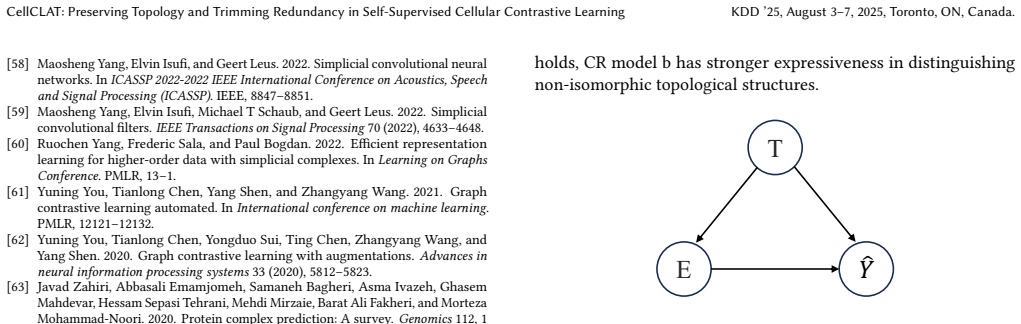
The paper's central discovery is that the higher-order cells of a cellular complex are a mixed blessing: they add expressive power, but some are semantically redundant and actively hurt downstream tasks. CellCLAT formalises this by lifting each graph to its 2-skeleton (vertices as 0-cells, edges as 1-cells, induced cycles as 2-cells), then learning graph-level embeddings $H_X$ by cellular message passing over the boundary, co-boundary, lower, and upper neighbourhoods. To make contrastive learning topology-safe it perturbs the MLP weights of the encoder with Gaussian noise, producing augmented embeddings $\widetilde{H}_X$ from the same complex; pairs $(H_X,\widetilde{H}_X)$ are trained with the NT-Xent loss. To remove redundancy it introduces a trimming scheduler $\Psi(\tau_\alpha)$ that samples a Gumbel-Softmax keep/drop decision for each 2-cell from its learned embedding, and updates the scheduler through bi-level meta-learning: one gradient step of the encoder and projection head, then an update of $\Psi$ on the contrastive loss. The paper argues this process realises the backdoor adjustment $P(\hat{Y}\mid do(E)) = \int P(\hat{Y}\mid E,T)\,P(T)\,dT$, with the 2-cell distribution $T$ as a confounder between the embedding $E$ and the prediction $\hat{Y}$. It also proves that the cellular encoder is strictly more expressive than the 1-WL test, and reports that CellCLAT reaches the best average rank on six TU benchmarks while trimming 2-cells is the only ablation variant that improves over the untrimmed model.
Load-bearing premise
The paper's argument depends on the trimming mask, trained only on the contrastive loss, pointing at the same cells a downstream label would call redundant; if the similarity-based signal and task relevance diverge, the trimming step can remove the very cells that matter.
Editorial extensions
If this is right
- Self-supervised pretraining on cellular complexes becomes feasible without hand-crafted augmentations, because weight perturbation supplies contrastive views while leaving the complex's attaching maps and closure intact.
- Adaptively trimming 2-cells, rather than using all higher-order interactions, can improve downstream classification and reduce variance; the ablations show the gain comes from 2-cells, not from trimming nodes or edges.
- A cellular-complex encoder used this way is strictly more expressive than graph neural networks bounded by the 1-WL test, since it can colour non-isomorphic graphs that GNNs collapse.
- The causal interpretation implies that learned representations are deconfounded with respect to higher-order topology, so classification reflects the embedding-to-label relation rather than a spurious correlation through 2-cell structure.
- In the semi-supervised setting with only 10% labels, CellCLAT keeps the best average rank, so the pretrained representations remain useful when labels are scarce.
Reading between the lines
- My inference: the learned per-cell masks may be readable as explanations, since the trimmed 2-cells could be inspected to identify ring or community structures a domain user would recognise as task-irrelevant; the paper does not test this interpretability claim.
- My inference: because the augmentation only perturbs weights and the scheduler only gates 2-cell embeddings, the same two-pronged design should transfer to node-level or link-level cellular SSL and to combinatorial complexes, but each new task would need its own mask.
- My inference: if the causal story is taken seriously, a mask pretrained on one downstream task should not transfer to a different label distribution; re-training the scheduler after a task shift would be necessary, which is an untested consequence of the backdoor interpretation.
- My inference: a testable extension is to compare CellCLAT's automatically chosen masks against domain-defined functional groups on molecular datasets; agreement would validate the redundancy claim mechanistically, while disagreement would show where the contrastive gradient and label relevance diverge.
Editorial analysis
A structured set of objections, weighed in public.
Referee Report
Summary. The paper introduces CellCLAT, a self-supervised contrastive learning framework for cellular complexes lifted from graphs. It proposes (i) a parameter-perturbation augmentation that adds Gaussian noise to encoder weights rather than modifying the cellular complex, thereby preserving attaching-map and closure-finiteness constraints, and (ii) a learned cellular trimming scheduler (CellTrim) that adaptively weights 2-cell contributions via a bi-level meta-learning objective. The authors claim that the scheduler removes task-irrelevant 2-cells, that this realizes a backdoor adjustment P(Ŷ | do(E)) = ∫ P(Ŷ | E, T) P(T) dT with the 2-cell distribution T as a confounder, and that the CCNN backbone is strictly more expressive than the 1-WL test. Empirical results are reported on six TU datasets in unsupervised and semi-supervised settings, with CellCLAT achieving the best average rank in both.
Significance. If the central claims hold, CellCLAT would be a useful step toward self-supervised topological deep learning: the augmentation idea is simple and structure-preserving, the code is publicly available, and the empirical comparison covers standard TU benchmarks with multiple baselines. The motivation experiment in Figure 1 is also a nice demonstration that not all 2-cells are beneficial for downstream classification. However, the significance is currently limited by two gaps: the trimming scheduler is trained with the same contrastive loss it is supposed to improve and has no access to task labels, so the identification of trimmed cells as 'task-irrelevant' is not established; and the causal backdoor-adjustment interpretation in Section 4 is asserted rather than implemented or tested. The expressiveness theorem, while correctly positioned in the topological-deep-learning literature, is a re-derivation of prior work on CCNNs and does not cover the full CellCLAT pipeline including the trimming scheduler.
major comments (4)
- [§3.3, Eqs. (7)–(9)] The scheduler Ψ is trained by minimizing the same contrastive loss ℒ_CellCL at both levels of the bi-level objective, and no true or predicted downstream label appears anywhere in Eqs. (7)–(9). Consequently, the paper has not established that trimmed cells are task-irrelevant: a cell can be dropped because removing it improves alignment or uniformity even if it is task-relevant, and a task-irrelevant cell can be retained if it helps the contrastive objective. The current evidence does not discriminate between these possibilities. The authors should either (i) include a label-dependent term in the meta-objective using a held-out validation set, or (ii) provide direct evidence linking the learned mask to task relevance, for example by comparing the downstream accuracy of representations produced by the learned mask against random masks with matched sparsity and against masks optimized for a downstream classifier. The ablation in Table 3 only compares against untrimmed CellCL, and Figure 1 shows that random trimming can also improve accuracy, so the reported gains do not isolate the scheduling mechanism.
- [§4, Eq. (10) and Appendix A.2] The backdoor adjustment formula is not implemented. In the proposed SCM, T (the 2-cell distribution) is a confounder between E and Ŷ, but the model never estimates P(Ŷ | E, T) from label data: the encoder and scheduler are trained with ℒ_CellCL, and Eq. (10) is not used in training. Moreover, the SCM structure is asserted rather than learned or tested, and the scheduler outputs soft Gumbel-Softmax weights rather than samples from an estimated distribution P(T). Thus the statement that CellCLAT implements the backdoor adjustment is unsupported. A concrete test would be to show that the learned trimming decisions transfer across downstream tasks, or to compare against a model that explicitly optimizes P(Ŷ | E, T) on a validation set; without such evidence, the causal language should be removed or explicitly labeled as an analogy.
- [§4, Theorem 1 and Appendix A.1] Theorem 1 and its proof concern the base CCNN architecture only. The proof never uses the parameter-perturbation augmentation of Eq. (2), the trimming mask of Eq. (6), or the bi-level objective of Eq. (7). As a result, the Introduction's claim that 'CellCLAT's expressiveness surpasses GNN-based SSL methods' is not established for the complete framework; the theorem at most shows that the CCNN backbone is strictly more expressive than 1-WL-bounded GNNs, which is a known result from Bodnar et al. [6]. The authors should either present the theorem as a property of the backbone or provide an expressiveness analysis that covers the full CellCLAT pipeline, including the learned trimming.
- [§5, Tables 1 and 2] The headline empirical claim rests on average ranks over six datasets, but no significance testing or effect-size analysis is reported. Several per-dataset differences against the strongest baselines are small and within the reported standard deviations (e.g., NCI1: 79.4±0.2 vs. SimGRACE 79.1±0.4; PROTEINS: 75.7±0.1 vs. 75.3±0.1), and the five-seed runs may not establish that the differences are reliable. The authors should report paired significance tests across datasets (e.g., Wilcoxon signed-rank) or per-seed comparisons, or temper the 'substantial improvements' claim to 'consistent average-rank improvement'.
minor comments (4)
- [§3.2, Eq. (3)] In the NT-Xent loss, negatives are drawn only from augmented embeddings Z̃_{X_j}, while the non-augmented embeddings Z_{X_j} are not used as negatives; please clarify whether this is intentional and how it affects the alignment-uniformity trade-off.
- [§5.4, Table 3] The text states that 0-CellTrim leads to the most substantial performance degradation, but on IMDB-B and IMDB-M the 0-CellTrim row improves over CellCL (73.5 vs. 73.0 and 50.5 vs. 50.3, respectively); the narrative should be adjusted to match the table.
- [§3.3, Eq. (6)] The framework is described as 'trimming' cells, but Ψ(τ_α) is a soft Gumbel-Softmax weight in (0,1) during training; only in the ζ→0 limit is it a hard mask. Please specify the inference-time discretization (e.g., threshold or hard sampling) and report which form is used for the results in Tables 1 and 2.
- [Throughout] There are numerous OCR/rendering artifacts in the manuscript, including garbled arrow symbols in Definition 3 and Eq. (12), 'neighborh-ood' in §3.1, 'Eqivalence' in Definition 2, and the inconsistent use of 'permuted rate' for the perturbation magnitude η; these should be cleaned up.
Circularity Check
The trimming scheduler is trained on the same contrastive loss it is supposed to improve, so the claimed identification of task-irrelevant 2-cells and the backdoor adjustment in Eq. (10) reduce by construction to the ℒ_CellCL objective.
-
fitted input called prediction
[Section 3.3 (Eqs. 7-9) and Section 4 (Eq. 10)]
"The goal is to guide Ψ towards suppressing the gradient contributions of higher-order 2-cells that contain task-irrelevant information in the contrastive learning task loss. ... min_Υ ℒ_CellCL(Z′_X, Z̃′_X ; Θ*(Υ), Φ*(Υ)), where Θ*(Υ), Φ*(Υ) = arg min_{Θ,Φ} ℒ_CellCL(Z′_X, Z̃′_X ; Θ, Φ, Υ). ... Each value of T=t_i can be estimated using the cellular trimming scheduler Ψ."
Eq. (7) fixes the scheduler's objective to be the same contrastive loss at both the inner and outer levels, so the mask is, by construction, the minimizer of ℒ_CellCL. The paper then labels the masked-out 2-cells 'task-irrelevant' and identifies the scheduler's decisions with the confounder values T that enter the backdoor formula Eq. (10). But Eq. (7) contains no downstream label, no task-loss term, and no estimate of P(T); the only signal available to Ψ is alignment/uniformity of embeddings. Hence 'trimmed = task-irrelevant' is not derived from any task-related quantity; it is a relabeling of the contrastive-loss solution. Eq.
full rationale
Sections 3.2 and 5 are self-contained in the sense that the parameter-perturbation encoder is built on the externally cited SimGRACE [56], the expressiveness argument of Theorem 1 is explicitly adopted from Bodnar et al. [6], and the empirical gains are measured against ten external baselines on TU benchmarks. There is no load-bearing self-citation: [28] and [30] share authors but are not used to justify the central derivation. The circular step is confined to the causal framing of CellTrim. Eq. (7) trains Ψ with ℒ_CellCL at both optimization levels; Eq. (10) then declares that Ψ estimates the confounder values T and that the procedure implements backdoor adjustment. Since no term involving the downstream label or task performance appears in Eq. (7), the identification 'trimmed = task-irrelevant = T' is a renaming of the contrastive-loss solution rather than an estimated causal quantity. The observed accuracy improvements are consistent with a regularization or contrastive effect and do not validate the backdoor story.
Assumptions & free parameters
free parameters (3)
- ring size m =
6 for all datasets (Table 6)
- permuted rate eta =
0.1 (chosen on NCI1, Fig. 4b)
- Gumbel-Softmax temperature zeta and contrastive temperature rho =
rho = 0.2; zeta not explicitly reported
assumptions (4)
- domain assumption The gluing of induced cycles of length at most m produces a valid 2-dimensional cellular complex whose 1-skeleton is the original graph.
- ad hoc to paper The SCM E <- T -> Y correctly represents the data-generating process, with 2-cell distribution T as a confounder between embedding E and label Y.
- ad hoc to paper Optimizing the trimming mask with the contrastive loss via a one-step bi-level approximation is a valid proxy for removing task-irrelevant information.
- standard math Background expressiveness results: the 1-WL test, GNN boundedness by WL, and the CW-network expressiveness results of Bodnar et al. (2021).
invented entities (2)
-
Cellular Topological Redundancy
-
Confounder T (2-cell distribution) in the SCM
Cite this review
Pith. "Pith review of CellCLAT: Preserving Topology and Trimming Redundancy in Self-Supervised Cellular Contrastive Learning." pith.science (2026). https://pith.science/paper/FXJFSWHU
@misc{pith2026250521587,
  author       = {Pith},
  title        = {Pith review of: CellCLAT: Preserving Topology and Trimming Redundancy in Self-Supervised Cellular Contrastive Learning},
  year         = {2026},
  howpublished = {\url{https://pith.science/paper/FXJFSWHU}},
  note         = {Machine review of arXiv:2505.21587}
}
read the original abstract
Self-supervised topological deep learning (TDL) represents a nascent but underexplored area with significant potential for modeling higher-order interactions in simplicial complexes and cellular complexes to derive representations of unlabeled graphs. Compared to simplicial complexes, cellular complexes exhibit greater expressive power. However, the advancement in self-supervised learning for cellular TDL is largely hindered by two core challenges: \textit{extrinsic structural constraints} inherent to cellular complexes, and intrinsic semantic redundancy in cellular representations. The first challenge highlights that traditional graph augmentation techniques may compromise the integrity of higher-order cellular interactions, while the second underscores that topological redundancy in cellular complexes potentially diminish task-relevant information. To address these issues, we introduce Cellular Complex Contrastive Learning with Adaptive Trimming (CellCLAT), a twofold framework designed to adhere to the combinatorial constraints of cellular complexes while mitigating informational redundancy. Specifically, we propose a parameter perturbation-based augmentation method that injects controlled noise into cellular interactions without altering the underlying cellular structures, thereby preserving cellular topology during contrastive learning. Additionally, a cellular trimming scheduler is employed to mask gradient contributions from task-irrelevant cells through a bi-level meta-learning approach, effectively removing redundant topological elements while maintaining critical higher-order semantics. We provide theoretical justification and empirical validation to demonstrate that CellCLAT achieves substantial improvements over existing self-supervised graph learning methods, marking a significant attempt in this domain.
Figures


Figures from the paper (6 more)




Reference graph
Works this paper leans on
-
[6]
Cristian Bodnar, Fabrizio Frasca, Nina Otter, Yuguang Wang, Pietro Lio, Guido F Montufar, and Michael Bronstein. 2021. Weisfeiler and lehman go cellular: Cw networks. Advances in neural information processing systems 34 (2021), 2625– 2640
work page 2021
-
[1]
Bijaya Adhikari, Yao Zhang, Naren Ramakrishnan, and B Aditya Prakash. 2018. Sub2vec: Feature learning for subgraphs. In Advances in Knowledge Discovery and Data Mining: 22nd Pacific-Asia Conference, PAKDD 2018, Melbourne, VIC, Australia, June 3-6, 2018, Proceedings, Part II 22 . Springer, 170–182
work page 2018
-
[2]
Devanshu Arya and Marcel Worring. 2018. Exploiting relational information in social networks using geometric deep learning on hypergraphs. In Proceedings of the 2018 ACM on International Conference on Multimedia Retrieval . 117–125
work page 2018
-
[3]
Rubén Ballester and Bastian Rieck. 2023. On the expressivity of persistent homology in graph learning. arXiv preprint arXiv:2302.09826 (2023)
arXiv 2023
-
[4]
Claudio Battiloro, Ege Karaismailoğlu, Mauricio Tec, George Dasoulas, Michelle Audirac, and Francesca Dominici. 2024. E (n) Equivariant Topological Neural Networks. arXiv preprint arXiv:2405.15429 (2024). KDD ’25, August 3–7, 2025, Toronto, ON, Canada. Bin Qin et al
arXiv 2024
-
[5]
Claudio Battiloro, Lucia Testa, Lorenzo Giusti, Stefania Sardellitti, Paolo Di Lorenzo, and Sergio Barbarossa. 2024. Generalized simplicial attention neural networks. IEEE Transactions on Signal and Information Processing over Networks (2024)
work page 2024
-
[7]
Cristian Bodnar, Fabrizio Frasca, Yuguang Wang, Nina Otter, Guido F Montufar, Pietro Lio, and Michael Bronstein. 2021. Weisfeiler and lehman go topological: Message passing simplicial networks. In International Conference on Machine Learning. PMLR, 1026–1037
work page 2021
-
[8]
Davide Buffelli, Farzin Soleymani, and Bastian Rieck. 2024. CliquePH: Higher- Order Information for Graph Neural Networks through Persistent Homology on Clique Graphs. arXiv preprint arXiv:2409.08217 (2024)
arXiv 2024
Show all 69 references
-
[9]
Yuzhou Chen, Baris Coskunuzer, and Yulia Gel. 2021. Topological relational learning on graphs. Advances in neural information processing systems 34 (2021), 27029–27042
2021
-
[10]
Jun Dan, Weiming Liu, Chunfeng Xie, Hua Yu, Shunjie Dong, and Yanchao Tan
-
[11]
Stefania Ebli, Michaël Defferrard, and Gard Spreemann. 2020. Simplicial neural networks. arXiv preprint arXiv:2010.03633 (2020)
2020 arXiv
-
[12]
Herbert Edelsbrunner and John Harer. 2010. Computational topology: an intro- duction. American Mathematical Soc
2010
-
[13]
Yam Eitan, Yoav Gelberg, Guy Bar-Shalom, Fabrizio Frasca, Michael Bronstein, and Haggai Maron. 2024. Topological blind spots: Understanding and extend- ing topological deep learning through the lens of expressivity. arXiv preprint arXiv:2408.05486 (2024)
2024 arXiv
-
[14]
Wenqi Fan, Yao Ma, Qing Li, Yuan He, Eric Zhao, Jiliang Tang, and Dawei Yin
-
[15]
Rui Ferreira, Roberto Grossi, Romeo Rizzi, Gustavo Sacomoto, and Marie-France Sagot. 2014. Amortized-delay algorithm for listing chordless cycles in undirected graphs. In European Symposium on Algorithms . Springer, 418–429
2014
-
[16]
Justin Gilmer, Samuel S Schoenholz, Patrick F Riley, Oriol Vinyals, and George E Dahl. 2017. Neural message passing for quantum chemistry. In International conference on machine learning . PMLR, 1263–1272
2017
-
[17]
Lorenzo Giusti, Claudio Battiloro, Paolo Di Lorenzo, Stefania Sardellitti, and Sergio Barbarossa. 2022. Simplicial attention neural networks. arXiv preprint arXiv:2203.07485 (2022)
2022 arXiv
-
[18]
Lorenzo Giusti, Claudio Battiloro, Lucia Testa, Paolo Di Lorenzo, Stefania Sardel- litti, and Sergio Barbarossa. 2023. Cell attention networks. In 2023 International Joint Conference on Neural Networks (IJCNN) . IEEE, 1–8
2023
-
[19]
Lorenzo Giusti, Teodora Reu, Francesco Ceccarelli, Cristian Bodnar, and Pietro Liò. 2023. Cin++: Enhancing topological message passing. arXiv preprint arXiv:2306.03561 (2023)
2023 arXiv
-
[20]
Christopher Wei Jin Goh, Cristian Bodnar, and Pietro Lio. 2022. Simplicial attention networks. arXiv preprint arXiv:2204.09455 (2022)
2022 arXiv
-
[21]
Aditya Grover and Jure Leskovec. 2016. node2vec: Scalable feature learning for networks. In Proceedings of the 22nd ACM SIGKDD international conference on Knowledge discovery and data mining . 855–864
2016
-
[22]
Mustafa Hajij, Kyle Istvan, and Ghada Zamzmi. 2020. Cell complex neural networks. arXiv preprint arXiv:2010.00743 (2020)
2020 arXiv
-
[24]
Mustafa Hajij, Ghada Zamzmi, Theodore Papamarkou, Nina Miolane, Aldo Guzmán-Sáenz, Karthikeyan Natesan Ramamurthy, Tolga Birdal, Tamal K Dey, Soham Mukherjee, Shreyas N Samaga, et al. 2023. Topological Deep Learning: Going Beyond Graph Data. arXiv preprint arXiv:2206.00606 (2023)
2023 arXiv
-
[25]
Jakob Hansen and Robert Ghrist. 2019. Toward a spectral theory of cellular sheaves. Journal of Applied and Computational Topology 3, 4 (2019), 315–358
2019
-
[26]
Max Horn, Edward De Brouwer, Michael Moor, Yves Moreau, Bastian Rieck, and Karsten Borgwardt. 2021. Topological graph neural networks. arXiv preprint arXiv:2102.07835 (2021)
2021 arXiv
-
[27]
Eric Jang, Shixiang Gu, and Ben Poole. 2016. Categorical reparameterization with gumbel-softmax. arXiv preprint arXiv:1611.01144 (2016)
2016 arXiv
-
[28]
Qirui Ji, Jiangmeng Li, Jie Hu, Rui Wang, Changwen Zheng, and Fanjiang Xu
-
[29]
See Hian Lee, Feng Ji, and Wee Peng Tay. 2022. SGAT: Simplicial graph attention network. arXiv preprint arXiv:2207.11761 (2022)
2022 arXiv
-
[30]
Jiangmeng Li, Yifan Jin, Hang Gao, Wenwen Qiang, Changwen Zheng, and Fuchun Sun. 2024. Hierarchical topology isomorphism expertise embedded graph contrastive learning. In Proceedings of the AAAI Conference on Artificial Intelligence, Vol. 38. 13518–13527
2024
-
[31]
In Proceedings of the AAAI Conference on Artificial Intelligence, Vol
Rethinking dimensional rationale in graph contrastive learning from causal perspective. In Proceedings of the AAAI Conference on Artificial Intelligence, Vol. 38. 12810–12820
-
[32]
Hanxiao Liu, Karen Simonyan, and Yiming Yang. 2018. Darts: Differentiable architecture search. arXiv preprint arXiv:1806.09055 (2018)
2018 arXiv
-
[33]
Shikun Liu, Andrew Davison, and Edward Johns. 2019. Self-supervised generali- sation with meta auxiliary learning. Advances in Neural Information Processing Systems 32 (2019)
2019
-
[34]
Sihang Li, Xiang Wang, An Zhang, Yingxin Wu, Xiangnan He, and Tat-Seng Chua. 2022. Let invariant rationale discovery inspire graph contrastive learning. In International conference on machine learning . PMLR, 13052–13065
2022
-
[35]
Hiren Madhu and Sundeep Prabhakar Chepuri. 2023. TopoSRL: topology pre- serving self-supervised simplicial representation learning. Advances in Neural Information Processing Systems 36 (2023)
2023
-
[36]
Christopher Morris, Fabrizio Frasca, Nadav Dym, Haggai Maron, Ismail Ilkan Ceylan, Ron Levie, Derek Lim, Michael M Bronstein, Martin Grohe, and Stefanie Jegelka. 2024. Position: Future Directions in the Theory of Graph Machine Learning. In Forty-first International Conference ...
2024
-
[37]
Chris J Maddison, Andriy Mnih, and Yee Whye Teh. 2016. The concrete distri- bution: A continuous relaxation of discrete random variables. arXiv preprint arXiv:1611.00712 (2016)
2016 arXiv
-
[38]
Annamalai Narayanan, Mahinthan Chandramohan, Rajasekar Venkatesan, Lihui Chen, Yang Liu, and Shantanu Jaiswal. 2017. graph2vec: Learning distributed representations of graphs. arXiv preprint arXiv:1707.05005 (2017)
2017 arXiv
-
[39]
Theodore Papamarkou, Tolga Birdal, Michael M Bronstein, Gunnar E Carlsson, Justin Curry, Yue Gao, Mustafa Hajij, Roland Kwitt, Pietro Lio, Paolo Di Lorenzo, et al. 2024. Position: Topological Deep Learning is the New Frontier for Relational Learning. In Forty-first Internation...
2024
-
[40]
Christopher Morris, Nils M Kriege, Franka Bause, Kristian Kersting, Petra Mutzel, and Marion Neumann. 2020. Tudataset: A collection of benchmark datasets for learning with graphs. arXiv preprint arXiv:2007.08663 (2020)
2020 arXiv
-
[41]
Mathilde Papillon, Sophia Sanborn, Mustafa Hajij, and Nina Miolane. 2023. Archi- tectures of Topological Deep Learning: A Survey on Topological Neural Networks. arXiv preprint arXiv:2304.10031 (2023)
2023 arXiv
-
[42]
Judea Pearl. 2009. Causality. Cambridge university press
2009
-
[43]
Mathilde Papillon, Guillermo Bernárdez, Claudio Battiloro, and Nina Miolane
-
[44]
arXiv preprint arXiv:2410.06530 (2024)
TopoTune: A Framework for Generalized Combinatorial Complex Neural Networks. arXiv preprint arXiv:2410.06530 (2024)
2024
-
[45]
T Mitchell Roddenberry, Nicholas Glaze, and Santiago Segarra. 2021. Principled simplicial neural networks for trajectory prediction. In International Conference on Machine Learning. PMLR, 9020–9029
2021
-
[46]
Franco Scarselli, Marco Gori, Ah Chung Tsoi, Markus Hagenbuchner, and Gabriele Monfardini. 2008. The graph neural network model. IEEE transactions on neural networks 20, 1 (2008), 61–80
2008
-
[47]
Judea Pearl, Madelyn Glymour, and Nicholas P Jewell. 2016. Causal inference in statistics: A primer. John Wiley & Sons
2016
-
[48]
V Srinivasa Rao, K Srinivas, GN Sujini, and GN Sunand Kumar. 2014. Protein- protein interaction detection: methods and analysis. International journal of proteomics 2014, 1 (2014), 147648
2014
-
[49]
Yogesh Verma, Amauri H Souza, and Vikas Garg. 2024. Topological Neural Net- works go Persistent, Equivariant, and Continuous.arXiv preprint arXiv:2406.03164 (2024)
2024 arXiv
-
[50]
Tongzhou Wang and Phillip Isola. 2020. Understanding contrastive representation learning through alignment and uniformity on the hypersphere. In International conference on machine learning . PMLR, 9929–9939
2020
-
[51]
Fan-Yun Sun, Jordan Hoffman, Vikas Verma, and Jian Tang. [n. d.]. InfoGraph: Unsupervised and Semi-supervised Graph-Level Representation Learning via Mutual Information Maximization. In International Conference on Learning Rep- resentations
-
[52]
Susheel Suresh, Pan Li, Cong Hao, and Jennifer Neville. 2021. Adversarial graph augmentation to improve graph contrastive learning. Advances in Neural Infor- mation Processing Systems 34 (2021), 15920–15933
2021
-
[53]
Hanrui Wu, Andy Yip, Jinyi Long, Jia Zhang, and Michael K Ng. 2023. Simplicial complex neural networks. IEEE Transactions on Pattern Analysis and Machine Intelligence (2023)
2023
-
[54]
Zhenqin Wu, Bharath Ramsundar, Evan N Feinberg, Joseph Gomes, Caleb Ge- niesse, Aneesh S Pappu, Karl Leswing, and Vijay Pande. 2018. MoleculeNet: a benchmark for molecular machine learning.Chemical science 9, 2 (2018), 513–530
2018
-
[55]
Boris Weisfeiler and Andrei Leman. 1968. The reduction of a graph to canonical form and the algebra which appears therein. nti, Series 2, 9 (1968), 12–16
1968
-
[56]
John HC Whitehead. 1949. Combinatorial homotopy I. Bull. Amer. Math. Soc 55, 3 (1949), 213–245
1949
-
[57]
Maosheng Yang and Elvin Isufi. 2023. Convolutional learning on simplicial complexes. arXiv preprint arXiv:2301.11163 (2023). CellCLAT: Preserving Topology and Trimming Redundancy in Self-Supervised Cellular Contrastive Learning KDD ’25, August 3–7, 2025, Toronto, ON, Canada
2023 arXiv
-
[58]
Maosheng Yang, Elvin Isufi, and Geert Leus. 2022. Simplicial convolutional neural networks. In ICASSP 2022-2022 IEEE International Conference on Acoustics, Speech and Signal Processing (ICASSP) . IEEE, 8847–8851
2022
-
[59]
Zhirong Wu, Yuanjun Xiong, Stella X Yu, and Dahua Lin. 2018. Unsupervised feature learning via non-parametric instance discrimination. In Proceedings of the IEEE conference on computer vision and pattern recognition . 3733–3742
2018
-
[60]
Jun Xia, Lirong Wu, Jintao Chen, Bozhen Hu, and Stan Z Li. 2022. Simgrace: A simple framework for graph contrastive learning without data augmentation. In Proceedings of the ACM web conference 2022 . 1070–1079
2022
-
[61]
Yuning You, Tianlong Chen, Yang Shen, and Zhangyang Wang. 2021. Graph contrastive learning automated. In International conference on machine learning . PMLR, 12121–12132
2021
-
[62]
Yuning You, Tianlong Chen, Yongduo Sui, Ting Chen, Zhangyang Wang, and Yang Shen. 2020. Graph contrastive learning with augmentations. Advances in neural information processing systems 33 (2020), 5812–5823
2020
-
[63]
Maosheng Yang, Elvin Isufi, Michael T Schaub, and Geert Leus. 2022. Simplicial convolutional filters. IEEE Transactions on Signal Processing 70 (2022), 4633–4648
2022
-
[64]
Ruochen Yang, Frederic Sala, and Paul Bogdan. 2022. Efficient representation learning for higher-order data with simplicial complexes. In Learning on Graphs Conference. PMLR, 13–1
2022
-
[67]
Javad Zahiri, Abbasali Emamjomeh, Samaneh Bagheri, Asma Ivazeh, Ghasem Mahdevar, Hessam Sepasi Tehrani, Mehdi Mirzaie, Barat Ali Fakheri, and Morteza Mohammad-Noori. 2020. Protein complex prediction: A survey. Genomics 112, 1 (2020), 174–183. A Derivation of Theoretical Justif...
2020
-
[68]
At iteration𝑡 = 0, the initial features (or colours) of the 0-cells in CCNN are obtained directly from the node features of the graph
Base Case. At iteration𝑡 = 0, the initial features (or colours) of the 0-cells in CCNN are obtained directly from the node features of the graph. By construction, we have b𝑓{︃𝐺1}︃,0 = b𝑓{︃𝐺2}︃,0/Leftr⫯g⊸tl⫯ne⇒ a𝐺1,0 = a𝐺2,0
-
[69]
Assume that after𝑡 iterations the WL colour- ing a𝑡 is topological reduced to the CCNN colouring b𝑡 , i.e., a𝑡 ⪯ b𝑡
Inductive Step. Assume that after𝑡 iterations the WL colour- ing a𝑡 is topological reduced to the CCNN colouring b𝑡 , i.e., a𝑡 ⪯ b𝑡 . Consider two 0-cells𝜎 in𝑋 and𝜏 in𝑌 such that b𝑡+1{︃𝜎}︃= b𝑡+1{︃𝜏}︃. We know that b𝑡+1{︃𝜎}︃= b𝑡 {︃𝜎}︃, b𝑡 {︃ℬ{︃𝜎}︃}︃, b𝑡 {︃𝒞{︃𝜎}︃}︃, b𝑡 {︃𝒩↓{︃𝜎}︃...
2025
-
[100]
Additionally, the variance remains relatively stable, suggesting the robustness of our approach across different training durations
We observe a general upward trend in accuracy as the number of epochs increases, indicating that prolonged training allows the model to learn more discriminative representations. Additionally, the variance remains relatively stable, suggesting the robustness of our approach ac...
-
[2019]
In The world wide web conference
Graph neural networks for social recommendation. In The world wide web conference. 417–426
-
[2024]
In The Thirty-eighth An- nual Conference on Neural Information Processing Systems
TFGDA: Exploring Topology and Feature Alignment in Semi-supervised Graph Domain Adaptation through Robust Clustering. In The Thirty-eighth An- nual Conference on Neural Information Processing Systems
Reviewed August 7, 2026 · model on record in the stance chip above.
Discussion (0). Sign in to comment.