REVIEW 4 major objections 4 minor 46 references
Pioneering 4-Bit FP Quantization for Diffusion Models: Mixup-Sign Quantization and Timestep-Aware Fine-Tuning
T0 review · 4 major / 4 minor · reviewed 2026-08-07 · deepseek-v4-flash
Pith's one-line read 4-bit floating-point quantization with mixup-sign formats and timestep-routed LoRAs beats 4-bit integer fine-tuning for diffusion models.
desk verdict Useful novel quantization idea, but the ImageNet numbers that carry the 4-bit claim are internally inconsistent and the paper's explanation does not hold. read the letter →
The pith
A machine-rendered reading of the paper's core claim, the machinery that carries it, and where it could break.
The reading
What carries the argument
The load-bearing identity is the denoising factor $\gamma_t = (1-\alpha_t)/\sqrt{\alpha_t(1-\alpha_t)}$, which the paper derives as the coefficient of the predicted noise $\varepsilon_\theta$ in the DDIM update $x_{t-1} = (1/\sqrt{\alpha_t})(x_t - ((1-\alpha_t)/\sqrt{1-\alpha_t})\varepsilon_\theta) + \sigma_t \delta$. It carries the loss-alignment argument: multiplying the raw noise-prediction MSE by $\gamma_t$ makes the fine-tuning loss proportional to how strongly that step's error moves the output image, which the paper treats as the real quantization damage. The other two mechanisms are a quantizer and a router. The MSFP quantizer searches both signed FP formats and unsigned FP formats (sign bit cleared, zero point added) and assigns each activation layer the better one, since the asymmetric layers want unsigned formats while normal layers keep signed FP. The TALoRA router is a small shared network—a timestep embedding plus an MLP—that outputs a distribution over LoRA adapters for each timestep, with a straight-through estimator converting it to a one-hot selection, so each layer is fine-tuned by exactly one active adapter per step.
What would settle it
Fix MSFP and TALoRA, and compare DFA-weighted fine-tuning against uniformly weighted fine-tuning by FID on 50k generated samples from a dataset such as CIFAR-10; the alignment claim predicts a clear, reproducible FID win for the weighted loss, and statistically indistinguishable FID would mean the $\gamma_t$ reweighting is not doing the work claimed. A complementary check targets the asymmetry story: forcing unsigned-FP-with-zero-point onto a layer with genuinely symmetric activations should measurably worsen activation quantization error, and if it does not, the SiLU-asymmetry explanation for MSFP's gains is incomplete.
Extended reading notes
Core claim
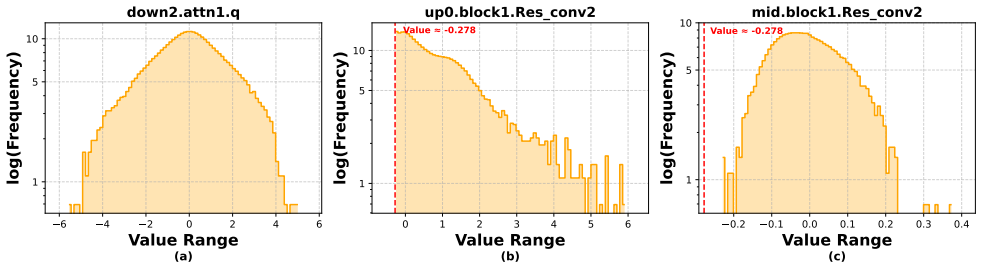
The central discovery is that the poor showing of low-bit FP quantization in diffusion models is not a failure of FP formats themselves but the sum of three fixable causes. Layers whose activations are skewed by SiLU—the Anomalous-Activation-Distribution Layers, where essentially all negative values are squeezed into the narrow band [−0.278, 0)—lose almost all sub-zero precision under signed FP quantization; giving those layers an unsigned FP format with an added zero point frees the wasted sign bit to become exponent or mantissa precision and cuts activation quantization error in over 95% of such layers. The denoising process is itself a multi-task procedure—outlines first, details later—so a single LoRA shared across all timesteps underfits; a router that reads the timestep and dispatches one LoRA per step reflects that structure, and the learned allocation indeed settles into the two-phase pattern, with two adapters sufficing in most experiments. Finally, the per-step fine-tuning loss tracks real degradation only when reweighted by the denoising factor $\gamma_t = (1-\alpha_t)/\sqrt{\alpha_t(1-\alpha_t)}$, the coefficient with which predicted noise enters the DDIM update, so that steps where prediction error moves the output more are weighted more. In the CelebA ablation the three components together take the 4-bit model from FID 16.02 to 7.69 against a full-precision 6.49, and the full method reports 4-bit results that beat the compared baselines on CIFAR-10, LSUN-Bedroom, LSUN-Church, and ImageNet.
Load-bearing premise
The method rests on the assumption that the damage quantization does to the predicted noise at a given timestep is faithfully captured by the DDIM coefficient $\gamma_t$, so that reweighting the per-step MSE by $\gamma_t$ makes the loss proportional to real degradation—yet the paper checks this only against a proxy, $\mathrm{MSE}(x_{t-1}, \hat{x}_{t-1})$, computed from the same DDIM update that defines $\gamma_t$, and never against end-to-end FID or at steps where $\gamma_t$ is near zero.
Editorial extensions
If this is right
- Fully 4-bit (W4/A4) diffusion models become deployable via lightweight fine-tuning rather than retraining: CIFAR-10 lands at FID 6.02 versus the full-precision 4.26, and LSUN-Church at 8.81 versus 4.06, with Inception Score roughly preserved.
- The mixup-sign search extends the FP-quantization toolbox from large language models to convolutional diffusion models, making unsigned FP with a zero point a first-class candidate format inside the standard search-based quantization pipeline.
- Reweighting the fine-tuning loss by the DDIM coefficient makes the loss curve track measured performance degradation across timesteps rather than run opposite to it, so fine-tuning capacity is spent where quantization damage is real.
- On ImageNet conditional generation the method reports 4-bit sFID 7.42 versus 7.67 for the full-precision model and 14.42 for the best compared 4-bit fine-tuning baseline, with IS 190.74 versus 139.45, under identical layer-wise quantization settings.
- Two LoRAs suffice: the router's learned allocation concentrates on a two-stage pattern consistent with the outlines-first, details-later account of denoising, and a four-LoRA hub adds no gain over two in most datasets.
Reading between the lines
- The DFA recipe is not tied to FP formats or to LoRA: any quantized iterative generative solver could reweight its per-step loss by the sensitivity of the output to that step's prediction error, and applying the same $\gamma_t$ weighting to an integer-quantized diffusion fine-tuner would test how much of the reported FP advantage is due to the alignment rather than the format.
- Because the learned router converges to a stable two-stage allocation across datasets, it could likely be frozen after training and replaced by a fixed outline/detail schedule, removing routing overhead at inference; the h=4 experiments, where the router effectively uses two LoRAs, support this.
- The paper's own observation that FID improves as bit-width decreases on ImageNet—while sFID and IS degrade—implies FID alone is unreliable for ranking quantized generative models, so earlier integer-quantization comparisons built on FID may deserve re-examination.
- The mixup-sign principle suggests a broader quantizer design where the search decides not only exponent and mantissa splits but whether the format carries a sign at all, per layer and per tensor; the paper applies this only to activations, leaving weights and per-channel sign choices as natural extensions.
Editorial analysis
A structured set of objections, weighed in public.
Referee Report
Summary. The paper proposes a fully quantized 4-bit floating-point (FP) scheme for diffusion models, combining three components: mixup-sign FP quantization (MSFP), timestep-aware LoRA (TALoRA), and denoising-factor loss alignment (DFA). MSFP searches per layer between signed and unsigned FP formats, adding a zero point for activation layers whose SiLU-induced distributions are asymmetric. TALoRA trains a small router that selects one of several LoRA adapters per denoising timestep. DFA reweights the noise-prediction MSE by the DDIM denoising coefficient gamma_t. The paper reports DDIM and LDM experiments on CIFAR-10, CelebA, LSUN-Bedroom, LSUN-Church, and ImageNet, claiming state-of-the-art 4-bit results that beat integer-quantization fine-tuning baselines such as EfficientDM and QuEST.
Significance. If the central empirical claim holds, the paper would be a useful step for deploying diffusion models at 4-bit precision. The main positive contributions are (i) identifying the asymmetric-activation failure of signed FP quantization in AALs and offering a simple zero-point fix, (ii) treating fine-tuning as a timestep-dependent multi-task problem, and (iii) providing a broad evaluation across two diffusion architectures and several datasets. The per-layer FP-format search is straightforward and the method is plausible. However, the ImageNet FID anomaly and the partly circular validation of DFA mean that the headline result is not yet fully established; the paper also does not state a code-release plan, which limits reproducibility.
major comments (4)
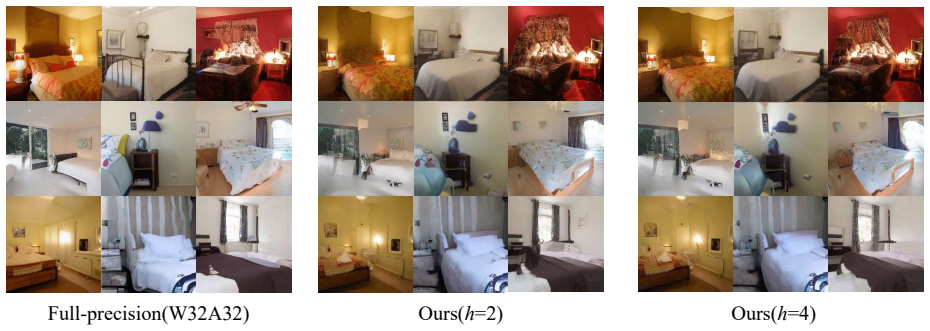
- [Section 5.2, Table 3; Appendix F, Table 10] The ImageNet results contain an internally contradictory FID trend that the paper acknowledges but does not explain: the 4-bit h=2 model reports FID 6.50 versus 11.69 for the full-precision model and 10.10 for its own 6-bit model, and the same inversion appears in the PLMS and DPM-Solver results of Table 10 (e.g., 4-bit FID 7.27 versus FP 11.71). Because sFID and IS are computed from the same generated samples, any protocol issue that corrupts FID can also corrupt those metrics. The paper needs to identify the cause (e.g., class-conditioning handling, LoRA modules left in full precision at inference, or FID implementation) and either report corrected numbers or provide an independent, defensible reason for selecting sFID and IS over FID.
- [Section 3.2, Observation 3; Eq. (3), (4), (9); Figure 3] The validation of the denoising-factor loss alignment is circular. The 'performance deterioration metric' in Figure 3 is defined as MSE(xt-1, xhat-1) using the DDIM update equation, and the proposed reweighting multiplies the per-step loss by exactly the coefficient gamma_t that appears in that same equation. The observed alignment therefore follows in part from the definitions and does not independently demonstrate that the reweighted loss tracks end-to-end image degradation. The authors should validate DFA against an independent measure (e.g., FID of quantized versus full-precision generation, or error in the final x0 estimate), and report behavior at timesteps where gamma_t is near zero.
- [Section 5.2, Table 2 and following text] The claim that 6-bit quantization achieves 'nearly identical performance to full precision' is contradicted by Table 2: LSUN-Bedroom FID is 8.42 versus 3.02 and LSUN-Church is 6.24 versus 4.06. This overstatement matters because it supports the argument that FP quantization is inherently well suited to diffusion models and makes the anomalous ImageNet FID improvement in the 4-bit setting harder to dismiss. Please rephrase the claim and discuss the actual gaps.
- [Section 5.1, Baselines paragraph; Appendix G] The baseline standardization is not fully specified. The main text says EfficientDM is 'standardized in a consistent manner' and that other standardized results are 'procured from DilateQuant,' but the exact layer sets, calibration sizes, fine-tuning schedules, and sampling protocols are not reported in one place. Without this information, the central comparison to EfficientDM and QuEST cannot be independently reproduced. Please provide a complete protocol table for every baseline and dataset, including which layers are quantized in each method.
minor comments (4)
- [Appendix B and C] There are several typos and OCR-style errors, including 'f ormat', 'abd', 'linsapce', and 'f omrat'; these should be corrected.
- [Table 4] The row labels '%' and '!' are unexplained; please add a legend defining which modules are active in each row.
- [Figure 3] The caption says 'Two loss'; it should read 'Two losses' or 'Comparison of two loss functions.'
- [Overall] The paper does not mention code or model release; adding a reproducibility statement with the exact random seeds, calibration sets, and evaluation scripts would strengthen the submission.
Circularity Check
Localized definitional circularity in the DFA validation and the MSFP per-layer MSE evidence; the central external benchmark claims remain independent.
-
self definitional
[Section 3.2 (Eqs. 3-4 and the performance-gap proxy) and Section 4.3 / Figure 3]
"γt = 1√αt · 1 − αt√1 − αt . (4) According to Equation 3, γt indicates the impact of the prediction noise under timestep t. ... We input the previous output image xt from the full-precision model and calculate the performance gap between the denoised image xt−1 from the full-precision model and the denoised image bxt−1 from the quantized model, measured by M SE(xt−1, bxt−1). ... By introducing γt, which accurately reflects the utilization of the predicted noise at each time step, we achieve a preliminary alignment between the loss and the actual quantization error, as shown in Figure 3."
The denoising factor γt in Eq. 4 is exactly the coefficient multiplying the predicted-noise error in the DDIM update Eq. 3. For identical xt and injected noise, xt−1 − x̂t−1 = γt(εθ − ε̂θ), so the validation proxy MSE(xt−1, x̂t−1) equals γt²·MSE(εθ, ε̂θ). The 'performance deterioration metric' is therefore a deterministic rescaling of the same per-step noise MSE that DFA reweights; the consistent trend in Figure 3 follows from the definitions of Eqs. 3 and 4 rather than from an independent measurement of end-to-end image-quality degradation. The DFA ablation in Table 4 is combined with the other modules, so no isolated end-to-end test of the gamma weighting is provided.
-
fitted input called prediction
[Section 4.1 / Figure 4 and Appendix B, Algorithm 1]
"We implement the proposed MSFP strategy using a search-based method [2, 25], wherein the quantization parameters are determined by minimizing the MSE between the distributions before and after quantization. ... As illustrated in Figure 4, unsigned FP quantization with a zero point significantly improves representation in over 95% of AALs, compared to traditional signed FP quantization."
Algorithm 1 selects, per Anomalous-Activation-Distribution Layer, the sign/zero-point variant that minimizes the per-layer activation MSE. The 'over 95% of AALs' improvement is then reported using that same per-layer MSE objective. Thus the quantitative evidence for MSFP's representational advantage is the direct output of the optimization criterion being minimized, not an independent evaluation of the format choice. The end-to-end FID gains in Tables 2-4 are external to this per-layer metric and retain independent content.
full rationale
The paper's headline claim is an empirical state-of-the-art claim against external baselines (EfficientDM, QuEST, Q-Diffusion, EDA-DM) using FID, sFID and IS on CIFAR-10, CelebA, LSUN and ImageNet. Those comparisons are self-contained and are not derived from the paper's own assumptions, so the central result is not circular. The circularity found is confined to two internal validations. First, the DFA alignment is validated in Figure 3 against MSE(xt−1, x̂t−1), a proxy that is a deterministic function of the same DDIM coefficient γt used to define the reweighted loss; the agreement is therefore partly built into the definitions rather than established by an independent image-quality measurement. Second, the 'over 95% of AALs' advantage of MSFP in Figure 4 is measured with the same per-layer activation MSE that Algorithm 1 minimizes when choosing between signed and unsigned+zero-point formats, so that statistic restates the optimization objective. Neither of these issues infects the external FID/sFID benchmarks, which is why the score is not higher. The paper also explicitly flags an evaluation anomaly on ImageNet - 'as the bit-width of the quantized model decreases, the FID score improves, which contradicts the expected trend' - and excludes FID from the ImageNet discussion; that is a serious evaluation-validity concern but it is not circularity. There is no load-bearing self-citation chain or imported uniqueness theorem: the search-based FP initialization is credited to prior external work [2, 25], and the final benchmark numbers are compared against independently published baselines.
Assumptions & free parameters
free parameters (6)
- Per-layer FP format (ExMy) selection =
4-bit: one of E3M0, E2M1, E1M2, E0M3; similar discrete sets for 6/8 bit
- Per-layer maxval threshold (bias) =
Searched inside [0.8*maxval0, 2*maxval0] for weights and linspace(0, maxval0, 100) for activations
- Zero point zp for unsigned FP in AALs =
Searched over linspace(-0.3, 0, 6), typically near -0.278
- TALoRA rank =
32
- LoRA hub size h and training hyperparameters =
h=2 (main), lr=1e-4, epochs=160 (DDIM) or 320 (LDM), batch 16/8/4
- Calibration set size and construction =
2000 random images for maxval0; 256 samples (DDIM) or 128 samples (LDM) for calibration
assumptions (5)
- domain assumption The DDIM/DDPM update (Eq. 3) and its coefficient gamma_t correctly measure the impact of predicted noise on the next latent, so weighting the fine-tuning loss by gamma_t produces a loss aligned with true quantization damage.
- domain assumption The SiLU activation compresses negative activations into a fixed range around [-0.278, 0) for AALs, and this range transfers across datasets and models.
- domain assumption Per-layer MSE-based search on calibration images generalizes to test-time activations and leads to better end-to-end FID.
- domain assumption The denoising process separates into outline generation followed by detail refinement, so two timestep-aware LoRA experts are sufficient.
- domain assumption On ImageNet, FID is an unreliable metric for comparing quantized models, while sFID and IS are reliable.
Cite this review
Pith. "Pith review of Pioneering 4-Bit FP Quantization for Diffusion Models: Mixup-Sign Quantization and Timestep-Aware Fine-Tuning." pith.science (2026). https://pith.science/paper/EJ4UHSHL
@misc{pith2026250521591,
  author       = {Pith},
  title        = {Pith review of: Pioneering 4-Bit FP Quantization for Diffusion Models: Mixup-Sign Quantization and Timestep-Aware Fine-Tuning},
  year         = {2026},
  howpublished = {\url{https://pith.science/paper/EJ4UHSHL}},
  note         = {Machine review of arXiv:2505.21591}
}
read the original abstract
Model quantization reduces the bit-width of weights and activations, improving memory efficiency and inference speed in diffusion models. However, achieving 4-bit quantization remains challenging. Existing methods, primarily based on integer quantization and post-training quantization fine-tuning, struggle with inconsistent performance. Inspired by the success of floating-point (FP) quantization in large language models, we explore low-bit FP quantization for diffusion models and identify key challenges: the failure of signed FP quantization to handle asymmetric activation distributions, the insufficient consideration of temporal complexity in the denoising process during fine-tuning, and the misalignment between fine-tuning loss and quantization error. To address these challenges, we propose the mixup-sign floating-point quantization (MSFP) framework, first introducing unsigned FP quantization in model quantization, along with timestep-aware LoRA (TALoRA) and denoising-factor loss alignment (DFA), which ensure precise and stable fine-tuning. Extensive experiments show that we are the first to achieve superior performance in 4-bit FP quantization for diffusion models, outperforming existing PTQ fine-tuning methods in 4-bit INT quantization.
Figures


Figures from the paper (7 more)



Reference graph
Works this paper leans on
-
[1]
Estimating or propagating gradients through stochastic neurons for conditional computation
Yoshua Bengio, Nicholas L ´eonard, and Aaron Courville. Estimating or propagating gradients through stochastic neurons for conditional computation. arXiv preprint arXiv:1308.3432, 2013. 6
arXiv 2013
-
[2]
Low-Bitwidth Floating Point Quantization for Efficient High-Quality Diffusion Models
Cheng Chen, Christina Giannoula, and Andreas Moshovos. Low-bitwidth floating point quantization for efficient high- quality diffusion models. arXiv preprint arXiv:2408.06995,
-
[3]
Qncd: Quantization noise correction for diffusion models
Huanpeng Chu, Wei Wu, Chengjie Zang, and Kun Yuan. Qncd: Quantization noise correction for diffusion models. In Proceedings of the 32nd ACM International Conference on Multimedia, pages 10995–11003, 2024. 2
work page 2024
-
[4]
Imagenet: A large-scale hierarchical image database
Jia Deng, Wei Dong, Richard Socher, Li-Jia Li, Kai Li, and Li Fei-Fei. Imagenet: A large-scale hierarchical image database. In 2009 IEEE conference on computer vision and pattern recognition, pages 248–255. Ieee, 2009. 7, 4
work page 2009
-
[5]
Qlora: efficient finetuning of quantized llms (2023)
Tim Dettmers, Artidoro Pagnoni, Ari Holtzman, and Luke Zettlemoyer. Qlora: efficient finetuning of quantized llms (2023). arXiv preprint arXiv:2305.14314 , 52:3982–3992,
arXiv 2023
-
[6]
Learned step size quantization
Steven K Esser, Jeffrey L McKinstry, Deepika Bablani, Rathinakumar Appuswamy, and Dharmendra S Modha. Learned step size quantization. In International Conference on Learning Representations, 2019. 1, 2
work page 2019
-
[7]
Mixture-of-loras: An efficient multitask tun- ing method for large language models
Wenfeng Feng, Chuzhan Hao, Yuewei Zhang, Yu Han, and Hao Wang. Mixture-of-loras: An efficient multitask tun- ing method for large language models. In Proceedings of the 2024 Joint International Conference on Computational Linguistics, Language Resources and Evaluation (LREC- COLING 2024), pages 11371–11380, 2024. 3
work page 2024
-
[8]
Efficientdm: Efficient quantization-aware fine-tuning of low-bit diffusion models
Yefei He, Jing Liu, Weijia Wu, Hong Zhou, and Bo- han Zhuang. Efficientdm: Efficient quantization-aware fine-tuning of low-bit diffusion models. arXiv preprint arXiv:2310.03270, 2023. 1, 2, 7, 8, 4
arXiv 2023
Show all 46 references
-
[9]
Ptqd: Accurate post-training quantization for diffusion models
Yefei He, Luping Liu, Jing Liu, Weijia Wu, Hong Zhou, and Bohan Zhuang. Ptqd: Accurate post-training quantization for diffusion models. Advances in Neural Information Pro- cessing Systems, 36, 2024. 2
2024
-
[10]
Gans trained by a two time-scale update rule converge to a local nash equilib- rium
Martin Heusel, Hubert Ramsauer, Thomas Unterthiner, Bernhard Nessler, and Sepp Hochreiter. Gans trained by a two time-scale update rule converge to a local nash equilib- rium. Advances in neural information processing systems , 30, 2017. 7
2017
-
[11]
Denoising dif- fusion probabilistic models
Jonathan Ho, Ajay Jain, and Pieter Abbeel. Denoising dif- fusion probabilistic models. Advances in neural information processing systems, 33:6840–6851, 2020. 3
2020
-
[12]
Lora: Low-rank adaptation of large language models
Edward J Hu, Yelong Shen, Phillip Wallis, Zeyuan Allen- Zhu, Yuanzhi Li, Shean Wang, Lu Wang, and Weizhu Chen. Lora: Low-rank adaptation of large language models. arXiv preprint arXiv:2106.09685, 2021. 3
2021 arXiv
-
[13]
An empirical study of llama3 quantization: From llms to mllms
Wei Huang, Xingyu Zheng, Xudong Ma, Haotong Qin, Chengtao Lv, Hong Chen, Jie Luo, Xiaojuan Qi, Xianglong Liu, and Michele Magno. An empirical study of llama3 quantization: From llms to mllms. Visual Intelligence, 2(1): 36, 2024. 1
2024
-
[14]
Quantization and training of neural networks for efficient integer-arithmetic-only inference
Benoit Jacob, Skirmantas Kligys, Bo Chen, Menglong Zhu, Matthew Tang, Andrew Howard, Hartwig Adam, and Dmitry Kalenichenko. Quantization and training of neural networks for efficient integer-arithmetic-only inference. In Proceed- ings of the IEEE conference on computer vision ...
2018
-
[15]
Quantizing deep convolu- tional networks for efficient inference: A whitepaper
Raghuraman Krishnamoorthi. Quantizing deep convolu- tional networks for efficient inference: A whitepaper. arXiv preprint arXiv:1806.08342, 2018. 1
2018 arXiv
-
[16]
Learning multiple layers of features from tiny images
Alex Krizhevsky, Geoffrey Hinton, et al. Learning multiple layers of features from tiny images. 2009. 7
2009
-
[17]
Fp8 quanti- zation: The power of the exponent
Andrey Kuzmin, Mart Van Baalen, Yuwei Ren, Markus Nagel, Jorn Peters, and Tijmen Blankevoort. Fp8 quanti- zation: The power of the exponent. Advances in Neural In- formation Processing Systems, 35:14651–14662, 2022. 2
2022
-
[18]
Contemporary ad- vances in neural network quantization: A survey
Min Li, Zihao Huang, Lin Chen, Junxing Ren, Miao Jiang, Fengfa Li, Jitao Fu, and Chenghua Gao. Contemporary ad- vances in neural network quantization: A survey. In2024 In- ternational Joint Conference on Neural Networks (IJCNN) , pages 1–10. IEEE, 2024. 1
-
[19]
Q-diffusion: Quantizing diffusion models
Xiuyu Li, Yijiang Liu, Long Lian, Huanrui Yang, Zhen Dong, Daniel Kang, Shanghang Zhang, and Kurt Keutzer. Q-diffusion: Quantizing diffusion models. In Proceedings of the IEEE/CVF International Conference on Computer Vi- sion, pages 17535–17545, 2023. 1, 2, 7
2023
-
[20]
Q-dm: An efficient low-bit quantized dif- fusion model
Yanjing Li, Sheng Xu, Xianbin Cao, Xiao Sun, and Baochang Zhang. Q-dm: An efficient low-bit quantized dif- fusion model. Advances in Neural Information Processing Systems, 36, 2024. 1, 2
2024
-
[21]
Pruning and quantization for deep neural network acceleration: A survey
Tailin Liang, John Glossner, Lei Wang, Shaobo Shi, and Xi- aotong Zhang. Pruning and quantization for deep neural network acceleration: A survey. Neurocomputing, 461:370– 403, 2021. 1
2021
-
[22]
Microsoft coco: Common objects in context
Tsung-Yi Lin, Michael Maire, Serge Belongie, James Hays, Pietro Perona, Deva Ramanan, Piotr Doll´ar, and C Lawrence Zitnick. Microsoft coco: Common objects in context. In Computer Vision–ECCV 2014: 13th European Conference, Zurich, Switzerland, September 6-12, 2014, Proceeding...
2014
-
[23]
Improving neural network efficiency via post-training quan- tization with adaptive floating-point
Fangxin Liu, Wenbo Zhao, Zhezhi He, Yanzhi Wang, Zongwu Wang, Changzhi Dai, Xiaoyao Liang, and Li Jiang. Improving neural network efficiency via post-training quan- tization with adaptive floating-point. In Proceedings of the IEEE/CVF international conference on computer visio...
2021
-
[24]
Pseudo numerical methods for diffusion models on manifolds.arXiv preprint arXiv:2202.09778, 2022
Luping Liu, Yi Ren, Zhijie Lin, and Zhou Zhao. Pseudo numerical methods for diffusion models on manifolds.arXiv preprint arXiv:2202.09778, 2022. 4 9
2022 arXiv
-
[25]
Llm-fp4: 4-bit floating-point quan- tized transformers
Shih-yang Liu, Zechun Liu, Xijie Huang, Pingcheng Dong, and Kwang-Ting Cheng. Llm-fp4: 4-bit floating-point quan- tized transformers. arXiv preprint arXiv:2310.16836, 2023. 2, 4, 1
2023 arXiv
-
[26]
Dilatequant: Accu- rate and efficient diffusion quantization via weight dilation
Xuewen Liu, Zhikai Li, and Qingyi Gu. Dilatequant: Accu- rate and efficient diffusion quantization via weight dilation. arXiv preprint arXiv:2409.14307, 2024. 7
2024 arXiv
-
[27]
En- hanced distribution alignment for post-training quantization of diffusion models
Xuewen Liu, Zhikai Li, Junrui Xiao, and Qingyi Gu. En- hanced distribution alignment for post-training quantization of diffusion models. arXiv preprint arXiv:2401.04585, 2024. 2
2024 arXiv
-
[28]
Deep learning face attributes in the wild
Ziwei Liu, Ping Luo, Xiaogang Wang, and Xiaoou Tang. Deep learning face attributes in the wild. In Proceedings of the IEEE international conference on computer vision, pages 3730–3738, 2015. 7, 4
2015
-
[29]
Dpm-solver: A fast ode solver for diffusion probabilistic model sampling in around 10 steps
Cheng Lu, Yuhao Zhou, Fan Bao, Jianfei Chen, Chongxuan Li, and Jun Zhu. Dpm-solver: A fast ode solver for diffusion probabilistic model sampling in around 10 steps. Advances in Neural Information Processing Systems , 35:5775–5787,
-
[30]
Fp8 formats for deep learning
Paulius Micikevicius, Dusan Stosic, Neil Burgess, Mar- ius Cornea, Pradeep Dubey, Richard Grisenthwaite, Sang- won Ha, Alexander Heinecke, Patrick Judd, John Kamalu, et al. Fp8 formats for deep learning. arXiv preprint arXiv:2209.05433, 2022. 1, 2
2022 arXiv
-
[31]
Up or down? adap- tive rounding for post-training quantization
Markus Nagel, Rana Ali Amjad, Mart Van Baalen, Chris- tos Louizos, and Tijmen Blankevoort. Up or down? adap- tive rounding for post-training quantization. In International Conference on Machine Learning, pages 7197–7206. PMLR,
-
[32]
Blackwell platform sets new llm inference records in mlperf inference v4.1, 2024
NVIDIA. Blackwell platform sets new llm inference records in mlperf inference v4.1, 2024. Available at: https://developer.nvidia.com/blog/nvidia-blackwell- platform-sets-new-llm-inference-records-in-mlperf- inference-v4-1, Accessed: 2024-11-14. 2
2024
-
[33]
High-resolution image synthesis with latent diffusion models
Robin Rombach, Andreas Blattmann, Dominik Lorenz, Patrick Esser, and Bj ¨orn Ommer. High-resolution image synthesis with latent diffusion models. In Proceedings of the IEEE/CVF conference on computer vision and pattern recognition, pages 10684–10695, 2022. 1, 7
2022
-
[34]
Improved techniques for training gans
Tim Salimans, Ian Goodfellow, Wojciech Zaremba, Vicki Cheung, Alec Radford, and Xi Chen. Improved techniques for training gans. Advances in neural information processing systems, 29, 2016. 7
2016
-
[35]
Post-training quantization on diffusion models
Yuzhang Shang, Zhihang Yuan, Bin Xie, Bingzhe Wu, and Yan Yan. Post-training quantization on diffusion models. In Proceedings of the IEEE/CVF conference on computer vi- sion and pattern recognition, pages 1972–1981, 2023. 1, 2
1972
-
[36]
Temporal dynamic quantization for dif- fusion models
Junhyuk So, Jungwon Lee, Daehyun Ahn, Hyungjun Kim, and Eunhyeok Park. Temporal dynamic quantization for dif- fusion models. Advances in Neural Information Processing Systems, 36, 2024. 2
2024
-
[37]
Denoising diffusion implicit models
Jiaming Song, Chenlin Meng, and Stefano Ermon. Denoising diffusion implicit models. arXiv preprint arXiv:2010.02502, 2020. 7
2010 arXiv
-
[38]
Tmpq-dm: Joint timestep reduction and quantization precision selection for efficient diffusion mod- els
Haojun Sun, Chen Tang, Zhi Wang, Yuan Meng, Xinzhu Ma, Wenwu Zhu, et al. Tmpq-dm: Joint timestep reduction and quantization precision selection for efficient diffusion mod- els. arXiv preprint arXiv:2404.09532, 2024. 2
2024 arXiv
-
[39]
Fp8 ver- sus int8 for efficient deep learning inference
Mart van Baalen, Andrey Kuzmin, Suparna S Nair, Yuwei Ren, Eric Mahurin, Chirag Patel, Sundar Subramanian, Sanghyuk Lee, Markus Nagel, Joseph Soriaga, et al. Fp8 ver- sus int8 for efficient deep learning inference. arXiv preprint arXiv:2303.17951, 2023. 2
2023 arXiv
-
[40]
Diffusion models gener- ate images like painters: an analytical theory of outline first, details later
Binxu Wang and John J Vastola. Diffusion models gener- ate images like painters: an analytical theory of outline first, details later. arXiv preprint arXiv:2303.02490, 2023. 2, 8, 4
2023 arXiv
-
[41]
Towards accurate data- free quantization for diffusion models
Changyuan Wang, Ziwei Wang, Xiuwei Xu, Yansong Tang, Jie Zhou, and Jiwen Lu. Towards accurate data- free quantization for diffusion models. arXiv preprint arXiv:2305.18723, 2(5), 2023. 7, 2
2023 arXiv
-
[42]
Quest: Low-bit diffusion model quantization via efficient selective finetuning
Haoxuan Wang, Yuzhang Shang, Zhihang Yuan, Junyi Wu, Junchi Yan, and Yan Yan. Quest: Low-bit diffusion model quantization via efficient selective finetuning. arXiv preprint arXiv:2402.03666, 2024. 1, 2, 7, 4
2024 arXiv
-
[43]
Fp4-quantization: Lossless 4bit quantization for large lan- guage models
Jie Wang, Huanxi Liu, Dawei Feng, Jie Ding, and Bo Ding. Fp4-quantization: Lossless 4bit quantization for large lan- guage models. In 2024 IEEE International Conference on Joint Cloud Computing (JCC), pages 61–67. IEEE, 2024. 2
2024
-
[44]
Lsun: Construction of a large-scale image dataset using deep learning with humans in the loop
Fisher Yu, Ari Seff, Yinda Zhang, Shuran Song, Thomas Funkhouser, and Jianxiong Xiao. Lsun: Construction of a large-scale image dataset using deep learning with humans in the loop. arXiv preprint arXiv:1506.03365, 2015. 1, 7
2015 arXiv
-
[45]
Integer or floating point? new outlooks for low-bit quantization on large language models
Yijia Zhang, Lingran Zhao, Shijie Cao, Sicheng Zhang, Wenqiang Wang, Ting Cao, Fan Yang, Mao Yang, Shang- hang Zhang, and Ningyi Xu. Integer or floating point? new outlooks for low-bit quantization on large language models. In 2024 IEEE International Conference on Multimedia a...
2024
-
[46]
The input channels of the router match the channel count of the timestep embedding in the diffusion model
The selection of different TALoRAs at each timestep is managed by a router, which is implemented as a linear layer. The input channels of the router match the channel count of the timestep embedding in the diffusion model. Adam optimizers are assigned to both the TALoRAs and t...
Reviewed August 7, 2026 · model on record in the stance chip above.
Discussion (0). Sign in to comment.