REVIEW 3 major objections 5 minor 71 references
What is Adversarial Training for Diffusion Models?
T0 review · 3 major / 5 minor · reviewed 2026-08-07 · deepseek-v4-flash
Pith's one-line read The paper argues that adversarial training for diffusion models must enforce equivariance—shifting the predicted noise by the same perturbation added to the input—rather than invariance.
desk verdict A genuinely new equivariance-based regularizer for robust diffusion training, with a flawed variational derivation and a partially circular attack evaluation. read the letter →
The pith
A machine-rendered reading of the paper's core claim, the machinery that carries it, and where it could break.
The reading
What carries the argument
The load-bearing object is the time-dependent equivariance regularizer in Equation (9), combined with a scheduled perturbation. The perturbation δ is drawn uniformly in an $\ell_\infty$ ball of radius $r_\beta(t)$ and, in the adversarial variant, refined by one FGSM step with random start; the effective deviation added to $x_t$ scales as $(\sqrt{1-\alpha_t})^\omega + \gamma\beta$, so it is large in the noise phase, small in the content phase, and never below a floor. The regularization weight $\lambda_t = \lambda\sqrt{3}/(\beta r(t))$ is rescaled by the perturbation's standard deviation so that the smoothness constraint stays comparable across timesteps. The mechanism forces the denoising network to map $x_t+\delta$ to the same next state $x_{t-1}$ as the unperturbed point, which is what keeps the chain aligned with the data distribution while absorbing local noise.
What would settle it
Train with δ drawn from a genuinely independent zero-mean Gaussian with the same time-dependent radius, omitting the FGSM refinement, and compare FID on 90%-corrupted CIFAR-10; if the Gaussian version matches the uniform-plus-FGSM version, the FGSM component is not needed and the claimed derivation is not the mechanism. Alternatively, on held-out points measure the equivariance error $\|\epsilon_\theta(x_t+\delta,t)-\epsilon_\theta(x_t,t)-\delta\|$; if robustness to corruption persists where this error is large, the regularizer is not what produces the robustness.
Extended reading notes
Core claim
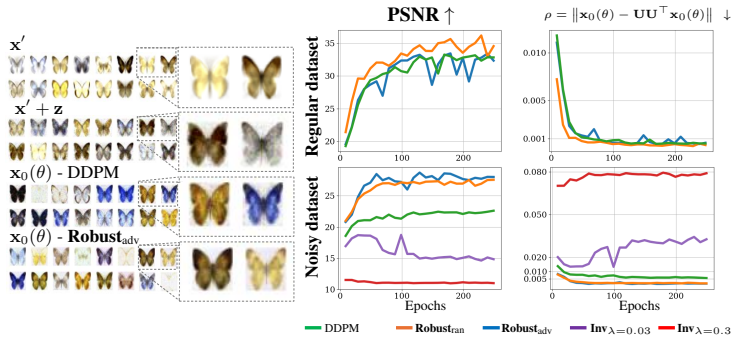
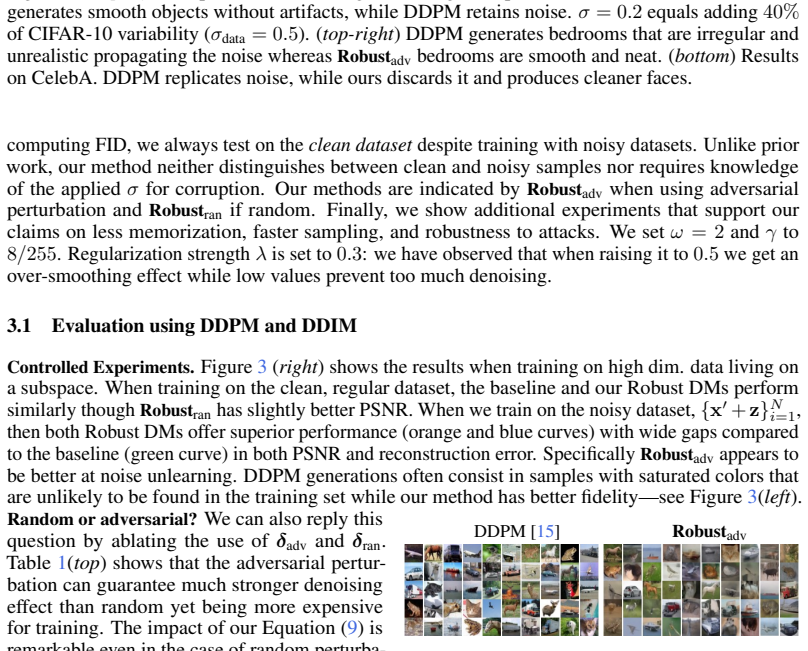
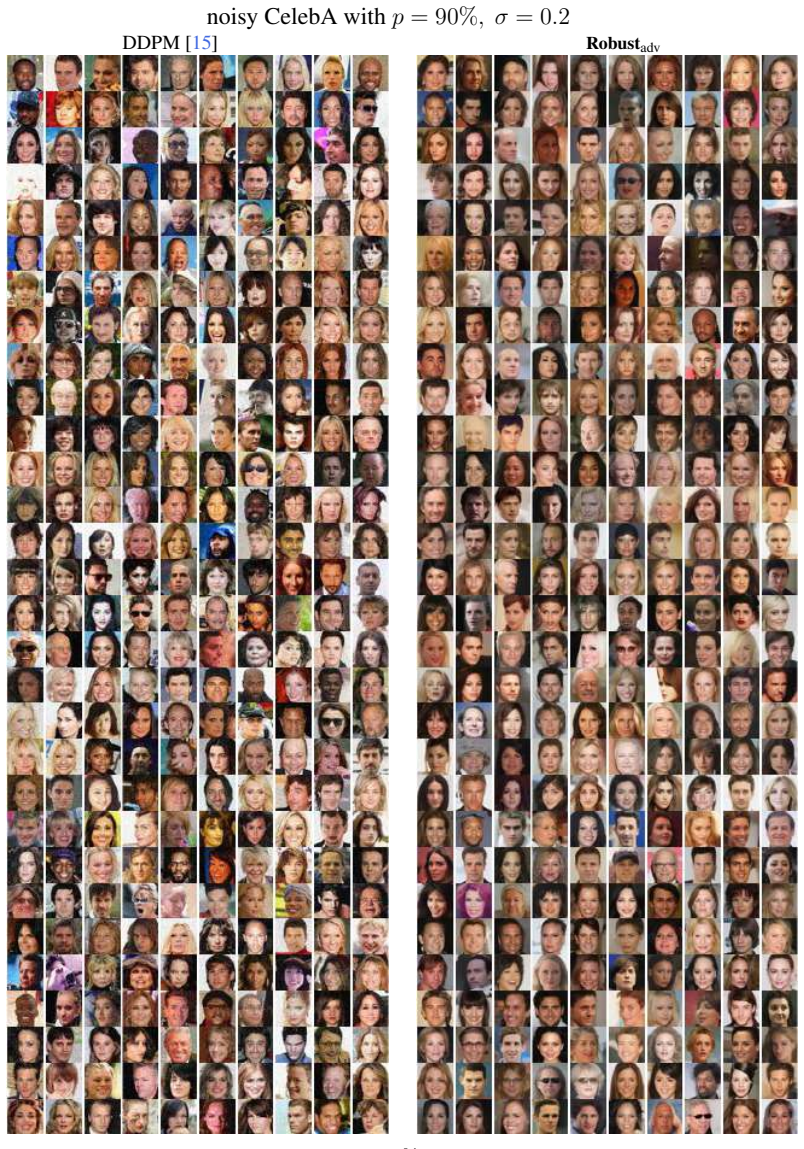
The central claim is that adversarial training for diffusion models is a smoothing operation on the diffusion flow, and it must be formulated as equivariance. Concretely, the paper proposes to minimize $L_{\rm AT} = \|\epsilon_\theta(x_t,t)-\epsilon\|_2^2 + \lambda_t \|\epsilon_\theta(x_t^{\rm adv},t)-[\epsilon_\theta(x_t,t)+\delta]\|_2^2$, where the first term is the usual denoising objective and the second term requires the network's noise prediction to shift by the same perturbation δ that was added to the input. The authors argue that the naive invariance objective $\|\epsilon_\theta(x_t+\delta,t)-\epsilon_\theta(x_t,t)\|_2^2$ causes the model to learn the wrong distribution. With the equivariant loss, a DDPM trained on up to 90% corrupted data with strong Gaussian noise generates samples close to the clean distribution, resists white-box trajectory attacks better, memorizes less, and supports faster sampling.
Load-bearing premise
The derivation of the equivariance loss assumes that the added perturbation δ is an independent Gaussian transition appended to the forward chain, so the corrupted chain remains a product of Gaussian kernels; in the actual algorithm δ is uniform and then refined by FGSM, so if that Gaussian model fails, the ELBO argument does not justify Equation (9) and the regularizer stands or falls on its empirical behavior.
Editorial extensions
If this is right
- A DDPM trained with the equivariant regularizer can be trained on datasets in which 90% of the samples are corrupted by Gaussian noise at σ=0.2 and still produce images close to the clean distribution, where the unregularized baseline's FID rises above 100 on CIFAR-10.
- The correct formulation of adversarial training for generative models is equivariance: enforcing invariance makes the reverse process diverge from the data manifold, as the paper shows on both synthetic and real data.
- The regularized model memorizes less: on CIFAR-10 the similarity histogram of generated samples shifts left and has fewer near-duplicates above 0.9 similarity.
- Smoother diffusion flow allows faster sampling: on clean CIFAR-10 the robust model reaches 24.34 FID with 500 inference steps, better than 28.68 with the standard 1000 steps.
- The regularized model is more resistant to white-box trajectory attacks, keeping FID in a reasonable range when up to 50% of inference timesteps are attacked under both FGSM and PGD variants.
Reading between the lines
- I infer that the equivariance loss, being stated at the level of the noise-prediction field, should transfer to latent diffusion and consistency models, though the paper only tests DDPM.
- Because the method never requires knowing the corruption level or distinguishing clean from noisy samples, it could be paired with blind denoising or used as a training-time defense before adversarial purification; the paper does not test these combinations.
- The schedule that shrinks perturbation strength in the content phase suggests a general principle — regularization strength should track the signal-to-noise ratio — that could be tested on other generative frameworks, including the fully corrupted p=100% case the paper lists as future work.
Editorial analysis
A structured set of objections, weighed in public.
Referee Report
Summary. The paper addresses the question in its title by proposing that adversarial training (AT) for diffusion models should enforce equivariance rather than invariance. The central proposal is the training objective in Eq. (9), which combines the standard DDPM denoising loss with a regularizer that pushes the epsilon-prediction at a perturbed input x_t+delta toward the prediction at x_t plus the perturbation delta. The perturbation is chosen from a time-dependent ray schedule r_beta(t) and can be random or adversarial (FGSM with random start). The authors argue that this 'equivariant' regularization smooths the diffusion flow, and they support the claim with experiments on synthetic low-dimensional and high-dimensional data with known distributions, as well as CIFAR-10, CelebA, and LSUN Bedroom under 90% Gaussian corruption. They also report reduced memorization, faster sampling, and improved robustness to FGSM and PGD trajectory attacks.
Significance. If the central claim were established, the paper would make a useful conceptual and practical contribution: it offers a simple regularization term that integrates into standard DDPM training and shows strong empirical gains in training on heavily corrupted data, without requiring knowledge of the noise level. The paper's strengths include the use of synthetic datasets with closed-form reconstruction error, the release of code, and a relatively broad evaluation across datasets and corruption levels. However, the theoretical derivation that is advertised as establishing the 'equivariance is required' claim does not actually yield Eq. (9), and the robustness evaluation attacks an objective closely aligned with the training regularizer. The contribution is therefore best regarded at present as an empirical regularizer with promising results, not as a formally grounded principle for AT in diffusion models.
major comments (3)
- [Appendix A.1.3, Eq. (9)] The variational derivation does not establish Eq. (9). The factorization between the penultimate and final lines of the ELBO computation replaces p_theta(x_{t-1}|x_t+delta_t) by p_theta(x_{t-1}|x_t) p'_theta(x_t|x_t+delta_t), which is not a valid conditional-probability identity. In addition, the ratio q'(x_t|x_0)/q'(x_t+delta_t|x_0) disappears without comment, and the sign of the boundary term log p'_theta(x_0|x_1+delta_1) changes incorrectly. More importantly, even if the ELBO algebra were correct, the two resulting KL terms do not reduce to the explicit equivariance regularizer ||epsilon_theta(x_t+delta) - [epsilon_theta(x_t)+delta]||^2: no step of the derivation maps the variational bound to Eq. (9). The abstract's assertion that AT for DMs 'requires equivariance' is therefore supported only by the experiments, not by the theory as written.
- [Appendix A.1.1 and Section 2.3 / Algorithm 1] The theoretical forward-chain model assumes the perturbation is an independent Gaussian transition, q''(x_t+delta_t|x_{t-1}) = q'(x_t+delta_t|x_t) q(x_t|x_{t-1}), with delta_t independent of x_t and of the model. The algorithm actually used draws delta from U[-r_beta(t), r_beta(t)] and then applies an FGSM step (Eq. (7)) whose gradient is computed through epsilon_theta; hence delta_adv is a deterministic function of the current weights theta and of x_t, is not Gaussian, and changes throughout training. The factorization and the subsequent ELBO manipulation therefore do not apply to the method in Algorithm 1, and Eq. (9) functions as an ad hoc regularizer whose justification is empirical. If the theoretical claim is to be kept, this gap must be closed, for example by treating the adversarial perturbation as an outer maximization over a Gaussian model or by deriving the regularizer directly from a different principle.
- [Section 3.4, Algorithm 2 and Appendix A.2] The robustness evaluation is partly circular. Algorithm 2, and its epsilon-prediction reformulation in Appendix A.2, define the attack cost as J_theta(x_t,delta,t) = ||epsilon_theta(x_t+delta,t) - epsilon_theta(x_t,t)||^2, which is the same pairwise output difference that the regularizer in Eq. (9) is designed to suppress (the regularizer's target is epsilon_theta(x_t)+delta rather than epsilon_theta(x_t), but for small delta the two objectives are closely aligned). Training on Eq. (9) therefore specifically reduces the quantity the attack maximizes, so the reported FID improvements under this attack do not demonstrate general trajectory robustness. I recommend evaluating robustness with an attack that is not derived from the training objective, such as attacking the final generated samples, or using a downstream classifier or perceptual metric, and reporting whether the gains persist.
minor comments (5)
- [Section 2.1, Eq. (3)] The sampling notation t ~ U(0,I) is a typo; it should be t ~ U({1,...,T}) or an equivalent discrete uniform distribution over timesteps.
- [Section 2.4, Eqs. (8) and (9)] The left-hand sides of Eqs. (8) and (9) use 'arg min_theta' although the right-hand sides are loss values; this notation is misleading and should be replaced by a plain loss definition.
- [Section 3, Table 2] The column layout of Table 2 is difficult to parse; in particular, the p=0 row and the separation between the columns for DDPM, Robust adv, DDIM, and Robust adv should be explicitly formatted so that each FID/IS pair is unambiguous.
- [Appendix B.4.1 and B.3.3] The text in B.4.1 says 'both with p=0.9%' and should read p=90%; B.3.3 contains the typo 'Instea,d DDPM'.
- [Appendix A.1.3] The notation q'(x_t|x_0) is used but q' was only defined as a transition q'(x_t+delta|x_t), not as a marginal distribution; this needs to be defined or the derivation needs to be rewritten.
Circularity Check
The attack-robustness experiment re-uses the exact pairwise-output cost the regularizer minimizes, and the central 'equivariance is required' claim restates the regularizer's defining constraint; the rest of the empirical study is independent.
-
self definitional
[Section 2.4 (Eq. 9) and Appendix B.1.1 (Eqs. 13-14)]
"Being the diffusion a regression task, we formulated again the AT taking into account the need for input sensitivity of the model by enforcing equivariance. ... This objective is reached by taking into account δ in the AT loss as arg minθ ||ϵθ(xt+δ,t)-[ϵ+δ]||². While this equation enforces equivariance, it does not yet enforce smoothness ... Our final formulation is given in Equation (9)."
Appendix B.1.1 defines equivariance as f(a∘x)=a∘f(x), which for the additive perturbation used in the paper is exactly f(xt+δ)=f(xt)+δ. Eq. (9)'s regularizer Lreg = λt||ϵθ(xadv_t,t)-[ϵθ(xt,t)+δ]||² is the squared-error loss for precisely that identity. The headline conclusion that AT for DMs 'requires equivariance' is therefore the defining constraint of the proposed loss stated as a result; the ELBO derivation in A.1.3 is never carried through algebraically to Eq. (9), so the conclusion is not a separately derived consequence. The invariance-vs-equivariance experiments provide empirical support, but the conceptual claim itself is largely a restatement of the regularizer's definition.
-
fitted input called prediction
[Section 2.3, Eq. (7); Section 3.4, Algorithm 2; Appendix A.2]
"The final adversarial perturbation δadv is then computed by taking a step in the direction of the gradient of Jθ ... δadv = Prβ(t)(δran + rβ(t)/√3 S(∇xt Jθ(xt,δran,t))) ... This cost function, if considered in light of the model's prediction in the epsilon-prediction setting, can be formulated as: Jθ(xt,δ,t)=||ϵθ(xt+δ,t)-ϵθ(xt,t)||²."
Training crafts δadv by maximizing Jθ, the squared norm of the pairwise output difference, and Eq. (9) trains ϵθ so that at this crafted δadv the output difference equals δadv. The evaluation attack in Algorithm 2 maximizes the perturbed-vs-unperturbed predicted-mean discrepancy, which Appendix A.2 explicitly reduces to the same Jθ. Under the trained equivariance, the attack's gradient is approximately zero, so the reported 'robustness to attacks' measures whether the model minimized the very quantity its own regularizer was built to shrink. This is a partial by-construction result rather than an independent adversarial probe; the PGD variant in A.3 maximizes the same cost.
full rationale
Most of the paper is a self-contained empirical study: the FID/IS comparisons on corrupted CIFAR-10, CelebA and LSUN, the memorization histogram against DINO-v2, and the faster-sampling tests are external benchmarks computed with standard metrics, and they do not reduce to the paper's inputs. There is no load-bearing self-citation chain; the only same-author citation appears in a list of AT methods and is not used to justify a uniqueness claim. The circularity concerns are concentrated in two places. First, the conceptual answer to the title question is definitional: 'equivariance' is defined as the additive consistency f(xt+δ)=f(xt)+δ, and Eq. (9) enforces exactly that identity, so the statement 'AT in DMs requires equivariance' restates the regularizer's construction rather than following from the ELBO. The ELBO in Appendix A.1 is not a clean derivation of Eq. (9); the paper concedes in A.1.2 that 'there is no modeling available' for the attack distribution, which depends on the model state, while A.1.1 treats the perturbation as an independent Gaussian transition. That inconsistency undermines the formal claim but is a rigor gap more than a circular reduction. Second, the adversarial-robustness experiment is partially circular: Appendix A.2 reduces the attack cost to the same Jθ used to craft training perturbations, and Eq. (9) was trained to make that cost's gradient vanish. The comparison against DDPM is still informative about relative behavior, and the PGD extension adds some transfer, but the headline robustness result is not an independent probe of the training objective. Overall the paper has substantial independent empirical content, so the circularity is partial rather than total.
Assumptions & free parameters
free parameters (6)
- lambda (lambda) =
0.3
- omega (omega) =
2
- gamma (gamma) =
8/255
- beta (beta) =
sampled from U[0.5,2]
- attack strength phi (phi) =
not specified in main text
- perturbation ray schedule r_beta(t) =
time-dependent function
assumptions (3)
- ad hoc to paper The perturbation delta can be modeled as an independent Gaussian transition q'(xt+delta|xt), so the forward chain remains a product of Gaussians.
- ad hoc to paper The hand-designed ray r_beta(t) with omega=2 and gamma=8/255 is appropriate for all corruption levels and noise types.
- domain assumption Standard DDPM Gaussian transition and score matching assumptions.
Cite this review
Pith. "Pith review of What is Adversarial Training for Diffusion Models?." pith.science (2026). https://pith.science/paper/FXRZYHXA
@misc{pith2026250521742,
  author       = {Pith},
  title        = {Pith review of: What is Adversarial Training for Diffusion Models?},
  year         = {2026},
  howpublished = {\url{https://pith.science/paper/FXRZYHXA}},
  note         = {Machine review of arXiv:2505.21742}
}
read the original abstract
We answer the question in the title, showing that adversarial training (AT) for diffusion models (DMs) fundamentally differs from classifiers: while AT in classifiers enforces output invariance, AT in DMs requires equivariance to keep the diffusion process aligned with the data distribution. AT is a way to enforce smoothness in the diffusion flow, improving robustness to outliers and corrupted data. Unlike prior art, our method makes no assumptions about the noise model and integrates seamlessly into diffusion training by adding random noise, similar to randomized smoothing, or adversarial noise, akin to AT. This enables intrinsic capabilities such as handling noisy data, dealing with extreme variability such as outliers, preventing memorization, and improving robustness. We rigorously evaluate our approach with proof-of-concept datasets with known distributions in low- and high-dimensional space, thereby taking a perfect measure of errors; we further evaluate on standard benchmarks such as CIFAR-10, CelebA and LSUN Bedroom, showing strong performance under severe noise, data corruption, and iterative adversarial attacks.
Figures


Figures from the paper (21 more)





Reference graph
Works this paper leans on
-
[1]
Solving inverse problems with score-based generative priors learned from noisy data
Asad Aali, Marius Arvinte, Sidharth Kumar, and Jonathan I Tamir. Solving inverse problems with score-based generative priors learned from noisy data. InAsilomar Conference on Signals, Systems, and Computers, 2023
work page 2023
-
[2]
Extracting training data from diffusion models
Nicolas Carlini, Jamie Hayes, Milad Nasr, Matthew Jagielski, Vikash Sehwag, Florian Tramer, Borja Balle, Daphne Ippolito, and Eric Wallace. Extracting training data from diffusion models. InUSENIX Security Symposium, 2023
work page 2023
-
[3]
(certified!!) adversarial robustness for free! InICLR, 2023
Nicholas Carlini, Florian Tramer, Krishnamurthy Dj Dvijotham, Leslie Rice, Mingjie Sun, and J Zico Kolter. (certified!!) adversarial robustness for free! InICLR, 2023
work page 2023
-
[4]
Perception prioritized training of diffusion models
Jooyoung Choi, Jungbeom Lee, Chaehun Shin, Sungwon Kim, Hyunwoo Kim, and Sungroh Yoon. Perception prioritized training of diffusion models. InProceedings of the IEEE/CVF Conference on Computer Vision and Pattern Recognition, pages 11472–11481, 2022
2022
-
[5]
Certified adversarial robustness via randomized smoothing
Jeremy Cohen, Elan Rosenfeld, and Zico Kolter. Certified adversarial robustness via randomized smoothing. InICML, pages 1310–1320. PMLR, 2019
work page 2019
-
[6]
A high-quality robust diffusion framework for corrupted dataset
Quan Dao, Binh Ta, Tung Pham, and Anh Tran. A high-quality robust diffusion framework for corrupted dataset. InECCV, 2024
work page 2024
-
[7]
Giannis Daras, Yeshwanth Cherapanamjeri, and Constantinos Daskalakis. How much is a noisy image worth? data scaling laws for ambient diffusion.arXiv e-prints, pages arXiv–2411, 2024
work page 2024
-
[8]
Soft diffusion: Score matching with general corruptions.TMLR, 2024
Giannis Daras, Mauricio Delbracio, Hossein Talebi, Alex Dimakis, and Peyman Milanfar. Soft diffusion: Score matching with general corruptions.TMLR, 2024
work page 2024
Show all 71 references
-
[9]
Consistent diffusion meets tweedie: Training exact ambient diffusion models with noisy data
Giannis Daras, Alex Dimakis, and Constantinos Costis Daskalakis. Consistent diffusion meets tweedie: Training exact ambient diffusion models with noisy data. InICML, 2024
2024
-
[10]
Ambient diffusion: Learning clean distributions from corrupted data
Giannis Daras, Kulin Shah, Yuval Dagan, Aravind Gollakota, Alex Dimakis, and Adam Klivans. Ambient diffusion: Learning clean distributions from corrupted data. InNeurIPS, 2024
2024
-
[11]
Diffusion models beat gans on image synthesis
Prafulla Dhariwal and Alexander Nichol. Diffusion models beat gans on image synthesis. InNeurIPS, 2021
2021
-
[12]
Explaining and harnessing adversarial examples
Ian Goodfellow, Jonathon Shlens, and Christian Szegedy. Explaining and harnessing adversarial examples. InICLR, 2015
2015
-
[13]
Generative adversarial networks.Communications of the ACM, 63(11): 139–144, 2020
Ian Goodfellow, Jean Pouget-Abadie, Mehdi Mirza, Bing Xu, David Warde-Farley, Sherjil Ozair, Aaron Courville, and Yoshua Bengio. Generative adversarial networks.Communications of the ACM, 63(11): 139–144, 2020
2020
-
[14]
Gans trained by a two time-scale update rule converge to a local nash equilibrium
Martin Heusel, Hubert Ramsauer, Thomas Unterthiner, Bernhard Nessler, and Sepp Hochreiter. Gans trained by a two time-scale update rule converge to a local nash equilibrium. InNeurIPS, 2017
2017
-
[15]
Denoising diffusion probabilistic models
Jonathan Ho, Ajay Jain, and Pieter Abbeel. Denoising diffusion probabilistic models. InNeurIPS, 2020
2020
-
[16]
Adversarial examples are not bugs, they are features
Andrew Ilyas, Shibani Santurkar, Dimitris Tsipras, Logan Engstrom, Brandon Tran, and Aleksander Madry. Adversarial examples are not bugs, they are features. InNeurIPS, 2019
2019
-
[17]
Measuring forgetting of memorized training examples
Matthew Jagielski, Om Thakkar, Florian Tramer, Daphne Ippolito, Katherine Lee, Nicholas Carlini, Eric Wallace, Shuang Song, Abhradeep Guha Thakurta, Nicolas Papernot, et al. Measuring forgetting of memorized training examples. InICLR, 2023
2023
-
[18]
Elucidating the design space of diffusion-based generative models
Tero Karras, Miika Aittala, Timo Aila, and Samuli Laine. Elucidating the design space of diffusion-based generative models. InNeurIPS, 2022
2022
-
[19]
Analyzing and improving the training dynamics of diffusion models
Tero Karras, Miika Aittala, Jaakko Lehtinen, Janne Hellsten, Timo Aila, and Samuli Laine. Analyzing and improving the training dynamics of diffusion models. InCVPR, 2024
2024
-
[20]
Gsure-based diffusion model training with corrupted data.TMLR, 2024
Bahjat Kawar, Noam Elata, Tomer Michaeli, and Michael Elad. Gsure-based diffusion model training with corrupted data.TMLR, 2024
2024
-
[21]
Learning multiple layers of features from tiny images
Alex Krizhevsky, Geoffrey Hinton, et al. Learning multiple layers of features from tiny images. Technical report, CIFAR, 2009. 37
2009
-
[22]
Goodfellow, and Samy Bengio
Alexey Kurakin, Ian J. Goodfellow, and Samy Bengio. Adversarial machine learning at scale. InICLR, 2017
2017
-
[23]
ADBM: Adversarial diffusion bridge model for reliable adversarial purification
Xiao Li, Wenxuan Sun, Huanran Chen, Qiongxiu Li, Yingzhe He, Jie Shi, and Xiaolin Hu. ADBM: Adversarial diffusion bridge model for reliable adversarial purification. InICLR, 2025
2025
-
[24]
Celeb-df: A new dataset for deepfake forensics.arXiv preprint arXiv:1909.12962, 2019
Yuezun Li, Xin Yang, Pu Sun, Honggang Qi, and Siwei Lyu. Celeb-df: A new dataset for deepfake forensics.arXiv preprint arXiv:1909.12962, 2019
1909 arXiv
-
[25]
Mist: Towards improved adversarial examples for diffusion models
Chumeng Liang and Xiaoyu Wu. Mist: Towards improved adversarial examples for diffusion models. arXiv preprint arXiv:2305.12683, 2023
2023 arXiv
-
[26]
Adversarial example does good: preventing painting imitation from diffusion models via adversarial examples
Chumeng Liang, Xiaoyu Wu, Yang Hua, Jiaru Zhang, Yiming Xue, Tao Song, Zhengui Xue, Ruhui Ma, and Haibing Guan. Adversarial example does good: preventing painting imitation from diffusion models via adversarial examples. InProceedings of the 40th International Conference on Ma...
2023
-
[27]
Adversarial training on purification (ATop): Advancing both robustness and generalization
Guang Lin, Chao Li, Jianhai Zhang, Toshihisa Tanaka, and Qibin Zhao. Adversarial training on purification (ATop): Advancing both robustness and generalization. InThe Twelfth International Conference on Learning Representations, 2024
2024
-
[28]
Towards understanding the robustness of diffusion-based purification: A stochastic perspective
Yiming Liu, Kezhao Liu, Yao Xiao, ZiYi Dong, Xiaogang Xu, Pengxu Wei, and Liang Lin. Towards understanding the robustness of diffusion-based purification: A stochastic perspective. InICLR, 2025
2025
-
[29]
Deep learning face attributes in the wild
Ziwei Liu, Ping Luo, Xiaogang Wang, and Xiaoou Tang. Deep learning face attributes in the wild. In ICCV, 2015
2015
-
[30]
Towards deep learning models resistant to adversarial attacks
Aleksander Madry, Aleksandar Makelov, Ludwig Schmidt, Dimitris Tsipras, and Adrian Vladu. Towards deep learning models resistant to adversarial attacks. InICLR, 2018
2018
-
[31]
Unsupervised learning with stein’s unbiased risk estimator.arXiv preprint arXiv:1805.10531, 202
Christopher A Metzler, Ali Mousavi, Reinhard Heckel, and Richard G Baraniuk. Unsupervised learning with stein’s unbiased risk estimator.arXiv preprint arXiv:1805.10531, 202
-
[32]
Explicit tradeoffs between adversarial and natural distributional robustness
Mazda Moayeri, Kiarash Banihashem, and Soheil Feizi. Explicit tradeoffs between adversarial and natural distributional robustness. InNeurIPS, 2022
2022
-
[33]
A comprehensive study of image classifica- tion model sensitivity to foregrounds, backgrounds, and visual attributes
Mazda Moayeri, Phillip Pope, Yogesh Balaji, and Soheil Feizi. A comprehensive study of image classifica- tion model sensitivity to foregrounds, backgrounds, and visual attributes. InCVPR, 2022
2022
-
[34]
Shedding more light on robust classifiers under the lens of energy-based models
Mirza Mujtaba Hussain, Briglia Maria Rosaria, Beadini Senad, and Masi Iacopo. Shedding more light on robust classifiers under the lens of energy-based models. InECCV, 2024
2024
-
[35]
Spurious features everywhere-large-scale detection of harmful spurious features in imagenet
Yannic Neuhaus, Maximilian Augustin, Valentyn Boreiko, and Matthias Hein. Spurious features everywhere-large-scale detection of harmful spurious features in imagenet. InICCV, 2023
2023
-
[36]
Adversarial Attacks, Regression, and Numerical Stability Regular- ization
Andre T Nguyen and Edward Raff. Adversarial Attacks, Regression, and Numerical Stability Regular- ization. InThe AAAI-19 Workshop on Engineering Dependable and Secure Machine Learning Systems, 2019
2019
-
[37]
Improved denoising diffusion probabilistic models
Alexander Quinn Nichol and Prafulla Dhariwal. Improved denoising diffusion probabilistic models. In ICML, 2021
2021
-
[38]
Diffusion models for adversarial purification
Weili Nie, Brandon Guo, Yujia Huang, Chaowei Xiao, Arash Vahdat, and Animashree Anandkumar. Diffusion models for adversarial purification. InICML, 2022
2022
-
[39]
Dinov2: Learning robust visual features without supervision.TMLR, 2023
Maxime Oquab, Timothée Darcet, Théo Moutakanni, Huy V V o, Marc Szafraniec, Vasil Khalidov, Pierre Fernandez, Daniel HAZIZA, Francisco Massa, Alaaeldin El-Nouby, et al. Dinov2: Learning robust visual features without supervision.TMLR, 2023
2023
-
[40]
Sdxl: Improving latent diffusion models for high-resolution image synthesis
Dustin Podell, Zion English, Kyle Lacey, Andreas Blattmann, Tim Dockhorn, Jonas Müller, Joe Penna, and Robin Rombach. Sdxl: Improving latent diffusion models for high-resolution image synthesis. In ICLR, 2024
2024
-
[41]
High-resolution image synthesis with latent diffusion models
Robin Rombach, Andreas Blattmann, Dominik Lorenz, Patrick Esser, and Björn Ommer. High-resolution image synthesis with latent diffusion models. InCVPR, 2022
2022
-
[42]
Improved techniques for training gans
Tim Salimans, Ian Goodfellow, Wojciech Zaremba, Vicki Cheung, Alec Radford, Xi Chen, and Xi Chen. Improved techniques for training gans. InNeurIPS, 2016. 38
2016
-
[43]
Do adversarially robust imagenet models transfer better? InNeurIPS, 2020
Hadi Salman, Andrew Ilyas, Logan Engstrom, Ashish Kapoor, and Aleksander Madry. Do adversarially robust imagenet models transfer better? InNeurIPS, 2020
2020
-
[44]
Denoised smoothing: A provable defense for pretrained classifiers.NeurIPS, 2020
Hadi Salman, Mingjie Sun, Greg Yang, Ashish Kapoor, and J Zico Kolter. Denoised smoothing: A provable defense for pretrained classifiers.NeurIPS, 2020
2020
-
[45]
Adversarial diffusion distillation
Axel Sauer, Dominik Lorenz, Andreas Blattmann, and Robin Rombach. Adversarial diffusion distillation. InECCV, 2024
2024
-
[46]
Adversarial training for free! InNeurIPS, 2019
Ali Shafahi, Mahyar Najibi, Mohammad Amin Ghiasi, Zheng Xu, John Dickerson, Christoph Studer, Larry S Davis, Gavin Taylor, and Tom Goldstein. Adversarial training for free! InNeurIPS, 2019
2019
-
[47]
Salient imagenet: How to discover spurious features in deep learning? In ICLR, 2022
Sahil Singla and Soheil Feizi. Salient imagenet: How to discover spurious features in deep learning? In ICLR, 2022
2022
-
[48]
Diffusion art or digital forgery? investigating data replication in diffusion models
Gowthami Somepalli, Vasu Singla, Micah Goldblum, Jonas Geiping, and Tom Goldstein. Diffusion art or digital forgery? investigating data replication in diffusion models. InCVPR, 2023
2023
-
[49]
Denoising diffusion implicit models
Jiaming Song, Chenlin Meng, and Stefano Ermon. Denoising diffusion implicit models. InICLR, 2021
2021
-
[50]
Mimicdiffusion: Purifying adversarial perturbation via mimicking clean diffusion model
Kaiyu Song, Hanjiang Lai, Yan Pan, and Jian Yin. Mimicdiffusion: Purifying adversarial perturbation via mimicking clean diffusion model. InCVPR, 2024
2024
-
[51]
Generative modeling by estimating gradients of the data distribution
Yang Song and Stefano Ermon. Generative modeling by estimating gradients of the data distribution. In NeurIPS, 2019
2019
-
[52]
Pixeldefend: Leveraging generative models to understand and defend against adversarial examples
Yang Song, Taesup Kim, Sebastian Nowozin, Stefano Ermon, and Nate Kushman. Pixeldefend: Leveraging generative models to understand and defend against adversarial examples. InICLR, 2018
2018
-
[53]
Score-based generative modeling through stochastic differential equations
Yang Song, Jascha Sohl-Dickstein, Diederik P Kingma, Abhishek Kumar, Stefano Ermon, and Ben Poole. Score-based generative modeling through stochastic differential equations. InICLR, 2021
2021
-
[54]
Consistency models
Yang Song, Prafulla Dhariwal, Mark Chen, and Ilya Sutskever. Consistency models. InICML, 2023
2023
-
[55]
Venkatesh Babu
Gaurang Sriramanan, Sravanti Addepalli, Arya Baburaj, and R. Venkatesh Babu. Guided adversarial attack for evaluating and enhancing adversarial defenses. InNeurIPS, 2020
2020
-
[56]
Towards efficient and effective adversarial training.NeurIPS, 2021
Gaurang Sriramanan, Sravanti Addepalli, Arya Baburaj, et al. Towards efficient and effective adversarial training.NeurIPS, 2021
2021
-
[57]
Unsure: Unknown noise level stein’s unbiased risk estimator.arXiv preprint arXiv:2409.01985, 2024
Julián Tachella, Mike Davies, and Laurent Jacques. Unsure: Unknown noise level stein’s unbiased risk estimator.arXiv preprint arXiv:2409.01985, 2024
2024 arXiv
-
[58]
A comprehensive survey on poisoning attacks and counter- measures in machine learning.ACM Computing Surveys, 55(8):1–35, 2022
Zhiyi Tian, Lei Cui, Jie Liang, and Shui Yu. A comprehensive survey on poisoning attacks and counter- measures in machine learning.ACM Computing Surveys, 55(8):1–35, 2022
2022
-
[59]
Improving out-of-distribution generalization by adversarial training with structured priors.NeurIPS, 2022
Qixun Wang, Yifei Wang, Hong Zhu, and Yisen Wang. Improving out-of-distribution generalization by adversarial training with structured priors.NeurIPS, 2022
2022
-
[60]
Improving adversarial robustness requires revisiting misclassified examples
Yisen Wang, Difan Zou, Jinfeng Yi, James Bailey, Xingjun Ma, and Quanquan Gu. Improving adversarial robustness requires revisiting misclassified examples. InICLR, 2020
2020
-
[61]
Better diffusion models further improve adversarial training
Zekai Wang, Tianyu Pang, Chao Du, Min Lin, Weiwei Liu, and Shuicheng Yan. Better diffusion models further improve adversarial training. InICML, 2023
2023
-
[62]
Fast is better than free: Revisiting adversarial training
Eric Wong, Leslie Rice, and J Zico Kolter. Fast is better than free: Revisiting adversarial training. InICLR, 2020
2020
-
[63]
Ddm ˆ2: Self- supervised diffusion mri denoising with generative diffusion models.arXiv preprint arXiv:2302.03018, 2023
Tiange Xiang, Mahmut Yurt, Ali B Syed, Kawin Setsompop, and Akshay Chaudhari. Ddm ˆ2: Self- supervised diffusion mri denoising with generative diffusion models.arXiv preprint arXiv:2302.03018, 2023
2023 arXiv
-
[64]
Structure-guided adversarial training of diffusion models
Ling Yang, Haotian Qian, Zhilong Zhang, Jingwei Liu, and Bin Cui. Structure-guided adversarial training of diffusion models. InCVPR, 2024
2024
-
[65]
Spurious correlations in machine learning: A survey.arXiv preprint arXiv:2402.12715, 2024
Wenqian Ye, Guangtao Zheng, Xu Cao, Yunsheng Ma, Xia Hu, and Aidong Zhang. Spurious correlations in machine learning: A survey.arXiv preprint arXiv:2402.12715, 2024
2024
-
[66]
Lsun: Construction of a large-scale image dataset using deep learning with humans in the loop.arXiv preprint arXiv:1506.03365, 2015
Fisher Yu, Yinda Zhang, Shuran Song, Ari Seff, and Jianxiong Xiao. Lsun: Construction of a large-scale image dataset using deep learning with humans in the loop.arXiv preprint arXiv:1506.03365, 2015. 39
2015 arXiv
-
[67]
A causal view on robustness of neural networks
Cheng Zhang, Kun Zhang, and Yingzhen Li. A causal view on robustness of neural networks. InNeurIPS, 2020
2020
-
[68]
Xing, Laurent El Ghaoui, and Michael I
Hongyang Zhang, Yaodong Yu, Jiantao Jiao, Eric P. Xing, Laurent El Ghaoui, and Michael I. Jordan. Theoretically principled trade-off between robustness and accuracy. InICML, 2019
2019
-
[69]
Adversarial robustness through the lens of causality
Yonggang Zhang, Mingming Gong, Tongliang Liu, Gang Niu, Xinmei Tian, Bo Han, Bernhard Schölkopf, and Kun Zhang. Adversarial robustness through the lens of causality. InICLR, 2022
2022
-
[70]
Rethinking generative mode coverage: A pointwise guaranteed approach
Peilin Zhong, Yuchen Mo, Chang Xiao, Pengyu Chen, and Changxi Zheng. Rethinking generative mode coverage: A pointwise guaranteed approach. InNeurIPS, 2019
2019
-
[71]
Towards understanding the generative capability of adversarially robust classifiers
Yao Zhu, Jiacheng Ma, Jiacheng Sun, Zewei Chen, Rongxin Jiang, Yaowu Chen, and Zhenguo Li. Towards understanding the generative capability of adversarially robust classifiers. InICCV, 2021. 40
2021
Reviewed August 7, 2026 · model on record in the stance chip above.
Discussion (0). Sign in to comment.