REVIEW 3 major objections 6 minor 126 references
Multimodal Federated Learning: A Survey through the Lens of Different FL Paradigms
T0 review · 3 major / 6 minor · reviewed 2026-08-07 · deepseek-v4-flash
Pith's one-line read Multimodal federated learning is best organized by the underlying federated-learning paradigm, with horizontal, vertical, and hybrid settings each posing its own dominant challenge.
desk verdict Useful paradigm-based survey of MFL; read it for the overview, but the hybrid FL branch is thinner and more self-referential than the 'taxonomy of existing work' claim admits. read the letter →
The pith
A machine-rendered reading of the paper's core claim, the machinery that carries it, and where it could break.
The reading
What carries the argument
The carrying object is the taxonomy itself, built on the three classical FL data-partitioning schemes: horizontal, vertical, and hybrid. Each branch is analyzed along three fixed dimensions — problem formulation, training algorithm, and key challenge — so that heterogeneous methods can be compared within a consistent structure. The taxonomy is what does the argumentative work: it assigns each surveyed method to a paradigm, attaches a dominant challenge to that paradigm, and then uses the challenge to explain why standard FL tools (such as FedAvg's shared-feature-space aggregation) fail in multimodal settings.
What would settle it
A concrete falsifier would be to take any proposed hybrid-FL method and reimplement it as a nested or alternating sequence of a horizontal-FL method and a vertical-FL method, then show the composed system matches the hybrid method in accuracy, privacy, and communication cost; success would show hybrid FL is not a separate paradigm. A complementary falsifier would be a hybrid-FL system whose measured bottleneck is privacy leakage or modality heterogeneity rather than efficiency, contradicting the claim that efficiency is the most fundamental concern in that paradigm.
Extended reading notes
Core claim
The central claim is that existing MFL research falls naturally into three federated-learning paradigms, and that this is the first taxonomy to organize the field that way. In horizontal FL, clients share a feature space but own different samples, and the paper identifies modality heterogeneity — clients holding different subsets of modalities — as the most critical obstacle. In vertical FL, clients own different features of the same samples, and the exchange of intermediate embeddings makes privacy leakage the most critical challenge. In hybrid FL, both the sample space and the feature space are partitioned, and efficiency becomes the most fundamental practical concern. The survey backs these claims with problem formulations, training algorithms, and catalogs of representative methods and attacks, and it concludes that each paradigm's challenges are qualitatively different from those in unimodal FL or centralized multimodal learning.
Load-bearing premise
The taxonomy's third branch assumes that hybrid FL — simultaneous partitioning of the sample space and feature space — is a genuinely distinct paradigm and not just a composition of horizontal and vertical FL; the paper itself concedes that the setting reduces to the HFL or VFL cases when only one dimension is partitioned.
Editorial extensions
If this is right
- If the taxonomy is correct, a researcher encountering a new MFL method can classify it by data-partition geometry and immediately know which challenge to design for.
- In multimodal HFL, the taxonomy implies that aggregation rules assuming a common feature space will fail when clients hold different modality subsets, motivating modality-aware aggregation.
- In multimodal VFL, the survey's challenge analysis implies that privacy defenses for embeddings and gradients, not efficiency measures, should be the primary design target.
- In hybrid FL, the taxonomy implies that efficiency — computational and communication overhead from dual-axis partitioning — is the bottleneck that needs resource-management and compression techniques.
- The compiled dataset and application catalog gives practitioners a concrete starting point for benchmarking MFL methods.
Reading between the lines
- A testable extension of the taxonomy is to vary the sample-space/feature-space partition ratio in hybrid FL and measure when the efficiency bottleneck displaces privacy or heterogeneity as the dominant concern.
- The taxonomy's logic extends beyond multimodality: any client-side feature-space heterogeneity (e.g., differing sensor suites, label spaces, or missing features) could be analyzed along the same paradigm axes.
- The hybrid-FL branch currently rests on a narrow base: the paper's running example and efficiency discussion are drawn largely from the authors' own prior work, so an independent implementation of hybrid FL with different models and datasets would test whether the paradigm stands on its own.
- If the per-paradigm dominant challenges hold, they suggest a meta-design rule: choose aggregation, privacy, and compression strategies from the data-partition geometry rather than from the application domain.
Editorial analysis
A structured set of objections, weighed in public.
Referee Report
Summary. This survey proposes a taxonomy of multimodal federated learning (MFL) organized by three federated learning (FL) paradigms: horizontal FL (HFL), vertical FL (VFL), and hybrid FL. For each paradigm, the paper provides a problem formulation, reviews representative algorithms, identifies a key challenge, and discusses applications and datasets. The main contributions claimed are: (i) a novel taxonomy that is the first to systematically organize existing MFL research by the underlying FL paradigm; (ii) problem formulations, algorithm reviews, and per-paradigm challenge analyses; (iii) a compilation of datasets and applications; and (iv) a discussion of open challenges and future directions. The paper's central narrative is that multimodal data introduces distinct challenges in each FL paradigm, with modality heterogeneity being the most critical challenge in HFL, privacy leakage in VFL, and efficiency in hybrid FL.
Significance. If the taxonomy and the per-paradigm challenge claims are accepted, the paper would provide a useful organizing framework for a growing literature at the intersection of multimodal learning and federated learning. The survey's strengths include broad coverage of recent MFL works, a systematic presentation of HFL and VFL problem formulations, a reasonably detailed catalog of privacy attacks in VFL, and a practical list of datasets and applications. These features make the manuscript a potentially valuable reference for researchers entering the field. However, the significance is currently tempered by two load-bearing issues: the hybrid FL branch is defined in a way that reduces to a composition of HFL and VFL and is operationalized almost entirely through the authors' prior work, and the HFL problem formulation excludes the very modality heterogeneity that the paper later identifies as the central HFL challenge. Both issues affect the validity of the central claim that the paper offers a taxonomy grounded in three core FL paradigms.
major comments (3)
- [§5, §2] The hybrid FL branch is not convincingly established as a distinct third paradigm. Section 5 defines hybrid FL as simultaneous partitioning of both the sample space and the feature space, but immediately concedes that the term is non-standard and that 'when reduced to a single-dimensional partition, this setting corresponds to either the HFL or VFL cases.' This makes hybrid FL a composition of the other two paradigms rather than a primitive one. Moreover, the only described training workflow in §5.2 is 'the hybrid FL training workflow introduced in [77]', and §5.3 repeatedly points to [77, 82]; all of these are papers by the same research group. No independent body of literature is classified under the hybrid branch. Since the paper's central claim in §1 is that it presents a taxonomy of 'existing MFL research' grounded in three core FL paradigms, the hybrid branch as presented is better described as a proposed setting rather than a surveyed category. The authors should either reframe the contribution as a two-paradigm survey plus a research proposal for hybrid FL, or provide independent examples demonstrating that hybrid FL with simultaneous sample-space and feature-space partitioning is an established paradigm with a substantial literature.
- [§3.1, §3.4] There is a direct internal inconsistency between the problem formulation and the stated key challenge of HFL. Section 3.1 formalizes multimodal HFL under the assumption that 'all clients share the same set of modalities' and that 'each sample contains the same types of features.' Section 3.4 then declares modality heterogeneity, i.e., clients holding different subsets of modalities, to be 'the most critical challenge in multimodal HFL.' These two statements are mutually exclusive: the formal setting in Eq. (1) and the local dataset definition D_m = {(x_i_m, y_i_m)} exclude the modality-heterogeneous scenario. The authors should either generalize the problem formulation to accommodate heterogeneous modality availability, or explicitly present §3.1 as the consistent-modality special case and formalize the modality-heterogeneous setting separately before discussing challenges.
- [§3.4, §4.3, §5.3] The paper's per-paradigm 'most critical challenge' claims are asserted without comparative support. Section 3.4 states that modality heterogeneity is 'the most critical challenge' in HFL, §4.3 states that privacy leakage is 'one of the most critical challenges' in VFL, and §5.3 states that efficiency 'stands out as the most fundamental and practical concern' in hybrid FL. The survey does not provide any structured comparison of challenge importance, nor does it present evidence from the reviewed works that would justify these prioritizations. For instance, the VFL discussion in §4.3 catalogs a wide range of privacy attacks but does not compare their severity with, say, communication overhead or feature imbalance, which are mentioned only in passing. The authors should either (i) add a comparative analysis that justifies why one challenge is more critical than others within each paradigm, or (ii) soften these claims to say that these are important challenges rather than the most critical ones.
minor comments (6)
- [§4.1] The definition 'h0(θ0; xi) := θ0' is confusing: the server head is treated both as a parameter and as an embedding function. Consider writing the objective in Eq. (1) with an explicit server-head function applied to the concatenation of client embeddings, e.g., ℓ(h0(θ0; [h1(θ1; x_i^1), ..., hK(θK; x_i^K)]), y_i).
- [§5.1] The phrase 'bi-orthogonally partitioned' is used without definition. Please clarify what 'bi-orthogonal' means in this context, or replace it with a more standard term such as 'both horizontally and vertically partitioned.'
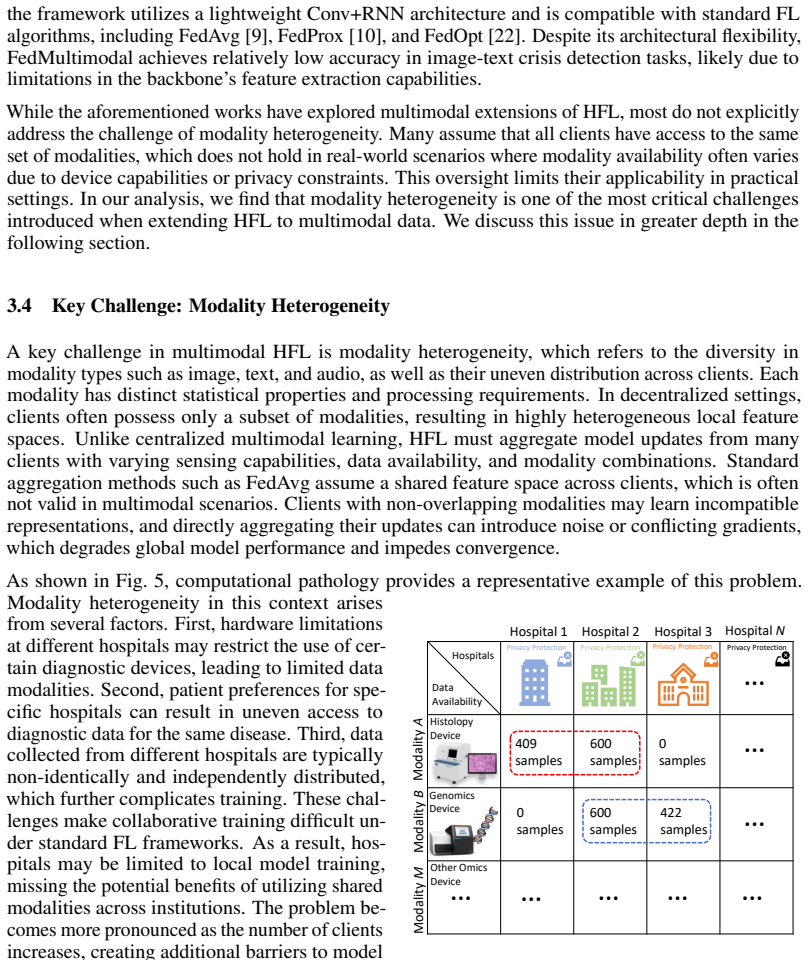
- [§5.2] The sentence 'Every RQ updates, the global server aggregates the local models' is ambiguous. Specify whether R refers to the number of global rounds and Q to the number of local updates per round, and define the notation before using it.
- [§6.2, Table 3] The dataset 'SEW A' is listed in Table 3 without a citation. Either provide a reference for this dataset or remove it from the table.
- [§3.3, §6.1] The abbreviation 'FedMEKT' is used for two different works: reference [36] in Table 1 and reference [89] in Section 6.1. Please disambiguate the names, for example by using the full author names or a version number, to avoid confusion.
- [§6.1] In the discussion of embodied intelligence, the paper cites [92] as 'emerging' research, but the reference is a Nature Communications paper on embodied intelligence via learning and evolution. Please verify that this citation is appropriate for the claim being made about federated multimodal robot learning.
Circularity Check
The central HFL/VFL axes are externally grounded, but the survey's distinctive third branch (hybrid FL) is defined as a composition of the other two and is populated almost entirely by the authors' own prior work ([77], [82]), making the 'first taxonomy of existing MFL research' claim partially self-citational.
-
self citation load bearing
[Section 5, 'Multimodal Hybrid Federated Learning' (definition in the section opening, workflow example in §5.2, efficiency challenge in §5.3)]
"Although some studies use the term "hybrid FL" to describe scenarios where both the client and the server hold training data, in this paper, we define hybrid FL as the case where both the sample space and the feature space are partitioned across clients. ... For an example of the hybrid FL training workflow introduced in [77], each silo contains K vertical parties that engage in vertical FL, while M silos communicate horizontally through periodic global aggregation."
The paper's central claim is to be the first to organize existing MFL research into three core paradigms, with hybrid FL as the novel third branch. But the paper itself concedes that this branch is a composition of the first two ('reduced to a single-dimensional partition, this setting corresponds to either the HFL or VFL cases'), and the only concrete workflow presented under the branch is 'the hybrid FL training workflow introduced in [77]', an earlier paper by the same University of Florida group (Peng, Wu, Bian, Xu). Section 5.3 again anchors efficiency as the defining challenge on '[77, 82]', also the authors' own prior works.
full rationale
Most of the paper's organizational scaffolding is externally grounded: HFL and VFL are standard FL paradigms with citations to Kairouz et al., Liu et al., and many independent MFL papers are classified under those branches (FedMultimodal, MMFed, FedMSplit, MMVFL, etc.). The circularity risk is concentrated in the third branch. Section 5 defines hybrid FL as simultaneous sample/feature partitioning, concedes the term is non-standard ('Although some studies use the term ...'), concedes that a one-dimensional partition reduces to HFL or VFL, then gives [77] as the example workflow and later anchors the efficiency challenge on [77, 82]; both references are the same University of Florida group. The survey's 'first to systematically organize MFL research' claim therefore depends on counting the authors' own proposed setting as an established paradigm; that step is load-bearing self-citation rather than a survey of independent literature. This is not a case of a fitted parameter renamed as prediction, and the HFL/VFL halves retain independent content, so the score is moderate rather than high. The paper's internal inconsistency between §3.1's assumption that 'all clients share the same set of modalities' and §3.4's claim that modality heterogeneity is the most critical HFL challenge is a correctness/consistency issue, not a circularity issue.
Assumptions & free parameters
assumptions (4)
- domain assumption The three FL paradigms (HFL, VFL, hybrid) form a complete partition of federated settings, with hybrid as a co-equal third paradigm.
- domain assumption The formal HFL model assumes all clients share the same set of modalities.
- ad hoc to paper No prior work has systematically organized MFL through FL paradigms.
- domain assumption The four-category VFL attack taxonomy (representation-based inference, gradient-based reconstruction, label inference, model stealing) is complete for multimodal VFL.
Cite this review
Pith. "Pith review of Multimodal Federated Learning: A Survey through the Lens of Different FL Paradigms." pith.science (2026). https://pith.science/paper/QCBUKHQ2
@misc{pith2026250521792,
  author       = {Pith},
  title        = {Pith review of: Multimodal Federated Learning: A Survey through the Lens of Different FL Paradigms},
  year         = {2026},
  howpublished = {\url{https://pith.science/paper/QCBUKHQ2}},
  note         = {Machine review of arXiv:2505.21792}
}
read the original abstract
Multimodal Federated Learning (MFL) lies at the intersection of two pivotal research areas: leveraging complementary information from multiple modalities to improve downstream inference performance and enabling distributed training to enhance efficiency and preserve privacy. Despite the growing interest in MFL, there is currently no comprehensive taxonomy that organizes MFL through the lens of different Federated Learning (FL) paradigms. This perspective is important because multimodal data introduces distinct challenges across various FL settings. These challenges, including modality heterogeneity, privacy heterogeneity, and communication inefficiency, are fundamentally different from those encountered in traditional unimodal or non-FL scenarios. In this paper, we systematically examine MFL within the context of three major FL paradigms: horizontal FL (HFL), vertical FL (VFL), and hybrid FL. For each paradigm, we present the problem formulation, review representative training algorithms, and highlight the most prominent challenge introduced by multimodal data in distributed settings. We also discuss open challenges and provide insights for future research. By establishing this taxonomy, we aim to uncover the novel challenges posed by multimodal data from the perspective of different FL paradigms and to offer a new lens through which to understand and advance the development of MFL.
Figures


Figures from the paper (7 more)



Reference graph
Works this paper leans on
-
[77]
Hybrid federated learning for multimodal iot systems,
Y . Peng, Y . Wu, J. Bian, and J. Xu, “Hybrid federated learning for multimodal iot systems,” IEEE Internet of Things Journal, 2024
work page 2024
-
[1]
Cross-modal retrieval: a systematic review of methods and future directions,
T. Wang, F. Li, L. Zhu, J. Li, Z. Zhang, and H. T. Shen, “Cross-modal retrieval: a systematic review of methods and future directions,” Proceedings of the IEEE, 2025
2025
-
[2]
Deep learning approaches on image captioning: A review,
T. Ghandi, H. Pourreza, and H. Mahyar, “Deep learning approaches on image captioning: A review,”ACM Computing Surveys, vol. 56, no. 3, pp. 1–39, 2023
2023
-
[3]
A comprehensive survey of multi-view video summarization,
T. Hussain, K. Muhammad, W. Ding, J. Lloret, S. W. Baik, and V . H. C. De Albuquerque, “A comprehensive survey of multi-view video summarization,”Pattern Recognition, vol. 109, p. 107567, 2021
2021
-
[4]
Learning Language and Multimodal Privacy-Preserving Markers of Mood from Mobile Data
P. P. Liang, T. Liu, A. Cai, M. Muszynski, R. Ishii, N. Allen, R. Auerbach, D. Brent, R. Salakhutdinov, and L.-P. Morency, “Learning language and multimodal privacy-preserving markers of mood from mobile data,” arXiv preprint arXiv:2106.13213, 2021
work page Pith review arXiv 2021
-
[5]
Resvit: residual vision transformers for multimodal medical image synthesis,
O. Dalmaz, M. Yurt, and T. Çukur, “Resvit: residual vision transformers for multimodal medical image synthesis,” IEEE Transactions on Medical Imaging, vol. 41, no. 10, pp. 2598– 2614, 2022
2022
-
[6]
Multimodal federated learning via contrastive representation ensemble,
Q. Yu, Y . Liu, Y . Wang, K. Xu, and J. Liu, “Multimodal federated learning via contrastive representation ensemble,” arXiv preprint arXiv:2302.08888, 2023
arXiv 2023
-
[7]
Multimodal federated learning in healthcare: a review,
J. Thrasher, A. Devkota, P. Siwakotai, R. Chivukula, P. Poudel, C. Hu, B. Bhattarai, and P. Gyawali, “Multimodal federated learning in healthcare: a review,” arXiv preprint arXiv:2310.09650, 2023
arXiv 2023
Show all 126 references
-
[8]
Advances and open problems in federated learning,
P. Kairouz, H. B. McMahan, B. Avent, A. Bellet, M. Bennis, A. N. Bhagoji, K. Bonawitz, Z. Charles, G. Cormode, R. Cummings et al., “Advances and open problems in federated learning,” Foundations and trends® in machine learning, vol. 14, no. 1–2, pp. 1–210, 2021
2021
-
[9]
Communication-efficient learning of deep networks from decentralized data,
H. B. McMahan, E. Moore, D. Ramage, S. Hampson et al., “Communication-efficient learning of deep networks from decentralized data,” Proceedings of the 20th International Conference on Artificial Intelligence and Statistics (AISTATS), 2017
2017
-
[10]
Federated optimization in heterogeneous networks,
T. Li, A. K. Sahu, A. Talwalkar, and V . Smith, “Federated optimization in heterogeneous networks,” Proceedings of Machine Learning and Systems (MLSys), 2020
2020
-
[11]
Scaffold: Stochastic controlled averaging for federated learning,
S. P. Karimireddy, S. Kale, M. Mohri, S. Reddi, S. Stich, and A. T. Suresh, “Scaffold: Stochastic controlled averaging for federated learning,” in International conference on machine learning. PMLR, 2020, pp. 5132–5143
2020
-
[12]
Fedbn: Federated learning on non-iid features via local batch normalization,
X. Li, M. Jiang, X. Zhang, M. Kamp, and Q. Dou, “Fedbn: Federated learning on non-iid features via local batch normalization,” arXiv preprint arXiv:2102.07623, 2021
2021 arXiv
-
[13]
Tackling the objective inconsistency problem in heterogeneous federated optimization,
J. Wang, Q. Liu, H. Liang, G. Joshi, and H. V . Poor, “Tackling the objective inconsistency problem in heterogeneous federated optimization,” Advances in neural information processing systems, vol. 33, pp. 7611–7623, 2020
2020
-
[14]
Multimodal melanoma detection with federated learning,
B. L. Y . Agbley, J. Li, A. U. Haq, E. K. Bankas, S. Ahmad, I. O. Agyemang, D. Kulevome, W. D. Ndiaye, B. Cobbinah, and S. Latipova, “Multimodal melanoma detection with federated learning,” in 2021 18th international computer conference on wavelet active media technology and i...
2021
-
[15]
A unified framework for multi-modal federated learning,
B. Xiong, X. Yang, F. Qi, and C. Xu, “A unified framework for multi-modal federated learning,” Neurocomputing, vol. 480, pp. 110–118, 2022
2022
-
[16]
Model-agnostic meta-learning for fast adaptation of deep networks,
C. Finn, P. Abbeel, and S. Levine, “Model-agnostic meta-learning for fast adaptation of deep networks,” in International conference on machine learning. PMLR, 2017, pp. 1126–1135
2017
-
[17]
Towards a multimodal human activity dataset for healthcare,
M. Hu, M. Luo, M. Huang, W. Meng, B. Xiong, X. Yang, and J. Sang, “Towards a multimodal human activity dataset for healthcare,” Multimedia Systems, vol. 29, no. 1, pp. 1–13, 2023
2023
-
[18]
Medical report generation based on multimodal federated learning,
J. Chen and R. Pan, “Medical report generation based on multimodal federated learning,” Computerized Medical Imaging and Graphics, vol. 113, p. 102342, 2024. 20
2024
-
[19]
Attention is all you need,
A. Vaswani, N. Shazeer, N. Parmar, J. Uszkoreit, L. Jones, A. N. Gomez, Ł. Kaiser, and I. Polosukhin, “Attention is all you need,” Advances in neural information processing systems, vol. 30, 2017
2017
-
[20]
Fl-fd: Federated learning-based fall detection with multi- modal data fusion,
P. Qi, D. Chiaro, and F. Piccialli, “Fl-fd: Federated learning-based fall detection with multi- modal data fusion,” Information fusion, vol. 99, p. 101890, 2023
2023
-
[21]
Fedmultimodal: A benchmark for multimodal federated learning,
T. Feng, D. Bose, T. Zhang, R. Hebbar, A. Ramakrishna, R. Gupta, M. Zhang, S. Avestimehr, and S. Narayanan, “Fedmultimodal: A benchmark for multimodal federated learning,” in Proceedings of the 29th ACM SIGKDD Conference on Knowledge Discovery and Data Mining, 2023, pp. 4035–4045
2023
-
[22]
Adaptive federated optimization,
S. Reddi, Z. Charles, M. Zaheer, Z. Garrett, K. Rush, J. Kone ˇcn`y, S. Kumar, and H. B. McMahan, “Adaptive federated optimization,”arXiv preprint arXiv:2003.00295, 2020
2003 arXiv
-
[23]
Communication- efficient multimodal federated learning: Joint modality and client selection,
L. Yuan, D.-J. Han, S. Wang, D. Upadhyay, and C. G. Brinton, “Communication- efficient multimodal federated learning: Joint modality and client selection,” arXiv preprint arXiv:2401.16685, 2024
2024
-
[24]
Fedmsplit: Correlation-adaptive federated multi-task learning across multimodal split networks,
J. Chen and A. Zhang, “Fedmsplit: Correlation-adaptive federated multi-task learning across multimodal split networks,” inProceedings of the 28th ACM SIGKDD conference on knowledge discovery and data mining, 2022, pp. 87–96
2022
-
[25]
On disentanglement of asymmetrical knowledge transfer for modality-task agnostic federated learning,
——, “On disentanglement of asymmetrical knowledge transfer for modality-task agnostic federated learning,” in Proceedings of the AAAI Conference on Artificial Intelligence, vol. 38, no. 10, 2024, pp. 11 311–11 319
2024
-
[26]
Autofed: Heterogeneity-aware federated multimodal learning for robust autonomous driving,
T. Zheng, A. Li, Z. Chen, H. Wang, and J. Luo, “Autofed: Heterogeneity-aware federated multimodal learning for robust autonomous driving,” in Proceedings of the 29th annual international conference on mobile computing and networking, 2023, pp. 1–15
2023
-
[27]
Har- mony: Heterogeneous multi-modal federated learning through disentangled model training,
X. Ouyang, Z. Xie, H. Fu, S. Cheng, L. Pan, N. Ling, G. Xing, J. Zhou, and J. Huang, “Har- mony: Heterogeneous multi-modal federated learning through disentangled model training,” in Proceedings of the 21st Annual International Conference on Mobile Systems, Applications and Se...
2023
-
[28]
Cross-modal federated human activity recognition,
X. Yang, B. Xiong, Y . Huang, and C. Xu, “Cross-modal federated human activity recognition,” IEEE Transactions on Pattern Analysis and Machine Intelligence, 2024
2024
-
[29]
Fedfusion: Manifold-driven federated learning for multi- satellite and multi-modality fusion,
D. Li, W. Xie, Y . Li, and L. Fang, “Fedfusion: Manifold-driven federated learning for multi- satellite and multi-modality fusion,” IEEE Transactions on Geoscience and Remote Sensing, vol. 62, pp. 1–13, 2023
2023
-
[30]
Cross-modal federated human activity recognition via modality-agnostic and modality-specific representation learning,
X. Yang, B. Xiong, Y . Huang, and C. Xu, “Cross-modal federated human activity recognition via modality-agnostic and modality-specific representation learning,” in Proceedings of the AAAI conference on artificial intelligence, vol. 36, no. 3, 2022, pp. 3063–3071
2022
-
[31]
Federated modality-specific encoders and multimodal anchors for personalized brain tumor segmentation,
Q. Dai, D. Wei, H. Liu, J. Sun, L. Wang, and Y . Zheng, “Federated modality-specific encoders and multimodal anchors for personalized brain tumor segmentation,” in Proceedings of the AAAI Conference on Artificial Intelligence, vol. 38, no. 2, 2024, pp. 1445–1453
2024
-
[32]
Federated learning for vision-and-language grounding problems,
F. Liu, X. Wu, S. Ge, W. Fan, and Y . Zou, “Federated learning for vision-and-language grounding problems,” in Proceedings of the AAAI conference on artificial intelligence, vol. 34, no. 07, 2020, pp. 11 572–11 579
2020
-
[33]
Towards optimal multi-modal federated learning on non-iid data with hierarchical gradient blending,
S. Chen and B. Li, “Towards optimal multi-modal federated learning on non-iid data with hierarchical gradient blending,” in IEEE INFOCOM 2022-IEEE conference on computer communications. IEEE, 2022, pp. 1469–1478
2022
-
[34]
Fedclip: Fast generalization and personalization for clip in federated learning,
W. Lu, X. Hu, J. Wang, and X. Xie, “Fedclip: Fast generalization and personalization for clip in federated learning,” arXiv preprint arXiv:2302.13485, 2023
2023 arXiv
-
[35]
Fedcmr: Federated cross-modal retrieval,
L. Zong, Q. Xie, J. Zhou, P. Wu, X. Zhang, and B. Xu, “Fedcmr: Federated cross-modal retrieval,” in Proceedings of the 44th International ACM SIGIR Conference on Research and Development in Information Retrieval, 2021, pp. 1672–1676. 21
2021
-
[36]
Multimodal federated learning on iot data,
Y . Zhao, P. Barnaghi, and H. Haddadi, “Multimodal federated learning on iot data,” in2022 IEEE/ACM Seventh International Conference on Internet-of-Things Design and Implementa- tion (IoTDI). IEEE, 2022, pp. 43–54
2022
-
[37]
Pfedprompt: Learning personalized prompt for vision-language models in federated learning,
T. Guo, S. Guo, and J. Wang, “Pfedprompt: Learning personalized prompt for vision-language models in federated learning,” in Proceedings of the ACM Web Conference 2023, 2023, pp. 1364–1374
2023
-
[38]
Multimodal federated learning with missing modality via prototype mask and contrast,
G. Bao, Q. Zhang, D. Miao, Z. Gong, L. Hu, K. Liu, Y . Liu, and C. Shi, “Multimodal federated learning with missing modality via prototype mask and contrast,” arXiv preprint arXiv:2312.13508, 2023
2023 arXiv
-
[39]
Fedusl: A federated annotation method for driving fatigue detection based on multimodal sensing data,
S. Yu, Q. Yang, J. Wang, and C. Wu, “Fedusl: A federated annotation method for driving fatigue detection based on multimodal sensing data,” ACM Transactions on Sensor Networks, 2024
2024
-
[40]
Fedsea: Federated learning via selective feature alignment for non-iid multimodal data,
M. Tan, Y . Feng, L. Chu, J. Shi, R. Xiao, H. Tang, and J. Yu, “Fedsea: Federated learning via selective feature alignment for non-iid multimodal data,”IEEE Transactions on Multimedia, vol. 26, pp. 5807–5822, 2023
2023
-
[41]
Fedmm: Federated multi-modal learning with modality hetero- geneity in computational pathology,
Y . Peng, J. Bian, and J. Xu, “Fedmm: Federated multi-modal learning with modality hetero- geneity in computational pathology,” inICASSP 2024-2024 IEEE International Conference on Acoustics, Speech and Signal Processing (ICASSP). IEEE, 2024, pp. 1696–1700
2024
-
[42]
Prioritizing modalities: Flexible importance scheduling in federated multimodal learning,
J. Bian, L. Wang, and J. Xu, “Prioritizing modalities: Flexible importance scheduling in federated multimodal learning,” arXiv preprint arXiv:2408.06549, 2024
2024 arXiv
-
[43]
A multi-modal vertical federated learning framework based on homomorphic encryption,
M. Gong, Y . Zhang, Y . Gao, A. K. Qin, Y . Wu, S. Wang, and Y . Zhang, “A multi-modal vertical federated learning framework based on homomorphic encryption,” IEEE Transactions on Information Forensics and Security, vol. 19, pp. 1826–1839, 2023
2023
-
[44]
Toward multimodal vertical federated learning: A traf- fic analysis case study,
A. P. Sundar, F. Li, X. Zou, and T. Gao, “Toward multimodal vertical federated learning: A traf- fic analysis case study,” in 2024 33rd International Conference on Computer Communications and Networks (ICCCN). IEEE, 2024, pp. 1–9
2024
-
[45]
Cross-modal vertical federated learning for mri reconstruction,
Y . Yan, H. Wang, Y . Huang, N. He, L. Zhu, Y . Xu, Y . Li, and Y . Zheng, “Cross-modal vertical federated learning for mri reconstruction,”IEEE Journal of Biomedical and Health Informatics, vol. 28, no. 11, pp. 6384–6394, 2024
2024
-
[46]
Vertical Federated Learning: Concepts, Advances, and Challenges,
Y . Liu, Y . Kang, T. Zou, Y . Pu, Y . He, X. Ye, Y . Ouyang, Y .-Q. Zhang, and Q. Yang, “Vertical Federated Learning: Concepts, Advances, and Challenges,” IEEE Transactions on Knowledge and Data Engineering, vol. 36, pp. 3615–3634, 2024
2024
-
[47]
Compressed-vfl: Communication-efficient learning with vertically partitioned data,
T. J. Castiglia, A. Das, S. Wang, and S. Patterson, “Compressed-vfl: Communication-efficient learning with vertically partitioned data,” in International Conference on Machine Learning. PMLR, 2022, pp. 2738–2766
2022
-
[48]
Flexible vertical federated learning with heterogeneous parties,
T. Castiglia, S. Wang, and S. Patterson, “Flexible vertical federated learning with heterogeneous parties,” IEEE Transactions on Neural Networks and Learning Systems, 2023
2023
-
[49]
Less-vfl: Communication-efficient feature selection for vertical federated learning,
T. Castiglia, Y . Zhou, S. Wang, S. Kadhe, N. Baracaldo, and S. Patterson, “Less-vfl: Communication-efficient feature selection for vertical federated learning,” in International Conference on Machine Learning. PMLR, 2023, pp. 3757–3781
2023
-
[50]
Fedbcd: A communication- efficient collaborative learning framework for distributed features,
Y . Liu, X. Zhang, Y . Kang, L. Li, T. Chen, M. Hong, and Q. Yang, “Fedbcd: A communication- efficient collaborative learning framework for distributed features,” IEEE Transactions on Signal Processing, vol. 70, pp. 4277–4290, 2022
2022
-
[51]
Exploiting Shared Representations for Personalized Federated Learning,
L. Collins, H. Hassani, A. Mokhtari, and S. Shakkottai, “Exploiting Shared Representations for Personalized Federated Learning,” in International conference on machine learning. Virtual Event: PMLR, 2021, pp. 2089–2099
2021
-
[52]
Overlearning reveals sensitive attributes,
C. Song and V . Shmatikov, “Overlearning reveals sensitive attributes,” arXiv preprint arXiv:1905.11742, 2019. 22
1905 arXiv
-
[53]
Exploiting unintended feature leakage in collaborative learning,
L. Melis, C. Song, E. De Cristofaro, and V . Shmatikov, “Exploiting unintended feature leakage in collaborative learning,” in 2019 IEEE symposium on security and privacy (SP) . IEEE, 2019, pp. 691–706
2019
-
[54]
{ML-Doctor}: Holistic risk assessment of inference attacks against machine learning models,
Y . Liu, R. Wen, X. He, A. Salem, Z. Zhang, M. Backes, E. De Cristofaro, M. Fritz, and Y . Zhang, “{ML-Doctor}: Holistic risk assessment of inference attacks against machine learning models,” in 31st USENIX Security Symposium (USENIX Security 22) , 2022, pp. 4525–4542
2022
-
[55]
Feature inference attack on model predictions in vertical federated learning,
X. Luo, Y . Wu, X. Xiao, and B. C. Ooi, “Feature inference attack on model predictions in vertical federated learning,” in 2021 IEEE 37th international conference on data engineering (ICDE). IEEE, 2021, pp. 181–192
2021
-
[56]
Practical privacy attacks on vertical federated learning,
H. Weng, J. Zhang, X. Ma, F. Xue, T. Wei, S. Ji, and Z. Zong, “Practical privacy attacks on vertical federated learning,” arXiv preprint arXiv:2011.09290, 2020
2011 arXiv
-
[57]
Is vertical logistic regression privacy-preserving? a comprehensive privacy analysis and beyond,
Y . Hu, T. Cai, J. Shan, S. Tang, C. Cai, E. Song, B. Li, and D. Song, “Is vertical logistic regression privacy-preserving? a comprehensive privacy analysis and beyond,”arXiv preprint arXiv:2207.09087, 2022
2022 arXiv
-
[58]
Model inversion attacks against collaborative inference,
Z. He, T. Zhang, and R. B. Lee, “Model inversion attacks against collaborative inference,” in Proceedings of the 35th Annual Computer Security Applications Conference , 2019, pp. 148–162
2019
-
[59]
Comprehensive analysis of privacy leakage in vertical federated learning during prediction,
X. Jiang, X. Zhou, and J. Grossklags, “Comprehensive analysis of privacy leakage in vertical federated learning during prediction,” Proceedings on privacy enhancing technologies, 2022
2022
-
[60]
Cafe: Catastrophic data leakage in vertical federated learning,
X. Jin, P.-Y . Chen, C.-Y . Hsu, C.-M. Yu, and T. Chen, “Cafe: Catastrophic data leakage in vertical federated learning,” Advances in neural information processing systems, vol. 34, pp. 994–1006, 2021
2021
-
[61]
Defending batch- level label inference and replacement attacks in vertical federated learning,
T. Zou, Y . Liu, Y . Kang, W. Liu, Y . He, Z. Yi, Q. Yang, and Y .-Q. Zhang, “Defending batch- level label inference and replacement attacks in vertical federated learning,”IEEE Transactions on Big Data, 2022
2022
-
[62]
Exploit: Extracting private labels in split learning,
S. Kariyappa and M. K. Qureshi, “Exploit: Extracting private labels in split learning,” in 2023 IEEE conference on secure and trustworthy machine learning (SaTML). IEEE, 2023, pp. 165–175
2023
-
[63]
Residue-based label protection mechanisms in vertical logistic regression,
J. Tan, L. Zhang, Y . Liu, A. Li, and Y . Wu, “Residue-based label protection mechanisms in vertical logistic regression,” in 2022 8th International Conference on Big Data Computing and Communications (BigCom). IEEE, 2022, pp. 356–364
2022
-
[64]
See through gradi- ents: Image batch recovery via gradinversion,
H. Yin, A. Mallya, A. Vahdat, J. M. Alvarez, J. Kautz, and P. Molchanov, “See through gradi- ents: Image batch recovery via gradinversion,” in Proceedings of the IEEE/CVF conference on computer vision and pattern recognition, 2021, pp. 16 337–16 346
2021
-
[65]
Cgir: Conditional generative instance reconstruction attacks against federated learning,
X. Xu, P. Liu, W. Wang, H.-L. Ma, B. Wang, Z. Han, and Y . Han, “Cgir: Conditional generative instance reconstruction attacks against federated learning,” IEEE Transactions on Dependable and Secure Computing, vol. 20, no. 6, pp. 4551–4563, 2022
2022
-
[66]
Feature reconstruction attacks and countermeasures of dnn training in vertical federated learning,
P. Ye, Z. Jiang, W. Wang, B. Li, and B. Li, “Feature reconstruction attacks and countermeasures of dnn training in vertical federated learning,” IEEE Transactions on Dependable and Secure Computing, 2024
2024
-
[67]
Label inference attacks against vertical federated learning,
C. Fu, X. Zhang, S. Ji, J. Chen, J. Wu, S. Guo, J. Zhou, A. X. Liu, and T. Wang, “Label inference attacks against vertical federated learning,” in 31st USENIX security symposium (USENIX Security 22), 2022, pp. 1397–1414
2022
-
[68]
Label leakage and protection in two-party split learning,
O. Li, J. Sun, X. Yang, W. Gao, H. Zhang, J. Xie, V . Smith, and C. Wang, “Label leakage and protection in two-party split learning,” arXiv preprint arXiv:2102.08504, 2021
2021 arXiv
-
[69]
Label leakage and protection from forward embedding in vertical federated learning,
J. Sun, X. Yang, Y . Yao, and C. Wang, “Label leakage and protection from forward embedding in vertical federated learning,” arXiv preprint arXiv:2203.01451, 2022. 23
2022 arXiv
-
[70]
Your labels are selling you out: Relation leaks in vertical federated learning,
P. Qiu, X. Zhang, S. Ji, T. Du, Y . Pu, J. Zhou, and T. Wang, “Your labels are selling you out: Relation leaks in vertical federated learning,” IEEE Transactions on Dependable and Secure Computing, vol. 20, no. 5, pp. 3653–3668, 2022
2022
-
[71]
Federated learning with differential privacy: Algorithms and performance analysis,
K. Wei, J. Li, M. Ding, C. Ma, H. H. Yang, F. Farokhi, S. Jin, T. Q. Quek, and H. V . Poor, “Federated learning with differential privacy: Algorithms and performance analysis,” IEEE transactions on information forensics and security, vol. 15, pp. 3454–3469, 2020
2020
-
[72]
Ldp-fed: Federated learning with local differential privacy,
S. Truex, L. Liu, K.-H. Chow, M. E. Gursoy, and W. Wei, “Ldp-fed: Federated learning with local differential privacy,” inProceedings of the third ACM international workshop on edge systems, analytics and networking, 2020, pp. 61–66
2020
-
[73]
Safelearn: Secure aggregation for private federated learning,
H. Fereidooni, S. Marchal, M. Miettinen, A. Mirhoseini, H. Möllering, T. D. Nguyen, P. Rieger, A.-R. Sadeghi, T. Schneider, H. Yalame et al., “Safelearn: Secure aggregation for private federated learning,” in 2021 IEEE Security and Privacy Workshops (SPW). IEEE, 2021, pp. 56–62
2021
-
[74]
Lightsecagg: a lightweight and versatile design for secure aggregation in federated learning,
J. So, C. He, C.-S. Yang, S. Li, Q. Yu, R. E Ali, B. Guler, and S. Avestimehr, “Lightsecagg: a lightweight and versatile design for secure aggregation in federated learning,” Proceedings of Machine Learning and Systems, vol. 4, pp. 694–720, 2022
2022
-
[75]
{BatchCrypt}: Efficient homomorphic encryption for {Cross-Silo} federated learning,
C. Zhang, S. Li, J. Xia, W. Wang, F. Yan, and Y . Liu, “{BatchCrypt}: Efficient homomorphic encryption for {Cross-Silo} federated learning,” in 2020 USENIX annual technical conference (USENIX ATC 20), 2020, pp. 493–506
2020
-
[76]
Homomorphic encryption-based privacy-preserving federated learning in iot-enabled healthcare system,
L. Zhang, J. Xu, P. Vijayakumar, P. K. Sharma, and U. Ghosh, “Homomorphic encryption-based privacy-preserving federated learning in iot-enabled healthcare system,”IEEE Transactions on Network Science and Engineering, vol. 10, no. 5, pp. 2864–2880, 2022
2022
-
[78]
Deep compression: Compressing deep neural networks with pruning, trained quantization and huffman coding,
S. Han, H. Mao, and W. J. Dally, “Deep compression: Compressing deep neural networks with pruning, trained quantization and huffman coding,” arXiv preprint arXiv:1510.00149, 2015
2015 arXiv
-
[79]
Fedmd: Heterogenous federated learning via model distillation,
D. Li and J. Wang, “Fedmd: Heterogenous federated learning via model distillation,”arXiv preprint arXiv:1910.03581, 2019
1910 arXiv
-
[80]
Communication-efficient on- device machine learning: Federated distillation and augmentation under non-iid private data,
E. Jeong, S. Oh, H. Kim, J. Park, M. Bennis, and S.-L. Kim, “Communication-efficient on- device machine learning: Federated distillation and augmentation under non-iid private data,” arXiv preprint arXiv:1811.11479, 2018
2018 arXiv
-
[81]
Split learning for health: Distributed deep learning without sharing raw patient data,
P. Vepakomma, O. Gupta, T. Swedish, and R. Raskar, “Split learning for health: Distributed deep learning without sharing raw patient data,” arXiv preprint arXiv:1812.00564, 2018
2018 arXiv
-
[82]
Joint horizontal and vertical federated learning for multimodal iot,
Y . Peng, Z. Lu, and J. Xu, “Joint horizontal and vertical federated learning for multimodal iot,” in Proceedings of the 30th Annual International Conference on Mobile Computing and Networking, 2024, pp. 2371–2376
2024
-
[83]
Sparse communication for distributed gradient descent,
A. F. Aji and K. Heafield, “Sparse communication for distributed gradient descent,” arXiv preprint arXiv:1704.05021, 2017
2017 arXiv
-
[84]
Qsgd: Communication-efficient sgd via gradient quantization and encoding,
D. Alistarh, D. Grubic, J. Li, R. Tomioka, and M. V ojnovic, “Qsgd: Communication-efficient sgd via gradient quantization and encoding,” Advances in neural information processing systems, vol. 30, 2017
2017
-
[85]
Fedpaq: A communication-efficient federated learning method with periodic averaging and quantiza- tion,
A. Reisizadeh, A. Mokhtari, H. Hassani, A. Jadbabaie, and R. Pedarsani, “Fedpaq: A communication-efficient federated learning method with periodic averaging and quantiza- tion,” in International conference on artificial intelligence and statistics. PMLR, 2020, pp. 2021–2031
2020
-
[86]
Asynchronous federated optimization,
C. Xie, S. Koyejo, and I. Gupta, “Asynchronous federated optimization,” arXiv preprint arXiv:1903.03934, 2019. 24
1903 arXiv
-
[87]
Client-edge-cloud hierarchical federated learning,
L. Liu, J. Zhang, S. Song, and K. B. Letaief, “Client-edge-cloud hierarchical federated learning,” in ICC 2020-2020 IEEE international conference on communications (ICC). IEEE, 2020, pp. 1–6
2020
-
[88]
Towards personalized federated learning,
A. Z. Tan, H. Yu, L. Cui, and Q. Yang, “Towards personalized federated learning,” IEEE transactions on neural networks and learning systems, vol. 34, no. 12, pp. 9587–9603, 2022
2022
-
[89]
Fedmekt: Distillation-based embedding knowledge transfer for multimodal federated learning,
H. Q. Le, M. N. Nguyen, C. M. Thwal, Y . Qiao, C. Zhang, and C. S. Hong, “Fedmekt: Distillation-based embedding knowledge transfer for multimodal federated learning,” Neural Networks, vol. 183, p. 107017, 2025
2025
-
[90]
Fedcmd: A federated cross-modal knowledge distillation for drivers’ emotion recognition,
S. Bano, N. Tonellotto, P. Cassarà, and A. Gotta, “Fedcmd: A federated cross-modal knowledge distillation for drivers’ emotion recognition,”ACM Transactions on Intelligent Systems and Technology, vol. 15, no. 3, pp. 1–27, 2024
2024
-
[91]
Deep learning model with multi-feature fusion and label association for suicide detection,
Z. Li, W. Cheng, J. Zhou, Z. An, and B. Hu, “Deep learning model with multi-feature fusion and label association for suicide detection,” Multimedia systems, vol. 29, no. 4, pp. 2193–2203, 2023
2023
-
[92]
Embodied intelligence via learning and evolution,
A. Gupta, S. Savarese, S. Ganguli, and L. Fei-Fei, “Embodied intelligence via learning and evolution,” Nature communications, vol. 12, no. 1, p. 5721, 2021
2021
-
[93]
Learning transferable visual models from natural language supervi- sion,
A. Radford, J. W. Kim, C. Hallacy, A. Ramesh, G. Goh, S. Agarwal, G. Sastry, A. Askell, P. Mishkin, J. Clark et al., “Learning transferable visual models from natural language supervi- sion,” in International conference on machine learning. PmLR, 2021, pp. 8748–8763
2021
-
[94]
Knowledge-driven egocentric multimodal activity recognition,
Y . Huang, X. Yang, J. Gao, J. Sang, and C. Xu, “Knowledge-driven egocentric multimodal activity recognition,” ACM Transactions on Multimedia Computing, Communications, and Applications (TOMM), vol. 16, no. 4, pp. 1–133, 2020
2020
-
[95]
The kinetics human action video dataset,
W. Kay, J. Carreira, K. Simonyan, B. Zhang, C. Hillier, S. Vijayanarasimhan, F. Viola, T. Green, T. Back, P. Natsevet al., “The kinetics human action video dataset,” arXiv preprint arXiv:1705.06950, 2017
2017 arXiv
-
[96]
Ucf101: A dataset of 101 human actions classes from videos in the wild,
K. Soomro, A. R. Zamir, and M. Shah, “Ucf101: A dataset of 101 human actions classes from videos in the wild,” arXiv preprint arXiv:1212.0402, 2012
2012 arXiv
-
[97]
Human fall detection on embedded platform using depth maps and wireless accelerometer,
B. Kwolek and M. Kepski, “Human fall detection on embedded platform using depth maps and wireless accelerometer,” Computer methods and programs in biomedicine, vol. 117, no. 3, pp. 489–501, 2014
2014
-
[98]
Emotion recognition from multiple modalities: Fundamentals and methodologies,
S. Zhao, G. Jia, J. Yang, G. Ding, and K. Keutzer, “Emotion recognition from multiple modalities: Fundamentals and methodologies,” IEEE Signal Processing Magazine, vol. 38, no. 6, pp. 59–73, 2021
2021
-
[99]
Iemocap: Interactive emotional dyadic motion capture database,
C. Busso, M. Bulut, C.-C. Lee, A. Kazemzadeh, E. Mower, S. Kim, J. N. Chang, S. Lee, and S. S. Narayanan, “Iemocap: Interactive emotional dyadic motion capture database,” Language resources and evaluation, vol. 42, pp. 335–359, 2008
2008
-
[100]
M3er: Multiplicative multimodal emotion recognition using facial, textual, and speech cues,
T. Mittal, U. Bhattacharya, R. Chandra, A. Bera, and D. Manocha, “M3er: Multiplicative multimodal emotion recognition using facial, textual, and speech cues,” in Proceedings of the AAAI conference on artificial intelligence, vol. 34, no. 02, 2020, pp. 1359–1367
2020
-
[101]
Meld: A multimodal multi-party dataset for emotion recognition in conversations,
S. Poria, D. Hazarika, N. Majumder, G. Naik, E. Cambria, and R. Mihalcea, “Meld: A multimodal multi-party dataset for emotion recognition in conversations,” arXiv preprint arXiv:1810.02508, 2018
2018 arXiv
-
[102]
Multimodal language anal- ysis in the wild: Cmu-mosei dataset and interpretable dynamic fusion graph,
A. B. Zadeh, P. P. Liang, S. Poria, E. Cambria, and L.-P. Morency, “Multimodal language anal- ysis in the wild: Cmu-mosei dataset and interpretable dynamic fusion graph,” in Proceedings of the 56th Annual Meeting of the Association for Computational Linguistics (Volume 1: Long...
2018
-
[103]
Vilt: Vision-and-language transformer without convolution or region supervision,
W. Kim, B. Son, and I. Kim, “Vilt: Vision-and-language transformer without convolution or region supervision,” in International conference on machine learning . PMLR, 2021, pp. 5583–5594. 25
2021
-
[104]
Vlmo: Unified vision-language pre-training with mixture-of-modality-experts,
H. Bao, W. Wang, L. Dong, Q. Liu, O. K. Mohammed, K. Aggarwal, S. Som, S. Piao, and F. Wei, “Vlmo: Unified vision-language pre-training with mixture-of-modality-experts,” Advances in Neural Information Processing Systems, vol. 35, pp. 32 897–32 912, 2022
2022
-
[105]
Flickr30k entities: Collecting region-to-phrase correspondences for richer image-to-sentence models,
B. A. Plummer, L. Wang, C. M. Cervantes, J. C. Caicedo, J. Hockenmaier, and S. Lazebnik, “Flickr30k entities: Collecting region-to-phrase correspondences for richer image-to-sentence models,” in Proceedings of the IEEE international conference on computer vision, 2015, pp. 2641–2649
2015
-
[106]
Microsoft coco: Common objects in context,
T.-Y . Lin, M. Maire, S. Belongie, J. Hays, P. Perona, D. Ramanan, P. Dollár, and C. L. Zitnick, “Microsoft coco: Common objects in context,” inComputer vision–ECCV 2014: 13th European conference, zurich, Switzerland, September 6-12, 2014, proceedings, part v 13. Springer, 201...
2014
-
[107]
Making the v in vqa matter: Elevating the role of image understanding in visual question answering,
Y . Goyal, T. Khot, D. Summers-Stay, D. Batra, and D. Parikh, “Making the v in vqa matter: Elevating the role of image understanding in visual question answering,” in Proceedings of the IEEE conference on computer vision and pattern recognition, 2017, pp. 6904–6913
2017
-
[108]
Client selection for federated learning with heterogeneous re- sources in mobile edge,
T. Nishio and R. Yonetani, “Client selection for federated learning with heterogeneous re- sources in mobile edge,” in IEEE International Conference on Communications (ICC), 2019
2019
-
[109]
Splitfed: When federated learning meets split learning,
Y . Jiang, J. Koneˇcn`y, S. Tople, F. Wang, D. Beutel, B. Zhaoet al., “Splitfed: When federated learning meets split learning,” in International Conference on Machine Learning (ICML) , 2023
2023
-
[110]
How to backdoor federated learning,
E. Bagdasaryan, A. Veit, Y . Hua, D. Estrin, and V . Shmatikov, “How to backdoor federated learning,” in Proceedings of the 23rd International Conference on Artificial Intelligence and Statistics (AISTATS), 2020
2020
-
[111]
Model inversion attacks that exploit confidence information and basic countermeasures,
M. Fredrikson, S. Jha, and T. Ristenpart, “Model inversion attacks that exploit confidence information and basic countermeasures,” in Proceedings of the 22nd ACM SIGSAC conference on computer and communications security, 2015, pp. 1322–1333
2015
-
[112]
Deep models under the gan: Information leakage from collaborative deep learning,
B. Hitaj, G. Ateniese, and F. Perez-Cruz, “Deep models under the gan: Information leakage from collaborative deep learning,” in Proceedings of the 2017 ACM SIGSAC Conference on Computer and Communications Security (CCS), 2017
2017
-
[113]
Privacy-preserving deep learning via additively homomorphic encryption,
Y . Aono, T. Hayashi, M. Abuhamadet al., “Privacy-preserving deep learning via additively homomorphic encryption,” in IEEE Transactions on Information Forensics and Security, 2017
2017
-
[114]
Differentially private federated learning: A client level perspective,
R. C. Geyer, T. Klein, and M. Nabi, “Differentially private federated learning: A client level perspective,” in NeurIPS Workshop on Private Multi-Party Machine Learning, 2017
2017
-
[115]
Blockchain federated learning: A robust decentralized learning framework,
C. Zhang, S. Xie, H. Bai, F. Yuet al., “Blockchain federated learning: A robust decentralized learning framework,” IEEE Transactions on Industrial Informatics, 2020
2020
-
[116]
Federated transfer learning with multimodal data,
Y . Sun, “Federated transfer learning with multimodal data,”arXiv preprint arXiv:2209.03137, 2022
2022 arXiv
-
[117]
Federated self-supervised learning of multisensor representations for embedded intelligence,
A. Saeed, F. D. Salim, T. Ozcelebi, and J. Lukkien, “Federated self-supervised learning of multisensor representations for embedded intelligence,” IEEE Internet of Things Journal , vol. 8, no. 2, pp. 1030–1040, 2020
2020
-
[118]
A simple framework for contrastive learning of visual representations,
T. Chen, S. Kornblith, M. Norouzi, and G. Hinton, “A simple framework for contrastive learning of visual representations,” in International conference on machine learning. PmLR, 2020, pp. 1597–1607
2020
-
[119]
Contrastive multiview coding,
Y . Tian, D. Krishnan, and P. Isola, “Contrastive multiview coding,” inEuropean Conference on Computer Vision (ECCV), 2020
2020
-
[120]
Federated semi-supervised learning with inter-client consistency and disjoint learning,
E. Jeong, J. Shin, and J. Kim, “Federated semi-supervised learning with inter-client consistency and disjoint learning,” in International Conference on Learning Representations (ICLR), 2020
2020
-
[121]
Federated learning with person- alization layers,
M. Arivazhagan, A. Aggarwal, N. Singh, and S. Choudhary, “Federated learning with person- alization layers,” in NeurIPS Workshop on Federated Learning, 2019. 26
2019
-
[122]
Federated multi-task learning,
V . Smith, C.-K. Chiang, M. Sanjabi, and A. S. Talwalkar, “Federated multi-task learning,” in Advances in Neural Information Processing Systems (NeurIPS), 2017
2017
-
[123]
Towards personalized federated learning via heterogeneous model reassembly,
J. Wang, X. Yang, S. Cui, L. Che, L. Lyu, D. D. Xu, and F. Ma, “Towards personalized federated learning via heterogeneous model reassembly,” Advances in Neural Information Processing Systems, vol. 36, pp. 29 515–29 531, 2023
2023
-
[124]
Fedkd: Communication-efficient federated learning via knowledge distillation,
H. Zhang, Y . Wang, Y . Li, Z. Liet al., “Fedkd: Communication-efficient federated learning via knowledge distillation,” in IEEE International Conference on Data Mining (ICDM), 2022
2022
-
[125]
Gpt-4o technical report,
OpenAI, “Gpt-4o technical report,” 2024, https://openai.com/index/gpt-4o
2024
-
[126]
Grad-cam: Visual explanations from deep networks via gradient-based localization,
R. R. Selvaraju, M. Cogswell, A. Das, R. Vedantam, D. Parikh, and D. Batra, “Grad-cam: Visual explanations from deep networks via gradient-based localization,” inProceedings of the IEEE International Conference on Computer Vision (ICCV), 2017. 27
2017
Reviewed August 7, 2026 · model on record in the stance chip above.
Discussion (0). Sign in to comment.