REVIEW 2 major objections 5 minor 37 references
Matter Accumulations and Accretion Tori around Wormholes
T0 review · 2 major / 5 minor · reviewed 2026-08-07 · deepseek-v4-flash
Pith's one-line read Symmetric wormholes can host stable circular orbits at their throat, and accretion models turn those orbits into matter accumulations that make the throat look like a bright star-like core rather than a dark shadow.
desk verdict Wormhole-accretion paper with a clean Polish Doughnut extension and a problematic TE approximation that should be fixed before it is relied on. read the letter →
The pith
A machine-rendered reading of the paper's core claim, the machinery that carries it, and where it could break.
The reading
What carries the argument
The central object is the spectrum of circular orbits at the wormhole throat, carried by the boundary formulas $\ell^\pm_B$ for bound orbits and $\ell^\pm_S$ for stability, evaluated at the throat $l = 0$ and taken from the companion analysis in [30]. For the Teo wormhole the bound boundary is approximated by Eq. (32), whose denominator vanishes at $a_E = 0.184$ and triggers the ergoregion phase transition. The Polish Doughnut thick-disk model then converts a specific angular momentum $\ell_0$ lying in this spectrum into an equilibrium fluid accumulation with effective potential $W = \ln|u_t|$; the intersection of $\ell_0$ with the equatorial Keplerian profile $\ell^\pm_K$ decides whether the accumulation is isolated, connected through a cusp to an outer torus, or absent. These two ingredients—the throat-orbit spectrum and the equatorial $\ell^\pm_K$ distribution—generate the five-way classification of disk configurations.
What would settle it
Directly integrate the radial effective potential $V(l)$ near $l = 0$ for the TE wormhole at, say, $a = 0.1$ with $\ell_0 = 1$: if $\partial_l V$ does not vanish at the throat or $\partial_l^2 V$ is negative there, the claimed stable throat equilibrium does not exist, and comparing the exact boundaries with the approximate Eq. (32) would settle the phase-space map.
Extended reading notes
Core claim
The paper establishes that for symmetric wormholes, where both sides are joined smoothly and matter inflowing from both sides meets at the throat, the pressure gradient vanishes and a spectrum of circular orbits can exist exactly at the throat; for the three studied metrics the allowed specific angular momenta lie between the bound boundaries $\ell^\pm_B$ and, for the stable subset, within limits $\ell^\pm_S$. In the Teo example the spectrum undergoes a phase transition at spin $a_E = 0.184$, where an ergoregion appears; in the rotating Simpson–Visser metric the spectrum grows with spin $a$ and shrinks with the regularization parameter $\xi$; in the static beyond-Horndeski wormhole it is largest for small parameter $\alpha$ and throat radius close to $r_0 = 2$. Combining the throat spectrum with the equatorial Keplerian specific angular momentum $\ell^\pm_K$ yields five disk configurations: a throat-only accumulation, a throat centre with a detached outer torus, a throat centre connected by a cusp to an outer torus, a throat cusp attached to an outer centre, and an ordinary outer torus. On this basis the paper concludes that vast regions of the parameter space admit stable throat orbits, so matter accumulations at the throat are a plausible generic feature, and their spherical emission profile may make wormholes look more star-like than shadow-like.
Load-bearing premise
The load-bearing premise is the companion analysis [30] that the boundaries of bound and stable circular orbits at a symmetric wormhole throat are given by Eqs. (30) and (31), together with the unproven approximation Eq. (32) for the Teo case; if that throat-orbit analysis or the approximation is wrong, the phase-space maps and every disk classification built on them collapse.
Editorial extensions
If this is right
- Wormholes with accretion may appear as bright, roughly spherical central sources rather than dark shadows, making them harder to distinguish from stars or other compact objects.
- For RSV wormholes, larger $\xi$ shrinks the throat-orbit spectrum and weakens the binding, so stable matter accumulations become less likely as the regularization parameter grows.
- A cusp at the throat, present in some rotating solutions, provides a channel for matter to flow through the wormhole from one side to the other.
- In the studied cases unstable throat orbits appear only for $a > 0$, so cusp-at-throat configurations may be a rotation-driven phenomenon.
- Because vast parameter regions admit stable throat orbits, wormholes with ergoregions may be dynamically unstable, with matter accumulation as a possible trigger.
Reading between the lines
- A concrete observational extension: ray-trace the displayed density configurations (for instance the TE spherical solution with $\ell_0 = 0$) and compare the image with the shadow prediction for the same metric; a central brightness peak instead of a shadow would be a direct test.
- The same throat-orbit machinery could be applied to asymmetric wormholes, where the pressure gradient at the throat does not vanish by symmetry; the symmetric case treated here is likely the most favorable for accumulation.
- If throat matter is generic, estimates of wormhole lifetimes from exotic-matter stability should be revisited, since the accumulated disk changes the stress-energy at the throat that supports the geometry.
- The instability hint could be tested by adding a small fluid perturbation to the throat accumulation and computing its quasi-normal modes; a growing mode would confirm the ergoregion-instability scenario.
Editorial analysis
A structured set of objections, weighed in public.
Referee Report
Summary. The paper investigates circular orbits and accretion structures in three symmetric wormhole spacetimes: an exponential Teo-class rotating wormhole (TE), a rotating Simpson-Visser wormhole in the wormhole regime (RSV), and a static beyond-Horndeski wormhole (BH). Using the standard Polish Doughnut model, the authors argue that the spectrum of circular orbits at the wormhole throat gives rise to matter accumulations that can appear as central bright, star-like regions, and that combining throat orbits with equatorial Keplerian orbits yields five distinct disk configurations. The analysis is largely analytic, with explicit boundary formulas for the RSV and BH cases and phase diagrams for all three models.
Significance. If the central claims hold, the paper provides a concrete observational discriminator between wormholes and black holes: wormhole throats with stable circular orbits can host long-lived central matter accumulations, turning the expected dark shadow into a bright central emission. The use of the Polish Doughnut model is standard, and the paper's parameter-space exploration for three different wormhole families is broad and clearly presented. The explicit analytic boundaries for the RSV and BH cases, together with the exemplary density cross-sections, make the main idea easy to grasp. However, the accuracy of the TE-case results is compromised by an unvalidated approximation in the throat-orbit boundary, which affects the quantitative phase diagrams and the classification of disk configurations.
major comments (2)
- [4.1, Eq. (32)] The approximate boundary formula for the TE throat orbits is not a faithful approximation to the exact expression derived from Eq. (30). For the TE metric (8) at the throat (l=0, θ=π/2, r0=1), one has g_tt = 4a^2 - e^{-2}, g_tφ = -2a, g_φφ = 1, so Eq. (30) gives ℓ±_B = (2a ± e^{-1}√(1 - e^{-2} + 4a^2))/(4a^2 - e^{-2}). At a=0.15, this exact interval is approximately [-14.55, 1.31], whereas Eq. (32), read as a single fraction, yields approximately [-14.5, -0.34]; the alternative reading (1.472a^2 + 2a ± 0.318/(4a^2 - 0.135)) gives [-3.13, 3.56] at a=0.1. In either reading the approximate upper boundary differs qualitatively from the exact one for moderate a, so the bound-orbit interval, and consequently the 'Throat Center' versus 'Outer Center' classification in Table I and the phase diagram in Fig. 11, are incorrect for a significant range of ℓ0. The paper provides no derivation or error estimate for Eq. (32), and the discrepancy grows as a approaches the ergoregion onset a_E ≈ 0.184. The TE disk configurations built on this formula are therefore not reliable; the authors should replace Eq. (32) by the exact formula (or a properly validated approximation) and recompute the affected figures.
- [Sec. 4, Eq. (31)] The stability regions shown in Figs. 1, 3, 4, and 5 (blue vs. red areas) are derived from the general stability boundary Eq. (31), but the paper does not present the evaluation of this formula for any of the three spacetimes. Since the central claim that 'vast regions of the parameter space correspond to stable orbits' rests on these stability boundaries, the absence of the explicit ℓ±_S expressions (or at least a clear description of the numerical evaluation) makes the stability maps unverifiable from the manuscript. This is particularly relevant for the TE case, where the approximate Eq. (32) also feeds into the stability discussion. Please provide the explicit stability-boundary formulas for the TE, RSV, and BH models, or state that they are evaluated numerically and include the resulting curves.
minor comments (5)
- [Introduction] The name 'Morris-Thorne' is misspelled as 'Morris-Throne' in both the text and reference [7].
- [5.1] The phrase 'leads to to a combination' contains a duplicated 'to'.
- [Fig. 1 caption] The caption mentions the photon orbit impact parameter ℓ±_P, but ℓ_P is never defined in the text; please add a definition.
- [Table I] The notation 'ℓ0 /∈ ℓ±_K' is ambiguous; it should be written as, for example, 'ℓ0 ∉ {ℓ_K(l)}' to make clear that ℓ0 is not in the set of values taken by the Keplerian specific angular momentum.
- [References] Reference [3] has the typo 'relativit' in the title; it should be 'relativity'.
Circularity Check
Self-citation is load-bearing for the throat-orbit spectrum, but the Polish Doughnut disk construction is independent.
-
self citation load bearing
[Sec. 4, introductory paragraph before Eqs. (30) and (31)]
"In [30] it was shown, that not only one, but a whole spectrum of circular orbits in the parameter space could exist at the wormhole throat, depending on the properties of the metric components at the throat. We will apply this analysis of circular orbits at the throat here to the selected wormhole solutions and expand it by including the Thick Disk model, which infers the existence of circular orbits to mass accumulations at the throat."
The central claim that a spectrum of bound and stable circular orbits exists at the throat, and hence that matter can accumulate there, is not derived in this paper. Instead, Eqs. (30) and (31), which define the ℓ±B and ℓ±S boundaries used to produce every throat-orbit phase diagram, are quoted from the authors' own companion paper [30]. The subsequent classifications, including Table I, are logical consequences of those imported boundaries. Thus the paper's headline result is a re-application of the same authors' prior result rather than an independent derivation within the present work, making the self-citation load-bearing.
full rationale
The manuscript's Polish Doughnut analysis is self-contained: Sec. 3 derives the effective potential W and the disk classification from the metric components and the geodesic equations, with no fitted parameters and no appeal to external benchmarks. The equatorial Keplerian orbit analysis in Sec. 5 is also a direct computation from the given metrics. The only major circularity concern is the throat-orbit spectrum: Sec. 4 introduces Eqs. (30) and (31) as 'the parameter space boundaries given in [30]' and applies them to the TE, RSV, and BH metrics, where [30] is a companion paper by the same three authors. Consequently, the conclusion that 'vast regions of the parameter space correspond to stable orbits' is an application of that self-cited result rather than an independent derivation in this manuscript. This raises the circularity score, but not to the highest levels, because the disk-model content and the classification into the five configurations do not reduce to a data fit or to a renaming. The TE formula (32) is marked 'approximately given by' with no derivation; if it conflicts with Eq. (30), that would be an internal correctness issue rather than circularity, so it is not counted as an additional circular step here.
Assumptions & free parameters
free parameters (7)
- Spin parameter a (TE wormhole) =
scanned over [0, ~1]
- Spin parameter a (RSV wormhole) =
scanned, e.g., 0.6 to above 5 in phase diagrams
- Regularization parameter xi (RSV wormhole) =
1.8, 2.1, 2.5
- Parameter alpha (BH wormhole) =
0 to 1.5
- Throat radius r0 (BH wormhole) =
2.1 and 2.5
- Disk specific angular momentum l0 =
varies over the parameter space
- Disk inner-edge effective potential W_in =
bounded between W_c and 0
assumptions (6)
- standard math Effective potential conditions for circular timelike geodesics: V = 0, partial_l V = 0, and partial^2_l V >= 0 for stability.
- standard math Keplerian angular velocity formula (25) and specific angular momentum (26) correctly describe equatorial circular orbits.
- domain assumption The throat orbit boundaries and stability limits from [30], Eqs. (30) and (31), are correct for symmetric wormhole throats.
- domain assumption The three wormhole metrics are traversable, with a smooth symmetric throat and no horizons or singularities in the analyzed parameter ranges.
- domain assumption The Polish Doughnut model (non-self-gravitating perfect fluid, constant specific angular momentum) captures the qualitative accretion structures at the throat.
- domain assumption At the throat, symmetry makes the pressure gradient vanish, allowing a hydrostatic accumulation of matter.
Cite this review
Pith. "Pith review of Matter Accumulations and Accretion Tori around Wormholes." pith.science (2026). https://pith.science/paper/25QLUMGV
@misc{pith2026250521840,
  author       = {Pith},
  title        = {Pith review of: Matter Accumulations and Accretion Tori around Wormholes},
  year         = {2026},
  howpublished = {\url{https://pith.science/paper/25QLUMGV}},
  note         = {Machine review of arXiv:2505.21840}
}
read the original abstract
We study circular orbits and accretion structures around symmetric wormholes. As exemplary solutions we choose three different wormhole spacetimes, namely rotating traversable wormholes from the Teo class, the rotating Simpson-Visser metric with the parameter spectrum corresponding to wormholes and a static wormhole from beyond Horndeski theories. We show the existence of a spectrum of circular orbits at the wormhole throat for each of these wormhole solutions and analyze the boundaries of this spectrum across the respective wormhole parameter range. For each of the solutions we identified that vast regions of the parameter space correspond to stable orbits. The presence of this orbit spectrum can be linked through accretion disk models to matter accumulations which may form at the throat. We present here examples of such disk solutions by implementing the Polish Doughnut model. In some cases, these matter accumulations are encapsulating the throat and could imply central bright regions of the wormhole spacetime. Furthermore, the combined analysis of the equatorial Keplerian orbits and the throat orbits, leads to a set of different disk configurations, where matter accumulations at the throat may be present with outer tori around them, in some cases also as a connected structure. Our results may hint to possible instabilities of wormholes, especially if they have an ergoregion. Moreover, wormholes with such disks, may appear more star-like when it comes to their observational signature, due to the centralized and more spherical emission profile associated with the possible matter accumulations at the throat.
Figures


Figures from the paper (13 more)



Reference graph
Works this paper leans on
-
[30]
L. G. Fishbone and V. Moncrief, Relativistic fluid disks in orbit around Kerr black holes., Astrophys. J. 207, 962 (1976)
work page 1976
-
[1]
INTRODUCTION Observational signatures in the form of emission spectra play a fundamental role when it comes to the search for astrophysical bodies. If we observe signatures from an object in the electro-magnetic spectrum and if they are not reflections, either the observed object is self-emitting, which is the case for stars, or it is surrounded by accumu...
work page Pith review arXiv 2025
-
[2]
TRA VERSABLE WORMHOLES Traversable wormhole solutions were popularized by Michael S. Morris and Kip S. Thorne in [7]. By formulating a set of conditions for the metric functions they obtained a class of metrics, which describes the geometry of a wormhole and further on ensures its traversability for observers. This class of metric solutions is known as th...
-
[3]
CIRCULAR ORBITS AND POLISH DOUGHNUTS In this section we will present the basics of circular orbits and the Polish Doughnut model. Considering an axisym- metric and stationary spacetime, the line element for the equatorial plane ( dθ = 0) can be written in general form as ds2 eq = gttdt2 + glldl2 + 2gtφdtdφ + gφφdφ2, (19) where the metric components gtt, g...
-
[4]
MA TTER ACCUMULA TIONS A T WORMHOLE THROA TS The existence of circular orbits at the throat could lead to matter accumulations, which form an equilibrium state at the throat. For symmetrical wormholes the pressure gradient vanishes exactly at the junction of the upper and lower side of the wormhole, as the acting forces of the inflowing matter cancel each...
-
[5]
ACCRETION TORI AROUND WORMHOLES In this section we will continue our analysis by investigating thick accretion disks around the wormholes. We analyze hereby the Keplerian circular orbit distribution within the equatorial plane to determine the types of possible accretion 14 structures and furthermore combine this analysis with the results from the previou...
-
[6]
CONCLUSION In this work we investigated possible matter accumulations and accretion tori in symmetric wormhole spacetimes. Methodically, we analyzed the presence of circular orbits at the throat, as well as the equatorial Keplerian orbit distribution and linked them to accretion structures with the use of the Polish Doughnut model. As exemplary wormholes ...
-
[7]
M. S. Morris and K. S. Throne, Wormholes in spacetime and their use for interstellar travel: A tool for teaching general relativity, American Journal of Physics 56, 395 (1988)
work page 1988
Show all 37 references
-
[8]
13 (a) BH: Throat orbits for r0 = 2.1 (b) BH: Throat orbits for r0 = 2.5 (c) BH: Exemplary disk solutions Fig
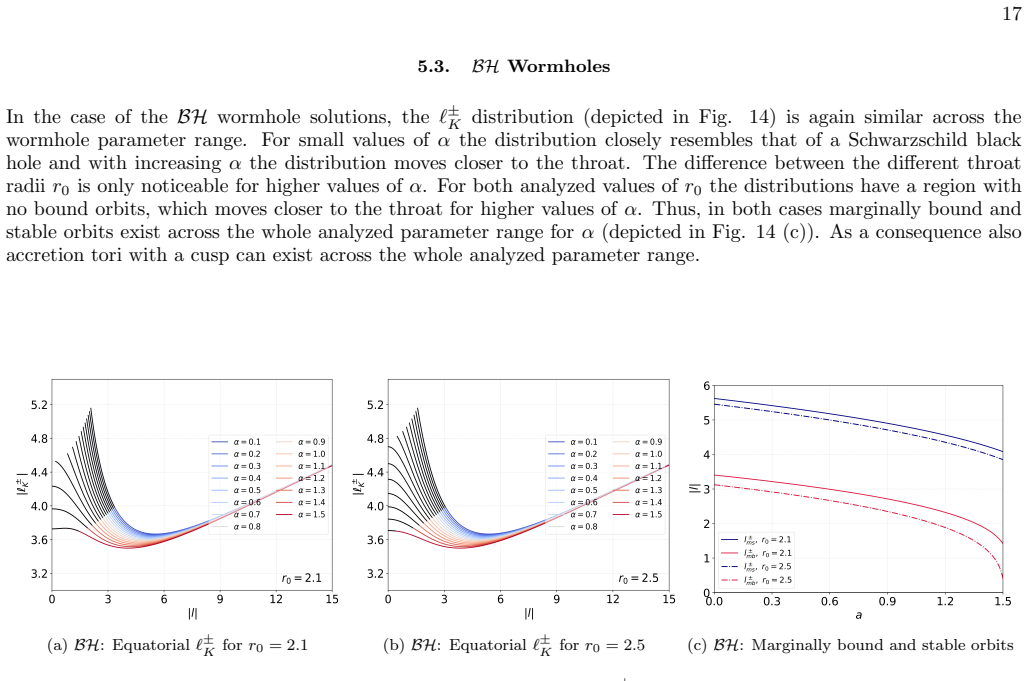
Since greater values for α are considered unphysical, we restrict our analyses to the interval α ∈ [0, 1.5]. 13 (a) BH: Throat orbits for r0 = 2.1 (b) BH: Throat orbits for r0 = 2.5 (c) BH: Exemplary disk solutions Fig. 8: (a) and (b) showcase the parameter space with regard t...
-
[9]
Flamm, Republication of: Contributions to einstein’s theory of gravitation, General Relativity and Gravitation 47 (2015)
L. Flamm, Republication of: Contributions to einstein’s theory of gravitation, General Relativity and Gravitation 47 (2015)
2015
-
[10]
Scholz, Hermann weyl’s raum - zeit - materie and a general introduction to his scientific work, Springer DMV Seminar 30 (2001)
E. Scholz, Hermann weyl’s raum - zeit - materie and a general introduction to his scientific work, Springer DMV Seminar 30 (2001)
2001
-
[11]
Einstein and N
A. Einstein and N. Rosen, The particle problem in the general theory of relativit, Physical Review 48, https://doi.org/10.1103/PhysRev.48.73 (1935)
1935 doi
-
[12]
R. W. Fuller and J. A. Wheeler, Causality and multiply connected space-time, Physical Review 128, https://doi.org/10.1103/PhysRev.128.919 (1962)
1962 doi
-
[13]
H. G. Ellis, Ether flow through a drainhole: A particle model in general relativity, Journal of Mathematical Physics 14, 104 (1973)
1973
-
[14]
K. A. Bronnikov, Scalar-tensor theory and scalar charge, Acta Physica Polonica B 4, 251 (1973)
1973
-
[15]
Visser, Traversable wormholes from surgically modified schwarzschild spacetimes, Nuclear Physics B 328, 203 (1989)
M. Visser, Traversable wormholes from surgically modified schwarzschild spacetimes, Nuclear Physics B 328, 203 (1989)
1989
-
[16]
Teo, Rotating traversable wormholes, Physical Review D 58, 10.1103/physrevd.58.024014 (1998)
E. Teo, Rotating traversable wormholes, Physical Review D 58, 10.1103/physrevd.58.024014 (1998)
1998 doi
-
[17]
J. G. Cramer et al. , Natural wormholes as gravitational lenses, Physical Review D 51, https://doi.org/10.1103/PhysRevD.51.3117 (1995)
1995 doi
-
[18]
mass without mass
E. Gravanis and S. Willison, “mass without mass” from thin shells in gauss-bonnet gravity, Phys. Rev. D 75, 084025 (2007)
2007
-
[19]
K. A. Bronnikov and A. M. Galiakhmetov, Wormholes without exotic matter in einstein–cartan theory, Gravitation and Cosmology 21, 283–288 (2015)
2015
-
[20]
J. L. Bl´ azquez-Salcedo, C. Knoll, and E. Radu, Traversable wormholes in einstein-dirac-maxwell theory, Physical Review Letters 126, 10.1103/physrevlett.126.101102 (2021)
2021 doi
-
[21]
Bakopoulos, C
A. Bakopoulos, C. Charmousis, and P. Kanti, Traversable wormholes in beyond horndeski theories, Journal of Cosmology and Astroparticle Physics 2022 (05), 022
2022
-
[22]
Mazza, E
J. Mazza, E. Franzin, and S. Liberati, A novel family of rotating black hole mimickers, Journal of Cosmology and As- troparticle Physics 2021 (04), 082
2021
-
[23]
P. G. Nedkova, V. K. Tinchev, and S. S. Yazadjiev, Shadow of a rotating traversable wormhole, Physical Review D 88, 10.1103/physrevd.88.124019 (2013)
2013 doi
-
[24]
Gyulchev, P
G. Gyulchev, P. Nedkova, V. Tinchev, and S. Yazadjiev, On the shadow of rotating traversable wormholes, Eur. Phys. J. C 78, 544 (2018), arXiv:1805.11591 [gr-qc]
2018 arXiv
-
[25]
Huang, J
H. Huang, J. Kunz, J. Yang, and C. Zhang, Light ring behind wormhole throat: Geodesics, images, and shadows, Physical Review D 107, 10.1103/physrevd.107.104060 (2023)
2023 doi
-
[26]
S. Paul, R. Shaikh, P. Banerjee, and T. Sarkar, Observational signatures of wormholes with thin accretion disks, Journal of Cosmology and Astroparticle Physics 2020 (03), 055–055. 20
2020
-
[27]
Deligianni, J
E. Deligianni, J. Kunz, P. Nedkova, S. Yazadjiev, and R. Zheleva, Quasiperiodic oscillations around rotating traversable wormholes, Phys. Rev. D 104, 024048 (2021), arXiv:2103.13504 [gr-qc]
2021 arXiv
-
[28]
Deligianni, B
E. Deligianni, B. Kleihaus, J. Kunz, P. Nedkova, and S. Yazadjiev, Quasiperiodic oscillations in rotating Ellis wormhole spacetimes, Phys. Rev. D 104, 064043 (2021), arXiv:2107.01421 [gr-qc]
2021 arXiv
-
[29]
Delijski, G
V. Delijski, G. Gyulchev, P. Nedkova, and S. Yazadjiev, Polarized image of equatorial emission in horizonless spacetimes: Traversable wormholes, Phys. Rev. D 106, 104024 (2022), arXiv:2206.09455 [gr-qc]
2022 arXiv
-
[31]
Abramowicz, M
M. Abramowicz, M. Jaroszynski, and M. Sikora, Relativistic, accreting disks., Astronomy and Astrophysics 63, 221 (1978)
1978
-
[32]
Kozlowski, M
M. Kozlowski, M. Jaroszynski, and M. A. Abramowicz, The analytic theory of fluid disks orbiting the Kerr black hole., Astronomy and Astrophysics 63, 209 (1978)
1978
-
[33]
M. A. Abramowicz, M. Calvani, and L. Nobili, Thick accretion disks with super-Eddington luminosities, Astrophys. J. 242, 772 (1980)
1980
-
[34]
Paczy´ nsky and P
B. Paczy´ nsky and P. J. Wiita, Thick Accretion Disks and Supercritical Luminosities, Astronomy and Astrophysics 88, 23 (1980)
1980
-
[35]
Paczynski and G
B. Paczynski and G. Bisnovatyi-Kogan, A Model of a Thin Accretion Disk around a Black Hole, Acta Astronomica 31, 283 (1981)
1981
-
[36]
Paczynski and M
B. Paczynski and M. A. Abramowicz, A model of a thick disk with equatorial accretion, Astrophys. J. 253, 897 (1982)
1982
-
[37]
Gjorgjieski, J
K. Gjorgjieski, J. Kunz, and P. Nedkova, Circular orbits and photon orbits at wormhole throats (2025), arXiv:2505.07507 [gr-qc]
2025 arXiv
Reviewed August 7, 2026 · model on record in the stance chip above.
Discussion (0). Sign in to comment.