REVIEW 4 major objections 4 minor 101 references
Exact Quantum Many-Body Scars in 2D Quantum Gauge Models
T0 review · 4 major / 4 minor · reviewed 2026-08-07 · deepseek-v4-flash
Pith's one-line read Applying the Kramers–Wannier duality operator to the 2D XY model's even-parity stripe states yields exact low-entanglement eigenstates — quantum many-body scars — in the dual $\mathbb{Z}_2$ lattice gauge theory.
desk verdict Sound exact construction of 2D XY scars and a duality transfer theorem; the abstract overreaches on the kagome/dice case. read the letter →
The pith
A machine-rendered reading of the paper's core claim, the machinery that carries it, and where it could break.
The reading
What carries the argument
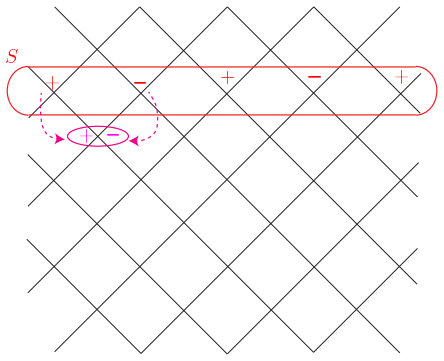
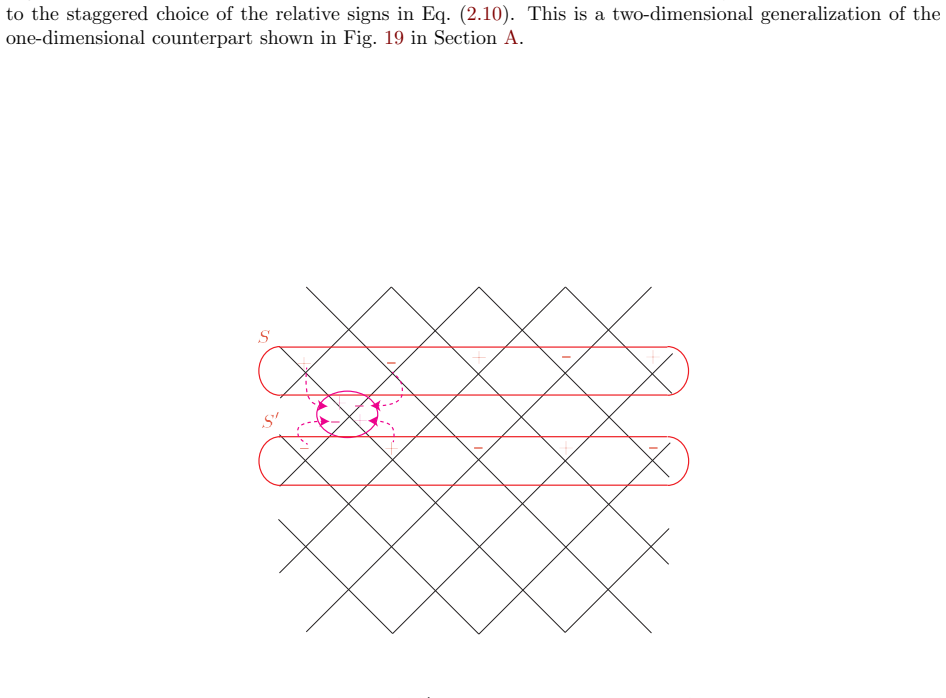
Two objects carry the argument. First, the stripe states: staggered superpositions of a single magnon along a straight row of sites, $Q^{\pm}_S |\Downarrow\rangle$ with signs alternating across the bipartite lattice; their defining property is the cancelation mechanism by which the XY exchange term's two hopping paths around each square cancel, so $H_{XY}$ annihilates them, and only straight, mutually nonadjacent stripes are allowed. Second, the duality operator $D$: a generalized Kramers–Wannier map (dual spins live on edges of the dual lattice) realized as a projected entangled-pair operator (PEPO) with isometries, satisfying the intertwining relations $D H_{XY} = H_{\rm dual} D$ and $D H_Z = H D$, the projector identity $D^{\dagger}D = I + \prod \sigma^z$, and $D$ annihilating odd-parity states. The scar transfer then follows from the isomorphism $D$ induces between the even $\mathbb{Z}_2$-parity sector of the XY model and the even 1-form-symmetry sector of the gauge theory; the area-law claim for the dual states rests on the assertion, in Sec. 3.2, that the PEPO is a low-depth tensor network operator that preserves area-law entanglement scaling.
What would settle it
A concrete check would be to compute the von Neumann entanglement entropy of the dual state $D|\{S_1,\dots,S_n\}\rangle$ for a half-system bipartition on the torus (or via tensor-network contraction of the PEPO on increasingly large lattices) and compare its growth with subsystem size. If the entropy scales with the volume of the subsystem rather than its boundary, the paper's identification of these states as quantum many-body scars of the $\mathbb{Z}_2$ gauge model fails, even though Eq. (3.5) would still guarantee they are exact eigenstates.
Extended reading notes
Core claim
The central discovery, stated on the paper's own terms, is that the exact quantum many-body scars of the two-dimensional spin-1/2 XY model survive the generalized Kramers–Wannier duality and become exact quantum many-body scars of the dual $\mathbb{Z}_2$ lattice gauge model. In the XY model, the states $|\{S_1,\dots,S_n\}\rangle_{\pm}$, superpositions of $n$ up-spins placed on nonadjacent straight stripes with staggered signs, are exact eigenstates because every hopping contribution that moves a magnon is cancelled by an opposite-sign contribution from the neighbouring site; they form a tower of states with energies $(2n-N)h$ relative to the all-down vacuum and with entanglement entropy computable stripe by stripe. Gauging the $\mathbb{Z}_2$ 0-form symmetry produces the dual gauge theory, and the duality operator $D$ obeys $D H_{XY} = H_{\rm dual} D$ together with the projection identity $D^{\dagger}D = I + \prod \sigma^z$, making the even-parity subsector of the XY model isomorphic to the even 1-form-symmetry sector of the gauge theory. Consequently $D|\{S_1,\dots,S_n\}\rangle_{\pm}$ with $n$ even is an exact eigenstate of the gauge model at the same energy; the paper argues, from the tensor-network (PEPO) implementation of $D$, that these states retain area-law entanglement and therefore qualify as quantum many-body scars. The same construction is carried out for the honeycomb/triangular and kagome/dice lattices, and for part of the XXZ-type deformation.
Load-bearing premise
The load-bearing premise is that the tensor-network operator implementing the duality preserves area-law entanglement when applied to the stripe states; the paper asserts this from the operator's 'low-depth' character in Sec. 3.2 but supplies no proof and no direct computation of the dual states' entanglement entropies, so if the dual states in fact acquire volume-law entanglement they remain exact eigenstates yet cease to be quantum many-body scars in the standard sense.
Editorial extensions
If this is right
- The dual $\mathbb{Z}_2$ gauge model acquires a tower of exact low-entanglement eigenstates at energies $2kh$ above the vacuum for $k$ up to $O(L)$ on the square lattice, placing scars squarely in the middle of a 2D gauge-theory spectrum.
- The construction repeats for the triangular and dice lattice gauge models, so the mechanism is lattice-independent rather than a square-lattice accident.
- Because the XY stripe states survive correlated disorder and inhomogeneous magnetic fields, the corresponding scars persist in disordered gauged models and can be given distinct energy labels for detection.
- The XY model itself provides experimentally plausible hosts (Rydberg arrays, strongly interacting bosons in optical lattices, superconducting circuits) where the stripes could be prepared and their slow thermalization probed.
- The gauging perspective suggests a general principle: gauging a subgroup of a global symmetry of a scarred model typically produces a scarred model, since gauging is implemented by a low-depth tensor network that preserves entanglement as long as the scars are not projected out.
Reading between the lines
- The one open link is the entanglement claim for the dual states, and it is directly testable: computing the half-system entanglement entropy of $D|\{S_1,\dots,S_n\}\rangle$ on larger lattices would confirm the area law, or, if the entropy instead grows with subsystem volume, the states would remain exact eigenstates while losing the standard scar characterization.
- A natural testable extension is to apply the same PEPO duality to other scarred lattice models with a $\mathbb{Z}_2$ symmetry — for instance the spin-1 XY model or the square-lattice Heisenberg scar candidates — and check whether their even-sector scars map to exact low-entanglement states of the corresponding gauge models.
- The stripe mechanism is a 2D relative of the one-dimensional four-state construction, but with a key quantitative difference: the number of scar states grows with system size ($O(L)$ on the square lattice, exponentially on the kagome lattice), so the paper effectively constructs a scarred subspace whose dimension is large yet still exponentially smaller than the full Hilbert space.
- Since the dual Hamiltonian sits at the critical point between trivial and SPT phases in the pivot-Hamiltonian family, the scar states live in a gapless gauge theory with a (2+1)-dimensional CFT limit; a dynamical probe, such as a quench starting from $D|S\rangle$, would test whether the scars produce the slow revivals characteristic of scar physics in an experimentally realisable gauge setting.
Editorial analysis
A structured set of objections, weighed in public.
Referee Report
Summary. The paper constructs a family of exact energy eigenstates of the two-dimensional spin-1/2 XY model on tilted square, honeycomb, and kagome lattices, built from staggered superpositions of magnons along non-bending stripes or around hexagons. It proves, by direct commutator cancellation, that these states are exact eigenstates with zero XY energy, and it computes their entanglement entropies and identifies them as quantum many-body scars (QMBS). The paper then gauges the Z2 0-form symmetry through a Kramers-Wannier duality implemented as a PEPO, derives the intertwining relation D H_XY = H_dual D (Eq. 3.5), and maps even-number stripe states to exact eigenstates of the dual Z2 lattice-gauge model. The construction is extended to honeycomb/triangular and kagome/dice lattices, with an appendix treating the XXZ extension.
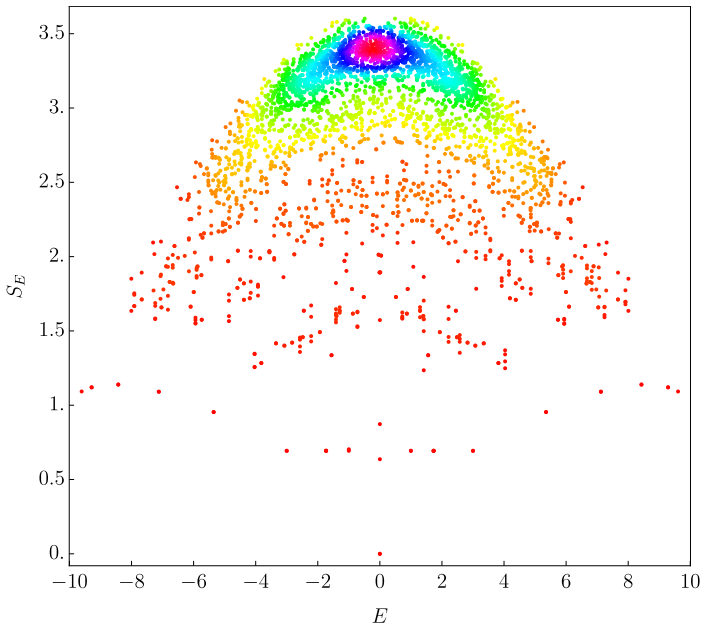
Significance. If the advertised claims hold, the paper provides rare examples of exact QMBS in two-dimensional spin and gauge models, with several strong technical assets: the algebraic proof in Appendix D is self-contained and parameter-free; the intertwining relation (3.5) is exact and clean; the disorder generalization and inhomogeneous-field bookkeeping are explicit; and the 12-site numerical entanglement spectra in Fig. 8 support the existence of low-entanglement eigenstates. The honeycomb/triangular construction appears to be a solid extension of the square-lattice mechanism. However, the paper's significance is reduced by a scope mismatch between the abstract and the body: the kagome/dice states are explicitly not QMBS in the homogeneous model by the paper's own criterion, and the 'middle of the spectrum' characterization for the square-lattice stripe states is not supported by the stated counting. These issues are fixable in revision, and I do not see a fatal flaw in the core algebraic derivation.
major comments (4)
- [Abstract; §5.1] The abstract's unconditional claim that 'the exact QMBS of the XY model (and XXZ model) after the transformation are the exact QMBS of the dual Z2 gauge model' is contradicted by §5.1, which explicitly states that the kagome hexagon states are ground states in fixed down-spin sectors and that 'interpreting these eigenstates as QMBS is not appropriate, since their energies are no longer located in the middle of the spectrum.' Section 5.2 only establishes that the dual dice-lattice states are exact eigenstates when the number of excitations is even. The advertised claim should be restricted to the square and honeycomb/triangular constructions, with the kagome/dice results presented as exact-eigenstate candidates rather than established QMBS.
- [§5.2] The proposed promotion of the kagome/dice states to QMBS by inhomogeneous magnetic fields is not carried out. The text says that 'these states can be promoted to QMBS by adding inhomogeneous magnetic fields designed to shift their energies,' but no explicit dice-lattice Hamiltonian with such fields is written, no proof is given that the corresponding dual fields preserve the eigenstate property under the duality operator, and no energy-shift calculation is supplied. Until this construction is provided, the claim that the dual dice-lattice states are QMBS remains unsupported.
- [§2.2] The statement at the end of §2.2 that the stripe states 'reside in the middle of the energy spectrum' does not follow from the preceding counting. For N = 2L^2 sites and k = O(L) stripes, the energy is E = h(2k - N) = -hN + O(L), so E/N → -h as L → ∞. Since the full Hamiltonian is invariant under the global spin flip that sends H_Z to -H_Z, the spectral center is near E = 0, making these states near the bottom of the spectrum rather than in the middle. This point is load-bearing for the QMBS identification, and the manuscript should either revise the energy-location argument or clarify which definition of 'middle of the spectrum' is being used.
- [§3.2] The assertion that the PEPO realization of the duality operator 'guarantees that it preserves the area-law scaling of entanglement entropy' is made without proof. This is not a fatal gap: the duality operator in Eq. (3.3) is a fixed-bond-dimension tensor network, and applying it to the stripe states, whose entanglement across any cut is controlled by the stripe-crossing fraction, should preserve area-law scaling. However, the paper should spell out this argument explicitly and, ideally, verify it by a direct computation of the entanglement entropy of D|S> for a small system, rather than relying on the ambiguous phrase 'low-depth tensor network operator.'
minor comments (4)
- [Appendix C] In Eq. (C.1), the fourth scar creation operator is written as Q±_{H3} twice; from the subsequent energy expressions it should be Q±_{V3}.
- [§2.3] In the paragraph following Eq. (2.19), the sentence defining N^{(A)}_{S_n} repeats 'N^{(A)}_{S_n}' twice; the second occurrence should presumably be N^{(B)}_{S_n}.
- [References] References [59] and [82] are the same paper (Lootens, Delcamp, Ortiz, Verstraete, PRX Quantum 4, 020357), and references [70] and [96] are the same arXiv preprint (arXiv:2501.12514); these duplicates should be consolidated.
- [§3.2] The phrase 'low-depth tensor network operator' is not defined in the text; since the PEPO in Eq. (3.3) is a fixed-bond-dimension tensor network, describing it in those terms rather than as a circuit would be clearer and would avoid implying a finite-depth unitary implementation.
Circularity Check
No significant circularity: the stripe eigenstates and their dual images follow from direct commutator identities and an operator intertwining relation, not from fitted inputs or self-citation.
full rationale
I find no circular step. The exact stripe eigenstates of the XY model are derived by an explicit commutator calculation (Eqs. 2.13-2.14): the hopping terms cancel pairwise because of the staggered sign choice, and the total energy is set by the U(1) magnetic-field term. Multiple-stripe states are obtained by applying commuting creation operators, and the energy eigenvalues are computed from H_Z, not fitted. The random disorder and inhomogeneous magnetic fields are introduced after the construction to split degeneracies and to allow numerical identification; they are not used to adjust the spectral position or entanglement of the scar states. The dual gauge model is not defined by demanding that D|S> be eigenstates; it is the image of the full XY Hamiltonian under the Kramers-Wannier/PEPO duality, and the relation D H_XY = H_double D (Eq. 3.5) is an operator identity. Therefore, if |S> is an eigenstate of H_XY with energy E, then D|S> is an eigenstate of H_double with the same energy, by direct substitution. The only questionable step is the unproven assertion in Sec. 3.2 that the PEPO is a low-depth tensor network operator preserving area-law entanglement; that is a missing proof or a correctness concern, not a circular argument. Self-citations such as [13] for the entanglement-entropy formula and [83] for the Bilinear Phase Map form are used for standard repackaging and are not load-bearing. The abstract's general claim about the kagome/dice case is in tension with Sec. 5.1's explicit caveat that the hexagon eigenstates are not in the middle of the spectrum and hence are not appropriately called QMBS, but this is a scope/overclaim issue, not circularity.
Assumptions & free parameters
assumptions (5)
- ad hoc to paper Only straight, non-bending stripes yield exact eigenstates; bending stripes break the cancellation.
- ad hoc to paper The correlated disorder couplings satisfy recursion (2.24) and boundary condition (2.25).
- ad hoc to paper The duality operator D is a low-depth PEPO preserving area-law entanglement.
- domain assumption The XY model in 2D has no nontrivial local conserved quantities, hence is non-integrable.
- ad hoc to paper On the honeycomb lattice, two sub-stripes must be combined into thick stripes with relative sign k = ±1 to complete cancellation.
Cite this review
Pith. "Pith review of Exact Quantum Many-Body Scars in 2D Quantum Gauge Models." pith.science (2026). https://pith.science/paper/I674IXJV
@misc{pith2026250521921,
  author       = {Pith},
  title        = {Pith review of: Exact Quantum Many-Body Scars in 2D Quantum Gauge Models},
  year         = {2026},
  howpublished = {\url{https://pith.science/paper/I674IXJV}},
  note         = {Machine review of arXiv:2505.21921}
}
abstract
Quantum many-body scars (QMBS) serve as important examples of ergodicity-breaking phenomena in quantum many-body systems. Despite recent extensive studies, exact QMBS are rare in dimensions higher than one. In this paper, we study a two-dimensional quantum $\mathbb{Z}_2$ gauge model that is dual to a two-dimensional spin-$1/2$ XY model defined on bipartite graphs. We identify the exact eigenstates of the XY model with a tower structure as exact QMBS. Exploiting the duality transformation, we show that the exact QMBS of the XY model (and XXZ model) after the transformation are the exact QMBS of the dual $\mathbb{Z}_2$ gauge model. This construction is versatile and has potential applications for finding new QMBS in other higher-dimensional models.
Figures


Figures from the paper (16 more)




Reference graph
Works this paper leans on
-
[1]
Quantum statistical mechanics in a closed system,
J. M. Deutsch, “Quantum statistical mechanics in a closed system,”Phys. Rev. A43(Feb, 1991) 2046–2049.https://link.aps.org/doi/10.1103/PhysRevA.43.2046
-
[2]
Chaos and quantum thermalization,
M. Srednicki, “Chaos and quantum thermalization,”Phys. Rev. E50(Aug, 1994) 888–901. https://link.aps.org/doi/10.1103/PhysRevE.50.888
-
[3]
Proof of the ergodic theorem and the H-theorem in quantum mechanics,
J. von Neumann, “Proof of the ergodic theorem and the H-theorem in quantum mechanics,”Eur. Phys. J. H35no. 2, (2010) 201–237.https://doi.org/10.1140/epjh/e2010-00008-5. [English translation of (by R. Tumulka) Z. Phys.57, 30 (1929)]
-
[4]
From quantum chaos and eigenstate thermalization to statistical mechanics and thermodynamics,
L. D’Alessio, Y. Kafri, A. Polkovnikov, and M. Rigol, “From quantum chaos and eigenstate thermalization to statistical mechanics and thermodynamics,”Adv. Phys.65no. 3, (2016) 239–362, arXiv:1509.06411 [cond-mat.stat-mech]
arXiv 2016
-
[5]
Weak ergodicity breaking from quantum many-body scars,
C. J. Turner, A. A. Michailidis, D. A. Abanin, M. Serbyn, and Z. Papi´ c, “Weak ergodicity breaking from quantum many-body scars,”Nature Physics14no. 7, (May, 2018) 745–749. http://dx.doi.org/10.1038/s41567-018-0137-5
-
[6]
C. J. Turner, A. A. Michailidis, D. A. Abanin, M. Serbyn, and Z. Papi´ c, “Quantum scarred eigenstates in a Rydberg atom chain: Entanglement, breakdown of thermalization, and stability to perturbations,”Physical Review B98no. 15, (Oct., 2018) 155134. http://dx.doi.org/10.1103/PhysRevB.98.155134
-
[7]
Quantum many-body scars and weak breaking of ergodicity,
M. Serbyn, D. A. Abanin, and Z. Papi´ c, “Quantum many-body scars and weak breaking of ergodicity,”Nature Phys.17no. 6, (2021) 675–685,arXiv:2011.09486 [quant-ph]
arXiv 2021
-
[8]
Quantum many-body scars and Hilbert space fragmentation: a review of exact results,
S. Moudgalya, B. A. Bernevig, and N. Regnault, “Quantum many-body scars and Hilbert space fragmentation: a review of exact results,”Rept. Prog. Phys.85no. 8, (2022) 086501, arXiv:2109.00548 [cond-mat.str-el]
arXiv 2022
Show all 101 references
-
[9]
Quantum Many-Body Scars: A Quasiparticle Perspective,
A. Chandran, T. Iadecola, V. Khemani, and R. Moessner, “Quantum Many-Body Scars: A Quasiparticle Perspective,”Annu. Rev. Condens. Matter Phys.14no. 1, (2023) 443–469, arXiv:2206.11528 [cond-mat.str-el]. https://doi.org/10.1146/annurev-conmatphys-031620-101617
2023 arXiv
-
[10]
Flat band quantum scar,
Y. Kuno, T. Mizoguchi, and Y. Hatsugai, “Flat band quantum scar,”Physical Review B102no. 24, (Dec., 2020) 241115.http://dx.doi.org/10.1103/PhysRevB.102.241115
2020 doi
-
[11]
Emergence of Hilbert Space Fragmentation in Ising Models with a Weak Transverse Field,
A. Yoshinaga, H. Hakoshima, T. Imoto, Y. Matsuzaki, and R. Hamazaki, “Emergence of Hilbert Space Fragmentation in Ising Models with a Weak Transverse Field,”Phys. Rev. Lett.129no. 9, (2022) 090602,arXiv:2111.05586 [cond-mat.stat-mech]
2022 arXiv
-
[12]
Weak Ergodicity Breaking and Quantum Many-Body Scars in Spin-1 XY Magnets,
M. Schecter and T. Iadecola, “Weak Ergodicity Breaking and Quantum Many-Body Scars in Spin-1 XY Magnets,”Phys. Rev. Lett.123no. 14, (2019) 147201,arXiv:1906.10131 [cond-mat.str-el]. 33
2019 arXiv
-
[13]
Quantum many-body scars in spin models with multibody interactions,
K. Sanada, Y. Miao, and H. Katsura, “Quantum many-body scars in spin models with multibody interactions,”Phys. Rev. B108no. 15, (2023) 155102,arXiv:2304.13624 [cond-mat.str-el]
2023 arXiv
-
[14]
Towers of Quantum Many-body Scars from Integrable Boundary States,
K. Sanada, Y. Miao, and H. Katsura, “Towers of Quantum Many-body Scars from Integrable Boundary States,”arXiv:2411.01270 [cond-mat.stat-mech]
-
[15]
Quantum many-body scar states in two-dimensional Rydberg atom arrays,
C.-J. Lin, V. Calvera, and T. H. Hsieh, “Quantum many-body scar states in two-dimensional Rydberg atom arrays,”Phys. Rev. B101(Jun, 2020) 220304. https://link.aps.org/doi/10.1103/PhysRevB.101.220304
2020 doi
-
[16]
Quantum many-body scars of spinless fermions with density-assisted hopping in higher dimensions,
K. Tamura and H. Katsura, “Quantum many-body scars of spinless fermions with density-assisted hopping in higher dimensions,”Phys. Rev. B106no. 14, (2022) 144306,arXiv:2207.06040 [quant-ph].https://doi.org/10.1103/PhysRevB.106.144306
2022 arXiv
-
[17]
Scars from protected zero modes and beyond inU(1) quantum link and quantum dimer models,
S. Biswas, D. Banerjee, and A. Sen, “Scars from protected zero modes and beyond inU(1) quantum link and quantum dimer models,”SciPost Phys.12no. 5, (2022) 148,arXiv:2202.03451 [cond-mat.str-el].https://www.scipost.org/SciPostPhys.12.5.148
2022 arXiv
-
[18]
Quantum Many-Body Scarring in 2 + 1D Gauge Theories with Dynamical Matter,
J. Osborne, I. P. McCulloch, and J. C. Halimeh, “Quantum Many-Body Scarring in 2 + 1D Gauge Theories with Dynamical Matter,”arXiv:2403.08858 [cond-mat.quant-gas]
-
[19]
Stabilizer Scars,
J. Hartse, L. Fidkowski, and N. Mueller, “Stabilizer Scars,”arXiv:2411.12797 [quant-ph]
-
[20]
Disorder-free localization and many-body quantum scars from magnetic frustration,
P. A. McClarty, M. Haque, A. Sen, and J. Richter, “Disorder-free localization and many-body quantum scars from magnetic frustration,”Phys. Rev. B102no. 22, (2020) 224303, arXiv:2007.01311 [cond-mat.stat-mech].https://doi.org/10.1103/PhysRevB.102.224303
2020 arXiv
-
[21]
Exact Valence-Bond Solid Scars in the Square-Lattice Heisenberg Model,
D. D. Dai, “Exact Valence-Bond Solid Scars in the Square-Lattice Heisenberg Model,” arXiv:2412.08874 [cond-mat.str-el]
-
[22]
The Bond-Algebraic Approach to Dualities,
E. Cobanera, G. Ortiz, and Z. Nussinov, “The Bond-Algebraic Approach to Dualities,”Adv. Phys.60 (2011) 679–798,arXiv:1103.2776 [cond-mat.stat-mech]
2011 arXiv
-
[23]
An introduction to lattice gauge theory and spin systems,
J. B. Kogut, “An introduction to lattice gauge theory and spin systems,”Rev. Mod. Phys.51(Oct,
-
[24]
Ferromagnetism in the Hubbard model with topological/non-topological flat bands,
H. Katsura, I. Maruyama, A. Tanaka, and H. Tasaki, “Ferromagnetism in the Hubbard model with topological/non-topological flat bands,”Europhys. Lett.91no. 5, (2010) 57007,arXiv:0907.4564 [cond-mat.str-el].https://dx.doi.org/10.1209/0295-5075/91/57007
2010 arXiv
-
[25]
Generalized spin helix states in quantum spin graphs,
C. H. Zhang, Y. B. Shi, and Z. Song, “Generalized spin helix states in quantum spin graphs,”Phys. Scripta100no. 3, (2025) 035912,arXiv:2310.11786 [quant-ph]
2025 arXiv
-
[26]
All product eigenstates in Heisenberg models from a graphical construction,
F. Gerken, I. Runkel, C. Schweigert, and T. Posske, “All product eigenstates in Heisenberg models from a graphical construction,”Phys. Rev. Res.7no. 1, (2025) L012008,arXiv:2310.13158 [cond-mat.str-el]
2025 arXiv
-
[27]
Exact volume-law entangled zero-energy eigenstates in a large class of spin models,
S. Mohapatra, S. Moudgalya, and A. C. Balram, “Exact volume-law entangled zero-energy eigenstates in a large class of spin models,”Phys. Rev. Lett.134no. 21, (2025) 210403,arXiv:2410.22773 [cond-mat.str-el].https://doi.org/10.1103/PhysRevLett.134.210403
2025 arXiv
-
[28]
TheS= 1 2 XY and XYZ models on the two or higher dimensional hypercubic lattice do not possess nontrivial local conserved quantities,
N. Shiraishi and H. Tasaki, “TheS= 1 2 XY and XYZ models on the two or higher dimensional hypercubic lattice do not possess nontrivial local conserved quantities,”arXiv:2412.18504 [cond-mat.stat-mech]
-
[29]
Kramers-wannier duality from conformal defects,
J. Fr¨ ohlich, J. Fuchs, I. Runkel, and C. Schweigert, “Kramers-wannier duality from conformal defects,”Phys. Rev. Lett.93(Aug, 2004) 070601. https://link.aps.org/doi/10.1103/PhysRevLett.93.070601
2004 doi
-
[30]
Duality and defects in rational conformal field theory,
J. Frohlich, J. Fuchs, I. Runkel, and C. Schweigert, “Duality and defects in rational conformal field theory,”Nucl. Phys. B763(2007) 354–430,arXiv:hep-th/0607247. 34
2007 arXiv
-
[31]
On finite symmetries and their gauging in two dimensions,
L. Bhardwaj and Y. Tachikawa, “On finite symmetries and their gauging in two dimensions,”JHEP 03(2018) 189,arXiv:1704.02330 [hep-th]
2018 arXiv
-
[32]
Topological Defects on the Lattice I: The Ising model,
D. Aasen, R. S. K. Mong, and P. Fendley, “Topological Defects on the Lattice I: The Ising model,”J. Phys. A49no. 35, (2016) 354001,arXiv:1601.07185 [cond-mat.stat-mech]
2016 arXiv
-
[33]
Topological Defects on the Lattice: Dualities and Degeneracies,
D. Aasen, P. Fendley, and R. S. K. Mong, “Topological Defects on the Lattice: Dualities and Degeneracies,”arXiv:2008.08598 [cond-mat.stat-mech]
2008 arXiv
-
[34]
Algebraic higher symmetry and categorical symmetry: A holographic and entanglement view of symmetry,
L. Kong, T. Lan, X.-G. Wen, Z.-H. Zhang, and H. Zheng, “Algebraic higher symmetry and categorical symmetry: A holographic and entanglement view of symmetry,”Phys. Rev. Res.2(Oct, 2020) 043086.https://link.aps.org/doi/10.1103/PhysRevResearch.2.043086
2020 doi
-
[35]
Classification of topological phases with finite internal symmetries in all dimensions,
L. Kong, T. Lan, X.-G. Wen, Z.-H. Zhang, and H. Zheng, “Classification of topological phases with finite internal symmetries in all dimensions,”JHEP09(2020) 093,arXiv:2003.08898 [math-ph]
2020 arXiv
-
[36]
Defect lines, dualities, and generalised orbifolds,
J. Frohlich, J. Fuchs, I. Runkel, and C. Schweigert, “Defect lines, dualities, and generalised orbifolds,” in16th International Congress on Mathematical Physics. 9, 2009.arXiv:0909.5013 [math-ph]
2009 arXiv
-
[37]
Kramers-wannier-like duality defects in (3 + 1)dgauge theories,
J. Kaidi, K. Ohmori, and Y. Zheng, “Kramers-wannier-like duality defects in (3 + 1)dgauge theories,” Phys. Rev. Lett.128(Mar, 2022) 111601. https://link.aps.org/doi/10.1103/PhysRevLett.128.111601
2022 doi
-
[38]
Symmetry TFTs for Non-invertible Defects,
J. Kaidi, K. Ohmori, and Y. Zheng, “Symmetry TFTs for Non-invertible Defects,”Commun. Math. Phys.404no. 2, (2023) 1021–1124,arXiv:2209.11062 [hep-th]
2023 arXiv
-
[39]
Non-invertible symmetries ofN= 4 SYM and twisted compactification,
J. Kaidi, G. Zafrir, and Y. Zheng, “Non-invertible symmetries ofN= 4 SYM and twisted compactification,”JHEP08(2022) 053,arXiv:2205.01104 [hep-th]
2022 arXiv
-
[40]
Fermionic minimal models,
C.-T. Hsieh, Y. Nakayama, and Y. Tachikawa, “Fermionic minimal models,”Phys. Rev. Lett.126 (May, 2021) 195701.https://link.aps.org/doi/10.1103/PhysRevLett.126.195701
2021 doi
-
[41]
Open spin chain realization of a topological defect in a one-dimensional ising model: Boundary and bulk symmetry,
Y. Fukusumi and S. Iino, “Open spin chain realization of a topological defect in a one-dimensional ising model: Boundary and bulk symmetry,”Phys. Rev. B104(Sep, 2021) 125418. https://link.aps.org/doi/10.1103/PhysRevB.104.125418
2021 doi
-
[42]
Fermionization and boundary states in 1+1 dimensions,
Y. Fukusumi, Y. Tachikawa, and Y. Zheng, “Fermionization and boundary states in 1+1 dimensions,” SciPost Phys.11(2021) 082.https://scipost.org/10.21468/SciPostPhys.11.4.082
2021 doi
-
[43]
Topological Defect Lines in Two Dimensional Fermionic CFTs,
C.-M. Chang, J. Chen, and F. Xu, “Topological Defect Lines in Two Dimensional Fermionic CFTs,” SciPost Phys.15(2023) 216,arXiv:2208.02757 [hep-th]
2023 arXiv
-
[44]
Topological holography: Towards a unification of Landau and beyond-Landau physics,
H. Moradi, S. F. Moosavian, and A. Tiwari, “Topological holography: Towards a unification of Landau and beyond-Landau physics,”SciPost Phys. Core6(2023) 066,arXiv:2207.10712 [cond-mat.str-el]
2023 arXiv
-
[45]
Non-invertible higher-categorical symmetries,
L. Bhardwaj, L. E. Bottini, S. Schafer-Nameki, and A. Tiwari, “Non-invertible higher-categorical symmetries,”SciPost Phys.14no. 1, (2023) 007,arXiv:2204.06564 [hep-th]
2023 arXiv
-
[46]
Universal Non-Invertible Symmetries,
L. Bhardwaj, S. Schafer-Nameki, and J. Wu, “Universal Non-Invertible Symmetries,”Fortsch. Phys. 70no. 11, (2022) 2200143,arXiv:2208.05973 [hep-th]
2022 arXiv
-
[47]
Non-invertible Symmetries and Higher Representation Theory I,
T. Bartsch, M. Bullimore, A. E. V. Ferrari, and J. Pearson, “Non-invertible Symmetries and Higher Representation Theory I,”arXiv:2208.05993 [hep-th]
-
[48]
Unifying constructions of non-invertible symmetries,
L. Bhardwaj, S. Schafer-Nameki, and A. Tiwari, “Unifying constructions of non-invertible symmetries,”SciPost Phys.15no. 3, (2023) 122,arXiv:2212.06159 [hep-th]
2023 arXiv
-
[49]
Higher categorical symmetries and gauging in two-dimensional spin systems,
C. Delcamp and A. Tiwari, “Higher categorical symmetries and gauging in two-dimensional spin systems,”SciPost Phys.16(2024) 110.https://scipost.org/10.21468/SciPostPhys.16.4.110. 35
2024 doi
-
[50]
Categorical symmetry of the standard model from gravitational anomaly,
P. Putrov and J. Wang, “Categorical symmetry of the standard model from gravitational anomaly,” Phys. Rev. D110(Dec, 2024) 125028.https://link.aps.org/doi/10.1103/PhysRevD.110.125028
2024 doi
-
[51]
When are Duality Defects Group-Theoretical?,
Z. Sun and Y. Zheng, “When are Duality Defects Group-Theoretical?,”arXiv:2307.14428 [hep-th]
-
[52]
Generalized symmetries in singularity-free nonlinear σmodels and their disordered phases,
S. D. Pace, C. Zhu, A. Beaudry, and X.-G. Wen, “Generalized symmetries in singularity-free nonlinear σmodels and their disordered phases,”Phys. Rev. B110(Nov, 2024) 195149. https://link.aps.org/doi/10.1103/PhysRevB.110.195149
2024 doi
-
[53]
Noninvertible symmetry-protected topological order in a group-based cluster state,
C. Fechisin, N. Tantivasadakarn, and V. V. Albert, “Noninvertible symmetry-protected topological order in a group-based cluster state,”Phys. Rev. X15(Mar, 2025) 011058. https://link.aps.org/doi/10.1103/PhysRevX.15.011058
2025 doi
-
[54]
Lattice realizations of topological defects in the critical (1+1)-d three-state Potts model,
M. Sinha, F. Yan, L. Grans-Samuelsson, A. Roy, and H. Saleur, “Lattice realizations of topological defects in the critical (1+1)-d three-state Potts model,”JHEP07(2024) 225,arXiv:2310.19703 [hep-th]
2024 arXiv
-
[55]
What’s Done Cannot Be Undone: TASI Lectures on Non-Invertible Symmetries,
S.-H. Shao, “What’s Done Cannot Be Undone: TASI Lectures on Non-Invertible Symmetries,” arXiv:2308.00747 [hep-th]
-
[56]
Self-duality under gauging a non-invertible symmetry,
Y. Choi, D.-C. Lu, and Z. Sun, “Self-duality under gauging a non-invertible symmetry,”JHEP01 (2024) 142,arXiv:2310.19867 [hep-th]
2024 arXiv
-
[57]
Emergent generalized symmetries in ordered phases and applications to quantum disordering,
S. D. Pace, “Emergent generalized symmetries in ordered phases and applications to quantum disordering,”SciPost Phys.17no. 3, (2024) 080,arXiv:2308.05730 [cond-mat.str-el]
2024 arXiv
-
[58]
Fusion surface models: 2+1d lattice models from fusion 2-categories,
K. Inamura and K. Ohmori, “Fusion surface models: 2+1d lattice models from fusion 2-categories,” SciPost Phys.16(2024) 143,arXiv:2305.05774 [cond-mat.str-el]
2024 arXiv
-
[59]
Dualities in one-dimensional quantum lattice models: Symmetric hamiltonians and matrix product operator intertwiners,
L. Lootens, C. Delcamp, G. Ortiz, and F. Verstraete, “Dualities in one-dimensional quantum lattice models: Symmetric hamiltonians and matrix product operator intertwiners,”PRX Quantum4(Jun,
-
[60]
Duality, criticality, anomaly, and topology in quantum spin-1 chains,
H. Yang, L. Li, K. Okunishi, and H. Katsura, “Duality, criticality, anomaly, and topology in quantum spin-1 chains,”Phys. Rev. B107(Mar, 2023) 125158. https://link.aps.org/doi/10.1103/PhysRevB.107.125158
2023 doi
-
[61]
Noninvertible duality transformation between symmetry-protected topological and spontaneous symmetry breaking phases,
L. Li, M. Oshikawa, and Y. Zheng, “Noninvertible duality transformation between symmetry-protected topological and spontaneous symmetry breaking phases,”Phys. Rev. B108(Dec,
-
[62]
Subsystem non-invertible symmetry operators and defects,
W. Cao, L. Li, M. Yamazaki, and Y. Zheng, “Subsystem non-invertible symmetry operators and defects,”SciPost Phys.15no. 4, (2023) 155,arXiv:2304.09886 [cond-mat.str-el]
2023 arXiv
-
[63]
Intrinsically/purely gapless-SPT from non-invertible duality transformations,
L. Li, M. Oshikawa, and Y. Zheng, “Intrinsically/purely gapless-SPT from non-invertible duality transformations,”SciPost Phys.18(2025) 153. https://scipost.org/10.21468/SciPostPhys.18.5.153
2025 doi
-
[64]
214429.https://link.aps.org/doi/10.1103/PhysRevB.108.214429
-
[65]
Majorana chain and Ising model – (non-invertible) translations, anomalies, and emanant symmetries,
N. Seiberg and S.-H. Shao, “Majorana chain and Ising model – (non-invertible) translations, anomalies, and emanant symmetries,”SciPost Phys.16(2024) 064,arXiv:2307.02534 [cond-mat.str-el]
2024 arXiv
-
[66]
Generating lattice non-invertible symmetries,
W. Cao, L. Li, and M. Yamazaki, “Generating lattice non-invertible symmetries,”SciPost Phys.17 no. 4, (2024) 104,arXiv:2406.05454 [cond-mat.str-el]
2024 arXiv
-
[67]
Non-invertible symmetries and LSM-type constraints on a tensor product Hilbert space,
N. Seiberg, S. Seifnashri, and S.-H. Shao, “Non-invertible symmetries and LSM-type constraints on a tensor product Hilbert space,”SciPost Phys.16(2024) 154,arXiv:2401.12281 [cond-mat.str-el]
2024 arXiv
-
[68]
Noninvertible Symmetries Act Locally by Quantum Operations,
M. Okada and Y. Tachikawa, “Noninvertible Symmetries Act Locally by Quantum Operations,”Phys. Rev. Lett.133(Nov, 2024) 191602.https://link.aps.org/doi/10.1103/PhysRevLett.133.191602
2024 doi
-
[69]
Noninvertible Symmetry-Enriched Quantum Critical Point,
L. Li, R.-Z. Huang, and W. Cao, “Noninvertible Symmetry-Enriched Quantum Critical Point,” arXiv:2411.19034 [cond-mat.str-el]
-
[70]
Realizing triality andp-ality by lattice twisted gauging in (1+1)d quantum spin systems,
D.-C. Lu, Z. Sun, and Y.-Z. You, “Realizing triality andp-ality by lattice twisted gauging in (1+1)d quantum spin systems,”SciPost Phys.17(2024) 136. https://scipost.org/10.21468/SciPostPhys.17.5.136. 36
2024 doi
-
[71]
Gauging non-invertible symmetries on the lattice,
S. Seifnashri, S.-H. Shao, and X. Yang, “Gauging non-invertible symmetries on the lattice,” arXiv:2503.02925 [cond-mat.str-el]
-
[72]
Duality in Generalized Ising Models and Phase Transitions Without Local Order Parameters,
F. J. Wegner, “Duality in Generalized Ising Models and Phase Transitions Without Local Order Parameters,”J. Math. Phys.12(1971) 2259–2272
1971
-
[74]
Gauging quantum states: From global to local symmetries in many-body systems,
J. Haegeman, K. Van Acoleyen, N. Schuch, J. I. Cirac, and F. Verstraete, “Gauging quantum states: From global to local symmetries in many-body systems,”Phys. Rev. X5(Feb, 2015) 011024. https://link.aps.org/doi/10.1103/PhysRevX.5.011024
2015 doi
-
[75]
Higher Gauging and Non-invertible Condensation Defects,
K. Roumpedakis, S. Seifnashri, and S.-H. Shao, “Higher Gauging and Non-invertible Condensation Defects,”Commun. Math. Phys.401no. 3, (2023) 3043–3107,arXiv:2204.02407 [hep-th]
2023 arXiv
-
[76]
Pivot Hamiltonians as generators of symmetry and entanglement,
N. Tantivasadakarn, R. Thorngren, A. Vishwanath, and R. Verresen, “Pivot Hamiltonians as generators of symmetry and entanglement,”SciPost Phys.14no. 2, (2023) 012,arXiv:2110.07599 [cond-mat.str-el]
2023 arXiv
-
[77]
Gapless symmetry-protected topological phases and generalized deconfined critical points from gauging a finite subgroup,
L. Su and M. Zeng, “Gapless symmetry-protected topological phases and generalized deconfined critical points from gauging a finite subgroup,”Phys. Rev. B109(Jun, 2024) 245108. https://link.aps.org/doi/10.1103/PhysRevB.109.245108
2024 doi
-
[78]
Gapped Phases in (2+1)d with Non-Invertible Symmetries: Part II,
L. Bhardwaj, S. Schafer-Nameki, A. Tiwari, and A. Warman, “Gapped Phases in (2+1)d with Non-Invertible Symmetries: Part II,”arXiv:2502.20440 [hep-th]
-
[79]
Non-invertible and higher-form symmetries in 2+1d lattice gauge theories,
Y. Choi, Y. Sanghavi, S.-H. Shao, and Y. Zheng, “Non-invertible and higher-form symmetries in 2+1d lattice gauge theories,”SciPost Phys.18(2025) 008. https://scipost.org/10.21468/SciPostPhys.18.1.008
2025 doi
-
[80]
Building models of topological quantum criticality from pivot Hamiltonians,
N. Tantivasadakarn, R. Thorngren, A. Vishwanath, and R. Verresen, “Building models of topological quantum criticality from pivot Hamiltonians,”SciPost Phys.14(2023) 013. https://scipost.org/10.21468/SciPostPhys.14.2.013
2023 doi
-
[81]
Application of spin-wave theory to the ground state of xy quantum hamiltonians,
G. Gomez-Santos and J. D. Joannopoulos, “Application of spin-wave theory to the ground state of xy quantum hamiltonians,”Phys. Rev. B36(Dec, 1987) 8707–8711. https://link.aps.org/doi/10.1103/PhysRevB.36.8707
1987 doi
-
[82]
Duality viewpoint of noninvertible symmetry protected topological phases,
W. Cao, M. Yamazaki, and L. Li, “Duality viewpoint of noninvertible symmetry protected topological phases,”arXiv:2502.20435 [cond-mat.str-el]
-
[83]
Generalized Kramers-Wanier Duality from Bilinear Phase Map,
H. Yan and L. Li, “Generalized Kramers-Wanier Duality from Bilinear Phase Map,” arXiv:2403.16017 [cond-mat.str-el]
-
[84]
Exact solution of an ising model with three-spin interactions on a triangular lattice,
R. J. Baxter and F. Y. Wu, “Exact solution of an ising model with three-spin interactions on a triangular lattice,”Phys. Rev. Lett.31(Nov, 1973) 1294–1297. https://link.aps.org/doi/10.1103/PhysRevLett.31.1294. 37
1973 doi
-
[85]
Dualities in One-Dimensional Quantum Lattice Models: Symmetric Hamiltonians and Matrix Product Operator Intertwiners,
L. Lootens, C. Delcamp, G. Ortiz, and F. Verstraete, “Dualities in One-Dimensional Quantum Lattice Models: Symmetric Hamiltonians and Matrix Product Operator Intertwiners,”PRX Quantum4 no. 2, (2023) 020357,arXiv:2112.09091 [quant-ph]
2023 arXiv
-
[86]
Particle statistics, frustration, and ground-state energy,
W. Nie, H. Katsura, and M. Oshikawa, “Particle statistics, frustration, and ground-state energy,” Phys. Rev. B97no. 12, (2018) 125153,arXiv:1401.2090 [cond-mat.stat-mech]. https://doi.org/10.1103/PhysRevB.97.125153
2018 arXiv
-
[87]
Macroscopic magnetization jumps due to independent magnons in frustrated quantum spin lattices,
J. Schulenburg, A. Honecker, J. Schnack, J. Richter, and H.-J. Schmidt, “Macroscopic magnetization jumps due to independent magnons in frustrated quantum spin lattices,”Phys. Rev. Lett.88no. 16, (2002) 167207,arXiv:cond-mat/0108498 [cond-mat.str-el]. https://doi.org/10.1103/Ph...
2002 arXiv
-
[88]
Bose–Hubbard model on two-dimensional line graphs,
J. Motruk and A. Mielke, “Bose–Hubbard model on two-dimensional line graphs,”J. Phys. A: Math. Theor.45no. 22, (2012) 225206,arXiv:1112.0131 [cond-mat.stat-mech]. https://iopscience.iop.org/article/10.1088/1751-8113/45/22/225206/meta
2012 arXiv
-
[89]
Relaxation of an isolated dipolar-interacting Rydberg quantum spin system,
A. P. Orioli, A. Signoles, H. Wildhagen, G. G¨ unter, J. Berges, S. Whitlock, and M. Weidem¨ uller, “Relaxation of an isolated dipolar-interacting Rydberg quantum spin system,”Phys. Rev. Lett.120 no. 6, (2018) 063601,arXiv:1703.05957 [physics.atom-ph]. https://doi.org/10.1103/...
2018 arXiv
-
[90]
Glassy dynamics in a disordered Heisenberg quantum spin system,
A. Signoles, T. Franz, R. Ferracini Alves, M. G¨ arttner, S. Whitlock, G. Z¨ urn, and M. Weidem¨ uller, “Glassy dynamics in a disordered Heisenberg quantum spin system,”Phys. Rev. X11no. 1, (2021) 011011,arXiv:1909.11959 [quant-ph].https://doi.org/10.1103/PhysRevX.11.011011
2021 arXiv
-
[91]
Exact low-temperature behavior of a kagom´ e antiferromagnet at high fields,
M. Zhitomirsky and H. Tsunetsugu, “Exact low-temperature behavior of a kagom´ e antiferromagnet at high fields,”Physical Review B—Condensed Matter and Materials Physics70no. 10, (2004) 100403, arXiv:cond-mat/0405578 [cond-mat.stat-mech]. https://doi.org/10.1103/PhysRevB.70.100403
2004 arXiv
-
[92]
Continuous symmetry breaking in a two-dimensional Rydberg array,
C. Chen, G. Bornet, M. Bintz, G. Emperauger, L. Leclerc, V. S. Liu, P. Scholl, D. Barredo, J. Hauschild, S. Chatterjee,et al., “Continuous symmetry breaking in a two-dimensional Rydberg array,”Nature616no. 7958, (2023) 691–695,arXiv:2207.12930 [cond-mat.quant-gas]. https://doi...
2023 arXiv
-
[93]
A lattice model of liquid helium, I,
T. Matsubara and H. Matsuda, “A lattice model of liquid helium, I,”Prog. Theor. Phys.16no. 6, (1956) 569–582.https://doi.org/10.1143/PTP.16.569
1956 doi
-
[94]
Floquet Hamiltonian engineering of an isolated many-body spin system,
S. Geier, N. Thaicharoen, C. Hainaut, T. Franz, A. Salzinger, A. Tebben, D. Grimshandl, G. Z¨ urn, and M. Weidem¨ uller, “Floquet Hamiltonian engineering of an isolated many-body spin system,” Science374no. 6571, (2021) 1149–1152,arXiv:2105.01597 [cond-mat.quant-gas]. https://...
2021 arXiv
-
[95]
From the XXZ chain to the integrable Rydberg-blockade ladder via non-invertible duality defects,
L. Eck and P. Fendley, “From the XXZ chain to the integrable Rydberg-blockade ladder via non-invertible duality defects,”SciPost Phys.16(2024) 127. https://scipost.org/10.21468/SciPostPhys.16.5.127
2024 doi
-
[96]
Global symmetries of quantum lattice models under non-invertible dualities,
W. Cao, Y. Miao, and M. Yamazaki, “Global symmetries of quantum lattice models under non-invertible dualities,”arXiv:2501.12514 [cond-mat.str-el]
-
[97]
Thermalization and criticality on an analogue–digital quantum simulator,
T. I. Andersenet al., “Thermalization and criticality on an analogue–digital quantum simulator,” Nature638no. 8049, (2025) 79–85,arXiv:2405.17385 [quant-ph]
2025 arXiv
-
[98]
Symmetry-protected topological phases from decorated domain walls,
X. Chen, Y.-M. Lu, and A. Vishwanath, “Symmetry-protected topological phases from decorated domain walls,”Nature Commun.5no. 1, (2014) 3507
2014
-
[99]
Decorated defect construction of gapless-SPT states,
L. Li, M. Oshikawa, and Y. Zheng, “Decorated defect construction of gapless-SPT states,”SciPost Phys.17no. 1, (2024) 013,arXiv:2204.03131 [cond-mat.str-el]. 38
2024 arXiv
-
[100]
Duality viewpoint of criticality,
L. Li and Y. Yao, “Duality viewpoint of criticality,”Phys. Rev. B106no. 22, (2022) 224420, arXiv:2209.13450 [quant-ph]
2022 arXiv
-
[1979]
659–713.https://link.aps.org/doi/10.1103/RevModPhys.51.659
-
[2023]
020357.https://link.aps.org/doi/10.1103/PRXQuantum.4.020357
Reviewed August 7, 2026 · model on record in the stance chip above.
Discussion (0). Sign in to comment.