REVIEW 3 major objections 4 minor 51 references
From Failures to Fixes: LLM-Driven Scenario Repair for Self-Evolving Autonomous Driving
T0 review · 3 major / 4 minor · reviewed 2026-08-07 · deepseek-v4-flash
Pith's one-line read SERA, a large-language-model framework, claims to repair autonomous driving failures by retrieving semantically matched scenarios from a bank and fine-tuning on them, improving four metrics across four simulation baselines.
desk verdict The SERA closed loop is new and the ablation is sensible, but the paper's core evidence for generalization collapses if pre-evaluation and final evaluation share the same 220 Bench2Drive routes, which the text never rules out. read the letter →
The pith
A machine-rendered reading of the paper's core claim, the machinery that carries it, and where it could break.
The reading
What carries the argument
The load-bearing mechanism is the failure-aware scenario recommendation loop. Performance logs $\mathcal{L}$ are fed to an LLM that produces failure patterns $\mathcal{P}$; a relevance scorer $r(s,\mathcal{P})$, the average semantic similarity between a bank scenario $s$ and each pattern $p$, selects the top-$K$ candidates $\mathcal{C}$; an LLM reflection module audits $\mathcal{C}$ for coverage and diversity and emits a refined set $\mathcal{C}'$; and the model is updated by minimizing a failure-specific loss $\mathcal{L}_{\mathrm{fail}}$ over observation-action pairs sampled from $\mathcal{C}'$ (Eq.~(12)). The reflection module is the paper's distinctive component, and the ablations attribute the gap between random selection and full SERA to this refinement step.
What would settle it
Run SERA with the failure-logging routes explicitly withheld from the 220 evaluation routes and report the scores; or inspect the fine-tuning data to verify that each recommended textual scenario appears as an actual (observation, action) pair. If the gap between random selection and full SERA vanishes under a disjoint split, or if the fine-tuning set contains no real sensor observations, the central claim is refuted.
Extended reading notes
Core claim
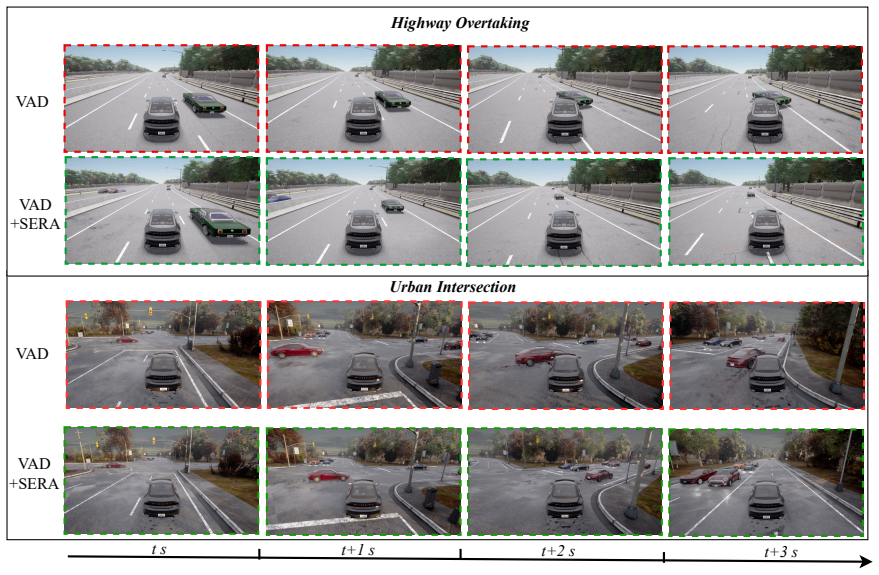
The paper's central claim is that a closed loop of failure analysis and semantic scenario selection turns pre-evaluation failures into targeted training data. SERA first executes a policy on pre-evaluation routes, producing logs that record semantic failures rather than scalar losses. An LLM extracts failure patterns, a relevance scorer retrieves the top-K scenarios from a bank, and an LLM reflection pass refines the set for coverage and diversity. Fine-tuning on the refined scenarios for two epochs yields consistent gains across all four baselines: driving score rises by 3.93–5.75 percent, success rate by 1.38–1.58 points, efficiency by 3.90–12.86 percent, and comfort by 3.47–8.33 percent, with ability-level improvements in emergency braking, merging, overtaking, give-way, and traffic-sign handling.
Load-bearing premise
The improvement claim assumes the failure-logging routes are disjoint from the 220 evaluation routes and that the recommended textual scenarios can actually be converted into concrete observation-action training examples; if either fails, the gains are fitted to the test rather than a genuine repair.
Editorial extensions
If this is right
- If SERA works as reported, an autonomous driving policy can be improved with very little data: two epochs of fine-tuning on a small, semantically curated set of scenarios.
- Semantic relevance, not scenario volume, is what drives adaptation, since random selection performs worst in every ablation.
- The reflection pass is necessary for the reported gains: removing it consistently lowers driving score and success rate across all baselines.
- The gains transfer across architectures with different input modalities, from an ego-state-only MLP to transformer models using six cameras.
- Safety-critical abilities such as emergency braking, merging, and give-way improve alongside the aggregate metrics, suggesting the repair targets failure modes rather than just average driving quality.
Reading between the lines
- A direct stress test would rerun SERA with the failure-logging routes formally disjoint from the 220 evaluation routes; the paper does not state that they are, so the generalization claim is only as strong as that separation.
- The pipeline relies on textual scenario descriptions, but fine-tuning requires observation-action pairs; how each recommended scenario is instantiated as concrete sensor data is left unspecified, and verifying that mapping would settle whether Eq. (12) is actually executable.
- If the loop is as data-efficient as reported, the same failure-log-to-recommendation-to-fine-tune pattern could be applied to real fleet logs, where recorded infractions take the place of simulation logs.
- The ability-wise gains suggest the method changes specific behaviors, not just aggregate scores; an extension would be to measure how much of each ability gain comes from the reflection pass versus the initial retrieval alone.
Editorial analysis
A structured set of objections, weighed in public.
Referee Report
Summary. The paper proposes SERA, an LLM-driven framework that aims to let autonomous driving policies self-evolve by repairing observed failures. SERA first runs a pre-evaluation to collect performance logs, uses an LLM to extract failure patterns, retrieves semantically relevant scenarios from a scenario bank, refines this candidate set through an LLM-based reflection module, and then fine-tunes the driving policy on the refined scenarios. Experiments on the Bench2Drive/CARLA benchmark compare four end-to-end driving baselines with and without SERA and report consistent improvements in driving score, success rate, efficiency, and comfort. An ablation compares random selection, initial recommendation, and full SERA across the same baselines.
Significance. If the reported gains were validated on a properly held-out evaluation set, the work would be a useful contribution: the pipeline of failure analysis, semantic retrieval, and reflection-driven refinement is coherent, and the ablation in Table 4 supports the internal ranking of random selection, initial recommendation, and full SERA. The paper does not ship code, data, or machine-checked artifacts, however, and the central generalization claim currently rests on an undocumented relationship between the pre-evaluation routes and the final evaluation routes. The framework is plausible, but the evidence as presented is not sufficient to establish the abstract's claim of generalizability under safety-critical conditions.
major comments (3)
- [§3.4.1, §4.2, Table 2] The paper never establishes that the pre-evaluation route set T used for failure-log collection is disjoint from the 220 benchmark routes on which final scores are reported. Algorithm 1 selects fine-tuning scenarios from logs collected on T, and Section 4.2 states that closed-loop evaluation is performed on the standard set of 220 benchmark routes; if T is the same 220 routes, the gains in Table 2 reflect fitting the evaluation distribution rather than generalization. Please document the split explicitly, or re-run the protocol with a held-out evaluation set; this is required for the abstract's generalizability claim.
- [§3.5, Eq. (12)] Equation (12) defines the repair objective as an expectation over observation-action pairs (o,a) drawn from C′, but C′ is defined earlier as a set of textual scenario descriptions. The manuscript does not describe how each recommended scenario is converted into concrete sensor observations and expert actions for fine-tuning; without this mapping, the fine-tuning step is not reproducible and the equation is not operational. Please specify the conversion from scenario text to training samples.
- [§4.4, Tables 2 and 4] All reported numbers are single-run evaluations with no variance or significance testing. Given that the improvements over baselines are small (e.g., +0.39 to +1.46 points in Success Rate), multiple seeds or repeated evaluations are needed to support the claim that SERA consistently improves each baseline.
minor comments (4)
- [§4.4.1, Table 2] The text reports AD-MLP Comfortness improving by +14.00%, but Table 2 reports +15.71%; please correct the inconsistency.
- [§3.4.1, Eq. (4)] In Eq. (4), T denotes the episode horizon, while Table 1 and Algorithm 1 use T for the set of pre-evaluation routes; please use distinct symbols for these quantities.
- [§4.4.1, Tables 2 and 4] Section 4.4.1 refers to 'TCP-traj' but Table 2 and the method list use 'TCP'; please standardize the name.
- [Table 3] The header row of Table 3 contains a stray 'Avg.' and the AD-MLP rows report '0.000' in a way that is difficult to read; please reformat the table.
Circularity Check
Reported gains are measured on the same 220-route benchmark used to select repair scenarios, so 'generalizability' is a closed-loop fit unless a held-out split is documented.
-
fitted input called prediction
[Section 3.4.1 and Section 4.2 (Eq. 6, Eq. 12, Table 2)]
"we first conduct pre-evaluation by executing the autonomous driving policy πθ across a set of designated test routes T. ... Collectively, the pre-evaluation process produces a set of performance logs L={ℓ(τi,πθ)|τi∈T} (6) ... For closed-loop evaluation, each autonomous driving model is executed in CARLA across the standard set of 220 benchmark routes."
The paper never states that the pre-evaluation route set T is disjoint from the 220 benchmark routes on which Table 2 reports final scores; the only route set described in the experimental setup is the standard 220-route set. Since SERA's scenario recommendation and fine-tuning (Eq. 12) are driven by failure logs L collected on T, evaluating on the same routes makes the reported gains a closed-loop fit to the evaluation distribution: the fine-tuning data are selected precisely because they match failures on the routes where success is then announced. This does not evidence generalization to new safety-critical conditions; it is the evaluation metric being improved on its own selection signal.
full rationale
The central claim of 'generalizability under safety-critical conditions' rests on an undocumented experimental separation. Section 3.4.1 defines pre-evaluation over routes T, and Section 4.2 evaluates all models on 'the standard set of 220 benchmark routes,' with no statement that these sets are disjoint. As written, the failure logs that drive scenario selection and fine-tuning come from the same benchmark on which the final scores are measured, so the reported improvements are consistent with test-set leakage rather than with self-evolving generalization. This is the one load-bearing circularity. The self-citations in the reference list (e.g., [22], [36] share author Hong Chen) are not load-bearing and do not by themselves raise the score. The missing mapping from textual scenario descriptions C' to observation-action pairs in Eq. (12) is a separate implementation gap, not a circularity. If the authors supply a held-out pre-evaluation split, the generalization claim would be independently testable; as submitted, the missing split reduces the headline result to a closed-loop fit.
Assumptions & free parameters
free parameters (3)
- fine-tuning hyperparameters =
lr=1e-5, batch_size=2, epochs=2
- top-K candidate count K =
not reported
- LLM prompt templates and decoding settings =
not reported
assumptions (4)
- domain assumption Bench2Drive/CARLA closed-loop metrics are a valid proxy for real-world safety-critical autonomous driving performance.
- domain assumption Textual scenario descriptions can be converted into executable observation-action training samples for fine-tuning.
- domain assumption LLaMA-3 8B produces reliable failure patterns and reflection suggestions.
- ad hoc to paper The relevance score phi(T_s, p) measures semantic similarity that is useful for repair.
Cite this review
Pith. "Pith review of From Failures to Fixes: LLM-Driven Scenario Repair for Self-Evolving Autonomous Driving." pith.science (2026). https://pith.science/paper/U7UVZQUU
@misc{pith2026250522067,
  author       = {Pith},
  title        = {Pith review of: From Failures to Fixes: LLM-Driven Scenario Repair for Self-Evolving Autonomous Driving},
  year         = {2026},
  howpublished = {\url{https://pith.science/paper/U7UVZQUU}},
  note         = {Machine review of arXiv:2505.22067}
}
read the original abstract
Ensuring robust and generalizable autonomous driving requires not only broad scenario coverage but also efficient repair of failure cases, particularly those related to challenging and safety-critical scenarios. However, existing scenario generation and selection methods often lack adaptivity and semantic relevance, limiting their impact on performance improvement. In this paper, we propose \textbf{SERA}, an LLM-powered framework that enables autonomous driving systems to self-evolve by repairing failure cases through targeted scenario recommendation. By analyzing performance logs, SERA identifies failure patterns and dynamically retrieves semantically aligned scenarios from a structured bank. An LLM-based reflection mechanism further refines these recommendations to maximize relevance and diversity. The selected scenarios are used for few-shot fine-tuning, enabling targeted adaptation with minimal data. Experiments on the benchmark show that SERA consistently improves key metrics across multiple autonomous driving baselines, demonstrating its effectiveness and generalizability under safety-critical conditions.
Figures


Figures from the paper (1 more)
Reference graph
Works this paper leans on
-
[1]
Xuan Cai, Xuesong Bai, Zhiyong Cui, Danmu Xie, Daocheng Fu, Haiyang Yu, and Yilong Ren
-
[2]
Yue Cao and CS Lee. 2023. Robot behavior-tree- based task generation with large language models. arXiv preprint arXiv:2302.12927(2023). 3
arXiv 2023
-
[3]
Nicolas Carion, Francisco Massa, Gabriel Synnaeve, Nicolas Usunier, Alexander Kirillov, and Sergey Zagoruyko. 2020. End-to-end object detection with transformers. InEuropean conference on computer vi- sion. Springer, 213–229. 2
work page 2020
-
[4]
Cheng Chang, Dongpu Cao, Long Chen, Kui Su, Kuifeng Su, Yuelong Su, Fei-Yue Wang, Jue Wang, Ping Wang, Junqing Wei, et al. 2022. MetaScenario: A framework for driving scenario data description, storage and indexing.IEEE Transactions on Intelli- gent Vehicles8, 2 (2022), 1156–1175. 1
work page 2022
-
[5]
Baiming Chen, Xiang Chen, Qiong Wu, and Liang Li
-
[6]
Li Chen, Penghao Wu, Kashyap Chitta, Bernhard Jaeger, Andreas Geiger, and Hongyang Li. 2024. End- to-end autonomous driving: Challenges and frontiers. IEEE Transactions on Pattern Analysis and Machine Intelligence(2024). 1
work page 2024
-
[7]
Shaoyu Chen, Bo Jiang, Hao Gao, Bencheng Liao, Qing Xu, Qian Zhang, Chang Huang, Wenyu Liu, and Xinggang Wang. 2024. Vadv2: End-to-end vectorized autonomous driving via probabilistic planning.arXiv preprint arXiv:2402.13243(2024). 2
arXiv 2024
-
[8]
Yao Deng, Jiaohong Yao, Zhi Tu, Xi Zheng, Mengshi Zhang, and Tianyi Zhang. 2023. Target: Traffic rule- based test generation for autonomous driving systems. arXiv preprint arXiv:2305.06018(2023). 1, 3
arXiv 2023
Show all 51 references
-
[9]
Wenhao Ding, Chejian Xu, Mansur Arief, Haohong Lin, Bo Li, and Ding Zhao. 2023. A survey on safety- critical driving scenario generation—a methodolog- ical perspective.IEEE Transactions on Intelligent Transportation Systems24, 7 (2023), 6971–6988. 1
2023
-
[10]
Yan Duan, Marcin Andrychowicz, Bradly Stadie, OpenAI Jonathan Ho, Jonas Schneider, Ilya Sutskever, Pieter Abbeel, and Wojciech Zaremba. 2017. One- shot imitation learning.Advances in neural informa- tion processing systems30 (2017). 3
2017
-
[11]
Daniel J Fremont, Edward Kim, Yash Vardhan Pant, Sanjit A Seshia, Atul Acharya, Xantha Bruso, Paul Wells, Steve Lemke, Qiang Lu, and Shalin Mehta
-
[12]
Mathias Gehrig, Willem Aarents, Daniel Gehrig, and Davide Scaramuzza. 2021. Dsec: A stereo event cam- era dataset for driving scenarios.IEEE Robotics and Automation Letters6, 3 (2021), 4947–4954. 1
2021
-
[13]
Zahra Ghodsi, Siva Kumar Sastry Hari, Iuri Frosio, Timothy Tsai, Alejandro Troccoli, Stephen W Keck- ler, Siddharth Garg, and Anima Anandkumar. 2021. Generating and characterizing scenarios for safety testing of autonomous vehicles. In2021 IEEE Intel- ligent Vehicles Symposium...
2021
-
[14]
Sascha Hornauer, Baladitya Yellapragada, Arian Ran- jbar, and Stella Yu. 2019. Driving scene retrieval by example from large-scale data. InProceedings of the IEEE/CVF Conference on Computer Vision and Pat- tern Recognition Workshops. 25–28. 1
2019
-
[15]
Peiyun Hu, Aaron Huang, John Dolan, David Held, and Deva Ramanan. 2021. Safe local motion planning with self-supervised freespace forecasting. InPro- ceedings of the IEEE/CVF Conference on Computer Vision and Pattern Recognition. 12732–12741. 2
2021
-
[16]
Yihan Hu, Jiazhi Yang, Li Chen, Keyu Li, Chong- hao Sima, Xizhou Zhu, Siqi Chai, Senyao Du, Tian- wei Lin, Wenhai Wang, et al. 2023. Planning-oriented autonomous driving. InProceedings of the IEEE/CVF conference on computer vision and pattern recogni- tion. 17853–17862. 2, 6, 7, 8
2023
-
[17]
Yu Huang and Yue Chen. 2020. Autonomous driving with deep learning: A survey of state-of-art technolo- gies.arXiv preprint arXiv:2006.06091(2020). 1
2020 arXiv
-
[18]
Xiaosong Jia, Zhenjie Yang, Qifeng Li, Zhiyuan Zhang, and Junchi Yan. 2024. Bench2drive: To- wards multi-ability benchmarking of closed-loop end-to-end autonomous driving.arXiv preprint arXiv:2406.03877(2024). 6
2024 arXiv
-
[19]
Bo Jiang, Shaoyu Chen, Qing Xu, Bencheng Liao, Jiajie Chen, Helong Zhou, Qian Zhang, Wenyu Liu, Chang Huang, and Xinggang Wang. 2023. Vad: Vec- torized scene representation for efficient autonomous driving. InProceedings of the IEEE/CVF Interna- tional Conference on Computer V...
2023
-
[20]
Quanyi Li, Zhenghao Mark Peng, Lan Feng, Zhizheng Liu, Chenda Duan, Wenjie Mo, and Bolei Zhou. 2023. 10 Scenarionet: Open-source platform for large-scale traffic scenario simulation and modeling.Advances in neural information processing systems36 (2023), 3894–3920. 3
2023
-
[21]
Shu Li, Honglin He, Jingxuan Yang, Jianming Hu, Yi Zhang, and Shuo Feng. 2024. Few-Shot Testing of Autonomous Vehicles with Scenario Similarity Learn- ing.arXiv preprint arXiv:2409.14369(2024). 3
2024 arXiv
-
[22]
Xincheng Li, Zhaoyi Wang, Yanjun Huang, and Hong Chen. 2023. A survey on self-evolving autonomous driving: a perspective on data closed-loop technol- ogy.IEEE Transactions on Intelligent Vehicles8, 11 (2023), 4613–4631. 1
2023
-
[23]
Zhiqi Li, Wenhai Wang, Hongyang Li, Enze Xie, Chonghao Sima, Tong Lu, Qiao Yu, and Jifeng Dai
-
[24]
Weibo Mao, Chenxin Xu, Qi Zhu, Siheng Chen, and Yanfeng Wang. 2023. Leapfrog diffusion model for stochastic trajectory prediction. InProceedings of the IEEE/CVF conference on computer vision and pattern recognition. 5517–5526. 2
2023
-
[25]
Antonio Valerio Miceli-Barone, Alex Lascarides, and Craig Innes. 2023. Dialogue-based generation of self- driving simulation scenarios using Large Language Models.arXiv preprint arXiv:2310.17372(2023). 3
2023 arXiv
-
[26]
Daniel Omeiza, Helena Webb, Marina Jirotka, and Lars Kunze. 2021. Explanations in autonomous driv- ing: A survey.IEEE Transactions on Intelligent Transportation Systems23, 8 (2021), 10142–10162. 1
2021
-
[27]
Sagar Pathrudkar, Saadhana Venkataraman, Deepika Kanade, Aswin Ajayan, Palash Gupta, Shehzaman Khatib, Vijaya Sarathi Indla, and Saikat Mukherjee
-
[28]
Hongping Ren, Hui Gao, He Chen, and Guangzhen Liu. 2022. A survey of autonomous driving scenar- ios and scenario databases. In2022 9th International Conference on Dependable Systems and Their Appli- cations (DSA). IEEE, 754–762. 1
2022
-
[29]
Siyu Teng, Xuemin Hu, Peng Deng, Bai Li, Yuchen Li, Yunfeng Ai, Dongsheng Yang, Lingxi Li, Zhe Xu- anyuan, Fenghua Zhu, et al. 2023. Motion planning for autonomous driving: The state of the art and fu- ture perspectives.IEEE Transactions on Intelligent Vehicles8, 6 (2023), 369...
2023
-
[30]
Haoxiang Tian, Xingshuo Han, Guoquan Wu, Yuan Zhou, Shuo Li, Jun Wei, Dan Ye, Wei Wang, and Tian- wei Zhang. 2024. An llm-enhanced multi-objective evolutionary search for autonomous driving test sce- nario generation.arXiv preprint arXiv:2406.10857 (2024). 1
2024 arXiv
-
[31]
Hanlin Tian, Kethan Reddy, Yuxiang Feng, Mo- hammed Quddus, Yiannis Demiris, and Panagiotis Angeloudis. 2024. Enhancing autonomous vehicle training with language model integration and critical scenario generation.arXiv preprint arXiv:2404.08570 (2024). 1
2024 arXiv
-
[32]
Simon Ulbrich, Till Menzel, Andreas Reschka, Fabian Schuldt, and Markus Maurer. 2015. Defining and substantiating the terms scene, situation, and scenario for automated driving. In2015 IEEE 18th interna- tional conference on intelligent transportation sys- tems. IEEE, 982–988. 1, 2
2015
-
[33]
Huang, Trevor Darrell, Joseph E
Xin Wang, Thomas E. Huang, Trevor Darrell, Joseph E. Gonzalez, and Fisher Yu. 2020. Frustrat- ingly simple few-shot object detection. InProceed- ings of the 37th International Conference on Ma- chine Learning (ICML’20). JMLR.org, Article 920, 10 pages. 3
2020
-
[34]
Xinghua Wang, Yong Peng, Tuo Xu, Qian Xu, Xian- hui Wu, Guoliang Xiang, Shengen Yi, and Honggang Wang. 2022. Autonomous driving testing scenario generation based on in-depth vehicle-to-powered two- wheeler crash data in China.Accident Analysis & Pre- vention176 (2022), 106812. 1
2022
-
[35]
Yue Wang, Vitor Campagnolo Guizilini, Tianyuan Zhang, Yilun Wang, Hang Zhao, and Justin Solomon
-
[36]
Yujin Wang, Quanfeng Liu, Jiaqi Fan, Jinlong Hong, Hongqing Chu, Mengjian Tian, Bingzhao Gao, and Hong Chen. 2024. RAC3: Retrieval-Augmented Corner Case Comprehension for Autonomous Driv- ing with Vision-Language Models.arXiv preprint arXiv:2412.11050(2024). 1
2024
-
[37]
Penghao Wu, Xiaosong Jia, Li Chen, Junchi Yan, Hongyang Li, and Yu Qiao. 2022. Trajectory-guided control prediction for end-to-end autonomous driving: A simple yet strong baseline.Advances in Neural In- formation Processing Systems35 (2022), 6119–6132. 6, 7, 8
2022
-
[38]
Zhiheng Xi, Wenxiang Chen, Xin Guo, Wei He, Yi- wen Ding, Boyang Hong, Ming Zhang, Junzhe Wang, Senjie Jin, Enyu Zhou, et al. 2025. The rise and po- tential of large language model based agents: A sur- vey.Science China Information Sciences68, 2 (2025), 121101. 1 11
2025
-
[39]
Pengfei Yao, Yinglong Zhu, Huikun Bi, Tianlu Mao, and Zhaoqi Wang. 2024. TrajCLIP: Pedestrian trajec- tory prediction method using contrastive learning and idempotent networks.Advances in Neural Informa- tion Processing Systems37 (2024), 77023–77037. 2
2024
-
[40]
Jiang-Tian Zhai, Ze Feng, Jinhao Du, Yongqiang Mao, Jiang-Jiang Liu, Zichang Tan, Yifu Zhang, Xiaoqing Ye, and Jingdong Wang. 2023. Rethinking the open- loop evaluation of end-to-end autonomous driving in nuscenes.arXiv preprint arXiv:2305.10430(2023). 6, 7, 8
2023 arXiv
-
[41]
Gongjie Zhang, Zhipeng Luo, Kaiwen Cui, Shijian Lu, and Eric P Xing. 2022. Meta-detr: Image- level few-shot detection with inter-class correlation exploitation.IEEE transactions on pattern analy- sis and machine intelligence45, 11 (2022), 12832– 12843. 3
2022
-
[42]
Yifan Zhang, Bingyi Kang, Bryan Hooi, Shuicheng Yan, and Jiashi Feng. 2023. Deep Long-Tailed Learn- ing: A Survey.IEEE Transactions on Pattern Analysis and Machine Intelligence45, 9 (2023), 10795–10816. https://doi.org/10.1109/TPAMI.2023. 32681181
2023 doi
-
[43]
Ziyuan Zhong, Davis Rempe, Yuxiao Chen, Boris Ivanovic, Yulong Cao, Danfei Xu, Marco Pavone, and Baishakhi Ray. 2023. Language-guided traffic simula- tion via scene-level diffusion. InConference on Robot Learning. PMLR, 144–177. 3
2023
-
[44]
Rui Zhou, Yuping Liu, Kai Zhang, and Ou Yang
-
[51]
Genetic algorithm-based challenging scenarios generation for autonomous vehicle testing.IEEE Jour- nal of Radio Frequency Identification6 (2022), 928–
2022
-
[2020]
In2020 IEEE 23rd International Conference on Intelligent Transportation Systems (ITSC)
Formal scenario-based testing of autonomous vehicles: From simulation to the real world. In2020 IEEE 23rd International Conference on Intelligent Transportation Systems (ITSC). IEEE, 1–8. 2
-
[2021]
Adversarial evaluation of autonomous vehicles in lane-change scenarios.IEEE transactions on in- telligent transportation systems23, 8 (2021), 10333– 10342. 2
2021
-
[2022]
InConference on Robot Learning
Detr3d: 3d object detection from multi-view images via 3d-to-2d queries. InConference on Robot Learning. PMLR, 180–191. 2
-
[2023]
SAFR-A V: Safety Analysis of Autonomous Vehicles using Real World Data–An end-to-end so- lution for real world data driven scenario-based test- ing for pre-certification of A V stacks.arXiv preprint arXiv:2302.14601(2023). 2
2023 arXiv
-
[2024]
Bevformer: learning bird’s-eye-view repre- sentation from lidar-camera via spatiotemporal trans- formers.IEEE Transactions on Pattern Analysis and Machine Intelligence(2024). 2
2024
-
[2025]
Text2Scenario: Text-Driven Scenario Gener- ation for Autonomous Driving Test.arXiv preprint arXiv:2503.02911(2025). 1
2025 arXiv
Reviewed August 7, 2026 · model on record in the stance chip above.
Discussion (0). Sign in to comment.