REVIEW 4 major objections 6 minor 64 references
Multimodal Forecasting of Sparse Intraoperative Hypotension Events Powered by Language Model
T0 review · 4 major / 6 minor · reviewed 2026-08-07 · deepseek-v4-flash
Pith's one-line read IOHFuseLM, a GPT-2-based multimodal framework, predicts intraoperative hypotension 5–15 minutes ahead by fusing patient descriptions with blood-pressure series, and outperforms six forecasting baselines on two real surgical datasets.
desk verdict A competent application paper with code and ablations, but the headline AUC/recall gains are not reproducible until the authors specify how forecasts become event-level scores. read the letter →
The pith
A machine-rendered reading of the paper's core claim, the machinery that carries it, and where it could break.
The reading
What carries the argument
The load-bearing mechanism is token-level cross-modal alignment inside the GPT-2 backbone, governed by a patient-specific attention mask. MAP series are cut into fixed-length patches and linearly projected into patch tokens; the clinical description is tokenized with an extended vocabulary; the mask $M_i = \mathbf{1}_{(l+t)/p}\bigl(\mathbf{1}_\eta - m_i\bigr)^{\top}$ zeroes out attention from text tokens to padding positions, so each meaningful token attends only to genuine physiological tokens under a large penalty $\lambda$ (Eq. 10–11). Around this mechanism are three supporting parts: MTRDA, which splits each series into a multi-scale trend (the average of centered sliding-window smoothings) and a residual, then runs a DDPM-style denoiser on the residual to synthesize additional IOH-bearing series; domain-adaptive pretraining, which masks 20% of patch tokens and minimizes MSE on the masked positions over the augmented set; and task fine-tuning with $\mathcal{L} = \mathrm{MSE}_{\mathrm{normal}} + \rho\,\mathrm{MSE}_{\mathrm{IOH}}$, $\rho=10$, which up-weights errors on hypotensive timestamps so the model is biased toward detecting the rare events.
What would settle it
Run the released code on the 10-second Clinical IOH split and recompute recall and AUC using only the stated rule — more than 60% of forecast MAP values below 65 mmHg within a one-minute window — and check whether a single risk score per instance underlies the AUC; if the headline numbers (74.46% recall, 0.7425 AUC) change materially under the literal rule, or turn out to be computed pointwise on hypotensive timestamps rather than from forecast events, the claimed superiority over GPT4TS (62.68%, 0.7309) is not yet demonstrated.
Extended reading notes
Core claim
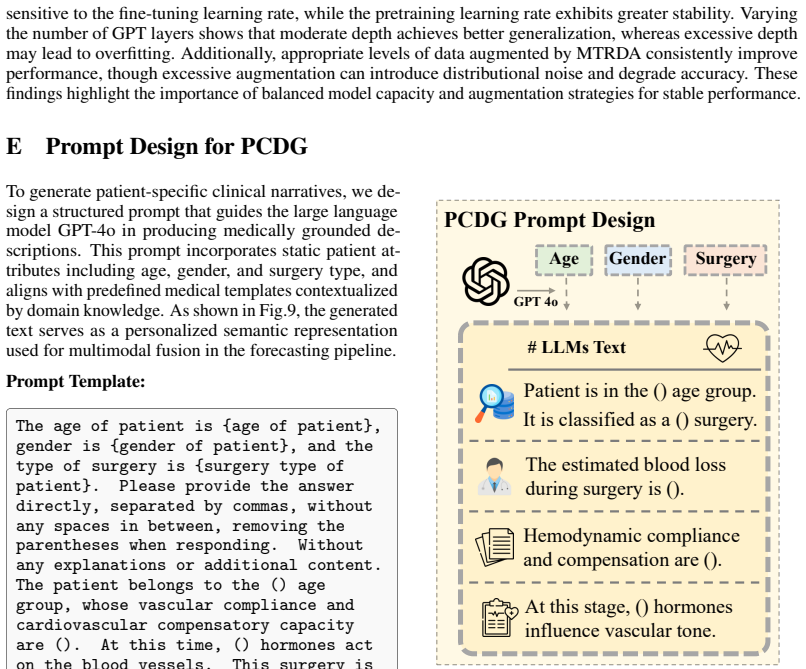
The discovery the paper claims is that the scarcity and heterogeneity of IOH events — not the forecasting architecture — is the binding constraint, and that a multimodal language model breaks it. Static attributes are turned into structured clinical narratives by GPT-4o (PCDG), sparse MAP series are decomposed into trend plus residual and enriched by a diffusion generator (MTRDA), and the two modalities are fused at token level under a patient-specific attention mask before a GPT-2 backbone forecasts the future MAP series. On the Clinical IOH dataset (1,452 patients) and VitalDB (1,522 recordings), the model reports the best recall and AUC in every setting, with the largest margins exactly where events are sparsest and sampling is coarsest; ablations attribute the gain to pretraining, augmentation, the expanded tokenizer, and the clinical descriptions jointly. The paper frames this as evidence that personalized semantic context plus physiologically realistic augmentation yields clinically usable early warning.
Load-bearing premise
The argument depends on the step that turns a continuous MAP forecast into an event-level score: the paper defines a predicted event as more than 60% of forecast values in a one-minute window below 65 mmHg, but it never specifies how the reported AUC and recall are computed from that rule, and the claimed margins stand or fall on that unspecified scoring protocol.
Editorial extensions
If this is right
- On the 10-second Clinical IOH split the model reaches 74.46% recall and 0.7425 AUC, against 62.68% and 0.7309 for the best baseline (GPT4TS): roughly eleven more hypotensive events per hundred are caught.
- Because the forecast horizon is 5–15 minutes and each prediction is split into a two-minute warning window followed by a monitoring window, the output is directly usable as an early-warning alarm rather than a post-hoc label.
- Every component matters: ablating the clinical descriptions drops recall from 74.46% to 68.62%, removing diffusion augmentation to 67.78%, and removing pretraining entirely to 67.85%.
- Transfer learning from the Clinical IOH dataset to a new cohort with different window lengths lifts recall from 0.00% to 17.65% and AUC from 0.50 to 0.58, indicating the pretrained representations carry over to unseen settings.
- The 48 ms inference time on an RTX 4090 meets the real-time responsiveness standard (ISO 80601-2-77:2017) cited in the paper, so the framework is computationally deployable in an operating-room loop.
Reading between the lines
- Editorial extension: since the clinical descriptions are generated from just three attributes (age, gender, surgery type), an ablation that replaces GPT-4o narratives with the raw attribute strings would isolate whether the recall gain comes from the wording or simply from an implicit surgery-type prior on baseline risk.
- Editorial extension: the same trend–residual diffusion augmentation and weighted fine-tuning recipe transfers directly to other sparse high-risk events the paper itself names — intraoperative hypoxia, ICU sepsis onset, arrhythmia — where the alignment of waveform patches with structured text is equally natural.
- Editorial extension: fixing the event-scoring protocol in code (the 60%-below-threshold rule applied to continuous forecasts) would let the reported AUROC be re-derived as a true event-level metric and compared against alarm-rate-per-case statistics from the early-warning literature, a comparison the paper does not report.
- Editorial extension: adding further structured fields to the description — comorbidities, medications, lab values — is a drop-in change at the token level, and the framework's gains on three attributes suggest richer text would likely improve personalization further; this is a direct prediction of the paper's alignment mechanism, not a result it reports.
Editorial analysis
A structured set of objections, weighed in public.
Referee Report
Summary. The paper proposes IOHFuseLM, a multimodal language-model framework for forecasting intraoperative hypotension (IOH) by predicting future mean arterial pressure (MAP) series from a historical MAP window and static patient attributes encoded as clinical text. The method has two training stages: a diffusion-based augmentation stage (MTRDA) that generates synthetic MAP series from a trend-residual decomposition, followed by domain-adaptive pretraining that aligns text tokens with MAP patch tokens via a patient-specific attention mask, and then task fine-tuning with an IOH-weighted MSE loss. The authors evaluate on a private Clinical IOH dataset and the public VitalDB dataset, reporting MSE, MAE, recall, and AUC, and claim consistent improvement over six baselines. Ablation studies, transfer-learning experiments, qualitative forecasts, and a runtime comparison are also included, and the code is publicly available.
Significance. If the reported results are reproducible and the evaluation is well defined, the work is a useful contribution to clinical decision support: it addresses event sparsity through diffusion augmentation, integrates static and dynamic patient information at the token level, and provides a practical forecasting framework with public code. The ablation study and the transfer experiment to a new cohort are valuable, and the runtime comparison with HMF supports deployability. However, the central claim of 'consistently outperforming' the baselines depends on an incompletely specified event-level evaluation metric, on point estimates without uncertainty quantification, and on a private dataset, so the significance cannot be fully assessed from the manuscript as written.
major comments (4)
- [Section 3, 'IOH Event Evaluation'] The definition of a predicted IOH event is given as 'more than 60% of the forecasted MAP values within the same one-minute window fall below this threshold,' but the manuscript never specifies how a continuous risk score is derived from the forecasted MAP series to compute the reported ROC AUC, nor how the reported recall is aggregated from timestamp-level or window-level predictions. Without this mapping, the AUC and recall values in Table 1 are not uniquely defined, and the comparison against baselines is not reproducible. This is load-bearing because the claimed improvement over the strongest baseline (0.7425 vs. 0.7309 AUC, 74.46% vs. 62.68% recall on Clinical IOH at 10 s sampling) is small enough that a different but equally plausible event-scoring rule could change the ranking. Please specify the exact algorithm, including any threshold scanning procedure, and state whether the same conversion is applied to all baselines.
- [Table 1 and Appendix B] Table 1 reports only point estimates averaged over three runs, with no standard deviations, confidence intervals, or significance tests for the discriminative metrics. The sensitivity analysis in Appendix D reports uncertainty only for MSE/MAE, not for recall or AUC, so the reader cannot judge whether the differences between IOHFuseLM and GPT4TS or PatchTST are stable. Given the main claim is 'consistently outperforms established baselines,' the authors should report run-level variability for all metrics and, where meaningful, statistical tests or at least per-run ranges.
- [Section 3, 'Series Instance Construction'] The statement that 'instances with historical windows overlapping IOH episodes are excluded' introduces a potential selection bias: the model is never trained or evaluated on the clinically important situation in which hypotension is already developing within the historical window, yet that is precisely the regime in which an early-warning system would be used. The paper should either justify this exclusion with a clinical rationale or report an additional evaluation on windows that do contain pre-IOH risk patterns. The adaptive sampling intervals Delta_Normal and Delta_IOH also alter the effective class balance; the paper should specify how evaluation is weighted so that the reported recall and AUC are not artifacts of the sampling scheme.
- [Section 4.2, Eq. (9), and Appendix A] The augmented dataset is defined as X2 = X1 union of augmented pairs for all i in [N], where X1 contains all records in the dataset, with no explicit restriction to the training split. If augmentation and domain-adaptive pretraining use validation or test patients, then the subject-independent split is violated and the reported results are optimistically biased. The paper must clarify that augmentation and pretraining are performed exclusively on the training partition, or otherwise demonstrate that no information from held-out patients enters the pretraining stage.
minor comments (6)
- [Throughout] There are repeated typos and inconsistent terms: 'domaim' for 'domain' (Sections 1, 4.3, 5.2), 'IOHFuseFM' for 'IOHFuseLM' (Section 1), 'MTSDA' for 'MTRDA' (Figure 3), and 'Broder Impacts' for 'Broader Impacts' (Appendix F).
- [Appendix A, Table 4] The VitalDB row of Table 4 is malformed, making the train/validation/test counts unreadable; the table should be reformatted so that each dataset, sampling rate, and prediction horizon is clearly separated.
- [Appendix A, Table 5] The dataset label 'CH-OBPB' appears to be a typo for the Clinical IOH dataset, and several rows are visually garbled; please correct the labels and align the hyperparameter entries.
- [Section 5.2 and Appendix D] The hyperparameter sensitivity discussion is qualitative and refers to Figure 8 without reporting the numerical values behind the curves; providing the exact scores and ranges would make the sensitivity claims verifiable.
- [Appendix G] The Limitations appendix acknowledges sensitivity to data collection protocols and reliance on generated clinical descriptions, but these caveats are not reflected in the abstract or conclusion, which state the performance claims without qualification.
- [Section 4.1] The use of GPT-4o to generate clinical descriptions is described as based on physician recommendations and literature, but no examples of the generated text or a validation of its clinical correctness are provided; including sample descriptions and a small manual review would strengthen the reproducibility of the PCDG module.
Circularity Check
No significant circularity: the IOH prediction pipeline is trained on real and diffusion-augmented data and evaluated against external baselines; no claim reduces to its inputs by construction.
full rationale
The paper's derivation chain is empirical rather than definitional. IOHFuseLM is trained in two stages—domain-adaptive pretraining on diffusion-augmented MAP series and task fine-tuning on real clinical records—and its headline performance is measured against independent baselines (DLinear, PatchTST, Fredformer, HMF, GPT4TS, TimeLLM) on two datasets. No equation defines the reported AUC or recall in terms of a fitted parameter or a self-cited result. The 60% one-minute event rule in Section 3 is a fixed clinical evaluation criterion, not a fitted input, and it is applied consistently to predictions. The only notable self-citation is HMF [12], which is used as a baseline rather than as load-bearing justification for the model's components or evaluation. The unspecified mapping from forecasted MAP values to the ROC/AUC curve is a reproducibility and correctness concern, but it is not a circular dependency: the metric is not defined so that the model's superiority is guaranteed. The paper is self-contained against external benchmarks, and no step reduces to its own inputs.
Assumptions & free parameters
free parameters (5)
- IOH loss weight ρ =
10
- Pretraining masking ratio R =
0.2
- Number of augmented series H =
varies (e.g., 3-5)
- Sampling intervals ΔNormal and ΔIOH =
varies by setting
- Diffusion steps K =
50
assumptions (4)
- domain assumption MAP below 65 mmHg for ≥1 minute defines IOH.
- domain assumption GPT-4o-generated descriptions capture relevant clinical context.
- domain assumption Diffusion-augmented series improve representation learning.
- standard math Standard backpropagation and attention mechanisms.
Cite this review
Pith. "Pith review of Multimodal Forecasting of Sparse Intraoperative Hypotension Events Powered by Language Model." pith.science (2026). https://pith.science/paper/OQ5HAIL5
@misc{pith2026250522116,
  author       = {Pith},
  title        = {Pith review of: Multimodal Forecasting of Sparse Intraoperative Hypotension Events Powered by Language Model},
  year         = {2026},
  howpublished = {\url{https://pith.science/paper/OQ5HAIL5}},
  note         = {Machine review of arXiv:2505.22116}
}
read the original abstract
Intraoperative hypotension (IOH) frequently occurs under general anesthesia and is strongly linked to adverse outcomes such as myocardial injury and increased mortality. Despite its significance, IOH prediction is hindered by event sparsity and the challenge of integrating static and dynamic data across diverse patients. In this paper, we propose \textbf{IOHFuseLM}, a multimodal language model framework. To accurately identify and differentiate sparse hypotensive events, we leverage a two-stage training strategy. The first stage involves domain adaptive pretraining on IOH physiological time series augmented through diffusion methods, thereby enhancing the model sensitivity to patterns associated with hypotension. Subsequently, task fine-tuning is performed on the original clinical dataset to further enhance the ability to distinguish normotensive from hypotensive states. To enable multimodal fusion for each patient, we align structured clinical descriptions with the corresponding physiological time series at the token level. Such alignment enables the model to capture individualized temporal patterns alongside their corresponding clinical semantics. In addition, we convert static patient attributes into structured text to enrich personalized information. Experimental evaluations on two intraoperative datasets demonstrate that IOHFuseLM outperforms established baselines in accurately identifying IOH events, highlighting its applicability in clinical decision support scenarios. Our code is publicly available to promote reproducibility at https://github.com/zjt-gpu/IOHFuseLM.
Figures


Figures from the paper (6 more)


Reference graph
Works this paper leans on
-
[1]
Intraoperative hypotension: Pathophysiology, clinical relevance, and therapeutic approaches
Karim Kouz, Phillip Hoppe, Luisa Briesenick, and Bernd Saugel. Intraoperative hypotension: Pathophysiology, clinical relevance, and therapeutic approaches. Indian journal of anaesthesia, 64(2):90–96, 2020
work page 2020
-
[2]
Jianghui Cai, Mi Tang, Huaye Wu, Jing Yuan, Hua Liang, Xuan Wu, Shasha Xing, Xiao Yang, and Xiao-Dong Duan. Association of intraoperative hypotension and severe postoperative complications during non-cardiac surgery in adult patients: A systematic review and meta- analysis. Heliyon, 9(5), 2023
work page 2023
-
[3]
Association between intraoperative hypotension and myocardial injury after vascular surgery
Judith AR Van Waes, Wilton A Van Klei, Duminda N Wijeysundera, Leo Van Wolfswinkel, Thomas F Lindsay, and W Scott Beattie. Association between intraoperative hypotension and myocardial injury after vascular surgery. Survey of anesthesiology, 60(5):212, 2016
work page 2016
-
[4]
M Wijnberge, J Schenk, E Bulle, AP Vlaar, K Maheshwari, MW Hollmann, JM Binnekade, BF Geerts, and DP Veelo. Association of intraoperative hypotension with postoperative morbid- ity and mortality: systematic review and meta-analysis. BJS open, 5(1):zraa018, 2021
work page 2021
-
[5]
Intraoperative hypoten- sion and the risk of postoperative adverse outcomes: a systematic review
EM Wesselink, TH Kappen, HM Torn, AJC Slooter, and W A Van Klei. Intraoperative hypoten- sion and the risk of postoperative adverse outcomes: a systematic review. British journal of anaesthesia, 121(4):706–721, 2018
work page 2018
-
[7]
Feras Hatib, Zhongping Jian, Sai Buddi, Christine Lee, Jos Settels, Karen Sibert, Joseph Rinehart, and Maxime Cannesson. Machine-learning algorithm to predict hypotension based on high-fidelity arterial pressure waveform analysis. Anesthesiology, 129(4):663–674, 2018
work page 2018
-
[8]
Deep learning models for the prediction of intraoperative hypotension
Solam Lee, Hyung-Chul Lee, Yu Seong Chu, Seung Woo Song, Gyo Jin Ahn, Hunju Lee, Sejung Yang, and Sang Baek Koh. Deep learning models for the prediction of intraoperative hypotension. British journal of anaesthesia, 126(4):808–817, 2021
work page 2021
-
[9]
Heejoon Jeong, Donghee Kim, Dong Won Kim, Seungho Baek, Hyung-Chul Lee, Yusung Kim, and Hyun Joo Ahn. Prediction of intraoperative hypotension using deep learning models based on non-invasive monitoring devices. Journal of Clinical Monitoring and Computing, pages 1–9, 2024
work page 2024
Show all 64 references
-
[10]
An algorithm based on deep learning for predicting in-hospital cardiac arrest
Joon-myoung Kwon, Youngnam Lee, Yeha Lee, Seungwoo Lee, and Jinsik Park. An algorithm based on deep learning for predicting in-hospital cardiac arrest. Journal of the American Heart Association, 7(13):e008678, 2018
2018
-
[11]
Prediction of blood pressure after induction of anesthesia using deep learning: A feasibility study
Young-Seob Jeong, Ah Reum Kang, Woohyun Jung, So Jeong Lee, Seunghyeon Lee, Misoon Lee, Yang Hoon Chung, Bon Sung Koo, and Sang Hyun Kim. Prediction of blood pressure after induction of anesthesia using deep learning: A feasibility study. Applied Sciences, 9(23):5135, 2019
2019
-
[12]
Hmf: A hybrid multi-factor framework for dynamic intraoperative hypotension prediction
Mingyue Cheng, Jintao Zhang, Zhiding Liu, Chunli Liu, and Yanhu Xie. Hmf: A hybrid multi-factor framework for dynamic intraoperative hypotension prediction. arXiv preprint arXiv:2409.11064, 2024
2024
-
[13]
A composite multi-attention framework for intraoperative hypotension early warning
Feng Lu, Wei Li, Zhiqiang Zhou, Cheng Song, Yifei Sun, Yuwei Zhang, Yufei Ren, Xiaofei Liao, Hai Jin, Ailin Luo, et al. A composite multi-attention framework for intraoperative hypotension early warning. In Proceedings of the AAAI Conference on Artificial Intelligence, volume ...
2023
-
[14]
Long short-term memory
Alex Graves and Alex Graves. Long short-term memory. Supervised sequence labelling with recurrent neural networks, pages 37–45, 2012
2012
-
[15]
Crossformer: Transformer utilizing cross-dimension dependency for multivariate time series forecasting
Yunhao Zhang and Junchi Yan. Crossformer: Transformer utilizing cross-dimension dependency for multivariate time series forecasting. In The eleventh international conference on learning representations, 2023. 10
2023
-
[16]
itransformer: Inverted transformers are effective for time series forecasting
Yong Liu, Tengge Hu, Haoran Zhang, Haixu Wu, Shiyu Wang, Lintao Ma, and Mingsheng Long. itransformer: Inverted transformers are effective for time series forecasting. arXiv preprint arXiv:2310.06625, 2023
2023 arXiv
-
[17]
Timexer: Empowering transformers for time series forecasting with exogenous variables
Yuxuan Wang, Haixu Wu, Jiaxiang Dong, Guo Qin, Haoran Zhang, Yong Liu, Yunzhong Qiu, Jianmin Wang, and Mingsheng Long. Timexer: Empowering transformers for time series forecasting with exogenous variables. arXiv preprint arXiv:2402.19072, 2024
2024 arXiv
-
[18]
Are transformers effective for time series forecasting? In Proceedings of the AAAI Conference on Artificial Intelligence , volume 37, pages 11121–11128, 2023
Aixin Zeng, Ming Chen, Lei Zhang, and Qiang Xu. Are transformers effective for time series forecasting? In Proceedings of the AAAI Conference on Artificial Intelligence , volume 37, pages 11121–11128, 2023
2023
-
[20]
Diffusion-ts: Interpretable diffusion for general time series genera- tion
Xinyu Yuan and Yan Qiao. Diffusion-ts: Interpretable diffusion for general time series genera- tion. arXiv preprint arXiv:2403.01742, 2024
2024 arXiv
-
[22]
Effective data augmentation with diffusion models
Brandon Trabucco, Kyle Doherty, Max Gurinas, and Ruslan Salakhutdinov. Effective data augmentation with diffusion models. arXiv preprint arXiv:2302.07944, 2023
2023 arXiv
-
[23]
One fits all: Power general time series analysis by pretrained lm
Tian Zhou, Peisong Niu, Liang Sun, Rong Jin, et al. One fits all: Power general time series analysis by pretrained lm. Advances in neural information processing systems, 36:43322–43355, 2023
2023
-
[24]
Time-llm: Time series forecasting by reprogramming large language models
Ming Jin, Shiyu Wang, Lintao Ma, Zhixuan Chu, James Y Zhang, Xiaoming Shi, Pin-Yu Chen, Yuxuan Liang, Yuan-Fang Li, Shirui Pan, et al. Time-llm: Time series forecasting by reprogramming large language models. arXiv preprint arXiv:2310.01728, 2023
-
[25]
Perioperative hypotension: clinical impact, diagnosis, and therapeutic approaches
Phillip Hoppe, Karim Kouz, and Bernd Saugel. Perioperative hypotension: clinical impact, diagnosis, and therapeutic approaches. Journal of emergency and critical care medicine , 4, 2020
2020
-
[26]
Early intraoperative hypotension and its associated factors among surgical patients undergoing surgery under general anesthesia: An observational study
Netsanet Temesgen, Efrem Fenta, Chernet Eshetie, and Moges Gelaw. Early intraoperative hypotension and its associated factors among surgical patients undergoing surgery under general anesthesia: An observational study. Annals of Medicine and Surgery, 71:102835, 2021
2021
-
[27]
Prediction of an acute hypotensive episode during an icu hospitalization with a super learner machine-learning algorithm
Ményssa Cherifa, Alice Blet, Antoine Chambaz, Etienne Gayat, Matthieu Resche-Rigon, and Romain Pirracchio. Prediction of an acute hypotensive episode during an icu hospitalization with a super learner machine-learning algorithm. Anesthesia & Analgesia, 130(5):1157–1166, 2020
2020
-
[28]
Supervised machine-learning predictive analytics for prediction of postinduction hypotension
Samir Kendale, Prathamesh Kulkarni, and Rosenberg et al. Supervised machine-learning predictive analytics for prediction of postinduction hypotension. Anesthesiology, 129(4):675– 688, 2018
2018
-
[29]
Predicting hypotension by learning from multivariate mixed responses
Jodie Ritter, Xiaoyu Chen, Lihui Bai, and Jiapeng Huang. Predicting hypotension by learning from multivariate mixed responses. In Proceedings of the International MultiConference of Engineers and Computer Scientists, 2023
2023
-
[30]
Intraoperative hypotension prediction based on features automatically generated within an interpretable deep learning model
Eugene Hwang, Yong-Seok Park, Jin-Young Kim, Sung-Hyuk Park, Junetae Kim, and Sung- Hoon Kim. Intraoperative hypotension prediction based on features automatically generated within an interpretable deep learning model. IEEE Transactions on Neural Networks and Learning Systems, 2023
2023
-
[31]
Frequency domain deep learning with non-invasive features for intraoperative hypotension prediction
Jeong-Hyeon Moon, Garam Lee, Seung Mi Lee, Jiho Ryu, Dokyoon Kim, and Kyung-Ah Sohn. Frequency domain deep learning with non-invasive features for intraoperative hypotension prediction. IEEE Journal of Biomedical and Health Informatics, 2024. 11
2024
-
[32]
A comprehensive survey of time series forecasting: Concepts, challenges, and future directions
Mingyue Cheng, Zhiding Liu, Xiaoyu Tao, Qi Liu, Jintao Zhang, Tingyue Pan, Shilong Zhang, Panjing He, Xiaohan Zhang, Daoyu Wang, et al. A comprehensive survey of time series forecasting: Concepts, challenges, and future directions. Authorea Preprints, 2025
2025
-
[33]
Ariyo, Adewumi O
Adebiyi A. Ariyo, Adewumi O. Adewumi, and Charles K. Ayo. Stock price prediction using the arima model. In 2014 UKSim-AMSS 16th International Conference on Computer Modelling and Simulation, pages 106–112, 2014
2014
-
[34]
Convtimenet: A deep hierarchical fully convolutional model for multivariate time series analysis
Mingyue Cheng, Jiqian Yang, Tingyue Pan, Qi Liu, Zhi Li, and Shijin Wang. Convtimenet: A deep hierarchical fully convolutional model for multivariate time series analysis. In Companion Proceedings of the ACM on Web Conference 2025, pages 171–180, 2025
2025
-
[35]
Gate-variants of gated recurrent unit (gru) neural networks
Rahul Dey and Fathi M Salem. Gate-variants of gated recurrent unit (gru) neural networks. In 2017 IEEE 60th MWSCAS, pages 1597–1600. IEEE, 2017
2017
-
[36]
Informer: Beyond efficient transformer for long sequence time-series forecasting
Haoyi Zhou, Shanghang Zhang, Jieqi Peng, Shuai Zhang, Jianxin Li, Hui Xiong, and Wancai Zhang. Informer: Beyond efficient transformer for long sequence time-series forecasting. In Proceedings of the AAAI conference on artificial intelligence, volume 35, pages 11106–11115, 2021
2021
-
[37]
Autoformer: Decomposition trans- formers with auto-correlation for long-term series forecasting
Haixu Wu, Jiehui Xu, Jianmin Wang, and Mingsheng Long. Autoformer: Decomposition trans- formers with auto-correlation for long-term series forecasting. Advances in neural information processing systems, 34:22419–22430, 2021
2021
-
[38]
Fedformer: Frequency enhanced decomposed transformer for long-term series forecasting
Tian Zhou, Ziqing Ma, Qingsong Wen, Xue Wang, Liang Sun, and Rong Jin. Fedformer: Frequency enhanced decomposed transformer for long-term series forecasting. In International conference on machine learning, pages 27268–27286. PMLR, 2022
2022
-
[39]
Formertime: Hi- erarchical multi-scale representations for multivariate time series classification
Mingyue Cheng, Qi Liu, Zhiding Liu, Zhi Li, Yucong Luo, and Enhong Chen. Formertime: Hi- erarchical multi-scale representations for multivariate time series classification. In Proceedings of the ACM Web Conference 2023, pages 1437–1445, 2023
2023
-
[40]
A time series is worth 64 words: Long-term forecasting with transformers
Yuqi Nie, Nam H Nguyen, Phanwadee Sinthong, and Jayant Kalagnanam. A time series is worth 64 words: Long-term forecasting with transformers. arXiv preprint arXiv:2211.14730, 2022
2022 arXiv
-
[41]
Tsmixer: Lightweight mlp-mixer model for multivariate time series forecasting
Vijay Ekambaram, Arindam Jati, Nam Nguyen, Phanwadee Sinthong, and Jayant Kalagnanam. Tsmixer: Lightweight mlp-mixer model for multivariate time series forecasting. In Proceedings of the 29th ACM SIGKDD Conference on Knowledge Discovery and Data Mining , pages 459–469, 2023
2023
-
[42]
Frequency-domain mlps are more effective learners in time series forecasting
Kun Yi, Qi Zhang, Wei Fan, Shoujin Wang, Pengyang Wang, Hui He, Ning An, Defu Lian, Longbing Cao, and Zhendong Niu. Frequency-domain mlps are more effective learners in time series forecasting. Advances in Neural Information Processing Systems, 36:76656–76679, 2023
2023
-
[43]
Cyclenet: enhancing time series forecasting through modeling periodic patterns
Shengsheng Lin, Weiwei Lin, Xinyi Hu, Wentai Wu, Ruichao Mo, and Haocheng Zhong. Cyclenet: enhancing time series forecasting through modeling periodic patterns. Advances in Neural Information Processing Systems, 37:106315–106345, 2024
2024
-
[44]
Csdi: Conditional score-based diffusion models for probabilistic time series imputation
Yusuke Tashiro, Jiaming Song, Yang Song, and Stefano Ermon. Csdi: Conditional score-based diffusion models for probabilistic time series imputation. Advances in neural information processing systems, 34:24804–24816, 2021
2021
-
[45]
Non-autoregressive conditional diffusion models for time series prediction
Lifeng Shen and James Kwok. Non-autoregressive conditional diffusion models for time series prediction. In International Conference on Machine Learning, pages 31016–31029. PMLR, 2023
2023
-
[46]
Retrieval-augmented diffusion models for time series forecasting
Jingwei Liu, Ling Yang, Hongyan Li, and Shenda Hong. Retrieval-augmented diffusion models for time series forecasting. Advances in Neural Information Processing Systems, 37:2766–2786, 2024
2024
-
[47]
Fdf: Flexible decoupled framework for time series forecasting with conditional denoising and polynomial modeling
Jintao Zhang, Mingyue Cheng, Xiaoyu Tao, Zhiding Liu, and Daoyu Wang. Fdf: Flexible decoupled framework for time series forecasting with conditional denoising and polynomial modeling. arXiv preprint arXiv:2410.13253, 2024. 12
2024
-
[48]
s2ip-llm: Semantic space informed prompt learning with llm for time series forecasting
Zijie Pan, Yushan Jiang, Sahil Garg, Anderson Schneider, Yuriy Nevmyvaka, and Dongjin Song. s2ip-llm: Semantic space informed prompt learning with llm for time series forecasting. In Forty-first International Conference on Machine Learning, 2024
2024
-
[49]
Are language models actually useful for time series forecasting? Advances in Neural Information Processing Systems, 37:60162–60191, 2024
Mingtian Tan, Mike Merrill, Vinayak Gupta, Tim Althoff, and Tom Hartvigsen. Are language models actually useful for time series forecasting? Advances in Neural Information Processing Systems, 37:60162–60191, 2024
2024
-
[50]
Perioperative myocardial injury and the contribution of hypotension
Daniel I Sessler and Ashish K Khanna. Perioperative myocardial injury and the contribution of hypotension. Intensive care medicine, 44(6):811–822, 2018
2018
-
[51]
Pe- rioperative quality initiative consensus statement on intraoperative blood pressure, risk and outcomes for elective surgery
Daniel I Sessler, Joshua A Bloomstone, Solomon Aronson, Colin Berry, Tong J Gan, John A Kellum, James Plumb, Monty G Mythen, Michael PW Grocott, Mark R Edwards, et al. Pe- rioperative quality initiative consensus statement on intraoperative blood pressure, risk and outcomes fo...
2019
-
[52]
Formula and nomogram for the sphygmomanometric calculation of the mean arterial pressure
Eduardo Meaney, Felix Alva, Rafael Moguel, Alejandra Meaney, JUAN ALV A, and RICHARD WEBEL. Formula and nomogram for the sphygmomanometric calculation of the mean arterial pressure. Heart, 84(1):64–64, 2000
2000
-
[53]
The meaning of blood pressure
S Magder. The meaning of blood pressure. Critical Care, 22(1):257, 2018
2018
-
[54]
Marije Wijnberge, Bart F Geerts, Liselotte Hol, Nikki Lemmers, Marijn P Mulder, Patrick Berge, Jimmy Schenk, Lotte E Terwindt, Markus W Hollmann, Alexander P Vlaar, et al. Effect of a machine learning–derived early warning system for intraoperative hypotension vs standard care...
2020
-
[55]
Language models are unsupervised multitask learners
Alec Radford, Jeffrey Wu, Rewon Child, David Luan, Dario Amodei, Ilya Sutskever, et al. Language models are unsupervised multitask learners. OpenAI blog, 1(8):9, 2019
2019
-
[56]
Definition of clinically relevant intraoperative hypotension: A data-driven approach
Mathias Maleczek, Daniel Laxar, Angelika Geroldinger, Andreas Gleiss, Paul Lichtenegger, and Oliver Kimberger. Definition of clinically relevant intraoperative hypotension: A data-driven approach. Plos one, 19(11):e0312966, 2024
2024
-
[57]
Mitigating intraoperative hypotension: a review and update on recent advances
Wael Saasouh, Navid Manafi, Asifa Manzoor, and George McKelvey. Mitigating intraoperative hypotension: a review and update on recent advances. Advances in Anesthesia, 42(1):67–84, 2024
2024
-
[58]
Denoising diffusion probabilistic models
Jonathan Ho, Ajay Jain, and Pieter Abbeel. Denoising diffusion probabilistic models. Advances in neural information processing systems, 33:6840–6851, 2020
2020
-
[59]
Vector quantized diffusion model for text-to-image synthesis
Shuyang Gu, Dong Chen, Jianmin Bao, Fang Wen, Bo Zhang, Dongdong Chen, Lu Yuan, and Baining Guo. Vector quantized diffusion model for text-to-image synthesis. In Proceedings of the IEEE/CVF conference on computer vision and pattern recognition, pages 10696–10706, 2022
2022
-
[60]
Adaln: a vision transformer for multidomain learning and predisaster building information extraction from images
Yunhui Guo, Chaofeng Wang, Stella X Yu, Frank McKenna, and Kincho H Law. Adaln: a vision transformer for multidomain learning and predisaster building information extraction from images. Journal of Computing in Civil Engineering, 36(5):04022024, 2022
2022
-
[61]
A survey on time-series pre-trained models
Qianli Ma, Zhen Liu, Zhenjing Zheng, Ziyang Huang, Siying Zhu, Zhongzhong Yu, and James T Kwok. A survey on time-series pre-trained models. IEEE Transactions on Knowledge and Data Engineering, 2024
2024
-
[62]
Time-ffm: To- wards lm-empowered federated foundation model for time series forecasting
Qingxiang Liu, Xu Liu, Chenghao Liu, Qingsong Wen, and Yuxuan Liang. Time-ffm: To- wards lm-empowered federated foundation model for time series forecasting. arXiv preprint arXiv:2405.14252, 2024
2024 arXiv
-
[63]
Intraoperative hypotension–physiologic basis and future directions
Hamdy Awad, Gabriel Alcodray, Arwa Raza, Racha Boulos, Michael Essandoh, Sujatha Bhandary, and Ryan Dalton. Intraoperative hypotension–physiologic basis and future directions. Journal of Cardiothoracic and Vascular Anesthesia, 36(7):2154–2163, 2022. 13
2022
-
[64]
Fred- former: Frequency debiased transformer for time series forecasting
Xihao Piao, Zheng Chen, Taichi Murayama, Yasuko Matsubara, and Yasushi Sakurai. Fred- former: Frequency debiased transformer for time series forecasting. In Proceedings of the 30th ACM SIGKDD Conference on Knowledge Discovery and Data Mining, pages 2400–2410, 2024
2024
-
[65]
Llama: Open and efficient foundation language models
Hugo Touvron, Thibaut Lavril, Gautier Izacard, Xavier Martinet, Marie-Anne Lachaux, Timo- thée Lacroix, Baptiste Rozière, Naman Goyal, Eric Hambro, Faisal Azhar, et al. Llama: Open and efficient foundation language models. arXiv preprint arXiv:2302.13971, 2023
2023 arXiv
-
[66]
Adam: A method for stochastic optimization
Diederik P Kingma and Jimmy Ba. Adam: A method for stochastic optimization. arXiv preprint arXiv:1412.6980, 2014
2014 arXiv
-
[67]
Autoregressive denois- ing diffusion models for multivariate probabilistic time series forecasting
Kashif Rasul, Calvin Seward, Ingmar Schuster, and Roland V ollgraf. Autoregressive denois- ing diffusion models for multivariate probabilistic time series forecasting. In International Conference on Machine Learning, pages 8857–8868. PMLR, 2021. 14 A Dataset Details Table 4: S...
2021
Reviewed August 7, 2026 · model on record in the stance chip above.
Discussion (0). Sign in to comment.