REVIEW 3 major objections 5 minor 57 references
Sentiment Simulation using Generative AI Agents
T0 review · 3 major / 5 minor · reviewed 2026-08-07 · deepseek-v4-flash
Pith's one-line read Psychographically grounded generative agents can reproduce original survey responses at 92% alignment and simulate sentiment on new scenarios at 81-86% accuracy.
desk verdict The paper's core claim of 81-86% sentiment simulation accuracy is inflated by a permissive metric and questionable because the agent profiles appear to include the very attitudes being predicted. read the letter →
The pith
A machine-rendered reading of the paper's core claim, the machinery that carries it, and where it could break.
The reading
What carries the argument
The load-bearing machinery is the psychographic agent profile and its encoding. Each agent is embodied with a respondent's sociodemographic variables and validated psychological constructs drawn from the survey, operationalized either as categorical labels or as contextualized narratives that spell out how traits manifest in scenario-relevant situations. The argument is carried by the comparison between these encodings on the Quadratic Weighted Accuracy (QWA) metric, which scores ordinal agreement between agent and human Likert responses, penalizing distant mismatches more heavily than near misses. What makes the machinery work, according to the paper, is that contextualized narratives give the language model a psychologically plausible basis for flexible, profile-consistent responses.
What would settle it
Hold out the respondents' own attitude ratings on inflation, wage policy, budget transparency, justice system, and political dynasties from the agent's embodiment prompt, then measure QWA on those scenarios; if alignment collapses, the reported 81-86% reflects stored opinions rather than generative sentiment prediction.
Extended reading notes
Core claim
The central claim is that human sentiment responses to new scenarios can be generated, rather than retrospectively classified, by embedding each respondent's stable psychographic profile, including personality, values, beliefs, and socio-political attitudes, into a language-model agent. The discovery is that the way the profile is encoded matters: translating variable scores into narrative descriptions that connect traits to scenario-relevant contexts yields substantially better alignment with human ratings than feeding ranked labels such as Low, Moderate, or High. The paper reports $81$-$86\%$ Quadratic Weighted Accuracy across five scenarios, with contextualized encoding significantly beating categorical ($p < 0.0001$, $d = 0.70$), while remaining stable across repeated trials and framing variations. From the authors' standpoint, this establishes that generative agents grounded in real psychographic data can stand in for human respondents in prospective sentiment tasks.
Load-bearing premise
The load-bearing premise is that the scenario-specific sentiment ratings are not already contained in the psychographic profiles the agent is given, because the survey records general attitudes on the same economic and social issues used in the simulation and the paper does not state that those target attitudes were excluded from the prompt.
Editorial extensions
If this is right
- Surveys could be pre-run on synthetic respondents before fielding, generating pilot distributions and rationales without new data collection.
- Contextualized profile encoding would become the default for persona-based simulation, since it consistently beats categorical encoding in this setting.
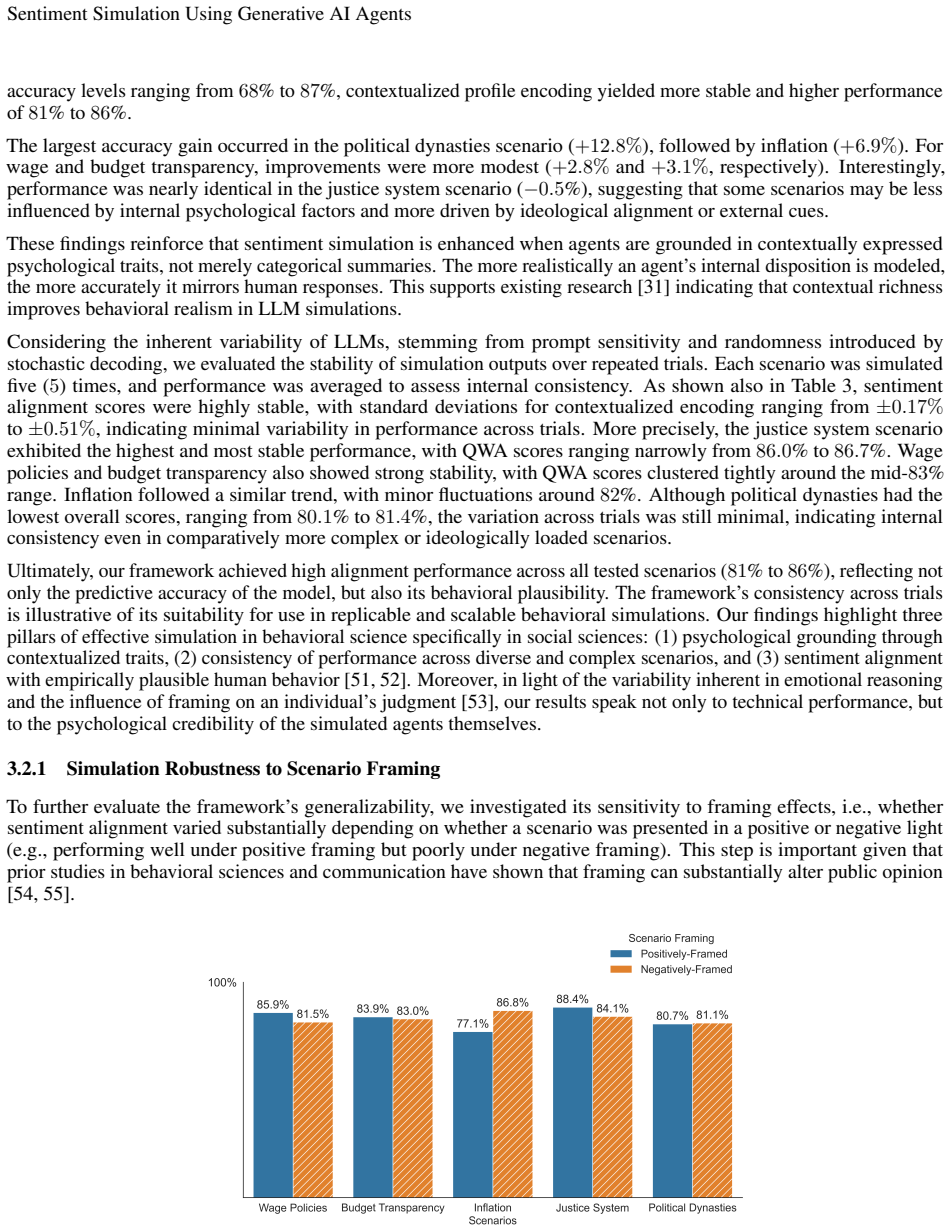
- The framing robustness means scenario wording can be varied to examine issue-presentation effects without changing the agent's underlying psychographic story.
- The low trial-to-trial variance ($\pm 0.2$-$0.5$ percentage points) makes the simulation reproducible enough for policy and narrative testing.
Reading between the lines
- The paper leaves implicit that the 81-86% ceiling may be close to human retest reliability, so further gains would likely require adding situational dynamics such as mood, recency, or peer effects rather than more detailed trait narratives.
- A testable extension beyond the paper's claims: remove the respondents' stored attitude items on the tested issues from the embodiment prompt and re-measure QWA; if alignment holds, the framework generalizes to novel issues not covered by the survey, and if it drops, the earlier numbers are partly retrieval.
- If the framework is valid, it could be used to build counterfactual populations, such as different demographic distributions, for policy debates without running a new survey, but the authors do not demonstrate that out-of-distribution use.
Editorial analysis
A structured set of objections, weighed in public.
Referee Report
Summary. The paper proposes a framework for simulating human sentiment by instantiating LLM agents with psychological profiles derived from a nationally representative Philippine survey (N=2,485). Agents are embodied using categorical or contextualized prompt encodings of sociodemographic and psychographic variables, exposed to socio-political and economic scenarios, and asked to produce 5-point sentiment ratings with rationales. The authors report 92% QWA in a survey replication task and 81%–86% QWA in sentiment simulation, with contextualized encoding outperforming categorical encoding and with results reported as stable across repeated trials and framing conditions. The central claim is that psychographically grounded generative agents can prospectively simulate human sentiment at high fidelity.
Significance. If the central claim were established, the framework would be a valuable tool for policy testing, narrative framing analysis, and synthetic-population research. The paper has concrete strengths: a large and nationally representative survey sample; integration of validated psychological constructs into agent prompts; a systematic comparison of two encoding strategies; and explicit attention to trial-to-trial stability and framing robustness. However, the current evidence does not establish the claim. The sentiment-simulation task may be circular because the profile appears to include attitudes toward the same topics used as test scenarios, and the headline "accuracy" is Quadratic Weighted Accuracy, a lenient ordinal agreement score whose chance baseline is 75% on a 5-point scale. These two issues are load-bearing for the paper's main conclusion, so the manuscript requires substantial revision rather than minor polishing.
major comments (3)
- [§2.2.2, §A.1] The circularity concern raised in review is substantiated. Supplementary A.1 states that the survey instrument includes "general citizen attitudes toward four major economic issues (e.g., inflation, minimum wage, etc) and four key social issues," while Section 2.2.2 tests scenarios on inflation, wage policies, budget transparency, political dynasties, and the justice system. If these attitudes are part of the agent profile used to construct the prompt, the simulation task can be solved by retrieving a stored opinion rather than by generating a new sentiment. The paper does not state that the target sentiment items were excluded from the profile during the sentiment simulation task. Please report the exact list of profile variables, run an ablation that removes the five scenario target variables from the profile, or otherwise demonstrate that the target responses are not contained in the prompt.
- [§2.3.1, Table 3] The headline "81% to 86% accuracy" in the abstract and Section 3.2 is Quadratic Weighted Accuracy, not exact-match accuracy. For a 5-point scale, Eq. (1) gives 93.75% credit for a one-category miss, and the expected QWA for two independent uniform random responses is 75%. Table 3 therefore reports values that are only 6–11 percentage points above a chance baseline, while the text compares them with "accuracy" values from prior studies (e.g., the 69–73% and 76% figures cited in Section 3.1). Please report exact-match accuracy, adjacent-match rates, confusion matrices, and a chance or majority-class baseline, and rename the table and axis labels accordingly.
- [§3.2.1] The framing-invariance claim rests on a paired comparison of QWA scores across positive and negative framing, but with only five scenarios the analysis has very low power; p=0.9676 and Cohen's d=0.02 cannot establish that framing has no effect on agent-level sentiment. Please report the analysis at the respondent/agent level (2,485 agents, or a clearly stated subsample) or provide a power analysis justifying the scenario-level test.
minor comments (5)
- [Table 3] The table headers should read "Mean QWA" and "SD across five trials" rather than "Average SD" and "Accuracy," to avoid conflating weighted agreement with exact-match accuracy.
- [§2.1] Section 2.1 cites the psychological frameworks by name but does not cite the original validation studies for HEXACO, Schwartz values, Affective Intelligence Theory, or Social Axioms; those references should be added.
- [Supplementary B–C] The prompt templates show placeholders but no fully instantiated prompt; include one complete example prompt for a real respondent to make the method reproducible and to let readers verify which variables enter the prompt.
- [§2.2.1] The procedure for constructing contextualized narrative descriptions is not described; state whether these narratives were hand-authored or LLM-generated and whether any checks were performed to ensure they do not encode the target sentiment.
- [§2.2.3] Section 2.2.3 mentions a self-assessment step (a Yes/No consistency check) but does not say whether responses failing this check were filtered, re-generated, or retained; the decision rule should be stated.
Circularity Check
Both headline results—92% survey replication and 81–86% sentiment simulation—test attitudes already supplied in the agent profile, so the reported alignment largely measures profile recall rather than generative prediction.
-
self definitional
[Section 1 Contributions, A.1 Survey Design, and 2.2.2 Agent Exposure to Scenario]
"These profiles incorporate socio-demographic data and variables from validated psychological frameworks and attitudes on key socio-political and economic issues, providing agents with psychographically grounded priors. ... A.1: 'the survey instrument also includes an additional section to assess general citizen attitudes toward four major economic issues (e.g., inflation, minimum wage, etc) and four key social issues (e.g., the West Philippine Sea dispute, corruption, etc).' 2.2.2: 'agents were presented with real-world scenarios ..."
The agent profile is described as including attitudes on the same issues used as test scenarios: inflation and minimum wage/wage policies appear both in the survey's attitude section and in the scenario list. For those scenarios, the simulated 5-point sentiment is an attitude already present in the prompt, so a high QWA reflects retrieval or restatement of stored opinion rather than generative prediction. The paper never states that the target scenario attitudes were excluded from the profile during the sentiment simulation task, and the prompt templates in Supplementary B/C are dynamically populated with real survey data without listing such exclusions. The 81–86% alignment therefore does not establish out-of-sample sentiment simulation.
-
self definitional
[Section 2.2.1 Agent Embodiment]
"To evaluate the effectiveness of embodiment, we conducted a survey replication task wherein each agent, embodied with a specific respondent's profile, answered the same Likert-scale survey items as the human participant."
The agent is constructed from the respondent's own survey-derived profile and is then asked to re-answer the same survey instrument that generated that profile. The reported 92% alignment is therefore a measure of how faithfully the LLM echoes its input profile, not a prediction of unseen responses. This task tests prompt consistency, not the capacity to simulate individual-level psychographic data prospectively.
full rationale
The central empirical claims are that profiles can replicate the original survey (92% QWA) and that agents simulate sentiment on scenarios (81–86% QWA). Both reduce to reading back inputs. The profile is built from the respondent's survey responses, including attitudes on the same economic and social issues used as scenarios; the replication task re-asks the same items; and the simulation task asks for sentiment on inflation, wage policies, and related topics that are listed among the profile's stored attitudes. No holdout of target variables is described. Thus the favorable QWA numbers do not demonstrate out-of-sample generative prediction. The categorical-versus-contextualized comparison and framing-robustness tests are not themselves circular, but they compare two ways of retrieving stored opinions and do not rescue the simulation claim. The only self-citation (ref. [46], used to justify model selection) is not load-bearing for the central result, so it does not further increase the score. The score reflects partial but central circularity: the replication task is circular by construction, and at least the inflation and wage-policy scenarios in the simulation task overlap directly with profile attitudes.
Assumptions & free parameters
free parameters (1)
- Contextualized narrative templates =
Hand-authored prompt text, not disclosed
assumptions (4)
- domain assumption LLM-generated responses can stand in for human psychological processes
- domain assumption The survey constructs are temporally stable and valid for Filipino adults
- ad hoc to paper Llama 3.1 70B is appropriate for unbiased political simulation
- standard math QWA is a sufficient accuracy metric for ordinal sentiment
Cite this review
Pith. "Pith review of Sentiment Simulation using Generative AI Agents." pith.science (2026). https://pith.science/paper/OGHWF3TT
@misc{pith2026250522125,
  author       = {Pith},
  title        = {Pith review of: Sentiment Simulation using Generative AI Agents},
  year         = {2026},
  howpublished = {\url{https://pith.science/paper/OGHWF3TT}},
  note         = {Machine review of arXiv:2505.22125}
}
read the original abstract
Traditional sentiment analysis relies on surface-level linguistic patterns and retrospective data, limiting its ability to capture the psychological and contextual drivers of human sentiment. These limitations constrain its effectiveness in applications that require predictive insight, such as policy testing, narrative framing, and behavioral forecasting. We present a robust framework for sentiment simulation using generative AI agents embedded with psychologically rich profiles. Agents are instantiated from a nationally representative survey of 2,485 Filipino respondents, combining sociodemographic information with validated constructs of personality traits, values, beliefs, and socio-political attitudes. The framework includes three stages: (1) agent embodiment via categorical or contextualized encodings, (2) exposure to real-world political and economic scenarios, and (3) generation of sentiment ratings accompanied by explanatory rationales. Using Quadratic Weighted Accuracy (QWA), we evaluated alignment between agent-generated and human responses. Contextualized encoding achieved 92% alignment in replicating original survey responses. In sentiment simulation tasks, agents reached 81%--86% accuracy against ground truth sentiment, with contextualized profile encodings significantly outperforming categorical (p < 0.0001, Cohen's d = 0.70). Simulation results remained consistent across repeated trials (+/-0.2--0.5% SD) and resilient to variation in scenario framing (p = 0.9676, Cohen's d = 0.02). Our findings establish a scalable framework for sentiment modeling through psychographically grounded AI agents. This work signals a paradigm shift in sentiment analysis from retrospective classification to prospective and dynamic simulation grounded in psychology of sentiment formation.
Figures


Figures from the paper (7 more)


Reference graph
Works this paper leans on
-
[1]
Opinion mining and sentiment analysis
Bo Pang, Lillian Lee, et al. Opinion mining and sentiment analysis. Foundations and Trends® in information retrieval, 2(1–2):1–135, 2008. 10 Sentiment Simulation Using Generative AI Agents
work page 2008
-
[2]
Sentiment analysis and opinion mining
Bing Liu. Sentiment analysis and opinion mining. Springer Nature, 2012
work page 2012
-
[3]
Sentiment analysis: Capturing favorability using natural language processing
Tetsuya Nasukawa and Jeonghee Yi. Sentiment analysis: Capturing favorability using natural language processing. In Proceedings of the 2nd international conference on Knowledge capture, pages 70–77, 2003
work page 2003
-
[4]
Mining the peanut gallery: Opinion extraction and semantic classification of product reviews
Kushal Dave, Steve Lawrence, and David M Pennock. Mining the peanut gallery: Opinion extraction and semantic classification of product reviews. In Proceedings of the 12th international conference on World Wide Web, pages 519–528, 2003
work page 2003
-
[5]
Opinion quality in public opinion research
Vincent Price and Peter Neijens. Opinion quality in public opinion research. International Journal of Public Opinion Research, 9(4):336–360, 1997
work page 1997
-
[6]
Opinion mining and sentiment analysis in policy formulation initiatives: The eu-community approach
Yannis Charalabidis, Manolis Maragoudakis, and Euripides Loukis. Opinion mining and sentiment analysis in policy formulation initiatives: The eu-community approach. InElectronic Participation: 7th IFIP 8.5 International Conference, ePart 2015, Thessaloniki, Greece, August 30–September 2, 2015, Proceedings 7, pages 147–160. Springer, 2015
work page 2015
-
[7]
Sentiment analysis of the new indonesian government policy (omnibus law) on social media twitter
Eki Aidio Sukma, Achmad Nizar Hidayanto, Adam Imansyah Pandesenda, Arif Nur Yahya, Punto Widharto, and Untung Rahardja. Sentiment analysis of the new indonesian government policy (omnibus law) on social media twitter. In 2020 International Conference on Informatics, Multimedia, Cyber and Information System (ICIMCIS), pages 153–158. IEEE, 2020
work page 2020
-
[8]
Jiri Hradec, Nicole Ostlaender, Alba Bernini, et al. Fables: framework for autonomous behaviour-rich language- driven emotion-enabled synthetic populations. Technical report, Joint Research Centre, 2023
work page 2023
Show all 57 references
-
[9]
Like, comment, and share: Analyzing public sentiments of government policies in social media
Jana Flor V Vizmanos, Sheila V Siar, Jose Ramon G Albert, Janina Luz C Sarmiento, and Angelo C Hernandez. Like, comment, and share: Analyzing public sentiments of government policies in social media. Technical report, PIDS Discussion Paper Series, 2023
2023
-
[10]
Sentiment analysis of facebook users reacting to political campaign posts
Rodrigo Sandoval-Almazan and David Valle-Cruz. Sentiment analysis of facebook users reacting to political campaign posts. Digital Government: Research and Practice, 1(2):1–13, 2020
2020
-
[11]
It is not only what you say, it is also how you say it: The strategic use of campaign sentiment
Charles Crabtree, Matt Golder, Thomas Gschwend, and Indri ¯di H Indri ¯dason. It is not only what you say, it is also how you say it: The strategic use of campaign sentiment. The Journal of Politics, 82(3):1044–1060, 2020
2020
-
[12]
Exploring philippine presidentsâ C™ speeches: A sentiment analysis and topic modeling approach
John Paul P Miranda and Rex P Bringula. Exploring philippine presidentsâ C™ speeches: A sentiment analysis and topic modeling approach. Cogent Social Sciences, 7(1):1932030, 2021
2021
-
[13]
Sentiment analysis: A case study among the selected government agencies in the philippines
Julieta M Umali, John Paul P Miranda, and Anicia L Ferrer. Sentiment analysis: A case study among the selected government agencies in the philippines. International Journal, 9(3), 2020
2020
-
[14]
Pre-and post-launch emotions in new product development: Insights from twitter analytics of three products
Ashish Kumar Rathore and P Vigneswara Ilavarasan. Pre-and post-launch emotions in new product development: Insights from twitter analytics of three products. International Journal of Information Management, 50:111–127, 2020
2020
-
[15]
Social media and sensemaking patterns in new product development: demystifying the customer sentiment
Mihalis Giannakis, Rameshwar Dubey, Shishi Yan, Konstantina Spanaki, and Thanos Papadopoulos. Social media and sensemaking patterns in new product development: demystifying the customer sentiment. Annals of Operations Research, 308:145–175, 2022
2022
-
[16]
Exploring sentiment analysis on e-commerce business: Lazada and shopee
Jenny Yow Bee Yin, Nor Hasliza Md Saad, and Zulnaidi Yaacob. Exploring sentiment analysis on e-commerce business: Lazada and shopee. Tem journal, 11(4):1508, 2022
2022
-
[17]
A systematic literature review on machine learning applications for consumer sentiment analysis using online reviews
Praphula Kumar Jain, Rajendra Pamula, and Gautam Srivastava. A systematic literature review on machine learning applications for consumer sentiment analysis using online reviews. Computer science review, 41:100413, 2021
2021
-
[18]
Sentiment analysis of product reviews using machine learning and pre-trained llm
Pawanjit Singh Ghatora, Seyed Ebrahim Hosseini, Shahbaz Pervez, Muhammad Javed Iqbal, and Nabil Shaukat. Sentiment analysis of product reviews using machine learning and pre-trained llm. Big Data and Cognitive Computing, 8(12):199, 2024
2024
-
[19]
Sentiment analysis in the age of generative ai
Jan Ole Krugmann and Jochen Hartmann. Sentiment analysis in the age of generative ai. Customer Needs and Solutions, 11(1):3, 2024
2024
-
[20]
Sentiment analysis methods, applications, and challenges: A systematic literature review
Yanying Mao, Qun Liu, and Yu Zhang. Sentiment analysis methods, applications, and challenges: A systematic literature review. Journal of King Saud University-Computer and Information Sciences, page 102048, 2024
2024
-
[21]
Recent advancements and challenges of nlp-based sentiment analysis: A state-of-the-art review
Jamin Rahman Jim, Md Apon Riaz Talukder, Partha Malakar, Md Mohsin Kabir, Kamruddin Nur, and Mo- hammed Firoz Mridha. Recent advancements and challenges of nlp-based sentiment analysis: A state-of-the-art review. Natural Language Processing Journal, page 100059, 2024
2024
-
[22]
Identifying biased users in online social networks to enhance the accuracy of sentiment analysis: A user behavior-based approach
Amin Mahmoudi. Identifying biased users in online social networks to enhance the accuracy of sentiment analysis: A user behavior-based approach. arXiv preprint arXiv:2105.05950, 2021. 11 Sentiment Simulation Using Generative AI Agents
2021 arXiv
-
[23]
Personality-based refinement for sentiment classification in microblog
Junjie Lin, Wenji Mao, and Daniel D Zeng. Personality-based refinement for sentiment classification in microblog. Knowledge-Based Systems, 132:204–214, 2017
2017
-
[24]
Personality associations with attitudes toward ai
Jiyoung Park and Sang Eun Woo. Personality associations with attitudes toward ai. In The Impact of Artificial Intelligence on Societies: Understanding Attitude Formation Towards AI, pages 57–70. Springer, 2024
2024
-
[25]
Beyond weird: Can synthetic survey participants substitute for humans in global policy research? Behavioral Science & Policy, page 23794607241311793, 2025
Pujen Shrestha, Dario Krpan, Fatima Koaik, Robin Schnider, Dima Sayess, and May Saad Binbaz. Beyond weird: Can synthetic survey participants substitute for humans in global policy research? Behavioral Science & Policy, page 23794607241311793, 2025
2025
-
[26]
The emergence of social media data and sentiment analysis in election prediction
Priyavrat Chauhan, Nonita Sharma, and Geeta Sikka. The emergence of social media data and sentiment analysis in election prediction. Journal of Ambient Intelligence and Humanized Computing, 12:2601–2627, 2021
2021
-
[27]
Improving sentiment analysis in election-based conversations on twitter with elecbert language model
Asif Khan, Huaping Zhang, Nada Boudjellal, Arshad Ahmad, and Maqbool Khan. Improving sentiment analysis in election-based conversations on twitter with elecbert language model. Computers, Materials & Continua, 76(3), 2023
2023
-
[28]
Situated cognition
Wolff-Michael Roth and Alfredo Jornet. Situated cognition. Wiley Interdisciplinary Reviews: Cognitive Science, 4(5):463–478, 2013
2013
-
[29]
EBook: Social Psychology 3e
David Myers, Jackie Abell, and Fabio Sani. EBook: Social Psychology 3e. McGraw Hill, 2020
2020
-
[30]
Reflections on sentiment/opinion analysis
Jiwei Li and Eduard Hovy. Reflections on sentiment/opinion analysis. A practical guide to sentiment analysis, pages 41–59, 2017
2017
-
[31]
Can large language model agents simulate human trust behavior? In The Thirty-eighth Annual Conference on Neural Information Processing Systems, 2024
Chengxing Xie, Canyu Chen, Feiran Jia, Ziyu Ye, Shiyang Lai, Kai Shu, Jindong Gu, Adel Bibi, Ziniu Hu, David Jurgens, et al. Can large language model agents simulate human trust behavior? In The Thirty-eighth Annual Conference on Neural Information Processing Systems, 2024
2024
-
[32]
Using large language models to simulate multiple humans and replicate human subject studies
Gati V Aher, Rosa I Arriaga, and Adam Tauman Kalai. Using large language models to simulate multiple humans and replicate human subject studies. In International Conference on Machine Learning, pages 337–371. PMLR, 2023
2023
-
[33]
Llm-driven agents for influencer selection in digital advertising campaigns
Xiaoqing Zhang, Xiuying Chen, Yuhan Liu, Jianzhou Wang, Zhenxing Hu, and Rui Yan. Llm-driven agents for influencer selection in digital advertising campaigns. arXiv e-prints, pages arXiv–2403, 2024
2024
-
[34]
Zou Aaron Shaw Benjamin Mako Hill Carrie Cai Meredith Ringel Morris Robb Willer Percy Liang Park, Joon Sung and Michael S
Carolyn Q. Zou Aaron Shaw Benjamin Mako Hill Carrie Cai Meredith Ringel Morris Robb Willer Percy Liang Park, Joon Sung and Michael S. Bernstein. Generative agent simulations of 1,000 people. arXiv preprint, page arXiv:2411.10109, 2024
2024 arXiv
-
[35]
Chawla Olaf Wiest Guo, Taicheng and Xiangliang Zhang
Xiuying Chen Yaqi Wang Ruidi Chang Shichao Pei Nitesh V . Chawla Olaf Wiest Guo, Taicheng and Xiangliang Zhang. Large language model based multi-agents: A survey of progress and challenges. arXiv preprint, page arXiv:2402.01680, 2024
2024 arXiv
-
[36]
Generative agents: Interactive simulacra of human behavior
Joon Sung Park, Joseph O’Brien, Carrie Jun Cai, Meredith Ringel Morris, Percy Liang, and Michael S Bernstein. Generative agents: Interactive simulacra of human behavior. In Proceedings of the 36th annual acm symposium on user interface software and technology, pages 1–22, 2023
2023
-
[37]
User behavior simulation with large language model based agents
Lei Wang, Jingsen Zhang, Hao Yang, Zhiyuan Chen, Jiakai Tang, Zeyu Zhang, Xu Chen, Yankai Lin, Ruihua Song, Wayne Xin Zhao, et al. User behavior simulation with large language model based agents. arXiv preprint arXiv:2306.02552, 2023
2023 arXiv
-
[38]
Evaluating the ability of large language models to emulate personality
Yilei Wang, Jiabao Zhao, Deniz S Ones, Liang He, and Xin Xu. Evaluating the ability of large language models to emulate personality. Scientific reports, 15(1):519, 2025
2025
-
[39]
Personality
American Psychological Association. Personality. https://dictionary.apa.org/personality, n.d. APA Dictionary of Psychology
-
[40]
Changing personal values through value-manipulation tasks: a systematic literature review based on schwartzâC™s theory of basic human values
Claudia Russo, Francesca Danioni, Ioana Zagrean, and Daniela Barni. Changing personal values through value-manipulation tasks: a systematic literature review based on schwartzâC™s theory of basic human values. European Journal of Investigation in Health, Psychology and Educati...
2022
-
[41]
Social axioms and psychological toll: A study of emotional, behavioral, and cognitive responses across 35 cultures during the covid-19 pandemic
Frank Tian-fang Ye, Bryant PH Hui, Jacky CK Ng, Ben CP Lam, Algae KY Au, Wesley CH Wu, Hilary KY Ng, and Sylvia Xiaohua Chen. Social axioms and psychological toll: A study of emotional, behavioral, and cognitive responses across 35 cultures during the covid-19 pandemic. Applie...
2024
-
[42]
Ulat ng bayan: June 2024 nationwide survey on national concerns prior to the sona
Pulse Asia Research Inc. Ulat ng bayan: June 2024 nationwide survey on national concerns prior to the sona. Research report, Pulse Asia Research Inc., July 2024. Accessed: 2025-04-16
2024
-
[43]
Filipino personality structure and the big five model: A lexical approach
A Timothy Church, Jose Alberto S Reyes, Marcia S Katigbak, and Stephanie D Grimm. Filipino personality structure and the big five model: A lexical approach. Journal of Personality, 65(3):477–528, 1997. 12 Sentiment Simulation Using Generative AI Agents
1997
-
[44]
The development of the masaklaw na panukat ng loob (mapa ng loob)
Gregorio EH Del Pilar. The development of the masaklaw na panukat ng loob (mapa ng loob). Philippine Journal Of Psychology, 50(1):103–141, 2017
2017
-
[45]
Personality disorders and the five-factor model among filipino non-clinical sample
Mary Rachelle R Wapaño. Personality disorders and the five-factor model among filipino non-clinical sample. International Journal of Research and Innovation in Social Science (IJRISS), V , 2021
2021
-
[46]
Measuring political bias and framing effects in large language models (llms): A sensitivity analysis
Melrose Tia, Jerome Espina, and Jason Albia. Measuring political bias and framing effects in large language models (llms): A sensitivity analysis. Manuscript in preparation, 2025
2025
-
[47]
The llama 3 herd of models
Aaron Grattafiori, Abhimanyu Dubey, Abhinav Jauhri, Abhinav Pandey, Abhishek Kadian, Ahmad Al-Dahle, Aiesha Letman, Akhil Mathur, Alan Schelten, Alex Vaughan, et al. The llama 3 herd of models. arXiv preprint arXiv:2407.21783, 2024
2024 arXiv
-
[48]
A common language effect size statistic
Kenneth O McGraw and Seok P Wong. A common language effect size statistic. Psychological bulletin, 111(2):361, 1992
1992
-
[49]
Llm-mirror: A generated-persona approach for survey pre-testing
Sunwoong Kim, Jongho Jeong, Jin Soo Han, and Donghyuk Shin. Llm-mirror: A generated-persona approach for survey pre-testing. arXiv e-prints, pages arXiv–2412, 2024
2024
-
[50]
Using large language models to create ai personas for replication and prediction of media effects: An empirical test of 133 published experimental research findings
Leo Yeykelis, Kaavya Pichai, James J Cummings, and Byron Reeves. Using large language models to create ai personas for replication and prediction of media effects: An empirical test of 133 published experimental research findings. arXiv preprint arXiv:2408.16073, 2024
2024 arXiv
-
[51]
Lab experiments are a major source of knowledge in the social sciences
Armin Falk and James J Heckman. Lab experiments are a major source of knowledge in the social sciences. science, 326(5952):535–538, 2009
2009
-
[52]
Life in the network: the coming age of computational social science
David Lazer, Devon Brewer, Nicholas Christakis, James Fowler, and Gary King. Life in the network: the coming age of computational social science. Science, 323(5915):721–723, 2009
2009
-
[53]
Choices, values, and frames
Daniel Kahneman and Amos Tversky. Choices, values, and frames. American psychologist, 39(4):341, 1984
1984
-
[54]
Framing theory
Dennis Chong and James N Druckman. Framing theory. Annu. Rev. Polit. Sci., 10(1):103–126, 2007
2007
-
[55]
The structure of political argument and the logic of issue framing
Paul M Sniderman and Sean M Theriault. The structure of political argument and the logic of issue framing. Studies in public opinion: Attitudes, nonattitudes, measurement error, and change, 3(03):133–65, 2004
2004
-
[56]
Personality trait structure as a human universal
Robert R McCrae and Paul T Costa Jr. Personality trait structure as a human universal. American psychologist, 52(5):509, 1997
1997
-
[57]
2022 registered voters and voters with accessible polling places (final)
Commission on Elections (COMELEC). 2022 registered voters and voters with accessible polling places (final). https://comelec.gov.ph/?r=2022NLE/Statistics/2022RVVAVmcocfinal, 2022. Accessed: 2024-10- 01. 13 Sentiment Simulation Using Generative AI Agents Supplementary Material ...
2022
Reviewed August 7, 2026 · model on record in the stance chip above.
Discussion (0). Sign in to comment.