REVIEW 3 major objections 5 minor 1 cited by
What Makes for Text to 360-degree Panorama Generation with Stable Diffusion?
T0 review · 3 major / 5 minor · reviewed 2026-08-07 · deepseek-v4-flash
Pith's one-line read Fine-tuning Stable Diffusion for 360-degree panoramas succeeds because the value and output projections of cross-attention carry the spherical structure, while query and key projections do not; freezing query/key and strengthening output…
desk verdict A solid empirical study with a clean method whose headline mechanistic claim ('Wq/Wk learn shared knowledge') is not actually supported by its own experiments. read the letter →
The pith
A machine-rendered reading of the paper's core claim, the machinery that carries it, and where it could break.
The reading
What carries the argument
The argument is carried by the four LoRA weight matrices of the cross-attention block, $W_q$, $W_k$, $W_v$, $W_o$, with $Q = z_t W_q$, $K = y W_k$, $V = y W_v$, and the output projection $W_o$. Two probing procedures do the analytical work: training each matrix in isolation to see whether it can learn the spherical structure, and deactivating subsets of LoRAs after joint fine-tuning to see which are load-bearing for panorama versus perspective generation. UniPano turns the findings into a design: it freezes $W_q$ and $W_k$, keeps $W_v$ as a LoRA, and replaces the $W_o$ LoRA with a mixture of experts (four LoRA experts, top-2 routing, load-balancing auxiliary loss), which the ablations show is the best of the compared capacity-boosting choices.
What would settle it
Measure the relative size and effective rank of each LoRA update after joint fine-tuning: if $\|\Delta W_q\|/\|W_q\|$ and $\|\Delta W_k\|/\|W_k\|$ are negligible compared with the value/output updates, the 'shared knowledge' reading is falsified, because the only observed effect of removing query/key LoRAs would be explained by their smallness. Alternatively, apply the trained query/key LoRAs to ordinary perspective-image prompts and compare outputs against the base model with random updates of the same scale: no detectable difference would show that these LoRAs carry no usable shared knowledge.
Extended reading notes
Core claim
The central discovery is a functional division of labor inside the cross-attention modules during LoRA fine-tuning for panorama generation. The paper shows that training only $W_q$ or $W_k$ on panoramic data fails to produce spherical/equirectangular structure, while training only $W_v$ or $W_o$ succeeds. After joint fine-tuning, removing the $W_v$ and $W_o$ LoRAs restores the model's ability to generate perspective images, and removing $W_q$ and $W_k$ does not change panoramic outputs. From this the authors conclude that $W_q$ and $W_k$ learn domain-shared semantic information that is irrelevant to the panorama, while $W_v$ and $W_o$ specialize in the equirectangular structure; UniPano then freezes $W_q$/$W_k$, strengthens $W_o$ with a mixture of LoRA experts, and shows this beats or matches the dual-branch baseline at lower cost.
Load-bearing premise
The load-bearing premise is that the deactivation experiment reveals what the query/key low-rank updates learned, but the same visual outcomes would occur if those updates are simply small enough to be harmless; UniPano itself needs only the weaker claim that they are unnecessary.
Editorial extensions
If this is right
- Freezing $W_q$ and $W_k$ during panoramic fine-tuning does not hurt quality: in the ablations it improves FID while keeping FAED comparable to full LoRA, so roughly half the trainable attention weights can be dropped.
- Extra capacity for panorama generation should be spent on $W_o$, not on query/key or on extra branches; replacing the $W_o$ LoRA with a mixture of experts yields the largest gains in the paper's ablations.
- The dual-branch design of the prior strongest system is not necessary to reach its quality: UniPano reports better FAED and horizontal-view FID than PanFusion while using roughly half the peak GPU memory and about half the training time.
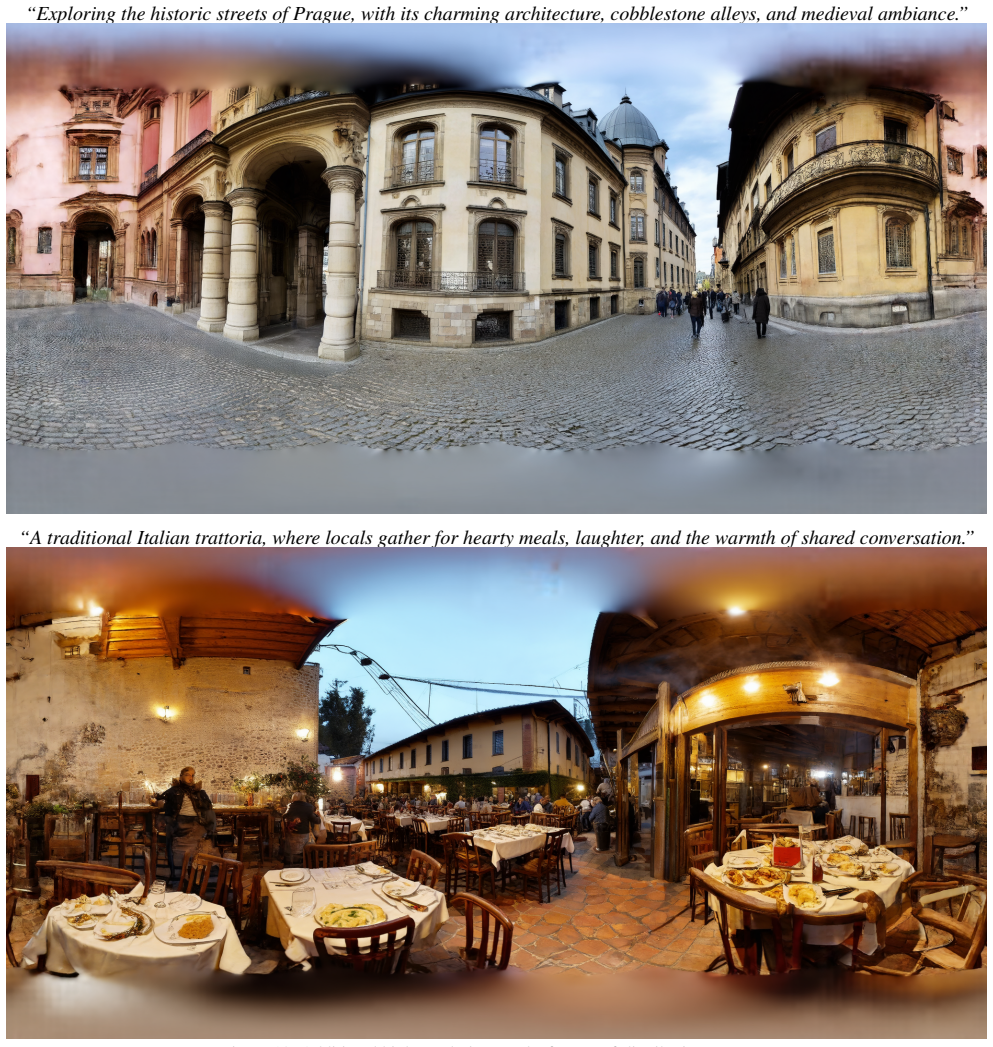
- Cheaper training makes end-to-end higher-resolution panoramas practical: the same recipe builds on Stable Diffusion 3 to generate 1024×2048 images directly, without a separate super-resolution stage.
- A single jointly fine-tuned checkpoint can serve both domains: dropping only the $W_v$/$W_o$ LoRAs returns the model to perspective generation, while keeping them produces panoramas.
Reading between the lines
- The deactivation result also follows if the query/key LoRA updates are merely small; a direct comparison of the norms or effective ranks of the four updates, or a transfer test that applies the q/k LoRAs to perspective prompts, would separate 'shared knowledge' from 'effectively unchanged'.
- If the pattern is general, other geometric or domain shifts handled by diffusion fine-tuning — depth estimation, outpainting, stylization — might also be carried mainly by value/output projections, so the freeze-query/key recipe could be tested there.
- The saturation of the mixture of experts at only four experts suggests the fine-tuning task needs modest extra capacity, so a single higher-rank LoRA on $W_o$ might capture much of the benefit without routing overhead; the paper does not test this.
Editorial analysis
A structured set of objections, weighed in public.
Referee Report
Summary. This paper studies LoRA fine-tuning of Stable Diffusion for text-to-360-degree panorama generation. It isolates the four cross-attention weight matrices Wq, Wk, Wv, Wo and reports two findings: (1) training Wv or Wo in isolation captures equirectangular structure while Wq or Wk does not; (2) after joint fine-tuning, deactivating Wv/Wo restores perspective generation, while deactivating Wq/Wk leaves panorama generation unchanged. From this the authors conclude that Wq/Wk encode shared perspective-panorama knowledge and Wv/Wo specialize in panoramic structure. Based on this analysis, they propose UniPano, which freezes Wq/Wk and replaces the Wo LoRA with a mixture of LoRA experts. UniPano is reported to outperform prior methods on Matterport3D at 512x1024 and to scale to 1024x2048 with Stable Diffusion 3, while using less memory and training time than PanFusion.
Significance. If the central mechanistic claim is supported, the paper would make a useful contribution to understanding parameter-efficient fine-tuning for domain transfer, and the UniPano recipe itself is a simple, memory-efficient baseline that the community could adopt. The strengths of the paper are its clean ablation structure, the direct comparison of alternative capacity-boosting designs for Wo, the explicit memory/time reporting, and the promise of code release. However, the paper's main interpretative conclusion is currently underdetermined by the presented evidence, and the quantitative comparison lacks variance estimates; these issues need to be resolved before the significance can be fully assessed.
major comments (3)
- [Sec. 3.2 (Conclusion 3.5, Fig. 4)] The deactivation experiment does not support the strong mechanistic claim that Wq/Wk 'learn shared knowledge' and 'preserve/enhance' the perspective prior. The observation that removing Wv/Wo restores perspective generation (Fig. 4c) is exactly what would be expected if the Wq/Wk LoRAs were near-identity or functionally dead, because the base perspective model would then dominate regardless of those LoRAs; similarly, Fig. 4d shows only that Wq/Wk are unnecessary for panorama generation. No norm, scale, or functional-difference measurement of the learned LoRA deltas is reported, so the evidence cannot distinguish 'shared knowledge' from 'no contribution.' I request a control in which random or zero-initialized Wq/Wk LoRAs are used instead, plus quantitative measures (e.g., delta norms, projection alignment, or head-level ablation) that positively identify what Wq/Wk encode. The UniPano recipe depends only on the weaker claim that Wq/Wk can be frozen, which the ablations support, but the paper's abstract and conclusion rest on the stronger interpretation.
- [Table 3 and Appendix B] The state-of-the-art comparison is not fully supported as reported. The caption states that results are reproduced with FP32 precision, but Appendix B states that SD+LoRA, Pano Only, and PanFusion metrics are directly taken from [56]; no own runs, seeds, or confidence intervals are provided. The reported FAED gap between UniPano (5.90) and PanFusion (6.04) is small and may be within run-to-run noise, especially given the 20-view sampling randomness. Please reproduce all baselines under identical conditions with at least three seeds, report mean and standard deviation, and reconcile the footnote with the appendix.
- [Sec. 3.3, Tables 2, 4, 5] The design choice of MoE over the other Wo-capacity strategies is made on the same Matterport3D evaluation set used for the final comparison, and the MoE hyperparameters (n=4, k=2) are selected from Table 5 on that same set; this creates a selection-circularity risk. In addition, Table 4 shows that freezing Wq/Wk yields mixed results relative to the LoRA baseline (FAED 7.99 vs. 7.90, FID 48.62 vs. 50.40), so the claim that freezing improves performance is not uniformly supported. Please validate the key choices on a held-out prompt set or with multiple seeds, or temper the claim accordingly.
minor comments (5)
- [Sec. 4.3] The phrase 'non-parametric-specific information' should probably read 'non-panorama-specific information' or 'panorama-agnostic information'; as written it is confusing.
- [Fig. 9 caption] The caption lists '1024 x 2024', while the text and Fig. 1 state 1024 x 2048; please correct the typo.
- [Appendix B] For MVDiffusion, the statement that reported results are 'directly taken from [56]' conflicts with the description of a resolution change; please specify exactly which numbers were recomputed and which were copied.
- [Sec. 4.4] The high-resolution experiments are qualitative only and are described as illustrations; the abstract should not imply a fully evaluated scalability result without a clarifying caveat.
- [General] Please include a reproducibility statement with exact LoRA ranks, learning rates, MoE routing loss coefficient, and the number of training epochs for each of Wq, Wk, Wv, and Wo in the main text or supplementary material.
Circularity Check
No circularity found: the empirical analysis and UniPano design are based on direct experiments and external baselines; the main weakness is an underdetermined mechanistic interpretation, not a circular step.
full rationale
The paper's central claims are derived from isolation experiments (training Wq, Wk, Wv, Wo separately, Table 1 and Fig. 3) and deactivation experiments after joint fine-tuning (Fig. 4). These are direct empirical observations, not definitions or fitted-input predictions. The conclusion that Wq/Wk learn 'shared knowledge across panoramic and perspective domains' is an interpretation of Observation 3.4, which is also consistent with the null hypothesis that those LoRAs are near-identity or inactive. However, this underdetermination is a scientific-evidence limitation, not circularity: the claimed conclusion does not reduce by construction to the experimental setup, and the paper does not define Wq/Wk in terms of the outcome. The UniPano recipe (freezing Wq/Wk, increasing Wo capacity via MoE) is subsequently validated on the same Matterport3D benchmark, but this is standard empirical model selection rather than a fitted parameter being relabeled as a prediction. There are no load-bearing self-citations; references such as PanFusion [56] are prior external work, and no uniqueness theorem from the authors is invoked. The quantitative results are compared against external baselines, and the design ablation (Table 4) explicitly tests the proposed strategy versus the full-LoRA baseline. Thus the derivation chain is self-contained, and any weakness concerns interpretative rigor, not circular reasoning.
Assumptions & free parameters
free parameters (3)
- LoRA rank for Wv (and Wq/Wk when active) =
r=4
- Number of MoE experts for Wo =
n=4
- Top-k selected experts in MoE =
k=2
assumptions (4)
- domain assumption LoRA on cross-attention weights W{q,k,v,o} is sufficient to adapt Stable Diffusion for panorama generation.
- domain assumption Matterport3D with BLIP-2 captions and the split of [44,56] is an adequate evaluation corpus.
- domain assumption FID/FAED/IS/CS faithfully measure panorama quality.
- domain assumption The base Stable Diffusion model has a perspective prior that can be cleanly separated from panoramic structure.
Cite this review
Pith. "Pith review of What Makes for Text to 360-degree Panorama Generation with Stable Diffusion?." pith.science (2026). https://pith.science/paper/22VMUH32
@misc{pith2026250522129,
  author       = {Pith},
  title        = {Pith review of: What Makes for Text to 360-degree Panorama Generation with Stable Diffusion?},
  year         = {2026},
  howpublished = {\url{https://pith.science/paper/22VMUH32}},
  note         = {Machine review of arXiv:2505.22129}
}
read the original abstract
Recent prosperity of text-to-image diffusion models, e.g. Stable Diffusion, has stimulated research to adapt them to 360-degree panorama generation. Prior work has demonstrated the feasibility of using conventional low-rank adaptation techniques on pre-trained diffusion models to generate panoramic images. However, the substantial domain gap between perspective and panoramic images raises questions about the underlying mechanisms enabling this empirical success. We hypothesize and examine that the trainable counterparts exhibit distinct behaviors when fine-tuned on panoramic data, and such an adaptation conceals some intrinsic mechanism to leverage the prior knowledge within the pre-trained diffusion models. Our analysis reveals the following: 1) the query and key matrices in the attention modules are responsible for common information that can be shared between the panoramic and perspective domains, thus are less relevant to panorama generation; and 2) the value and output weight matrices specialize in adapting pre-trained knowledge to the panoramic domain, playing a more critical role during fine-tuning for panorama generation. We empirically verify these insights by introducing a simple framework called UniPano, with the objective of establishing an elegant baseline for future research. UniPano not only outperforms existing methods but also significantly reduces memory usage and training time compared to prior dual-branch approaches, making it scalable for end-to-end panorama generation with higher resolution. The code will be released.
Figures


Figures from the paper (10 more)




Forward citations
Cited by 1 Pith paper
-
PanoLora: Bridging Perspective and Panoramic Video Generation with LoRA Adaptation
Fine-tuning a pretrained video diffusion model with LoRA rank 16 on about 1,000 synthetic videos produces panoramic video with good seam closure, but the claim that rank must exceed 8 degrees of freedom is not proven.
Reference graph
Works this paper leans on
-
[56]
Taming stable diffusion for text to 360° panorama image generation
Cheng Zhang, Qianyi Wu, Camilo Cruz Gambardella, Xi- aoshui Huang, Dinh Phung, Wanli Ouyang, and Jianfei Cai. Taming stable diffusion for text to 360° panorama image generation. In CVPR, 2024. 1, 2, 3, 4, 6, 7, 8, 9, 11, 12, 13
work page 2024
-
[1]
Chief architect 360° panorama renderings. https : / / www . chiefarchitect . com / products / 360 - panorama-viewer. Accessed: 2025-03-03. 11
work page 2025
-
[2]
Online 360° panorama viewer vr. https : / / renderstuff . com / tools / 360 - panorama - web-viewer. Accessed: 2025-03-03. 11
work page 2025
-
[3]
Di- verse plausible 360-degree image outpainting for efficient 3dcg background creation
Naofumi Akimoto, Yuhi Matsuo, and Yoshimitsu Aoki. Di- verse plausible 360-degree image outpainting for efficient 3dcg background creation. In CVPR, 2022. 3
work page 2022
-
[4]
Multidiffusion: Fusing diffusion paths for controlled image generation
Omer Bar-Tal, Lior Yariv, Yaron Lipman, and Tali Dekel. Multidiffusion: Fusing diffusion paths for controlled image generation. In ICML, 2023. 3
work page 2023
-
[5]
Matterport3d: Learning from rgb-d data in indoor environments
Angel Chang, Angela Dai, Thomas Funkhouser, Maciej Hal- ber, Matthias Niessner, Manolis Savva, Shuran Song, Andy Zeng, and Yinda Zhang. Matterport3d: Learning from rgb-d data in indoor environments. In 3DV, 2017. 1, 6, 11
work page 2017
-
[6]
Dif- fusiondet: Diffusion model for object detection
Shoufa Chen, Peize Sun, Yibing Song, and Ping Luo. Dif- fusiondet: Diffusion model for object detection. In ICCV,
-
[7]
Text2light: Zero-shot text-driven hdr panorama generation
Zhaoxi Chen, Guangcong Wang, and Ziwei Liu. Text2light: Zero-shot text-driven hdr panorama generation. TOG, 2022. 6, 8
work page 2022
Show all 59 references
-
[8]
Text-to-3d using gaussian splatting
Zilong Chen, Feng Wang, Yikai Wang, and Huaping Liu. Text-to-3d using gaussian splatting. In CVPR, 2024. 3
2024
-
[9]
Scaling recti- fied flow transformers for high-resolution image synthesis
Patrick Esser, Sumith Kulal, Andreas Blattmann, Rahim Entezari, Jonas M ¨uller, Harry Saini, Yam Levi, Dominik Lorenz, Axel Sauer, Frederic Boesel, et al. Scaling recti- fied flow transformers for high-resolution image synthesis. In ICML, 2024. 3, 8
2024
-
[10]
Scaling diffusion transformers to 16 bil- lion parameters
Zhengcong Fei, Mingyuan Fan, Changqian Yu, Debang Li, and Junshi Huang. Scaling diffusion transformers to 16 bil- lion parameters. arXiv preprint arXiv:2407.11633, 2024. 6, 8
2024 arXiv
-
[11]
An image is worth one word: Personalizing text-to-image gen- eration using textual inversion
Rinon Gal, Yuval Alaluf, Yuval Atzmon, Or Patashnik, Amit H Bermano, Gal Chechik, and Daniel Cohen-Or. An image is worth one word: Personalizing text-to-image gen- eration using textual inversion. In ICLR, 2023. 3
2023
-
[12]
Neighborhood attention transformer
Ali Hassani, Steven Walton, Jiachen Li, Shen Li, and Humphrey Shi. Neighborhood attention transformer. In CVPR, 2023. 6
2023
-
[13]
Classifier-free diffusion guidance
Jonathan Ho and Tim Salimans. Classifier-free diffusion guidance. arXiv preprint arXiv:2207.12598, 2022. 11
2022 arXiv
-
[14]
Denoising diffu- sion probabilistic models
Jonathan Ho, Ajay Jain, and Pieter Abbeel. Denoising diffu- sion probabilistic models. In NeurIPS, 2020. 3
2020
-
[15]
LoRA: Low-rank adaptation of large language models
Edward J Hu, Yelong Shen, Phillip Wallis, Zeyuan Allen- Zhu, Yuanzhi Li, Shean Wang, Lu Wang, and Weizhu Chen. LoRA: Low-rank adaptation of large language models. In ICLR, 2022. 1, 3, 6, 7, 8, 11
2022
-
[16]
Squeeze-and-excitation net- works
Jie Hu, Li Shen, and Gang Sun. Squeeze-and-excitation net- works. In CVPR, 2018. 6
2018
-
[17]
Cubediff: Repurposing diffusion-based image models for panorama generation
Nikolai Kalischek, Michael Oechsle, Fabian Manhardt, Philipp Henzler, Konrad Schindler, and Federico Tombari. Cubediff: Repurposing diffusion-based image models for panorama generation. In ICLR, 2025. 1, 3
2025
-
[18]
Repurpos- ing diffusion-based image generators for monocular depth estimation
Bingxin Ke, Anton Obukhov, Shengyu Huang, Nando Met- zger, Rodrigo Caye Daudt, and Konrad Schindler. Repurpos- ing diffusion-based image generators for monocular depth estimation. In CVPR, 2024. 1, 3
2024
-
[19]
Panogen: Text-conditioned panoramic environment generation for vision-and-language navigation
Jialu Li and Mohit Bansal. Panogen: Text-conditioned panoramic environment generation for vision-and-language navigation. In NeurIPS, 2023. 1, 3
2023
-
[20]
Blip-2: Bootstrapping language-image pre-training with frozen image encoders and large language models
Junnan Li, Dongxu Li, Silvio Savarese, and Steven Hoi. Blip-2: Bootstrapping language-image pre-training with frozen image encoders and large language models. In ICML,
-
[21]
4k4dgen: Panoramic 4d generation at 4k resolution
Renjie Li, Panwang Pan, Bangbang Yang, Dejia Xu, Shi- jie Zhou, Xuanyang Zhang, Zeming Li, Achuta Kadambi, Zhangyang Wang, Zhengzhong Tu, et al. 4k4dgen: Panoramic 4d generation at 4k resolution. arXiv preprint arXiv:2406.13527, 2024. 1
2024 arXiv
-
[22]
Panofree: Tuning-free holistic multi- view image generation with cross-view self-guidance
Aoming Liu, Zhong Li, Zhang Chen, Nannan Li, Yi Xu, and Bryan A Plummer. Panofree: Tuning-free holistic multi- view image generation with cross-view self-guidance. In ECCV, 2024. 3
2024
-
[23]
Flow straight and fast: Learning to generate and transfer data with rectified flow
Xingchao Liu, Chengyue Gong, and Qiang Liu. Flow straight and fast: Learning to generate and transfer data with rectified flow. In ICLR, 2023. 3
2023
-
[24]
Decoupled weight decay regularization
Ilya Loshchilov and Frank Hutter. Decoupled weight decay regularization. In ICLR, 2019. 6
2019
-
[25]
Autoregressive omni-aware outpainting for open- vocabulary 360-degree image generation
Zhuqiang Lu, Kun Hu, Chaoyue Wang, Lei Bai, and Zhiy- ong Wang. Autoregressive omni-aware outpainting for open- vocabulary 360-degree image generation. In AAAI, 2024. 3
2024
-
[26]
Repaint: Inpainting using denoising diffusion probabilistic models
Andreas Lugmayr, Martin Danelljan, Andres Romero, Fisher Yu, Radu Timofte, and Luc Van Gool. Repaint: Inpainting using denoising diffusion probabilistic models. In CVPR,
-
[27]
On distillation of guided diffusion models
Chenlin Meng, Robin Rombach, Ruiqi Gao, Diederik Kingma, Stefano Ermon, Jonathan Ho, and Tim Salimans. On distillation of guided diffusion models. In CVPR, 2023. 3
2023
-
[28]
Bips: Bi-modal in- door panorama synthesis via residual depth-aided adversarial learning
Changgyoon Oh, Wonjune Cho, Yujeong Chae, Daehee Park, Lin Wang, and Kuk-Jin Yoon. Bips: Bi-modal in- door panorama synthesis via residual depth-aided adversarial learning. In ECCV, 2022. 3, 6
2022
-
[29]
Scalable diffusion models with transformers
William Peebles and Saining Xie. Scalable diffusion models with transformers. In ICCV, 2023. 11
2023
-
[30]
Sdxl: Improving latent diffusion models for high-resolution image synthesis
Dustin Podell, Zion English, Kyle Lacey, Andreas Blattmann, Tim Dockhorn, Jonas M ¨uller, Joe Penna, and Robin Rombach. Sdxl: Improving latent diffusion models for high-resolution image synthesis. In ICLR, 2024. 3 9
2024
-
[31]
Dreamfusion: Text-to-3d using 2d diffusion
Ben Poole, Ajay Jain, Jonathan T Barron, and Ben Milden- hall. Dreamfusion: Text-to-3d using 2d diffusion. In ICLR,
-
[32]
Do transformers need deep long- range memory? In ACL, 2020
Jack Rae and Ali Razavi. Do transformers need deep long- range memory? In ACL, 2020. 6
2020
-
[33]
Zero-shot text-to-image generation
Aditya Ramesh, Mikhail Pavlov, Gabriel Goh, Scott Gray, Chelsea V oss, Alec Radford, Mark Chen, and Ilya Sutskever. Zero-shot text-to-image generation. In ICML, 2021. 1, 3
2021
-
[34]
Hierarchical text-conditional image gener- ation with clip latents
Aditya Ramesh, Prafulla Dhariwal, Alex Nichol, Casey Chu, and Mark Chen. Hierarchical text-conditional image gener- ation with clip latents. arXiv preprint arXiv:2204.06125, 1 (2):3, 2022
2022 arXiv
-
[35]
High-resolution image syn- thesis with latent diffusion models
Robin Rombach, Andreas Blattmann, Dominik Lorenz, Patrick Esser, and Bj¨orn Ommer. High-resolution image syn- thesis with latent diffusion models. In CVPR, 2022. 1, 3, 7, 11
2022
-
[36]
U-net: Convolutional networks for biomedical image segmentation
Olaf Ronneberger, Philipp Fischer, and Thomas Brox. U-net: Convolutional networks for biomedical image segmentation. In MICCAI, 2015. 11
2015
-
[37]
Dreambooth: Fine tuning text-to-image diffusion models for subject-driven generation
Nataniel Ruiz, Yuanzhen Li, Varun Jampani, Yael Pritch, Michael Rubinstein, and Kfir Aberman. Dreambooth: Fine tuning text-to-image diffusion models for subject-driven generation. In CVPR, 2023. 1, 3
2023
-
[38]
Laion-5b: An open large-scale dataset for training next generation image-text models
Christoph Schuhmann, Romain Beaumont, Richard Vencu, Cade Gordon, Ross Wightman, Mehdi Cherti, Theo Coombes, Aarush Katta, Clayton Mullis, Mitchell Worts- man, et al. Laion-5b: An open large-scale dataset for training next generation image-text models. In NeurIPS, 2022. 1
2022
-
[39]
Outra- geously large neural networks: The sparsely-gated mixture- of-experts layer
Noam Shazeer, Azalia Mirhoseini, Krzysztof Maziarz, Andy Davis, Quoc Le, Geoffrey Hinton, and Jeff Dean. Outra- geously large neural networks: The sparsely-gated mixture- of-experts layer. In ICLR, 2017. 8
2017
-
[40]
Denois- ing diffusion implicit models
Jiaming Song, Chenlin Meng, and Stefano Ermon. Denois- ing diffusion implicit models. In ICLR, 2020. 3, 11
2020
-
[41]
Score-based generative modeling through stochastic differential equa- tions
Yang Song, Jascha Sohl-Dickstein, Diederik P Kingma, Ab- hishek Kumar, Stefano Ermon, and Ben Poole. Score-based generative modeling through stochastic differential equa- tions. In ICLR, 2021. 3
2021
-
[42]
Consistency models
Yang Song, Prafulla Dhariwal, Mark Chen, and Ilya Sutskever. Consistency models. In ICML, 2023. 3
2023
-
[43]
Rethinking the inception ar- chitecture for computer vision
Christian Szegedy, Vincent Vanhoucke, Sergey Ioffe, Jon Shlens, and Zbigniew Wojna. Rethinking the inception ar- chitecture for computer vision. In CVPR, 2016. 6
2016
-
[44]
Mvdiffusion: Enabling holistic multi- view image generation with correspondence-aware diffusion
Shitao Tang, Fuyang Zhang, Jiacheng Chen, Peng Wang, and Yasutaka Furukawa. Mvdiffusion: Enabling holistic multi- view image generation with correspondence-aware diffusion. In NeurIPS, 2023. 1, 3, 6, 7, 11
2023
-
[45]
Diffusers: State-of-the-art diffu- sion models
Patrick von Platen, Suraj Patil, Anton Lozhkov, Pedro Cuenca, Nathan Lambert, Kashif Rasul, Mishig Davaadorj, Dhruv Nair, Sayak Paul, William Berman, Yiyi Xu, Steven Liu, and Thomas Wolf. Diffusers: State-of-the-art diffu- sion models. https://github.com/huggingface/ diffusers...
2022
-
[46]
Stylelight: Hdr panorama generation for lighting estimation and editing
Guangcong Wang, Yinuo Yang, Chen Change Loy, and Zi- wei Liu. Stylelight: Hdr panorama generation for lighting estimation and editing. In ECCV, 2022. 3
2022
-
[47]
Customizing 360-degree panoramas through text-to-image diffusion models
Hai Wang, Xiaoyu Xiang, Yuchen Fan, and Jing-Hao Xue. Customizing 360-degree panoramas through text-to-image diffusion models. In WACV, 2024. 3
2024
-
[48]
Panodif- fusion: 360-degree panorama outpainting via diffusion
Tianhao Wu, Chuanxia Zheng, and Tat-Jen Cham. Panodif- fusion: 360-degree panorama outpainting via diffusion. In ICLR, 2024. 3
2024
-
[49]
Mixture of lora experts
Xun Wu, Shaohan Huang, and Furu Wei. Mixture of lora experts. In ICLR, 2024. 6, 8
2024
-
[50]
Vision transformer with deformable attention
Zhuofan Xia, Xuran Pan, Shiji Song, Li Erran Li, and Gao Huang. Vision transformer with deformable attention. In CVPR, 2022. 6
2022
-
[51]
Smartbrush: Text and shape guided object inpainting with diffusion model
Shaoan Xie, Zhifei Zhang, Zhe Lin, Tobias Hinz, and Kun Zhang. Smartbrush: Text and shape guided object inpainting with diffusion model. In CVPR, 2023. 3
2023
-
[52]
Open-vocabulary panop- tic segmentation with text-to-image diffusion models
Jiarui Xu, Sifei Liu, Arash Vahdat, Wonmin Byeon, Xiao- long Wang, and Shalini De Mello. Open-vocabulary panop- tic segmentation with text-to-image diffusion models. In CVPR, 2023. 3
2023
-
[53]
Dreamspace: Dreaming your room space with text-driven panoramic texture propa- gation
Bangbang Yang, Wenqi Dong, Lin Ma, Wenbo Hu, Xiao Liu, Zhaopeng Cui, and Yuewen Ma. Dreamspace: Dreaming your room space with text-driven panoramic texture propa- gation. In IEEE VR, 2024. 1
2024
-
[54]
Diffpano: Scalable and con- sistent text to panorama generation with spherical epipolar- aware diffusion
Weicai Ye, Chenhao Ji, Zheng Chen, Junyao Gao, Xiaoshui Huang, Song-Hai Zhang, Wanli Ouyang, Tong He, Cairong Zhao, and Guofeng Zhang. Diffpano: Scalable and con- sistent text to panorama generation with spherical epipolar- aware diffusion. In NeurIPS, 2024. 3
2024
-
[55]
Long-term photometric consistent novel view synthesis with diffusion models
Jason J Yu, Fereshteh Forghani, Konstantinos G Derpanis, and Marcus A Brubaker. Long-term photometric consistent novel view synthesis with diffusion models. In ICCV, 2023. 3
2023
-
[57]
Adding conditional control to text-to-image diffusion models
Lvmin Zhang, Anyi Rao, and Maneesh Agrawala. Adding conditional control to text-to-image diffusion models. In ICCV, 2023. 1
2023
-
[58]
Unipc: A unified predictor-corrector framework for fast sampling of diffusion models
Wenliang Zhao, Lujia Bai, Yongming Rao, Jie Zhou, and Jiwen Lu. Unipc: A unified predictor-corrector framework for fast sampling of diffusion models. In NeurIPS, 2023. 3
2023
-
[59]
a bedroom with a ceiling fan
Kaiwen Zheng, Cheng Lu, Jianfei Chen, and Jun Zhu. Dpm- solver-v3: Improved diffusion ode solver with empirical model statistics. In NeurIPS, 2023. 3 10 A. Preliminary on Diffusion Models For completeness sake, we provide preliminary on diffusion models, particularly latent di...
2023
Reviewed August 7, 2026 · model on record in the stance chip above.
Discussion (0). Sign in to comment.