REVIEW 4 major objections 5 minor 38 references
The paper argues that a rank-8 LoRA adapter on a standard perspective-video diffusion model is enough to generate seamless 360° panoramic video, treating the projection change as an 8-degree-of-freedom style shift.
Reviewed by Pith at T0; open to challenge. T0 means a machine referee read the full paper against a public rubric. the ladder, T0–T4 →
T0 review · deepseek-v4-flash
2026-08-04 17:05 UTC pith:5OMB2MNN
load-bearing objection A plausible LoRA-based recipe for panoramic video generation, but the theoretical rank-sufficiency claim is an upper-bound argument that doesn't hold and is contradicted by the paper's own rank-8 ablation. the 4 major comments →
PanoLora: Bridging Perspective and Panoramic Video Generation with LoRA Adaptation
The pith
A machine-rendered reading of the paper's core claim, the machinery that carries it, and where it could break.
Core claim
The central claim is that the transformation from a perspective video to a panoramic equirectangular video is a low-dimensional projection change with 8 degrees of freedom (horizontal and forward translation, yaw, focal lengths, principal-point offsets, and scale). The paper proves that the rank of the output change induced by a LoRA update is bounded by the LoRA rank, so any adaptation that must cover the 8-dimensional solution space requires rank ≥ 8. On this basis, the authors fine-tune a pretrained video diffusion model with LoRA adapters of rank 16 on ~1,000 rendered panoramic videos and report left-right consistency of 0.99 and motion magnitudes approaching ground-truth levels, while r
What carries the argument
The rank-degree-of-freedom inequality: for a LoRA update Δθ = AB with A∈R^{p×r}, B∈R^{r×1}, the resulting output variation δF = J_F(θ)·Δθ has rank at most r, because rank(XY) ≤ min(rank X, rank Y). Since the perspective-to-panoramic projection is argued to have 8 degrees of freedom, the LoRA rank must be at least 8 to cover that solution space. The paper also reduces the naive 11-DoF projection model to 8 DoF using camera-pose statistics from its own 447 training clips, dropping roll, pitch, and vertical shift as low-variance parameters.
Load-bearing premise
The central threshold rank ≥ 8 depends on the claim that the perspective-to-panoramic transformation has only 8 degrees of freedom, a claim the paper supports only with statistics from its own 447 training clips, where pitch, roll, and vertical shift happen to vary very little.
What would settle it
Fine-tune the same LoRA pipeline on panoramic videos with substantial pitch or roll variation (for example, aerial footage with camera tilt), keeping rank 8; if left-right consistency drops below ~0.9 or the 360° seam breaks, the 8-DoF simplification is violated and the rank threshold fails.
If this is right
- LoRA with rank ≥ 8 on a pretrained perspective-video diffusion model can produce panoramic video with proper projection geometry, reaching 0.99 left-right consistency and motion magnitudes near ground truth at rank 16.
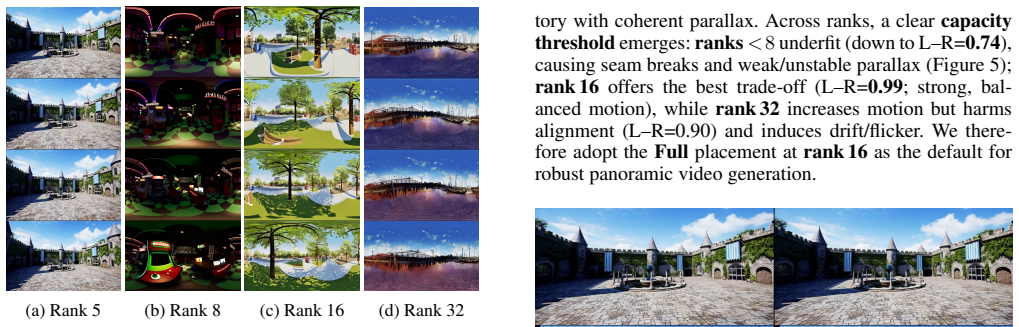
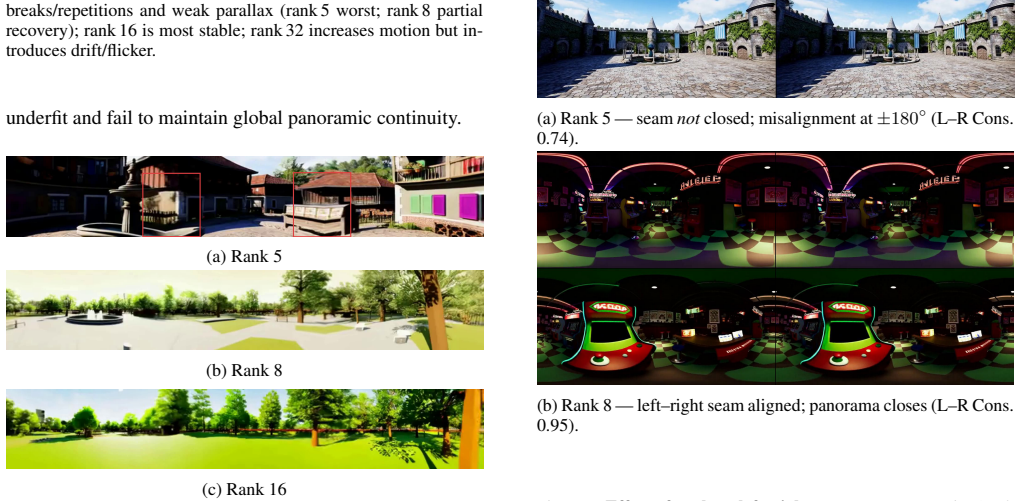
- Ranks below 8 underfit: rank 5 yields left-right consistency of 0.74 with visible seam breaks, and rank 8 only partially recovers to 0.95, supporting the theoretical rank threshold.
- The method needs only ~1,000 training videos and about 10 hours on 8 A100 GPUs, suggesting that 360° video generation can be achieved with lightweight fine-tuning rather than new architectures.
- The placement of LoRA adapters affects motion type: attention-only adapters favor lateral/rotational alignment, linear-only adapters favor appearance/texture modulation, and combining both yields balanced depth-aware motion.
Where Pith is reading between the lines
- The rank-8 threshold is derived from the camera-motion statistics of the paper's own synthetic dataset, where pitch, roll, and vertical shift have very small variance; on real-world panoramic footage with strong pitch or roll, the effective degrees of freedom would rise and the rank requirement would likely increase.
- The theoretical proof shows only that the LoRA update has the capacity to span the 8-dimensional space, not that it actually does so; the observed left-right consistency of 0.95 at rank 8, versus the perfect closure the theory suggests, hints that the practical rank requirement may be higher than the DoF count.
- A natural testable extension is to apply the same rank ≥ degrees-of-freedom principle to other projection transitions, such as perspective-to-fisheye or perspective-to-cubemap, where the DoF count differs and the rank threshold would change predictably.
- Even the best configuration still produces motion magnitudes around half the ground-truth values (front 4.02 vs 7.64), suggesting that LoRA adaptation captures projection geometry but may need extra capacity or conditioning to fully match real-world dynamics.
Editorial analysis
A structured set of objections, weighed in public.
Referee Report
Summary. The paper proposes PanoLora, which treats text-to-panoramic-video generation as a low-rank adaptation (LoRA) problem on a pretrained perspective-video diffusion model (Wan2.1-14B). The authors first argue, from camera-projection geometry and statistics of their own 447 training clips, that the perspective-to-panoramic transformation has 8 degrees of freedom. They then present a 'theoretical proof' that a LoRA rank r ≥ 8 suffices to span this transformation space. Empirically, they fine-tune Wan2.1 on ~1,000 synthetic UE panoramic videos and report improvements over 360DVD, 360DVD+, and GenEX on left-right consistency and per-view optical-flow motion magnitude. Ablations vary LoRA placement (attention vs. linear layers) and rank (5, 8, 16, 32), concluding that rank 16 is the best configuration.
Significance. The reformulation of panoramic video generation as a lightweight LoRA adaptation is practically appealing and the paper includes a reasonably extensive ablation over rank and injection points. If the theoretical claim were valid, it would provide a simple design rule for choosing LoRA rank. However, the theoretical argument is not sound: it derives only an upper bound on the rank of the output change and then asserts sufficiency. The paper's own experiments contradict the rank-8 threshold (rank 8 gives L-R consistency 0.95, rank 16 gives 0.99). The empirical evaluation is also narrow, relying on only two custom metrics and a small set of baselines on synthetic data. The central contribution—the theoretical justification—is therefore unsupported, and the empirical results, while suggestive, do not establish state-of-the-art performance.
major comments (4)
- [Section 3.3, single-layer case] The proof derives rank(δF) ≤ min(rank(J_F), rank(Δθ)) ≤ r, which is an upper bound on the rank of the output variation. It then claims that if r ≥ 8, 'the changeable space can be fully covered.' This is a non-sequitur: an upper bound does not imply that a rank-r LoRA can realize any desired 8-dimensional output change, nor that the specific perspective-to-panoramic weight update lies in the reachable subspace. Moreover, δF is defined as a vector in R^q, so rank(δF) is at most 1; the argument appears to conflate the rank of a matrix with the dimension of the output space. No lower bound or reachability argument is provided.
- [Section 3.3, multi-layer and nonlinear extension] In the multi-layer linear case, δF is the sum of per-layer Jacobian contributions. The claim that each layer with rank r ≥ 8 yields a total variation spanning a space of dimension at least 8 is not proved: the contributions can cancel or overlap, so the rank of the sum can be much smaller than the sum of ranks. The extension to nonlinear networks invokes local linearity, but local linearity does not convert an upper bound into a lower bound. Thus the sufficiency result remains unsupported.
- [Section 3.1, Table 1 and Section 4.4, Table 3] The 8-DoF simplification is derived from the authors' own training clips (Table 1), not from an independent analysis of the target distribution; pitch and roll are discarded because their standard deviations are small in this particular dataset. If test data contain substantial pitch or roll variation, the threshold fails. More importantly, the paper's own ablation contradicts the claimed threshold: Table 3 reports L-R consistency 0.95 at rank 8 and 0.99 at rank 16, with rank 5 at 0.74. If r ≥ 8 were sufficient, rank 8 should achieve near-perfect closure. The empirical results therefore do not support the central claim and instead suggest a monotonic improvement up to rank 16.
- [Section 4, Main Results and Evaluation] The state-of-the-art claim is based on comparison with only one dedicated panoramic baseline (360DVD), a LoRA-augmented variant (360DVD+), and a general video model (GenEX). The evaluation uses only two custom metrics (left-right seam cosine similarity and optical-flow magnitude) on synthetic UE-generated scenes. No standard video generation metrics (e.g., FVD, LPIPS, CLIP score) or user study are reported, and no real-world 360° video test set is used. This is insufficient to establish the claimed superior performance and generalizability.
minor comments (5)
- [Section 3.3, notation] The LoRA parameterization Δθ = AB with A∈R^{p×r}, B∈R^{r×1} makes Δθ a vector, not a low-rank matrix. This conflicts with the standard LoRA update ΔW = BA used in the preceding section. Please reconcile the notation and clarify what 'rank' means for a vector.
- [Section 3.1, Eq. (3)] The eight degrees of freedom are listed as fx, fy, cx, cy, s, tx, ty, θyaw, but the text refers to 'scale factors' (plural). Please define s precisely and explain how it relates to the intrinsic matrix parameters.
- [Figures 2 and 4] The captions and text do not consistently match panel labels; for example, the text refers to panels (d–e) in some places and (a)–(e) in others. Please align all panel references with the figures.
- [Throughout] There are several typos and formatting issues, e.g., 'mulit-layer' in Section 3.3, '360 ◦' spacing, and inconsistent use of 'equirectangular' vs. 'panoramic.' These should be corrected.
- [Section 4, Implementation Details] The paper states that LoRA is applied to 'spatial and temporal layers' in the Related Works, but the implementation only mentions QKVO projections and FFNs in attention blocks. Clarify whether temporal modules are adapted and if not, remove the claim.
Circularity Check
The LoRA rank threshold r≥8 is not derived externally: the 8-DoF count is an empirical simplification of the authors' own training clips, and the proof only shows an upper bound on rank, not that a rank-8 LoRA spans the mapping; the paper's own ablation shows rank 8 underperforms rank 16.
specific steps
-
fitted input called prediction
[Section 3.1, Task Definition, Eq. (3)]
"Based on the above analysis, we empirically simplify the camera motion model, retaining only the horizontal shift (tx), forward shift (ty), yaw angle (θyaw), focal lengths fx, fy, optical center cx, cy, and scale factors, resulting in an 8-dof model."
The 8-DoF count is measured from the authors' own 447 training clips (Table 1) by dropping tz, pitch, and roll because their standard deviations are small. This data-derived number is then used as the required dimension d in the theoretical proof to set the LoRA rank threshold r≥8. Thus the 'prediction' that rank ≥8 suffices is not an independent theoretical result; it is a restatement of the authors' own empirical simplification. The theory does not derive 8 from first principles; it takes it as an input. The paper's own ablation (Table 3) shows rank 8 gives L-R Cons. 0.95, below the rank-16 value of 0.99, so the predicted threshold is not even validated by the authors' experiments.
-
self definitional
[Section 3.3, Theoretical Proof, single-layer case]
"For the transformation to span a subspace of dimension d, the rank r must satisfy r≥d. Since the transformation from a perspective to a panoramic view requires 8 degrees of freedom, we conclude that if the LoRA rank r≥8, the changeable space can be fully covered."
The proof establishes only rank(δF) ≤ min(rank(J_F), rank(Δθ)) ≤ r, an upper bound on the rank of the actual output change for a given LoRA update. It then equates 'the transformation requires 8 degrees of freedom' with 'the changeable space has dimension 8' and concludes r≥8 covers it. This is definitional: the 'required space' is defined to be 8-dimensional from the camera model, so the conclusion that an 8-dimensional LoRA spans an 8-dimensional space is true by definition. It does not show that the specific perspective-to-panoramic weight update in a 14B diffusion transformer lies in a rank-8 subspace. An upper bound on rank cannot establish a lower bound on the space of achievable changes, so the conclusion reduces to the definition of the solution space rather than being derived from
full rationale
No load-bearing self-citations or imported uniqueness theorems are present; the derivation is the authors' own. However, the central theoretical claim is circular in the sense that the 8-DoF count is read off the authors' training clips (Table 1) and then used as the required dimension in the rank argument. Moreover, the rank inequality rank(δF) ≤ r is an upper bound and does not imply sufficiency: the paper never shows that the needed perspective-to-panoramic weight update lies in the rank-r subspace. The paper's own Table 3 contradicts the sufficiency claim, since rank 8 gives L-R consistency 0.95 (not the near-perfect closure implied by the theory) while rank 16 gives 0.99. Thus the 'theoretical analysis' does not independently predict the optimal configuration; it is post hoc and data-fitted. Score 6 reflects partial circularity: the rank threshold is fitted to the authors' data and the proof is a non-sequitur, though the experimental contributions and empirical comparisons stand on their own.
Axiom & Free-Parameter Ledger
free parameters (2)
- Task degrees of freedom d =
8
- LoRA rank r =
16 (default)
axioms (3)
- domain assumption The perspective-to-panoramic transformation for the target distribution is fully described by 8 DoF.
- ad hoc to paper The output change delta F satisfies rank(delta F) <= min(rank(J_F), rank(delta theta)) <= r and spans dimension d whenever r >= d.
- domain assumption Non-linear layers (ReLU, Softmax, attention) behave linearly on the scale of the LoRA perturbation, so the linear rank analysis extends.
read the original abstract
Generating high-quality 360{\deg} panoramic videos remains a significant challenge due to the fundamental differences between panoramic and traditional perspective-view projections. While perspective videos rely on a single viewpoint with a limited field of view, panoramic content requires rendering the full surrounding environment, making it difficult for standard video generation models to adapt. Existing solutions often introduce complex architectures or large-scale training, leading to inefficiency and suboptimal results. Motivated by the success of Low-Rank Adaptation (LoRA) in style transfer tasks, we propose treating panoramic video generation as an adaptation problem from perspective views. Through theoretical analysis, we demonstrate that LoRA can effectively model the transformation between these projections when its rank exceeds the degrees of freedom in the task. Our approach efficiently fine-tunes a pretrained video diffusion model using only approximately 1,000 videos while achieving high-quality panoramic generation. Experimental results demonstrate that our method maintains proper projection geometry and surpasses previous state-of-the-art approaches in visual quality, left-right consistency, and motion diversity.
Figures


Reference graph
Works this paper leans on
-
[1]
, " * write output.state after.block = add.period write newline
ENTRY address archivePrefix author booktitle chapter edition editor eid eprint howpublished institution isbn journal key month note number organization pages publisher school series title type volume year label extra.label sort.label short.list INTEGERS output.state before.all mid.sentence after.sentence after.block FUNCTION init.state.consts #0 'before.a...
-
[2]
write newline
" write newline "" before.all 'output.state := FUNCTION n.dashify 't := "" t empty not t #1 #1 substring "-" = t #1 #2 substring "--" = not "--" * t #2 global.max substring 't := t #1 #1 substring "-" = "-" * t #2 global.max substring 't := while if t #1 #1 substring * t #2 global.max substring 't := if while FUNCTION word.in bbl.in capitalize " " * FUNCT...
-
[3]
B.; and Tulyakov, S
Bahmani, S.; Skorokhodov, I.; Qian, G.; Siarohin, A.; Menapace, W.; Tagliasacchi, A.; Lindell, D. B.; and Tulyakov, S. 2025. Ac3d: Analyzing and improving 3d camera control in video diffusion transformers. In Proceedings of the Computer Vision and Pattern Recognition Conference, 22875--22889
2025
-
[4]
Conrad, M.; Kablitz, D.; and Schumann, S. 2024. Learning effectiveness of immersive virtual reality in education and training: A systematic review of findings. Computers & Education: X Reality, 4: 100053
2024
-
[5]
Farneb \"a ck, G. 2003. Two-frame motion estimation based on polynomial expansion. In Scandinavian conference on Image analysis, 363--370. Springer
2003
-
[6]
Ferreira, S. B. L.; dos Santos, R. C.; da Silveira, D.; and Ferreira, M. G. L. 2007. Panorama. RCA--Revista de Controle e Administra c \ a o Volume III, n 2, jul./dez. 2007 Conselho Editorial , 3(2): 205
2007
-
[7]
B.; and Dengel, A
Frolov, S.; Moser, B. B.; and Dengel, A. 2025. Spotdiffusion: A fast approach for seamless panorama generation over time. In 2025 IEEE/CVF Winter Conference on Applications of Computer Vision (WACV), 2073--2081. IEEE
2025
-
[8]
Gao, S.; Yang, K.; Shi, H.; Wang, K.; and Bai, J. 2022. Review on panoramic imaging and its applications in scene understanding. IEEE Transactions on Instrumentation and Measurement, 71: 1--34
2022
-
[9]
Y.; Taylor, D.; and Clarke, D
Gledhill, D.; Tian, G. Y.; Taylor, D.; and Clarke, D. 2003. Panoramic imaging—a review. Computers & Graphics, 27(3): 435--445
2003
-
[10]
J.; Shen, Y.; Wallis, P.; Allen-Zhu, Z.; Li, Y.; Wang, S.; Wang, L.; Chen, W.; et al
Hu, E. J.; Shen, Y.; Wallis, P.; Allen-Zhu, Z.; Li, Y.; Wang, S.; Wang, L.; Chen, W.; et al. 2022. Lora: Low-rank adaptation of large language models. ICLR, 1(2): 3
2022
-
[11]
Jayaram, S.; Vance, J.; Gadh, R.; Jayaram, U.; and Srinivasan, H. 2001. Assessment of VR technology and its applications to engineering problems. Journal of Computing and Information Science in Engineering, 1(1): 72--83
2001
-
[12]
Li, Y.; Shum, H.-Y.; Tang, C.-K.; and Szeliski, R. 2004. Stereo reconstruction from multiperspective panoramas. IEEE Transactions on Pattern Analysis and Machine Intelligence, 26(1): 45--62
2004
-
[13]
N.; Tulyakov, S.; and Ren, J
Liang, H.; Cao, J.; Goel, V.; Qian, G.; Korolev, S.; Terzopoulos, D.; Plataniotis, K. N.; Tulyakov, S.; and Ren, J. 2025. Wonderland: Navigating 3d scenes from a single image. In Proceedings of the Computer Vision and Pattern Recognition Conference, 798--810
2025
-
[14]
Liang, H.; Yin, Y.; Xu, D.; Liang, H.; Wang, Z.; Plataniotis, K. N.; Zhao, Y.; and Wei, Y. 2024. Diffusion4d: Fast spatial-temporal consistent 4d generation via video diffusion models. arXiv preprint arXiv:2405.16645
Pith/arXiv arXiv 2024
-
[15]
Liu, J.; Lin, S.; Li, Y.; and Yang, M.-H. 2025. Dynamicscaler: Seamless and scalable video generation for panoramic scenes. In Proceedings of the Computer Vision and Pattern Recognition Conference, 6144--6153
2025
-
[16]
Lu, T.; Shu, T.; Xiao, J.; Ye, L.; Wang, J.; Peng, C.; Wei, C.; Khashabi, D.; Chellappa, R.; Yuille, A.; et al. 2024. Genex: Generating an explorable world. arXiv preprint arXiv:2412.09624
Pith/arXiv arXiv 2024
-
[17]
Ma, J.; Lu, E.; Paiss, R.; Zada, S.; Holynski, A.; Dekel, T.; Curless, B.; Rubinstein, M.; and Cole, F. 2024. VidPanos: Generative panoramic videos from casual panning videos. In SIGGRAPH Asia 2024 Conference Papers, 1--11
2024
-
[18]
Mangrulkar, S.; Gugger, S.; Debut, L.; Belkada, Y.; Paul, S.; and Bossan, B. 2022. PEFT : State-of-the-art Parameter-Efficient Fine-Tuning methods. https://github.com/huggingface/peft
2022
-
[19]
Miller, A. L. 1996. The Panorama, the Cinema and the Emergence of the Spectacular. Wide Angle, 18(2): 34--69
1996
-
[20]
Ni, J.; Zhang, C.-B.; Zhang, Q.; and Zhang, J. 2025. What Makes for Text to 360-degree Panorama Generation with Stable Diffusion? arXiv preprint arXiv:2505.22129
Pith/arXiv arXiv 2025
-
[21]
Paliwal, A.; Zhou, X.; Tsarov, A.; and Kalantari, N. K. 2024. PanoDreamer: Optimization-Based Single Image to 360 3D Scene With Diffusion. arXiv preprint arXiv:2412.04827
arXiv 2024
-
[22]
Pintore, G.; Jaspe-Villanueva, A.; Hadwiger, M.; Gobbetti, E.; Schneider, J.; and Agus, M. 2023. PanoVerse: automatic generation of stereoscopic environments from single indoor panoramic images for Metaverse applications. In Proceedings of the 28th International ACM Conference on 3D Web Technology, 1--10
2023
-
[23]
A.; Fromm, J.; and Wohlgenannt, I
Radianti, J.; Majchrzak, T. A.; Fromm, J.; and Wohlgenannt, I. 2020. A systematic review of immersive virtual reality applications for higher education: Design elements, lessons learned, and research agenda. Computers & education, 147: 103778
2020
-
[24]
Ren, X.; Shen, T.; Huang, J.; Ling, H.; Lu, Y.; Nimier-David, M.; M \"u ller, T.; Keller, A.; Fidler, S.; and Gao, J. 2025. Gen3c: 3d-informed world-consistent video generation with precise camera control. In Proceedings of the Computer Vision and Pattern Recognition Conference, 6121--6132
2025
-
[25]
Slater, M.; and Sanchez-Vives, M. V. 2016. Enhancing our lives with immersive virtual reality. Frontiers in Robotics and AI, 3: 236866
2016
-
[26]
Sun, W.; Chen, S.; Liu, F.; Chen, Z.; Duan, Y.; Zhang, J.; and Wang, Y. 2024 a . Dimensionx: Create any 3d and 4d scenes from a single image with controllable video diffusion. arXiv preprint arXiv:2411.04928
Pith/arXiv arXiv 2024
-
[27]
Sun, X.; Chen, Y.; Huang, Y.; Xie, R.; Zhu, J.; Zhang, K.; Li, S.; Yang, Z.; Han, J.; Shu, X.; et al. 2024 b . Hunyuan-large: An open-source moe model with 52 billion activated parameters by tencent. arXiv preprint arXiv:2411.02265
Pith/arXiv arXiv 2024
-
[28]
Tan, J.; Yang, S.; Wu, T.; He, J.; Guo, Y.; Liu, Z.; and Lin, D. 2024. Imagine360: Immersive 360 video generation from perspective anchor. arXiv preprint arXiv:2412.03552
Pith/arXiv arXiv 2024
-
[29]
Team, Q. 2024. Qwen2 technical report. arXiv preprint arXiv:2407.10671
Pith/arXiv arXiv 2024
-
[30]
Wan, T.; Wang, A.; Ai, B.; Wen, B.; Mao, C.; Xie, C.-W.; Chen, D.; Yu, F.; Zhao, H.; Yang, J.; Zeng, J.; Wang, J.; Zhang, J.; Zhou, J.; Wang, J.; Chen, J.; Zhu, K.; Zhao, K.; Yan, K.; Huang, L.; Feng, M.; Zhang, N.; Li, P.; Wu, P.; Chu, R.; Feng, R.; Zhang, S.; Sun, S.; Fang, T.; Wang, T.; Gui, T.; Weng, T.; Shen, T.; Lin, W.; Wang, W.; Wang, W.; Zhou, W....
Pith/arXiv arXiv 2025
-
[31]
Wang, Q.; Li, W.; Mou, C.; Cheng, X.; and Zhang, J. 2024 a . 360dvd: Controllable panorama video generation with 360-degree video diffusion model. In Proceedings of the IEEE/CVF Conference on Computer Vision and Pattern Recognition, 6913--6923
2024
-
[32]
Wang, X.; Zheng, Y.; Wan, Z.; and Zhang, M. 2024 b . Svd-llm: Truncation-aware singular value decomposition for large language model compression. arXiv preprint arXiv:2403.07378
Pith/arXiv arXiv 2024
-
[33]
Xing, K.; Liang, H.; Xu, D.; Yin, Y.; Plataniotis, K. N.; Zhao, Y.; and Wei, Y. 2025. TiP4GEN: Text to Immersive Panorama 4D Scene Generation. arXiv preprint arXiv:2508.12415
Pith/arXiv arXiv 2025
-
[34]
Yang, Z.; Teng, J.; Zheng, W.; Ding, M.; Huang, S.; Xu, J.; Yang, Y.; Hong, W.; Zhang, X.; Feng, G.; et al. 2024. Cogvideox: Text-to-video diffusion models with an expert transformer. arXiv preprint arXiv:2408.06072
Pith/arXiv arXiv 2024
-
[35]
Ye, W.; Ji, C.; Chen, Z.; Gao, J.; Huang, X.; Zhang, S.-H.; Ouyang, W.; He, T.; Zhao, C.; and Zhang, G. 2024. Diffpano: Scalable and consistent text to panorama generation with spherical epipolar-aware diffusion. Advances in Neural Information Processing Systems, 37: 1304--1332
2024
-
[36]
Yin, Y.; Xu, D.; Wang, Z.; Zhao, Y.; and Wei, Y. 2023. 4dgen: Grounded 4d content generation with spatial-temporal consistency. arXiv preprint arXiv:2312.17225
Pith/arXiv arXiv 2023
-
[37]
Yu, H.; Wang, C.; Zhuang, P.; Menapace, W.; Siarohin, A.; Cao, J.; Jeni, L.; Tulyakov, S.; and Lee, H.-Y. 2024. 4real: Towards photorealistic 4d scene generation via video diffusion models. Advances in Neural Information Processing Systems, 37: 45256--45280
2024
-
[38]
Zhang, S.; Zhang, Y.; Zheng, Q.; Ma, R.; Hua, W.; Bao, H.; Xu, W.; and Zou, C. 2024. 3d-scenedreamer: Text-driven 3d-consistent scene generation. In Proceedings of the IEEE/CVF Conference on Computer Vision and Pattern Recognition, 10170--10180
2024
discussion (0)
Sign in with ORCID, Apple, or X to comment. Anyone can read and Pith papers without signing in.