REVIEW 4 major objections 6 minor 74 references
FaceEditTalker: Controllable Talking Head Generation with Facial Attribute Editing
T0 review · 4 major / 6 minor · reviewed 2026-08-07 · deepseek-v4-flash
Pith's one-line read This paper claims FaceEditTalker, a single framework that unifies facial attribute editing with audio-driven talking head generation: a linear shift of the semantic code yields the desired attribute, and audio-guided landmarks keep lip…
desk verdict A credible engineering pipeline with a 'first' claim that its own references contradict; worth revising, not rejecting. read the letter →
The pith
A machine-rendered reading of the paper's core claim, the machinery that carries it, and where it could break.
The reading
What carries the argument
The load-bearing mechanism is linear attribute editing in the semantic latent space coupled to conditional DDIM generation. Following DiffAE's dual-layer encoding, the framework separates high-level semantics ($z_{\text{sem}}$) from stochastic detail ($Z_T$); a single-layer MLP classifier trained on image-attribute labels yields one direction vector $w_{\text{att}}$ per attribute, and Eq. (3) applies $z'_{\text{sem}} = z_{\text{sem}} + \alpha \cdot w_{\text{att}}$. On the generation side, wav2vec audio features go through a landmark predictor inspired by AniPortrait to produce landmark features, which are concatenated with $Z_T$ and injected as motion control, while $z_{\text{sem}}$ is injected through cross-attention as global attribute control. Because the same edited semantic code conditions every denoising step, the paper argues that the target attribute stays fixed across frames while the landmarks supply synchronized, dynamic motion.
What would settle it
Take unseen identities, edit all 40 attributes at several strengths, and measure both attribute classification accuracy (does the output actually show the requested attribute?) and face-recognition identity similarity on the edited frames. If making the target attribute visible also flips non-target attributes or drops identity similarity below the unedited baseline, the linear-space assumption is falsified; the paper currently offers PCA separation and interpolation visuals but no such quantitative check on edited outputs.
Extended reading notes
Core claim
The central discovery claimed is a two-module architecture built on a dual-layer latent encoding in the style of DiffAE. A semantic encoder produces a low-dimensional semantic code $z_{\text{sem}}$ that carries high-level attributes, and a stochastic encoder produces a detail code $Z_T$ that carries fine textures; a linear classifier trained on the 40 binary attributes of CelebA-HQ provides an attribute direction vector $w_{\text{att}}$, and editing is the simple addition $z'_{\text{sem}} = z_{\text{sem}} + \alpha \cdot w_{\text{att}}$. The edited semantic code is then injected into a DDIM generator through cross-attention, while audio features from wav2vec pass through a landmark predictor to produce motion features that are concatenated with $Z_T$ and drive the denoising process. This design lets one edited semantic code guide every frame, which is how the paper claims to preserve temporal coherence and identity while changing attributes such as hair, facial structure, and accessories. The paper asserts this is the first framework to unify fine-grained facial attribute editing with audio-synchronized talking head generation, and reports competitive or better lip-sync and video-quality scores than talking-head baselines, plus better identity consistency than video-editing baselines in its user study.
Load-bearing premise
The method assumes that each facial attribute is a straight, separable direction in a learned semantic space, so adding a fixed vector learned from labeled photos changes only that attribute and works on any new face; if the space is entangled or the direction does not transfer, editing will alter the wrong features or break identity.
Editorial extensions
If this is right
- Users can supply one photo, an audio clip, and an attribute label, and receive a video in which the person speaks with the new attribute rather than a static edited image.
- Because editing is a vector addition, the same 40 attribute directions can be scaled by $\alpha$ and combined, enabling fine-grained control without retraining the generator.
- The framework removes the need for a separate edit-then-animate pipeline; temporal consistency is handled by feeding the same edited semantic code to every diffusion step.
- If the reported numbers hold, FaceEditTalker matches or beats talking-head baselines on FID and lip-sync while surpassing video-editing baselines on identity consistency and attribute editing in the user study.
- The unification is a step toward personalized avatars and digital agents whose appearance and speech are jointly controllable from a single reference image.
Reading between the lines
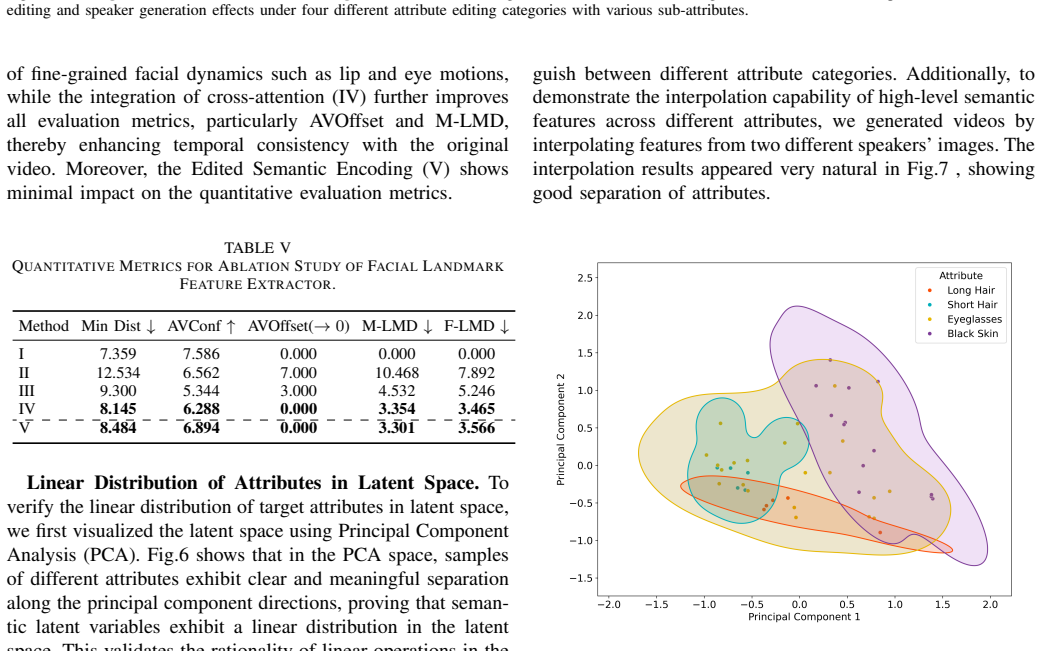
- The paper's PCA visualization and interpolation results are suggestive, but the linearity of the semantic space is an empirical claim: a direct measurement of attribute classification accuracy on edited frames would be the cleanest way to test it.
- Because attribute directions are learned from independent binary labels, multi-attribute edits (e.g., young plus glasses) may interact nonlinearly; the framework would benefit from quantitative evidence on combined edits.
- The same attribute library could in principle be reused with other diffusion decoders, since the edit happens in the semantic code before video generation; that would decouple attribute learning from any particular talking-head model.
- Replacing the fixed 40 attributes with text-derived directions, which the paper names as future work, is natural only if the semantic space is text-aligned; the current experiments do not demonstrate that alignment.
Editorial analysis
A structured set of objections, weighed in public.
Referee Report
Summary. The paper proposes FaceEditTalker, a framework that combines facial attribute editing with audio-driven talking head generation. The method uses a DiffAE-style dual-layer latent encoding to extract semantic and stochastic codes, learns attribute direction vectors with a linear classifier on CelebA-HQ, and edits the semantic code as z'_sem = zsem + alpha * watt (Eq. 3). The edited semantic code and audio-driven landmarks from an AniPortrait-style predictor are fed into a conditional DDIM generator to produce synchronized videos. Experiments on HDTF and VoxCeleb2 compare the method with Wav2Lip, SadTalker, DiffTalk, EchoMimic, and Hallo; video-editing comparisons and a 50-participant user study are also reported.
Significance. If the central claims are substantiated, FaceEditTalker would be a practically useful system that unifies two previously separate tasks: controllable facial attribute editing and audio-driven talking head generation. The architecture is clearly described, the ablation study isolates components, and the paper includes a limitation section and ethical considerations. However, the novelty claim is not supportable as written: the paper's own reference [21] (StyleHEAT) already describes an editable talking face generation method. In addition, the quantitative evaluation contains implausible duplicated values and lacks error bars, and attribute controllability is not validated quantitatively on edited outputs. These issues affect the load-bearing claims of novelty and superiority.
major comments (4)
- [§I and §V.A] The first-contribution claim that FaceEditTalker is 'the first framework that seamlessly unifies facial attribute editing and audio-driven talking head generation' is contradicted by the paper's own reference [21], StyleHEAT (arXiv:2203.04036), whose title and abstract describe one-shot high-resolution editable talking face generation via pre-trained StyleGAN. Section V.A additionally states that 'there is no existing method capable of generating high-resolution, audio-driven speaker videos with editable facial attributes' without addressing this citation. Please either remove or qualify the 'first' claim, add a direct comparison with StyleHEAT, or provide an explicit technical argument for why StyleHEAT's approach is excluded from this characterization. This is load-bearing because the unification novelty is the paper's central contribution.
- [Table II] In Table II, the M-LMD and F-LMD columns are identical between the HDTF and VoxCeleb2 blocks for Wav2Lip (4.368/4.256), SadTalker (3.368/3.192), EchoMimic (3.983/3.790), and Our Method (3.354/3.465). Since the two datasets contain different videos, identical values to three decimal places are implausible and indicate an evaluation or reporting error. Please recompute and report per-dataset metrics with error bars or significance tests; as presented, the table cannot support the claim that the method achieves the best M-LMD.
- [§V.C and Eq. (3)] The central editing operation z'_sem = zsem + alpha * watt (Eq. 3) is validated only qualitatively through PCA visualization and interpolation (Figs. 6-7) and through the user-study attribute-editing score. The ablation in Table V shows that adding the Edited Semantic Encoding (V) changes M-LMD from 3.354 to 3.301 and F-LMD from 3.465 to 3.566 relative to configuration IV, i.e., a minimal quantitative effect on the metrics reported. Please provide a quantitative evaluation of attribute controllability on edited outputs (for example, attribute classifier accuracy on generated frames, or identity/attribute trade-off measurements) and clarify whether the edited semantic code changes non-target regions as intended.
- [§V.B and Table IV] The text states that FaceEditTalker 'surpasses most baselines' in the user study, but Table IV shows a realism score of 3.18 for the proposed method, which is lower than Wav2Lip (3.38), SadTalker (3.24), and DiffTalk (3.30); EchoMimic and Hallo also score higher on realism. The favorable attribute-editing score (4.04) is not sufficient to support a general claim of overall superiority. Please report and discuss these per-dimension results accurately rather than making an aggregate superiority claim.
minor comments (6)
- [§III-B and §III-C] Equation (1) writes z'_sem = C(zsem, y, alpha), but the actual operation is first defined in Eq. (3) as z'_sem = zsem + alpha * watt; the notation should be reconciled so that the task formulation and the method section use the same definition.
- [§III-E] There is a typo in 'motion lanmark features'; it should read 'motion landmark features'.
- [Algorithm 4] In Algorithm 4, line 6 uses ZT in the construction of K, but ZT is not defined in the inference algorithm; please specify that ZT is obtained by applying the stochastic encoder to the reference image.
- [Table V] The column labels I-V in Table V are explained only in the text; please add a legend to the table so that each configuration is identifiable from the caption alone.
- [Table IV] The row label 'Lip [1]' should be 'Wav2Lip [1]' to match the reference list and the other rows.
- [Algorithm 1] The output description of Algorithm 1 says 'Weight vectors corresponding to each attribute list,' but this stage trains the semantic and stochastic encoders; the output description should match the stated objective.
Circularity Check
No meaningful circularity: Eq. 3's linear edit is an explicit classifier construction, all claimed outputs are verified externally; the StyleHEAT 'first' contradiction is a novelty/correctness issue, not circularity.
full rationale
The paper's derivation chain reduces to four learned or adopted steps, none of which is equivalent to its own input by construction. (i) The dual-layer encoding into semantic code zsem and stochastic code ZT is adopted from external DiffAE work (reference [28]); (ii) the attribute direction watt is the weight vector of a single-layer MLP classifier trained with cross-entropy on CelebA-HQ labels (Eq. 12), an explicit construction rather than a hidden fit; (iii) the edit z'_sem = zsem + alpha * watt (Eq. 3) is a stated linear extrapolation, and the paper nowhere renames this fitted direction as a 'prediction' of attribute presence; (iv) audio-driven landmarks come from an AniPortrait-style predictor (Eq. 7) and wav2vec (Eq. 6), both external. Every claimed outcome — lip-sync accuracy, identity preservation, temporal consistency, attribute controllability — is measured on generated videos with external metrics (SyncNet, M-LMD/F-LMD in Table II, TL-ID/TG-ID in Table III, user study in Table IV), none of which is forced by Eq. 3. The self-citations ([12] LesTalker, [15] EmoSpeaker, [35] Gaussian-Face) appear only inside grouped related-work mentions in Section I ('emotional expression [12]–[17]') and justify no premise of the method, so they are not load-bearing. No uniqueness theorem is imported, and no prior result by these authors is invoked to forbid alternatives. Two weaknesses are noted but they are not circularity: the PCA visualization in Fig. 6 is in-sample evidence for the linearity assumption, and no quantitative attribute-classification accuracy on edited outputs is reported, so attribute success rests on qualitative and user-study evidence. Separately, the Section I contribution bullet claims 'the first framework that seamlessly unifies facial attribute editing and audio-driven talking head generation,' which is difficult to square with the paper's own reference [21] StyleHEAT ('One-shot high-resolution editable talking face generation via pre-trained StyleGAN') and with Section V.A's assertion that 'there is no existing method capable of generating high-resolution, audio-driven speaker videos with editable facial attributes'; under the review rules this is a novelty and correctness concern, not a circularity, so it does not raise the circularity score. Overall: no circular step exists; score 2 reflects only the presence of minor, non-load-bearing self-citations.
Assumptions & free parameters
free parameters (2)
- Attribute direction vectors watt =
Learned weights of the linear classifier on CelebA-HQ (40 attribute classes)
- Editing strength alpha =
User-specified; not reported in experiments
assumptions (5)
- domain assumption The DiffAE semantic latent space is linearly separable for facial attributes, so linear classifier directions can edit attributes by vector addition.
- domain assumption The AniPortrait-style landmark predictor produces landmarks accurate enough for lip-sync and temporal consistency.
- domain assumption Dataset filtering with LatentSync sync confidence and HyperIQA scores yields an unbiased training and evaluation set.
- standard math DDIM sampling and the forward diffusion noise schedule are valid as in Song et al.
- domain assumption Wav2Vec audio features contain sufficient speech information to drive facial landmark prediction.
Cite this review
Pith. "Pith review of FaceEditTalker: Controllable Talking Head Generation with Facial Attribute Editing." pith.science (2026). https://pith.science/paper/HPIACNYH
@misc{pith2026250522141,
  author       = {Pith},
  title        = {Pith review of: FaceEditTalker: Controllable Talking Head Generation with Facial Attribute Editing},
  year         = {2026},
  howpublished = {\url{https://pith.science/paper/HPIACNYH}},
  note         = {Machine review of arXiv:2505.22141}
}
read the original abstract
Recent advances in audio-driven talking head generation have achieved impressive results in lip synchronization and emotional expression. However, they largely overlook the crucial task of facial attribute editing. This capability is indispensable for achieving deep personalization and expanding the range of practical applications, including user-tailored digital avatars, engaging online education content, and brand-specific digital customer service. In these key domains, flexible adjustment of visual attributes, such as hairstyle, accessories, and subtle facial features, is essential for aligning with user preferences, reflecting diverse brand identities and adapting to varying contextual demands. In this paper, we present FaceEditTalker, a unified framework that enables controllable facial attribute manipulation while generating high-quality, audio-synchronized talking head videos. Our method consists of two key components: an image feature space editing module, which extracts semantic and detail features and allows flexible control over attributes like expression, hairstyle, and accessories; and an audio-driven video generation module, which fuses these edited features with audio-guided facial landmarks to drive a diffusion-based generator. This design ensures temporal coherence, visual fidelity, and identity preservation across frames. Extensive experiments on public datasets demonstrate that our method achieves comparable or superior performance to representative baseline methods in lip-sync accuracy, video quality, and attribute controllability. Project page: https://peterfanfan.github.io/FaceEditTalker/
Figures


Figures from the paper (4 more)



Reference graph
Works this paper leans on
-
[21]
Styleheat: One-shot high-resolution editable talking face generation via pre-trained stylegan,
F. Yin, Y . Zhang, X. Cun, M. Cao, Y . Fan, X. Wang, Q. Bai, B. Wu, J. Wang, and Y . Yang, “Styleheat: One-shot high-resolution editable talking face generation via pre-trained stylegan,” 2022. [Online]. Available: https://arxiv.org/abs/2203.04036
arXiv 2022
-
[1]
A lip sync expert is all you need for speech to lip generation in the wild,
K. R. Prajwal, R. Mukhopadhyay, V . P. Namboodiri, and C. Jawahar, “A lip sync expert is all you need for speech to lip generation in the wild,” in Proceedings of the 28th ACM International Conference on Multimedia (MM ’20). New York, NY , USA: Association for Computing Machinery, 2020, pp. 484–492
work page 2020
-
[2]
Synctalkface: Talking face generation with precise lip-syncing via audio-lip memory,
S. J. Park, M. Kim, J. Hong, J. Choi, and Y . M. Ro, “Synctalkface: Talking face generation with precise lip-syncing via audio-lip memory,” in Proceedings of the AAAI Conference on Artificial Intelligence, vol. 36, 2022, pp. 2062–2070
work page 2022
-
[3]
Videoretalking: Audio-based lip synchronization for talking head video editing in the wild,
K. Cheng, X. Cun, Y . Zhang, M. Xia, F. Yin, M. Zhu, X. Wang, J. Wang, and N. Wang, “Videoretalking: Audio-based lip synchronization for talking head video editing in the wild,” in SIGGRAPH Asia 2022 Conference Papers, 2022, pp. 1–9
work page 2022
-
[4]
Ad- nerf: Audio driven neural radiance fields for talking head synthesis,
Y . Guo, K. Chen, S. Liang, Y .-J. Liu, H. Bao, and J. Zhang, “Ad- nerf: Audio driven neural radiance fields for talking head synthesis,” in Proceedings of the IEEE/CVF International Conference on Computer Vision, 2021, pp. 5784–5794
2021
-
[5]
Sd-nerf: Towards lifelike talking head animation via spatially-adaptive dual-driven nerfs,
S. Shen, W. Li, X. Huang, Z. Zhu, J. Zhou, and J. Lu, “Sd-nerf: Towards lifelike talking head animation via spatially-adaptive dual-driven nerfs,” IEEE Transactions on Multimedia , 2023
2023
-
[7]
Ae-nerf: Audio enhanced neural radiance field for few shot talking head synthesis,
D. Li, K. Zhao, W. Wang, B. Peng, Y . Zhang, J. Dong, and T. Tan, “Ae-nerf: Audio enhanced neural radiance field for few shot talking head synthesis,” in Proceedings of the AAAI Conference on Artificial Intelligence, vol. 38, no. 4, 2024, pp. 3037–3045
work page 2024
-
[8]
Audio- driven facial animation with deep learning: A survey,
D. Jiang, J. Chang, L. You, S. Bian, R. Kosk, and G. Maguire, “Audio- driven facial animation with deep learning: A survey,” Information, vol. 15, no. 11, p. 675, 2024
work page 2024
Show all 74 references
-
[9]
Application of chatgpt-based digital human in animation creation,
C. Lan, Y . Wang, C. Wang, S. Song, and Z. Gong, “Application of chatgpt-based digital human in animation creation,” Future Internet , vol. 15, no. 9, p. 300, 2023
2023
-
[10]
Stylesync: High-fidelity generalized and personalized lip sync in style-based generator,
J. Guan, Z. Zhang, H. Zhou, T. HU, K. Wang, D. He, H. Feng, J. Liu, E. Ding, Z. Liu, and J. Wang, “Stylesync: High-fidelity generalized and personalized lip sync in style-based generator,” in Proceedings of the IEEE/CVF Conference on Computer Vision and Pattern Recognition (CV...
2023
-
[11]
Audio-driven talking face generation with stabilized synchronization loss,
D. Yaman, F. I. Eyiokur, L. B ¨armann, H. K. Ekenel, and A. Waibel, “Audio-driven talking face generation with stabilized synchronization loss,” 2024. [Online]. Available: https://arxiv.org/abs/2307.09368
2024 arXiv
-
[12]
Les- talker: Fine-grained emotion editing for talking head generation in linear emotion space,
G. Feng, Z. Qian, Y . Li, S. Jin, Q. Miao, and C.-M. Pun, “Les- talker: Fine-grained emotion editing for talking head generation in linear emotion space,” arXiv preprint arXiv:2411.09268 , 2024. 12
2024 arXiv
-
[13]
Emotivetalk: Expressive talking head generation through audio information decoupling and emotional video diffusion,
H. Wang, Y . Weng, Y . Li, Z. Guo, J. Du, S. Niu, J. Ma, S. He, X. Wu, Q. Hu et al., “Emotivetalk: Expressive talking head generation through audio information decoupling and emotional video diffusion,” arXiv preprint arXiv:2411.16726, 2024
2024 arXiv
-
[14]
Emotional conversation: Empowering talking faces with cohesive expression, gaze and pose generation,
J. Liang and F. Lu, “Emotional conversation: Empowering talking faces with cohesive expression, gaze and pose generation,” arXiv preprint arXiv:2406.07895, 2024
2024 arXiv
-
[15]
Emospeaker: One-shot fine-grained emotion-controlled talking face generation,
G. Feng, H. Cheng, Y . Li, Z. Ma, C. Li, Z. Qian, Q. Miao, and C.- M. Pun, “Emospeaker: One-shot fine-grained emotion-controlled talking face generation,” arXiv preprint arXiv:2402.01422 , 2024
2024 arXiv
-
[16]
Stochastic latent talking face generation toward emotional expressions and head poses,
Z. Sheng, L. Nie, M. Zhang, X. Chang, and Y . Yan, “Stochastic latent talking face generation toward emotional expressions and head poses,” IEEE Transactions on Circuits and Systems for Video Technology , vol. 34, no. 4, pp. 2734–2748, 2024
2024
-
[17]
Multimodal emotional talking face generation based on action units,
J. Lyu, X. Lan, G. Hu, H. Jiang, W. Gan, J. Wang, and J. Xue, “Multimodal emotional talking face generation based on action units,” IEEE Transactions on Circuits and Systems for Video Technology , vol. 35, no. 5, pp. 4026–4038, 2025
2025
-
[18]
A style-based generator architecture for generative adversarial networks,
T. Karras, S. Laine, and T. Aila, “A style-based generator architecture for generative adversarial networks,” in 2019 IEEE/CVF Conference on Computer Vision and Pattern Recognition (CVPR) , 2019, pp. 4396– 4405
2019
-
[19]
Analyzing and improving the image quality of stylegan,
T. Karras, S. Laine, M. Aittala, J. Hellsten, J. Lehtinen, and T. Aila, “Analyzing and improving the image quality of stylegan,” in 2020 IEEE/CVF Conference on Computer Vision and Pattern Recognition (CVPR), 2020, pp. 8107–8116
2020
-
[20]
Temporally consistent semantic video editing,
Y . Xu, B. AlBahar, and J.-B. Huang, “Temporally consistent semantic video editing,” arXiv preprint arXiv: 2206.10590 , 2022
2022 arXiv
-
[22]
Temporally consistent semantic video editing,
Y . Xu, B. AlBahar, and J.-B. Huang, “Temporally consistent semantic video editing,” 2022. [Online]. Available: https://arxiv.org/abs/2206. 10590
2022
-
[23]
A latent transformer for disentangled face editing in images and videos,
X. Yao, A. Newson, Y . Gousseau, and P. Hellier, “A latent transformer for disentangled face editing in images and videos,” in Proceedings of the IEEE/CVF international conference on computer vision , 2021, pp. 13 789–13 798
2021
-
[24]
Stitch it in time: Gan-based facial editing of real videos,
R. Tzaban, R. Mokady, R. Gal, A. Bermano, and D. Cohen-Or, “Stitch it in time: Gan-based facial editing of real videos,” in SIGGRAPH Asia 2022 Conference Papers, 2022, pp. 1–9
2022
-
[25]
Diffusionact: Controllable diffusion autoencoder for one-shot face reenactment,
S. Bounareli, C. Tzelepis, V . Argyriou, I. Patras, and G. Tzimiropoulos, “Diffusionact: Controllable diffusion autoencoder for one-shot face reenactment,” in Proceedings of the IEEE International Conference on Automatic Face and Gesture Recognition (FG) , 2025
2025
-
[26]
Diffusion video autoencoders: Toward temporally consistent face video editing via disentangled video encoding,
G. Kim, H. Shim, H. Kim, Y . Choi, J. Kim, and E. Yang, “Diffusion video autoencoders: Toward temporally consistent face video editing via disentangled video encoding,” in Proceedings of the IEEE/CVF Conference on Computer Vision and Pattern Recognition (CVPR) , June 2023, pp....
2023
-
[27]
Qffusion: Controllable portrait video editing via quadrant-grid attention learning,
M. Li, L. Lin, Y . Liu, Y . Zhu, and Y . Li, “Qffusion: Controllable portrait video editing via quadrant-grid attention learning,” 2025. [Online]. Available: https://arxiv.org/abs/2501.06438
2025 arXiv
-
[28]
Diffusion autoencoders: Toward a meaningful and decodable represen- tation,
K. Preechakul, N. Chatthee, S. Wizadwongsa, and S. Suwajanakorn, “Diffusion autoencoders: Toward a meaningful and decodable represen- tation,” in Proceedings of the IEEE/CVF conference on computer vision and pattern recognition , 2022, pp. 10 619–10 629
2022
-
[29]
Aniportrait: Audio-driven synthesis of photorealistic portrait animation,
H. Wei, Z. Yang, and Z. Wang, “Aniportrait: Audio-driven synthesis of photorealistic portrait animation,” 2024. [Online]. Available: https://arxiv.org/abs/2403.17694
2024 arXiv
-
[30]
Efficient region-aware neural radiance fields for high-fidelity talking portrait synthesis,
J. Li, J. Zhang, X. Bai, J. Zhou, and L. Gu, “Efficient region-aware neural radiance fields for high-fidelity talking portrait synthesis,” in Proceedings of the IEEE/CVF International Conference on Computer Vision, 2023, pp. 7568–7578
2023
-
[31]
Ae-nerf: Audio enhanced neural radiance field for few-shot talking head synthesis,
D. Li, K. Zhao, W. Wang, B. Peng, Y . Zhang, J. Dong, and T. Tan, “Ae-nerf: Audio enhanced neural radiance field for few-shot talking head synthesis,” in Proceedings of the AAAI Conference on Artificial Intelligence, vol. 38, no. 4, 2024, pp. 28 086–28 094. [Online]. Available...
2024
-
[32]
Gensync: A generalized talking head framework for audio-driven multi-subject lip-sync using 3d gaussian splatting,
A. Agarwal, M. Y . Hassan, and T. Chafekar, “Gensync: A generalized talking head framework for audio-driven multi-subject lip-sync using 3d gaussian splatting,” arXiv preprint arXiv:2505.01928 , 2025
2025 arXiv
-
[33]
Mimictalk: Mimicking a personalized and expressive 3d talking face in minutes,
Z. Ye, T. Zhong, Y . Ren, Z. Jiang, J. Huang, R. Huang, J. Liu, J. He, C. Zhang, Z. Wang et al. , “Mimictalk: Mimicking a personalized and expressive 3d talking face in minutes,” Advances in neural information processing systems, vol. 37, pp. 1829–1853, 2024
2024
-
[34]
Talk- inggaussian: Structure-persistent 3d talking head synthesis via gaussian splatting,
J. Li, J. Zhang, X. Bai, J. Zheng, X. Ning, J. Zhou, and L. Gu, “Talk- inggaussian: Structure-persistent 3d talking head synthesis via gaussian splatting,” in European Conference on Computer Vision. Springer, 2024, pp. 127–145
2024
-
[35]
Gaussian-face: Talking head generation with hybrid density via 3d gaussian splatting,
G. Feng, Y . Zhang, Y . Li, S. Jin, and Q. Miao, “Gaussian-face: Talking head generation with hybrid density via 3d gaussian splatting,” in ICASSP 2025-2025 IEEE International Conference on Acoustics, Speech and Signal Processing (ICASSP) . IEEE, 2025, pp. 1–5
2025
-
[36]
Monocular and generalizable gaussian talking head animation,
S. Gong, H. Li, J. Tang, D. Hu, S. Huang, H. Chen, T. Chen, and Z. Liu, “Monocular and generalizable gaussian talking head animation,” arXiv preprint arXiv:2504.00665, 2025
2025 arXiv
-
[37]
Instag: Learning personalized 3d talking head from few-second video,
J. Li, J. Zhang, X. Bai, J. Zheng, J. Zhou, and L. Gu, “Instag: Learning personalized 3d talking head from few-second video,” in Proceedings of the IEEE/CVF conference on computer vision and pattern recognition , 2025
2025
-
[38]
Hierarchical cross- modal talking face generation with dynamic pixel-wise loss,
L. Chen, R. K. Maddox, Z. Duan, and C. Xu, “Hierarchical cross- modal talking face generation with dynamic pixel-wise loss,” in 2019 IEEE/CVF Conference on Computer Vision and Pattern Recognition (CVPR), 2019, pp. 7824–7833
2019
-
[39]
Makeittalk: Speaker-aware talking-head animation,
Y . Zhou, X. Han, E. Shechtman, J. Echevarria, E. Kalogerakis, and D. Li, “Makeittalk: Speaker-aware talking-head animation,” ACM Transactions on Graphics, vol. 39, no. 6, pp. 1–15, 2020
2020
-
[40]
Flow-guided one-shot talking face generation with a high-resolution audio-visual dataset,
Z. Zhang, L. Li, Y . Ding, and C. Fan, “Flow-guided one-shot talking face generation with a high-resolution audio-visual dataset,” in 2021 IEEE/CVF Conference on Computer Vision and Pattern Recognition (CVPR), 2021, pp. 3660–3669
2021
-
[41]
Sadtalker: Learning realistic 3d motion coefficients for stylized audio-driven single image talking face animation,
W. Zhang, X. Cun, X. Wang, Y . Zhang, X. Shen, Y . Guo, Y . Shan, and F. Wang, “Sadtalker: Learning realistic 3d motion coefficients for stylized audio-driven single image talking face animation,” in 2023 IEEE/CVF Conference on Computer Vision and Pattern Recognition (CVPR), 2...
2023
-
[42]
Echomimic: Lifelike audio-driven portrait animations through editable landmark conditioning,
Z. Chen, J. Cao, Z. Chen, Y . Li, and C. Ma, “Echomimic: Lifelike audio-driven portrait animations through editable landmark conditioning,” in Proceedings of the AAAI Conference on Artificial Intelligence, vol. 39, no. 3, 2025, p. 32241. [Online]. Available: https://ojs.aaai.o...
2025
-
[43]
Difftalk: Crafting diffusion models for generalized audio-driven portraits anima- tion,
S. Shen, W. Zhao, Z. Meng, W. Li, Z. Zhu, J. Zhou, and J. Lu, “Difftalk: Crafting diffusion models for generalized audio-driven portraits anima- tion,” in Proceedings of the IEEE/CVF Conference on Computer Vision and Pattern Recognition, 2023, pp. 1982–1991
2023
-
[44]
Emo: Emote portrait alive- generating expressive portrait videos with audio2video diffusion model under weak conditions,
L. Tian, Q. Wang, B. Zhang, and L. Bo, “Emo: Emote portrait alive- generating expressive portrait videos with audio2video diffusion model under weak conditions,” arXiv preprint, vol. arXiv:2402.17485, 2024
2024 arXiv
-
[45]
Hallo: Hierarchical audio-driven visual synthesis for portrait image animation,
M. Xu, H. Li, Q. Su, H. Shang, L. Zhang, C. Liu, J. Wang, L. V . Gool, Y . Yao, and S. Zhu, “Hallo: Hierarchical audio-driven visual synthesis for portrait image animation,” arXiv preprint , vol. arXiv:2406.08801, 2024
2024 arXiv
-
[46]
Syncdiff: Synchronized motion diffusion for multi-body human-object interaction synthesis,
W. He, Y . Liu, R. Liu, and L. Yi, “Syncdiff: Synchronized motion diffusion for multi-body human-object interaction synthesis,” arXiv preprint arXiv:2412.20104, 2024
2024 arXiv
-
[47]
Long-term talkingface generation via motion-prior conditional diffusion model,
F. Shen, C. Wang, J. Gao, Q. Guo, J. Dang, J. Tang, and T.-S. Chua, “Long-term talkingface generation via motion-prior conditional diffusion model,” arXiv preprint arXiv:2502.09533 , 2025
2025 arXiv
-
[48]
Skyreels-a1: Expressive portrait animation in video diffusion transformers,
D. Qiu, Z. Fei, R. Wang, J. Bai, C. Yu, M. Fan, G. Chen, and X. Wen, “Skyreels-a1: Expressive portrait animation in video diffusion transformers,” arXiv preprint arXiv:2502.10841 , 2025
2025 arXiv
-
[49]
Av-flow: Transforming text to audio-visual human-like interactions,
A. Chatziagapi, L.-P. Morency, H. Gong, M. Zollhoefer, D. Samaras, and A. Richard, “Av-flow: Transforming text to audio-visual human-like interactions,” arXiv preprint arXiv:2502.13133 , 2025
2025 arXiv
-
[50]
Hunyuanportrait: Implicit condition control for enhanced portrait animation,
Z. Xu, Z. Yu, Z. Zhou, J. Zhou, X. Jin, F.-T. Hong, X. Ji, J. Zhu, C. Cai, S. Tang et al., “Hunyuanportrait: Implicit condition control for enhanced portrait animation,” arXiv preprint arXiv:2503.18860 , 2025
2025 arXiv
-
[51]
Audio-visual controlled video diffusion with masked selective state spaces modeling for natural talking head generation,
F.-T. Hong, Z. Xu, Z. Zhou, J. Zhou, X. Li, Q. Lin, Q. Lu, and D. Xu, “Audio-visual controlled video diffusion with masked selective state spaces modeling for natural talking head generation,” arXiv preprint arXiv:2504.02542, 2025
2025 arXiv
-
[52]
Echomimicv2: Towards striking, simplified, and semi-body human animation,
R. Meng, X. Zhang, Y . Li, and C. Ma, “Echomimicv2: Towards striking, simplified, and semi-body human animation,” 2025. [Online]. Available: https://arxiv.org/abs/2411.10061
2025
-
[53]
Echomimicv3: 1.3b parameters are all you need for unified multi- modal and multi-task human animation,
R. Meng, Y . Wang, W. Wu, R. Zheng, Y . Li, and C. Ma, “Echomimicv3: 1.3b parameters are all you need for unified multi- modal and multi-task human animation,” 2025. [Online]. Available: https://arxiv.org/abs/2507.03905
2025
-
[54]
Hallo2: Long-duration and high-resolution audio-driven portrait image animation,
J. Cui, H. Li, Y . Yao, H. Zhu, H. Shang, K. Cheng, H. Zhou, S. Zhu, and J. Wang, “Hallo2: Long-duration and high-resolution audio-driven portrait image animation,” 2024. [Online]. Available: https://arxiv.org/abs/2410.07718 13
2024 arXiv
-
[55]
Hallo3: Highly dynamic and realistic portrait image animation with video diffusion transformer,
J. Cui, H. Li, Y . Zhan, H. Shang, K. Cheng, Y . Ma, S. Mu, H. Zhou, J. Wang, and S. Zhu, “Hallo3: Highly dynamic and realistic portrait image animation with video diffusion transformer,” 2025. [Online]. Available: https://arxiv.org/abs/2412.00733
2025 arXiv
-
[56]
Image2stylegan: How to embed images into the stylegan latent space?
R. Abdal, Y . Qin, and P. Wonka, “Image2stylegan: How to embed images into the stylegan latent space?” in 2019 IEEE/CVF International Conference on Computer Vision (ICCV) , 2019, pp. 4431–4440
2019
-
[57]
Encoding in style: a stylegan encoder for image-to- image translation,
E. Richardson, Y . Alaluf, O. Patashnik, Y . Nitzan, Y . Azar, S. Shapiro, and D. Cohen-Or, “Encoding in style: a stylegan encoder for image-to- image translation,” in 2021 IEEE/CVF Conference on Computer Vision and Pattern Recognition (CVPR) , 2021, pp. 2287–2296
2021
-
[58]
Learning transferable visual models from natural language supervi- sion,
A. Radford, J. W. Kim, C. Hallacy, A. Ramesh, G. Goh, S. Agarwal, G. Sastry, A. Askell, P. Mishkin, J. Clark, G. Krueger, and I. Sutskever, “Learning transferable visual models from natural language supervi- sion,” Image, vol. 2, p. T2, 2021
2021
-
[59]
Styleclip: Text-driven manipulation of stylegan imagery,
O. Patashnik, Z. Wu, E. Shechtman, D. Cohen-Or, and D. Lischinski, “Styleclip: Text-driven manipulation of stylegan imagery,” in 2021 IEEE/CVF International Conference on Computer Vision (ICCV) , 2021, pp. 2065–2074
2021
-
[60]
Identity- preserving aging of face images via latent diffusion models,
S. Banerjee, G. Mittal, A. Joshi, C. Hegde, and N. D. Memon, “Identity- preserving aging of face images via latent diffusion models,” in 2023 IEEE International Joint Conference on Biometrics (IJCB) , 2023, pp. 1–10
2023
-
[61]
Diffusionrig: Learning personalized priors for facial appearance editing,
Z. Ding, X. Zhang, Z. Xia, L. Jebe, Z. Tu, and X. Zhang, “Diffusionrig: Learning personalized priors for facial appearance editing,” in 2023 IEEE/CVF Conference on Computer Vision and Pattern Recognition (CVPR), 2023, pp. 12 736–12 746
2023
-
[62]
wav2vec 2.0: A framework for self-supervised learning of speech representations,
A. Baevski, Y . Zhou, A. Mohamed, and M. Auli, “wav2vec 2.0: A framework for self-supervised learning of speech representations,” Advances in neural information processing systems, vol. 33, pp. 12 449– 12 460, 2020
2020
-
[64]
Denoising diffusion implicit models,
——, “Denoising diffusion implicit models,” 2022. [Online]. Available: https://arxiv.org/abs/2010.02502
2022 arXiv
-
[65]
Maskgan: Towards diverse and interactive facial image manipulation,
C.-H. Lee, Z. Liu, L. Wu, and P. Luo, “Maskgan: Towards diverse and interactive facial image manipulation,” in Proceedings of the IEEE/CVF conference on computer vision and pattern recognition, 2020, pp. 5549– 5558
2020
-
[66]
Flow-guided one-shot talking face generation with a high-resolution audio-visual dataset,
Z. Zhang, L. Li, Y . Ding, and C. Fan, “Flow-guided one-shot talking face generation with a high-resolution audio-visual dataset,” in Proceedings of the IEEE/CVF conference on computer vision and pattern recognition, 2021, pp. 3661–3670
2021
-
[67]
V oxceleb: Large- scale speaker verification in the wild,
A. Nagrani, J. S. Chung, W. Xie, and A. Zisserman, “V oxceleb: Large- scale speaker verification in the wild,” Computer Speech & Language , vol. 60, p. 101027, 2020
2020
-
[68]
Vfhq: A high- quality dataset and benchmark for video face super-resolution,
L. Xie, X. Wang, H. Zhang, C. Dong, and Y . Shan, “Vfhq: A high- quality dataset and benchmark for video face super-resolution,” in Proceedings of the IEEE/CVF Conference on Computer Vision and Pattern Recognition, 2022, pp. 657–666
2022
-
[69]
Latentsync: Audio conditioned latent diffusion models for lip sync,
C. Li, C. Zhang, W. Xu, J. Xie, W. Feng, B. Peng, and W. Xing, “Latentsync: Audio conditioned latent diffusion models for lip sync,” arXiv preprint arXiv:2412.09262 , 2024
2024 arXiv
-
[70]
The fr ´echet distance between multivariate normal distributions,
D. Dowson and B. Landau, “The fr ´echet distance between multivariate normal distributions,” Journal of multivariate analysis , vol. 12, no. 3, pp. 450–455, 1982
1982
-
[71]
From error visibility to structural similarity,
I. Q. Assessment, “From error visibility to structural similarity,” IEEE transactions on image processing , vol. 13, no. 4, p. 93, 2004
2004
-
[72]
J ¨ahne, Digital image processing
B. J ¨ahne, Digital image processing . Springer Science & Business Media, 2005
2005
-
[73]
A no-reference image blur metric based on the cumulative probability of blur detection (cpbd),
N. D. Narvekar and L. J. Karam, “A no-reference image blur metric based on the cumulative probability of blur detection (cpbd),” IEEE Transactions on Image Processing, vol. 20, no. 9, pp. 2678–2683, 2011
2011
-
[74]
Lip movements generation at a glance,
L. Chen, Z. Li, R. K. Maddox, Z. Duan, and C. Xu, “Lip movements generation at a glance,” in Proceedings of the European conference on computer vision (ECCV) , 2018, pp. 520–535
2018
-
[75]
A lip sync expert is all you need for speech to lip generation in the wild,
K. Prajwal, R. Mukhopadhyay, V . P. Namboodiri, and C. Jawahar, “A lip sync expert is all you need for speech to lip generation in the wild,” in Proceedings of the 28th ACM international conference on multimedia , 2020, pp. 484–492. Guanwen Feng received the B.S. degree in sof...
2020
-
[2020]
degree with the School of Computer Science and Technology, Xidian University
He is currently pursuing the Ph.D. degree with the School of Computer Science and Technology, Xidian University. His research interests include talking face animation, sign language generation, and traffic prediction. Zhiyuan Ma received the B.S. degree in computer science and...
2021
Reviewed August 7, 2026 · model on record in the stance chip above.
Discussion (0). Sign in to comment.