REVIEW 4 major objections 5 minor 34 references
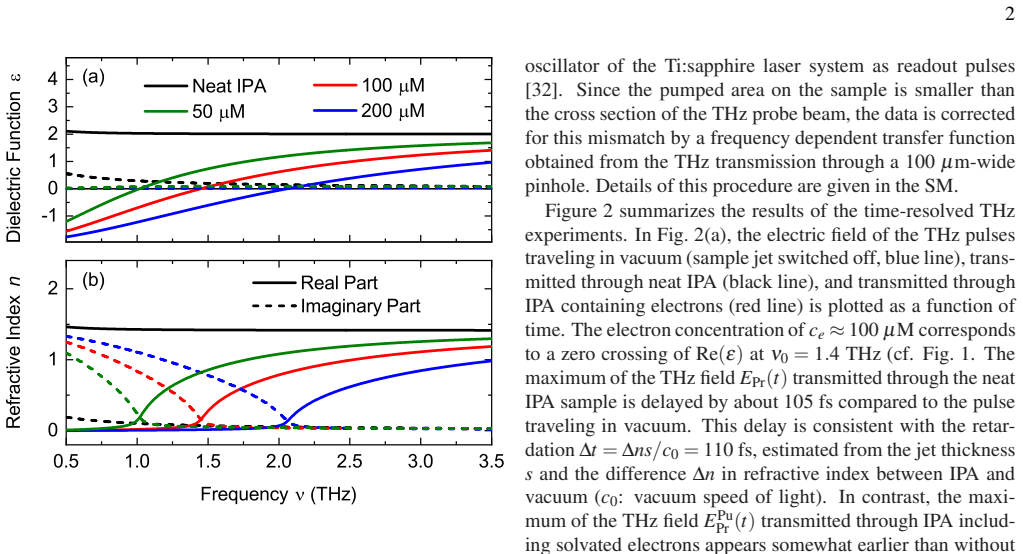
Solvated electrons in polar liquids as epsilon-near-zero materials tunable in the terahertz frequency range
T0 review · 4 major / 5 minor · reviewed 2026-08-07 · deepseek-v4-flash
Pith's one-line read Solvated electrons in a polar liquid behave as a concentration-tunable epsilon-near-zero material at terahertz frequencies, with the zero crossing of the dielectric function and the resulting THz pulse reshaping reproduced by a…
desk verdict Solid, incremental THz propagation data that points to concentration-tunable ENZ behavior in solvated electrons, but the central claim is model-dependent rather than directly measured. read the letter →
The pith
A machine-rendered reading of the paper's core claim, the machinery that carries it, and where it could break.
The reading
What carries the argument
The central object is the Clausius-Mossotti expression $(\varepsilon(\nu,c_e)-1)/(\varepsilon(\nu,c_e)+2) = 3(\varepsilon_{\mathrm{neat}}(\nu)-1)/(\varepsilon_{\mathrm{neat}}(\nu)+2) + c_e N_A \alpha_{\mathrm{el}}(\nu)$, with the free-electron Drude polarizability $\alpha_{\mathrm{el}}(\nu) = -e^2/(\varepsilon_0 m[(2\pi\nu)^2 + i\gamma(2\pi\nu)])$ and $\gamma$ set to zero. This converts the measured neat-solvent dielectric function and an optically inferred electron concentration into a predicted $\varepsilon(\nu,c_e)$ whose real part crosses zero at a tunable $\nu_0$. The propagation model then divides the sample into radiatively coupled thin layers and superposes the field emitted by each layer's induced current, producing the pulse reshaping seen in the experiment.
What would settle it
A model-independent measurement of the complex THz dielectric function of the excited liquid, for example phase-resolved transmission and reflection from a sample of known thickness without assuming Clausius-Mossotti, that fails to find Re($\varepsilon$) crossing zero near the predicted $\nu_0$, or that finds an imaginary part large enough to erase the ENZ signatures, would refute the central claim.
Extended reading notes
Core claim
The paper establishes that introducing solvated electrons into 2-propanol drives Re($\varepsilon(\nu)$) through zero at a frequency $\nu_0$ that increases with electron concentration, and that THz pulses propagating through the excited liquid show the consequences: below $\nu_0$ the field is absorbed and re-emitted through the induced current (an inductive response that broadens the pulse envelope), while above $\nu_0$ dispersion dominates and the field maximum travels with a phase velocity exceeding the vacuum speed of light. The transition from absorption to bleaching in the transmitted spectrum occurs at $\nu_0$ and shifts from 1.2 to 1.4 THz when the electron concentration is raised from 75 to 100 $\mu$M. The measured transients are reproduced by a Clausius-Mossotti model with a free-electron Drude polarizability and by a radiative multi-layer propagation calculation.
Load-bearing premise
The predicted zero crossing and the ENZ interpretation rest on the Clausius-Mossotti local-field formula with an undamped free-electron Drude polarizability, rather than on a direct measurement of $\varepsilon(\nu)$ for the solvated-electron liquid.
Editorial extensions
If this is right
- The zero-crossing frequency of the liquid ENZ medium is set by the pump-generated electron concentration, so the same sample can be tuned across the THz range by varying pump intensity.
- THz pulse envelopes can be reshaped on demand: frequency components below $\nu_0$ are absorbed and re-emitted, producing the observed temporal broadening and early arrival of the field maximum.
- Phase-resolved THz propagation provides a direct, time-domain fingerprint of ENZ behavior that can be applied to other candidate ENZ materials.
- The conclusion that electrons in polar liquids form a new ENZ material class suggests solvated-electron systems as platforms for THz time-refraction and nonlinear optics.
Reading between the lines
- Because the Drude polarizability scales the zero-crossing frequency roughly with the square root of electron concentration, the same approach could push $\nu_0$ across the full 0.5-3 THz window by varying the pump energy, a continuous tunability solid ENZ materials lack.
- The model sets the damping $\gamma$ to zero; if experiments at higher spectral resolution reveal a finite $\gamma$, the resulting small imaginary part would set a lower bound on absorption losses and on how close the group velocity can approach zero, a parameter the current paper leaves open.
- Since solvated electrons recombine on picosecond timescales, the ENZ condition could be switched on and off optically within a pulse train, enabling time-varying-media experiments in the THz range without fabricating nanostructures.
Editorial analysis
A structured set of objections, weighed in public.
Referee Report
Summary. The manuscript reports THz transmission experiments through a 75-µm jet of 2-propanol containing solvated electrons generated by multiphoton ionization with an 800-nm pump. The authors observe that the transmitted THz pulse arrives earlier and is broadened below a concentration-dependent frequency ν0, and that the difference spectrum between excited and neat samples changes from absorption to bleaching at ν0 ≈ 1.4 THz (100 µM) and 1.2 THz (75 µM). They interpret these observations as epsilon-near-zero (ENZ) behavior: using a Clausius-Mossotti local-field model with a free-electron Drude polarizability, Eqs. (1)-(2) with γ=0, they predict that Re(ε) crosses zero at ν0, and they model the pulse propagation with a multi-layer radiative-coupling calculation, Eqs. (3)-(5), which reproduces the qualitative features of the experiment. The paper claims that solvated electrons in polar liquids constitute a novel type of tunable ENZ material in the THz range.
Significance. If the ENZ interpretation is correct, this work introduces a new class of concentration-tunable ENZ materials in the terahertz range and demonstrates propagation effects (modified phase/group velocity, envelope broadening) that have rarely been mapped directly. The experimental data are phase-resolved and the concentration-dependent crossover is a clean, falsifiable observation. The multi-layer propagation model is more realistic than a simple Beer-Lambert treatment and accounts for radiative coupling. However, the central claim is not directly proven by the data: the zero crossing is inferred from a model, and a quantitative comparison between model and experiment is currently missing. With those gaps addressed, this would be a valuable contribution to THz photonics.
major comments (4)
- [Eqs. (1)-(2), Fig. 1, and experimental section] The central claim that the excited liquid is an ENZ material rests on the zero crossing of Re(ε) at ν0, but this zero crossing is not an experimental observable in the present work: it is generated by the Clausius-Mossotti expression, Eq. (1), combined with the free-electron Drude polarizability, Eq. (2), with γ set to zero. The measured phase-resolved THz transients are never inverted (e.g., via Fresnel equations for the known 75-µm thickness) to retrieve a model-independent complex dielectric function ε(ν) of the excited sample. Since the title and abstract assert ENZ behavior, the authors should either extract ε(ν) from the transients or explicitly rephrase the claim as 'consistent with an ENZ model' and provide a test that distinguishes the ENZ scenario from an ordinary absorption resonance producing the same crossover from absorption to bleaching.
- [Fig. 2(a) and Fig. 3(c)] The manuscript states that calculations based on Eqs. (3)-(5) reproduce the ENZ behavior, but no direct quantitative comparison between the calculated transmitted field and the measured THz transient is shown: Fig. 3 displays the calculated local field in the sample (contour plots) and Fig. 2 shows the measured transients, but the two are never overlaid for the same conditions (ce = 100 µM, s = 75 µm). To support the reproduction claim, please overlay the calculated transmitted field and/or its envelope on the experimental red curve in Fig. 2(a), and report a quantitative agreement metric (e.g., least-squares residual or fitted parameter values with uncertainties).
- [Eq. (2) and Fig. 1] The robustness of the predicted ENZ behavior to a finite damping constant γ is not assessed. With γ = 0, the electron contribution to ε'' is exactly zero, and the strong absorption below ν0 arises solely from the neat solvent's ε'' in the Clausius-Mossotti relation. If the true electron response has appreciable γ (as expected for solvated electrons), the zero-crossing frequency can shift or disappear, which would invalidate the quantitative predictions. Please estimate γ from the literature (e.g., from the linewidths measured in Refs. [26,28]) or from the present transients, and show that the predicted ν0, the pulse arrival shifts, and the envelope broadening are stable for a plausible range of γ and for reasonable local-field corrections beyond the point-dipole Clausius-Mossotti approximation.
- [Experimental details and Supplemental Material] The manuscript depends on the Supplemental Material for three load-bearing procedures: (i) the determination of ce from the 800-nm probe absorption and the assumed uniformity of the electron distribution, (ii) the frequency-dependent transfer function used to correct the pump/probe area mismatch (pinhole measurement), and (iii) the extraction of pulse envelopes from the phase-resolved transients. These procedures are essential for the quantitative statements (40% amplitude reduction, ~100 fs delays, crossover frequencies). Since the SM is not part of the manuscript under review, the essential information from these procedures must be included in the main text or the SM must be made available to reviewers.
minor comments (5)
- [Fig. 2 and text following Fig. 2(b)] The zero-crossing frequency for ce = 100 µM is given as ν0 = 1.4 THz in the caption of Fig. 2(a) and as ν0 = 1.5 THz in the text following Fig. 2(b). Please harmonize this value.
- [Eq. (5)] In Eq. (5), the summation index runs from l = 0 to n, but the layers are described as n layers; please clarify the indexing (e.g., l = 1..n, l ≠ j) and the definition of the incident field in the first layer.
- [Experimental section] The symbol ε is used both for the permittivity (Eq. (1)) and for the molar extinction coefficient ('ε = 1.388 × 10^4 M−1cm−1'). Please introduce a different symbol for the extinction coefficient to avoid confusion.
- [References] Reference [29] cites Eur. J. Phys. 4, 141-143 with the year 1883; this is likely a typo for 1983. Please verify and correct.
- [Experimental section] The sentence 'The electron concentration of about 100 µM is derived from a measurement of the absorption of an 800-nm probe pulse in the excited sample' would benefit from specifying whether the 800-nm probe absorption and the THz measurement are performed under identical excitation conditions and at the same time delay (3 ps).
Circularity Check
No circularity: the ENZ zero-crossing is a model prediction from a standard local-field expression and an independently measured electron concentration, checked against phase-resolved THz transients; the central caveat is model dependence, not circularity.
full rationale
The paper's derivation chain does not reduce to its inputs. The zero crossing of Re(ε(ν)) is generated by the Clausius-Mossotti expression Eq. (1) with the Drude polarizability Eq. (2) and γ=0, but the electron concentration ce is not fitted to the THz data; it is independently derived from 800-nm absorption using a literature extinction coefficient quoted in the experimental section. The measured THz transients are raw phase-resolved data, and the observed transition from absorption to bleaching in the difference spectrum ΔE(ν) is determined from these data, not imposed by the model. The model calculation using the multilayer radiative-coupling equations (3)-(5) is then compared with the experiment as a consistency check. Reuse of the authors' previously fitted neat-IPA dielectric function from Ref. [28] is a reuse of an independently measurable input, not a circular step, because the target claim is the solvated-electron ENZ response, not the neat-solvent spectrum. The local-field expression Eq. (1) is a standard Clausius-Mossotti relation and is not defended by a self-citation uniqueness theorem. The main scientific limitation, that the complex dielectric function is not directly retrieved from the transients and the ENZ interpretation is therefore model-dependent, is a testability/correctness concern rather than a circularity. No specific equation or fitted parameter was found that is equivalent by construction to the claimed ENZ prediction.
Assumptions & free parameters
free parameters (3)
- electron concentration ce =
~100 micromolar (75 micromolar in one dataset)
- damping constant gamma =
0
- neat IPA Debye parameters =
not given in this paper (from Ref. [28])
assumptions (4)
- domain assumption Clausius-Mossotti relation in Eq. (1), treating electrons and solvent molecules as point-like dipoles, applies to solvated electrons in a polar liquid
- domain assumption Free-electron Drude polarizability in Eq. (2) with electron rest mass and gamma=0 represents the polaron resonance
- standard math Thin-layer radiation formula Eq. (3) with sigma = -2 pi i nu epsilon0 (epsilon - 1) and the radiative coupling in Eq. (5) correctly describe propagation through the 75-micrometer jet
- domain assumption Electron concentration inferred from 800 nm absorption is uniform across the pump area and representative of the THz probed volume at 3 ps delay
Cite this review
Pith. "Pith review of Solvated electrons in polar liquids as epsilon-near-zero materials tunable in the terahertz frequency range." pith.science (2026). https://pith.science/paper/OFHKIMJR
@misc{pith2026250522198,
  author       = {Pith},
  title        = {Pith review of: Solvated electrons in polar liquids as epsilon-near-zero materials tunable in the terahertz frequency range},
  year         = {2026},
  howpublished = {\url{https://pith.science/paper/OFHKIMJR}},
  note         = {Machine review of arXiv:2505.22198}
}
read the original abstract
Electrons in polar liquids give rise to a polaron resonance at a terahertz (THz) frequency \nu_0 depending on electron concentration. The impact of this resonance on light propagation is studied in experiments, where a femtosecond pump pulse generates electrons via multiphoton ionization and a THz probe pulse propagated through the excited sample is detected in a phase-resolved way. We observe a behavior characteristic for epsilon-near-zero (ENZ) materials with strongly modified phase and group velocities around \nu_0, and a broadening of the THz pulse envelope below \nu_0. Calculations based on a local-field approach reproduce the ENZ behavior.
Figures


Figures from the paper (1 more)

Reference graph
Works this paper leans on
-
[1]
I. Liberal and N. Engheta, Near-zero refractive index photonics, Nat. Photon. 11, 149 (2017)
work page 2017
- [2]
- [3]
-
[4]
M. H. Javani and M. I. Stockman, Real and imaginary proper- ties of epsilon-near-zero materials, Phys. Rev. Lett.117, 107404 (2016)
work page 2016
-
[5]
M. Silveirinha and N. Engheta, Tunneling of Electromagneti c Energy through Subwavelength Channels and Bends using ε- Near-Zero Materials, Phys. Rev. Lett. 97, 157403 (2006)
work page 2006
-
[6]
B. Edwards, A. Al` u, M. E. Y oung, M. Silveirinha, and N. En- gheta, Experimental verification of epsilon-near-zero met ama- terial coupling and energy squeezing using a microwave waveg- uide, Phys. Rev. Lett. 100, 033903 (2008)
work page 2008
-
[7]
L. Caspani, R. Kaipurath, M. Clerici, M. Ferrera, T. Roger, J. Kim, N. Kinsey, M. Pietrzyk, A. Di Falco, V . Shalaev, A. Boltasseva, and D. Faccio, Enhanced nonlinear refractiv e index in ε-near-zero materials, Phys. Rev. Lett. 116, 233901 (2016)
work page 2016
- [8]
Show all 34 references
-
[9]
J. B. Khurgin, M. Clerici, V . Bruno, L. Caspani, C. DeV ault, J. Kim, A. Shaltout, A. Boltasseva, V . M. Shalaev, M. Fer- rera, D. Faccio, and N. Kinsey, Adiabatic frequency shiftin g in epsilon-near-zero materials: the role of group velocity, O ptica 7, 226 (2020)
2020
-
[10]
Y . Zhou, Z. A. Alam, M. Karimi, J. Upham, O. Reshef, C. Liu, A. E. Willner, and R. W. Boyd, Broadband frequency transla- tion through time refraction in an epsilon-near-zero mater ial, Nat. Comm. 11, 2180 (2020)
2020
-
[11]
Lustig, O
E. Lustig, O. Segal, S. Saha, E. Bordo, S. N. Chowdhury, Y . Sharabi, A. Fleischer, A. Boltasseva, O. Cohen, V . M. Sha- laev, and M. Segev, Time-refraction optics with single cycl e modulation, Nanophotonics 12, 2221 (2023)
2023
-
[12]
G. V . Naik, J. Kim, and A. Boltasseva, Oxides and nitrides as alternative plasmonic materials in the optical range [invi ted], Opt. Mater. Express 1, 1090 (2011)
2011
-
[13]
Marqu´ es, J
R. Marqu´ es, J. Martel, F. Mesa, and F. Medina, Left- Handed-Media Simulation and Transmission of EM Waves in Subwavelength Split-Ring-Resonator-Loaded Metallic Waveg- uides, Phys. Rev. Lett. 89, 183901 (2002)
2002
-
[14]
Park, J.-H
J. Park, J.-H. Kang, X. Liu, and M. L. Brongersma, Electri- cally Tunable Epsilon-Near-Zero (ENZ) Metafilm Absorbers, Sci. Rep. 5, 15754 (2015)
2015
-
[15]
J. Bohn, T. S. Luk, C. Tollerton, S. W. Hutchings, I. Brener, S. Horsley, W. L. Barnes, and E. Hendry, All-optical switchi ng of an epsilon-near-zero plasmon resonance in indium tin oxi de, Nat. Comm. 12, 1017 (2021)
2021
-
[16]
C. G. B. Garrett and D. E. McCumber, Propagation of a gaus- sian light pulse through an anomalous dispersion medium, Phys. Rev. A 1, 305 (1970)
1970
-
[17]
Segard and B
B. Segard and B. Macke, Observation of negative velocity pulse propagation, Phys. Lett. 109, 213 (1985)
1985
-
[18]
Chu and S
S. Chu and S. Wong, Linear pulse propagation in an absorbing medium, Phys. Rev. Lett. 48, 738 (1982)
1982
-
[19]
Turi and P
L. Turi and P . J. Rossky, Theoretical Studies of Spectroscop y and Dynamics of Hydrated Electrons, Chem. Rev. 112, 5641 (2012)
2012
-
[20]
B. C. Webster, The polaron viewpoint of solvated electrons, Nat. Phys. Sci. 239, 79 (1972)
1972
-
[21]
G. A. Kenney-Wallace and C. D. Jonah, Picosecond spec- troscopy and solvation clusters. The dynamics of localizin g electrons in polar fluids, J. Phys. Chem. 86, 2572 (1982)
1982
-
[22]
X. Shi, F. H. Long, H. Lu, and K. B. Eisenthal, Electron solva- tion in neat alcohols, J. Phys. Chem. 99, 6917 (1995)
1995
-
[23]
I. A. Taub, D. A. Harter, M. C. Sauer, and L. M. Dorfman, Pulse radiolysis studies. IV. the solvated electron in the alipha tic al- cohols, J. Chem. Phys. 41, 979 (1964)
1964
-
[24]
Savolainen, F
J. Savolainen, F. Uhlig, S. Ahmed, P . Hamm, and P . Jungwirth, Direct observation of the collapse of the delocalized exces s electron in water, Nat. Chem. 6, 697 (2014)
2014
-
[25]
Ghalgaoui, L.-M
A. Ghalgaoui, L.-M. Koll, B. Sch¨ utte, B. P . Fingerhut, K. Reimann, M. Woerner, and T. Elsaesser, Field-induced tun - neling ionization and terahertz-driven electron dynamics in liq- uid water, J. Phys. Chem. Lett. 11, 7717 (2020)
2020
-
[26]
Ghalgaoui, B
A. Ghalgaoui, B. P . Fingerhut, K. Reimann, T. Elsaesser, and M. Woerner, Terahertz polaron oscillations of electrons solvated in liquid water, Phys. Rev. Lett. 126, 097401 (2021)
2021
-
[27]
Singh, J
P . Singh, J. Zhang, A. Ghalgaoui, K. Reimann, B. P . Finger- hut, M. Woerner, and T. Elsaesser, Coherent polaron dynamic s of electrons solvated in polar liquids, PNAS Nexus 1, pgac078 (2022)
2022
-
[28]
Runge, K
M. Runge, K. Reimann, M. Woerner, and T. Elsaesser, Non- linear terahertz polarizability of electrons solvated in a polar liquid, Phys. Rev. Lett. 131, 166902 (2023)
2023
-
[29]
J. H. Hannay, The Clausius-Mossotti equation: An alternati ve derivation, Eur. J. Phys. 4, 141-143 (1883)
-
[30]
M Woerner, B. P . Fingerhut, and T. Elsaesser, Field-induced electron generation in water: Solvation dynamics and many- body interactions, J. Phys. Chem. B 126, 2621-2634 (2022)
2022
-
[31]
M. C. Sauer, Jr., S. Arai, and L. M. Webster, Pulse radioly- sis studies. VII. The absorption spectra and radiation chem ical yields of the solvated electron in the aliphatic alcohols, J. Chem. Phys. 42, 708–712 (1965)
1965
-
[32]
Reimann, M
K. Reimann, M. Woerner, and T. Elsaesser, Two-dimensional terahertz spectroscopy of condensed-phase molecular syst ems, J. Chem. Phys. 154, 120901 (2021)
2021
-
[33]
T. Shih, K. Reimann, M. Woerner, T. Elsaesser, I. Waldm¨ uller, A. Knorr, R. Hey, and K. H. Ploog, Nonlinear response of radiatively coupled intersubband transitions of quasi– two- dimensional electrons, Phys. Rev. B 72, 195338 (2005)
2005
-
[34]
Masur, D
J. Masur, D. I. Bondar, and G. McCaul, Dynamical generation 6 of epsilon-near-zero behaviour via tracking and feedback c on- trol, arXiv:2301.12069
Reviewed August 7, 2026 · model on record in the stance chip above.
Discussion (0). Sign in to comment.