REVIEW 3 major objections 4 minor 77 references
Enhancing Uncertainty Estimation and Interpretability via Bayesian Non-negative Decision Layer
T0 review · 3 major / 4 minor · reviewed 2026-08-07 · deepseek-v4-flash
Pith's one-line read A Bayesian non-negative decision layer replaces the softmax layer and improves accuracy, uncertainty, and interpretability.
desk verdict A practically useful Bayesian last-layer with an overstated theoretical guarantee; the empirical results are the real contribution. read the letter →
The pith
A machine-rendered reading of the paper's core claim, the machinery that carries it, and where it could break.
The reading
What carries the argument
The load-bearing object is the factorized generative model of the decision layer, $y_j \mid \theta_j \sim \mathrm{Category}(\theta_j \Phi)$, with gamma priors on the per-sample score $\theta_j$ and global loading $\Phi$, plus the Weibull variational inference network that approximates their posteriors. Substituting the variational means turns the layer into NMF, and the partial identifiability condition of exact NMF (a selective-window row plus $r-1$ zeros per column) is what the authors use to claim disentanglement. The Weibull reparameterization and the analytic KL divergence make stochastic gradient training practical.
What would settle it
Inspect the learned loading matrix $\Phi$ of a trained BNDL on a dataset with $r$ classes: if the number of exactly zero entries in any column is less than $r-1$, or no row is a scalar multiple of a standard basis vector, then the claimed partial-identifiability guarantee is not satisfied for that column. A controlled alternative is to generate synthetic labels from a known sparse non-negative factor model and test whether BNDL's inferred factors recover the generating columns up to permutation and scaling.
Extended reading notes
Core claim
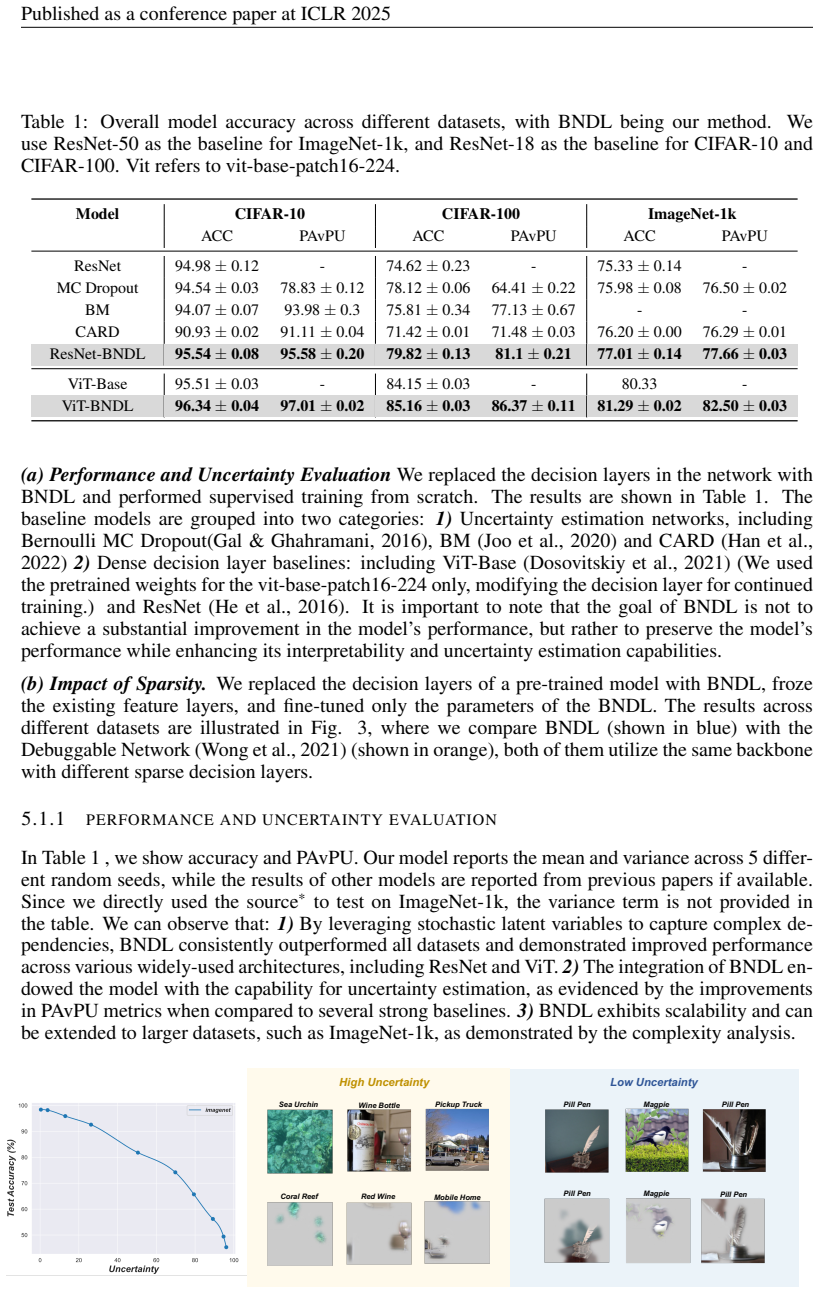
BNDL's central claim is that a softmax output layer can be replaced by a generative Bayesian non-negative factor model without sacrificing performance, while gaining calibrated uncertainty and interpretability. Formally, the label $y_j$ is drawn from a categorical distribution parameterized by $\theta_j \Phi$, where $\theta_j$ is a sample-specific non-negative factor score with prior $\mathrm{Gamma}(f_\theta(x_j), 1)$ and $\Phi$ is a global non-negative loading matrix with prior $\mathrm{Gamma}(1, 1)$. A Weibull variational network approximates the intractable posteriors, with an analytic gamma-to-Weibull KL divergence, so training is by ordinary SGD on the ELBO. The paper argues that at the expectation of the variational posteriors the layer is exactly a non-negative matrix factorization $Y = \theta \Phi$, and invokes partial identifiability results for NMF to claim the learned factors are unique up to permutation and scaling, which is the formal sense in which the features are disentangled. Experiments across ResNet-18/50 and ViT show accuracy gains (e.g., 95.54 vs 94.98 on CIFAR-10 for ResNet, 77.01 vs 75.33 on ImageNet), higher PAvPU, orders-of-magnitude sparser decision layers, and LIME/GradCAM visualizations that align with object semantics.
Load-bearing premise
The disentanglement guarantee holds only if the trained decision layer satisfies the exact sparsity and selective-window conditions required by the cited NMF identifiability theorem, and the paper checks neither condition directly in the trained models.
Editorial extensions
If this is right
- BNDL can replace the softmax layer in standard ResNet and ViT classifiers and yield higher or equal accuracy while adding uncertainty estimation on CIFAR-10, CIFAR-100, ImageNet-1k, and Places-10.
- Uncertainty from BNDL is usable for flagging likely mistakes: accuracy falls monotonically as estimated uncertainty rises across ten ImageNet-1k subsets.
- The decision layer can be made orders of magnitude sparser with little accuracy loss, which is what supports the interpretability claim.
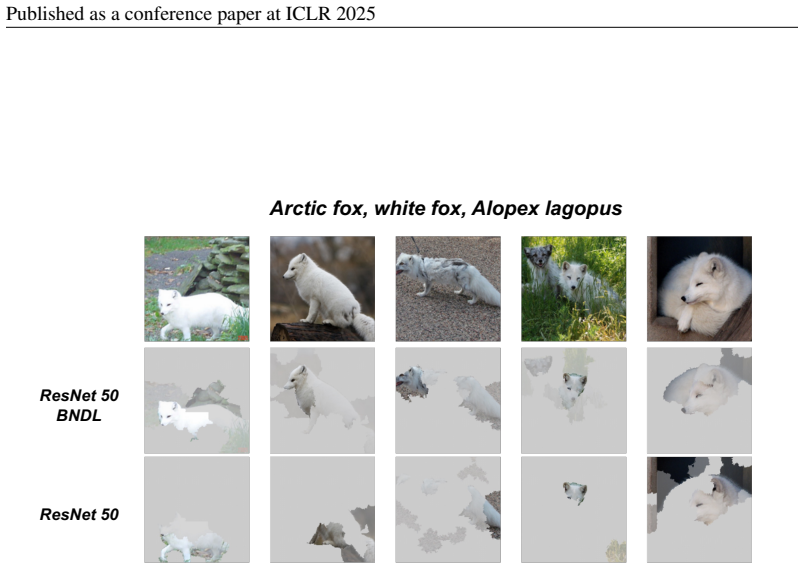
- BNDL's learned features score higher on the SEPIN@k disentanglement metric than a standard ResNet, and LIME and GradCAM visualizations concentrate on the object rather than background.
- Computational overhead is negligible compared with the backbone, and uncertainty estimation needs one forward pass instead of multiple full-network runs.
Reading between the lines
- The paper's own reported ImageNet decision-layer sparsity (1-sparsity about 0.04) is a density measure, not the $r-1$ exact zeros per column the identifiability theorem asks for, so the formal guarantee may be weaker than claimed for the 1000-class model even if the empirical disentanglement holds.
- If BNDL's uncertainty is reliable across domains, the same layer could serve as a lightweight out-of-distribution detector: sampling from the posterior and testing whether the predictive p-value drops below threshold would be an OOD signal obtainable without retraining ensembles.
- The approach could transfer to other output structures, such as multi-label or regression settings, wherever the response is a non-negative combination of latent components; the categorical likelihood would need to be replaced, but the gamma and Weibull machinery is likelihood-agnostic.
- A clean test of the disentanglement mechanism would be to run BNDL on synthetic data generated from a known ground-truth NMF and check whether inferred factors recover the generating columns up to permutation and scaling; the ImageNet experiments are suggestive but do not provide such a controlled check.
Editorial analysis
A structured set of objections, weighed in public.
Referee Report
Summary. The paper proposes the Bayesian Non-negative Decision Layer (BNDL), which replaces the final softmax layer of a deep network with a non-negative factor-analysis-style generative layer. Labels are modeled under a categorical likelihood with gamma-distributed factor scores θ and factor loadings Φ, and a Weibull variational inference network approximates the intractable posterior. The authors claim that this layer improves or preserves accuracy, provides reliable uncertainty estimates, and yields disentangled and interpretable features, with theoretical guarantees based on partial identifiability results for non-negative matrix factorization (Gillis and Rajkó, 2023). Experiments are reported on CIFAR-10, CIFAR-100, ImageNet-1k, and Places-10 with ResNet and ViT backbones, using PAvPU for uncertainty, SEPIN for disentanglement, and LIME/Grad-CAM visualizations.
Significance. If the central claims held, BNDL would be a simple and scalable last-layer substitution that jointly improves uncertainty estimation, sparsity, and interpretability without requiring ensembles or multiple full-network passes. The empirical core is a genuine strength: the paper reports comparisons on four datasets, uses two uncertainty/interpretability measures (PAvPU and SEPIN), includes LIME and Grad-CAM visualizations, provides a complexity analysis, and releases code. The empirical results are plausible and potentially useful. However, the theoretical disentanglement guarantee, which is a headline contribution in the abstract, Section 4, and the appendix, is not established for the model as actually trained; the revision needs to either prove the claimed equivalence and verify the required assumptions for the real training objective, or substantially weaken those theoretical claims.
major comments (3)
- [Sec. 4, Eq. (14)] The reduction of the ELBO in Eq. (13) to the least-squares non-negative matrix factorization objective in Eq. (14) is asserted without proof. The ELBO contains a categorical cross-entropy expected log-likelihood plus two KL divergence terms; squared error is not a special case of categorical cross-entropy, and the point-mass limit discussed in Sec. 3.3 is not the regime used in training and does not remove the softmax normalization. Consequently, Proposition 1/2, even if correct as a statement about exact NMF, applies to a different optimization problem and cannot by itself support the paper's claim that BNDL provides theoretical guarantees for the learned model.
- [Sec. 4 and Appendix A.2] The two assumptions of Proposition 2 are never verified for the trained BNDL. The Selective Window condition requires a row of Φ equal to a scaled unit vector, and the Sparsity Constraint requires the k-th column of Φ to have at least r−1 zeros; with r = rank(Y) = C for one-hot classification labels, this means each column of Φ has at most one nonzero entry. The reported aggregate density values (e.g., 1-sparsity about 0.04 on ImageNet, or the 1-Sparsity values in Table 4) do not imply per-column zeros, and no experiment checks either condition. Therefore the statement in Appendix A.2 that 'BNDL satisfies the sparsity constraint' is unsupported, and the disentanglement guarantee is vacuous as stated.
- [Sec. 3.3, around Eqs. (8) and (11)] The claim that 'Equations 8 and 11 ensure E[θj] = λj and E[Φ] = λΦ' is not correct for the Weibull parameterization in Eq. (6): the mean of Weibull(k, λ) is λ Γ(1 + 1/k), not λ. With λ defined as ReLU(·)/exp(1 + 1/k), the mean equals ReLU(·) Γ(1 + 1/k)/exp(1 + 1/k), which equals the encoder output only asymptotically as k → ∞. Since the 'Connection with Non-negative Matrix Factorization' paragraph and the subsequent reformulation in Eq. (14) rely on this equality, the NMF interpretation is not exact for finite k and needs correction or qualification.
minor comments (4)
- [Throughout] There are several typographical errors, including 'Excat NMF' (Appendix A.2), 'Weilbull' (Section 3.3), 'Reproduciltly' (Reproducibility Statement), and 'the last two term is' (Section 3.4); these should be corrected.
- [Sec. 4 vs Appendix A.2] The same theorem is numbered Proposition 1 in Section 4 and Proposition 2 in Appendix A.2; the numbering should be harmonized.
- [Sec. 3.2] The notation θj ∈ R^K_+ is described as a 'factor score matrix', but it is a K-dimensional vector per sample; the text should say 'factor score vector'.
- [Fig. 3 and Table 4] The x-axis label '1 - Sparsity' in Figure 3 is at odds with the text's description 'x-axis shows the proportion of non-sparse weights' and with the '1-Sparsity' heading in Table 4; please define and use one consistent sparsity convention.
Circularity Check
No circularity: the empirical claims are measured against external benchmarks, and the theoretical identifiability argument rests on an external NMF theorem rather than on the paper's own definitions.
full rationale
The paper's central claims are that BNDL improves accuracy, uncertainty calibration (PAvPU), and interpretability. These are evaluated on held-out benchmark data (CIFAR-10, CIFAR-100, ImageNet-1k, Places-10) and compared with published baselines; none of the reported metrics are constructed from the method's own assumptions or fitted to the target outcome. The theoretical disentanglement claim in Section 4 imports an identifiability result from Gillis and Rajkó (2023), an external source with no author overlap, so it is not a self-citation chain. The Weibull variational inference machinery cites Zhang et al. (2018), which includes two of the present authors, but the reparameterization and closed-form KL divergence are stated explicitly in Eqs. (6)-(7), and the citation is not the sole support for the inference method; it is standard material and not load-bearing. The main logical weakness is that Eq. (14) replaces the categorical ELBO of Eq. (13) with a least-squares NMF objective and the per-column sparsity/selective-window hypotheses of Proposition 1 are not verified; however, that is an unproven bridge or correctness gap, not a circular reduction in which a prediction is equivalent to its input by construction. No fitted parameter is renamed as a prediction, no known result is repackaged as new, and no uniqueness conclusion is imported from the authors' own prior work. Accordingly, the appropriate circularity finding is none.
Assumptions & free parameters
free parameters (2)
- Latent dimension K
- Sparsity threshold alpha
assumptions (3)
- standard math Partial identifiability theorem for exact NMF under selective window and sparsity constraints (Gillis and Rajko, 2023).
- domain assumption The learned factor loading matrix Phi satisfies the selective window and sparsity constraints.
- ad hoc to paper The categorical ELBO objective is equivalent to the squared-error NMF objective ||Y - theta Phi||_F^2.
Cite this review
Pith. "Pith review of Enhancing Uncertainty Estimation and Interpretability via Bayesian Non-negative Decision Layer." pith.science (2026). https://pith.science/paper/OTPU4DTX
@misc{pith2026250522199,
  author       = {Pith},
  title        = {Pith review of: Enhancing Uncertainty Estimation and Interpretability via Bayesian Non-negative Decision Layer},
  year         = {2026},
  howpublished = {\url{https://pith.science/paper/OTPU4DTX}},
  note         = {Machine review of arXiv:2505.22199}
}
read the original abstract
Although deep neural networks have demonstrated significant success due to their powerful expressiveness, most models struggle to meet practical requirements for uncertainty estimation. Concurrently, the entangled nature of deep neural networks leads to a multifaceted problem, where various localized explanation techniques reveal that multiple unrelated features influence the decisions, thereby undermining interpretability. To address these challenges, we develop a Bayesian Non-negative Decision Layer (BNDL), which reformulates deep neural networks as a conditional Bayesian non-negative factor analysis. By leveraging stochastic latent variables, the BNDL can model complex dependencies and provide robust uncertainty estimation. Moreover, the sparsity and non-negativity of the latent variables encourage the model to learn disentangled representations and decision layers, thereby improving interpretability. We also offer theoretical guarantees that BNDL can achieve effective disentangled learning. In addition, we developed a corresponding variational inference method utilizing a Weibull variational inference network to approximate the posterior distribution of the latent variables. Our experimental results demonstrate that with enhanced disentanglement capabilities, BNDL not only improves the model's accuracy but also provides reliable uncertainty estimation and improved interpretability.
Figures


Figures from the paper (9 more)




Reference graph
Works this paper leans on
-
[1]
Sanity checks for saliency maps
Julius Adebayo, Justin Gilmer, Michael Muelly, Ian Goodfellow, Moritz Hardt, and Been Kim. Sanity checks for saliency maps. Advances in neural information processing systems, 31, 2018
2018
-
[2]
Alexander Amini, Wilko Schwarting, Ava Soleimany, and Daniela Rus. Deep evidential regression. Advances in neural information processing systems, 33: 0 14927--14937, 2020
work page 2020
-
[3]
Concrete problems in ai safety
Dario Amodei, Chris Olah, Jacob Steinhardt, Paul Christiano, John Schulman, and Dan Man \'e . Concrete problems in ai safety. arXiv preprint arXiv:1606.06565, 2016
arXiv 2016
-
[4]
Weight uncertainty in neural network
Charles Blundell, Julien Cornebise, Koray Kavukcuoglu, and Daan Wierstra. Weight uncertainty in neural network. In International conference on machine learning, pp.\ 1613--1622. PMLR, 2015
2015
-
[5]
A recurrent latent variable model for sequential data
Junyoung Chung, Kyle Kastner, Laurent Dinh, Kratarth Goel, Aaron C Courville, and Yoshua Bengio. A recurrent latent variable model for sequential data. Advances in neural information processing systems, 28, 2015
work page 2015
-
[6]
Laplace redux-effortless bayesian deep learning
Erik Daxberger, Agustinus Kristiadi, Alexander Immer, Runa Eschenhagen, Matthias Bauer, and Philipp Hennig. Laplace redux-effortless bayesian deep learning. Advances in Neural Information Processing Systems, 34: 0 20089--20103, 2021
2021
-
[7]
Imagenet: A large-scale hierarchical image database
Jia Deng, Wei Dong, Richard Socher, Li-Jia Li, Kai Li, and Li Fei-Fei. Imagenet: A large-scale hierarchical image database. In 2009 IEEE conference on computer vision and pattern recognition, pp.\ 248--255. Ieee, 2009
2009
-
[8]
Shehzaad Dhuliawala, Mrinmaya Sachan, and Carl Allen. Variational classification. Trans. Mach. Learn. Res., 2024, 2023 a . URL https://api.semanticscholar.org/CorpusID:258740937
work page 2024
Show all 77 references
-
[9]
Variational classification
Shehzaad Dhuliawala, Mrinmaya Sachan, and Carl Allen. Variational classification. arXiv preprint arXiv:2305.10406, 2023 b
2023 arXiv
-
[10]
Theory and evaluation metrics for learning disentangled representations
Kien Do and Truyen Tran. Theory and evaluation metrics for learning disentangled representations. arXiv preprint arXiv:1908.09961, 2019
1908 arXiv
-
[11]
An image is worth 16x16 words: Transformers for image recognition at scale
Alexey Dosovitskiy, Lucas Beyer, Alexander Kolesnikov, Dirk Weissenborn, Xiaohua Zhai, Thomas Unterthiner, Mostafa Dehghani, Matthias Minderer, Georg Heigold, Sylvain Gelly, Jakob Uszkoreit, and Neil Houlsby. An image is worth 16x16 words: Transformers for image recognition at...
2021
-
[12]
Sawtooth factorial topic embeddings guided gamma belief network
Zhibin Duan, Dongsheng Wang, Bo Chen, Chaojie Wang, Wenchao Chen, Yewen Li, Jie Ren, and Mingyuan Zhou. Sawtooth factorial topic embeddings guided gamma belief network. In International Conference on Machine Learning, pp.\ 2903--2913. PMLR, 2021
2021
-
[13]
A non-negative vae: the generalized gamma belief network
Zhibin Duan, Tiansheng Wen, Muyao Wang, Bo Chen, and Mingyuan Zhou. A non-negative vae: the generalized gamma belief network. arXiv preprint arXiv:2408.03388, 2024
2024 arXiv
-
[14]
Contextual dropout: An efficient sample-dependent dropout module
Xinjie Fan, Shujian Zhang, Korawat Tanwisuth, Xiaoning Qian, and Mingyuan Zhou. Contextual dropout: An efficient sample-dependent dropout module. In International Conference on Learning Representations, 2021. URL https://openreview.net/forum?id=ct8_a9h1M
2021
-
[15]
Sidiropoulos
Xiao Fu, Kejun Huang, and Nicholas D. Sidiropoulos. On identifiability of nonnegative matrix factorization. IEEE Signal Processing Letters, 25: 0 328--332, 2017. URL https://api.semanticscholar.org/CorpusID:3483466
2017
-
[16]
Dropout as a bayesian approximation: Representing model uncertainty in deep learning
Yarin Gal and Zoubin Ghahramani. Dropout as a bayesian approximation: Representing model uncertainty in deep learning. In international conference on machine learning, pp.\ 1050--1059. PMLR, 2016
2016
-
[17]
Nonnegative matrix factorization
Nicolas Gillis. Nonnegative matrix factorization. SIAM, 2020
2020
-
[18]
Partial identifiability for nonnegative matrix factorization
Nicolas Gillis and R \'o bert Rajk \'o . Partial identifiability for nonnegative matrix factorization. SIAM Journal on Matrix Analysis and Applications, 44 0 (1): 0 27--52, 2023
2023
-
[19]
On calibration of modern neural networks
Chuan Guo, Geoff Pleiss, Yu Sun, and Kilian Q Weinberger. On calibration of modern neural networks. In International conference on machine learning, pp.\ 1321--1330. PMLR, 2017
2017
-
[20]
Card: Classification and regression diffusion models
Xizewen Han, Huangjie Zheng, and Mingyuan Zhou. Card: Classification and regression diffusion models. ArXiv, abs/2206.07275, 2022. URL https://api.semanticscholar.org/CorpusID:249674651
2022 arXiv
-
[21]
HaoChen, Colin Wei, Adrien Gaidon, and Tengyu Ma
Jeff Z. HaoChen, Colin Wei, Adrien Gaidon, and Tengyu Ma. Provable guarantees for self-supervised deep learning with spectral contrastive loss. In Neural Information Processing Systems, 2021. URL https://api.semanticscholar.org/CorpusID:235367888
2021
-
[22]
Variational bayesian last layers
James Harrison, John Willes, and Jasper Snoek. Variational bayesian last layers. arXiv preprint arXiv:2404.11599, 2024
2024 arXiv
-
[23]
Deep residual learning for image recognition
Kaiming He, Xiangyu Zhang, Shaoqing Ren, and Jian Sun. Deep residual learning for image recognition. In Proceedings of the IEEE conference on computer vision and pattern recognition, pp.\ 770--778, 2016
2016
-
[24]
Probabilistic backpropagation for scalable learning of bayesian neural networks
Jos \'e Miguel Hern \'a ndez-Lobato and Ryan Adams. Probabilistic backpropagation for scalable learning of bayesian neural networks. In International conference on machine learning, pp.\ 1861--1869. PMLR, 2015
2015
-
[25]
Non-negative matrix factorization with sparseness constraints
Patrik O Hoyer. Non-negative matrix factorization with sparseness constraints. Journal of machine learning research, 5 0 (9), 2004
2004
-
[26]
Non-negative matrix factorization revisited: Uniqueness and algorithm for symmetric decomposition
Kejun Huang, Nicholas D Sidiropoulos, and Ananthram Swami. Non-negative matrix factorization revisited: Uniqueness and algorithm for symmetric decomposition. IEEE Transactions on Signal Processing, 62 0 (1): 0 211--224, 2013
2013
-
[27]
Being bayesian about categorical probability
Taejong Joo, Uijung Chung, and Minji Seo. Being bayesian about categorical probability. In International Conference on Machine Learning, 2020. URL https://api.semanticscholar.org/CorpusID:211171911
2020
-
[28]
Kingma and Jimmy Ba
Diederik P. Kingma and Jimmy Ba. Adam: A method for stochastic optimization. In Yoshua Bengio and Yann LeCun (eds.), 3rd International Conference on Learning Representations, ICLR 2015, San Diego, CA, USA, May 7-9, 2015, Conference Track Proceedings , 2015. URL http://arxiv.or...
2015 arXiv
-
[29]
Stochastic gradient vb and the variational auto-encoder
Diederik P Kingma and Max Welling. Stochastic gradient vb and the variational auto-encoder. In Second international conference on learning representations, ICLR, volume 19, pp.\ 121, 2014
2014
-
[30]
Semi-supervised learning with deep generative models
Durk P Kingma, Shakir Mohamed, Danilo Jimenez Rezende, and Max Welling. Semi-supervised learning with deep generative models. Advances in neural information processing systems, 27, 2014
2014
-
[31]
Variational dropout and the local reparameterization trick
Durk P Kingma, Tim Salimans, and Max Welling. Variational dropout and the local reparameterization trick. Advances in neural information processing systems, 28, 2015
2015
-
[32]
Stochastic gradient variational bayes for gamma approximating distributions
David A Knowles. Stochastic gradient variational bayes for gamma approximating distributions. arXiv preprint arXiv:1509.01631, 2015
2015 arXiv
-
[33]
Being bayesian, even just a bit, fixes overconfidence in relu networks
Agustinus Kristiadi, Matthias Hein, and Philipp Hennig. Being bayesian, even just a bit, fixes overconfidence in relu networks. In International conference on machine learning, pp.\ 5436--5446. PMLR, 2020
2020
-
[34]
Learning multiple layers of features from tiny images
A Krizhevsky. Learning multiple layers of features from tiny images. Master's thesis, University of Tront, 2009
2009
-
[35]
Simple and scalable predictive uncertainty estimation using deep ensembles
Balaji Lakshminarayanan, Alexander Pritzel, and Charles Blundell. Simple and scalable predictive uncertainty estimation using deep ensembles. Advances in neural information processing systems, 30, 2017
2017
-
[36]
Towards falsifiable interpretability research
Matthew L Leavitt and Ari Morcos. Towards falsifiable interpretability research. arXiv preprint arXiv:2010.12016, 2020
2010 arXiv
-
[37]
Deep learning
Yann LeCun, Yoshua Bengio, and Geoffrey Hinton. Deep learning. nature, 521 0 (7553): 0 436--444, 2015
2015
-
[38]
Learning the parts of objects by non-negative matrix factorization
Daniel D Lee and H Sebastian Seung. Learning the parts of objects by non-negative matrix factorization. Nature, 401 0 (6755): 0 788--791, 1999
1999
-
[39]
Preconditioned stochastic gradient langevin dynamics for deep neural networks
Chunyuan Li, Changyou Chen, David Carlson, and Lawrence Carin. Preconditioned stochastic gradient langevin dynamics for deep neural networks. In Proceedings of the AAAI conference on artificial intelligence, volume 30, 2016
2016
-
[40]
Deep ensembling with no overhead for either training or testing: The all-round blessings of dynamic sparsity
Shiwei Liu, Tianlong Chen, Zahra Atashgahi, Xiaohan Chen, Ghada Sokar, Elena Mocanu, Mykola Pechenizkiy, Zhangyang Wang, and Decebal Constantin Mocanu. Deep ensembling with no overhead for either training or testing: The all-round blessings of dynamic sparsity. arXiv preprint ...
2021
-
[41]
Energy-based out-of-distribution detection
Weitang Liu, Xiaoyun Wang, John Owens, and Yixuan Li. Energy-based out-of-distribution detection. Advances in neural information processing systems, 33: 0 21464--21475, 2020
2020
-
[42]
Multiplicative normalizing flows for variational bayesian neural networks
Christos Louizos and Max Welling. Multiplicative normalizing flows for variational bayesian neural networks. In International Conference on Machine Learning, pp.\ 2218--2227. PMLR, 2017
2017
-
[43]
Predictive uncertainty estimation via prior networks
Andrey Malinin and Mark Gales. Predictive uncertainty estimation via prior networks. Advances in neural information processing systems, 31, 2018
2018
-
[44]
Regression prior networks
Andrey Malinin, Sergey Chervontsev, Ivan Provilkov, and Mark Gales. Regression prior networks. arXiv preprint arXiv:2006.11590, 2020
2006 arXiv
-
[45]
Spade: Sparsity-guided debugging for deep neural networks
Arshia Soltani Moakhar, Eugenia Iofinova, and Dan Alistarh. Spade: Sparsity-guided debugging for deep neural networks. arXiv preprint arXiv:2310.04519, 2023
2023 arXiv
-
[46]
Identifiable deep generative models via sparse decoding
Gemma E Moran, Dhanya Sridhar, Yixin Wang, and David M Blei. Identifiable deep generative models via sparse decoding. arXiv preprint arXiv:2110.10804, 2021
2021 arXiv
-
[47]
Evaluating bayesian deep learning methods for semantic segmentation
Jishnu Mukhoti and Yarin Gal. Evaluating bayesian deep learning methods for semantic segmentation. arXiv preprint arXiv:1811.12709, 2018
2018 arXiv
-
[48]
Reparameterization gradients through acceptance-rejection sampling algorithms
Christian Naesseth, Francisco Ruiz, Scott Linderman, and David Blei. Reparameterization gradients through acceptance-rejection sampling algorithms. In Artificial Intelligence and Statistics, pp.\ 489--498. PMLR, 2017
2017
-
[49]
Multifaceted feature visualization: Uncovering the different types of features learned by each neuron in deep neural networks
Anh Nguyen, Jason Yosinski, and Jeff Clune. Multifaceted feature visualization: Uncovering the different types of features learned by each neuron in deep neural networks. arXiv preprint arXiv:1602.03616, 2016
2016 arXiv
-
[50]
Benchmarking the neural linear model for regression
Sebastian W Ober and Carl E Rasmussen. Benchmarking the neural linear model for regression. In Second Symposium on Advances in Approximate Bayesian Inference, 2019
2019
-
[51]
Feature visualization
Chris Olah, Alexander Mordvintsev, and Ludwig Schubert. Feature visualization. Distill, 2 0 (11): 0 e7, 2017
2017
-
[52]
Representation learning with contrastive predictive coding
Aaron van den Oord, Yazhe Li, and Oriol Vinyals. Representation learning with contrastive predictive coding. arXiv preprint arXiv:1807.03748, 2018
2018 arXiv
-
[53]
Listen to interpret: Post-hoc interpretability for audio networks with nmf
Jayneel Parekh, Sanjeel Parekh, Pavlo Mozharovskyi, Florence d'Alch \'e Buc, and Ga \"e l Richard. Listen to interpret: Post-hoc interpretability for audio networks with nmf. Advances in Neural Information Processing Systems, 35: 0 35270--35283, 2022
2022
-
[54]
why should i trust you?
Marco Tulio Ribeiro, Sameer Singh, and Carlos Guestrin. " why should i trust you?" explaining the predictions of any classifier. In Proceedings of the 22nd ACM SIGKDD international conference on knowledge discovery and data mining, pp.\ 1135--1144, 2016
2016
-
[55]
The generalized reparameterization gradient
Francisco R Ruiz, Titsias RC AUEB, David Blei, et al. The generalized reparameterization gradient. Advances in neural information processing systems, 29, 2016
2016
-
[56]
Imagenet large scale visual recognition challenge
Olga Russakovsky, Jia Deng, Hao Su, Jonathan Krause, Sanjeev Satheesh, Sean Ma, Zhiheng Huang, Andrej Karpathy, Aditya Khosla, Michael Bernstein, et al. Imagenet large scale visual recognition challenge. International journal of computer vision, 115: 0 211--252, 2015
2015
-
[57]
Grad-cam: Visual explanations from deep networks via gradient-based localization
Ramprasaath R Selvaraju, Michael Cogswell, Abhishek Das, Ramakrishna Vedantam, Devi Parikh, and Dhruv Batra. Grad-cam: Visual explanations from deep networks via gradient-based localization. In Proceedings of the IEEE international conference on computer vision, pp.\ 618--626, 2017
2017
-
[58]
Evidential deep learning to quantify classification uncertainty
Murat Sensoy, Lance Kaplan, and Melih Kandemir. Evidential deep learning to quantify classification uncertainty. Advances in neural information processing systems, 31, 2018
2018
-
[59]
Kernel implicit variational inference
Jiaxin Shi, Shengyang Sun, and Jun Zhu. Kernel implicit variational inference. arXiv preprint arXiv:1705.10119, 2017
2017 arXiv
-
[60]
Deep inside convolutional networks: Visualising image classification models and saliency maps
Karen Simonyan, Andrea Vedaldi, and Andrew Zisserman. Deep inside convolutional networks: Visualising image classification models and saliency maps. arXiv preprint arXiv:1312.6034, 2013
2013 arXiv
-
[61]
Learning structured output representation using deep conditional generative models
Kihyuk Sohn, Honglak Lee, and Xinchen Yan. Learning structured output representation using deep conditional generative models. Advances in neural information processing systems, 28, 2015
2015
-
[62]
Collapsed variational bounds for bayesian neural networks
Marcin Tomczak, Siddharth Swaroop, Andrew Foong, and Richard Turner. Collapsed variational bounds for bayesian neural networks. Advances in Neural Information Processing Systems, 34: 0 25412--25426, 2021
2021
-
[63]
Non-negative contrastive learning
Yifei Wang, Qi Zhang, Yaoyu Guo, and Yisen Wang. Non-negative contrastive learning. In The Twelfth International Conference on Learning Representations, 2024
2024
-
[64]
Latent derivative bayesian last layer networks
Joe Watson, Jihao Andreas Lin, Pascal Klink, Joni Pajarinen, and Jan Peters. Latent derivative bayesian last layer networks. In International Conference on Artificial Intelligence and Statistics, pp.\ 1198--1206. PMLR, 2021
2021
-
[65]
Optimizing over a bayesian last layer
Noah Weber, Janez Starc, Arpit Mittal, Roi Blanco, and Llu \' s M \`a rquez. Optimizing over a bayesian last layer. In NeurIPS workshop on Bayesian Deep Learning, 2018
2018
-
[66]
Simple statistical gradient-following algorithms for connectionist reinforcement learning
Ronald J Williams. Simple statistical gradient-following algorithms for connectionist reinforcement learning. Machine learning, 8: 0 229--256, 1992
1992
-
[67]
Leveraging sparse linear layers for debuggable deep networks
Eric Wong, Shibani Santurkar, and Aleksander Madry. Leveraging sparse linear layers for debuggable deep networks. In International Conference on Machine Learning, pp.\ 11205--11216. PMLR, 2021
2021
-
[68]
Understanding neural networks through deep visualization
Jason Yosinski, Jeff Clune, Anh Nguyen, Thomas Fuchs, and Hod Lipson. Understanding neural networks through deep visualization. arXiv preprint arXiv:1506.06579, 2015
2015 arXiv
-
[69]
Gaussian-process factor analysis for low-dimensional single-trial analysis of neural population activity
Byron M Yu, John P Cunningham, Gopal Santhanam, Stephen Ryu, Krishna V Shenoy, and Maneesh Sahani. Gaussian-process factor analysis for low-dimensional single-trial analysis of neural population activity. Advances in neural information processing systems, 21, 2008
2008
-
[70]
Whai: Weibull hybrid autoencoding inference for deep topic modeling
Hao Zhang, Bo Chen, Dandan Guo, and Mingyuan Zhou. Whai: Weibull hybrid autoencoding inference for deep topic modeling. arXiv preprint arXiv:1803.01328, 2018
2018 arXiv
-
[71]
Places: A 10 million image database for scene recognition
Bolei Zhou, Agata Lapedriza, Aditya Khosla, Aude Oliva, and Antonio Torralba. Places: A 10 million image database for scene recognition. IEEE transactions on pattern analysis and machine intelligence, 40 0 (6): 0 1452--1464, 2017
2017
-
[72]
Beta-negative binomial process and P oisson factor analysis
Mingyuan Zhou, Lauren Hannah, David Dunson, and Lawrence Carin. Beta-negative binomial process and P oisson factor analysis. In Artificial Intelligence and Statistics, pp.\ 1462--1471. PMLR, 2012
2012
-
[73]
The P oisson gamma belief network
Mingyuan Zhou, Yulai Cong, and Bo Chen. The P oisson gamma belief network. Advances in Neural Information Processing Systems, 28, 2015
2015
-
[74]
write newline
" write newline "" before.all 'output.state := FUNCTION n.dashify 't := "" t empty not t #1 #1 substring "-" = t #1 #2 substring "--" = not "--" * t #2 global.max substring 't := t #1 #1 substring "-" = "-" * t #2 global.max substring 't := while if t #1 #1 substring * t #2 gl...
-
[75]
@esa (Ref
\@ifxundefined[1] #1\@undefined \@firstoftwo \@secondoftwo \@ifnum[1] #1 \@firstoftwo \@secondoftwo \@ifx[1] #1 \@firstoftwo \@secondoftwo [2] @ #1 \@temptokena #2 #1 @ \@temptokena \@ifclassloaded agu2001 natbib The agu2001 class already includes natbib coding, so you should ...
-
[76]
\@lbibitem[] @bibitem@first@sw\@secondoftwo \@lbibitem[#1]#2 \@extra@b@citeb \@ifundefined br@#2\@extra@b@citeb \@namedef br@#2 \@nameuse br@#2\@extra@b@citeb \@ifundefined b@#2\@extra@b@citeb @num @parse #2 @tmp #1 NAT@b@open@#2 NAT@b@shut@#2 \@ifnum @merge>\@ne @bibitem@firs...
-
[77]
@open @close @open @close and [1] URL: #1 \@ifundefined chapter * \@mkboth \@ifxundefined @sectionbib * \@mkboth * \@mkboth\@gobbletwo \@ifclassloaded amsart * \@ifclassloaded amsbook * \@ifxundefined @heading @heading NAT@ctr thebibliography [1] @ \@biblabel @NAT@ctr \@bibset...
Reviewed August 7, 2026 · model on record in the stance chip above.
Discussion (0). Sign in to comment.